ABSTRACT
LIAKH, SIARHEI. Analyzing and Improving Linux Kernel Memory Protection: A Model
Checking Approach. (Under the direction of Dr. Xuxian Jiang.)
Code injection continues to pose a serious threat to computer systems. Among existing
solutions,
W
⊕
X
is a notable approach to prevent the execution of injected code. In this
thesis, we focus on the Linux kernel memory protection and systematically check for possible
Analyzing and Improving Linux Kernel Memory Protection: A Model Checking Approach
by
Siarhei Liakh
A thesis submitted to the Graduate Faculty of
North Carolina State University
in partial fulfillment of the
requirements for the Degree of
Master of Science
Computer Sciense
Raleigh, North Carolina
2010
APPROVED BY:
Dr. Vincent v. Freeh
Dr. Frank Mueller
BIOGRAPHY
ACKNOWLEDGEMENTS
TABLE OF CONTENTS
List of Tables
. . . .
vi
List of Figures
. . . .
vii
Chapter 1 Introduction
. . . .
1
Chapter 2 Modeling and Design
. . . .
3
2.1
Murphi background
. . . .
3
2.2
Linux kernel memory model . . . .
4
Chapter 3 Analysis
. . . .
9
3.1
Defining and applying invariants . . . .
9
3.2
P2 violation . . . 10
3.3
P3 violation . . . 11
3.4
P4 violation . . . 12
Chapter 4 Improvements and Prototype
. . . .
13
4.1
Fixing P2 violation: preserving the
write
access on kernel read-write data . . . . 14
4.2
Fixing P3 violation: removing mixed pages in kernel space . . . 14
4.3
Fixing P4 violation: disallowing memory aliasing with permission conflicts . . . . 15
Chapter 5 Evaluation
. . . .
17
5.1
Soundness . . . 17
5.2
Performance and memory overhead . . . 18
Chapter 6 Discussion
. . . .
20
Chapter 7 Related Work
. . . .
21
7.1
Model checking for improved security . . . 21
7.2
W
⊕
X
enforcement . . . 21
7.3
Other code injection defense mechanisms . . . 22
Chapter 8 Conclusion and Future Work
. . . .
23
References
. . . .
24
Appendices
. . . .
27
Appendix A Murphi Model Definition . . . 28
Appendix B
Patches for Linux Kernel . . . 40
B.1 Preserving write-access on kernel read-write data . . . 40
B.2 BIOS32 mapping . . . 42
B.3 Protection for loadable kernel modules . . . 45
B.5 Enforcing
W
⊕
X
. . . 55
Appendix C
Testing Data . . . 57
C.1 Vanilla kernel . . . 57
C.1.1 Page table dump . . . 57
C.1.2 Loaded module listing . . . 65
C.1.3 UnixBench test results . . . 66
C.2 Patched kernel . . . 73
C.2.1 Page table dump . . . 73
C.2.2 Loaded module listing . . . 79
LIST OF TABLES
LIST OF FIGURES
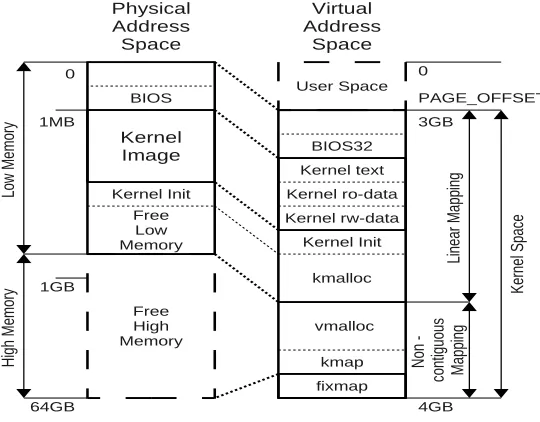
Figure 2.1
Typical Linux memory mapping . . . .
5
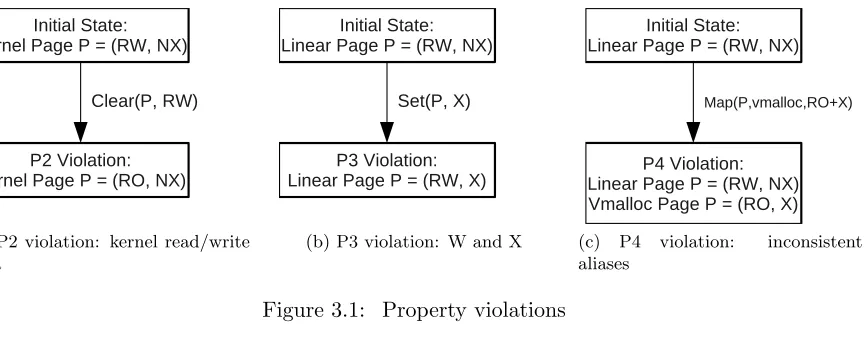
Figure 3.1
Property violations . . . 10
Figure 3.2
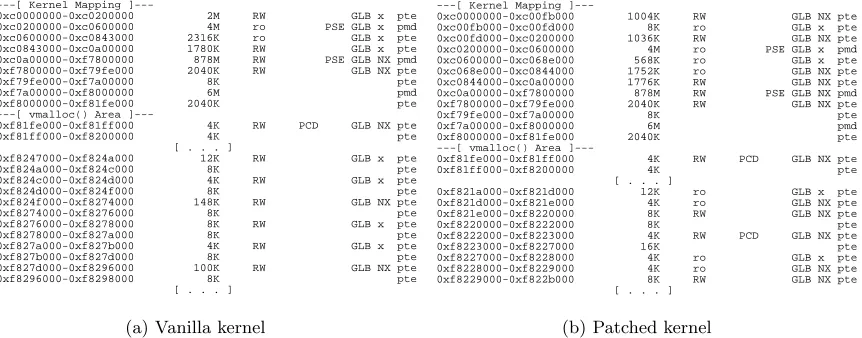
Dumping kernel page tables (kernel version 2
.
6
.
33) . . . 11
Chapter 1
Introduction
Despite years of research, code injection attacks continue to be one of the major ways of
com-puter break-ins and malware propagation [22]. Specifically, a code injection attack is a method
whereby an attacker inserts malicious code into a running process and transfers execution to
the malicious code (e.g., by hijacking its control flow). After that, the attacker can gain
con-trol of a running process and carry out other malicious activities, including the installation of
bot programs for remote control and the modification of system files to allow for unauthorized
access, etc.
There exist a variety of solutions [15, 26, 29, 30, 31, 34] to deal with code injection attacks.
Among the most notable,
W
⊕
X
1is a scheme that has been proposed to counter code injection
attacks. In essence,
W
⊕
X
enforces the following property, “a given memory page will never be
both writable and executable at the same time.” The basic premise behind it is that if a page
cannot be written to and later executed from, code injection becomes impossible. Due to its
effectiveness in defending against code injection attacks, since its proposition,
W
⊕
X
has been
widely adopted in commodity OSs (e.g., Windows and Linux). Moreover, hardware vendors
such as Intel and AMD follow up this scheme by providing necessary hardware support (in the
form of NX support [9]) to facilitate the
W
⊕
X
enforcement.
then apply model checking to verify the
W
⊕
X
property. In case of violation, model checking
has the unique advantage in accurately pinpointing potential problems in the current Linux
kernel design and implementation.
We have successfully developed a Murphi [10]-based abstract model to analyze Linux kernel
memory management. In our modeling process, we were surprised to discover several issues
related to Linux kernel memory management: (1) First, the current Linux kernel does not
strictly separate the kernel code and kernel data, immediately leading to
W
⊕
X
violation.
(2) Second, as part of its implementation, Linux kernel promotes creation of multiple virtual
aliases, potentially with conflicting permissions, for the same physical memory page, leading to
exploitable scenarios for kernel data execution or kernel code modification.
We have confirmed with the Linux kernel community the presence of these issues. We have
also accordingly developed kernel patches to fix these problems and these patches [19, 21, 20, 18]
are being integrated into mainstream Linux kernel.
2Our evaluation indicates that these patches
are compatible with existing Linux kernel code base and contain minimum modifications to the
existing interfaces that manage kernel memory. We also observe that these patches impose
virtually no performance overhead despite a moderate increase in memory consumption.
The rest of the thesis is structured as follows. We start with Linux kernel modeling in
Chapter 2 and present the model checking results in Chapter 3. Then we present and evaluate
our solution in Chapter 4 and Chapter 5, respectively. After that, we examine limitations of
our solution and suggest possible improvements in Chapter 6. Finally, we discuss related work
in Chapter 7 and conclude our thesis in Chapter 8.
Chapter 2
Modeling and Design
2.1
Murphi background
Our abstract modeling of Linux kernel memory protection is based on Murphi [10], which is
both a language and a tool for model verification with explicit state enumeration. To use
Murphi, we need to write a Finite State Machine (FSM) description, which will be taken as
an input by Murphi to produce an executable. The executable, once started, will perform the
model verification task and produce the output detailing the verification results.
In Murphi, a finite state machine description consists of three parts: a set of
states
, a set of
transition rules
and an
initial state
.
•
The set of
states
is implicitly defined through the declaration of global variables. Each
combination of values of each variable naturally produces a unique state of the system.
Note not all of these potential combinations are reachable in the FSM.
•
The transitions between the states of FSM are defined through a set of
transition rules
,
each consisting of two parts, a
guard
and an
action
. A guard is a logic expression that
determines the conditions under which an action can be taken. An action is a set of
instructions to manipulate the global variables, thus transitioning the FSM from one state
to another. An action is performed if, and only if the corresponding guard is evaluated
to be
TRUE
.
•
An
initial state
is defined by a special rule with an action which is executed only once,
right before the FSM state exploration begins. This allows to explicitly define an initial
state of the FSM.
A state is only considered
safe
iff all invariants evaluate to
TRUE
in this state. With that,
model verification is performed by exploring all reachable states, starting with a given initial
state. The state space exploration is performed by applying all possible rules to all states that
have already been reached with standard algorithms such as depth- or breadth-first search. For
each newly discovered reachable state Murphi evaluates the invariants. Should any invariant
evaluate
FALSE
, the system reports an error and prints out a set of states and transitions
that led to the unsafe state. The state exploration continues forward only when all invariants
evaluate to
TRUE
for the newly discovered state. In this work we apply model checking twice:
one in detecting the
W
⊕
X
violation in the current Linux Kernel (Chapter 3) and another in
validating our suggested solution (Chapter 4).
2.2
Linux kernel memory model
For proper modeling, it is important to understand how physical memory is being organized
and mapped in Linux. On a typical 32-bit Linux system with the paging-based virtual memory
enabled, the 4GB virtual memory space is split (Figure 2.1) between user space (bottom 3GB)
and kernel space (top 1GB). In other words, the kernel space starts at address
PAGE OFFSET
=
0
xc
0000000 (3
GB
) and stretches up to the end of virtual address space 0
xf f f f f f f f
(4
GB
−
1).
We also notice that on an i386 architecture, physical memory is typically split onto two regions:
low memory
and
high memory
. The low memory region starts at address 0
x
00000000 and ends
at around 800
M B
.
1In Linux, this region is mapped directly into the kernel space, starting at
PAGE OFFSET
and called
linear mapping
. Such linear mapping allows for simple translation
between the physical and virtual addresses for all pages within this region. Specifically, the
virtual address of any location within low memory can be obtained by adding
PAGE OFFSET
value to the physical address. The reverse translation is performed by simply subtracting
PAGE OFFSET
from the virtual address, without the need for page table lookup.
We point out that the linear mapping is established at kernel startup and persists all the
way through system shutdown [5, 13, 24]. The virtual address space within this region is used to
contain the following parts of the Linux kernel: BIOS32 services, kernel text, kernel read-only
data, kernel read-write data and dynamic memory allocations that require contiguous physical
pages (e.g., through
kmalloc()
call). Kernel initialization routines are also loaded here and later
released as free memory.
Figure 2.1: Typical Linux memory mapping
high memory is only mapped into kernel space when needed. There are two basic mechanisms
through which this memory is mapped:
vmalloc()
and
kmap()
. The major difference between
the two is that the former is used for long-term allocation of non-contiguous physical memory
into contiguous virtual address space (e.g., for loadable kernel module allocation), while the
latter is used strictly for short-term access to physical pages located in the high memory.
Another difference is that vmalloc() may allocate pages from either high or low memory, while
kmap() is strictly used for high memory only. Also, when vmalloc() allocates a page from low
memory, it creates an
alias
: the same physical page will be mapped into the kernel virtual
address space twice, one time in linear area and another one in vmalloc() area. The problem
with such aliasing is that memory management subsystem has to ensure consistency of page
attributes between all of the aliases. In the context of this work, both vmalloc() and kmap()
areas play the same role: mapping non-contiguous physical pages into the kernel address space.
Therefore, we treat them as the same in our model.
There is another memory area in Linux kernel called
fixmap
, which is located at the very
end of the address space and mainly used by kernel to establish reserved, pre-defined fixed
mappings such as PCI control registers and other memory-mapped services. Similar to the
linear mapping, the fixmap region is established at kernel startup and persists all the way until
system shutdown. Since this area does not represent an unique type of mapping that is distinct
form the ones described above, we do not explicitly include it in the model.
p g p r o t t : r e c o r d w : b o o l e a n ;
x : b o o l e a n ; end ;
−− page t a b l e e n t r y
−− ( mem index i s t h e memory frame number : [ 1 . . mem size ] ) p t e t : r e c o r d
mapped : b o o l e a n ; p r o t : p g p r o t t ; addr : mem index ; end ;
−− s i n g l e−l e v e l page t a b l e
−− ( p a g e i n d e x i s t h e page t a b l e i n d e x : [ 1 . . p t s i z e ] ) p g t a b l e t : a r r a y [ p a g e i n d e x ] o f p t e t ;
−− p h y s i c a l memory f r a m e s f r a m e t : r e c o r d
r e f e r e n c e c o u n t : 0 . . p t s i z e ; p r o t : p g p r o t t ;
end ;
f r a m e t a b l e t : a r r a y [ mem index ] o f f r a m e t ;
number of mapped virtual pages) and a most permissive set (
prot
) of the attributes derived
from all the virtual aliases pointing to it. As a result, the global definition of the page table
array and the physical memory array define the possible
states
in our model.
Based on the above abstraction, our model then captures the specifics of the initial state of
Linux kernel. As mentioned earlier and shown in Figure 2.1, the initialization of Linux kernel
memory involves three main parts: kernel linear mapping, static kernel image mapping, and
mapping of BIOS32 services. Accordingly, our model represents them by establishing three
basic properties as part of the model’s
initial state
:
S1
- linear mapping
,
S2
- static kernel
mapping
, and
S3
- BIOS32
. The detailed initialization sequence can be found in Appendix A.
After that, we further obtain the transition rules in our model. In particular, based on the
Linux kernel source code and our domain knowledge, we identify and extract a number of kernel
function routines or application program interfaces (APIs) that are used to affect the kernel
memory mapping. Some of them are:
•
map vm area()
maps a physical page to a virtual address.
•
static protections()
ensures that pre-defined areas of kernel’s virtual address space always
have correct attributes (kernel code should stay executable, kernel data readable and so
on.)
•
cpa process alias()
checks all mapped aliases for a given physical page frame and updates
them as necessary.
•
change page attr set clr()
receives a block request for memory attribute change and
translates it into a series of attribute and alias check calls for each individual page.
•
change page attr()
executes attribute change for the individual pages.
To represent them, we derive a set of basic rules to capture their behavior especially when
they perform memory mapping, re-mapping or change memory page attributes. By doing so,
we avoid the need of understanding specific memory use-cases such as kernel module loading
or unloading (as it is already captured with these APIs). In our model, we have three key
transition rules and use them in our Murphi-based FSM description.
•
T1
- Set
: This transition rule sets W and/or X flags for a given page table entry.
•
T2
- Clear
: This transition rule clears W and/or X flags for a given page table entry.
•
T3
- Map
: This transition rule changes the mapping between a physical frame and a
r u l e s e t i : p a g e i n d e x do r u l e s e t x : b o o l e a n do
r u l e s e t w : b o o l e a n do
−− s e t W and/ o r X f o r v i r t u a l page i r u l e ”T1 : S e t ”
t r u e ==>
b e g i n
set mem perm ( i , 1 , w, x ) ; end ;
−− c l e a r W and / o r X f o r v i r t u a l page i r u l e ” C l e a r ”
t r u e ==>
b e g i n
clr mem perm ( i , 1 , w, x ) ; end ;
end ; end ; end ;
−− map v i r t u a l a d d r e s s va t o p h y s i c a l a d d r e s s pa with p r o t a t t r i b u t e s r u l e s e t pa : f r a m e i n d e x do
r u l e s e t va : v m a l l o c i n d e x do r u l e s e t x : b o o l e a n do
r u l e s e t w : b o o l e a n do
r u l e ”T3 : Map” t r u e ==>
var
p r o t : p g p r o t t ; r e t : b o o l e a n ; b e g i n
p r o t . x := x ; p r o t . w := w ;
r e t := map vm area ( va , pa , p r o t ) ; end ;
Chapter 3
Analysis
3.1
Defining and applying invariants
After obtaining the abstract model of Linux kernel, we further define the invariants to analyze
possible Linux kernel states. Since our focus in this work is on the
W
⊕
X
enforcement, we
established the following properties through invariants in the model:
•
P1
: Kernel code should always be executable and read-only.
•
P2
: Kernel data should always be non-executable, the read-only kernel data should
remain read-only, and read-write kernel data should always be writable.
•
P3
: No page will be writable and executable at the same time in order to not violate
W
⊕
X
.
•
P4
: All virtual aliases of each physical page should have consistent access permissions.
i n v a r i a n t ”P1 : K e r n e l Code”
t r u e −> k e r n e l c o d e r o x ( ) = t r u e ;
i n v a r i a n t ”P2 : K e r n e l RO data ”
t r u e −> k e r n e l r o d a t a r o n x ( ) = t r u e ;
i n v a r i a n t ”P2 : K e r n e l RW data ”
t r u e −> k e r n e l r w d a t a r w n x ( ) = t r u e ;
i n v a r i a n t ”P3 : W xor X” t r u e −> w and x ( ) = f a l s e ;
(a) P2 violation: kernel read/write data
(b) P3 violation: W and X (c) P4 violation: inconsistent aliases
Figure 3.1: Property violations
More specifically, the P1 invariant is necessary to keep kernel code executable as
non-executable kernel code will lead to an immediate system crash. The P2 invariant ensures that
read-only kernel data that holds constants cannot be modified and that read-write data is
always accessible. It also ensures that static kernel data cannot be executed. The P3 invariant
states that any given page cannot be writable and executable at the same time. This property is
necessary to prevent code injection and is focal point of this work. The P4 invariant is necessary
to prevent code injection by accessing an alias which is mapped into a different virtual address
with different access permissions.
With invariants in place, the model checker is able to provide us with examples of possible
transitions if they lead to an unsafe state that violates
W
⊕
X
policy. Our experience with
the model checker indicates that there is no P1 violation in the current Linux design and
implementation. However, it reports violations for all other three invariants (Figure 3.1). Since
our model relies on simplified abstraction of the kernel code, some false-positives are possible.
Therefore, we confirm each of the reported violations by ensuring that the condition detected
in the model manifests itself on the live Linux system.
3.2
P2 violation
---[ Kernel Mapping
]---0xc0000000-0xc0200000 2M RW GLB x pte 0xc0200000-0xc0600000 4M ro PSE GLB x pmd 0xc0600000-0xc0843000 2316K ro GLB x pte 0xc0843000-0xc0a00000 1780K RW GLB x pte 0xc0a00000-0xf7800000 878M RW PSE GLB NX pmd 0xf7800000-0xf79fe000 2040K RW GLB NX pte 0xf79fe000-0xf7a00000 8K pte 0xf7a00000-0xf8000000 6M pmd 0xf8000000-0xf81fe000 2040K pte ---[ vmalloc() Area
]---0xf81fe000-0xf81ff000 4K RW PCD GLB NX pte 0xf81ff000-0xf8200000 4K pte [ . . . ]
0xf8247000-0xf824a000 12K RW GLB x pte 0xf824a000-0xf824c000 8K pte 0xf824c000-0xf824d000 4K RW GLB x pte 0xf824d000-0xf824f000 8K pte 0xf824f000-0xf8274000 148K RW GLB NX pte 0xf8274000-0xf8276000 8K pte 0xf8276000-0xf8278000 8K RW GLB x pte 0xf8278000-0xf827a000 8K pte 0xf827a000-0xf827b000 4K RW GLB x pte 0xf827b000-0xf827d000 8K pte 0xf827d000-0xf8296000 100K RW GLB NX pte 0xf8296000-0xf8298000 8K pte [ . . . ]
(a) Vanilla kernel
---[ Kernel Mapping
]---0xc0000000-0xc00fb000 1004K RW GLB NX pte 0xc00fb000-0xc00fd000 8K ro GLB x pte 0xc00fd000-0xc0200000 1036K RW GLB NX pte 0xc0200000-0xc0600000 4M ro PSE GLB x pmd 0xc0600000-0xc068e000 568K ro GLB x pte 0xc068e000-0xc0844000 1752K ro GLB NX pte 0xc0844000-0xc0a00000 1776K RW GLB NX pte 0xc0a00000-0xf7800000 878M RW PSE GLB NX pmd 0xf7800000-0xf79fe000 2040K RW GLB NX pte 0xf79fe000-0xf7a00000 8K pte 0xf7a00000-0xf8000000 6M pmd 0xf8000000-0xf81fe000 2040K pte ---[ vmalloc() Area
]---0xf81fe000-0xf81ff000 4K RW PCD GLB NX pte 0xf81ff000-0xf8200000 4K pte [ . . . ]
0xf821a000-0xf821d000 12K ro GLB x pte 0xf821d000-0xf821e000 4K ro GLB NX pte 0xf821e000-0xf8220000 8K RW GLB NX pte 0xf8220000-0xf8222000 8K pte 0xf8222000-0xf8223000 4K RW PCD GLB NX pte 0xf8223000-0xf8227000 16K pte 0xf8227000-0xf8228000 4K ro GLB x pte 0xf8228000-0xf8229000 4K ro GLB NX pte 0xf8229000-0xf822b000 8K RW GLB NX pte [ . . . ]
(b) Patched kernel
Figure 3.2: Dumping kernel page tables (kernel version 2
.
6
.
33)
to apply improper page attributes to a memory region when large (2MB) pages are used in the
kernel space (Chapter 4).
3.3
P3 violation
The violation of P3 happens in two scenarios. The first one occurs in the initial state. More
specifically, the way the BIOS32 is mapped into the kernel space during the initialization directly
contradicts the P3 invariant. Note that the BIOS32 services contain executable code and,
therefore, should be set as read-only. However, the Linux kernel simply indiscriminately maps
the whole BIOS region into the kernel address space as writable and executable. While the
actual BIOS code is typically stored in ROM and cannot be overwritten, such mapping still
provides an opportunity for data execution or code modification. In a typical page table dump
of the latest Linux kernel (version 2
.
6
.
33) shown in Figure 3.2a, this violation manifests itself
as a set of
RW
+
X
pages within the range
0xc0000000 - 0xc2000000
.
3.4
P4 violation
Chapter 4
Improvements and Prototype
Based on the findings described in the previous section, we propose a few improvements to the
Linux Kernel. Our improvement involves the changes to the initial states (S1, S2, and S3) as
well as the transition rules (T1, T2, and T3) such that no unsafe states will be reached from
the revised FSM description (Appendix A). For debugging and verification purposes, we have
developed five self-contained and independent patches (in total 703 source code of lines) to
Linux Kernel, four of which have been submitted to LKML [18, 19, 20, 21] and are currently
in the process of being integrated into the mainline kernel. The remaining one is still being
evaluated for suitability in the mainline kernel.
In the development of these patches, based on the counter-examples reported from Murphi,
we revised the memory management subsystem in Linux. Interestingly, we found that there
are two distinct levels of abstraction interfaces to manage Linux kernel memory. The low-level
interface is primarily tasked with direct manipulation of page table entries, and the high-level
interface is used to abstract page table layout and provide functions like
set memory nx()
. At
first glance, the low-level interface seems a better target to address previous violations. However,
the following significant shortcomings in its design complicate such approach. Therefore, we
chose the high-level interface as a target for our solution.
•
First, the low-level functions (e.g.,
pte mkexec()
) are intended as simple data
manipula-tion primitives which cannot fail. Our experience indicates that any deviamanipula-tion from this
assumption would yield unpredictable results, as the current kernel is not yet designed to
handle such failures gracefully.
•
Second, these functions operate on instances of
pte t
type, which by itself does not
guar-antee that the instance is in fact part of active or future page tables. This, in turn,
means that we would either need to check the address of each
pte t
in question, or enforce
a significant performance overhead while the latter one introduces unwanted side effects
into all intermediate transformations of
pte t
instances.
4.1
Fixing P2 violation: preserving the
write
access on kernel
read-write data
Our first patch fixes the violation of P2 invariant. More specifically, as discussed earlier, this
problem is caused by the inability of
static protections()
to preserve the
write
access to kernel
read-write data
(including the
BSS
section). The fix is a straightforward one. However, in the
process of re-mapping our model back to the original Linux kernel source code, we discovered
another implementation bug in the function routine
try preserve large pages()
. Specifically,
this function incorrectly processes access permission change requests for areas that start on
a boundary of a large page (i.e., 2
M
), but are smaller than the page itself. This leads to a
possibility of setting improper access flags to the memory area located within the same large
page, but immediately after the requested one. Specifically, this problem manifested itself by
kernel read-write data becoming read-only simply because it was initially mapped within the
same large page as kernel’s read-only data. Accordingly, we propose two changes in the patch
(that affects the file
arch/x86/mm/pageattr.c
): one is to allow
static protections()
to preserve
the
write
access for kernel’s read-write data area and another one is to verify each small page
within the large page for access flag compatibility [18]. The source code of the patch can be
found in Appendix B.1.
4.2
Fixing P3 violation: removing mixed pages in kernel space
Our next three patches address P3 violation, namely the presence of mixed code and data
pages in kernel space. Based on our model checking results, our investigation maps the related
transition rules that lead to an unsafe state back to the involved kernel routines. By doing so,
we are able to identify three distinct sources: BIOS32, loadable kernel modules (LKMs), and
static kernel image management.
protection for the area of physical memory under 2MB from
arch/x86/mm/pageattr.c
. Also,
we revised the file
mm/init 32.c
to properly report kernel text addresses [19] because of the
BIOS32 changes. Appendix B.2 contains the implementation details of this patch.
LKMs
The second source of violating
W
⊕
X
is located in the support of LKMs. In
particular, since all vmalloc() allocations default to “data” access mode (
RW
+
N X
), the only
source of mixed pages in this area is LKMs as their code is explicitly marked as “executable”.
More specifically, dynamic kernel linker allocates each loadable module in two parts: module init
and module core. The init part of the module will be discarded after initialization, while core
will stay resident in the kernel. In order to minimize a module’s footprint, the linker chooses the
minimum amount of spacing necessary between each of the module’s sections - just enough to
accommodate necessary section alignment, which introduces mixed kernel pages. Accordingly,
our patch allocates module sections in three groups: text, read-only data, read-write data and
further adjusts the linker to align each of the groups on a page boundary, ensuring that each
page contains only sections from the same group. Next, our patch assigns a set of appropriate
access permissions to all pages of each group as follows: read-only for text and read-only data,
non-executable for read-only data and read-write data. As this patch will inevitably introduce
additional memory consumption (Chapter 5), we create a compile-time option (i.e.,
CONFIG
-DEBUG SET MODULE RONX
) to turn on or off the functionality of this patch as needed [21].
Refer to Appendix B.3 for the specific implementation.
Static kernel image
Similar to the support of LKMs, our second patch includes the
code to split all sections of the static kernel image into three groups: text, read-only data, and
read-write data. Specifically, our patch addresses necessary group alignment by modifying the
related linker script (
kernel/vmlinux.lds.S
) and assigns proper access permissions to the pages
of each group at the end of kernel initialization (
mm/init.c
[20]). The functionality of this patch
is always enabled. Source code of this patch can be found in Appendix B.4.
4.3
Fixing P4 violation: disallowing memory aliasing with
per-mission conflicts
The remaining patch addresses the P4 violation. In particular, as we have mentioned in
Chap-ter 2.2, memory alias handling is being implemented in the kernel in
cpa process alias()
function.
However, the way it handles page aliases specifically excludes the case of an NX update.
/∗ No a l i a s c h e c k i n g f o r NX b i t m o d i f i c a t i o n s ∗/c h e c k a l i a s = ( p g p r o t v a l ( m a s k s e t ) | p g p r o t v a l ( m a s k c l r ) ) != PAGE NX ;
= 1
for all page attribute modifications.
s t a t i c i n l i n e p g p r o t tp r o c e s s W x o r X v i o l a t i o n ( p g p r o t t prot ,
u n s i g n e d l o n g a d d r e s s , u n s i g n e d l o n g pfn ) {
/∗
∗ We can Oops o r Panic h e r e i f needed . But f o r now we j u s t p r i n t out an
e r r o r message .
∗/
p r i n t k (KERN ERR ” (W xor X) v i o l a t i o n : ” ”VA=0x%l x , PFN=0x%l x ” , a d d r e s s , pfn ) ; /∗ S e t NX, j u s t i n c a s e ∗/
p g p r o t v a l ( p r o t ) |= PAGE NX ; r e t u r n p r o t ;
}
In addition, our patch implemented a helper routine
process WxorX violation()
(a part of
mm/pageattr.c
) for the strict enforcement of
W
⊕
X
property. Particularly, this function will be
Chapter 5
Evaluation
5.1
Soundness
Our improvements aim to make the Linux kernel compliant to the
W
⊕
X
property by
guar-anteeing exclusivity of write and execute page access. This means that all of the kernel code
that follows the interfaces in place will automatically be compliant with
W
⊕
X
policy without
additional modifications. To rigorously verify the
W
⊕
X
compliance, we revise the previous
FSM description to reflect our patches (Chapter 4). Also, in order to avoid unnecessary state
explosion, we chose a minimal configuration where we only modeled a system that contains
one virtual page of each type: kernel text, kernel read-only data, kernel read-write data, linear
mapping. To allow for variability, we use two pages in non-contiguous mappings, and model the
physical memory with one more page frame than the total size of the virtual address space. In
addition, the model contained a proposed memory interface, a full set of rules, and invariants
to establish and monitor the
W
⊕
X
property (Appendix A). The model checker examined
3402 states and 381024 rules without detecting any violations.
In order to further confirm the validity of our approach in a real system, we used a minimal
Ubuntu Server 8.04.4 LTS [33] system that runs the latest vanilla Linux 2.6.33 kernel [16]. Note
the vanilla Linux kernel has been compiled with Generic Ubuntu configuration, and then booted
and inspected. In Figure 3.2a, we show the virtual memory layout in the vanilla Linux kernel.
It shows that while all necessary elements of code and data separation are indeed present, they
are not applied in a consistent manner. Specifically,
RO
and
N X
flags are used sparsely. As
shown from the detailed kernel page table dump (Figure 3.2a), it fails to establish
W
⊕
X
property.
fixmap : 0xfff1e000 - 0xfffff000 ( 900 kB) pkmap : 0xffa00000 - 0xffc00000 (2048 kB) vmalloc : 0xf81fe000 - 0xff9fe000 ( 120 MB) lowmem : 0xc0000000 - 0xf79fe000 ( 889 MB) .init : 0xc08a3000 - 0xc0916000 ( 460 kB) .data : 0xc068d32c - 0xc08a29e8 (2133 kB) .text : 0xc0200000 - 0xc068d32c (4660 kB)
(a) Vanilla kernel
fixmap : 0xfff1e000 - 0xfffff000 ( 900 kB) pkmap : 0xffa00000 - 0xffc00000 (2048 kB) vmalloc : 0xf81fe000 - 0xff9fe000 ( 120 MB) lowmem : 0xc0000000 - 0xf79fe000 ( 889 MB) .init : 0xc08a3000 - 0xc0916000 ( 460 kB) .data : 0xc068e000 - 0xc08a3000 (2132 kB) .text : 0xc0200000 - 0xc068e000 (4664 kB)
(b) Patched kernel
Figure 5.1: Virtual kernel memory layout
•
a 2Mb area between
0xc0000000
and
0xc0200000
is now marked as
RW
+
N X
, except
for two
RO
+
X
pages
0xc00fb000 - 0xc00fd000
reserved for BIOS32 services.
•
Static Kernel image (
0xc02000000 - 0xc08a3000
) is clearly partitioned in three sections:
RO
+
X
code (
0xc02000000 - 0xc068e000
),
RO
+
N X
read-only data (
0xc08a3000
-0xc0844000
), and
RW
+
N X
read-write data (
0xc0844000 - 0xc08a3000
).
•
Loadable Kernel Modules (see addresses
0xf821a000 - 0xf8220000
and
0xf8227000
-0xf822b000
) are now clearly split into three parts:
RO
+
X
code,
RO
+
N X
read-only
data, and
RW
+
N X
read-write data.
The detailed kernel page table dumps can be found in Appendix C.1.1 and Appendix C.2.1.
5.2
Performance and memory overhead
To evaluate the performance overhead introduced, we measured its runtime overhead with three
tasks: UnixBench 5.1.2 [32] (index test group, SMP and Uniprocessor configurations), Linux
kernel compilation, and compression time of 10GB random data stream. All tests have been
performed on Ubuntu Server 8.04.4 LTS with Linux 2.6.33 compiled for i386 architecture in
standard Ubuntu Server configuration except for PAE enabled, and XEN disabled. Our test
platform is a Gigabyte MA78G-DS3HP system (AMD RS780/SB700 chipset) with dual-core
AMD Athlon 4850e processor (family 15, model 107, stepping 2) and 8GB of PC2-6400 RAM in
dual-channel configuration (4x2GB, CL5). The summary results are shown in Table 5.1, while
full test output can be found in Appendix C.1.3 and Appendix C.2.3.
Our results indicate that our patch set does not affect overall system performance in a
measurable way. In particular, the first four patches (related to static kernel image, LKM,
and BIOS32) do not introduce any additional performance overhead as all additional work are
mainly performed at compile-time. Though there is a slight overhead incurred during the
ker-nel/module initialization, it does not affect the runtime performance after initialization. Among
the five patches, the only patch that involves run-time penalty is the compliance checking of
Table 5.1: Run-time
W
⊕
X
enforcement overhead
Benchmark
Vanilla
Patched
Overhead%
UnixBench UP (index)
737.88
741.8
0.53%
UnixBench SMP (index)
1317.13
1310.88
-0.47%
Kernel Compilation (seconds)
1712
1725
0.76%
Gzip test (seconds)
2890
2873
-0.59%
Next, we evaluate the memory overhead introduced into the kernel by our patches. We
first investigate the difference in the size of the static kernel image and memory allocated to
individual modules. As can be seen on Figure 5.1, the size of the static kernel image has
increased from 6793
KB
(4660
KB
text + 2133
KB
data) to 6796
KB
(4664
KB
text + 2132
KB
data). This increase constitutes a mere 0.04%, and is thus not significant.
Chapter 6
Discussion
Chapter 7
Related Work
7.1
Model checking for improved security
The first category of related work includes recent efforts that leverage model checking to improve
systems security. For example, Mitchell et al. [23] applied model checking to successfully verify
the correctness of (and find bugs in) security protocol specifications. Chen et al. [8] utilized
model checking to analyze or demystify the confusing setuid system calls. Others [6, 7, 11] have
used software model checking and static analysis to find a general class of bugs in source code.
In contrast, our focus is on the analysis and verification of
W
⊕
X
enforcement for Linux kernel
memory protection.
7.2
W
⊕
X
enforcement
in that we use a model checking approach to systematically analyze the
W
⊕
X
protection in
the Linux kernel memory space while PaX and ExecShield mainly concentrate their efforts on
userspace application protection. Since our solution is based on the model-checking approach,
it can be formally verified.
7.3
Other code injection defense mechanisms
Chapter 8
Conclusion and Future Work
In this thesis, we have presented a model checking-based approach to analyze the
W
⊕
X
protection in the Linux kernel space. Our modeling has led to the discovery of several real
problems in the current Linux kernel design and implementation. Based on the model checking
results, we have accordingly developed five kernel patches to fix them. Four of them have been
accepted for integration into the mainline Linux kernel. Our evaluation with these patches
indicate that they involve minimal changes and incur negligible performance overhead to the
Linux kernel.
REFERENCES
[1] A look at ftrace.
http://lwn.net/Articles/322666/
.
[2] Advanced Micro Devices.
AMD64 Architecture Programmers Manual Volume 2: System
Programming
, 3.14 edition, September 2007.
[3] Elena Gabriela Barrantes, David H. Ackley, Stephanie Forrest, Trek S. Palmer, Darko
Ste-fanovic, and Dino Dai Zovi. Randomized Instruction Set Emulation to Disrupt Binary Code
Injection Attacks. In
CCS ’03: Proceedings of the ACM Computer and Communications
Security Conference
, 2003.
[4] Thomas C. Block.
Standard BIOS 32-bit Service Directory Proposal
. Phoenix Technologies
Ltd., 0.4 edition, June 1993.
[5] Daniel Bovet and Marco Cesati.
Understanding The Linux Kernel
. Oreilly & Associates
Inc, third edition, 2005.
[6] Cristian Cadar, Daniel Dunbar, and Dawson Engler. KLEE: Unassisted and Automatic
Generation of High-Coverage Tests for Complex Systems Programs.
OSDI’08: Proc. of
USENIX OSDI 2008
, December 2008.
[7] Hao Chen and David Wagner. MOPS: An Infrastructure for Examining Security Properties
of Software. In
CCS’02: Proc. of ACM Conference on Computer and Communications
Security
, 2002.
[8] Hao Chen, David Wagner, and Drew Dean. Setuid Demystified. In
Security ’02:
Proceed-ings of the 11th conference on USENIX Security Symposium
, 2002.
[9] Intel Corporation.
IA-32 Intel Architecture Software Developer’s Manual Volume 3A:
Sys-tem Programming Guide, Part 1
. Intel Corp., 2006. Publication number 253668.
[10] David L. Dill. The murphi verification system.
http://eprints.kfupm.edu.sa/70602/
1/70602.pdf
, 1996.
[11] Jason Franklin, Arvind Seshadri, Ning Qu, Sagar Chaki, and Anupam Datta.
Attack-ing, RepairAttack-ing, and Verifying SecVisor: A Retrospective on the Security of a Hypervisor
Research Area. Technical report, June 2008.
[12] Tal Garfinkel, Ben Pfaff, Jim Chow, Mendel Rosenblum, and Dan Boneh. Terra: A virtual
machine-based platform for trusted computing. In
SOSP ’03: Proceedings of the 19th
Symposium on Operating System Principles
, October 2003.
[13] Mel Gorman.
Understanding The Linux Virtual Memory Manager
. Prentice Hall, May
2004.
[14] Ralf Hund, Thorsten Holz, and Felix Freiling. Return-oriented rootkits: Bypassing kernel
code integrity protection mechanisms. In
Security ’09: Proceedings of the 18th conference
[15] Gaurav S. Kc, Angelos D. Keromytis, and Vassilis Prevelakis. Countering code-injection
attacks with instruction-set randomization. In
CCS ’03: Proceedings of the ACM Computer
and Communications Security Conference
, 2003.
[16] The Linux Kernel Archives.
http://www.kernel.org
.
[17] Kernel based virtual machine.
http://www.linux-kvm.org/page/Main_Page
.
[18] Siarhei Liakh and Xuxian Jiang. [1/4,tip:x86/mm] correcting improper large page
preser-vation. https://patchwork.kernel.org/patch/90045/, 2010.
[19] Siarhei Liakh and Xuxian Jiang.
[2/4,tip:x86/mm] set first mb as rw+nx.
https://patchwork.kernel.org/patch/90048/, 2010.
[20] Siarhei Liakh and Xuxian Jiang.
[3/4,tip:x86/mm] nx protection for kernel data.
https://patchwork.kernel.org/patch/90046/, 2010.
[21] Siarhei Liakh and Xuxian Jiang. [4/4,tip:x86/mm] ro/nx protection for loadable kernel
modules. https://patchwork.kernel.org/patch/90047/, 2010.
[22] Evangelos P. Markatos Michalis Polychronakis, Kostas G. Anagnostakis. An empirical
study of real-world polymorphic code injection attacks. In
LEET ’09: Proceedings of the
2nd USENIX Workshop on Large-Scale Exploits and Emergent Threats
. Usenix
Associa-tion, April 2009.
[23] John Mitchell, Vitaly Shmatikov, and Ulrich Stern. Finite-State Analysis of SSL 3.0. In
Security ’98: Proceedings of the 7th conference on USENIX Security Symposium
, 1998.
[24] Abhishek Nayani, Mel Gorman, and Rodrigo S. de Castro. Memory management in
linux - desktop companion to the linux source code.
http://www.ecsl.cs.sunysb.edu/
elibrary/linux/mm/mm.pdf
, May 2002.
[25] Pax aslr.
http://pax.grsecurity.net/docs/aslr.txt
.
[26] Pax noexec.
http://pax.grsecurity.net/docs/noexec.txt
.
[27] PCI Special Interest Group.
PCI BIOS Specification
, 2.1 edition, August 1994.
[28] Siani Pearson. Trusted computing platforms, the next security solution. Technical report,
HP Laboratories, November 2002.
[29] Ryan Riley, Xuxian Jiang, and Dongyan Xu. An architectural approach to preventing code
injection attacks. In
DSN ’07: Proccedings of The 37th Annual IEEE/IFIP International
Conference on Dependable Systems and Networks
. IEEE Computer Society, 2007.
[30] Ryan Riley, Xuxian Jiang, and Dongyan Xu. Guest-transparent prevention of kernel
rootk-its with vmm-based memory shadowing. In
RAID ’08: Proceedings of the 11th international
[31] Arvind Seshadri, Mark Luk, Ning Qu, and Adrian Perrig. Secvisor: a tiny hypervisor to
provide lifetime kernel code integrity for commodity oses. In
SOSP ’07: Proceedings of
twenty-first ACM SIGOPS symposium on Operating systems principles
. ACM, 2007.
[32] Jon Tombs, Ben Smith, Rick Grehan, Tom Yager, David C. Niemi, and Ian Smith.
Unixbench-5.1.2.
http://code.google.com/p/byte-unixbench/
.
[33] Ubuntu.
http://www.ubuntu.com/
.
Appendix A
Murphi Model Definition
−− Murphi model f o r (W xor X) patch v e r i f i c a t i o n f o r Linux k e r n e l
−− by S i a r h e i Liakh <s l i a k h @ n c s u . edu> and Xuxian J i a n g <j i a n g @ c s . ncsu . edu>
−− (C) NCSU 2010
c o n s t
−− v i r t u a l a d d r e s s o f t h e f i r s t page i n k e r n e l s p a c e p a g e o f f s e t : 1 ;
−− s i z e and v i r t u a l a d d r e s s d e f i n i t i o n s f o r −− d i f f e r e n t k e r n e l mappings .
−− ∗ s t a r t − a d d r e s s o f t h e f i r s t page o f t h e r e g i o n
−− ∗ end − a d d r e s s o f t h e l a s t page o f t h e r e g i o n
b i o s s i z e : 1 ;
b i o s s t a r t : p a g e o f f s e t ;
b i o s e n d : b i o s s t a r t + b i o s s i z e − 1 ;
k e r n e l t e x t s i z e : 1 ;
k e r n e l t e x t s t a r t : b i o s e n d + 1 ;
k e r n e l t e x t e n d : k e r n e l t e x t s t a r t + k e r n e l t e x t s i z e − 1 ;
k e r n e l r o s i z e : 1 ;
k e r n e l r o s t a r t : k e r n e l t e x t e n d + 1 ;
k e r n e l r o e n d : k e r n e l r o s t a r t + k e r n e l r o s i z e − 1 ;
k e r n e l r w s i z e : 1 ;
k e r n e l r w s t a r t : k e r n e l r o e n d + 1 ;
k e r n e l r w e n d : k e r n e l r w s t a r t + k e r n e l r w s i z e − 1 ;
k e r n e l e n d : k e r n e l r w e n d ;
k m a l l o c s i z e : 2 ;
k m a l l o c s t a r t : k e r n e l e n d + 1 ;
k m a l l o c e n d : k m a l l o c s t a r t + k m a l l o c s i z e − 1 ;
l i n e a r s i z e : b i o s s i z e + k e r n e l s i z e + k m a l l o c s i z e ; l i n e a r s t a r t : p a g e o f f s e t ;
l i n e a r e n d : l i n e a r s t a r t + l i n e a r s i z e − 1 ;
v m a l l o c s i z e : 2 ;
v m a l l o c s t a r t : l i n e a r e n d + 1 ;
v m a l l o c e n d : v m a l l o c s t a r t + v m a l l o c s i z e − 1 ;
−− p h y s i c a l memory s i z e
mem size : l i n e a r s i z e + v m a l l o c s i z e + 1 ;
−− f r e e p h y s i c a l memory
f r e e s i z e : mem size − b i o s s i z e − k e r n e l s i z e ; f r e e s t a r t : b i o s s i z e + k e r n e l s i z e ;
f r e e e n d : f r e e s t a r t + f r e e s i z e − 1 ;
−− page t a b l e s i z e
p t s i z e : p a g e o f f s e t + l i n e a r s i z e + v m a l l o c s i z e ;
type
−− f o l l o w i n g two t y p e s a r e used f o r c o u n t i n g p a g e c o u n t : 0 . . p t s i z e ;
f r a m e c o u n t : 0 . . mem size ; v m a l l o c c o u n t : 0 . . v m a l l o c s i z e ; f r e e c o u n t : 0 . . f r e e s i z e ;
word : 0 . . p t s i z e + mem size + 1 ;
−− f o l l o w i n g t y p e s a r e used f o r i n d e x i n g p a g e i n d e x : 0 . . ( p t s i z e − 1 ) ;
f r a m e i n d e x : 0 . . ( mem size − 1 ) ;
v m a l l o c i n d e x : v m a l l o c s t a r t . . v m a l l o c e n d ; f r e e i n d e x : f r e e s t a r t . . f r e e e n d ;
−− page p r o t e c t i o n a t t r i b u t e s p g p r o t t : r e c o r d
−− page t a b l e e n t r y
−− ( f r a m e i n d e x i s t h e memory frame number : [ 0 . . ( mem size−1) ] ) p t e t : r e c o r d
mapped : b o o l e a n ; p r o t : p g p r o t t ; addr : f r a m e i n d e x ; end ;
−− s i n g l e−l e v e l page t a b l e
−− ( p a g e i n d e x i s t h e page t a b l e i n d e x : [ 0 . . ( p t s i z e−1) ] ) p g t a b l e t : a r r a y [ p a g e i n d e x ] o f p t e t ;
−− p h y s i c a l memory f r a m e s f r a m e t : r e c o r d
r e f e r e n c e c o u n t : p a g e c o u n t ; p r o t : p g p r o t t ;
end ;
f r a m e t a b l e t : a r r a y [ f r a m e i n d e x ] o f f r a m e t ;
var
pt : p g t a b l e t ;
−− s e t page a t t r i b u t e s from mask
f u n c t i o n p g p r o t s e t ( p r o t : p g p r o t t ; mask : p g p r o t t ) : p g p r o t t ; var
new : p g p r o t t ; b e g i n
new . w := p r o t . w | mask . w ; new . x := p r o t . x | mask . x ;
r e t u r n new ; end ;
−− c l e a r page a t t r i b u t e s from mask
f u n c t i o n p g p r o t c l e a r ( p r o t : p g p r o t t ; mask : p g p r o t t ) : p g p r o t t ; var
new : p g p r o t t ; b e g i n
new . w := p r o t . w & ( ! mask . w) ; new . x := p r o t . x & ( ! mask . x ) ;
r e t u r n new ; end ;
r e t u r n pfn + p a g e o f f s e t ; end ;
−− l i n e a r c o n v e r s i o n o f v i r t u a l a d d r e s s t o p h y s i c a l f u n c t i o n p h y s i c a l ( va : p a g e i n d e x ) : f r a m e i n d e x ; b e g i n
r e t u r n va − p a g e o f f s e t ; end ;
f u n c t i o n w i t h i n ( x : word ; a : word ; b : word ) : b o o l e a n ; b e g i n
r e t u r n ( x>=a ) & ( x<=b ) ; end ;
p r o c e d u r e e x c e p t i o n ( pa : f r a m e i n d e x ; va : p a g e i n d e x ) ; b e g i n
−− do not r e a l l y do a n y t h i n g . end ;
f u n c t i o n s t a t i c p r o t e c t i o n s ( va : p a g e i n d e x ; p r o t : p g p r o t t ) : p g p r o t t ; var
new : p g p r o t t ; b e g i n
new := p r o t ; a l i a s
pa : pt [ va ] . addr ; do
−− a l l a l i a s e s f o r k e r n e l t e x t s h o u l d s t a y RO i f ( w i t h i n ( pa , p h y s i c a l ( k e r n e l t e x t s t a r t ) ,
p h y s i c a l ( k e r n e l t e x t e n d ) ) ) then
new . w := f a l s e ; end ;
−− primary mapping o f k e r n e l t e x t s h o u l d s t a y X i f ( w i t h i n ( va , k e r n e l t e x t s t a r t , k e r n e l t e x t e n d ) ) then
new . x := t r u e ; end ;
−− a l l a l i a s e s f o r k e r n e l ro−data s h o u l s s t a y RO+NX i f ( w i t h i n ( pa , p h y s i c a l ( k e r n e l r o s t a r t ) ,
p h y s i c a l ( k e r n e l r o e n d ) ) ) then
new . x := f a l s e ; end ;
−− a l l a l i a s e s f o r rw−data s h o u l d s t a y NX i f ( w i t h i n ( pa , p h y s i c a l ( k e r n e l r w s t a r t ) ,
p h y s i c a l ( k e r n e l r w e n d ) ) ) then
new . x := f a l s e ; end ;
−− primary mapping f o r k e r n e l rw−data s h o u l d s t a y RW i f ( w i t h i n ( va , k e r n e l r w s t a r t , k e r n e l r w e n d ) )
then
new . w := t r u e ; end ;
i f ( new . w & new . x ) then
e x c e p t i o n ( pa , va ) ; new . x := f a l s e ; end ;
end ;
r e t u r n new ; end ;
f u n c t i o n c h a n g e p a g e a t t r ( va : p a g e i n d e x ; s e t : p g p r o t t ; c l r : p g p r o t t ) : b o o l e a n ; var
n ew p r o t : p g p r o t t ; b e g i n
i f ( pt [ va ] . mapped ) then
n ew p r o t := pt [ va ] . p r o t ;
n ew p r o t := p g p r o t c l e a r ( new prot , c l r ) ; n ew p r o t := p g p r o t s e t ( new prot , s e t ) ;
n ew p r o t := s t a t i c p r o t e c t i o n s ( va , n ew p r o t ) ; pt [ va ] . p r o t := n ew p r o t ;
r e t u r n t r u e ; e l s e
r e t u r n f a l s e ; end ;
end ;
f o r i : p a g e i n d e x do
i f ( ( i != va ) & ( pt [ i ] . addr = pt [ va ] . addr ) ) then
i f ( ! c h a n g e p a g e a t t r ( i , s e t , c l r ) ) then
r e t u r n f a l s e ; end ;
end ; end ;
r e t u r n t r u e ; end ;
f u n c t i o n c h a n g e p a g e a t t r s e t c l r ( va : p a g e i n d e x ; count : p a g e i n d e x ; s e t : p g p r o t t ; c l r : p g p r o t t ) : b o o l e a n ;
b e g i n
f o r i := va t o ( va + count − 1 ) do i f ( ! c h a n g e p a g e a t t r ( i , s e t , c l r ) ) then
r e t u r n f a l s e ; end ;
i f ( ! p r o c e s s a l i a s ( i , s e t , c l r ) ) then
r e t u r n f a l s e ; end ;
end ;
r e t u r n t r u e ; end ;
f u n c t i o n map vm area ( va : p a g e i n d e x ; pa : f r a m e i n d e x ; p r o t : p g p r o t t ) : b o o l e a n ; var
c l r : p g p r o t t ; o l d p t e : p t e t ; b e g i n
i f ( w i t h i n ( va , k e r n e l s t a r t , k e r n e l e n d ) ) then
−− l i n e a r k e r n e l mapping r e t u r n f a l s e ;
e l s e
−− u s e r s p a c e and v m a l l o c o l d p t e := pt [ va ] ;
i f ( ! c h a n g e p a g e a t t r s e t c l r ( va , 1 , prot , c l r ) ) then
pt [ va ] := o l d p t e ; r e t u r n f a l s e ; end ;
r e t u r n t r u e ; end ;
end ;
p r o c e d u r e set mem perm ( va : p a g e i n d e x ; count : p a g e i n d e x ; w : b o o l e a n ; x : b o o l e a n ) ; var
s e t : p g p r o t t ; c l r : p g p r o t t ; r e t : b o o l e a n ; b e g i n
i f (w | x ) then
s e t . w := w ; s e t . x := x ; c l r . w := f a l s e ; c l r . x := f a l s e ;
r e t := c h a n g e p a g e a t t r s e t c l r ( va , count , s e t , c l r ) ; end ;
end ;
p r o c e d u r e clr mem perm ( va : p a g e i n d e x ; count : p a g e i n d e x ; w : b o o l e a n ; x : b o o l e a n ) ; var
s e t : p g p r o t t ; c l r : p g p r o t t ; r e t : b o o l e a n ; b e g i n
i f (w | x ) then
s e t . w := f a l s e ; s e t . x := f a l s e ; c l r . w := w ; c l r . x := x ;
r e t := c h a n g e p a g e a t t r s e t c l r ( va , count , s e t , c l r ) ; end ;
end ;
−− S1 : l i n e a r mapping p r o c e d u r e m a p l i n e a r ( ) ; b e g i n
pt [ va ] . addr := p h y s i c a l ( va ) ; pt [ va ] . mapped := t r u e ; pt [ va ] . p r o t . w := t r u e ; pt [ va ] . p r o t . x := f a l s e ; end ;
end ;
−− S2 : k e r n e l image mapping p r o c e d u r e m a p s t a t i c k e r n e l ( ) ; b e g i n
−− S2 : k e r n e l t e x t
f o r va : k e r n e l t e x t s t a r t . . k e r n e l t e x t e n d do pt [ va ] . addr := p h y s i c a l ( va ) ;
pt [ va ] . mapped := t r u e ; pt [ va ] . p r o t . w := f a l s e ; pt [ va ] . p r o t . x := t r u e ; end ;
−− S2 : k e r n e l ro−data
f o r va : k e r n e l r o s t a r t . . k e r n e l r o e n d do pt [ va ] . addr := p h y s i c a l ( va ) ;
pt [ va ] . mapped := t r u e ; pt [ va ] . p r o t . w := f a l s e ; pt [ va ] . p r o t . x := f a l s e ; end ;
−− S2 : k e r n e l rw−data
f o r va : k e r n e l r w s t a r t . . k e r n e l r w e n d do pt [ va ] . addr := p h y s i c a l ( va ) ;
pt [ va ] . mapped := t r u e ; pt [ va ] . p r o t . w := t r u e ; pt [ va ] . p r o t . x := f a l s e ; end ;
end ;
−− S3 : BIOS mapping p r o c e d u r e map bios ( ) ; b e g i n
f o r va : b i o s s t a r t . . b i o s e n d do pt [ va ] . addr := p h y s i c a l ( va ) ; pt [ va ] . mapped := t r u e ; pt [ va ] . p r o t . w := f a l s e ; pt [ va ] . p r o t . x := t r u e ; end ;
−− r e t u r n s t r u e i f a l l a l i a s e s have c o n s i s t e n t a c c e s s f l a g s f u n c t i o n p a g e a l i a s m a t c h i n g ( ) : b o o l e a n ;
var
pa : f r a m e i n d e x ; mem: f r a m e t a b l e t ; b e g i n
f o r i : f r a m e i n d e x do
mem[ i ] . r e f e r e n c e c o u n t := 0 ; mem[ i ] . p r o t . w := f a l s e ; mem[ i ] . p r o t . x := f a l s e ; end ;
f o r i : p a g e i n d e x do i f ( pt [ i ] . mapped ) then
pa := pt [ i ] . addr ;
mem[ pa ] . r e f e r e n c e c o u n t := mem[ pa ] . r e f e r e n c e c o u n t + 1 ; mem[ pa ] . p r o t := p g p r o t s e t (mem[ pa ] . prot , pt [ i ] . p r o t ) ;
i f (mem[ pa ] . p r o t . w & mem[ pa ] . p r o t . x ) then
r e t u r n f a l s e ; end ;
end ; end ;
r e t u r n t r u e ; end ;
−− r e t u r n s t r u e i s t h e r e i s a v i r t u a l page t h a t has W and X s e t f u n c t i o n w and x ( ) : b o o l e a n ;
b e g i n
f o r i : p a g e i n d e x do
i f ( pt [ i ] . p r o t . w & pt [ i ] . p r o t . x ) then
r e t u r n t r u e ; end ;
end ;
r e t u r n f a l s e ; end ;
f u n c t i o n k e r n e l r w d a t a r w n x ( ) : b o o l e a n ; b e g i n
then
r e t u r n f a l s e ; end ;
end ;
r e t u r n t r u e ; end ;
f u n c t i o n k e r n e l r o d a t a r o n x ( ) : b o o l e a n ; b e g i n
f o r i : k e r n e l r o s t a r t . . k e r n e l r o e n d do i f ( ( pt [ i ] . p r o t . w) | ( pt [ i ] . p r o t . x ) ) then
r e t u r n f a l s e ; end ;
end ;
r e t u r n t r u e ; end ;
f u n c t i o n k e r n e l c o d e r o x ( ) : b o o l e a n ; b e g i n
f o r i : k e r n e l t e x t s t a r t . . k e r n e l t e x t e n d do i f ( ( pt [ i ] . p r o t . w) | ( ! pt [ i ] . p r o t . x ) )
then
r e t u r n f a l s e ; end ;
end ;
r e t u r n t r u e ; end ;
−− T r a n s i t i o n r u l e s r u l e s e t i : p a g e i n d e x do
r u l e s e t x : b o o l e a n do r u l e s e t w : b o o l e a n do
−− s e t W and / o r X f o r v i r t u a l page i r u l e ”T1 : S e t ”
t r u e ==>
b e g i n
set mem perm ( i , 1 , w, x ) ; end ;
−− c l e a r W and / o r X f o r v i r t u a l page i r u l e ”T2 : C l e a r ”
t r u e ==>
clr mem perm ( i , 1 , w, x ) ; end ;
end ; end ; end ;
−− map v i r t u a l a d d r e s s va t o p h y s i c a l a d d r e s s pa with p r o t a t t r i b u t e s r u l e s e t pa : f r e e i n d e x do
r u l e s e t va : v m a l l o c i n d e x do r u l e s e t x : b o o l e a n do
r u l e s e t w : b o o l e a n do
r u l e ”T3 : Map” t r u e ==>
var
p r o t : p g p r o t t ; r e t : b o o l e a n ; b e g i n
p r o t . x := x ; p r o t . w := w ;
r e t := map vm area ( va , pa , p r o t ) ; end ;
end ; end ; end end ;
−− I n v a r i a n t s
i n v a r i a n t ”P1 : K e r n e l Code”
t r u e −> k e r n e l c o d e r o x ( ) = t r u e ;
i n v a r i a n t ”P2 : K e r n e l RO data ”
t r u e −> k e r n e l r o d a t a r o n x ( ) = t r u e ;
i n v a r i a n t ”P2 : K e r n e l RW data ”
t r u e −> k e r n e l r w d a t a r w n x ( ) = t r u e ;
i n v a r i a n t ”P3 : W xor X”
t r u e −> w and x ( ) = f a l s e ;
i n v a r i a n t ”P4 : A l i a s c o n s i s t e n c y ”
t r u e −> p a g e a l i a s m a t c h i n g ( ) = t r u e ;
c l e a r pt ; m a p l i n e a r ( ) ;
m a p s t a t i c k e r n e l ( ) ; map bios ( ) ;
Appendix B
Patches for Linux Kernel
B.1
Preserving write-access on kernel read-write data
d i f f −−g i t a / a r c h / x86 /mm/ p a g e a t t r . c b/ a r c h / x86 /mm/ p a g e a t t r . c i n d e x c f 0 7 c 2 6 . . f 4 e d 8 e b 100644
−−− a / a r c h / x86 /mm/ p a g e a t t r . c +++ b/ a r c h / x86 /mm/ p a g e a t t r . c
@@ −255 ,6 +255 ,7 @@ s t a t i c i n l i n e p g p r o t t s t a t i c p r o t e c t i o n s ( p g p r o t t prot , u n s i g n e d l o n g a d d r e s s ,
u n s i g n e d l o n g pfn ) {
p g p r o t t f o r b i d d e n = p g p r o t ( 0 ) ; + p g p r o t t r e q u i r e d = p g p r o t ( 0 ) ;
/∗
∗ The BIOS a r e a between 640 k and 1Mb n e e d s t o be e x e c u t a b l e f o r
@@ −278 ,6 +279 ,13 @@ s t a t i c i n l i n e p g p r o t t s t a t i c p r o t e c t i o n s ( p g p r o t t prot , u n s i g n e d l o n g a d d r e s s ,
i f ( w i t h i n ( pfn , p a ( ( u n s i g n e d l o n g ) s t a r t r o d a t a ) >> PAGE SHIFT , p a ( ( u n s i g n e d l o n g ) e n d r o d a t a ) >> PAGE SHIFT) )
p g p r o t v a l ( f o r b i d d e n ) |= PAGE RW; + /∗
+ ∗ . data and . b s s s h o u l d always be w r i t a b l e .
+ ∗/
+ i f ( w i t h i n ( a d d r e s s , ( u n s i g n e d l o n g ) s d a t a , ( u n s i g n e d l o n g ) e d a t a ) | | + w i t h i n ( a d d r e s s , ( u n s i g n e d l o n g ) b s s s t a r t ,
+ ( u n s i g n e d l o n g ) b s s s t o p ) ) + p g p r o t v a l ( r e q u i r e d ) |= PAGE RW ;
@@ −317 ,6 +325 ,7 @@ s t a t i c i n l i n e p g p r o t t s t a t i c p r o t e c t i o n s ( p g p r o t t prot , u n s i g n e d l o n g a d d r e s s ,
#e n d i f
p r o t = p g p r o t ( p g p r o t v a l ( p r o t ) & ˜ p g p r o t v a l ( f o r b i d d e n ) ) ; + p r o t = p g p r o t ( p g p r o t v a l ( p r o t ) | p g p r o t v a l ( r e q u i r e d ) ) ;
r e t u r n p r o t ; }
@@ −393 ,7 +402 ,7 @@ t r y p r e s e r v e l a r g e p a g e ( p t e t ∗kpte , u n s i g n e d l o n g a d d r e s s ,
{
u n s i g n e d l o n g n e x t p a g e a d d r , numpages , pmask , p s i z e , f l a g s , addr , pfn ; p t e t new pte , o l d p t e , ∗tmp ;
− p g p r o t t o l d p r o t , n ew p r o t ;
+ p g p r o t t o l d p r o t , new prot , r e q p r o t ; i n t i , d o s p l i t = 1 ;
u n s i g n e d i n t l e v e l ;
@@ −438 ,10 +447 ,10 @@ t r y p r e s e r v e l a r g e p a g e ( p t e t ∗kpte , u n s i g n e d l o n g a d d r e s s , ∗ We a r e s a f e now . Check whether t h e new p g p r o t i s t h e same :
∗/
o l d p t e = ∗kpte ;
− o l d p r o t = n ew p r o t = p t e p g p r o t ( o l d p t e ) ;
+ o l d p r o t = n ew p r o t = r e q p r o t = p t e p g p r o t ( o l d p t e ) ;
− p g p r o t v a l ( n ew p r o t ) &= ˜ p g p r o t v a l ( cpa−>m a s k c l r ) ; − p g p r o t v a l ( n ew p r o t ) |= p g p r o t v a l ( cpa−>m a s k s e t ) ; + p g p r o t v a l ( r e q p r o t ) &= ˜ p g p r o t v a l ( cpa−>m a s k c l r ) ; + p g p r o t v a l ( r e q p r o t ) |= p g p r o t v a l ( cpa−>m a s k s e t ) ;
/∗
∗ o l d p t e p o i n t s t o t h e l a r g e page b a s e a d d r e s s . So we need
@@ −450 ,17 +459 ,17 @@ t r y p r e s e r v e l a r g e p a g e ( p t e t ∗kpte , u n s i g n e d l o n g a d d r e s s ,
pfn = p t e p f n ( o l d p t e ) + ( ( a d d r e s s & ( p s i z e − 1 ) ) >> PAGE SHIFT) ; cpa−>pfn = pfn ;
− n ew p r o t = s t a t i c p r o t e c t i o n s ( new prot , a d d r e s s , pfn ) ; + n ew p r o t = s t a t i c p r o t e c t i o n s ( r e q p r o t , a d d r e s s , pfn ) ;
/∗
∗ We need t o check t h e f u l l range , whether
∗ s t a t i c p r o t e c t i o n ( ) r e q u i r e s a d i f f e r e n t p g p r o t f o r one o f ∗ t h e p a g e s i n t h e r a n g e we t r y t o p r e s e r v e :
∗/
− pfn++;
− f o r ( i = 1 ; i < cpa−>numpages ; i ++, addr += PAGE SIZE , pfn++) { − p g p r o t t c h k p r o t = s t a t i c p r o t e c t i o n s ( new prot , addr , pfn ) ; + addr = a d d r e s s & pmask ;
+ pfn = p t e p f n ( o l d p t e ) ;
+ f o r ( i = 0 ; i < ( p s i z e >> PAGE SHIFT) ; i ++, addr += PAGE SIZE , pfn++) { + p g p r o t t c h k p r o t = s t a t i c p r o t e c t i o n s ( r e q p r o t , addr , pfn ) ;
i f ( p g p r o t v a l ( c h k p r o t ) != p g p r o t v a l ( n ew p r o t ) ) g o t o o u t u n l o c k ;
@@ −483 ,7 +492 ,8 @@ t r y p r e s e r v e l a r g e p a g e ( p t e t ∗kpte , u n s i g n e d l o n g a d d r e s s , ∗ t h a t we l i m i t e d t h e number o f p o s s i b l e p a g e s a l r e a d y t o
∗ t h e number o f p a g e s i n t h e l a r g e page . ∗/
− i f ( a d d r e s s == ( n e x t p a g e a d d r − p s i z e ) && cpa−>numpages == numpages ) {
+ i f ( a d d r e s s == ( a d d r e s s & pmask ) &&
+ cpa−>numpages == ( p s i z e >> PAGE SHIFT) ) { /∗
∗ The a d d r e s s i s a l i g n e d and t h e number o f p a g e s ∗ c o v e r s t h e f u l l page .
B.2
BIOS32 mapping
d i f f −−g i t a / a r c h / x86 / K c o n f i g . debug b/ a r c h / x86 / K c o n f i g . debug i n d e x 4814 d35 . . 6 d b c b 6 f 100644
−−− a / a r c h / x86 / K c o n f i g . debug +++ b/ a r c h / x86 / K c o n f i g . debug
@@ −123 ,6 +123 ,17 @@ c o n f i g DEBUG NX TEST and t h e s o f t w a r e s e t u p o f t h i s f e a t u r e .
I f i n doubt , say ”N”
+c o n f i g DEBUG SET 1ST MB RWNX
+ b o o l ” S e t 1 s t MB o f k e r n e l s p a c e mapping a s RW+NX” + d e f a u l t n
+ depends on X86 + −−−help−−−
+ This o p t i o n h e l p s t o c a t c h u n i n t e n d e d m o d i f i c a t i o n s / e x e c u t i o n o f + 1 s t megabyte o f k e r n e l a d d r e s s s p a c e . Such p r o t e c t i o n may i n t e r f e r e + with run−time code p a t c h i n g and l e g a c y BIOS s e r v i c e s r e s i d i n g w i t h i n + t h e 1 s t MB o f p h y s i c a l a d d r e s s s p a c e .
+ I f i n doubt , say ”N” . +
c o n f i g 4KSTACKS
d i f f −−g i t a / a r c h / x86 /mm/ i n i t 3 2 . c b/ a r c h / x86 /mm/ i n i t 3 2 . c i n d e x 5 c b 3 f 0 f . . 2 2 c c f 0 8 100644
−−− a / a r c h / x86 /mm/ i n i t 3 2 . c +++ b/ a r c h / x86 /mm/ i n i t 3 2 . c @@ −52 ,6 +52 ,12 @@
#i n c l u d e <asm/ p a g e t y p e s . h>
#i n c l u d e <asm/ i n i t . h>
+#i f d e f CONFIG DEBUG SET 1ST MB RWNX +#d e f i n e TEXT START t e x t
+#e l s e
+#d e f i n e TEXT START PAGE OFFSET +#e n d i f
+
u n s i g n e d l o n g h i g h s t a r t p f n , h i g h e n d p f n ;
s t a t i c n o i n l i n e i n t d o t e s t w p b i t ( v o i d ) ;
@@ −225 ,7 +231 ,8 @@ p a g e t a b l e r a n g e i n i t ( u n s i g n e d l o n g s t a r t , u n s i g n e d l o n g end , p g d t ∗p g d b a s e )
s t a t i c i n l i n e i n t i s k e r n e l t e x t ( u n s i g n e d l o n g addr ) {
− i f ( addr >= PAGE OFFSET && addr <= ( u n s i g n e d l o n g ) i n i t e n d ) + i f ( addr >= ( u n s i g n e d l o n g )TEXT START
+ && addr <= ( u n s i g n e d l o n g ) i n i t e n d ) r e t u r n 1 ;
r e t u r n 0 ; }
d i f f −−g i t a / a r c h / x86 /mm/ p a g e a t t r . c b/ a r c h / x86 /mm/ p a g e a t t r . c i n d e x c f 0 7 c 2 6 . . 5 9 5 3 9 8 e 100644
−−− a / a r c h / x86 /mm/ p a g e a t t r . c +++ b/ a r c h / x86 /mm/ p a g e a t t r . c
@@ −256 ,13 +256 ,14 @@ s t a t i c i n l i n e p g p r o t t s t a t i c p r o t e c t i o n s ( p g p r o t t prot , u n s i g n e d l o n g a d d r e s s ,
{
p g p r o t t f o r b i d d e n = p g p r o t ( 0 ) ;
+#i f n d e f CONFIG DEBUG SET 1ST MB RWNX /∗
∗ The BIOS a r e a between 640 k and 1Mb n e e d s t o be e x e c u t a b l e f o r ∗ PCI BIOS based c o n f i g a c c e s s (CONFIG PCI GOBIOS) s u p p o r t . ∗/
i f ( w i t h i n ( pfn , BIOS BEGIN &