64:3 (2013) 29–33 | www.jurnalteknologi.utm.my | eISSN 2180–3722 | ISSN 0127–9696
Full paper
Jurnal
Teknologi
A Conceptual Model of Customer Behavioral Intentions: Moderating
Effects of Switching Barriers and Social Ties
Norazryana Mat Dawia*, Ahmad Jusoha, Khalil Md Nora
aFaculty of Management, Universiti Teknologi Malaysia, 81310 UTM Johor Bahru, Johor, Malaysia
*Corresponding author: [email protected]
Article history
Received :4 April 2013 Received in revised form : 25 July 2013
Accepted :15 October 2013
Abstract
Service quality and customer satisfaction are believed to affect customer behavior. On that basis, research related to service quality and customer satisfaction whether in manufacturing or services sector continued to gain great attention among social science researchers and academicians. One of the main research focus in marketing field is to get a better understanding in the dynamic relationship between service quality and customer satisfaction and their impact on customer behavior. The effect of switching barriers imposed by service provider to the relationship between customer satisfaction and customer behavioral intentions has received a considerable attention but it is still in the matter of debate. Review of the literature showed a little research has been done to measure the effect of social switching barrier as a result from interaction between customers who share same service. This paper proposed a conceptual framework which explained how the concept of switching barriers and social ties moderating the relationship between customer satisfaction and customer’s behavioral intentions in a pay TV setting. The findings of this article would provide important implications to the service provider. More importantly, based on the obtained results, service provider can enhance performance by improving the current strategies on customer relationship management.
Keywords: Service quality; customer satisfaction; social ties; switching barriers; behavioral intentions
© 2013 Penerbit UTM Press. All rights reserved.
1.0 INTRODUCTION
In the current situation where competition intensifies, firms must avoid losing their current customers. The reason lies behind this strategy is economically, it is more costly to recruit new customers rather than retaining current customers (Aydin & Özer, 2005). Additionally, customer retention is an important topic for almost every service provider, and is believed to be associated with increased revenue and reduced costs. Retaining customers is a challenging task for service provider as customers are exposed to switch to other alternatives. Thus, one of the critical elements to be understood is why customers switch to competitors and how to avoid it. Practitioners and academicians in the area of service marketing have found out that switching barriers can result in favorable outcomes for this problem (Vasudevan, Gaur, & Shinde, 2006). Recently, marketing research began to pay more attention to the influence of switching barriers which refer to any factor, making it difficult or costly for customers to change service providers. Previous study shows that raising switching barriers can become one of the strategies used to retain customer so that they are less likely to change to other service providers (Balabanis, Reynolds, & Simintiras, 2006; Han, Kim, & Hyun, 2011). It is based on
the argument that the higher level of switching behavior perceived by a customer will lead to a greater possibility of customer retention and less likely to switch to a competitor which later will secure financial benefits to the current company.
influence in theory of planned behavior reflex the role of social ties in generating customer behavior.
Even though there are numerous number of literature involving switching barriers as a result from interaction between customer and service provider, it is yet to consider social ties as a result of sharing and using service within community or family that directly affecting customer’s decision. Based on literature review, there are little number of researches has been done in acknowledging social relationship between customers as a factor of customer to perform favorable behavior. For instance, Tsai, Huang, Jaw, and Chen (2006) conceptualized social interaction as a sense of belonging to a community. Han, Back, and Kim (2011) has included preference as one of switching barriers item which refer to customer’s intention to return with service provider based on what other people and him/herself prefer. Meanwhile, Woisetschläger, et al. (2011) tested social ties as antecedent of loyalty intention and word-of-mouth as well as moderator in the relationship between customer satisfaction and the two behavioural consequences. Even though the number of researches on customers’ switching behavior continuously received attention, to the researchers' knowledge, to date there is no study has been done in pay TV setting in Malaysia. The pay TV market is a sub-sector under media and broadcasting sub-sector which is one of the major sectors in Malaysia’s communications and multimedia market. This market is forecasted worth about 4.5% of Malaysia’s gross domestic product in 2012 and in 2011 total investment in this subsector amounted to RM6 billion, all of which were domestic investments.1 Therefore, a better
understanding of customers’ behavior that lead to favorable outcome is important. Furthermore, pay TV setting serves a good environment to test the role of social ties because television consumption is being shared between family and community.
2.0 LITERATURE REVIEW
2.1 Service Quality
The theory of service quality started through the literature on product quality. Owing the characteristics of service; intangibility, heterogeneity and inseparability (Parasuraman, Zeithaml, & Berry, 1985) which makes service quality an abstract and elusive construct, knowledge in goods quality is not sufficient to understand service quality. Thus, since the eighties service quality has been one of the important issues in marketing literature and is considered as the vital element in management strategies in order to succeed in a competitive environment (Parasuraman, et al., 1985). Christian (1984) defined service quality as a measure of how well the service level delivered matches customer expectations. In other words, it is defined as the difference between customer expectations with actual service performance (Parasuraman, et al., 1985; Zeithaml, 1990). Another definition by Park, Robertson, and Wu (2004) is consumer’s overall impression of the relative efficiency of the organization and its services. Generally, service quality can be referred as how well the conformance of service performance has met customers’ expectations.
2.2 Satisfaction
Customer satisfaction is defined as a judgment made on the basis of a specific service encounter (Bolton & Drew, 1991;
1 Source: Ministry of Finance Malaysia
Cronin Jr & Taylor, 1992; Park, et al., 2004). It is an overall attitude formed based on the experience after customers purchase a product or use a service (Fornell, 1992). Oliver (1980) has defined satisfaction as the perceived difference between expectation and perceived performance. It is an individual’s feeling of pleasure or disappointment resulting from comparing a product’s perceived performance (or outcome) in relation to his or her expectations (Huo & Xu, 2010). When actual performance meets expectation, the consumer is satisfied. Otherwise, when the expectation is higher than actual
performance, it brings to negative disconfirmation,
dissatisfaction (Hoffman & Bateson, 2010).
2.3 Behavioral Intentions
Behavioral intentions has been defined by Eagly and Chaiken (1993) as a person’s conscious plan to exert effort to carry out a particular behaviour with these intentions being formed from both a personal evaluative and a normative construct. In the seminal work of Zeithaml, Berry, and Parasuraman (1996), behavioural intentions of customers were conceived as either favourable or unfavourable. Favorable behavioral intentions lead to the forging of bonds with the company, increased volume of business, expressing positive praise for the company, and willingness to pay premium price. In addition, Zeithaml, et al. (1996) specifically suggest that favourable behavioural intentions are the ability of customers to 1) say positive things about them, 2) recommend them to other consumers, 3) remain loyal to them (i.e., repurchase from them), 4) spend more with the company, and 5) pay price premiums.
2.4 Switching Barriers
Switching barriers represent any factor that makes it more difficult or costly for customers to change providers (Chen & Wang, 2009; Jones, et al., 2000). Switching barriers will cause customers experiencing a sense of being locked into a relationship associated with economic, social or psychological costs to leave a particular service provider (Bendapudi & Berry, 1997). Generally, it is the difficulties that customers perceive when they consider changing providers (Vázquez‐Casielles, Suárez‐Álvarez, & Del Río‐Lanza, 2009). There are different types of switching barriers found in previous literature. Liu, Guo, and Lee (2011) separated switching barriers into economic and psychological barriers while Vázquez‐Casielles, et al. (2009) grouped it into negative and positive switching barriers. The most widely used switching barriers types are those which were proposed by Jones, Mothersbaugh, and Beatty (2002); switching cost (Aydin, Özer, & Arasil, 2005; Burnham, Frels, & Mahajan, 2003; Han & Ryu, 2012; Jen, Tu, & Lu, 2011), interpersonal relationship (Chen & Wang, 2009; Ranaweera & Prabhu, 2003; Wang, 2009) and alternative attractiveness (Chen & Wang, 2009; Jen, et al., 2011; Wang, 2009). In the current study, we will use switching costs and attractiveness of alternatives as switching barriers. Interpersonal relationship is being omitted from the study because in the continuous purchasing pay TV setting, customers are less engaged with the company’s personnel.
2.5 Social Ties
customer to continuously subscribe the service provider. It has become a barrier to exit the relationship. Tie strength is the level of intensity of the social relationship between customers or degree of overlap of two individuals’ friendship (Steffes & Burgee, 2009). It varies across a customer’s social network. Strong primary tie occurs with close friends and family while a weak secondary tie is those with people rarely seen and non-existent tie with complete strangers. In our study, we will focus on social ties that exist between customers who are interacting and sharing the same service provider.
3.0 SUGGESTED FRAMEWORK
3.1 Service Quality and Satisfaction
A considerable number of authors have revealed that service quality is an important determinant of customer satisfaction (Cronin Jr & Taylor, 1992; Hu, Kandampully, & Juwaheer, 2009; Murray & Howat, 2002; Parasuraman, Zeithaml, & Berry, 1994). High service quality correlates with relatively high customer satisfaction (Bei & Chiao, 2006; Brady, Cronin, & Brand, 2002; Cronin, Brady, & Hult, 2000; Xu, Goedegebuure, & Van der Heijden, 2007). Overall, the service quality - satisfaction causal order receives considerable support and empirical validation (Brady & Robertson, 2001; Cronin, et al., 2000; Hu, et al., 2009; Liu, et al., 2011; Lu, Tu, & Jen, 2011). Although there is no ultimate consensus in the literature between service quality and customer satisfaction, a dominant view is that customer satisfaction precedes service quality. Further, the quality - satisfaction link holds up across different cultures and explains more variance in customer loyalty (Brady & Robertson, 2001; Lai, Griffin, & Babin, 2009). Therefore, the first proposition is being proposed.
Proposition 1: Service quality has a significant, positive effect on customer satisfaction.
Figure 1 Direct relationship between service quality and customer satisfaction
3.2 Satisfaction and Behavioral Intentions
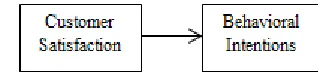
Oliver (1981) suggested that satisfaction is an emotional reaction which influences attitude and is consumption specific. There is evidence that the satisfaction of customer will ultimately determine their future intentions and behavior towards the service (e.g; Chen & Chen, 2010; Jen, et al., 2011; Ladhari, 2009; Park, et al., 2004; Robinson, 2012) . A study to six industries by Cronin, et al. (2000) find that satisfaction influenced behavioural intentions directly in all industries. In addition, evidence from Jones and Suh (2000) showed that overall satisfaction had a direct influence on how likely customers were to re-use the service; while Murray and Howat (2002) found that satisfaction appears to be a dominant antecedent of customers’ likelihood to recommend service to others. Therefore, the second proposition is being proposed.
Proposition 2: Customer satisfaction has a significant, positive effect on behavioral intentions.
Figure 2 Direct relationship between customer satisfaction and
behavioral intentions
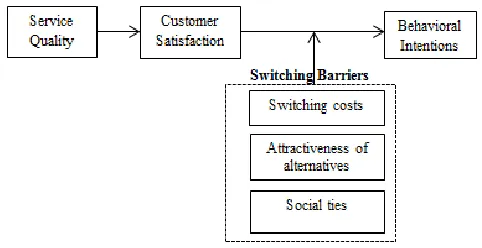
3.3 Moderating Effect of Switching Barriers and Social Ties to Customer Satisfaction – Behavioral Intentions Relationship
Based on the discussion above, there are positive relationships between customer satisfaction and behavioral intentions. Even though these two constructs are closely related, the relationship is not always linear (De Wulf, Odekerken-Schröder, & Iacobucci, 2001; Fornell, 1992; Jones, et al., 2000). Compared with dissatisfied customers who can switch in a situation of low switching barriers, dissatisfied customers in a situation of high switching barriers would unwillingly remain with their service provider because of the hardness to exit the relationship. Customers will stay with the service provider not because they are satisfied, hence; satisfaction gives less effect to customers’ behavioral intentions. In this situation, customer retention is influenced by high switching barriers and the role played by satisfaction receives less attention in the decision making process.
Switching costs may come in the form of termination costs from the current service provider to joining costs with the alternative service provider. It is the costs of changing service providers in terms of time, money, and psychological costs. Imposing high switching costs to customers has often become a strategy by firms to ‘lock’ their customers. When switching costs are low, the decision to stay or leave is based on the level of satisfaction. Conversely, when switching costs are high, it will outweigh the benefits of changing supplier and therefore; customer will stay with the incumbent service provider. In this situation, the relationship between satisfaction and customer’s behavioral intentions should be relatively weak.
Proposition 3: The effect of customer satisfaction to behavioral intentions is moderated by switching costs.
When there are only few other alternatives, it is possible for a customer to perform a positive behavior (repurchase) without being highly satisfied. In contrast, customer may not performing positive behaviour even they are highly satisfied when there are many choices. Attractiveness of alternatives is a customer perception of the extent whether there are competing alternatives are available in the market (Jones, et al., 2000). Therefore, in a situation where there is a lack of alternatives, it is less likely for customer to switch supplier and in this case, satisfaction is not the driver of behavioral intentions. In this study, pay TV industry in Malaysia can be grouped into oligopoly market where there are only a few service providers. Their service offerings differ to one another; hence customers do not have the power of switching to get the same products. Thus, customers will likely to stay with the current service provider regardless of their satisfaction level. In this situation, satisfaction plays lesser role in forming customers’ behavior.
Proposition 4: The effect of customer satisfaction to behavioral intentions is moderated by attractiveness of alternatives.
customers’ behavioral intention formation. Switching barriers in general is the barriers faced by customers that locked them in the relationship with service provider. Most of the times, switching barriers are conceptualized as the barriers imposed by the service provider. Further review on the literature found that there is also barrier occurring from the interaction between customers. In general this barrier generated by the experience shared between customers that interact with each other in the same social group who are consuming the same service. It is important to look on the effect of this interaction as it can influence customers’ future behavioral intention. However, there is a very limited research on social effects that will drive customers’ behavior. Social ties such as how strong relationship you are having in the social group will influence you to stay with current service provider. In condition where social ties are strong, dissatisfied customers find that staying with a service provider is important in order to keep a good social relationships. For instance, a dissatisfied pay TV subscriber need to continue subscribing when other customers within a family or friends are satisfied; whereby the termination of subscription could cause problem to the relationship among the members. Additionally, Brown and Reingen (1987) stressed that information obtained from strong tie connections are more influential in decision making than weak tie information. Therefore, it is believed that stronger social ties will moderate the relationship between customer satisfaction and behavioral intentions.
Proposition 5: The effect of customer satisfaction to behavioral intentions is moderated by social ties.
Figure .3 The suggested framework
4.0 CONCLUSION
Analysis on the literature provides the basis for the development of the conceptual model in understanding how the concept of switching barriers and social ties give impact to the relationship between customer satisfaction and customers’ behavioral intentions. Even though the model has not been empirically tested, the discussion of the relationships and interactions between the constructs studied in this paper will be of significant to academicians and service providers to review the related theories in the field of quality management and customer behavior.
For academic purposes, this study opens new directions for future research, providing ideas for researchers who intend to carry our customer behavior studies in the future. Adopting social switching barrier in understanding customer’s switching behavior is a new attempt to be included. Previously, researchers only tested the role of switching barriers imposed by a service provider to the relationship between customer satisfaction and behavioral intentions. To the researchers’
knowledge, no studies have examined the role of social ties between customers’ social network in influencing behavioral intentions. Therefore, based on the analysis on previous research, a new proposition is being proposed.
In addition, from the business perspective, this research will provide practical strategies to service provider in applying new strategies for retaining current customers. Switching barriers both economic and social is important in retaining customers. Better understanding on how these barriers can stop customers’ intention to switch to competitor is crucial. The intended research will guide the pay TV service provider in design and serve customers better
.
Acknowledgement
We are grateful for the scholarship by Zamalah Institutional Scholarship provided by Universiti Teknologi Malaysia and the Ministry of Higher Education of Malaysia to Author 1. We would like to take this opportunity to thank them.
References
[1] Aydin, S., & Özer, G. 2005. The Analysis of Antecedents of Customer
Loyalty in the Turkish Mobile Telecommunication Market. European
Journal of Marketing. 39(7/8): 910–925.
[2] Aydin, S., Özer, G., & Arasil, Ö. 2005. Customer Loyalty and the
Effect of Switching Costs as a Moderator Variable: A Case in the
Turkish Mobile Phone Market. Marketing Intelligence & Planning,
23(1): 89–103.
[3] Balabanis, G., Reynolds, N., & Simintiras, A. 2006. Bases of e-store
loyalty: Perceived Switching Barriers and Satisfaction. Journal of
Business Research. 59(2): 214–224.
[4] Bei, L. T., & Chiao, Y. C. 2006. The Determinants of Customer
Loyalty: An Analysis of Intangible Factors in Three Service Industries.
International Journal of Commerce and Management. 16(3/4): 162– 177.
[5] Bendapudi, N., & Berry, L. L. 1997. Customers' Motivations for
Maintaining Relationships with Service Providers. Journal of
Retailing. 73(1): 15–37.
[6] Bolton, R. N., & Drew, J. H. 1991. A Multistage Model of Customers'
Assessments of Service Quality and Value. Journal of Consumer
Research. 375–384.
[7] Brady, M. K., Cronin, J. J., & Brand, R. R. 2002. Performance-only
Measurement of Service Quality: A Replication and Extension. Journal
of Business Research. 55(1): 17–31.
[8] Brady, M. K., & Robertson, C. J. 2001. Searching for a Consensus on
the Antecedent Role of Service Quality and Satisfaction: An
Exploratory Cross-National Study. Journal of Business Research.
51(1): 53–60.
[9] Brown, J. J., & Reingen, P. H. 1987. Social Ties and Word-Of-Mouth
Referral Behavior. Journal of Consumer Research. 350–362.
[10] Burnham, T. A., Frels, J. K., & Mahajan, V. 2003. Consumer
Switching Costs: A Typology, Antecedents, and Consequences.
Journal of the Academy of Marketing Science. 31(2): 109–126.
[11] Chen, C. F., & Chen, F. S. 2010. Experience Quality, Perceived Value,
Satisfaction and Behavioral Intentions for Heritage Tourists. Tourism
Management. 31(1): 29–35.
[12] Chen, M. F., & Wang, L. H. 2009. The Moderating Role of Switching
Barriers on Customer Loyalty in the Life Insurance Industry. The
Service Industries Journal. 29(8): 1105–1123.
[13] Christian, G. 1984. A Service Quality Model and its Marketing
Implications. [DOI: 10.1108/EUM0000000004784]. European Journal
of marketing. 18(4): 36–44.
[14] Cronin, J. J., Brady, M. K., & Hult, G. T. M. (Writer). 2000. Assessing
the Effects of Quality, Value, and Customer Satisfaction on Consumer
Behavioral Intentions in Service Environments. Journal of Retailing.
[15] Cronin Jr, J. J., & Taylor, S. A. 1992. Measuring Service Quality: A
Reexamination and Extension. The Journal of Marketing. 55–68.
[16] De Wulf, K., Odekerken-Schröder, G., & Iacobucci, D. 2001.
Investments in Consumer Relationships: A Country and
[17] Eagly, A. H., & Chaiken, S. 1993. The Psychology of Attitudes. Harcourt Brace Jovanovich College Publishers.
[18] Fornell, C. 1992. A National Customer Satisfaction Barometer: The
Swedish Experience. The Journal of Marketing. 6–21.
[19] Han, H., Back, K. J., & Kim, Y. H. 2011. A multidimensional Scale of
Switching Barriers in the Full-Service Restaurant Industry. Cornell
Hospitality Quarterly. 52(1): 54–63.
[20] Han, H., Kim, W., & Hyun, S. S. 2011. Switching Intention Model
Development: Role of Service Performances, Customer Satisfaction,
and Switching Barriers in the Hotel Industry. International Journal of
Hospitality Management. 30(3): 619–629.
[21] Han, H., & Ryu, K. 2012. Key Factors Driving Customers’
Word-of-Mouth Intentions in Full-Service Restaurants: The Moderating Role of
Switching Costs. Cornell Hospitality Quarterly.
[22] Hoffman, K. D., & Bateson, J. E. G. 2010. Services Marketing:
Concepts, Strategies, & Cases. South-Western Pub.
[23] Hu, H.-H., Kandampully, J., & Juwaheer, T. D. 2009. Relationships
and Impacts of Service Quality, Perceived Value, Customer
Satisfaction, and Image: An Empirical Study. The Service Industries
Journal. 29(2): 111–125.
[24] Huo, Y., & Xu, L. 2010. The impact of Corporate Image and Customer
Expectation on Customer Satisfaction: An Empirical Study in Power Supply Industry.
[25] Jen, W., Tu, R., & Lu, T. 2011. Managing Passenger Behavioral
Intention: An Integrated Framework for Service Quality, Satisfaction,
Perceived Value, and Switching Barriers. Transportation. 38(2): 321–
342.
[26] Jones, M. A., Mothersbaugh, D. L., & Beatty, S. E. 2000. Switching
Barriers and Repurchase Intentions in Services. Journal of Retailing.
76(2): 259–274.
[27] Jones, M. A., Mothersbaugh, D. L., & Beatty, S. E. 2002. Why
Customers Stay: Measuring the Underlying Dimensions of Services Switching Costs and Managing Their Differential Strategic Outcomes.
Journal of Business Research. 55(6): 441–450.
[28] Jones, M. A., & Suh, J. 2000. Transaction-specific Satisfaction and
Overall Satisfaction: An Empirical Analysis. Journal of services
Marketing. 14(2): 147–159.
[29] Ladhari, R. 2009. Service Quality, Emotional Satisfaction, and
Behavioural Intentions: A Study in the Hotel Industry. Managing
Service Quality. 19(3): 308–331.
[30] Lai, F., Griffin, M., & Babin, B. J. 2009. How Quality, Value, Image,
and Satisfaction Create Loyalty at a Chinese Telecom. Journal of
Business Research. 62(10): 980–986.
[31] Liu, C. T., Guo, Y. M., & Lee, C. H. 2011. The Effects of Relationship
Quality and Switching Barriers On Customer Loyalty. International
Journal of Information Management. 31(1): 71–79.
[32] Lu, T., Tu, R., & Jen, W. 2011. The Role of Service Value and
Switching Barriers in an Integrated Model of Behavioural Intentions.
Total Quality Management & Business Excellence. 22(10): 1071–1089.
[33] Maslow, A. H., Frager, R., & Fadiman, J. 1970. Motivation and
Personality .Vol. 2. Harper & Row New York.
[34] Murray, D., & Howat, G. 2002. The Relationships Among Service
Quality, Value, Satisfaction, and Future Intentions of Customers at an
Australian Sports and Leisure Centre. Sport Management Review. 5(1):
25–43.
[35] Oliver, R. L. 1980. A Cognitive Model of the Antecedents and
Consequences of Satisfaction Decisions. Journal of Marketing
Research. 460–469.
[36] Oliver, R. L. 1981. Measurement and Evaluation of Satisfaction
Processes in Retail Settings. Journal of Retailing.
[37] Parasuraman, A., Zeithaml, V. A., & Berry, L. L. 1985. A Conceptual
Model of Service Quality and Its Implications for Future Research. The
Journal of Marketing. 41–50.
[38] Parasuraman, A., Zeithaml, V. A., & Berry, L. L. 1994. Reassessment
of Expectations as a Comparison Standard in Measuring Service
Quality: Implications For Further Research. The Journal of Marketing.
111–124.
[39] Park, J. W., Robertson, R., & Wu, C. L. 2004. The Effect of Airline
Service Qualityon Passengers' Behavioural Intentions: A Korean Case
Study. Journal of Air Transport Management. 10(6): 435–439.
[40] Ranaweera, C., & Prabhu, J. 2003. The Influence of Satisfaction, Trust
and Switching Barriers on Customer Retention in a Continuous
Purchasing Setting. International Journal of Service Industry
Management. 14(4): 374–395.
[41] Robinson, G. J. 2012. Delight, Satisfaction, and Behavioral Intentions
in a Hospital Setting: The Role of Environmental and Interpersonal Services. Unpublished 3510912, Cleveland State University, United States-Ohio.
[42] Steffes, E. M., & Burgee, L. E. 2009. Social Ties and Online Word of
mouth. Internet Research. 19(1): 42–59.
[43] Tsai, H. T., Huang, H. C., Jaw, Y. L., & Chen, W. K. 2006. Why
on‐line Customers Remain with a Particular E‐Retailer: An Integrative
Model and Empirical Evidence. Psychology and Marketing. 23(5):
447–464.
[44] Vasudevan, H., Gaur, S. S., & Shinde, R. K. 2006. Relational
Switching Costs, Satisfaction and Commitment: A Study in the Indian
Manufacturing Context. Asia Pacific Journal of Marketing and
Logistics. 18(4): 342–353.
[45] Vázquez‐Casielles, R., Suárez‐Álvarez, L., & Del Río‐Lanza, A. B.
2009. Customer Satisfaction and Switching Barriers: Effects on Repurchase Intentions, Positive Recommendations, and Price
Tolerance1. Journal of Applied Social Psychology. 39(10): 2275–2302.
[46] Wang, C. Y. 2009. Investigating Antecedents of Consumers'
Recommend Intentions and the Moderating Effect of Switching
Barriers. The Service Industries Journal. 29(9): 1231–1241.
[47] Woisetschläger, D. M., Lentz, P., & Evanschitzky, H. 2011. How
Habits, Social Ties, and Economic Switching Barriers Affect Customer
Loyalty in Contractual Service Settings. Journal of Business Research.
64(8): 800–808.
[48] Xu, Y., Goedegebuure, R., & Van der Heijden, B. 2007. Customer
Perception, Customer Satisfaction, and Customer Loyalty Within
Chinese Securities Business. Journal of Relationship Marketing. 5(4):
79–104.
[49] Zeithaml, V. A. 1990. Delivering Quality Service: Free Press.
[50] Zeithaml, V. A., Berry, L. L., & Parasuraman, A. 1996. The Behavioral