SCREEN DESIGN IMPROVEMENT SYSTEM (SDIS):
SYSTEM FOR ASSISTING STUDENTS IN SCREEN DESIGN PROCESS
Zaleha Abdullah, 1Juhazren Junaidi, 2Nor Azean Atan Department of Educational Multimedia
Faculty of Education Universiti Teknologi Malaysia 81310 Skudai, Johor, Malaysia
ABSTRACT
Visual is seen as a powerful tool to deliver information. An effective visual or a good production of screen design requires creativity and some design knowledge. Does this mean only designers are capable to come out with quality design? How about educators? Majority of educators do not possess any art or design background. In reality, an educator who provides visuals as a means of communication in the computer based learning process need to be able to produce visual design that are visually literate. Creative learning process helps to promote creativity. Screen designing work involves creative thinking and creativity can be trained using various methodologies or process. According to creativity expert Dr. R. Keith Sawyer, 2006- creativity is not some magical trait, it took lots of hard work. Creativity is a set of skills that can be learned, developed and used in daily life. The study explores primarily two important aspects. (1) How to improve non-designer (educators) screen design capability? (2) How to create creative learning process through online collaboration? For this reason, prototype of Screen Design Improvement System (SDIS) will be developed based on the Knowledge Creation Model and the Eight specific tasks of Genex Creativity framework. SDIS will go through evaluation phase to verify its capability. Samplings are the final year students from faculty of education, UTM. They are required to produce digital teaching and learning modules in multimedia classes which involve a lot with screen designing. Unfortunately, most of the students are having difficulty to come out with a quality design. They are future teachers in the field of mathematic, physic, chemistry, Islamic studies and English.
Keywords: Screen Design, Creative Learning Process, Non-Designer (Educators), Online Collaboration, Digital Teaching and Learning Aids.
INTRODUCTION
Professional designers refer to screen design as Graphical User Interface (GUI) design (Patrick Gerald, 1996). Screen design is seen important in every field and in education, it is indubitable that ‘the chalk and talk’ method of teaching has become less in favor. Digital media has a strong influence in our education systems nowadays, whether in traditional face-to-face or through distance learning courses. Our teaching and learning environments are influenced by increasingly accessible wireless networks, electronic mail(e-mail), instant messaging, chat rooms, live streaming video courses (Web logs), and podcasting- audio recording of lectures with mp3 players, which is considered to be the latest in technology. (Michigan Engineer, 2005) All of the educational technologies mentioned involve the use of screen design or graphical interface and it helps to enhance the learning process (Cristina D. Pomales-Garcia, 2006)
This study focuses on the screen design of the front learning module interface. The design of this screen is critical to learner success because it typically, (1) sets the tone for the rest of the intervention by introducing the subject, (2) acts as an overview or table-of-contents, (3) is the “home base” screen that the learner used to navigate through the module, and (4) provide learner with some degree of control of the learning through navigational access to subject matter.
RESEARCH OBJECTIVES
The study attempts to address the following objectives:
1. To develop a Screen Design Improvement System (SDIS) based on Knowledge Creation Model and Eight specific tasks of Genex Creativity framework.
2. To identify how SDIS components (S1 – S4) are able to help participants 3. To observe if screen design has improved after using SDIS
RESEARCH QUESTION
1. How well is the SDIS able to reflect the Knowledge Creation Model and the Eight specific tasks of Genex Creativity framework?
2. How do participants perceive SDIS components: 2.1 G1 (Externalization + Create)
2.2 G2 (Combination + Relate) 2.3 G3 (Internalization + Create) 2.4 G4 (Socialization + Donate)
3. Is there an improvement in the screen design after using SDIS? Conceptual Framework
Two conceptual frameworks are used as a foundation in this research. (1) Knowledge Creation Model (Ikujiro Nonaka, 2000)
(2) Eight specific tasks of Genex Creativity framework (Shneiderman, 2002)
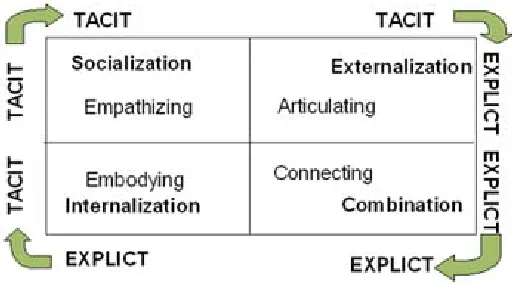
Figure 1: Knowledge Creation Process Model (Ikujiro Nonaka, 2000)
Knowledge Creation Model in Figure 1 describes:
• Learning should comprise both explicit and tacit knowledge; explicit (knowing about- the objective knowledge); tacit (knowing how -the subjective knowledge)
• Externalization: Tacit knowledge should be rationalize to make it easier for learner to understand
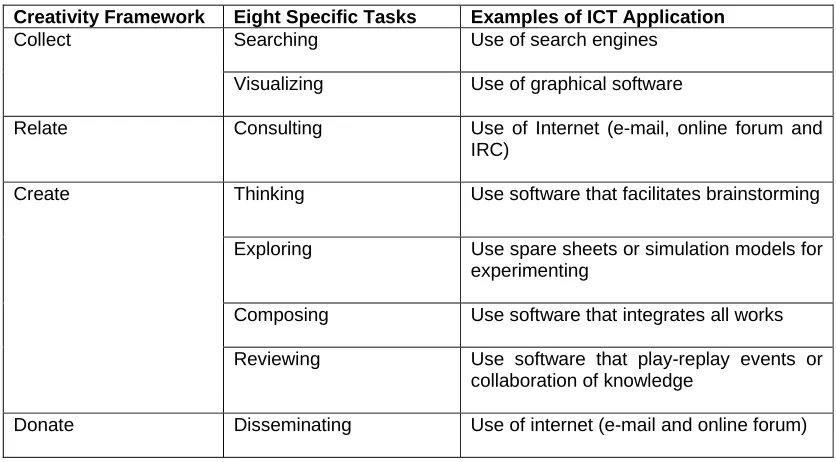
Table 1: Eight specific tasks of Genex Creativity framework (Shneiderman, 2002)
Creativity Framework Eight Specific Tasks Examples of ICT Application
Collect Searching Use of search engines
Visualizing Use of graphical software
Relate Consulting Use of Internet (e-mail, online forum and IRC)
Create Thinking Use software that facilitates brainstorming
Exploring Use spare sheets or simulation models for experimenting
Composing Use software that integrates all works Reviewing Use software that play-replay events or
collaboration of knowledge
Donate Disseminating Use of internet (e-mail and online forum)
Creative process is needed in every quality production of ideas and Eight specific tasks of Genex Creativity framework (Shneiderman,2002) is chosen because it represent ICT application in creative process The research will help to overcome some issues in linear classes.
• An alternative way to offer guidance
• Lecturer will be able to informally observe students’ process of design
• Provide an extended classroom environment that allows students to explore and be creative undue restraints.
• Encourage students to produce more original ideas than imitation
Components in SDIS collaboration system will be created found on the combination of two conceptual frameworks as mentioned in Figure 1 and Table 1. The result can be seen in Table 2.
Table 2: The creation of SDIS collaboration components (S1-S4)
Knowledge Creation Process
Creativity Framework
Eight Specific Tasks
Examples of ICT
Application
SDIS
Components
Externalization
(tacit – explicit)
Knowledge is stored. Learner
could refer
Collect
Searching Use of search engines
S1 Educator
share their tacit
knowledge in easier form to understand
Visualizing
Use of graphical
Knowledge Creation Process Creativity Framework Eight Specific Tasks Examples of ICT Application SDIS Components Combination (explicit – explicit) Help learner understand the content clearly
Relate Consulting
Use of Internet (e-mail, online forum and IRC) S2 Internalization (explicit – tacit) Learner learn by doing Create Thinking Use software that facilitates brainstorming S3 Learner internalize their experiences Exploring Use spare sheets or simulation models for experimenting Built their personal knowledge bases Composing Use software that integrates all works Reviewing Use software that play-replay events or collaboration of knowledge Socialization (tacit – tacit)
Share idea and continually contributed to online learning community
Donate Disseminating Use of
internet (e-mail and online forum)
S4
LITERATURE REVIEW
Screen designing work involves creative thinking and creativity can be trained using various methodologies or process. But then how do we teach people to be creative?
Research and development firms took this opportunity to find the best possible method on developing a medium to foster creativity depending on the disciplines targeted. Computer tools such as Adobe Photoshop and Macromedia Flash are final products produced which gave the opportunity for users to expand their creativity by materializing ideas into actions in the form of visual. As a result, changes in interface design on posters, magazines, book covers, courseware, websites and basically anything visual in nature can be seen on a daily basis.
Issues and research about fostering creativity have been emerging in every field over the half century since J.P Guilford presented his address on creativity at the American Psychological Association convention in 1950. Based on these empirical studies, it had been demonstrated in empirical studies that creativity can be improved by various training programs (Rose & Lin, 1984; Scope, 1999; Scott, G., Leritz, L.E., & Mumford, M.D., (2004b)
creative skills and yielding creative products. Therefore, the viewpoint about creativity is important in every development of instruction materials.
Most research on fostering creativity via technology uses creative process to enhance ones creativity for an example, IDEO project http://www.designinginteractions.com/interviews. The IDEO design team use brainstorming process to generate quality ideas and the “brainstormer” process has been nicely documented and used by many other organizations (Kelly, 2001). IDEO main aim is to help organization innovate through design.
Another similar research called Creativity Support Tools (CST) by George, Nunamaker and Valacich (1992). The goal of the research is to develop improved software and user interfaces that empower users to be not only more productive but also more innovative. According to the research, Creativity support tools can not succeed in a vacuum: it work best within communities where people share expertise and experiences with one another. When students use creativity support tools, for example, they require support from teachers, parents, and mentors. In developing creativity support tools for students, there is a need to build not only new technologies, but also communities of people who can help students learn with those new technologies. Another important element that encourages students to produce better design is through the power of sketching. Creative design resides not only in its externalized representation, but also in the act of producing the representation (Kumiyo Nakakoji, 2003) Finding by the a group of MIT Lab researchers (2005) provides a lesson that there can be cases where computational support can detrimentally affect creative processes, even though their design is well-motivated. For an example; users spend too much time exploring and not enough time maturing a single solution. SDIS will set a solution to overcome this by giving direct suggestion to any design decision made by the students but it does not imply that they have to pursue with it because this won’t reflect freedom of being creative.
One of the routes to maturing research in creativity fostering system is to promote more evaluations. Standardized instruments are one method to achieving this end. Creativity happens within a social context, and tools will partially need to be evaluated within this context (The Media Laboratory, MIT Media Lab, 2005)
METHODOLOGY
Qualitative and quantitative approach will be used to provide a more holistic perspective of the complexity of the variables involved in learning using S1-S4 approach. The instrument involved; interview session, observation, content analysis and questionnaires throughout evaluation process including pilot testing. The system development will be based on the design model of Rapid Prototyping (Bostock and Drammond, 1998) involves five phases; (1) analyzing, (2) design, (3) development (4) Implementation (5) Evaluation. All the phases in this model involve evaluation process and repetitions which is executed from time to time following the levels of phases mentioned.
CONCLUSION
Many technological innovations rely on screen design to elevate their technical complexity to a user friendly product. Technology alone may not win user acceptance and subsequent marketability. The User Experience, or how the user experiences the end product, is the key to acceptance. And that is where screen design enters the design process. Good screen design can make a product easy to understand and use, which results in greater user acceptance.( Jakob Nielsen,2000)
The growing emphasis on creativity is becoming more important to individuals, organizations and nations in facing the ever changing challenges. In education sector, teaching and learning process will be more effective if it possesses creativity. One of the creativity required is designing ability.
This research will contribute in improving educational practice, particularly to future teachers (non-designer) who is expected to deliver knowledge to the next conceptual age generation through computer. It will offer a helping hand by giving an alternative process to achieve it. In another word, to help them produce teaching and learning medium (screen design) based on the right principle.Edward Tufte (2000)highlighted that with good design, clear thinking can be made visible
REFERENCE
Edward R.Tufte (2000) Visual Explainations: Images and Quantities, Evidence and Narrative. Graphic Press. (27)-121.
Ben Shneiderman and Catherine Plaisant, (2004) Designing the User Interface: Strategies for Effective Human–Computer Interaction. 4th ed. Addison Wesley
Cristina D. Pomales-Garcia,2006. Aesthetic and performance aspects of Web-based distance learning technology. Doctoral Thesis: University of Michigan, 2006, 163 pages.
George Nunamaker and Valacich (1992) Creativity Support Tools (CST). NSF Workshop Report on Creativity Support Tools.
Heather Anne Kanuka (1997) Screen design: Effects of design principles on recall learning and study time. Doctoral Thesis:University Of Alberta (Canada), 113 pages.
Ikujiro Nonaka, Georg Von Krogh, Kazuo Ichijo, (2000) Enabling Knowledge Creation: How to Unlock the Mystery of Tacit Knowledge and Release the Power of Innovation. Oxford University Press.
Ikujiro Nonaka, (1994). A dynamic theory of organizational knowledge creation. Organization Science, 5 (1), 14-37.
Ikujiro Nonaka, & Takeuchi, H. (1995). The Knowledge-Creating Company. New York: Oxford University Press, Inc.
Ikujiro Nonaka, and Toyama, R. (2004). The knowledge-creating theory revisited: knowledge creation as a synthesizing process. Knowledge Management Research & Practice, 1 (1), 2-9.
Ikujiro Nonaka, Toyama, R., and Konno, N. (2000). SECI, Ba and leadership: a unified model of dynamic knowledge creation. Long Range Planning, 33, 5-34. Örtenblad, A. The learning organization.
Jakob Nielsen (2000), Designing web usability: the practice of simplicity. Indiana : New Riders Kelly (2001) IDEO: Masters of Innovation http://www.ideo.com/
Kumiyo Nakakoji, (2003) Seven Issues for Creativity Support Tool Researchers p.g 74 (83) NSF Workshop Report on Creativity Support Tools. University of Tokyo.
Michigan Engineer (2005), Digital Ed: Student Life and Leaning in the 21st Century, Michigan Engineer, 22 (2), 2-7. University of Michigan, College of Engineering Magazine.
MIT Media Lab researchers (2005) Design Principles for Tools to Support Creative Thinking. International Journal Of Human–Computer Interaction. Brad Myers, Mitchel Resnick, Carnegie Mellon Univ. Kumiyo Nakakoji, Univ. of Tokyo, Japan, Ben Shneiderman, Univ. of Maryland, Randy Pausch, Carnegie Mellon Univ, Ted Selker, Mike Eisenberg, Univ. Of Colorado Revised.
Patrick Gerald. Callaghan (1996), The impact of imagery on emotion and cognition: An exploratory investigation of interactive multimedia interface designs, Doctoral Thesis: Wayne State University, 89 pages.
R. Keith Sawyer (2006), Explaining Creativity: The science of human innovation, Oxford University Press Publisher.
Rose, L.H. and Lin, H.T. (1984) A meta-analysis of long-term creativity training programs. The Journal of Creative Behavior , 18, 11–22.
Scope, E. E. (1999). A meta-analysis of research on creativity: The effects of instructional variables. Dissertation Abstracts International, 59(7), 2348A.
Shneiderman, (2002). Supporting creativity with powerful composition tools for artifacs and performances. In Proceedings of the 33rd Hawaii International Conference on System Sciences. IEE Computer Scociety.
Shneiderman, B (2002). Creativity Support Tools. Communications of the ACM, 45 (10) 116-120.
The Media Laboratory, Cambridge, MA 02139-4307 USA http://www.media.mit.edu/.