74:2 (2015) 79–85 | www.jurnalteknologi.utm.my | eISSN 2180–3722 |
Jurnal
Teknologi
Full paper
Important Activities in Activity-based Life Cycle Cost in Building Facilities
Maintenance: A Case Study
Puvaneswary Thanarajua*, Hishamuddin M. Alib
aCentre of Real Estate Studies, Universiti Teknologi Malaysia, 81310 UTM Johor Bahru, Johor, Malaysia
b
Department of Political Science, School of Social Sciences, Universiti Sains Malaysia, Pulau Pinang, Malaysia
*Corresponding author: [email protected]
Article history
Received :1 November 2014 Received in revised form : 31 March 2015
Accepted :30 April 2015
Abstract
Public universities’ budget constraint faces various challenges in maintaining their building facilities. A cost management solution in based on life-cycle cost through activity-based could provide the systematic approach in organizing, monitoring and analyzing process of facilities' maintenance costs. The aim of this paper is to determine the important facilities’ maintenance activities that should be included in an activity-based life-cycle cost process of public university building maintenance. Descriptive analysis is conducted in determining the important and non-important facilities' maintenance activities. By prioritizing activities through value added and non-value added maintenance activities, cost can be managed and controlled effectively.
Keywords: Maintenance facilities activities; activity-based life cycle cost
Abstrak
Kekangan bajet antara universiti awam menghadapi pelbagai cabaran dalam mengekalkan tahap penyengaraan fasiliti bangunan mereka. Pengurusan kos berdasarkan kos kitar hayat yang berasaskan activity dapat menyediakan pendekatan yang sistematik dalam penganjuran, pemantauan dan proses analisis kos penyengaraan fasiliti berasaskan aktiviti. Tujuan utama kertas kerja ini adalah untuk mengenalpasti aktiviti-aktiviti penyengaraan fasiliti yang perlu dimasukkan dalam proses kos kitaran hayat berdasarkan aktiviti untuk penyenggaraan bangunan universiti. Pendekatan kuantitatif dengan menggunakan analisis deskriptif dijalankan dalam menentukan aktiviti penyengaraan fasiliti yang penting dan yang kurang penting. Dengan cara member keutamaan kepada aktiviti-aktiviti ini melalui aktiviti yang ada nilai-tambah dan aktiviti-aktiviti penyengaraan yang tiada nilai-tambah, kos dapat dikawal dan diuruskan dengan baik.
Kata kunci: Aktiviti peyengaraan fasiliti; kos kitaran hayat berdasarkan aktiviti
© 2015 Penerbit UTM Press. All rights reserved.
1.0 INTRODUCTION
Globally, asset management industry encounters difficulties in recent years, impact from the credit crisis of 2008-2009. Simultaneously, this situation has created challenges to be faced in similar closely related fields such as facilities management. Costs of maintenance plays the critical role in the cost management of organization, especially in public sector as the budget allocation or funding is limited. The main focus of this paper is on the operational aspect, which involves major cost involvement throughout the productivity life period of a building. In the past, companies and organizations were mainly bearing on the amount of their products or services were being able to expose into the
market. At circumstances, only a few practitioners use the existing resources in a cost-effective way. This situation was merely targeting on fulfilling the requirement of demand but lack in term of using resources efficiently where it can reduce the cost in using particular objectives and expands the accomplishment of particular activities in term of budget and resource constraint. Facilities management is based on business activity and responsive to changes in clients’ needs also according to time and
cost effective manner1. For many organizations, the effectiveness of
74:2 (2015) 79–85 | www.jurnalteknologi.utm.my | eISSN 2180–3722 | pressure to maximize its investments. Initial cost remains a practical
consideration, but the amount of money spent over the entire expected life of a n asset is also an important part of the
long-term exposure2. The key aspect of facilities management is to
ensure longevity of asset lifespan in providing a better return on
investment through reduced life cycle costs (LCC)3. In this matter,
the main aspect to be focused in facilities management is the maintenance because building maintenance is a major activity in sustaining a building and to keep it as a valuable asset. The only way to achieve this is by operating and maintaining the
facilities properly. Building facilities operation and maintenance
that comprehends all the broad spectrum of services required to assure the built environment will perform the functions for which a facility was assigned and constructed. Without a proper maintenance, a facility cannot operate at its highest productivity l e v e l i n a c h i e v i n g i t s f u n c t i o n a n d e n h a n c i n g i t s
structural integrity and appearance 4.
The basis for maintenance optimization is to find the rankings of all maintenance tasks based on their cost-effectiveness in an educational institution. Consideration on cost-effectiveness of maintenance task is a general overview where it relates the service provided in identifying the users’ experience towards the service; and the costs involved in carrying out the maintenance task. Both may provide a picture on how costs have been spent effectively in
order to obtain the service’s effectiveness5. In the view of higher
education institution, the users of the building maintenance services are the students, educators and also t h e office (administration) staffs. In order for a higher education institution to achieve its core business needs, maintenance activity plays a main role where it has to be affirmed with the education output at a most effective level. In fact, the majority of users of higher educational institution are the students and then followed by the number of academic and administrative staffs. In other mean, the cost-effectiveness of maintenance can be best represented through facilities conditions in an academic environment, especially in the academic built environment that contributes to the achievement of students in their education, the outcome of a teaching process for the educators and also comfortable working environment for the administrators. The maintenance service that considered in this study only covers the institutional buildings.
2.0 PUBLIC UNIVERSITY AS AN ASSET TO THE
GOVERNMENT
Universities represent a country’s image internationally which should be accommodated with updated facilities and good maintenance practices. Public assets in Malaysia face critical problems due to lack of better maintenance that caused the government to spend higher cost every year. In the process of transforming Malaysia into a knowledge-based economy, well-educated skilled workers considered as the main source of national prosperity and wealth, therefore allocation for the higher education institutions covers huge percentage form the total
allocation under Malaysian Plan6,7,8. In realizing this transformation
plan, each top tier of public universities must fully understand their institutions vision and mission and meet their objectives in achieving the core business needs. At an operation level, the public universities are responsible to recognize and identify the importance of core business and its support functions and the
critical required. Besides developing activity such as
commercialization of R&D and fundraising, cutting down avoidable
expenditures through a good management can also be a supportive function in contributing monetary vice.
Essentially, apart from staffs and students, buildings are the
most significant asset of the university organization and public universities in Malaysia dependent the strength of budget derivation they can make to governments for funds in order to
keep those buildings under his authorization in a good condition9.
Utilizing the government fund in a total effective way through a well-planned maintenance management will results overall goodness not only in the process of minimizing expenditure but also t i m e a n d t o p r o d u c e a b e t t e r environment o f f a c i l i t i e s management, after all, what is the point of generating more and more i n c o m e b u t t h e expenditure r e t a i n s t h e s a m e o r e v e n increasing. Naturally, t h e universities’ authorities are k e e n o n provide their built facilities in the most cost-effective manner10 but often maintenance of building is s o met i mes the first area to suffer when a university budget are reduced and it is obviously a not cost- effective option9.
In that situation, some of the critical elements that contribute
to the effectiveness in building facilities maintenance might be skipped. Consequently, in educational building where facilities are very much related to the users’ concern, must consider the most influenced t yp e of facilities services in the determination of maintenance budgeting to result more effective outputs. Cost- effective decisions in maintenance necessarily need access to information and data from all areas that may affect maintenance. For instance, life cycle cost analysis planned to be implemented for university building maintenance. To achieve that objective, certain criteria and procedures for data selection and also collection are equally necessary to ensure quality because data
alone will not produce cost-effective decisions11,12, 13. Thus,
information and data availability and reliability play an important role in producing cost-effective decision.
Institutional buildings and its facilities are very much
contributes to educational productivity and achievements. Therefore, identifying the relationship, contribution and impacts of educational building facilities are important for the management purpose, where cost reduction i s needed and building users (e.g. staffs and students) productivity is achieved. This study attempted in determining the elements of facilities maintenance activities that have been critical for management to focus on the costs and at the same time support the core function of institutional buildings.
3.0 COST EFFECTIVENESS IN ACTIVITY-BASED LIFE
CYCLE COST
74:2 (2015) 79–85 | www.jurnalteknologi.utm.my | eISSN 2180–3722 | cost-effective cost management tool in order to fulfill the core
business of public university through the buildings.
ABC can be considered as a method of costing activities that
are necessary and important for the production of the products or
services, for example activities being undertaken14. ABC interprets
as ways to see operating costs and provides methods to dissect the
underlying activities that cause costs to exist15. This allows any
organization to track the cost associated with activities performed
for produced products or in delivering services. Activity variables
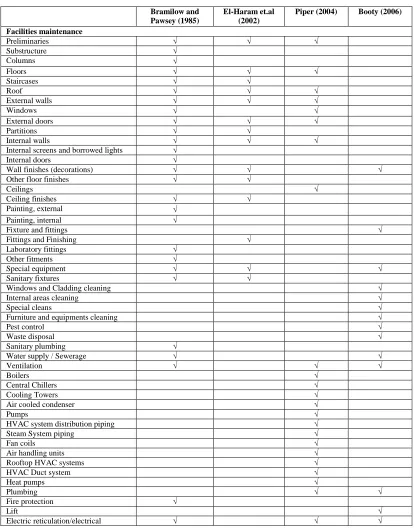
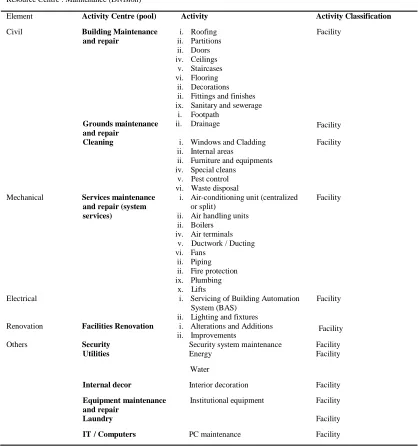
are listed in Table 1, based on the critical review from available
literature in the building maintenance industry16,17,18,19 particularly
in institutional organization and also information on maintenance activities that currently in practice from universities involved in this research scope. Appropriate facilities maintenance level (referring to facility level, which is the fourth area that involves costs in activity-based costing) activities cost elements are identified which considered in developing activity-based life cycle cost in Table 2. These activities are seen to be significant and important to be separated in regarding their value to the department
Table 1 Summary of building facilities cost elements
Bramilow and Pawsey (1985)
El-Haram et.al (2002)
Piper (2004) Booty (2006)
Facilities maintenance
Preliminaries √ √ √
Substructure √
Columns √
Floors √ √ √
Staircases √ √
Roof √ √ √
External walls √ √ √
Windows √ √
External doors √ √ √
Partitions √ √
Internal walls √ √ √ Internal screens and borrowed lights √ Internal doors √ Wall finishes (decorations) √ √ √
Other floor finishes √ √
Ceilings √
Ceiling finishes √ √ Painting, external √ Painting, internal √ Fixture and fittings √ Fittings and Finishing √ Laboratory fittings √ Other fitments √ Special equipment √ √ √
Sanitary fixtures √ √ Windows and Cladding cleaning √
Internal areas cleaning √ Special cleans √
Furniture and equipments cleaning √
Pest control √
Waste disposal √ Sanitary plumbing √ Water supply / Sewerage √ √
Ventilation √ √ √
Boilers √
Central Chillers √ Cooling Towers √ Air cooled condenser √
Pumps √
HVAC system distribution piping √ Steam System piping √
Fan coils √
Air handling units √ Rooftop HVAC systems √ HVAC Duct system √
Heat pumps √
Plumbing √ √
Fire protection √
Lift √
74:2 (2015) 79–85 | www.jurnalteknologi.utm.my | eISSN 2180–3722 |
Bramilow and Pawsey (1985)
El-Haram et.al (2002)
Piper (2004) Booty (2006)
Power Transformers √
Lighting √
Transportation system √ Special services √ Security System √
Disposal installation √
Energy √
Miscellaneous items √
Laundry √
Alteration and fitting out √
Table 2 Resource centre Resource Centre : Maintenance (Division)
Element Activity Centre (pool) Activity Activity Classification
Civil Building Maintenance and repair
Grounds maintenance and repair
i. Roofing ii. Partitions ii. Doors iv. Ceilings
v. Staircases vi. Flooring
ii. Decorations ii. Fittings and finishes ix. Sanitary and sewerage
i. Footpath ii. Drainage
Facility
Facility
Cleaning i. Windows and Cladding
ii. Internal areas
ii. Furniture and equipments iv. Special cleans
v. Pest control vi. Waste disposal
Facility
Mechanical Services maintenance and repair (system services)
i. Air-conditioning unit (centralized or split)
ii. Air handling units ii. Boilers
iv. Air terminals v. Ductwork / Ducting vi. Fans
ii. Piping ii. Fire protection ix. Plumbing
x. Lifts
Facility
Electrical i. Servicing of Building Automation System (BAS)
ii. Lighting and fixtures Renovation Facilities Renovation i. Alterations and Additions
ii. Improvements
Facility
Facility Others Security Security system maintenance Facility
Utilities Energy Facility
Water
Internal decor Interior decoration Facility
Equipment maintenance and repair
Institutional equipment Facility
Laundry Facility
74:2 (2015) 79–85 | www.jurnalteknologi.utm.my | eISSN 2180–3722 | Thus, the aim of the study is to identify the facilities
maintenance activities that are considered value added and non-value added activities to the public universities in order for them to undertake a cost management tool for building facilities maintenance.
4.0 SCOPE OF RESEARCH
This research is limited in scope to the public higher educational institutions (public university) in Malaysia and focused mainly on those public universities entitled under research university status. Public universities are under the control of government with objectives in line with Ministry of Higher Education. There are three categories of public higher educational institution in Malaysia, which are research universities, comprehensive (broad based) universities and focused (specialized) universities. To date, there are 20 public universities, where five are research universities, four comprehensive universities and 11 focused universities. Research universities have been selected to be studied-on in this research based on the funding level or stage. Malaysian government provides fund about 90% for the public universities whereas the remaining 10% is covered from students’ fees. Reason for focusing on Research Universities mainly because of restrictions and new policies were introduced by t h e government in the funding criteria for these universities. Research universities that mentioned are Universiti Malaya, Universiti Kebangsaan Malaysia, Universiti Putra Malaysia, Universiti Sains Malaysia and Universiti Teknologi Malaysia.
5.0 METHODOLOGY
These universities are not only categorized under the same title but also among the oldest public universities in the country with the most of them having been operating for more than 30 years. Thus, the maintenance of building in those universities would have passed through several critical stages since when it had been established; simultaneously it could inform the taxonomy of building service maintenance in higher educational institution. Hence, five public universities will be included in the survey which represents about 23% of the total public universities in Malaysia.
Questionnaire survey undertaken in identifying the critical maintenance activity cost element in terms of the level of importance given by the service providers of public university in activity-based life cycle cost process. Four scaled questionnaire developed based on the extensive literature reviews and a series of discussions with those in the university building maintenance field and concern about university building management. Probability sampling is used in this research as the convenience sampling as the respondents are willing and available to be
studied.
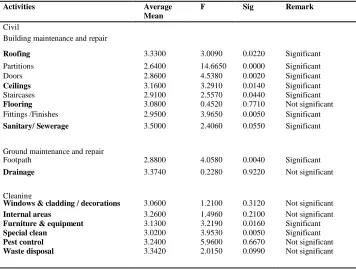
Activities that highlighted in yellow shows the most important activities that preferred by most of the institutions to be included in conducting life cycle cost in building maintenance. Activities such as roofing, ceilings, floorings, and also sanitary and sewerage are considered as important in civil facilities maintenance. In ground maintenance and repair category, drainage was considered important to be included in the life cycle cost process.
For sample size, each university owes a maintenance
department or divisions consist of several maintenance units. For
this research purpose, five units of building maintenance were selected. Averagely each unit consisted of four to five officers and the selection was made as follow:
Research universities (5)
Maintenance departments involved (5)
Units involved (five in each department) (5x5 = 25)
Respondents (25x5 = 125)
However, a total number of 125 questionnaires were passed to the officers and staffs personally in all the five universities. A total of 100 usable questionnaires were responded and returned. M ean while, 25 additional questionnaires were returned that were not considered useable. With 100 returned and usable questionnaires out of 125, the response rate was 80%. The questionnaire consists of two parts. The first part, section A consisted of demographic information such as respondents rank of position or occupation, number of years in service, facilities under their jurisdiction and finally understanding on LCC concept. The second part, section B of the questionnaire consisted of maintenance activities detail elements. Respondents were asked to indicate their opinion on the various dimensions of maintenance activities involved in public universities’ facilities maintenance as the variables being studied. Data gathered were descriptively analyzed using quantitative analysis software to determine the important or not important to be considered for life cycle cost.
6.0 RESULT DISCUSSION
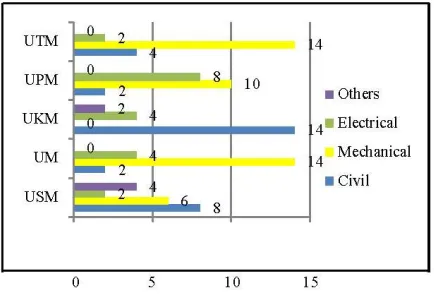
The respondents comprised of civil, mechanical, electrical, renovation and other maintenance work officers who handled the activities. The respondents a r e a l s o experienced i n t e r m s o f maintenance a n d management of building facilities, including costs involved i n mai n t en an c e works. Figure 1 consists of the number of respondents and the institutions and maintenance units involved in this survey. It also reveals the respondents’ background in buildings maintenance of overall five (5) institutions involved in this study. The respondents are experienced in their fields from three (3) years up to 20 years. They have sufficient knowledge on life cycle cost and involvements of maintenance activities in cost related management and also analysis, hence strengthen their opinion on the important activities to be included in activity-based life cycle cost process.
74:2 (2015) 79–85 | www.jurnalteknologi.utm.my | eISSN 2180–3722 | Besides that, cleaning of windows/cladding/decorations,
internal areas, furniture equipments, special clean and; pest control and waste disposal are also those activities mentioned as important under civil facilities of institutional buildings. While, under mechanical facilities, air-conditioning and the related to it such as air handling units, boilers, air terminals, ductwork, fans, piping, and; fire protection, plumbing and lifts are said to be important to be included in life cycle cost of institutional building maintenance. Other than that, both activities listed under electrical facilities, building automation system and; lighting and fixtures maintenance related cost are considered important in doing life cycle cost whereas,
improvements is considered important in renovation
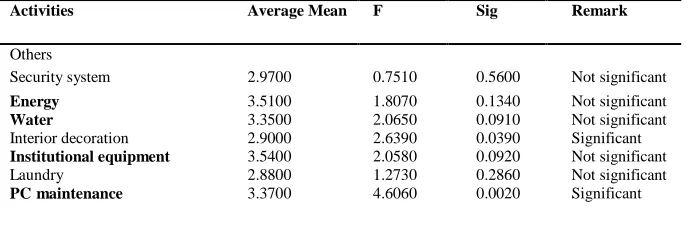
maintenance work. Lastly, other maintenance activities that suggested by respondents to be included in life cycle cost process are energy, water, institutional equipment and
maintenance of computer.
7.0 CONCLUSION
Most of the facilities maintenance activities that preferred to be included in life cycle cost process of university building maintenance a s s h o w n i n T a b l e 3 t o T a b l e 7 are those plays an important role in the facilities functions and services provided for the building occupants. Therefore, implementation of Activity-based life cycle Cost could increase the long-term profitability by identifying improvement opportunities by examine all activities that relevant and making most appropriate selections and adaptations in maintenance activity costs for institutional buildings facilities management.
Table 3 Civil facilities maintenance activities
Activities Average
Mean
F Sig Remark
Civil
Building maintenance and repair
Roofing 3.3300 3.0090 0.0220 Significant
Partitions 2.6400 14.6650 0.0000 Significant Doors 2.8600 4.5380 0.0020 Significant
Ceilings 3.1600 3.2910 0.0140 Significant
Staircases 2.9100 2.5570 0.0440 Significant
Flooring 3.0800 0.4520 0.7710 Not significant
Fittings /Finishes 2.9500 3.9650 0.0050 Significant
Sanitary/ Sewerage 3.5000 2.4060 0.0550 Significant
Ground maintenance and repair
Footpath 2.8800 4.0580 0.0040 Significant
Drainage 3.3740 0.2280 0.9220 Not significant
Cleaning
Windows & cladding / decorations 3.0600 1.2100 0.3120 Not significant
Internal areas 3.2600 1.4960 0.2100 Not significant
Furniture & equipment 3.1300 3.2190 0.0160 Significant
Special clean 3.0200 3.9530 0.0050 Significant
Pest control 3.2400 5.9600 0.6670 Not significant
Waste disposal 3.3420 2.0150 0.0990 Not significant
Table 4 Mechanical facilities maintenance activities
Activities Average
Mean
F Sig Remark
Mechanical
Service maintenance and repair
AC/split unit 3.4900 2.5700 0.0430 Significant
Air handling units 3.4000 2.5700 0.0800 Not significant
Boilers 3.3300 1.8030 0.1350 Not significant
Air terminals 3.3200 1.3240 0.2670 Not significant
Ductwork 3.2400 2.5710 0.0430 Significant
Fans 3.2400 0.9120 0.4600 Not significant
Piping 3.2200 0.5920 0.6660 Not significant
Fire protection 3.6100 4.1550 0.0040 Significant
Plumbing 3.3100 2.0130 0.0990 Not significant
74:2 (2015) 79–85 | www.jurnalteknologi.utm.my | eISSN 2180–3722 |
Table 5 Electrical facilities maintenance activities
Activities Average Mean F Sig Remark
Electrical
BAS (Building automation system) 3.8400 1.7860 0.1380 Not significant
Lighting & fixtures 3.5600 4.1270 0.0040 Significant
Table 6 Renovation maintenance activities
Activities Average Mean F Sig Remark
Renovation
Alteration / Additions 2.9100 1.6480 0.1690 Not significant
Improvements 3.3400 1.9310 0.1120 Not significant
Table 7 Other maintenance activities
Activities Average Mean F Sig Remark
Others
Security system 2.9700 0.7510 0.5600 Not significant
Energy 3.5100 1.8070 0.1340 Not significant
Water 3.3500 2.0650 0.0910 Not significant
Interior decoration 2.9000 2.6390 0.0390 Significant
Institutional equipment 3.5400 2.0580 0.0920 Not significant
Laundry 2.8800 1.2730 0.2860 Not significant
PC maintenance 3.3700 4.6060 0.0020 Significant
Acknowledgement
We are grateful for the Research University Grant Scheme (GUP) provided by Universiti Teknologi Malaysia (UTM).
References
[1] D. S. S. Then, and T. H. Tan. 2006. Aligning Facilities Management
Performance to Business Needs–An Exploratory Model Linking FM Performance to Business Performance. Proceeding of Trondheim CIBW70 International Symposium. 340–349, 12–14 June.
[2] A. H. Schwartz. 2008. Reducing Life-Cycle Cost. Retrieved July 2008,
from http://www.todaysfacilitymanager.com.
[3] A. Kumar. 2009. Facilities Management Sector Set to Grow Despite crisis.
Emirates Business. Retrieved 4th Jun, 2009, from
http://www.emirates247.com/eb247/companies-markets/real- estate/facilities-management-sector-set-to-grow-despite-crisis-2009-04- 06-1.96761.
[4] F. W. H. Yik. and J. H. K. Lai. 2005. The Trend of Outsourcing for
Building Services Operation and Maintenance in Hong Kong. Facilities.
23(1/2): 63–72.
[5] L. K. Quah. 1998. Introduction, Facilities Management and Maintenance–
The Way Ahead into the Millennium. McGraw-Hill, Singapore. 15–16.
[6] Government of Malaysia. 2001. Ninth Malaysian Plan 2001–2005.
Economic Planning Unit Prime Minister's Department. Putrajaya.
[7] Government of Malaysia. 2006. Ninth Malaysian Plan 2006–2010.
Economic Planning Unit Prime Minister's Department. Putrajaya.
[8] Government of Malaysia. 2011. Ninth Malaysian Plan 2011–2015.
Economic Planning Unit Prime Minister's Department, Putrajaya.
[9] A. L. Olanrewaju. 2009. Case for Alternative Approach to Building
Maintenance Management of Public Universities. Received (in revised form), 7th May 2009.
[10] F. J. Bromilow and M. R. Pawsey. 1987. Life-cycle Cost of University
Buildings. Construction Management & Economics. 5(S): 3–22,
[11] B. Al-Najjar. 1997. Condition-based Maintenance: Selection and
Improvement of a Cost-effective Vibration-based Policy for Rolling Element Bearings. Department of Industrial Engineering, Lund University,
[12] B. Al-Najjar. 2007. The Lack of Maintenance and Not Maintenance Which
Costs: A Model to Describe and Quantify the Impact of Vibration-based
Maintenance on Company’s Business. International Journal of Production
Economics. 107(1): 260–274.
[13] M. Kans, and A. Ingwald. 2008. Common Database for Cost-effective
Improvement of Maintenance Performance. Int. J. Production Economics.
113: 734–747.
[14] Kabiru Isa, Dandago. 2003. Advanced Accountancy: Theory and Practice.
Adonis &Abbey Publishing Limited,
[15] R. Sarbapriya. 2012. Relevance and Applicability of Activity Based
Costing. An Appraisal Journal of Expert Systems (JES). 1(3): 71–7.
[16] Bromilow. F. J. and Pawsey. M. R. 1987. Life-cycle Cost of University
Buildings. Construction Management & Economics. 5(S): 3–22.
[17] El-Haram. M. A and Horner. M. W. 2002. Factors Affecting Housing
Maintenance Cost. Journal of Quality in Maintenance Engineering. 8(2).
[18] Piper, J. 2004. Handbook of Facility Assessment. Fairmont Press,
Incorporated
[19]Booty, F. 2006. Facilities Management. 3rd Edition. Oxford: Butterworth-
Heinemann.