Succinct Randomized Encodings and their Applications
∗Nir Bitansky† Sanjam Garg‡ Huijia Lin§ Rafael Pass¶ Sidharth Telang§
April 21, 2015
Abstract
Arandomized encodingallows to express a “complex” computation, given by a functionf and inputx, by a “simple to compute” randomized representationfb(x) whose distribution encodes
f(x), while revealing nothing else regarding f and x. Existing randomized encodings, geared mostly to allow encoding with low parallel-complexity, have proven instrumental in various strong applications such as multiparty computation and parallel cryptography.
This work focuses on another natural complexity measure: the time required to encode. We constructsuccinct randomized encodings where the time to encode a computation, given by a program Π and input x, is essentially independent of Π’s time complexity, and only depends on its space complexity, as well as the size of its input, output, and description. The scheme guarantees computational privacy of (Π, x), and is based on indistinguishability obfuscation for a relatively simple circuit class, for which there exist instantiations based on polynomial hardness assumptions on multi-linear maps.
We then invoke succinct randomized encodings to obtain several strong applications, including:
• Succinct indistinguishability obfuscation, where the obfuscated programiO(Π) computes the same function as Π for inputsxof apriori-bounded size. Obfuscating Π is roughly as fast as encoding the computation of Π on any such inputx. Here we also require subexponentially-secure indistinguishability obfuscation for circuits.
• Succinct functional encryption, where a functional decryption key corresponding to Π allows decrypting Π(x) from encryptions of any plaintextxof apriori-bounded size. Key derivation is as fast as encoding the corresponding computation.
• Succinct reusable garbling, a stronger form of randomized encodings where any number of inputsxcan be encoded separately of Π, independently of Π’s time and space complexity. • Publicly-verifiable 2-message delegation where verifying the result of a long computation given
by Π and inputxis as fast as encoding the corresponding computation. We also show how to transform any 2-message delegation scheme to an essentially non-interactive system where the verifier message is reusable.
Previously, succinct randomized encodings or any of the above applications were only known based on various non-standard knowledge assumptions.
At the heart of our techniques is a generic method of compressing a piecemeal garbled computation, without revealing anything about the secret randomness utilized for garbling.
∗
This paper unifies [BGT14] and [LP14]. An extended abstract will appear in the proceedings of STOC 15’.
†
MIT,[email protected]. Part of this research was done at IBM T.J. Watson Research Center.
‡
University of California, Berkeley,[email protected].
§
University of California, Santa Barbara,[email protected].
¶
Cornell University,{rafael,sidtelang}@cs.cornell.edu. Work supported in part by a Alfred P. Sloan Fellowship, Microsoft New Faculty Fellowship, NSF Award CNS-1217821, NSF CAREER Award CCF-0746990, NSF Award CCF-1214844, AFOSR YIP Award
FA9550-10-1-0093, and DARPA and AFRL under contract FA8750-11-2-0211. The views and conclusions contained in this document are those of the
authors and should not be interpreted as representing the official policies, either expressed or implied, of the Defense Advanced Research Projects
Contents
1 Introduction 1
1.1 Contributions . . . 2
1.2 Techniques . . . 6
1.2.1 Main Ideas behind the Applications . . . 9
1.3 Concurrent and Subsequent Work. . . 10
2 Preliminaries 11 2.1 Models of Computation . . . 12
2.2 Garbling Schemes. . . 13
2.3 Indistinguishability Obfuscation . . . 17
2.4 Puncturable Pseudo-Random Functions . . . 19
3 Succinct Garbling for Bounded-Space Turing Machines 19 3.1 A Non-Succinct Garbling Scheme . . . 20
3.2 A Garbling Scheme for TM with Space-dependent Complexity . . . 25
4 Succinct Garbling in Other Models of Computation 33 4.1 Improved Construction and Analysis . . . 34
5 Applications 37 5.1 From Randomized Encodings to iO. . . 38
5.2 Publicly-Verifiable Delegation,SN ARGs for P, and Succinct NIZKs for NP . . . 42
5.2.1 P-delegation . . . 42
5.2.2 SN ARGs for P . . . 44
5.2.3 Succinct Perfect NIZK for NP. . . 48
1
Introduction
The notion of a randomized encoding, coined by Ishai and Kushilevitz [IK00], aims to trade the computation of a “complex” functionf(x) for the computation of a “simpler” randomized function whose output distribution fb(x) encodes f(x), but hides anything else regarding f and x. The
“complexity” of computingf is shifted to a decoding procedure that extracts f(x) fromfb(x).
The privacy of the function f and input x is naturally captured by an efficient simulator
Sim(f(x)), who given only the output f(x), produces a simulated encoding indistinguishable from
b
f(x); privacy can be perfect, statistical, or computational, according to the attained indistinguisha-bility. Capturing what it means to “simplify the computation of f(x)” may take quite different forms according to the complexity measure of interest. Most previous work have focused on comput-ing the randomized encodcomput-ingfb(x) with lower parallel-time complexity than required for computing
the original functionf, and has been quite successful. In particular, all log-space computations were shown to have perfectly-private randomized encodings inNC0 [IK00,IK02a,AIK04]. When settling for privacy against computationally bounded adversaries, and assuming low-depth pseudo-random generators, the latter extends to arbitrary poly-time computations [AIK06], which was already demonstrated in Yao’s seminal work on garbling circuits [Yao82]. The constructed randomized encodings were in turn shown to have various strong applications to parallel cryptography, secure computation, verifiable delegation, and more (see [App11b] for a survey).
Succinct Randomized Encodings. In this work, we focus on another natural complexity mea-sure: the time required to compute fb(x). Specifically, given the description off and the input x,
we would like to compute the encodingfb(x) in timeTb that is significantly smaller than the timeT
required to compute f(x). Decoding time, in contrast, would be as large as T, perhaps with some tolerable overhead. For this goal to be achievable,f has to be given in some succinct representation that is smaller than T, and cannot be given by, say, a size-T circuit. Concretely, we focus on the natural case that f is represented by a succinct program Π, e.g., a Turing machine (TM) or a random-access machine (RAM).
Besides being interesting from a purely complexity-theoretic perspective, such succinct ran-domized encodings may have powerful applications analogous to those of the known randomized encodings. One such immediate application is private delegation of computation: a weak client that wishes to use the aid of a server to run a long computation Π on a short private inputx, may quickly compute a succinct randomized encodingΠ(b x), and have the server decode the result Π(x),
without the server learning anything regarding x (with a little more effort, we can even ensure privacy of the output, and be able to verify that the server computed correctly).
Beyond shifting computation from weak parties to strong parties, succinct randomized encod-ings may sometimes save in communication and computation altogether. For instance, one of the first demonstrated applications of randomized encodings [IK00, IK02a] was to achieve such sav-ings in multi-party computation (MPC). Indeed, most known MPC solutions explicitly utilize the circuitCf(x1, . . . , xm) representing a functionf(x1, . . . , xm), and the overhead they incur, e.g. in
communication, may depend on the circuit size|C|. When the functionf is succinctly represented by a program Π, we may have the parties compute first a succinct randomized Π(b x1, . . . , xm), and
only decode at the end, thereby making communication overhead proportional to the smaller cir-cuit that computesΠ. Furthermore, the effort of decoding (proportional to Π’s running time) fallsb
only on the parties that obtain the output. If the overhead of decoding is small, it may reduce the computational complexity of the MPC protocol as well. (For instance, now only a single party, rather than each one of the parties, has to invest resources proportional to the running time off.)
assumptions, perfectly-private randomized encodings for all of P are unlikely to be computable too fast, e.g. in fixed polynomial time.1 In contrast, restricting attention to privacy against
computationally-bounded adversaries, no lower bounds or barriers are known. In fact, succinct indistinguishability obfuscation (iO) for any model of computation (e.g.,iO for Turing machines) would directly imply corresponding succinct randomized encodings.2 Still, constructions of suc-cinctiO [BCP14, ABG+13], or direct constructions of succinct randomized encodings [GKP+13a,
GHRW14b] are based on considerably strong computational assumptions such as extractable wit-ness encryption, succinct non-interactive arguments, and differing-inputs obfuscation. In the lan-guage of [Nao03] these assumptions are not efficiently-falsifiable; furthermore, in some cases they have been shown implausible [BP13,BCPR14,GGHW14].
1.1 Contributions
Our core contribution is a succinct randomized encoding relying on (non-succinct) iOforcircuits, for any class of a-priori bounded-space computations. That is, the time to encode depends on the space complexity of the computation, but is essentially independent of its time complexity. The construction, in fact, satisfies the enhanced guarantee ofa succinct garbling schemes[Yao82,AIK06,
BHR12b], with the extra feature that inputs can be encoded independently of the program and its complexity.
Theorem 1 (Main Theorem, Informally Stated). Assume the existence ofiOfor P/poly and one-way functions. Then, for every polynomial s(·), there exists a succinct randomized encoding (or garbling scheme) for all polynomial-time programs Π with space-complexity S(n) ≤ s(n). Specifi-cally, the time to encode depends polynomially on the size of Π, the lengths (n, m) of its input and output, and the space bound s(n), but only polylogarithmically on Π’s running-time.
On the Underlying Assumption: Assuming puncturable pseudo-random functions in NC1 (known based on various hardness assumptions, such as the hardness of the learning with errors prob-lem [BLMR13]), and restricting attention to any class of computations with a-priori-bounded run-ning time t(n), we can settle for iO for circuits in NC1 with input size O(log(t(n)) (which is a poly(t(n))-time falsifiable assumption on its own). ObtainingiO for this class may be done based on qualitatively weaker assumptions; indeed, for any polynomialt(·) the construction of Gentry et al. [GLSW14] would implyiOfor the corresponding class based on a polynomial hardness assump-tion on multi-linear maps.3
We then demonstrate the power of succinct randomized encodings in several applications, some new, and some analogous to previous applications of randomized encodings, but with new succinctness properties.
1
Specifically, it can be shown that, for a languageL, recognized by a givenT(n)-time Turing machine Π, succinct randomized encodings with perfect-privacy computable in time t(n) T(n), would imply that L has 2-message interactive proofs with aO(t(n))-time verifier, which already suggests thatt(n) should at least depend on the space (or depth) of the computation. Furthermore, under commonly believed derandomization assumptions (used to show thatAM⊆NP[Kv99,MV99]), the above would imply thatLcan be non-deterministically decided in time poly(t(n)), for some fixed polynomial poly. Thus, any speedup in encoding would imply related speedup by non-determinism, whereas significant speedup is believed to be unlikely.
2
To encode (Π, x) simply obfuscate a program that given no input computes Π(x). This can be simulated from y= Π(x) by obfuscating a program that only performs dummy steps and outputsy.
3More generally, one of the challenges in basingiOon an efficient black-box reduction is that the reduction may
Application 1: Succinct Indistinguishability Obfuscation. Our first (and somewhat strongest) application of succinct randomized encodings is succinct iO for bounded-space computations. In-distinguishability here means that the (succinct) obfuscations of two programs that have the same output and running time on all inputs x of some apriori-bounded length n are computationally indistinguishable. The construction is based on subexponential iO, whereas any form of succinct
iO realized so far [ABG+13, BCP14, IPS15] relies on differing-inputs obfuscation in conjunction with succinct non-interactive arguments (which already entail strong succinctness properties); as mentioned before, these are considered very strong up to implausible in certain settings.
Theorem 2(Informally Stated). Assume the existence of succinct randomized encodings for space-bounded programs, one-way functions, andiOforP/polythat are all subexponentially-secure. Then, for every polynomials(·), there exists a succinctiOfor all polynomial-time programs Πwith space-complexity S(n) ≤ s(n), Specifically, the time to obfuscate Π depends polynomially on the size of
Π, the input length n, and the space bounds(n), but only polylogarithmically on Π’s running-time and output length m.
The theorem is somewhat the succinct analog of previous bootstrapping theorems [App14,
CLTV15] who show how (non-succinct) randomized encodings and pseudo-random functions in
NC1, together with obfuscation for NC1 circuits, imply obfuscation for P/poly. Here, through succinct randomized encodings, we reduce iO for arbitrarily long computations to iO for circuits of fixed polynomial size.
Application 2: Succinct Functional Encryption and Reusable Garbling. The recent leap in the study of obfuscation has brought with it a corresponding leap in functional encryption (FE). Today, (indistinguishability-based) functional encryption for all circuits can be constructed from IO [GGH+13a, Wat14], or even from concrete (and efficiently falsifiable) assumptions on composite order multilinear graded-encodings [GGHZ14]. For models of computation with succinct representations, we may hope to havesuccinct FE, where a secret keyskΠ, allowing to decryption
Π(x) from an encryption ofx, can be computed faster than the running time of Π. However, here the state-of-art was similar to succinct randomized encodings, or succinctiO, requiring essentially the same strong (non-falsifiable) assumptions.
One can replace iO for circuits, in the above FE constructions, with the succinct iO from Theorem 2, and obtain FE where computing skΠ is comparable to (succinctly) obfuscating Π.
This, however, will require the same sub-exponential hardness ofiO for circuits. Based on existing non-succinct functional encryption schemes, we show that succinct FE can be constructed without relying on sub-exponentially hard primitives.
Theorem 3(Informally Stated). Assume the existence of succinct randomized encodings for space-bounded programs, one-way functions, and iO for P/poly. Then, for every polynomial s(·), there exists a succinct FE where a functional keyskΠcould be generated for any polynomial-time program
Π with space-complexity S(n) ≤s(n), and can decrypt encryption of messages of apriori-bounded length. The time to deriveskΠ depends polynomially on the size ofΠ, the input and output lengths
(n, m), and space bound s(n), but only polylogarithmically on Π’s running-time.
The scheme is selectively-secure. Assuming also puncturable pseudo-random functions in NC1, and the same assumptions on multi-linear maps made in [GGHZ14], results in full (adaptive) security.
specific input, and only depends on the machine Π. Π can then be “reused” together with a secondb
part bx encoding any input x. We get succinct reusable garbling for space-bounded computations: encoding Π depends on the space, but is done once, subsequent input-encodings depend only on the input size nand not on space.
Application 3: Publicly Verifiable Delegation and succinct NIZKs. Succinct random-ized encodings directly imply a one-round delegation scheme for polynomial-time computations with bounded space complexity. A main feature of the scheme is public-verifiability, meaning that given the verifier’s message σ anyone can verify the proof π from the prover, without requiring any secret verification state. Previous publicly-verifiable schemes relied on strong knowledge as-sumptions [GLR11,BCCT12,DFH12,BCCT13] or proven secure only in the random oracle model [Mic00].4 Another prominent feature of the scheme is that it guarantees input privacy for the verifier. (While this can generically be guaranteed with fully homomorphic encryption, the generic solution requires the prover to convert the computation into a circuit, which could incur quadratic blowup; in our solution, the complexity of the prover corresponds to decoding complexity, which could be made quasi-linear. See further discussion below.)
The delegation scheme is based only on randomized encodings (and one-way functions), and thus as explained above, can be based only on polynomial assumptions. Assuming also iO, we can make the verifier’s message reusable; namely, the verifier can publish his message σ once and for all, and then get non-interactive proofs for multiple computations.5
Theorem 4 (Informally Stated).
1. Assume the existence of succinct randomized encodings for space-bounded programs and one-way functions. Then, there exists a publicly-verifiable 2-message delegation scheme with input privacy where verifying a computation given by a programΠand inputx, is polynomial in the size of Π, input length and output lengths (n, m), and the space S required to compute Π(x), but only polylogarithmic in Π’s running-time.
2. Assuming also iOfor P/poly, the verifier message σ is made reusable for computations with a-priori bounded spaces(n). Furthermore, only the one-time generation ofσdepends ons(n), whereas subsequent verification depends only on the input sizen(and the security parameter).
Plugging in our succinct iOinto the perfect non-interactive zero-knowledge (NIZK) arguments of Sahai-Waters [SW14a] directly yields a construction of perfect succinct NIZK for bounded-space
NP from iO forP/poly and one-way functions that are both sub-exponentially-secure. The NIZK has a succinct common reference string whose size is independent of the time required to verify the
NP statement to be proven, and only depends on the space, and the size of the input and witness (verification time depends only on the length of the statement as in [SW14a]).
iO for NC1 is enough: We note that in all three theorems above, the assumption ofiO for P/poly
can replaced with assumingiOforNC1 and puncturable pseudo-random functions inNC1. Indeed, in the above applications the obfuscated circuit is dominated by computing a succinct randomized encoding and a puncturable PRF. Here we can rely on the observation that randomized encodings
4Notably, in the setting of private-verification Kalai, Raz, and Rothblum give a solution based on the
subexpo-nential learning with errors assumption [KRR14].
5Our transformation for reusing the verifier’s message is, in fact, a generic one that can be applied to any delegation
can be composed [AIK06]. Concretely, we can consider an outer layer of a non-succinct shallow randomized encoding (like Yao [Yao82]) that computes an inner succinct randomized encoding.
Other Applications. We reinspect additional previous applications of (non-succinct) randomized encodings and note the resulting succinctness features.
One application, briefly mentioned above, is to multiparty computation [IK00,IK02a], where we can reduce the communication overhead from depending on the circuit size required to compute a multiparty functionf(x1, . . . , xm) to depending on the space required to computef, which can be
much smaller. When focusing merely on communication this problem has by now general one-round solutions based on (multi-key) fully-homomorphic encryption [Gen09,AJL+12,LTV12,GGHR14]. Succinct randomized encodings allow in addition to shift the work load to one party (the decoder) that obtains the output, without inducing extra rounds. (With one extra message, outputs to weak parties can also be delivered, while guaranteeing their privacy and correctness.)
Another application is to amplification of key-dependent message security (KDM). In KDM encryption schemes, semantic security needs to hold, even when the adversary obtains encryptions of functions of the secret key taken from a certain class F. Applebaum [App11a] shows that any scheme that is KDM-secure with respect to some class of functions F can be made resilient to a bigger class F0 ⊇ F, if functions in F0 can be randomly encoded in F. Our succinct randomized encodings will essentially imply that KDM-security for circuits of any fixed polynomial size s(·) (such as the scheme of [BHHI10]) can be amplified to KDM-security for functions that can be computed by programs with spaceS s(n), but could potentially have larger running time.
Dependence on the output length. As stated above, the size of our basic randomized en-codings grows with the output of the underlying computation. Such dependence can be easily shown to be inherent as long as we require simulation-based security (using a standard incom-pressibility argument). Nevertheless, this dependence can be removed if we settle for a weaker indistinguishability-based guarantee saying that randomized encodings of two computations lead-ing to the same output are indistlead-inguishable. This guarantee, in fact, suffices, and allows removlead-ing output-dependence, in all of the applications above, except for the multi-party application (which requires simulation on its own).
Optimizing Decoding Time. While we have so far concentrated on how fast can a randomized encoding be computed, one may also be interested in optimizing the time and space complexity of decoding. Ideally the complexity of decoding should be as close as possible to that of the original computation. In our basic scheme, decoding Π(b x) of a T-time S-space computation Π(x), where S is a-priori bounded by some polynomial s(n), requires roughly time T ·poly(s(n)) and space poly(s(n)), while encoding takes only time poly(s(n)) (up to polynomial factors in the security parameter). This complexity is naturally inherited by all our applications of randomized encodings: for instance, the time to obfuscate a program Π is roughly poly(s(n)), and the time to evaluate the obfuscation (given by Theorem 2) on an input x is proportional to the decoding time for Π(b x).
We show how to optimize our randomized encodings to improve decoding time to roughly
T+s(n). This optimization further reduces the encoding time from poly(s(n)) to ˜O(s(n)).
Proposition 1 (Improved Efficiency, Informally Stated). Assume the existence of iO for P/poly
and one-way functions. Then, for every polynomial s(·), there exists a succinct randomized en-coding (or garbling scheme) for all polynomial-time RAM Π with space-complexity S(n) ≤ s(n). Specifically, the time to encode isquasi-linearin the size ofΠ, input lengthn, and the space bound
The improvement in encoding and decoding efficiency leads to improved efficiency for our appli-cations of succinct randomized encoding. For instance, we obtain a succinct iOfor bounded space RAM that takes time roughly s(n) to obfuscate, and T +s(n) to evaluate. Other applications such as FE, delegation, MPC directly inherit the improved decoding complexity (leading to better decryption time, prover efficiency, and computational complexity respectively).
We note that the above efficiency optimizations are inspired by a concurrent work of Canetti, Holmgren, Jain, and Vaikuntanathan [CHJV15], who constructed succinct iO for bounded space RAM, where evaluation takes time roughly T +s(n). We investigated these optimizations after being made aware that they achieve this feature.
1.2 Techniques
We next overview our construction of succinct randomized encodings for bounded space programs. BeyondiO, the main tool on which we rely is existingnon-succinctrandomized encodings, or more accurately their enhanced version ofgarbling schemes. As mentioned before, garbling schemes have the extra feature that the input x can be encoded separately of the program Π given a shared (short) stringkey [Yao82,BHR12b]. When considering (non-succinct) garbling, e.g. where Π is a circuit, a salient advantage of this separation is that the time to compute the encodedbxdepends on the length ofx, but not on the typically larger running time (or circuit size) of Π. In contrast, the time to compute the encodedΠ may be as large as its running time. This feature of “independentb
input encoding” is crucial for our construction.
We construct succinct randomized encodings, or in fact, succinct garbling schemes, in two steps: we first construct a non-succinct garbling scheme for bounded-space computations, with the property that the garbled program consists of many “small garbled pieces” that can be gener-ated separately. In the second step, we use iO to “compress” the size of the garbled program, by providing an obfuscated program that takes an index as input and generates the “garbled piece” corresponding to that index. As a result, the final garbled program (namely the obfuscated pro-gram) is small and can be efficiently computed. It is only at evaluation time that the underlying non-succinct garbled program is unravelled, by running the obfuscated program on every index, and decoded.
The Non-succinct Garbling Scheme. We outline thenon succinct garbling schemefor bounded computations, based on any one-way function. For concreteness, we shall focus on Turing machines. (The solution extends to any model of bounded-space computation, e.g. RAM, as long as a com-putation can be decomposed into a sequence of steps operating on one memory.)
A “trivial” approach towards such garbling is to simply transform any polynomial-time Turing machine into a circuit and then garble the circuit. While our construction in essence relies on this principle, it will in fact invoke garbling for “small” fixed-sized circuits. Concretely, we rely on the existence of a circuit garbling scheme satisfying two additional properties. First, we require that the shared string key, and thus also the input encoding, are generated independently of the circuit to be garbled (e.g., key is sampled at random and given to both the input-encoding and circuit-garbling procedures). Second, we require that encoded inputs can be simulated, given only the input size, whereas the garbled program is simulated using the result Π(x) of the computation (and the randomness used to simulate the encoded input). We refer to such schemes as garbling schemes with independent input encoding and note that Yao’s basic scheme [Yao82] satisfies the two properties.
of t(n) garbled circuits that evaluate Π step by step. More precisely, we first generate keys
key1, . . . ,keyt(n) for the t(n) garbled circuits. The jth garbled circuit (which is computed
us-ing key keyj) takes as input some state of Π and computes the next state (ie., the state after one computation step); if the next state is a final state, it returns the output generated by Π, otherwise it outputs an encoding of this new state using the next keykeyj+1. (Note that aftert(n) steps we are guaranteed to get to a final state and thus this process is well-defined.)
To encode the input, we simply encode the initial state of Π, including the inputx, usingkey1. To evaluate the garbled program, we sequentially evaluate each garbled circuit, using the encodings generated in the previous one as inputs to the next one, and so on until the output is generated.
Security of the Non-Succinct Scheme: an Overview. To show that this construction is a secure (non-succinct) garbling scheme we need to exhibit a simulator that, given just the output
y= Π(x) of the program Π on input xand the number of steps t∗ taken by Π(x), can simulate the encoded input and program. (The reason we provide the simulation with the number of steps t∗
is that we desire a garbling scheme with a “per-instance efficiency”—that is, the evaluation time is polynomial in the actual running-timet∗ and not just the worst-case running-time. To achieve such “per-instance efficiency” requires leaking the running-time, which is why the simulator gets access to it.) Towards this, we start by simulating the t∗th garbled circuit with the output being set to y; this simulation generates an encoded inputconfgt∗−1 and a garbled programΠet∗.
We then iteratively in descending order simulate the jth garbled circuits Πej with the output
being set to confgj+1 generated in the previously simulated garbled circuit. We finally simulate
the remaining j > t∗ garbled circuits Πej with the output being set to some arbitrary output in
the range of the circuit (e.g., the output y). The simulated encoded input is thenconfg1 and the
simulated garbled program is (Πe1, . . .Πet(n)).6
To prove indistinguishability of the simulated garbling and the real garbling, we consider a sequence of hybrid experiments H0, . . . , Ht(n), where in Hj the first j garbled circuits are
simu-lated, and the remainingt(n)−j garbled circuits are honestly generated. To “stitch together” the simulated circuits with the honestly generated ones, the jth garbled circuit is simulated using as output an honest encoding confdj of the actual configuration confj of the TM Π afterj steps.
It follows from the security of the garbling scheme that hybridsHj andHj+1 are
indistinguish-able and thus alsoH0 (i.e., the real experiment) and Ht(n).
Let us finally note a useful property of the above-mentioned simulation. Due to the fact that we rely on a garbling scheme with independent input encoding, each garbled circuit can in fact beindependently simulated—recall that the independent input encoding property guarantees that encoded inputs can be simulated without knowledge of the circuit to be computed and thus all simulated encoded inputs confg1, . . .confgt(n) can be generated in an initial step. Next, the garbled
circuits can be simulated in any order.
The Succinct Garbling Scheme: an Overview. We now show how to make this garbling scheme succinct. The idea is simple: instead of providing the actual garbled circuits in the clear, we provide an obfuscation of the randomized program that generates these garbled circuits. More precisely, we provide an iO of a program Πs,s0(·) where s and s0 are seeds for a PRFF: Πs,s0(j), given a “time-step” j ∈[t(n)], generates the jth garbled circuit in the non-succinct garbling of Π using pseudo-random coins generated by the PRF with seed s and s0. Specifically, it uses F(s, j) andF(s, j+ 1) as randomness to generate keyj and keyj+1 (recall that the functionality of thejth
circuit depends on keyj+1), and uses F(s0, j) as randomness for garbling the jth circuit.
6This “layered” simulation strategy resembles that of Applebaum, Ishai, and Kushilevitz in the context of
Now, the new succinct garbled program is the obfuscated program Λ ←$ iO(Πs,s0), and the encoding ˆx ofx remains the same as before, except that now it is generated using pseudo-random coins F(s,1). Given such a garbled pair Λ and ˆx, one can compute the output by gradually generating the non-succinct garbled program, one garbled circuit at a time, by computing Λ on every time stepj, and evaluating the produced garbled circuit with ˆxuntil the output is produced. (This way, the evaluation still has “per-instance efficiency”.)
Security of the Succinct Scheme: an Overview. Given that the new succinct garbled program
Λ produces “pieces” of the non-succinct garbled program, the natural idea for simulating the succinct garbled program is to obfuscate a program that produces “pieces” of the simulated succinct garbled program. The above-mentioned “independent simulation” property of the non-succinct garbling (following from independent input encoding) enables to fulfill this idea.
More precisely, given an output y and the running-time t∗ of Π(x), the simulator outputs the obfuscation Λe of a program Πey,t
∗,s,s0
that, given input j, outputs a simulated jth garbled circuit, using randomnessF(s, j+ 1) to generateconfgj+1as the output, andF(s, j) andF(s0, j) as the extra
randomness needed to simulate the input confgj and the garbled Πj. 7 The encoded input ˜x is
simulated as in the non-succinct garbling scheme, but using pseudo-random coins F(s,1).
It is not hard to see that this simulation works if the obfuscation is virtually black-box secure, as (non-succinct) garbling security guarantees that the entire truth tables of the two programsΠs,s0
and Πey,t ∗,s,s0
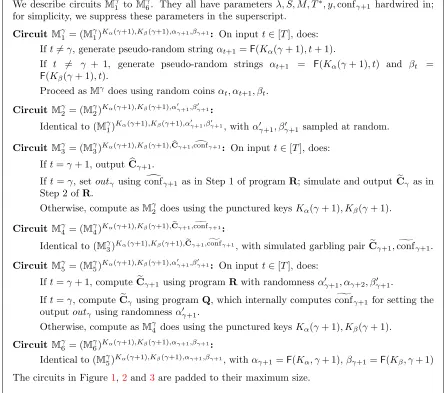
are indistinguishable given an encoding of x, when the hardwired PRF keys s, s0 are chosen at random. Our goal, however, is to show thatiO suffices. Towards this goal, we consider a sequence of hybrid experimentsH00, . . . , Ht0(n)with a corresponding sequence of obfuscated programs
e
Πs,s0 0, . . . ,Πes,s 0
t(n) that “morph” gradually from the realΠto the fully simulatedΠe. Specifically, the
programΠes,s 0
j obfuscated inH
0
j produces a non-succincthybridgarbled program as in hybridHj in
the proof of the non-succinct garbling scheme, except that pseudo-random coins are used instead of truly random coins. That is, for the firstj inputs,Πej produces simulated garbled circuits, and for
the rest of the inputs, it produces honestly generated garbled circuits, having hardwired the true configuration confj+1.
To prove indistinguishability of any two consecutive hybrids Hj0 and Hj0+1, we rely on the punctured program technique of Sahai and Waters [SW14a] to replace pseudo-random coinsF(s, j+ 1), F(s0, j + 1) for generating the j+ 1st simulated garbled circuit with truly random coins, and then rely on the indistinguishability of the simulation of the j+ 1st garbled circuit. A bit more concretely, at each step we puncture the seeds s, s0 only on the (three) points corresponding to the
j+ 1st step, and hardwire instead the corresponding outputs generated by Πe
s,s0
j ; next, relying on
the puncturing guarantee, we can sample these outputs using true independent randomness. At his point, we can already replace the real hardwired garbling with a simulated one. Finally, we go back to generating the hardwired value pseudorandomly as part of the circuit’s logic, now identical to Πe
s,s0
j+1, and “unpuncture” the seeds s, s
0. We note that each such step requires hardwiring a
new (real) intermediate configuration confj+1 (used to simulate thej+ 1st garbling), but now the
previous hardwired configuration confj can be “forgotten” and blowup is avoided.
iO for a Simple Class of Circuits is Enough. The obfuscated circuits in the construction are of a special kind—their input size isO(logt(n)). Canetti et al. [CLTV15] show thatiOforNC1can be bootstrapped to obtainiO for all circuits, assuming puncturable PRFs inNC1 [BLMR13], and incurring a security loss that is exponential in the size of the input. Accordingly, for polynomial
7
t(n), it suffices to assume (polynomially-secure)iOfor classes in NC1 with logarithmic-size inputs.
Generalizing and Optimizing. The solution described above does not apply uniquely to Turing machines, but rather to any model of computation that can be divided into sequential steps using one memory, for instance random access machines (RAMs). Thus it directly gives a succinct garbling scheme for bounded space RAMs.
Also note that, in the described solution, we can in fact replace the underlying circuit garbling scheme, with any garbling scheme, as long as it admits independent input encoding. For instance, in the case the program Π is a RAM, we may use previousgarbled RAMsolutions [LO13,GHL+14,
GLOS15]. The benefit is that this allows optimizing the efficiency of our scheme. Indeed, in the solution described above, each step of the machine is translated to a garbled circuit of sizeO(s(n)) (up to polynomial factors in the security parameter), which means that the complexity of encoding is polyiO(s(n)), where polyiO(·) is the overhead due to obfuscation, and the complexity of decoding for a T-time computation Π(x) is at leastT ·polyiO(s(n)), which may be significantly larger than the original computation.
In contrast, known garbled RAM solutions provide a more efficient way of garbling RAMs than converting them into circuits, taking into consideration the RAM structure, and guaranteeing that encoding and decoding require essentially the same time and space as the original RAM computation. Aiming to leverage this efficiency in our solution, instead of partitioning a RAM computation into t(n) steps, each implemented by a circuit of size s(n), we can partition it to
t(n)/s(n) pieces, where each piece is ans(n)-step RAM. The encoding and decoding time for each piece are essentially linear in its running time O(s(n)) (whereas a circuit implementing any such piece might be of size Ω(s(n)2)).
This modification on its own may still be insufficient; indeed, obfuscating the circuit that produces the garbled RAM may incur non-linear overhead polyiO(·), so that eventually decoding may take time polyiO(s(n))·t(n)/s(n) which may be again as large as t(n)·s(n).
To circumvent this blowup, and as a result of independent interest, we show how to bootstrap any iO for circuits to one that has quasi-linear blowup. Overall, in the new solution, for a T-time
S-space computation computation Π(x) whereS < s(n), encoding takes time ˜O(s(n)) and decoding
b
Π(x) takes timeO(T +s(n)).
1.2.1 Main Ideas behind the Applications
We briefly sketch the main ideas behind our main applications of succinct randomized encodings.
Succinct iO. The construction of succinct iO from randomized encoding and exponentialiO for circuits is a natural instantiation of the bootstrapping approach suggested by Applebaum [App14]. There, the goal is to reduce obfuscation of general circuits to obfuscation ofNC1 circuits; our goal is to reduce obfuscation of programs with large running time (but bounded space) to obfuscation of significantly smaller circuits. To obfuscate a succinct program Π with respect to inputs of size at mostn, we obfuscate a small circuitCΠ,K that has a hardwired seedK for a PRF, and given input
x, applies the PRF tox to derive randomness, and then computes a succinct randomized encoding of Π(b x). The obfuscatediO(Π), given inputx computes the encoding, decodes it, and returns the
result.
Succinct FE.The construction of succinct functional encryption follows rather directly by plugging in our randomized encodings into previous constructions of non-succinct functional encryption. Concretely, starting with the scheme of Gentry et al. [GHRW14b], we can replace the non-succinct randomized encodings for RAM in their construction with our succinct randomized encodings, and obtain selectively-secure FE.8 Alternatively, starting from the scheme of Garg et al. [GGHZ14], we can replace randomized encodings for circuits in their construction with our succinct randomized encodings, and get an adaptively secure succinct FE scheme. (Here we also need to rely on the fact that succinct randomized encodings can be computed in low depth, which is required in their construction.) We note that in both cases, our succinct randomized encodings already satisfy the required security for their security proof to go through, and only the succinctness features change.
Publicly-Verifiable Delegation. Finally, we sketch the basic ideas behind the delegation scheme. The delegation scheme is pretty simple and similar in spirit to previous delegation schemes (in a weaker processing model) [AIK10,GGP10,PRV12, GKP+13b]. To delegate a computation, given by Π and x, the verifier simply sends the prover a randomized encoding cΠ0(x, r), where Π0 is
a machine that returns r if and only if it accepts x, and r is a sufficiently long random string. The security of the randomized encoding implies that the prover learns nothing of r, unless the computation is accepting. The scheme can be easily made publicly verifiable by publishingf(r) for some one-way functionf. Furthermore, the scheme ensures input-privacy for the verifier.
We then propose a simple transformation that can be applied to any delegation scheme in order to make the first verifier message reusable. The idea is natural: we let the verifier’s first message be an obfuscation of a circuitCK that has a hardwired keyK for a puncturable PRF, and given a computation (Π, x), applies the PRF to derive randomness, and generates a first message for the delegation scheme. Thus, for each new computation, a first message is effectively sampled afresh. Relying oniOand the security of the puncturable PRF, we can show that (non-adaptive) soundness is guaranteed. The transformation can also be applied to privately-verifiable delegation schemes, such as the one of [KRR14] and maintains soundness, even if the prover has a verification oracle.
1.3 Concurrent and Subsequent Work
In concurrent work, Canetti, Holmgren, Jain, and Vaikuntanathan construct succinctiOfor RAMs assuming subexponentially secure iO forP/poly. The complexity of their succinct iO is also such that obfuscation depends on an a-priori bound on space, but not on the running time. This, in particular, implies a succinct randomized encoding with similar parameters.
The technique that they employ is quite different from ours, and requires stronger computa-tional assumptions. Their main step is also the construction of a succinct garbling scheme for RAMs; however, their succinct garbling scheme is very different. At a high-level, in our solution, the obfuscation is only responsible for garbling (or encoding); the evaluation of the garbled compo-nents (or decoding) is done “externally” by the evaluator; encoding and decoding themselves are implemented using existing garbling schemes. In their solution, the obfuscation deals not only with encoding, but also with decoding, getting as input at every step the encrypted and authenticated current state of the computation. They implement this mechanism by designing a primitive that they call Asymmetrically Constrained Encapsulation, in a careful combination with an oblivious RAM scheme. (In our basic solution, oblivious RAMs are not needed as we rely on garbling for circuits, which are already an oblivious model of computation, but an inefficient one that touches all of the state in every step. In our optimizations, the use of oblivious RAM is abstracted by
8
the underlying garbled RAMs, which are indeed implemented in [LO13,GHL+14,GLOS15] using oblivious RAMs.)
A disadvantage of their approach is that the circuit deals with inputs of size proportional to the security parameter (due to encryption and authentication of state bits), whereas in our case the circuit just takes a logarithmic size index (representing a time point in the computation); as discussed above,iOfor logarithmic length input seems to be a weaker assumption (in particular, it is falsifiable), and can be based on polynomial assumptions on multilinear maps. On the other hand, performing the entire evaluation “inside the obfuscation” as in their approach would eventually lead to a fully succinct solution in subsequent work (see below).
Full Succinctness. At first glance, our approach seems to suggest a natural way to achieve full succinctness, without any dependence on space. Instead of garbling a sequence of transition circuits, we can garble each gate in the circuit representation of the computation separately; indeed, the circuit corresponding to the computation can be succinctly represented by a small circuit that can output each gate and its corresponding neighbours. More accurately, as in the previous solution, we will garbled an augmented gate that encodes the output under the keys corresponding to its (constant number of) neighbours (towards the output gate). Again, garbling will be derandomized using a pseudo-random function.
This approach will, in fact, give a fully succinct garbling scheme if we assume virtual black-box security for the above “gate garbler”, as once again the truth tables of a real and a simulated garbling will be computationally indistinguishable. However, assuming iO it is not clear how to achieve any advantage over the previous solution. Intuitively, whenever we invoke iO we cannot “forget” an intermediate value in the computation, before all the connected gates in the layer above are simulated (inducing new values to remember). In the worst-case, we are forced to remember an entire configuration.
In a beautiful subsequent work, Koppula, Lewko, and Waters [KLW15] construct fully-succinct randomized encodings from iO. Their solution takes a similar route to that of Canetti et al. [CHJV15] in that each step of the computation is done “under the obfuscation”. To overcome the space barrier, they introduce a clever “selective enforcement mechanism” that allows avoiding storage of the entire state, by storing a special purpose succinct commitment. In the analysis, this commitment can be indistinguishably replaced with a commitment that statistically binds some selected location in the memory corresponding to a given step of the computation, and is thus “iO-friendly” in their terminology.
Organization In Section2, we provide preliminaries, including: different models of computation considered in the paper, definitions of garbling schemes and iO with different efficiency levels. In Section 3, we construct succinct garbling schemes for bounded space Turing machines. We then generalize this construction to any model of bounded space computation, in particular, RAM, and optimize the decoding efficiency in Section 4. Finally, in Section 5, we present applications of succinct randomized encodings to succintiOand delegation; we omit details for other applications that are achieved by directly plugging in randomized encodings in previous works. In AppendixA, we show how to bootstrap any circuitiO to one with quasi-linear blowup.
2
Preliminaries
from non-negative integers to reals is callednegligibleif for every constantc >0 and all sufficiently largen, it holds that ν(n)< n−c.
2.1 Models of Computation
In this work we will consider different models of computation. Below we define formally different classes of algorithms; we will start by defining classes of deterministic algorithms of fixed polynomial size, and then move to define classes of randomized algorithms and classes of algorithms of arbitrary polynomial size.
Classes of deterministic algorithms of fixed polynomial size.
Polynomial-time Circuits. For every polynomial D, the class CIR[D] = {Cλ} of include all
deterministic circuits of size at mostD(λ).
NC1 Circuits. For every constant c and polynomial D, the class NCc[D] = {Cλ} of
polynomial-sized circuits of depthclogλinclude all deterministic circuits of sizeD(λ) and depth at most
clogλ.
Exponential-time Turing Machines. We consider a canonical representation of Turing ma-chines M = (M0, n, m, S, T) with |n| = |m| = |S| = |T| = λ and n, m ≤ S ≤ T; M takes input x of length n, and runs M0(x) using S space for at most T steps, and finally out-puts the first m bits of the output of M0. (If M0(x) does not halt in time T or requires more than S space, M outputs ⊥.) In other words, given the description M of a Turing machine in this representation, one can efficiently read off its bound parameters denoted as (M.n, M.m, M.S, M.T).
Now we define the class of exponential time Turing machines. For every polynomial D, the classTM[D] ={Mλ}includes all deterministic Turing machines ΠM containing the canonical
representation of a Turing machine M of size D(λ); ΠM(x, t) takes input x and t of length
M.nand λrespectively, and runs M(x) for t steps, and finally outputs whatM returns.
Remark: Note that machine ΠM(x, t) on any input terminates in t < 2λ, and hence its
output is well-defined. Furthermore, for any two Turing machines M1 and M2, they have
the same functionality if and only if they produce identical outputs and run for the same number of steps for every input x. This property is utilized when defining and constructing indistinguishability obfuscation for Turing machines, as in previous work [BCP14].
Exponential-time RAM Machines. We consider a canonical representation of RAM machines
R= (R0, n, m, S, T) identical to the canonical representation of Turing machines above. For every polynomial D, the class RAM[D] = {Rλ} of polynomial-sized RAM machines
include all deterministic RAM machines ΠR, defined as ΠM above for Turning machines,
except that the Turing machineM is replace with a RAM machine R.
Classes of randomized algorithms: The above defined classes contain only deterministic algo-rithms. We define analogously these classes for their corresponding randomized algoalgo-rithms. Let
Classes of (arbitrary) polynomial-sized algorithms: The above defined classes consist of algorithms of a fixed polynomial D description size. We define corresponding classes of arbitrary polynomial size. Let X[D] be any class defined above, we simply denote byX =∪polyDX[D] the
corresponding class of algorithms of arbitrary polynomial size. For instance,CIRand rCIRdenotes all deterministic and randomized polynomial-sized circuits, and TM denotes all polynomial-sized Turing machines.
In the rest of the paper, when we write a family of algorithms {ALλ} ∈ X, we mean{ALλ} ∈
X[D] for some polynomial D. This means, the size of the family of algorithms is bounded by some polynomial. Below, for convenience of notation, whenX is a class of algorithms of arbitrary polynomial size, we writeAL∈ Xλ as a short hand for{ALλ} ∈ {Xλ}.
Classes of well-formed algorithms: In the rest of the preliminary, we define various crypto-graphic primitives. In order to avoid repeating the definitions for different classes of machines, we provide definitions for general classes of algorithms {ALλ} that can be instantiated with specific classes defined above. In particular, we will work with classes of algorithms that are well-formed, satisfying the following properties:
1. For everyAL∈ ALλ, and inputx,AL on inputx terminates in 2λ steps. Note that this also
implies thatAL has bounded input and output lengths.
2. the size of every ensemble of algorithms {ALλ} ∈ {ALλ} is bounded by some polynomialD
inλ, and
3. given the description of an algorithm AL ∈ ALλ, one can efficiently read off the bound parameters AL.n, AL.m, AL.S, AL.T.
All above defined algorithm classes are well-formed. Below, we denote byTAL(x) the running time
of AL on inputx, and TAL the worst case running time of AL. Note that well-formed algorithm
classes are not necessarily efficient; for instance the class of polynomial-sized Turing machines TM
contain Turing machines that run for exponential time. In order to define cryptographic primitives for only polynomial-time algorithms, we will use the notationALGT =
ALT
λ to denote the class
of algorithms in ALG={ALλ} that run in timeT(λ) (in particular, these with ALλ.T < T(λ)).
In the rest of the paper, all algorithm classes are well-formed.
2.2 Garbling Schemes
In this section, we define garbling schemes, following in most part the definitions in [BHR12b]. As explained in the introduction, the main difference between garbling schemes and randomized encodings is that in garbling schemes the input is encoded separately from the program. These extra properties will be utilized in our constructions of succinct randomized encodings (or more generally succinct garbling schemes). Our applications will only require randomized encodings; their definition is given in Section5, and is a direct projection of the definition of garbling schemes.
Definition 1 (Garbling Scheme). A Garbling scheme GS for a class of (well-formed) determinis-tic algorithms {ALλ}λ∈N consists of algorithms GS = (Garb,Encode,Eval) satisfying the following
properties:
Syntax: For every λ∈N, AL∈ ALλ and inputx,
• Garb is probabilistic and on input (1λ, AL) outputs a pair (AL,c key).9
9
• Encode is deterministic and on input (key, x) outputs xˆ.
• Eval is deterministic and on input (AL,c xˆ) produced by Garb,Encode outputs y.
Correctness: For every polynomial T and every family of algorithms {ALλ} ∈
ALTλ and se-quence of inputs {xλ}, There exists a negligible function µ, such that, for every λ ∈ N, AL=ALλ, x=xλ,
Pr[(AL,c key)
$
←Garb(1λ, AL), xˆ←$ Encode(key, x) : Eval(AL,c xˆ)6=AL(x)]≤µ(λ)
Definition 2 (Security of a Garbling Scheme). We say that a Garbling scheme GS for a class of deterministic algorithms {ALλ}λ∈
N is secure if the following holds.
Security: There exists a uniform machineSim, such that, for every non-uniformPPTdistinguisher D, every polynomialT0, every sequence of algorithms{ALλ} ∈ {ALT
0
λ }, and sequence of inputs
{xλ} where xλ ∈ {0,1}ALλ.n, there exists a negligible function µ, such that, for everyλ∈N, AL=ALλ, x=xλ the following holds:
Pr[(AL,c key)
$
←Garb(1λ, AL), xˆ←$ Encode(key, x) : D(AL,c xˆ) = 1]
−Pr[( ˜AL,x˜)←$ Sim(1λ,|x|,|AL|,(n, m, S, T), TAL(x), AL(x)) : D( ˜AL,x˜) = 1]
≤µ(λ)
where (n, m, S, T) = (AL.n, AL.m, AL.S, AL.T) and Sim runs in time poly(λ, T). µis called the distinguishing gap.
Furthermore, we say that GS is δ-indistinguishable if the above security condition holds with a distinguishing gap µ bounded by δ. Especially,GS is sub-exponentially indistinguishable if µ(λ)
is bounded by 2−λε for a constant ε.
We note that the exponentially indistinguishability defined above is weaker than usual sub-exponential hardness assumptions in that the distinguishing gap only need to be small for PPT
distinguisher, rather than sub-exponential time distinguishes.
We remark that in the above definition, simulator Sim receives many inputs, meaning that, a garbled pair AL,c xˆ reveals nothing but the following: The output AL(x), instance running time TAL(x), input length |x| and machine size |AL|, together with various parameters (n, m, S, T) of
AL. We note that the leakage of the instance running time is necessary in order to achieve instance-based efficiency (see efficiency guarantees below). The leakage of|AL|can be avoided by padding machines if an upper bound on their size is known. The leakage of parameters (n, m, S, T) can be avoided by setting them to 2λ; see Remark 1 for more details. In particular, when the algorithms are circuits, inputs to the simulation algorithm can be simplified to (1λ,|x|,|C|, AL(x)), since all bound parametersn, m, S, T can be set to 2λ.
Efficiency Guarantees. we proceed to describe the efficiency requirements for garbling schemes. When considering only circuit classes, all algorithmsGarb,Encode,Eval should be polynomial time machines, that is, the complexity of Garb,Eval scales with the size of the circuit |C|, and that of
Encode with the input length |x|. However, when considering general algorithm classes, since the description size|AL|could be much smaller than the running timeAL.T, or even other parameters
Definition 3 (Different Levels of Efficiency of Garbling Schemes). We say that a garbling scheme GS for a class of deterministic algorithms {ALλ}λ∈
N has succinctness or I/O / space /
time-dependent complexity if the following holds.
Optimal efficiency: There exists universal polynomials pGarb, pEncode, pEval, such that, for every λ∈N, AL∈ ALλ and inputx∈ {0,1}AL.n,
• ( ˆA,key)←$ Garb(1λ, AL) runs in time pGarb(λ,|AL|, AL.m),10
• xˆ=Encode(key, x) runs in time pEncode(λ,|x|, AL.m), and
• y=Eval(AL,c xˆ)runs in timepEval(λ,|AL|,|x|, AL.m)×TAL(x), with overwhelming
prob-ability over the random coins of Garb. We note that Eval has instance-based efficiency.
I/O-dependent complexity: The above efficiency conditions hold withpGarb, pEncode, pEvaltaking AL.n, AL.m as additional parameters.
Space-dependent complexity: The above efficiency conditions hold withpGarb, pEncode, pEval
tak-ing AL.S as an additional parameter.
Linear time-dependent complexity: The above efficiency conditions hold with pGarb, pEncode
taking AL.T as an additional parameter and depending (quasi-)linearly on AL.T, and the running time of Eval is bounded by AL.T ·pEval(λ,|AL|,|x|).
Furthermore, we say that the garbling scheme GS has succinct input encodings if the encoding algorithmEncode(key, x) runs in timepEncode(1λ,|x|).
We say that a garbling scheme is “succinct” if its complexity depends only poly-logarithmically on the time bound. Thus a scheme with space-dependent complexity is succinct for a class of algorithms whose space usage is bounded by a fixed polynomial.
On Output Dependence. Note that in the optimal efficiency defined above, the complexity of the algorithms depends on the length of their respective inputs and the bound on their output lengths
AL.m. We argue that this is necessary as long as we require simulation-based security. This follows from a standard incompressibility argument. Indeed, assume the existence of a pseudorandom generatorG, and consider the encoding ofGand a random input seeds. We claim that the size of the garbled functionGb and encoded inputsbmust be as large as the output|G(s)|. Otherwise, the
efficient simulator can “compress” random strings, as it cannot distinguish the actual output G(s) from a truly uniform one.
The dependence on the output size could possibly be eliminated if we settle for indistinguishability-based security, meaning that the garbling of two (equal-length) program-input pairs (ALc0,bx0),(ALc1,xb1)
are computationally indistinguishable, provided thatAL0(x0) andAL1(x1) output the same result
after a similar number of steps. In Section 5.1, we show how this can be achieved assuming iO.
Static v.s. Adaptive SecurityThroughout this work, we consider statically secure garbling schemes; that is, the privacy guarantees only hold when the entire computation (AL, x) to be garbled is chosen statically. In the literature, stronger privacy guarantees have been considered [BHR12a,BHK13], allowing the input x to be chosen maliciously and adaptively depending on the garbled ALc.
We leave open the question of constructing succinct adaptively secure garbling schemes.
Garbling Schemes for Specific Algorithm Classes. Next we instantiate the above definition of garbling scheme for general algorithm classed with concrete classes.
10Note that the running time ofGarband similarly other algorithms that takesALas an input, implicitly depends
Definition 4 (Garbling Scheme for Polynomial-sized Circuits). A triplet of algorithms GSCIR = (GarbCIR,EncodeCIR,EvalCIR) is a garbling scheme (with linear-time-dependent complexity) for
poly-nomial sized circuits if it is a garbling scheme for classCIR(with linear-time-dependent complexity).
We note that in the case of circuits, succinctness means the complexity scales polynomially in
|C|, whereas linear-time-dependency means the complexity scales linearly with |C|.
Definition 5 (Garbling Schemes for Polynomial Time Turing Machines). A triplet GSTM =
(GarbTM,EncodeTM,EvalTM) of algorithms is a garbling scheme with optimal efficiency or
I/O-/ space- I/O-/ linear-time-dependent complexity (and succinct input encodings) for Turing machines, if it is a garbling scheme for class TM, with the same level of efficiency.
Different efficiency requirements impose qualitatively different restrictions. In this work, we will construct a garbling scheme for Turing machines with space-dependent complexity assuming indistinguishability obfuscation for circuits. The construction of garbling scheme fromiOfor Turing machines, sketched in the introduction, has I/O-dependent complexity. On the other hand, we show that a scheme with is impossible; in particular, the complexity of the scheme must scale with the bound on the output length.
Definition 6 (Garbling Schemes for Polynomial Time RAM Machines). A triplet GSRAM = (GarbRAM,EncodeRAM,EvalRAM) of algorithms is a garbling scheme for polynomial-time RAM
ma-chines with optimal efficiency or I/O- / space- / linear-time- dependent-complexity, (and succinct input encodings), if it is a garbling scheme for classRAM, with the same level of efficiency.
Recently, the works by [LO13, GHL+14] give construction of a garbling scheme for RAM ma-chines with linear-time-dependent complexity and succinct input encodings, assuming only one-way functions.
Garbled Circuits with independent input encoding. In this work, we will make use of a garbling scheme for circuits with a special structural property. In Definition 4, the key key for garbling inputs is generated depending on the circuit (by Garb(1λ, C)); the special property of a circuit garbling scheme is that the key can be generated depending only on the length of the input 1|x|and the security parameter, which implies that the garbled inputs ˆxcan also be generated depending only on the plain inputxand the security parameterλ, independently of the circuit—we call this independent input encoding.
Definition 7(Garbling Scheme for Circuits with Independent Input Encoding). A Garbling scheme GS= (Garb,Encode,Eval) for a deterministic circuit class{Cλ}λ∈
N has independent input encod-ing if the following holds: For every λ∈N, and every C∈ Cλ,
• The algorithmGarbon input(1λ, C)invokes firstkey $
←Gen(1λ,1|x|)and then b
C ←$ Gb(key, C), where Gen andGb are all PPT algorithms.
• The security condition holds w.r.t. a simulator Sim that on input (1λ,1|x|,1|C|, TC(x), C(x))
invokes first (˜x,st) ←$ Sim.Gen(1λ,|x|) and then C˜ ←$ Sim.Gb((1λ,|x|,|C|, C(x),st), where
Sim.Gen and Sim.Gb runs in time poly(λ,|x|) and poly(λ,|C|) respectively.
It is easy to check that many known circuit garbling schemes, in particular the construction by Yao [Yao82], has independent input encoding.
Proposition 2. Assume the existence of one-way functions that are hard to invert inΓtime. Then, there exists a garbling schemeGSCIR for polynomial-sized circuits with independent input encoding
2.3 Indistinguishability Obfuscation
We recall the definition of indistinguishability obfuscation, adapting to arbitrary classes of algo-rithms. As before, we first define the syntax, correctness and security of iO, and then discuss about different efficiency guarantees.
Definition 8 (Indistinguishability Obfuscator (iO)). A uniform machine iO is a indistinguisha-bility obfuscator for a class of deterministic algorithms {ALλ}λ∈N, if the following conditions are
satisfied:
Correctness: For all security parameters λ∈N, for allAL∈ ALλ, for all input x, we have that
Pr[AL0←iO(1λ, AL) : AL0(x) =AL(x)] = 1
Security: For every polynomial T, everynon-uniform PPTsamplable distributionDover the sup-port
ALT
λ × ALTλ × {0,1}poly(λ) , and adversary A, there is a negligible function µ, such
that, for sufficiently large λ∈N, if
Pr[(AL1, AL2, z)← D(1λ) : ∀x, AL1(x) =AL2(x), TAL0(x) =TAL(x),
(|AL|, AL.n, AL.m, AL.S, AL.T) = (|AL0|, AL0.n, AL0.m, AL0.S, AL0.T)]>1−µ(λ)
Then,
Pr[(AL1, AL2, z)
$
← D(1λ) : A(iO(1λ, AL1), z)]
−Pr[(AL1, AL2, z)
$
← D(1λ) : A(iO(1λ, AL2), z)]
≤µ(λ)
where µ is called the distinguishing gap for D and A.
Furthermore, we say that iO is δ-indistinguishable if the above security condition holds with a distinguishing gap µ bounded by δ. Especially, iO is sub-exponentially indistinguishableif µ(λ)
is bounded by 2−λε for a constant ε.
Note that in the security guarantee above, the distributionDsamples algorithmsAL1, AL2that
has the same functionality, and matching bound parameters. This means, an obfuscated machine “reveals” the functionality (as desired) and these bound parameters. We remark that the leakage of the latter is without loss of generality: In the case of circuits, all bound parameters are set to 2λ. In the case of other algorithm classes, say Turing and RAM machines. If aniOscheme ensures that one parameter, say AL.S, is not revealed, one can simply consider a representation that always sets that parameter to 2λ; then security definition automatically ensures privacy of that parameter. See Remark 1for more details.
Definition 9 (Different Levels of Efficiency of IO). We say that an indistinguishability obfuscator
iO of a class of algorithms{ALλ} hasoptimal efficiency, if there is a universal polynomial p such that for every λ∈N, and every AL∈ ALλ, iO(1λ, AL) runs in timep(λ,|AL|).
Additionally, we say that iO has input- / space- / linear-time- dependent complexity, if
iO(1λ, AL) runs in timepoly(λ,|AL|, AL.n) / poly(λ,|AL|, AL.S) / poly(λ,|AL|)AL.T.
indistinguishability-based security does not require “programming” outputs, which is the case in simulation-based security for garbling.
iO for Specific Algorithm Classes. We recall the definition of iOfor polynomial-sized circuits,
NC1 [BGI+01]; and give definitions of iO for polynomial time Turing machines [BCP14] and RAM
machines with different efficiency guarantees.
Definition 10(Indistinguishability Obfuscator for Poly-sized Circuits andNC1). A uniformPPT
machine iOCIR(·,·) is an indistinguishability obfuscator for polynomial-sized circuits if it is an in-distinguishability obfuscator for CIRwith optimal efficiency.
A uniform PPT machine iONC1(·,·,·) is an indistinguishability obfuscator for NC1 circuits if for all constants c ∈ N, iONC1(c,·,·) is an indistinguishability obfuscator for NCc with optimal efficiency.
Definition 11 (iO for Turing Machines). A uniform machine iOTM(·,·) is a indistinguishability obfuscator for polynomial-time Turing machines, with optimal efficiency or input- / space-dependent complexity, if it is an indistinguishability obfuscator for the class TM with the same efficiency.
Recently, the works by [BCP14, ABG+13] give constructions of iO for Turing machines11 with input-dependent complexity assuming FHE, differing-input obfuscation for circuits, and P-certificates [CLP13]; furthermore, the dependency on input lengths can be removed—leading to a scheme with optimal efficiency—if assuming SNARK instead of P-certificates.
Definition 12 (iO for RAM Machines). A uniform machine iOTM(·,·) is a indistinguishability obfuscator for polynomial-time Turing machines, with optimal efficiency or linear-time-dependent complexity, if it is an indistinguishability obfuscator for the class RAMwith the same efficiency.
Remark 1 (Explicit v.s. Implicit Bound Parameters). In the above definitions of Garbling Scheme and iO for general algorithms, we considered a canonical representation of algorithms AL that gives information of various bound parameters of the algorithm, specifically, the size |AL|, bound on input and output lengthsAL.n, AL.m, space complexity AL.S, and time complexityAL.T. This representation allows us to define, in a unified way, different garbling and iOschemes that depend on different subsets of parameters. For instance,
• The Garbling and iO schemes for TM that we construct in Section 3 and 5.1 (from iO
and sub-exp iO for circuits respectively) has complexity poly(|AL|, AL.S,log(AL.T)). (In particular, the size of the garbled TM and obfuscated TM is of this order.)
• The garbling scheme for TM constructed (from iO for TM) sketched in the introduction has complexitypoly(|AL|, AL.n, AL.m,log(AL.T)).
• The garbling scheme for RAM from one-way functions by [LO13, GHL+14] has complexity scales polynomially in (|AL|, AL.n, AL.m) and quasi-linearly in AL.T. This construction leads to an iO for RAM (from sub-expiO for circuits) of the same complexity in5.1.
By using the canonical representation, our general definition allows the garbling or iO scheme to depend on any subset of parameters flexibly. Naturally, if a scheme depends on a subset of param-eters, the resulting garbled or obfuscated machines may “leak” these parameters (in the above three
11
examples above, the size of the garbled or obfuscated machines leaks the parameters they depend on); thus, the security definitions must reflect this “leakage” correspondingly. The general security defi-nitions 2 and 8 captures this by allowing leakage of all parameters|AL|, AL.n, AL.m, AL.S, AL.T. However, this seems to “overshoot”, as if a specific scheme does not depend on a particular param-eter (e.g.AL.S), then this parameter should be kept private. This can be easily achieved, by simply considering an algorithm representation that always set that parameter to 2λ (e.g. AL.S= 2λ).
2.4 Puncturable Pseudo-Random Functions
We recall the definition of puncturable pseudo-random functions (PRF) from [SW14a]. Since in this work, we only uses puncturing at one point, the definition below is restricted to puncturing only at one point instead of at a polynomially many points.
Definition(Puncturable PRFs). A puncturable family of PRFs is given by a triple of uniform PPT machines (PRF.Gen,PRF.Punc,F), and a pair of computable functions n(·) andm(·), satisfying the following conditions:
Correctness. For all outputsKofPRF.Gen(1λ), all pointsi∈ {0,1}n(λ), andK(−i) =PRF.Punc(K, i),
we have that F(K(−i), x) =F(K, x) for allx6=i.
Pseudorandom at punctured point. For every PPT adversary (A1,A2), there is a negligible functionµ, such that in an experiment whereA1(1λ)outputs a pointi∈ {0,1}n(λ)and a state
σ, K←$ PRF.Gen(1λ) andK(i) =PRF.Punc(K, i), the following holds
Pr[A2(σ, K(i), i,F(K, i)) = 1]−Pr[A2(σ, K(i), i, Um(λ)) = 1]
≤µ(λ)
where µ is called the distinguishing gap for (A1,A2).
Furthermore, we say that the puncturable PRF is δ-indistinguishable if the above pseudorandom property holds with a distinguishing gap µ bounded by δ. Especially, the puncturable PRF is sub-exponentially indistinguishable if µ(λ) is bounded by 2−λε for a constant ε.
As observed by [BW13,BGI14,KPTZ13], the GGM tree-based construction of PRFs [GGM86] from pseudorandom generators (PRGs) yields puncturable PRFs. Furthermore, it is easy to see that if the PRG underlying the GGM construction is sub-exponentially hard (and this can in turn be built from sub-exponentially hard OWFs), then the resulting puncturable PRF is sub-exponentially pseudo-random.
3
Succinct Garbling for Bounded-Space Turing Machines
In this section, we construct a garbling scheme for the class of Turing machines TM with space-dependent complexity. Thus when the space complexity of the TM is bounded, it yields a succinct scheme. We will see in the next section that our construction for Turing machines directly applies to general bounded space computation.
Theorem 5. Assuming the existence of iO for circuits and one-way functions. There exists a garbling scheme for TM with space-dependent complexity.