Projective Arithmetic Functional Encryption
and
Indistinguishability Obfuscation From Degree-5 Multilinear Maps
Prabhanjan Ananth
∗[email protected]
Amit Sahai
†[email protected]
Abstract
In this work, we propose a variant of functional encryption calledprojective arithmetic func-tional encryption (PAFE). Roughly speaking, our notion is like functional encryption for arith-metic circuits, but where secret keys only yield partially decrypted values. These partially decrypted values can be linearly combined with known coefficients and the result can be tested to see if it is a small value.
We give adegree-preservingconstruction of PAFE from multilinear maps. That is, we show how to achieve PAFE for arithmetic circuits of degreedusing only degree-dmultilinear maps. Our construction is based on an assumption over such multilinear maps, that we justify in a generic model. We then turn to applying our notion of PAFE to one of the most pressing open problems in the foundations of cryptography: building secure indistinguishability obfuscation (iO) from simpler building blocks.
iO from degree-5 multilinear maps. Recently, the works of Lin [Eurocrypt 2016] and Lin-Vaikuntanathan [FOCS 2016] showed how to build iO from constant-degree multilinear maps. However, no explicit constant was given in these works, and an analysis of these published works shows that the degree requirement would be in excess of 30. The ultimate “dream” goal of this line of work would be to reduce the degree requirement all the way to 2, allowing for the use of well-studied bilinear maps, or barring that, to a low constant that may be supportable by alternative secure low-degree multilinear map candidates. We make substantial progress toward this goal by showing how to leverage PAFE for degree-5 arithmetic circuits to achieveiO, thus yielding the firstiOconstruction from degree-5 multilinear maps.
∗
Affiliated with Center for Encrypted Functionalities and Department of Computer Science, UCLA. This work is partially supported by grant #360584 from the Simons Foundation and the grants under Amit Sahai.
†
Contents
1 Introduction 3
1.1 Our Contributions . . . 4
1.2 Technical Overview . . . 7
1.3 Organization . . . 14
2 Preliminaries 14 2.1 Indistinguishability Obfuscation (iO) . . . 14
2.2 Secret-Key Functional Encryption . . . 15
2.3 Exponentially-Efficient iO (XiO) . . . 16
3 Projective Arithmetic Functional Encryption 16 3.1 Definition . . . 16
3.2 Semi-Functional Security. . . 17
3.3 Other Notions. . . 19
4 (T,Φ)-Randomizing Polynomials 19 4.1 (T, φ)-Respecting Polynomials. . . 20
4.2 Definition of (T,Φ)-Randomizing Polynomials . . . 21
4.3 (T,Φ)-RP with Sub-linear Randomness: General Approach . . . 23
4.4 Tools to Instantiate General Approach . . . 24
4.5 Instantiations: (T,Φ)-RP with Sub-linear Randomness . . . 27
4.5.1 Via Randomizing Polynomials overF2 . . . 27
4.5.2 Via Randomizing Polynomials overFp . . . 28
4.5.3 Ensuring Homogeneity. . . 32
5 iO from Constant Degree PAFE 33 5.1 Security . . . 35
6 Slotted Encodings 38 6.1 Structured (Asymmetric) Multilinear Maps . . . 39
6.2 Instantiations of Structured Multilinear Maps . . . 40
6.3 Definition . . . 41
6.4 Evaluation of Polynomials on Slotted Encodings . . . 41
6.5 Implementation: Constant Degree Case . . . 42
7 Projective Arithmetic FE from Slotted Encodings 44 7.1 Construction . . . 44
7.2 Proof of Security . . . 45
7.2.1 Assumptions . . . 46
8 Justifying Assumptions in Ideal MMap Model 47 8.1 Ideal Multilinear Map Model . . . 47
8.2 Slotted Encodings: Proof in Ideal MMap Model. . . 48
8.2.1 Slot Preservation Property in Ideal MMap Model . . . 48
8.3 Security of Assumptions in Ideal Multilinear Map Model . . . 51
A Implication of Sub-Linear FE to XiO 56
1
Introduction
Functional encryption (FE), introduced by Sahai and Waters [SW05, SW08], allows for the creation of secret keys skf corresponding to functions f, such that when such a secret key
skf is applied to an encryption ofx, decryption yieldsf(x) but, intuitively speaking, nothing
more is revealed about x. In this work, we will focus on the secret-key variant of FE where knowledge of the master secret key is needed to perform encryption. Functional encryption has proven to be remarkably versatile: it captures as special cases efficient applications like attribute-based encryption for formulas [GPSW06,BSW07] and predicate encryption for inner products [KSW08] from bilinear maps. At the same time, the general notion of functional encryption implies remarkably powerful primitives, including most notably indistinguishability obfuscation (iO) [AJ15,BV15,AJS15,BNPW16].
In this work, we continue the study of functional encryption notions, constructions, and im-plications. As a byproduct of our study, we tackle the one of the most pressing open problems in theoretical cryptography: building secureiOfrom simpler building blocks. In particular, we give the first construction ofiO using only degree-5 multilinear maps.
FE in the arithmetic context. For a number of cryptographic objects that deal with gen-eral computations, arithmetic circuits have been considered in addition to boolean circuits. The primary motivation for this arises when we wish to apply these objects to cryptographic computations, since many cryptographic computations can be better expressed as arithmetic circuits rather than boolean circuits. For example, zero-knowledge proofs [GMR89] for arith-metic circuits (e.g. [GS08] in the bilinear setting) have been influential because they allow for the construction of zero-knowledge protocols whose structure and complexity more closely match the structure and complexity of algebraic cryptographic algorithms.
In a similar spirit, we study general FE in the context where secret keys should correspond to arithmetic circuits. Notably however, our motivation will not (primarily) be efficiency, but rather achieving new feasibility results, as we will elaborate below.
Previous work has studied FE for arithmetic circuits in two special cases: The work of Boneh et al. [BNS13,BGG+14] studied attribute-based encryption for arithmetic circuits from the LWE assumption. (Our work will diverge technically from this.) Another line of work started with the work of Katz, Sahai, and Waters [KSW08], studying FE where secret keys corresponded to arithmetic inner product computations, using bilinear groups as the underlying cryptographic tool. There has been several followup papers on FE for inner products [ABCP15, AAB+15,
BJK15,ABCP16,DDM16, LV16] with various security notions and correctness properties. An issue that will be important to us, and that arises already in the context of inner products, concerns thecorrectnessproperty of the FE scheme. Ideally, a secret key for an arithmetic circuit C, when applied to an encryption of x, should allow the decryptor to learn C(x). However, FE constructions typically store values “in the exponent,” and thus the difficulty of discrete logarithms in bilinear groups implies that if C(x) is superpolynomial, it will be difficult to recover. This issue has been dealt with in the past either by requiring that decryption only reveals whether C(x) = 0, as in [KSW08], or by requiring that decryption only reveals C(x) ifC(x) is polynomially bounded, such as in the works of Abdalla et al. and others [ABCP15,
BJK15, ABCP16, DDM16]. We will diverge from past work when dealing with this issue, in order to provide greater flexibility, and in so doing, we introduce our notion of projective1
1We call our notion projective FE because, roughly speaking, a user holding a collection of keys {sk C}C for
several arithmetic circuits C can only learn information about various linear projections P
CαCC(x) for known
small coefficients{αC}C. We discuss this in more detail below. Our name is also loosely inspired by the notion of
arithmetic FE.
1.1
Our Contributions
Projective Arithmetic FE (PAFE). In projective arithmetic FE, like in FE, encrypting a value x yields a ciphertext c. Also like in (arithmetic) FE, in PAFE each secret key skC is
associated with anarithmeticcircuit2 C. However, unlike in FE, in PAFE when the secret key skCis applied to the ciphertextc, it does not directly yield the decrypted valueC(x), but rather
this yields a partial decryptionpC. We call this process projective decryption. We envision a
party holding a collection of secret keys{skC}C would apply projective decryption using these
secret keys to the ciphertextcto obtain a collection of partial decryptions{pC}C. Finally, this
party can choose any collection of small coefficients{αC}C arbitrarily, and then call a different
efficient recovery algorithm which is given all the partial decryptions {pC}C and coefficients
{αC}C. The recovery algorithm then outputs a bit that indicates whetherPCαCC(x) = 0 or
not. (More generally, we can allow the user to recover the value ofP
CαCC(x) as long as it is
bounded by a polynomial.)
Thus, projective arithmetic FE can be seen as relaxing the correctness guarantee that would be provided by the standard notion of FE when applied to arithmetic circuits over fields of superpolynomial size (which is not known to be achievable). Of course, if decryption actually allowed a user to learn {C(x)}C for several arithmetic circuitsC, then the user would be able
to compute P
CαCC(x) for any set of small coefficients {αC}C of her choice. Note that our
notion is more permissive than only revealing whether C(x) = 0, as in the original work for FE for inner products [KSW08], or only revealing C(x) if it is polynomially bounded, such as in other works on FE for inner products [ABCP15, BJK15, ABCP16, DDM16]. With regard to security, our notion will, intuitively speaking, only require indistinguishability of encryptions of xfrom encryptions of y, if C(x) =C(y) for all secret keysskC obtained by the adversary.
However, for our application of PAFE to iO, we require a stronger notion of security that we call semi-functional security. We give an intuitive explanation of this notion in the technical overview.
Degree-preserving construction of PAFE from multilinear maps. The first main tech-nical contribution of our work is a construction of (secret-key) PAFE for degree-d arithmetic circuits, from degree-dasymmetricmultilinear maps3. Furthermore, it suffices that the groups over which the multilinear maps are defined are prime order. Our construction is based on an explicit pair of assumptions over such multilinear maps, that we can justify in the standard generic multilinear model.
Theorem 1 (Informal). There exists secret-key PAFE for degree-d arithmetic circuits from degree-d prime order asymmetric multilinear maps under Assumptions #1 and #2 (see Sec-tion7.2.1).
Our assumptions do not require any low-level encodings of 0 to be given to the adversary, and we thus believe them to be instantiable using existing candidate multilinear maps. Indeed, because of some pseudorandomness properties of our construction and generic proof of security, we believe that our assumptions can be proven secure in the Weak MMap model considered in the works of Miles et al. and Garg et al. [MSZ16,GMM+16], which would give further evidence of its instantiability. Because we want to posit instantiable assumptions, we do not formulate
linear projections, and they do not in general reveal the full information that should be learned by obtaining allC(x) values. However, to the best of our knowledge, only this loose relationship exists between projective hash functions and our notion of projective FE.
2We only are interested in arithmetic circuits of fan-in 2. 3
a succinct version of our assumption together with a reduction of security as was done in the works of Gentry et al. or Lin and Vaikuntanathan [GLSW15,LV16], because unfortunately no existing candidate multilinear map construction is known to securely support such reductions, and indeed the assumptions of [GLSW15, LV16] are broken when instantiated with existing candidates. We stress that, like in the recent work of [Lin16,LV16], if the degreedis constant, then our pair of assumptions would only involve a constant-degree multilinear map.
Our construction can be seen as a generalizing FE for inner products (degree 2 functions) from bilinear maps, to higher degrees in a degree preserving manner. Thus, our construction can be applied to cryptographic computations that are naturally represented as arithmetic func-tions of low degree, but not as inner products. In more detail, we introduce the notion of slotted encodings that has the same flavor of multilinear maps defined over composite order groups. We then show how to emulate slotted encodings using prime-order multilinear maps. However, this emulation strategy only works in the case of constant degree. We hope that this technique will be useful to transform constructions based on constant degree composite order multilinear maps (for example [Lin16]) to constructions based on constant degree prime order multilinear maps.
iO from degree-5 multilinear maps. Our motivation for building PAFE for arithmetic circuits in a degree-preserving manner is to achieve new feasibility results foriOfrom low-degree multilinear maps. The concept of iO was first defined by Barak et al. [BGI+01]. Informally speaking, iO converts a program (represented by a boolean circuit) into a “pseudo-canonical form.” That is, for any two equivalent programs P0, P1 of the same size, we require that iO(P0) is computationally indistinguishable from iO(P1). The first candidate construction of iO was given by Garg et al. [GGH+13b], and especially since the introduction of punctured programming techniques of Sahai and Waters [SW14], iO has found numerous applications, with numerous papers published since 2013 that use iO to accomplish cryptographic tasks that were not known to be feasible before (see, e.g., [GGH+13b, SW14, GGHR14, HSW14,
GGG+14, BPR15, BP15, CHN+16, BGJ+16]). However, it is still not known how to build iO from standard cryptographic assumptions. Given the enormous applicability of iO to a wide variety of cryptographic problems, one of the most pressing open problems in the foundations of cryptography is to find ways to constructiOfrom simpler building blocks. Indeed, while there have been dozens of papers published showing how to useiOto accomplish amazing things, only a handful of papers have explored simpler building blocks that suffice for constructingiO.
One line of work toward this objective is by Lin [Lin16] and Lin and Vaikuntanathan [LV16], who showed how to buildiOfrom constant-degree multilinear maps. Unfortunately, no explicit constant was given in these works, and an analysis of these published works shows that the degree requirement would be in excess of 100. The ultimate “dream” goal of this line of work would be to reduce the degree requirement all the way to 2, allowing for the use of well-studied bilinear maps, or barring that, to a low constant that may be supportable by alternative secure low-degree multilinear map candidates.
We make substantial progress toward this goal by showing how to achieve iO starting from PAFE. Specifically, we first constructε-sublinear secret key functional encryption forN C1 cir-cuits, with constantε <1, starting from PAFE4 for degree-darithmetic circuits and a specific type of degree d-randomizing polynomials [IK00, AIK06]5. We require that the randomiz-ing polynomials satisfy some additional properties such as the encodrandomiz-ing polynomials should be homogenous, the randomness complexity6 is ε-sub-linear in the circuit size and the decod-4We additionally require that PAFE has encryption complexity to be multiplicative overhead in the message size.
Our construction of PAFE satisfies this property.
5The degree of a randomizing polynomial is defined to be the maximum degree of the polynomials computing the
encoding function.
ing algorithm should be executed as a sequence of linear functions. We call a scheme that satisfies these additional properties as homogenous randomizing polynomials withε-sub-linear randomness complexity. As we will see later, we can achieveε-sub-linear randomness complex-ity property for free by employing an appropriate pseudorandom generator of ε10-stretch, where
constantε0>1 is related toε. Hence, we only care about constructing homogenous randomizing polynomials (without sublinear property) and we provide an information theoretic construction achieving the same.
Once we constructε-sublinear secret key functional encryption, we can then invoke the result of [BNPW16] and additionally assume learning with errors to obtain iO. For this transformation, we are required to assume that the underlying FE scheme and learning with errors is sub-exponentially secure. Thus,
Theorem 2 (Informal). We construct an indistinguishability obfuscation scheme for P/poly
assuming the following: for some constantd,
1. Sub-exponentially secure PAFE scheme for degreedarithmetic circuits with multiplicative overhead in encryption complexity. From Theorem1, this can be based on sub-exponentially secure Assumptions #1 and #2 (Section7.2.1).
2. Sub-exponentially secure degree d homogenous randomizing polynomials with ε-sub-linear randomness complexity. This can be based on sub-exponentially secure pseudorandom gen-erators of stretch ε10, where constant ε0>1 is related toε.
3. Sub-exponentially secure learning with errors.
Instantiation: We show how to leverage PAFE for degree-5 arithmetic circuits to achieve iO, thus yielding the first iO construction from degree-5 multilinear maps. The crucial step in this transformation is to first construct homogenous randomizing polynomials with sub-linear randomness complexity of degree 15. We first identify that the work of [AIK06] satisfies the required properties of a degree-3 homogenous randomizing polynomials scheme. To achieve sub-linear randomness complexity, we assume an explicit degree-2 pseudo-random generator (PRGs) achieving super-linear stretch in the boolean setting, and a related explicit degree-3 PRG achiev-ing super-quadratic stretch in the arithmetic settachiev-ing. In particular we use a boolean PRG of stretch 1.49 and an algebraic PRG of stretch 2.49 [OW14] (see also [AL16]). We then observe that for a special class of circuitsC, the degree of the above polynomials can be reduced to 5 if we additionally allow for pre-processing of randomness. Also, we show how to remove the algebraic PRG part in the construction of randomizing polynomials forC.
As alluded to above, the fact that our PAFE can directly deal with an arithmetic PRG in a degree-preserving manner is critical to allowing us to achieveiOwith just degree-5 mutlilinear maps.
Theorem 3 (Informal). We construct an indistinguishability obfuscation scheme for P/poly
assuming the following: for some constantd,
1. Sub-exponentially secure PAFE scheme for degree 5 arithmetic circuits with multiplicative overhead in encryption complexity. From Theorem1, this can be based on sub-exponentially secure Assumptions #1 and #2 (Section7.2.1).
2. Sub-exponentially secure degree 5 homogenous randomizing polynomials forC withε -sub-linear randomness complexity. This can be based on sub-exponentially secure boolean PRG of stretch 1.01 (see Section 4.4).
3. Sub-exponentially secure learning with errors.
Concurrent Work. In a concurrent work7, Lin obtains a new IO construction with a secu-rity reduction to 1) L-linear maps with the subexponential symmetric external Diffie-Hellman
7
(SXDH) assumption, 2) subexponentially secure locality-L PRG, and 3) subexponential LWE. When using a locality 5 PRG, 5-linear maps with the SXDH assumption suffice. The L-linear maps consist of L source groups G1,· · ·, GL, whose elements g1a1,· · ·, g
aL
L can be ”paired”
to-gether to yield an element in a target groupga1···aL
T . The SXDH assumption on such multilinear
maps is a natural generalization of the SXDH assumption on bilinear maps: It postulates that the DDH assumption holds in every source groupGd, that is, elementsgda, g
b d, g
ab
d are
indistin-guishable fromgda, gbd, gdr, for random a, b and r.
To obtain IO, she first constructs collusion-resistant FE schemes for computing degree-L polynomials fromL-linear maps, and then bootstraps such FE schemes to IO for P, assuming subexponentially secure locality-L PRG and LWE.
We now give a technical overview of our approach.
1.2
Technical Overview
We give an informal description of the algorithms of projective arithmetic functional encryption (PAFE). We focus on secret-key setting in this work.
• Setup: It outputs secret keyMSK.
• Key Generation: On input an arithmetic circuitC and master secret key, it produces a functional keyskC.
• Encryption: On input messagex, it outputs a ciphertext CT.
• Projective Decryption: On input a functional keyskC and ciphertextCT, it produces
a partial decrypted valueι.
• Recover: On input many partial decrypted values{ιi}and a linear function (specified as
co-efficients), it outputs the result of applying the linear function on the values contained in{ιi}.
We first show how to achieve iO starting from secret-key PAFE. Later, we show how to obtain PAFE for degreeD polynomials starting from degreeDmultilinear maps.
iO from Secret-Key PAFE: We start with the goal of constructing a sub-linear secret-key FE scheme forN C1starting from PAFE for constant degree arithmetic circuits. Our goal is to minimize the degree of arithmetic circuits that suffices us to achieve sub-linear FE.
We start with the standard tool of randomizing polynomials to implement N C1 using a constant degree arithmetic circuit. We use randomizing polynomials with a special decoder: the decoder is a sequence of linear functions chosen adaptively 8. At a high level the construction proceeds as follows: let the randomizing polynomial of circuitC, inputxand randomnessrbe of the formp1(x;r), . . . , pN(x;r). The sub-linear FE functional key corresponding to a circuitC
are a collection of PAFE keys forp1, . . . , pN. The encryption ofxw.r.t sublinear FE scheme is
a PAFE encryption of (x, r). To obtainC(x), first execute the projective decryption algorithm on key ofpi and ciphertext of (x, r) to obtain partial decrypted values corresponding topi(x, r).
the initial posting of our papers. During this time, with regard to the minimum level of multilinearity needed for constructing iO, certain milestones were reached at different times. In particular, our group had the first paper claiming iO from degree-15 maps. After that, Lin had the first paper claiming iO from degree-5 maps, and thereafter our group was able to modify our paper to claim iO from degree-5 maps (this work). Both groups independently relied on PRGs of locality 5 to achieve these results, and the common bottleneck at degree 5 reflects this. Prior to posting, however, the groups did not exchange any manuscripts, and worked independently. There are several other differences in our results, most notably with regard to the assumptions. In addition, the techniques are substantially different.
8That is, choice of every linear function could depend on the output of the previously chosen linear functions on
Now, execute the recover algorithm on input a linear function and the above partial decrypted values, where the linear function is chosen by the decoder of the randomizing polynomials scheme. Depending on the output of the recover algorithm, the decoder picks a new linear function. This process is repeated until we finally recover the output of the circuitC.
Before we justify why this scheme is secure, we remark as to why this scheme satisfies the sub-linear efficiency property. In order to achieve sub-linear efficiency, we require that |r| =
|C|1−ε for someε >0. Thus, we require randomizing polynomials with sub-linear randomness
complexity. We remark later how to achieve this.
The next goal is to argue security: prior works either employ function privacy proper-ties [BS15] or Trojan techniques [CIJ+13, ABSV15] to make the above approach work. How-ever, going through these routes is going to increase the degree of arithmetic circuits required to achieve sub-linear FE. Instead, we start with a PAFE scheme with a stronger security guarantee called semi-functionalsecurity. This notion is inspired by the dual system methodology intro-duced by Waters [Wat09] in different context and later employed by several other works (see for example, [LOS+10,GGHZ14]). Associated with this notion, there are two types of objects:
• Semi-Functional Keys: A semi-functional key is associated with an arithmetic circuit C and a hardwired valuev.
• Semi-Functional Ciphertexts: A semi-functional ciphertext is generated just using the master secret key.
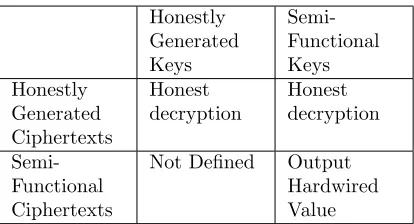
We define how honestly generated keys, honestly generated ciphertexts and semi-functional keys, semi-functional ciphertexts are required to behave with each other in Table1. Honestly gener-ated key or ciphertext refers to generation of key or ciphertext according to the description of the scheme.
Honestly Generated Keys
Semi-Functional Keys Honestly
Generated Ciphertexts
Honest decryption
Honest decryption
Semi-Functional Ciphertexts
Not Defined Output Hardwired Value
Table 1:
We consider four possibilities of decryption: (a) honestly generated keys correctly decrypts honestly generated ciphertexts (from correctness property), (b) semi-functional keys also correctly decrypts honestly generated ciphertexts, (c) there is no correctness guarantee on the decryption of honestly generated keys on semi-functional ciphertexts, (d) Finally, the decryption of semi-functional keys on semi-functional ciphertexts yields the hardwired value associated with the key.A PAFE scheme is said to satisfy semi-functional security if both the following definitions are satisfied:
• Indistinguishability of Semi-functional keys: It should be hard to distinguish an honestly generated functional key ofC from a semi-functional key of C associated with any hard-wired valuev.
Once we have a secret key PAFE scheme that satisfies semi-functional security then we can prove the security as follows: we consider a simple case when the adversary only submits one message query (x0, x1).
• We first turn the functional key associated with an arithmetic circuit C into a semi-functional key with the hardwired valueC(x0).
• Once all the functional keys are semi-functional, we can now switch the ciphertext of x0 to semi-functional ciphertext.
• SinceC(x0) =C(x1), we can switch back the semi-functional keys to be honestly generated functional keys.
• Finally, we switch back the ciphertext from semi-functional to honestly generated cipher-text ofx1.
If the adversary requests multiple message queries, then the above process is to be repeated one message query at a time.
Choice of Randomizing Polynomials with Sub-linear Randomness: The next question is what randomizing polynomials do we choose to instantiate the above approach. As we will see later, if we choose randomizing polynomials with sub-linear randomness complexity of degree D then it suffices build PAFE from degree D multilinear maps. Also, we will require the polynomials to be homogenous.
Hence, our goal is to choose a homogenous randomizing polynomials with minimal degree and also satisfying (i) linear decodability and (ii) sub-linear randomness complexity properties. We achieve this in the following steps:
1. First, build randomizing polynomials with minimal degree. We start with [AIK06] for N C1, where the polynomials are of degree 3. In spirit, this is essentially information theoretic Yao with the wire keys being elements overFpand every wire key is associated
with a random mask (which is represented as a bit) that helps in figuring out which of the four entries to be decoded for the next gate.
2. The above scheme already satisfies linear decodability property. This is because the de-cryption of every garbled gate is a linear operation. The linear function chosen to decrypt one garbled gate now depends on the linear functions chosen to decrypt its children gates.
3. Next, we tackle sub-linear randomness complexity: we generate the wire keys and the random masks as the output of a PRG. The total length of all the wire keys is roughly square the size of theN C1circuit. This is because, the size of the wire keys at the bottom most (input) layer are proportional to the size of the circuit. We use an algebraic PRG of stretch (2 +ε) to generate the wire keys and we use a boolean PRG to generate the random masks. The degree of the algebraic PRG over Fp is 3 while the degree of the boolean
PRG represented overFp is 5. When the above PRGs are plugged into the randomizing
polynomials construction from the above step, we get the degree of the polynomials to be 15.
4. Finally, we show how to make the above randomizing polynomials homogenous. This is done using a standard homogenization argument: add dummy variables to the polynomials such that the degree of all the terms in the polynomials are the same. While evaluating these polynomials, set all these dummy variables to 1. This retains the functionality and at the same time ensures homogeneity.
We can now use the above randomizing polynomials scheme to instantiate the above approach. After partial decryption, we get partial decrypted values associated with{pi(x;r)}. Now, since
Reducing the Degree: We can apply some preprocessing to reduce the degree of the above polynomials further. We remark how to reduce the degree to 5. Later, in the technical sections, we explore alternate ways of reducing the degree, as well.
Suppose we intend to construct sublinear FE for a specific class of circuits C. In this case, we are required to construct randomizing polynomials only forC ∈N C1.
We define C as follows: every circuit C ∈ C of output length N is of the form C = (C1, . . . , CN), where (i) Ci outputs the ith output bit of C, (ii) |Ci| = poly(λ) for a fixed
polynomial poly, (iii) Depth of Ci is c·log(λ), where c is a constant independent of |C| and,
(iv)Ci for everyi∈[N] has the same topology – what is different, however, are the constants
associated with the wires. We show later that it suffices to build sublinear FE forC to obtain iO. We now focus on obtain randomizing polynomials forC.
We start with the randomizing polynomials scheme that we described above. Recall that it involved generating a garbled table for every gate in the circuitC. Moreover, the randomness to generate this garbled table is derived from an algebraic and a boolean PRG. We make the following useful changes: let C = (C1, . . . , CN) such thatCi outputs the ith output bit of C.
Letwi
1, . . . , winw be the set of wires inCi andGi1, . . . , Ging be the set of gates inCi.
• We invokenwnumber of instantiations of boolean PRGsbPRGw1, . . . ,bPRGwnw andbPRGr1, . . . ,bPRGrnw. All these PRGs have the same structure (i.e., same predicates is used) and
have degree 5 over arbitrary field (with slightly superlinear stretch 1+ε). Pseudorandom generatorbPRGwj is used to generate wire keys for wires wj1, . . . , w
N
j . Recall that earlier
we were using an algebraic PRG of quadratic stretch. This is because the size of wire keys was proportional to exponential in depth, which could potentially be linear in the size of the circuit. However, since we are considering the specific circuit class C, the depth of every circuit isclog(λ). And thus the size of the wire keys is independent of the security parameter. This is turn allows us to use just a PRG of superlinear stretch 1+ε. Finally, bPRGrj is used to generate random masks for the wiresw1
j, . . . , wNj .
• We now consider the [AIK06] randomizing polynomials associated with circuit C. As before, we substitute the variables associated with wire keys and random masks with the polynomials associated with the appropriate PRGs. The formal variables in the PRG polynomials are associated with the seed.
• The result of the above process is the encoding ofC consisting of polynomials p1, . . . , pN
with variables associated with the seeds of PRGs. Note that the degree of these polynomials is still 15.
• We then observe that there are polynomialsq1, . . . , qT in seed variables such thatp1, . . . , pN
can be rewritten in terms ofq1, . . . , qT and moreover, the degree ofpi in the new variables
{qi}is 5. The advantage of doing this is that the polynomials{qi}can be evaluated during
the encryption phase9. The only thing we need to be wary of is the fact thatT could be as big as|C|. If this is the case then the encryption complexity would be at least linear in |C|, which violate the sublinearity of the FE scheme. We show how to carefully pick q1, . . . , qT such that T is sub-linear in |C| and the above properties hold. We refer the
reader to the technical sections for more details.
The only missing piece here is to show that sublinear FE for this special class of circuitsCwith sub-exponential security loss implies iO. To show this, it suffices to show that sublinear FE for
Cimplies sublinear FE for all circuits. Consider the transformation from FE forN C1to FE for all circuits by [ABSV15] – the same transformation also works for single-key sublinear secret key FE. We consider a variant of their transformation. In this transformation, a sublinear FE
9This idea is similar in spirit to the recent work of Bitansky et al. [BLP16], who introduced degree reduction
key for circuit C0 is generated by constructing a circuit C that has hardwired into it C0 and valuev. CircuitC takes as inputx, PRF keyKand modeb. Ifb= 0 it outputs a Yao’s garbled circuit of (C, x) computed w.r.t randomness derived fromK. If b = 1 it outputs the valuev. We can re-writeCas being composed of sub-circuitsC1, . . . , CNsuch that each ofCiis inN C1,
|Ci| = poly(λ) and depth of Ci is c·log(λ) for a fixed polynomial poly and fixed constantc.
Intuitively,Ci, has hardwired into it gate Gi of C0 and ith block of v. It computes a garbled
table corresponding toGi ifb= 0, otherwise it outputs theithblock of v.
Constructing PAFE: We now focus on building PAFE from multilinear maps. The first attempt to encrypt the input x= (x1, . . . , x`inp) would be to just encode every xi separately. Now, during evaluation of circuitsC1, . . . , CN on these encodings will yield a top level encoding
of Ci(x). This homomorphic evaluation would correspond to projective decryption operation.
The recover algorithm would just compute a linear function on all the top level encodings of Ci(x) and using zero test parameters, recover the answer if the output of the linear function is
0.
However, we cannot allow the adversary to evaluate recover outputs for circuits Ci of his
choice. We should ensure that he recovers outputs only for circuits corresponding to which he has been issued functional keys. The main challenge in designing a functional key for C is to guarantee authenticity – how do we ensure that if the adversary, given a functional key corresponding toC, can only evaluateCon these inputs? To ensure this, we introduce a parallel branch of computation: we instead encode (xi, αi) where{αi}are random elements determined
during the setup. Then as part of the functional key associated withC, we give out an encoding of C({αi}) at the top level that will allow us to cancel the αi part after computing C on
encodings of {(xi, αi)} and in the end, just get an encoding of C(x). However, to implement
this, we need to make sure that the computation of C on{xi} and {αi} are done separately
even thoughxi andαi are encoded together.
The work of [Zim15, AB15] used the above idea in the context of designing iO. As we will discuss below, we extend their techniques in several ways, to deal with the problem of mixing ciphertext components and achieving the semi-functional security properties we need from our PAFE scheme. However, before we discuss these difficulties, we note that the work of [Zim15,
AB15] implement parallel branches by using composite order multilinear maps. Composite order multilinear maps allow for jointly encoding for a vector of elements such that addition and multiplication operations can be homomorphically performed on every component of the vector separately.
However, one of the primary motivations for this line of work on building constructions foriO
from low-degree multilinear maps is to enable the use of future candidate low-degree multilinear maps, where achieving composite order may not be possible. Indeed, current instantiations of composite order multlinear maps [CLT13] have poorly understood security properties, and have been subject to efficient cryptanalytic attacks in some settings (see, e.g., [CHL+15,CGH+15]). Thus, instead of relying on composite order multilinear maps, we do the following: we introduce a primitive called a slotted encoding scheme, that allows for the same functionality as offered by composite order multilinear maps. This then helps us in implementing the idea of [Zim15,AB15] using a slotted encoding scheme. We later show how to realize a constant degree slotted encod-ing scheme usencod-ing prime order multilinear maps. We define slotted encodencod-ings next.
Slotted Encoding: A slotted encoding scheme, parameterized by L (number of slots), has the following algorithms: (i) Setup: this generates the secret parameters, (ii) Encode: it takes as input (a1, . . . , aL) and outputs an encoding of it, (iii) Arithmetic operations: it takes two
encodings of (a1, . . . , aL) and (b1, . . . , bL) and performs arithmetic operations on every
compo-nent separately. For instance, addition of encoding of (a1, . . . , aL) and (b1, . . . , bL) would lead
(a1, . . . , aL) is such thatai= 0 for everyi.
In this work, we will be interested in asymmetric slotted encodings, where the slotted en-codings is associated with a treeT such that every encoding is associated with a node inT and two encodings can be paired only if their associated nodes are siblings. The degree of slotted encodings is defined to be the maximum degree of polynomials the scheme lets us evaluate.
Constant Degree Slotted Encoding From Prime Order MMaps: We start with the simple case when degree of slotted encodings is 2 (the bilinear case). The idea of dual vector spaces were introduced by [OT08] and further developed as relevant to us by [OT09,BJK15] to address this problem for bilinear maps. In this framework, there is an algorithm that generates 2nvectors (µ1, . . . , µn),(ν1, . . . , νn) of dimensionnsuch that: (i) inner product,hµi, νii= 1 and,
(ii) inner product, hµi, νji= 0 when i 6=j. Using this, we can encode (a1, . . . , an) associated
with some nodeuin the tree as follows: encode every element of the vectora1µ1+· · ·+anµn.
The encoding of (b1, . . . , bn) associated with a nodev, which is a sibling ofu, will be encodings
of the vectorb1ν1+· · ·+bnνn. Now, computing inner product of both these encodings will lead
to an encoding ofa1·b1+· · ·+an·bn.
This idea doesn’t suffice for degree 3. So our idea is to work modularly, and consider multiple layers of vectors. The encoding of (a1, . . . , an) under node uwill be encodings of the
vector (a1µ1⊗µ01+· · ·+anµn⊗µ0n)10, where {µ0i} is a basis of a vector space associated with
the parent of nodeu. Now, when this is combined with encoding ofb1ν1+· · ·+bnνn, computed
under node v, we get encoding of (a1b1µ01+· · ·anbnµ0n). Using this we can then continue for
one more level.
To generalize this for higher degrees we require tensoring of multiple vectors (potentially as many as the depth of the tree). This means that the size of the encodings at the lower levels is exponential in the depth and thus, we can only handle constant depth trees. Implementing our tensoring idea for multiple levels is fairly technical, and we refer the reader to the relevant technical section for more details.
PAFE from Slotted Encodings: Using slotted encodings, we make a next attempt in con-structing PAFE:
• To encrypt x = (x1, . . . , x`inp), we compute a slotted encoding of (xi, αi), where αi are sampled uniformly at random during the setup phase.
• A functional key ofC consists of a slotted encoding of (0, C({αi})) at the top level.
The partial decryption first homomorphically evaluates C on slotted encodings of (xi, αi) to
get a slotted encoding of (C({xi}), C({αi})). The second slot can be ‘canceled’ using top level
encoding of (0, C({αi})) to get an encoding of (C({xi}),0). The hope is that if the evaluator
uses a different circuit C0 then the second slot will not get canceled and hence, he would be unable to get a zero encoding.
However, choosing a different C0 is not the only thing an adversary can do. He could also mix encodings from different ciphertexts and try to compute C on it – the above approach does not prevent such attacks. In order to handle this, we need to ensure that the evaluation of ciphertexts can never be mixed. In order to solve this problem, we use a mask γ that be independently sampled for every ciphertext. Every encoding will now be associated with this mask. Implementing this idea will crucially make use of the fact that the polynomial computed by the arithmetic circuit is a homogenous polynomial.
Yet another problem arises is in the security proof: for example, to design semi-functional keys, we need to hardwire a value in the functional key. In order to enable this, we introduce a third slot. With this new modification, we put forward a template of our construction. Our actual construction involves more details which we skip to keep this section informal.
10
• To encryptx= (x1, . . . , x`inp), we compute a slotted encoding of (xi, αi,0), where αi are sampled uniformly at random during the setup phase. Additionally, you give out encoding of (0, S,0) at one level lower than the top level, whereS is also picked at random in the setup phase.
• A functional key ofCconsists of a slotted encoding of (0, C({αi})·S−1,0) at the top level.
The decryption proceeds as before, except that the encodings of (0, C({αi})·S−1,0) and (0, S,0)
are paired together before we proceed.
Note that in both the ciphertext and the functional key, the third slot is not used at all. The third slot helps in the security proof. To see how we describe the semi-functional parameters at a high level as follows:
- Semi-functional Ciphertexts: To encryptx= (x1, . . . , x`inp), we compute a slotted encoding of (0, αi,0), whereαiis computed as before. Additionally, you give out encoding of (0, S,1)
at one level lower than the top level, whereS is also picked at random in the setup phase. Note that the third slot now contains 1 which signals that it is activated.
- Semi-functional Keys: A functional key ofCconsists of a slotted encoding of (0, C({αi}), v)
at the one level lower than top level, where v is the hardwired value associated with the semi-functional key.
During the decryption of semi-functional key with honestly generated ciphertext, the third slot will not be used since it will be deactivated in the ciphertext. So the decryption proceeds nor-mally. However, during the decryption of semi-functional key with semi-functional ciphertexts, the third slot is used since the third slot is activated in the ciphertext. We argue the security of our construction in the ideal multilinear map model.
Comparison With [
LV16
].
We now compare our work with the recent exciting work of [LV16], in order to illustrate some differences that allow us to achieve lower degree. The work of [LV16] first defines FE for N C0 with a non-trivial efficiency property and give a new boot-strapping theorem11 to achieve compact FE. They then show how to achieve FE forN C0 from constant degree multilinear maps12. Interestingly, they use arithmetic randomizing polynomials within their construction of FE forN C0 – this will be important as we note below.In contrast, we do not build FE for N C0, but rather show how to proceed directly from projective arithmetic FE for degree-5 arithmetic circuits to iO (without additional use of multi-linear maps). Furthermore, our construction of PAFE isdegree preserving, so to achieve PAFE for degree-5 arithmetic circuits, we only need degree-5 multilinear maps. In contrast, in [LV16], to build FE forN C0, their work has to “pay” in degree not only based on the depth of theN C0 circuit that underlies each secret key, but also for the arithmetic randomizing polynomial that they apply to theN C0 circuit. This adds a significant overhead in the constant degree their multilinear map must support. Our approach is simpler, as our randomizing polynomials are only used in the path from PAFE to iO, which does not use multilinear maps in any additional way. There are, of course, many other technical differences between our work and [LV16], as well. Another conceptual idea that we introduce, and that is different from [LV16], is the notion of slotted encodings, an abstraction of composite order multilinear maps, and our method for emulating slotted encodings using prime order multilinear maps without increasing the degree.
11
Their bootstrapping theorem also works if we start with FE for constant degree polynomials overF2.
12Note that, in particular, the security of their scheme reduces to a succinct assumption called the multilinear joint
SXDH assumption. As we noted earlier, unfortunately this assumption is not known to be instantiable with existing multilinear map candidates. However, one can posit a different assumption that directly assumes their FE forN C0
1.3
Organization
1. We start with preliminaries in Section2.
2. The concept of projective arithmetic functional encryption is defined in Section3. 3. We then show how to construct iO starting from PAFE. To do that, we construct sublinear
secret key FE. This is done in two steps:
• First, we introduce the notion of (homogenous) (T,Φ)-randomizing polynomials in Section4. This will be a tool used in the construction of iO.
• Once this is done, we construct sublinear secret key FE from PAFE and homogenous (T,Φ)-randomizing polynomials in Section5.
4. Finally, we demonstrate how to construct PAFE from multilinear maps. This is accom-plished in the following steps:
• We first define an abstraction of composite order multilinear maps, that we call slotted encodings. This is done in Section6. In the same section, we show how to implement slotted encodings from prime order multilinear maps.
• We construct PAFE from slotted encodings in Section 7. The security of PAFE is based on concrete assumptions on slotted encodings.
• Finally in Section8, we show how to justify the assumptions on slotted encodings in the ideal multilinear map model.
2
Preliminaries
We denote the security parameter by λ. Two distributions D1 and D2, defined on the same sample space, are said to be computationally indistinguishable, denoted by D1 ∼=c D2 if the following holds: for any PPT adversaryAand sufficiently large security parameterλ∈N,
Pr[1← A(1
λ, s
1) : s1 $
←− D1]−Pr[1← A(1λ, s2) : s2 $
←− D2(1λ)]
≤negl(λ),
wherenegl is some negligible function.
2.1
Indistinguishability Obfuscation (iO)
The notion of indistinguishability obfuscation (iO), first conceived by Barak et al. [BGI+01], guarantees that the obfuscation of two circuits are computationally indistinguishable as long as they both are equivalent circuits, i.e., the output of both the circuits are the same on every input. Formally,
Definition 1(Indistinguishability Obfuscator (iO) for Circuits). A uniform PPT algorithmiO is called an indistinguishability obfuscator for a circuit family {Cλ}λ∈N, where Cλ consists of
circuitsC of the formC:{0,1}inp→ {0,1} with inp=inp(λ), if the following holds:
• Completeness: For everyλ∈N, everyC∈ Cλ, every inputx∈ {0,1}inp, we have that
Pr[C0(x) =C(x) : C0 ←iO(λ, C)] = 1
• Indistinguishability: For any PPT distinguisher D, there exists a negligible function
negl(·) such that the following holds: for all sufficiently large λ ∈ N, for all pairs of
circuitsC0, C1∈ Cλ such that C0(x) =C1(x) for all inputsx∈ {0,1}inp and|C0|=|C1|,
we have:
Pr[D(λ,iO(λ, C0)) = 1]−Pr[D(λ,iO(λ, C1)) = 1]
• Polynomial Slowdown: For every λ ∈ N, every C ∈ Cλ, we have that |iO(λ, C)| =
poly(λ, C).
2.2
Secret-Key Functional Encryption
A secret-key functional encryption (FE) schemeFE over a message space X ={Xλ}λ∈N and a
function spaceC={Cλ}λ∈Nis a tuple (FE.Setup,FE.KeyGen,FE.Enc,FE.Dec) of PPT algorithms
with the following properties:
• FE.Setup(1λ): The setup algorithm takes as input the unary representation of the security
parameter, and outputs a secret keyFE.MSK.
• FE.KeyGen(FE.MSK, f): The key-generation algorithm takes as input the secret keyFE.MSK and a functionf ∈ Cλ, and outputs a functional keyFE.SKf.
• FE.Enc(FE.MSK, x): The encryption algorithm takes as input the secret key FE.MSKand a messagex∈ Xλ, and outputs a ciphertextCT.
• FE.Dec(FE.SKf,CT): The decryption algorithm takes as input a functional key FE.SKf
and a ciphertextCT, and outputsout.
In terms of correctness, we require that there exists a negligible functionnegl(·) such that for all sufficiently largeλ∈N, for every messagex∈ Xλ, and for every functionf ∈ Cλ it holds that
FE.Dec(FE.KeyGen(FE.MSK, f), FE.Enc(FE.MSK, x)) =f(x)
with probability at least 1−negl(λ), where FE.MSK ← FE.Setup(1λ), and the probability is taken over the random choices of all algorithms.
Definition 2(Security). A secret-key functional encryption schemeΠ = (FE.Setup,FE.KeyGen, FE.Enc,FE.Dec)over a function spaceC={Cλ}λ∈Nand a message spaceX ={Xλ}λ∈Nissecure if for any PPT adversaryA there exists a negligible functionnegl(·)such that
AdvtgeFEΠ,A(λ) = Pr[Expt
FE
Π,A(λ,0) = 1]−Pr[Expt
FE
Π,A(λ,1) = 1]
≤negl(λ),
for all sufficiently largeλ∈N, where for eachb∈ {0,1}andλ∈Nthe experimentExptFEΠ,A(1λ, b),
modeled as a game between the adversaryAand a challenger, is defined as follows:
1. Setup phase: The challenger samplesFE.MSK←FE.Setup(1λ).
2. Message queries: On input1λthe adversary submits((x(0) 1 , . . . , x
(0)
`x),(x (1) 1 , . . . , x
(1)
`x))for
some polynomial `x =`x(λ). The challenger replies with (CT1, . . . ,CT`x), whereCTi ← FE.Enc(FE.MSK, x(ib)) for everyi∈[`x].
3. Function queries: The adversary queries the challenger with any function f ∈ Fλ such
that f(x(0)i ) =f(x(1)i )for every i∈[`x]. The adversary makes `f such queries. For each
such query, the challenger replies withFE.skf ←FE.KeyGen(FE.MSK, f).
4. Output phase: The adversary outputs a bit b0 which is defined as the output of the experiment.
t
-overhead.
An FE scheme is said to havet-overhead if the size of a functional key, associated with functionf, has size at most (|f| ·λ)t. More formally,Definition 3. Consider a constantt∈N. A FE schemeFE= (Setup,KeyGen,Enc,ProjectDec)
for a class of functionsC is said to have t-overheadif|skf| ≤(|f| ·λ)tfor everyf ∈ C, where
(i)MSK←Setup(1λ)and, (ii)sk
Sublinear Secret Key FE.
A secret key functional encryption scheme is said to be sub-linear if the encryption complexity is subsub-linear in the complexity of the function family. More formally,Definition 4 ([BV15,AJ15]). Let pbe a polynomial. A secret key FE schemeFE= (FE.Setup, FE.KeyGen,FE.Enc,FE.Dec)forCis said to besublinearif the running time ofFE.Enc(FE.MSK, m)
is(`f)1−·p(λ,|m|), where FE.MSK←FE.Setup(1λ)and`f = max C∈C|m|
{C} withC|m| consisting
of all circuits inC with inputs of length|m|.
2.3
Exponentially-Efficient iO (XiO)
We recall the definition of XiO introduced by the work of Lin, Pass, Seth and Telang [LPST16].
Exponentially-Efficient iO (XiO).
XiO is an indistinguishability obfuscation with the weaker efficiency requirement that dictates that the size of the obfuscated circuit should be sublinear in the size of the truth table associated with the circuit.Definition 5. (Exponentially-Efficient iO (XiO)) For a constant γ < 1, a machine XiO is aγ-compressing exponentially-efficient indistinguishability obfuscator (XiO) for a circuit class {Cλ}λ∈Nif it satisfies the functionality and indistinguishability in Definition1and the following efficiency requirements:
• Non-trivial efficiency: For every λ ∈ N, every C ∈ Cλ, we have that |iO(λ, C)| ≤
2nγpoly(λ, C), wherenis the input length ofC.
3
Projective Arithmetic Functional Encryption
In this section, we introduce the notion of projective arithmetic functional encryption scheme. There are two main differences from a (standard) functional encryption scheme:
• Functional keys are associated with arithmetic circuits.
• The projective decryption algorithm only outputs partial decrypted values. There is a recover algorithm that computes on the partial decrypted values and produces an output.
3.1
Definition
We can consider either a public key projective arithmetic FE scheme or a secret key projective arithmetic secret key FE scheme. In this work, we define and construct a secret key projective arithmetic FE scheme.
A secret-key projective arithmetic functional encryption (FE) schemePAFEover field Fpis
associated with a message spaceX ={Xλ}λ∈N and a arithmetic circuit classC={Cλ}λ∈Nover
Fp. Here, X comprises of strings with every symbol in the string belongs toFp.
PAFEcomprises of a tuple (Setup,KeyGen,Enc,ProjectDec) of PPT algorithms with the fol-lowing properties:
• Setup(1λ): The setup algorithm takes as input the unary representation of the security
parameter, and outputs a secret keyMSK.
• KeyGen(MSK, C): The key-generation algorithm takes as input the secret keyMSKand a arithmetic circuitC∈ Cλ, over Fp, and outputs a functional keyskC.
• ProjectDec(skC,CT): The projective decryption algorithm takes as input a functional key
skC and a ciphertextCT, and outputs a partial decrypted valueι.
• Recover(c1, ι1, . . . , c`f, ι`f): The recover algorithm takes as input co-efficients c1, . . . , c`f ∈ Fp, partial decrypted valuesι1, . . . , ι`f and outputsout.
We first define the correctness property and later, define the security property.
B
-Correctness.
The correctness is parameterized by a set B ⊆ Fp. We emphasize thatB is a set of polynomial size, i.e., |B| = poly(λ). Consider an honestly generated ciphertext CT of input x. Consider honestly generated keys skC1, . . . , skC`f. Denote the corresponding decrypted values to be ι1, . . . , ι`f. If it holds that
P`f
i=1ci·Ci(x) =out∗ ∈B then we require
thatRecover(c1, ι1, . . . , c`f, ι`f), whereci ∈Fp, always outputsout
∗.
Remark 1. Our construction only supports the case when B = {0} when implemented by multilinear maps that only allows for zero testing at the final level. However, if encodings of 1 are given out at the top level, thenB can be defined to be the set{0, . . . ,poly(λ)}, where poly
is a fixed polynomial.
Remark 2((B, B0)-Correctness). We can also consider a property that we call(B, B0)-correctness. It is the same as B-correctness except that the co-efficients ci input to the above evaluation
al-gorithm has to be in the setB0⊆Fp.
Remark 3 (Alternate Notation of Evaluation). Instead of feeding coefficients to the evaluation algorithm, we can directly feed in the description of the linear function. That is, if out∗ ←
Recover(f,(ι1, . . . , ι``f))with f being a linear function then we require that f(C1(x), . . . , C``f) = out∗, whereιi is obtained by decrypting a functional key ofCi withx.
Remark 4 (General Recover Functions). Here, we are considering recover algorithms that compute a linear function on the outputs of the arithmetic circuits. This suffices for our work. However, we can envision more general type of evaluation functions which compute an arbitrary polynomial on the outputs of arithmetic circuits.
3.2
Semi-Functional Security
We introduce a notion of semi-functional security associated with projective arithmetic FE. We refer the reader to the technical overview for an informal intuition behind the notion of semi-functional security.
We define the following two auxiliary algorithms.
Semi-Functional Key Generation,sfKG(MSK, C, θ): On input master secret keyMSK, arith-metic circuitC, valueθ, it outputs a semi-functional keyskC.
Semi-Functional Encryption, sfEnc(MSK,1`inp): On input master secret key MSKand ` inp,
it outputs a semi-functional ciphertextCT.
We now introduce two security properties. We start with the first property, namely indistin-guishability of semi-functional keys.
This property states that it should be hard for an efficient adversary to distinguish a semi-functional key associated with circuitCand value vfrom an honestly generated key associated with C. Additionally, the adversary can request for other semi-functional keys or honestly generated keys. The ciphertexts will be honestly generated.
PAFEsatisfiesindistinguishability of semi-functional keyswith respect to sfKGif for any PPT adversaryAthere exists a negligible function negl(·)such that
AdvtgePAFEA (λ) = Pr[Expt
PAFE
A (λ,0) = 1]−Pr[Expt
PAFE
A (λ,1) = 1]
≤negl(λ),
for all sufficiently largeλ∈N, where for eachb∈ {0,1}andλ∈Nthe experimentExptPAFEA (1λ, b),
modeled as a game between the adversaryAand a challenger, is defined as follows:
1. Setup phase: The challenger samplesMSK←Setup(1λ).
2. Message queries: On input1λ the adversary submits(x
1, . . . , x`x)for some polynomial `x=`x(λ).
3. Function queries: The adversary also submits arithmetic circuit queries to the chal-lenger. There are three tuples the adversary submits:
• This comprises of circuits and values associated with every circuit;(C10, θ1, . . . , C`0f, θ`f).
Here,θj∈Fp.
• This comprises of just circuits;(C11, . . . , C`10
f).
• This corresponds to a challenge circuit pair query(C∗, θ∗)
4. Challenger’s response: The challenger replies with (CT1, . . . ,CT`x), where CTi ← Enc(MSK, xi) for every i ∈ [`x]. It also sends the following functional keys: for every
j∈[`f],
• skC0
j ←sfKG(MSK, C
0
j, θj).
• skC1
j ←KeyGen(MSK, C
1
j).
• Ifb= 0, generateskC∗←sfKG(MSK, C∗, θ∗). Otherwise generateskC∗←KeyGen(MSK,
C∗).
5. Output phase: The adversary outputs a bit b0 which is defined as the output of the experiment.
The second property is indistinguishability of semi-functional ciphertexts. This property states that it should be hard for an efficient adversary to distinguish honestly generated ciphertext of xfrom a semi-functional ciphertext. In this experiment, it is required that the adversary only gets semi-functional keys associated with circuitsCi and valuevi such thatvi=Ci(x).
Definition 7(Indistinguishability of Semi-Functional Ciphertexts). Consider a projective arith-metic functional encryption scheme PAFE= (Setup,KeyGen,Enc,ProjectDec,Recover). We say that PAFE satisfies indistinguishability of semi-functional ciphertexts with respect to
sfEncif for any PPT adversaryAthere exists a negligible function negl(·)such that
AdvtgePAFEA (λ) = Pr[Expt
PAFE
A (λ,0) = 1]−Pr[Expt
PAFE
A (λ,1) = 1]
≤negl(λ),
for all sufficiently largeλ∈N, where for eachb∈ {0,1}andλ∈Nthe experimentExptPAFEA (1λ, b),
modeled as a game between the adversaryAand a challenger, is defined as follows:
1. Setup phase: The challenger samplesMSK←Setup(1λ).
2. Message queries: On input1λ the adversary submits(x
1, . . . , x`x)for some polynomial `x=`x(λ)and it also sends the challenge queryx∗ .
3. Function queries: The adversary also submits arithmetic circuit queries to the chal-lenger. The query is of the form(C1, θ1, . . . , C`f, θ`f). It should hold that θj=Cj(x
∗) for
4. Challenger’s response: The challenger replies with (CT1, . . . ,CT`x), where CTi ← Enc(MSK, xi) for every i ∈ [`x]. It sends CT∗ ← Enc(MSK, x∗) only if b = 0,
other-wise it sends CT∗ ← sfEnc MSK,1|x∗|
. Finally, it sends the following functional keys: for everyj∈[`f], compute skCj ←sfKG(MSK, Cj, θj).
5. Output phase: The adversary outputs a bit b0 which is defined as the output of the experiment.
Remark 5. One can also define a stronger property where instead of submitting one challenge messagex∗, the challenger submits a challenge message pair (x∗0, x∗1) and the requirement that
for every circuit Cj query, Cj(x∗0) =Cj(x∗1). The reduction, in response, encrypts x∗b where b
is the challenge bit. It can be seen that this stronger security property is implied by the above property.
We now define semi-functional security property.
Definition 8. We say that a projective arithmetic FE scheme, over Fp, is said to be
semi-functionally secureif it satisfies both (i) indistinguishability of semi-functional keys property and, (ii) indistinguishability of semi-functional ciphertexts property.
3.3
Other Notions
We also consider the following two notions of projective arithmetic FE.
Constant Degree Projective Arithmetic FE.
In this work, we are interested in pro-jective arithmetic FE for circuits that compute constant degree arithmetic circuits. In particular, we consider constant degree arithmetic circuits over arbitrary fieldFp.Multiplicative Overhead in Encryption Complexity.
We say that a projective arithmetic FE scheme, over fieldFp, satisfies multiplicative overhead in encryption complexityproperty if the complexity of encryptingxis|x| ·poly(λ,log(p)). That is,
Definition 9(Multiplicative Overhead in Encryption Complexity). Consider a projective arith-metic FE scheme PAFE= (Setup,KeyGen,Enc,ProjectDec), over field Fp. We say that PAFE
satisfies multiplicative overhead in encryption complexity if|Enc(MSK, x)|=|x| ·poly(λ,log(p)), whereMSKis the secret key generated during setup.
Circuits versus Polynomials.
Often in this manuscript, we interchangeably use arith-metic circuits overFp with polynomials computed overFp. If there is a polynomialpover Fphaving poly(λ) number of terms then there is a poly0(λ)-sized arithmetic circuit overFp, where
poly and poly0 are polynomials. However, the reverse in general need not be true: if there is a poly0(λ)-sized arithmetic circuit overFpthen the associated polynomial could have
exponen-tially many terms. For example: (x1+x2)· · ·(x2n−1+x2n) has a succinct circuit representation
but when expanded as a polynomial has exponential number of terms.
In this work, we are only interested in arithmetic circuits which can be expressed as polyno-mials efficiently. In particular, we consider arithmetic circuits of constant fan-in and constant depth.
4
(
T,
Φ)
-Randomizing Polynomials
In this section, we define the notion of (T,Φ)-randomizing polynomials. We start by defining
u
1u
2u
3u
4Figure 1: Tree
T
1u
1u
2Figure 2: Tree
T
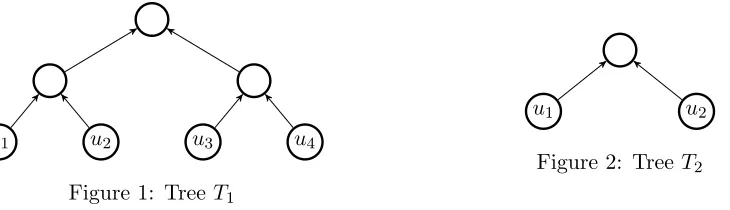
2Example: Consider a polynomial ring of 10 variables
x
1, . . . , x
10. A monomial
t
=
x
1x
2x
3x
4is
(
T
1, φ
)-respecting, where
φ
(
u
i) =
i
. However, it is not respecting with respect to (
T
1, φ
0)-respecting,
where
φ
0(
u
1) = 5. Similarly,
t
is not (
T
2, φ
)-respecting with respect to any
φ
.
4.1
(T, φ)
-Respecting Polynomials
Consider a binary treeT and a set of mapsφ~= (φ1, . . . , φN) withφi: [V]→[n]. We introduce
a property associated withn-variate polynomials, termed as (T, ~φ)-respecting. To do that, we first introduce the (T, φ)-respecting property in the context of monomials. Once we do that, we define a polynomialpoverFpto be (T, ~φ)-respecting if every monomialti is (T, φi)-respecting,
wherep=PN
i=1ci·ti andci∈Fp.
Definition 10 ((T, φ)-Respecting Monomials). Let T = (V, E)be a tree and let φ: [V]→[n]. We say that a monomial t ∈Fp[y1, . . . , yn] is a (T, φ)-respecting monomial over Fp if it is a
monomial and is computed as follows:
1. Ifuis a leaf node then the monomial associated withuistu=xφ(u).
2. Ifuis a non-leaf node and letv, w are children of uthen tu=tv·tw.
3. Ifrtis the root ofT thent=trt is the monomial associated withrt.
We are now ready to define (T, ~φ)-respecting polynomials. We also define the notion of homo-geneityin this context. A polynomial is said to be (T, ~φ)-respecting homogenous polynomial if firstly, it is (T, ~φ)-respecting and secondly, it is homogenous i.e., every monomial in the polyno-mial has the same degree.
Definition 11((T, ~φ)-Respecting (Homogenous) Polynomials). LetT = (V, E)be a tree and let −
→
φ = (φ1, . . . , φN), whereφi : [V]→[n]. A polynomial p∈Fp[y1, . . . , yn] is a(T, ~φ)-respecting
polynomial overFp and is computed as
p=
N
X
i=1 citi
• ci ∈Fp
• ti is a(T, φi)-respecting monomial.
Furthermore, we definepto be a homogenous polynomial if ti, for every i∈[N], has the same
degree.
Remark 6. For every polynomial p, there exists a tree T and a set of maps φ~ such that p
satisfies(T, ~φ)-respecting property.
Finally, we define the notion of degree of (T,Φ)-respecting polynomials.
Definition 12 (Degree). The degree of a (T,Φ)-respecting polynomial p ∈ Fp[y1, . . . , yn],
4.2
Definition of
(T,
Φ)
-Randomizing Polynomials
We now define (T,Φ)-randomizing polynomials. We later show how to construct (T,Φ)-randomizing polynomials with sub-linear randomness complexity.
The general approach is to combine existing randomizing polynomials with algebraic pseu-dorandom generators to get the desired result. We later show how to instantiate this approach by considering specific instantiations of randomizing polynomials and algebraic pseudorandom generators. As a result, we get low degree (T,Φ)-randomizing polynomials with sub-linear ran-domness complexity.
(
T,
Φ)
-(Homogenous) Randomizing Polynomials.
We first recall the definitions of randomizing polynomials [IK00,AIK06].Definition 13 (Randomizing Polynomials). A randomizing polynomials scheme RP = (E,D)
for a class of circuitsC has the following syntax:
• Encoding, E(1λ, C, x): On input security parameter λ, circuit C, input x, it outputs an encoding of C∈ C andx,h(C, x)i.
• Decoding, D(h(C, x)i): On input encoding of C andx, it output the decoded value α.
RPis required to satisfy the following properties:
• Correctness: For every security parameterλ∈N, circuitCand inputx,C(x) =D(E(1λ, C, x)).
• Efficiency: The typical efficiency we require is that the depth complexity of E should be independent of size/ depth complexity ofC.
• Security: For every PPT adversaryA, for large enough security parameter λ∈N, circuit C and inputx, there exists a simulatorSimsuch that:
E(1λ, C, x) ∼= n
Sim(1λ,1|C|, C(x))o
The indistinguishability can either be computational, statistical or perfect.
We now give the definition of (T,Φ)-randomizing polynomials. Its a randomizing polynomials scheme with two additional requirements: (i) the polynomials associated with the encoding algorithm are (T,Φ)-respecting and, (ii) the decoding algorithm should be of a specific form – in particular, it should be composed of many linear functions (computed adaptively). Furthermore, we also consider the notion of (T,Φ)-homogenousrandomizing polynomials: the polynomials in the encode procedure are homogenous.
We define the special decoding property, namely composable linear decoding property, that is necessary for our construction.
B-Composable Linear Decoding: We are interested in the following decoding property, parameterized by a constantB ∈Fp. Consider a circuitC and inputx. LetL be a list such
that theith element in L is h(C, x)ii ∈Fp, whereh(C, x)ii is the ithelement in h(C, x)i. The
decoding algorithmDproceeds as follows:
• The decoder has oracle access to elements inL. It proceeds in a sequence ofT steps.
• In the ith step, it submits a linear function f
i to L and in turn receives a value vi ∈
{0, . . . , B} which is the output offi(L). Iffi(L)∈ {/ 0, . . . , B}then oracle outputs⊥.
• LetvT be the output of the oracle in the Tth step.