Full Disk Encryption: Bridging
Theory and Practice
Louiza Khati1,2, Nicky Mouha3,4,5, and Damien Vergnaud1 1 Ecole Normale Sup´erieure - CNRS - Inria, Paris, France´
2 Oppida, Montigny-Le-Bretonneux, France
3 Dept. Electrical Engineering-ESAT/COSIC, KU Leuven, Leuven and
iMinds, Ghent, Belgium 4 Project-team SECRET, Inria, France
5 National Institute of Standards and Technology, Gaithersburg, MD, USA
[email protected],[email protected],[email protected]
Abstract. We revisit the problem of Full Disk Encryption (FDE), which refers to the encryption of each sector of a disk volume. In the context of FDE, it is assumed that there is no space to store additional data, such as an IV (Initialization Vector) or a MAC (Message Authentica-tion Code) value. We formally define the security notions in this model against chosen-plaintext and chosen-ciphertext attacks. Then, we clas-sify various FDE modes of operation according to their security in this setting, in the presence of various restrictions on the queries of the ad-versary. We willfind that our approach leads to new insights for both theory and practice. Moreover, we introduce the notion of adiversifier, which does not require additional storage, but allows the plaintext of a particular sector to be encrypted to different ciphertexts. We show how a 2-bit diversifier can be implemented in the EagleTree simulator for solid state drives (SSDs), while decreasing the total number of Input/Output Operations Per Second (IOPS) by only 4 %.
Keywords: Disk encryption theory, full disk encryption, FDE, XTS, IEEE P1619, uniquefirst block, diversifier, provable security.
1
Introduction
Additional efficiency constraints may be imposed on FDE as well. For ex-ample, it can be desirable to perform encryption and/or decryption in parallel, which is not possible for inherently sequential constructions where thei-th plain-text block of a sector cannot be processed until all previous plainplain-text blocks are processed. If there is not enough memory available to store an entire sector, it may be required that encryption and decryption are on-line, meaning that the i-th block of a sector may only depend on the preceding blocks.
These implementation constraints impose severe restrictions on the algo-rithms that can be used for FDE. A general problem in the domain of FDE, however, is that the security properties of the resulting constructions are not al-ways well-understood. On the other hand, cryptographers often complain about the absence of well-defined cryptographic goals for FDE (see e.g. Rogaway [25]), which are prerequisites tofind a good-trade-offbetween security and efficiency.
Our Contributions. Firstly, we want to measure “how much security is left” within the constraints of FDE. In order to do so, we introduce a theoretical framework to capture that a FDE algorithm behaves as “randomly as possible” subject to different practical constraints. We consider settings where the encryp-tion oracle can be random-up-to-repetiencryp-tion, random-up-to-prefix or random-up-to-block.
For each of the attack settings in the framework, we list an efficient con-struction that achieves security within this setting. We recall existing security results, and provide new proofs, in particular in theunique-first-block (ufb) set-ting where the Operaset-ting System (OS) or application ensures that the first n bits of the plaintext will not be repeated for a particular sector number, where nis the block size of the underlying block cipher.
Our model recalls that the modes of operation CBC (Cipher Block Chaining) and IGE (Infinite Garble Extension), even with a secret IV, do not achieve the security properties that developers often wrongly assume for these constructions. As already shown by Bellare et al. [2], CBC and IGE are not IND-CPA secure up-to-prefix. We will prove, however, that both constructions are IND-CPA secure under the ufb constraint.
Regarding chosen-ciphertext attacks, we point out that Added Redundancy Explicit Authentication (AREA) [12] is not secure when used with CBC or IGE, even when the IV is secret. The insecurity of constructions such as AREA was already shown in 2001 by Jutla [21], but has nevertheless not yet been pointed out in the context of FDE. We recall that there exist constructions that are secure in this setting, such as TC2 and TC3 [26].
For any particular sector, the diversifier value must be unique. But as we will explain later, additional requirements are necessary for performance reasons. When looking at all sectors at any particular point in time, each diversifier value should occur roughly the same number of times. Additionally, this diversifier value can typically only be a few bits long. These requirements put the diversifier in a class by itself, and not as a specific case of a random IV or a nonce (i.e. a number that is only used once).
When we benchmarked our solution in a modified EagleTree simulator [9], we found that it increases the average latency by at most 12 % for reads and 2 % for writes, and that it reduces the SSD throughput (read and write combined) by less than 4 %. This paper provides thefirst efficient FDE solution that can achieve indistinguishability against chosen-plaintext and chosen-ciphertext attacks.
Related Work. The problem of FDE has been researched extensively, see for example Rogaway [25] for a provable security treatment, or Fruhwirth [12] for an implementer’s perspective. The formal requirements of disk encryption are often not clearly stated.
FDE is a topic that has gathered significant interest from industry and stan-dardization, and often leads to application-specific solutions due to the special requirements of full disk encryption. Of particular interest are the elephant dif-fuser used in Microsoft’s BitLocker [11], or IEEE P1619’s XTS standard [18], which later became a NIST recommendation [10] as well.
Throughout this paper, we assume that adversary has access to the disk volume at any time. The adversary has (partial) knowledge and even control of the plaintext, and can even change the ciphertext as well. We therefore go beyond just “single point-in-time permanent offline compromise” (see e.g. [13,15]). Read and write operations are assumed to be atomic (on a sector level), so we do not consider blockwise adaptive attacks [19].
Sound key management is required to avoid that the plaintext contains the key, or any function of the key [16]. Physical access threats (e.g. cold boot, DMA, evil maid, or hot plug attacks [14, 22]) are also outside the scope of this paper.
2
Disk Encryption Methods
Data is read and written in a sector-addressable device by fixed-length units called sectors, usually 512 or 4096 bytes long. The OS can access a specific sector by itssector number s. We consider the case of an encrypted disk volume where data is encrypted by the OS before being stored.
We list the modes of operation that frequently appear in the context of FDE, whether it be in academic literature or in practical implementations. We also mention other modes with interesting security or efficiency properties.
s m1 . . . mℓ
. . .
c0 c1 c3 cℓ
EK′ EK EK
CBC-essiv
s m1 m2 . . .m3 mℓ
. . .
c0 c1 c2 c3 cℓ
EK′ EK EK EK
IGE-essiv
Fig. 1.Description of the CBC-essiv and IGE-essiv modes of operation.
CTR (Counter). This mode uses a counter (incremented for each block) that is encrypted and then XORed with the plaintext block to output the ci-phertext block. Typically, the counter is the sector number, bit-shifted to the left over a sufficient number of bits so that the least-significant bits can represent a counter for the number of blocks in one sector. CTR mode is IND-CPA secure [4] under the assumption that the counter is a nonce. In the context of FDE, this assumption does not hold as sectors can be overwritten.
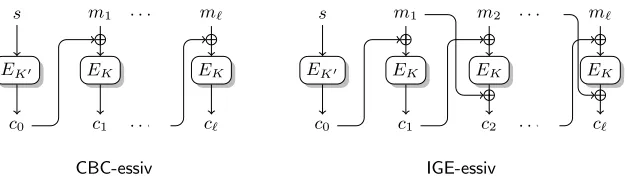
CBC. In this mode, each plaintext block is XORed with the previous ci-phertext block (or an IV for the first plaintext block) before being encrypted. To achieve the IND-CPA security notion, it is well-known that the IV has to be a random value [4]. However, for FDE, afirst natural idea is to use the sector number as an IV. Fruhwirth [12] proposed to use as an IV the encryption of the sector number by the block cipher keyed with an independent key (see Fig. 1).6
IGE.IGE was proposed by Campbell [8] as a variant of CBC mode where each block of plaintext is XORed with thenext ciphertext block (see Fig. 1). For FDE, since the sector number is not secret, we will consider the variant where the IV is the encryption of the sector numbersin whichsis not XORed to the
first ciphertext block. We will refer to this mode as IGE-essiv.
XTS. XTS [18] applies a tweakable block cipher to everyn-bit block of a sector, where the tweak depends on the sector number and on the index of the block within the sector. It usesciphertext stealing when the sector size is not a multiple ofnbits, however such sectors sizes are not considered in this paper.
TC1, TC2 and TC3.These modes for tweakable block ciphers were defined by Rogaway and Zhang in [26]. The difference between these constructions is the way the tweak is used:
– In TC1, the tweak is the previous ciphertext block as in the HCBC mode [2];
– In TC2, the tweak is the concatenation of the previous ciphertext block and the previous plaintext block as in the HCBC2 mode [2];
– In TC3 mode, the tweak is the XOR of the previous ciphertext block and the previous plaintext block as in the MHCBC2 mode [23].
6 Two distinct keys are needed: the message is encrypted with keyK, and the IV is
WTBC (Wide Tweakable Block ciphers).In the context of FDE, the block size of a WTBC is equal to the sector size, and the sector number is used as the tweak input. From a security point of view, any change in the plain-text or cipherplain-text affects the entire sector. A WTBC is typically realized using smaller (tweakable) block ciphers, as for example in the EME (Encrypt-Mix-Encrypt) [17] mode.
Our goal in this paper is to analyze these constructions and to evaluate their security in different models.
3
Security Notions for FDE
In this section, we formalize several security notions for FDE. We first give a formal syntactic definition of block-cipher-based FDE.
It is assumed that the plaintext of a sector is a multiple of nwhich is the block cipher size. All plaintexts areℓblocks ofnbits.mi denotes thei-th block of the plaintextmsuch thatm=m1||m2||...||mℓwhere||denotes concatenation
of strings. IND-CPA-xx corresponds to IND-CPA block, IND-CPA up-to-prefix, IND-CPA up-to-repetition and IND-CPA.
Definition 1. Let k,nandℓbe three positive integers. A(k, n, ℓ)-block-cipher-based FDE scheme is a pair of algorithms(Enc,Dec)such that:
– Enc is the (deterministic) encryption algorithm which takes as input a key
K∈{0,1}k, a sector numbers∈{0,1}n and a plaintext m∈{0,1}ℓ·n and
outputs a ciphertext c∈{0,1}ℓ·n;
– Dec is the (deterministic) decryption algorithm which takes as input a key
K∈{0,1}k, a sector number s∈{0,1}n and a ciphertext c∈{0,1}ℓ·n and
outputs a plaintext m∈{0,1}ℓ·n,
such that ∀(K, s, m)∈{0,1}k+n+ℓ·n: Dec(K, s,Enc(K, s, m)) =m.
For each security notion, we define two variants: security under Chosen-Plaintext Attack (CPA) where the adversary is given access to the Encrypt
procedure and security under Chosen-Ciphertext Attack (CCA) where the ad-versary is also given access to the Decrypt procedure. The adversary is not allowed to query the decryption of a ciphertext that was previously returned by
Encryptor vice versa.
Indistinguishability up-to-prefix. For i ∈ {1, . . . ,ℓ}, the i-th ciphertext block depends deterministically on the sector numbers and all previous plain-text blocks at position j for j ∈{1, . . . , i}, but again behave as “randomly as possible” subject to this constraint. The corresponding game described in Ap-pendix B uses independent random permutations Πi
m : {0,1}n → {0,1}n for each sector number sand each plaintext prefixm∈{0,1}t·n fort∈{1, . . . ,ℓ}. This notion corresponds to security notion described in [2] for on-line ciphers.
Indistinguishability up-to-repetition.Each ciphertext block depends deter-ministically on the plaintext block and the sector numbers, but behaves as “ran-domly as possible” subject to this constraint. The corresponding game described in Appendix B uses independent random permutations Πs :{0,1}n →{0,1}n for each sector numbers. It is the best achievable notion for (length-preserving) deterministic encryption [3].
Remark 1. If a construction is IND-CCA under one of these notions, it is also IND-CPA under the corresponding security notion.
Remark 2. If a construction is not IND-CPA under one of these notions, it is also not IND-CCA under the corresponding security notion.
As different ideal-world encryption oracles are used in the various security notions, it is trivially possible to distinguish between the encryption oracles. For example, for a fixed sector number and position on the plaintext, an IND-CPA up-to-block construction always returns the same ciphertext block. This construction does not reach IND-CPA up-to-prefix security, which requires in-distinguishablilty up to the longest common prefix for a fixed sector number. It also does not satisfy IND-CPA up-to-repetition security, which requires in-distinguishability up to repetition of the plaintext for a given sector number. Conversely, a construction that achieves IND-CPA up-to-prefix security will also not be IND-CPA up-to-block nor IND-CPA up-to-repetition using a similar rea-soning.
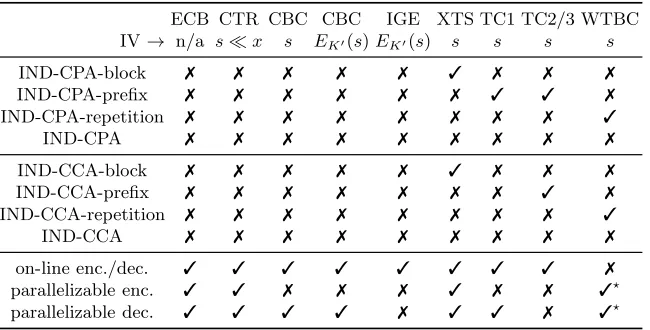
Analysis of Existing Constructions. We now analyze the FDE modes of operation described in Sect. 2 with respect to these security notions. These results are summarized in Table 1. The properties shown in the three last lines of Table 1 are relevant implementation properties, but are not taken into account in the security proofs.
ECB mode. Unsurprisingly, ECB is not IND-CPA for any of our three security notions.
CTR mode. CTR is not IND-CPA for any of our three security notions. An adversary can simply query the encryption ofm1= 0n||m2||..||mℓ andm2=
1n||m2||..||mℓ for the same sector numbers (wherem2, ..., mℓ can be anyn-bit
blocks). Thefirst blocks of the obtained ciphertextsc1andc2will always satisfy c1
Table 1. The security of FDE modes of operation when no diversifier is used. Here,
✓means that there is a security proof, and✗means that there is an attack. Proofs of
the security results can be found in Sect. 3. XTS: see [18]. TC1, TC2 and TC3 [26] are generalizations of the HCBC1 [2], HCBC2 [2] and MHCBC [23] constructions. WTBC: wide tweakable block cipher. The⋆symbol indicates that the property holds for some
constructions, but not for others. Here,x≥log2(ℓ).
ECB CTR CBC CBC IGE XTS TC1 TC2/3 WTBC IV→ n/a s≪x s EK′(s)EK′(s) s s s s
IND-CPA-block ✗ ✗ ✗ ✗ ✗ ✓ ✗ ✗ ✗
IND-CPA-prefix ✗ ✗ ✗ ✗ ✗ ✗ ✓ ✓ ✗
IND-CPA-repetition ✗ ✗ ✗ ✗ ✗ ✗ ✗ ✗ ✓
IND-CPA ✗ ✗ ✗ ✗ ✗ ✗ ✗ ✗ ✗
IND-CCA-block ✗ ✗ ✗ ✗ ✗ ✓ ✗ ✗ ✗
IND-CCA-prefix ✗ ✗ ✗ ✗ ✗ ✗ ✗ ✓ ✗
IND-CCA-repetition ✗ ✗ ✗ ✗ ✗ ✗ ✗ ✗ ✓
IND-CCA ✗ ✗ ✗ ✗ ✗ ✗ ✗ ✗ ✗
on-line enc./dec. ✓ ✓ ✓ ✓ ✓ ✓ ✓ ✓ ✗
parallelizable enc. ✓ ✓ ✗ ✗ ✗ ✓ ✗ ✗ ✓⋆
parallelizable dec. ✓ ✓ ✓ ✓ ✗ ✓ ✓ ✗ ✓⋆
CBC mode.The attack on the CTR mode also applies to the variant of the CBC mode where the sector number is used as an IV. In the context of FDE, this attack is known as a Saarinen’s watermarking attack [27]. Bellare et al. [2] describe an attack on the based online cipher that shows that CBC-essiv is not IND-CPA up-to-prefix. This attack can be adapted to construct an adversaryAfor our three security notions:
1. Aarbitrarily chooses (ℓ−1) blocksm2, .., mℓand a sector numbers.Abuilds
two plaintextsm1 = 0n||m2||. . .||mℓ and m2 = 1n||m2||. . .||mℓ that differ
only in theirfirst block.
2. Aqueries the Encrypt procedure to obtain the encryption of m1 and m2 on sector numbers:c1
b||c2b||. . .||c
ℓ
b ←Encrypt(s, mb) forb∈{1,2}. 3. Abuildsm3= 1n||m2
3||m3||. . .||mℓwherem23=m2⊕c11⊕c12and queries the
Encryptprocedure to obtain its encryption:c1
3||...||cℓ3←Encrypt(s, m3) 4. Areturns 0 to the Finalizeprocedure ifc2
3=c21and 1 otherwise. The equality c2
3 = c21 is always satisfied in the real world but holds only with probability 2−n in all three random worlds.
IGE-essiv mode.The previous attack on the CBC-essiv mode can easily be adapted to show that IGE-essiv is not IND-CPA for any of our three security notions. The attack is identical except that the adversaryAchecks whether the equalityc2
3=c21⊕1n holds or not.
sector number and index of the block within the sector. As argued by Rog-away [25], XTS is IND-CPA up-to-block secure. For syntactic reasons, it is not IND-CPA up-to-prefix nor IND-CPA up-to-repetition.
TC1, TC2, TC3 modes. Rogaway and Zhang [26] showed that TC1 is IND-CPA up-to-prefix secure but not IND-CCA up-to-prefix. They also proved that TC2 and TC3 are IND-CCA up-to-prefix (and thus also IND-CPA up-to-prefix) secure. For syntactic reasons, they are not IND-CPA up-to-block nor IND-CPA up-to-repetition.
WTBC modes.Halevi and Rogaway showed that EME is IND-CCA up-to-repetition (and thus IND-CPA up-up-to-repetition) secure in [17]. For syntactic reasons, these modes are not IND-CPA up-to-block nor IND-CPA up-to-prefix.
4
FDE Security with Unique First Block
Because encryption in the context of FDE is deterministic and length-preserving, encrypting the same plaintext twice will always result in an identical ciphertext. The OS or application may therefore want to use a particular encoding of the plaintext, in order to ensure that the ciphertext will not be repeated. This corre-sponds to Bellare and Rogaway’s Encode-Then-Encipher approach [5] to ensure strong privacy. One thus has to determine which encoding is sufficient to ensure security against CPA. In the context of security “up-to-block,” this would re-quire a large overhead, since encoding is then rere-quired for every block of a sector (typically 128 bits). However, for schemes that are IND-CPA “up-to-repetition” or “up-to-prefix,” it is sufficient to ensure that the beginning of every message is unique. This can be done by prepending either random data or a counter, as suggested by Bellare and Rogaway [5].
In this section, we consider variants of the previous security notions with
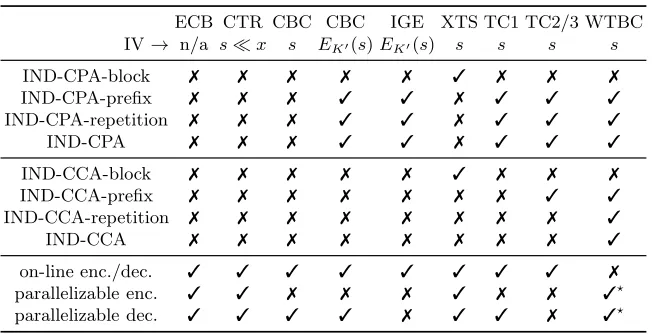
uniquefirst block (ufb) and we prove that IND-CPA security for CBC-essiv and IGE-essiv under this assumption. An application that is aware of this restriction, can therefore format its input such that thefirst block of every sector is unique. Appendix A gives a concrete example of such an application.
Relation to Previous Security Notions. The only difference between ufb model and the previous model is that for a given sector numbers,Acannot make two queries to encrypt plaintexts that have samefirst block. So if a construction is secure under a security notion described in Sect. 3, it is still the case in this model. Furthermore, the IND-CPA up-to-prefix, IND-CPA up-to-repetition and IND-CPA security notions become equivalent. This is easy to see: if thefirst block of plaintext is not repeated, then this is sufficient to ensure that the plaintext prefix or the entire plaintext is will not be repeated either.
Table 2.The security of FDE modes of operation when no diversifier is used, but the first plaintext block unique for any given sector. Here,✓means that there is a security
proof, and✗means that there is an attack.
ECB CTR CBC CBC IGE XTS TC1 TC2/3 WTBC IV→ n/a s≪x s EK′(s)EK′(s) s s s s
IND-CPA-block ✗ ✗ ✗ ✗ ✗ ✓ ✗ ✗ ✗
IND-CPA-prefix ✗ ✗ ✗ ✓ ✓ ✗ ✓ ✓ ✓
IND-CPA-repetition ✗ ✗ ✗ ✓ ✓ ✗ ✓ ✓ ✓
IND-CPA ✗ ✗ ✗ ✓ ✓ ✗ ✓ ✓ ✓
IND-CCA-block ✗ ✗ ✗ ✗ ✗ ✓ ✗ ✗ ✗
IND-CCA-prefix ✗ ✗ ✗ ✗ ✗ ✗ ✗ ✓ ✓
IND-CCA-repetition ✗ ✗ ✗ ✗ ✗ ✗ ✗ ✗ ✓
IND-CCA ✗ ✗ ✗ ✗ ✗ ✗ ✗ ✗ ✓
on-line enc./dec. ✓ ✓ ✓ ✓ ✓ ✓ ✓ ✓ ✗
parallelizable enc. ✓ ✓ ✗ ✗ ✗ ✓ ✗ ✗ ✓⋆
parallelizable dec. ✓ ✓ ✓ ✓ ✗ ✓ ✓ ✗ ✓⋆
and 2, we used the code-based game playing framework [7]. The proofs can be found in Appendix D.
ECB and CTR.The attacks described in Sect. 3 do not make queries with the samefirst block and the same sector number, and therefore still apply.
CBC-essiv. For this mode, in the attack of Sect. 3, A makes forbidden queries with the samefirst block. The following theorem states that CBC-essiv achieves IND-CPA-ufb security if the underlying block cipher E is a Pseudo-Random Function (PRF) [6].
Theorem 1 [The IND-CPA-ufb Security of CBC-essiv]
Let E:{0,1}k× {0,1}n→{0,1}n be a block cipher. LetAbe an IND-CPA-ufb
adversary against the FDE scheme obtained from the CBC-essiv mode onEsuch that A runs in time t and makes at most q queries to the Encryptprocedure. There exists an adversaryB (attacking the PRF security ofE) such that:
Advindcbc−−essivcpa−uf b(A)≤8·Adv prf E (B) +
q2(ℓ+ 1)2 2n−1
where B runs in time at most t′
= t+O(q+nq(ℓ+ 1)) and makes at most
q′
=q(ℓ+ 1) queries to its oracle.
The following attack shows that it does not achieve IND-CCA-ufb up-to-prefix security:
1. Achooses a plaintext m1=m1
1||m21||..||mℓ1 ∈{0,1}ℓ·n and a sector number sand queries theEncryptprocedure with (s, m1) to obtainc1
1||c21||..||cℓ1. 2. Abuilds a ciphertextc2=c1
2||c22||..||cℓ2 with c12 =c21,c22=c31 and arbitrary ci
2∈{0,1}nfori∈{3, . . . ,ℓ}and query theDecryptprocedure with (s, c2) to obtain a plaintextm2=m1
3. Aoutputs 0 ifm2
2=m31 and 1 otherwise. The equality m2
2 = m31 is always satisfied in the real world but this property holds only with probability 2−n in the random world.
IGE-essiv.The following theorem states that the mode IGE-essiv achieves IND-CPA-ufb security:
Theorem 2 [The IND-CPA-ufb Security of IGE-essiv]
Let E:{0,1}k× {0,1}n→{0,1}n be a block cipher. LetAbe an IND-CPA-ufb
adversary against the FDE scheme obtained from the IGE-essiv mode onEsuch that A runs in time t and makes at most q queries to the Encryptprocedure. There exists an adversaryB (attacking the PRF security ofE) such that:
Advindige−−essivcpa−uf b(A)≤8·Adv prf E (B) +
q2(ℓ+ 1)2 2n−1
where B runs in time at most t′
= t+O(q+nq(ℓ+ 1)) and makes at most
q′
=q(ℓ+ 1) queries to its oracle.
The following attack (inspired by Rohatgi [20]) shows that IGE-essiv does not achieve IND-CCA-ufb up-to-prefix security:
1. Achooses a plaintext m1=m1
1||m21||..||mℓ1 ∈{0,1}ℓ·n and a sector number sand queries theEncryptprocedure with (s, m1) to obtainc1
1||c21||..||cℓ1. 2. Abuilds a ciphertextc2=c1
2||c22||..||cℓ2 withc12=c11,c22=m21⊕c31⊕m11 and arbitraryci
2 ∈{0,1}n for i∈{3, . . . ,ℓ} and query the Decryptprocedure with (s, c2) to obtain a plaintextm2=m1
2||m22||..||mℓ2. 3. Aoutputs 0 ifm2
2=m31⊕c21⊕c11 and 1 otherwise. The equality m2
2 =m31⊕c21⊕c11 is always satisfied in the real world but this property holds only with probability 2−n in the random world.
The TC1, TC2, TC3 and WTBC constructions become IND-CPA with the ufb restriction because TC1/2/3 were IND-CPA up-to-prefix and WTBC con-structions were IND-CPA up-to-repetition as explained in Sect. 3.
5
FDE Security with a Diversi
fi
er
Typically, IND-CPA cannot be reached for FDE, as the deterministic nature of FDE means that identical plaintexts will result in identical ciphertexts. We worked around this problem in the previous section by imposing a restriction on the plaintext: thefirst plaintext block must be unique.
Now, we introduce another way to achieve IND-CPA, without imposing re-strictions on the plaintext, but still without storing additional data. Instead, we will use a diversifierj, which will be associated to every sector.
it is enough to consider that for each encryption, a diversifier is picked among {0,1}d, in such a way this diversifier is never repeated for a particular sector. Then two identical plaintexts with the same sector number will have different ciphertexts, a property that could previously not be achieved within the context of FDE.
The combination of the sector numbersand the diversifierj is used instead of the sector number in FDE constructions. The combination proposed is simply the concatenation between these two values s||j such ass∈{0,1}σ,j∈{0,1}d andn=d+σ.
For the analysis in this section, it suffices that the diversifier is never repeated for a particular sector. As such, the security analysis is the same as if the diver-sifier were a nonce. However, we will explain in Sect. 6 that efficiency reasons require that at any particular point in time, all diversifier values should occur roughly the same number of times, and that the diversifier must be a rather short value, typically only a few bits.
Security Results. IND-CPA up-to-repetition becomes equivalent to IND-CPA security: the only difference between these notions is that ifA asks to encrypt twice the same query (s, m) the answer will be the same ciphertext but these queries are not allowed any more under the diversifier model. Moreover in IND-CCA game, the adversary is not allowed to query the decryption of a ciphertext what was previously encrypted, or vice versa. It can therefore be seen that IND-CCA up-to-repetition becomes equivalent to IND-CCA. Similarly, since the adversaryAis not allowed to encrypt twice with the same pairs||j, the IND-CPA up-to-block property is also equivalent to the other IND-CPA security notions.
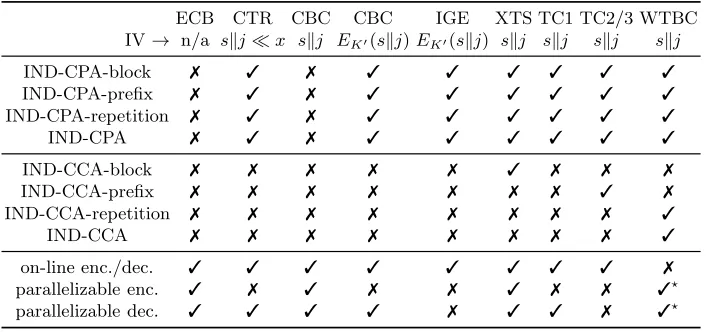
Table 3 summarizes the security properties achieved by the FDE modes of operation when used with a diversifier. The IND-CPA attacks of Sect. 3 still carry over to ECB and CBC with a sector-number IV. However CTR mode becomes secure as the counter value is not repeated [4]. The IND-CPA security of XTS, TC1, TC2, TC3 and WTBC follows from the fact that the tweak is not reused. For CBC-essiv and IGE-essiv, the IND-CPA security follows from the proof of Sect. 4: now thefirst block may be reused, but the IV is unique.
Let us explain the attacks under IND-CCA in Table 3:
– This following attack shows that CTR is not IND-CCA-xx: A encrypts (s||j, m) with m any plaintext and anys||j and receivesc thenA decrypts (s||j, c′
) wherec′
=c⊕0n−11.A. Then,m′1=m1⊕0n−11 is always satisfied in the real world, but holds only with probability 2−n in the ideal world.
– CBC-essiv and IGE-essiv are not secure: the attacks of Sect. 4 still apply, as they did not perform two encryptions with the same sector number.
– For syntactical reasons, an encryption scheme can only be IND-CCA up-to-block, IND-CCA up-to-prefix, or IND-CCA up-to-repetition. XTS is only IND-CCA up-to-block, TC2 and TC3 are only IND-CCA up-to-prefix and WBTC are only IND-CCA up-to-repetition.
IND-CCA security for WTBC constructions, which not achievable in a “classical” FDE model.
Table 3.The security of FDE modes of operation when a diversifier is used. Here,✓
means that there is a security proof, and✗means that there is an attack.
ECB CTR CBC CBC IGE XTS TC1 TC2/3 WTBC
IV→ n/a s�j≪x s�j EK′(s�j)EK′(s�j) s�j s�j s�j s�j
IND-CPA-block ✗ ✓ ✗ ✓ ✓ ✓ ✓ ✓ ✓
IND-CPA-prefix ✗ ✓ ✗ ✓ ✓ ✓ ✓ ✓ ✓
IND-CPA-repetition ✗ ✓ ✗ ✓ ✓ ✓ ✓ ✓ ✓
IND-CPA ✗ ✓ ✗ ✓ ✓ ✓ ✓ ✓ ✓
IND-CCA-block ✗ ✗ ✗ ✗ ✗ ✓ ✗ ✗ ✗
IND-CCA-prefix ✗ ✗ ✗ ✗ ✗ ✗ ✗ ✓ ✗
IND-CCA-repetition ✗ ✗ ✗ ✗ ✗ ✗ ✗ ✗ ✓
IND-CCA ✗ ✗ ✗ ✗ ✗ ✗ ✗ ✗ ✓
on-line enc./dec. ✓ ✓ ✓ ✓ ✓ ✓ ✓ ✓ ✗
parallelizable enc. ✓ ✗ ✓ ✗ ✗ ✓ ✗ ✗ ✓⋆
parallelizable dec. ✓ ✓ ✓ ✓ ✗ ✓ ✓ ✗ ✓⋆
6
Solid State Drive
We now explain the basics of SSD storage, so that we can explain how to modify only thefirmware of SSDs to associate adiversifier to every sector. This
diversi-fier allows us to encrypt the same plaintext in distinct ways for the same sector number.
SSDs are flash memory devices that are gradually replacing the magnetic Hard Disk Drive (HDD) due to their reliability and performance. Just like HDDs, they are sector-addressable devices. They are indexed by a sector number that is also known as a Logical Block Address (LBA). This ensures that the physical details of the storage device are not exposed to the OS, but are managed by the
firmware of the storage device.
For SSDs, the Flash Translation Layer (FTL) stores the mapping between LBAs and Physical Block Addresses (PBAs). This FTL is necessary to ensure an even distribution of writes to every sector number (wear leveling) and to invalidate blocks so that they can later be recycled (garbage collection). This FTL is necessary due to the physical constraints offlash storage: any physical address can only be written a limited number of times, and rewriting individual sectors is not possible: invalidated sectors can only be recovered in multiples of theerase block size.
blocks7and pages. Every page consists of one or more sectors, and is the small-est unit that can be written. The smallsmall-est unit that can be erased is a block. Invalidated blocks must be erased before writing, and the number of erasures and writes to every block is limited forflash storage.
To abstract away the notion of packages, dies and planes, the Open NAND Flash Interface (ONFI) standard introduces the notion of Logical Unit Number (LUN) as the minimum granularity of parallelism forflash storage. As operations can be issued to several planes in parallel, a LUN corresponds to a plane.
Introducing a Diversifier. In the context of SSD storage, we will show how to associate adiversifier to every LBA. This diversifier will not be stored, and will not modify the data structures of the SSD. Instead, the diversifier will impose an additional restriction on the FTL, meaning that the diversifier determines which PBAs can store the data corresponding to a particular LBA.
The intuition is that if the diversifier is selected “randomly” for every write operation, the data will be spread out evenly over the SSD, and the SSD per-formance should not be affected too much. We will verify this by implementing and benchmarking our proposed solution in Sect. 6.
When a write command is issued, there are various ways to specify a diver-sifier value for a given LBA. We will prefer to transmit this information in one operation. As such, we do not only avoid the performance drawbacks of issuing several operations to write one sector, but we also do not need to worry about inconsistent states when operations are lost, modified, or reordered.
In particular, we propose to send the diversifier along with the sector data as part of a “fat” sector that is already supported in SATA (Serial ATA) interface for storage devices. This diversifier value will be returned to the OS when a fat sector read command is issued.
In an attempt to make the diversifier as long as possible, we may want to con-sider the optimal (yet completely unrealistic) scenario: the diversifier uniquely specifies the physical page to which the data must be written. But even then, the size of the diversfier typically be very short: e.g., only 24 bits in case of an 128 GB SSD with 8 kB pages. We will, in fact, choose the diversifier to be much shorter, so that a practical implementation is possible that minimally modifies the SSD firmware. This diversifier cannot be selected at random, as it would be too short to avoid repetitions for a particular sector. But it can also not be a counter, as all diversifier values should be used roughly an equal number of times over all sectors to spread the writes over the entire disk layout.
In our solution, we want to avoid that the SSD needs to send data back to the host for decryption and re-encryption under a different diversifier, as this would affect the SSD performance quite drastically. Therefore, wear leveling and garbage collection operations may not change the diversifier. A straightforward solution is then to make the diversifier correspond to the LUN (or a set of LUNs), which is what we will implement and benchmark in the following section.
7 These blocks should not be confused with the blocks of the block cipher, nor with
Table 4.EagleTree Benchmarks for various diversifier sizes.
diversifier size (bits)
0 1 2 3
read latency (�s) 28.292 28.862 31.619 40.640
write latency (�s) 32.009 32.070 32.470 34.560
read throughput (IOPS) 20860 20493 19050 15634
write throughput (IOPS) 31240 31181 30797 28935
garbage collector reads 1284043 1295530 1356043 1489623 garbage collectorwrites 1284043 1295530 1356041 1489622
erasures 18569 18765 19661 21634
The OS can freely select the diversifier values, however they may not be re-peated for any particular sector, and all diversifier values should be used roughly the same number of times. In Appendix A, we give a concrete example of an application where the OS implements such diversifier. More specifically, we show how the OS can ensure randomness and uniqueness even for very short diversifier values.
EagleTree Benchmarks. In order to confirm that the concept of a diversifier is not just feasible but also efficient to implement, we implemented this feature in the EagleTree SSD simulator [9] and performed various benchmarks. An overview of the source code modifications can be found in Appendix C.
The device that is simulated consists of eight packages, each containing four dies of 256 blocks. Each block consists of 128 pages of 4096 bytes. EagleTree currently does not support multiple planes per die. The page read, page write, bus ctrl, bus data and block erase delays are 5�s, 20�s, 1�s, 10�s and 60�s respectively. We assume that any latencies incurred by the OS (including sector encryption and decryption) are negligible with respect to these numbers. The SSD has an overprovisioning factor of 0.7.
We simulate an SSD configured with DFTL and the greedy garbage collection policy. The base benchmarks use a simple block scheduler that assigns the next write to whichever package is free. We then compare this performance to various choices of the diversifier value, which determines the package for every write.
The workload used in our benchmarks, is the same as the example in Ea-gleTree’s demo.cppfile: first a large write is made to the entire logical address space. This write is performed in random order, but without writing to the same address twice. Once this large write isfinished, two threads are started up: one performs random reads, and the other performs random writes in the address space. After three million I/O operations, the simulation is stopped.
The average latency increases by 44 % for reads, and 8 % for writes. In this setup, the reads and writes of each garbage collection operation are restricted to one package, and this affects performance quite significantly. Reads suffer more than writes; this is mainly because there is no significant drop in performance for the initial write operations to fill up the SSD.
To avoid the large impact on performance, we must therefore choose the number of diversifier values to be smaller than the number of packages. When the diversifier is two bits, our simulations show an increase of the average latency of 12 % for reads and 1 % for writes, and a reduction of throughput of 9 % for reads and 1 % for writes. The total throughput reduction (reads and writes combined) is at most 4 %. For a diversifier of one bit, latency and throughput are affected by less than 2 %. We also looked into the number of garbage collection and the number of erasures. They worsen by less than 6 % for a diversifier of two bits, but by 16 % for a diversifier of three bits.
7
Conclusion
We presented a theoretical framework for disk encryption and we analyzed several existing constructions against chosen-plaintext and chosen-ciphertext attacks, under different notions of the ideal-world encryption oracle: up-to-repetition, up-to-prefix, or up-to-block.
Using this model, we recalled that IGE-essiv does not have chosen-ciphertext-security under any of the notions that we consider, which shows that the AREA construction proposed by Fruhwirth [12] is insecure. Nevertheless, we proved that IGE-essiv and even CBC-essiv can provide security under chosen-plaintext attacks, under the assumption that thefirst block of a plaintext is never repeated for the same sector number.
We also revisited FDE from an engineering perspective, and showed how to modify the firmware of a solid-state drive to associate a short “diversifier” to every sector-plaintext pair (s, m). This diversifier makes it possible to encrypt the same plaintext into different ciphertexts, something that was previously im-possible without additional storage.
Acknowledgments. Nicky Mouha is supported by a Postdoctoral Fellowship from the Flemish Research Foundation (FWO-Vlaanderen), by a JuMo grant from KU Leuven (JuMo/14/48CF), and by FWO travel grant 12F9714N. Cer-tain algorithms and commercial products are identified in this paper to foster understanding. Such identification does not imply recommendation or endorse-ment by NIST, nor does it imply that the algorithms or products identified are necessarily the best available for the purpose. Damien Vergnaud is supported in part by the French ANR JCJC ROMAnTIC project (ANR-12-JS02-0004).
References
1. Bellare, M., Boldyreva, A., Knudsen, L.R., Namprempre, C.: Online ciphers and the hash-CBC construction. In: CRYPTO 2001. LNCS, vol. 2139, pp. 292–309. Springer (2001)
2. Bellare, M., Boldyreva, A., Knudsen, L.R., Namprempre, C.: On-line ciphers and the hash-CBC constructions. Journal of Cryptology 25(4), 640–679 (Oct 2012) 3. Bellare, M., Boldyreva, A., O’Neill, A.: Deterministic and efficiently searchable
encryption. In: CRYPTO 2007. LNCS, vol. 4622, pp. 535–552. Springer (2007) 4. Bellare, M., Desai, A., Jokipii, E., Rogaway, P.: A concrete security treatment of
symmetric encryption. In: 38th FOCS. pp. 394–403. IEEE Computer Society Press (1997)
5. Bellare, M., Rogaway, P.: Encode-then-encipher encryption: How to exploit nonces or redundancy in plaintexts for efficient cryptography. In: ASIACRYPT 2000. LNCS, vol. 1976, pp. 317–330. Springer (2000)
6. Bellare, M., Rogaway, P.: Introduction to Modern Cryptography. In: UCSD CSE 207 Course Notes. p. 207 (2005)
7. Bellare, M., Rogaway, P.: The security of triple encryption and a framework for code-based game-playing proofs. In: EUROCRYPT 2006. LNCS, vol. 4004, pp. 409–426. Springer (May / Jun 2006)
8. Campbell, C.M.: Design and Specification of Cryptographic Capabilities. IEEE Communications Society Magazine 16(6), 15–19 (November 1978)
9. Dayan, N., Svendsen, M.K., Bjørling, M., Bonnet, P., Bouganim, L.: EagleTree: Exploring the Design Space of SSD-Based Algorithms. PVLDB 6(12), 1290–1293 (2013)
10. Dworkin, M.: Recommendation for Block Cipher Modes of Operation: The XTS-AES Mode for Confidentiality on Storage Devices. NIST SP 800-38E (2010) 11. Ferguson, N.: AES-CBC + Elephant diffuser: A Disk Encryption Algorithm for
Windows Vista.http://www.microsoft.com/en-us/download/details.aspx?id= 13866(2006)
12. Fruhwirth, C.: New methods in hard disk encryption. Master’s thesis, Vienna Uni-versity of Technology (2005)
13. Gjøsteen, K.: Security notions for disk encryption. In: ESORICS 2005. LNCS, vol. 3679, pp. 455–474. Springer (2005)
14. G¨otzfried, J., M¨uller, T.: Analysing Android’s Full Disk Encryption Feature. JoWUA 5(1), 84–100 (2014)
15. Halcrow, M., Savagaonkar, U., Ts’o, T., Muslukhov, I.: EXT4 Encryption Design Document (public version). Google Technical Report (2015)
16. Halevi, S.: Re: Lrw key derivation (formerly pink-herring). IEEE P1619 Mailing List (May 2006)
17. Halevi, S., Rogaway, P.: A parallelizable enciphering mode. In: CT-RSA 2004. LNCS, vol. 2964, pp. 292–304. Springer (2004)
18. IEEE: IEEE Standard for Cryptographic Protection of Data on Block-Oriented Storage Devices. IEEE Std 1619-2007 pp. 1–32 (2008)
19. Joux, A., Martinet, G., Valette, F.: Blockwise-adaptive attackers: Revisiting the (in)security of some provably secure encryption models: CBC, GEM, IACBC. In: CRYPTO 2002. LNCS, vol. 2442, pp. 17–30. Springer (2002)
21. Jutla, C.S.: Encryption modes with almost free message integrity. In: EURO-CRYPT 2001. LNCS, vol. 2045, pp. 529–544. Springer (2001)
22. M¨uller, T., Freiling, F.C.: A Systematic Assessment of the Security of Full Disk Encryption. IEEE Trans. Dependable Sec. Comput. 12(5), 491–503 (2015) 23. Nandi, M.: Two new efficient CCA-secure online ciphers: MHCBC and MCBC. In:
INDOCRYPT 2008. LNCS, vol. 5365, pp. 350–362. Springer (2008)
24. Rogaway, P.: Nonce-based symmetric encryption. In: FSE 2004. LNCS, vol. 3017, pp. 348–359. Springer (2004)
25. Rogaway, P.: Evaluation of Some Blockcipher Modes of Operation. Tech. rep., CRYPTREC Investigation Report (2011)
26. Rogaway, P., Zhang, H.: Online ciphers from tweakable blockciphers. In: CT-RSA 2011. LNCS, vol. 6558, pp. 237–249. Springer (2011)
A
Case Studies
We now present three case studies for FDE. They apply the theoretical frame-work developed in this paper, in order to obtain novel practical solutions that advance the state of the art. For each of the case studies, we explain the advan-tages of our solutions over existing techniques. The examples are rather concrete for the sake of clarity, but the practical relevance of our results is not limited to these particular examples.
A.1 On-Line Ciphers for FDE
Case Description. We consider an FDE application for which both encryption and decryption must be on-line. Off-line modes of operation cannot be imple-mented due to a practical restriction: the encryption and decryption must be performed by a hardware security module (HSM) that does not have enough memory to store an entire sector. With this consideration in mind, what FDE security notions can be achieved by this application?
Solution. As encryption and decryption must be on-line, we know that two plaintexts with a common prefix will result in ciphertexts that have a common prefix as well. In the “up-to-prefix” setting, Table 1 explains that neither the commonly-used CBC (e.g. in Microsoft’s BitLocker [11]) nor its “improved” IGE variant (see e.g. Fruhwirth [12]) provide chosen-plaintext or chosen-ciphertext security. However, these security properties can be achieved by TC2 and TC3.
Advantages. We are unaware of any applications of TC2 and TC3 in FDE. However, when encryption and decryption must be on-line, these constructions provide up-to-prefix chosen-ciphertext security in a setting where the commonly-used CBC and the often-proposed IGE are insecure.
A.2 FDE-Aware Database Applications
Case Description. After intensive benchmarking, a database application was found to achieve an insufficiently high throughput when encryption is enabled. Without encryption, the performance of the database application is within ac-ceptable limits. To avoid the security risks of storing data without encryption, a decision was made to use a hardware-based FDE based on CBC-essiv.
Database applications are often already aware of the sector size to align read and write operations to sector boundaries,8and these operations already contain some wastage.9This is also the case for the application that we consider, which additionally also knows whether FDE is enabled for a particular disk volume. For the given application, at least eight bytes of padding are added to the end of every
8
https://blogs.msdn.microsoft.com/psssql/2011/01/13/sql-server-new-drives-use-4k-sector-size/ 9
record in order to ensure sector alignment. Is it possible for this application to achieve indistinguishability under chosen plaintexts, which implies that identical sector plaintexts will result in distinct ciphertexts?
Solution. CBC-essiv is a common solution for FDE, but unfortunately Table 1 explains that it does not achieve any of the IND-CPA notions that are defined in this paper. However, Table 2 shows that IND-CPA can be achieved for CBC-essiv if thefirst plaintext block for every sector is unique. The application can decide to reduce the padding at the end of every record by eight bytes, and instead prepend an eight-byte time stamp. Assuming that this time stamp will not repeat, the
first plaintext block of every sector is unique, and indistinguishability under chosen plaintext attacks holds. Of course, the application should detect whether FDE using CBC-essiv is enabled for a particular disk, and return an error if this is not the case.
Advantages. To the best of our knowledge, existing solutions would encrypt at the application level, at the disk level using FDE, or would use a combination of both. The FDE is unaware of the application, as it performs encryption at the sector level. But what if the application is aware of the FDE? If that is the case, we explain how the application can generate plaintexts of a particular structure in order to obtain a stronger notion of FDE security, but without performing any encryption at the application level.
A.3 On-the-Fly Firmware Updates
Case Description. A medical monitoring system continuously measures the patient’s vital signs. The device has an Internet connection, which it uses to transmit its measurements, as well as to install security-critical on-the-flyfirmware updates. The firmware is stored in off-chip Flash memory. Hackers could easily read out previous versions of thefirmware, as they were stored without encryp-tion.
To prevent such attacks, the company has decided to use FDE because there is no space to store additional data such as IVs, nonces or tags. However, the company identifies a problem with FDE: if hackers know which sectors in the Flash memory are modified by a security update, they can compare these sectors with olderfirmware. These hackers can then sniffaround in the same part of the code to quickly rediscover the security vulnerability, and possibly exploit it before the devices in thefield are updated. How can this problem be avoided?
Solution. It seems that the company wants to represent sectors with identical plaintexts by different ciphertexts, in order to hide which sectors are affected by a
to introduce a diversifier. Depending on the security requirements against chosen ciphertexts, Table 3 proposes various solutions.
Initially, the diversifier will be the most significant d bits of the hash of the sector number, wheredis the size of the diversifier in bits. Everyfirmware update will have a version number, which will be XORed to the diversifier of every sector. Clearly, the number of firmware updates must be less than the number of diversifier values. Under this restriction, all diversifiers will be unique for a particular sector.
Note that the diversifier cannot be a counter, as this would result in a sig-nificant degradation of performance. But it can also not be chosen at random, as this will likely result in collisions due to the small size of the diversifier.
Advantages. An alternative solution may be to randomize all the instructions for everyfirmware update, but this technique is very error-prone and it will be difficult (if not impossible) to ensure that the device remains in a consistent state, in particular if power is lost during an on-the-fly firmware update. Our solution avoids this: for sectors that are unaffected by the update, the ciphertext changes but the plaintext remains the same.
Changing the FDE key is not an option for an on-the-fly update: while the device is being updated, there is no non-volatile memory available to store the mapping between encryption keys and sector numbers. However, changing the FDE key is possible during scheduled maintenance, when updates do not need to be performed on thefly. Thefirmware update counter can then be reset. There-fore, as long as the number of on-the-fly updates before scheduled maintenance is less thand, the small size of the diversifier does not present a problem.
B
Security Game De
fi
nitions
Indistinguishability up-to-block.Thefirst security game (described in Fig. 2) definesindistinguishability up-to-block. This notion formalizes that each cipher-text block depends deterministically on the plaincipher-text block, the sector number sand the block position in the plaintext, but behaves as “randomly as possible” subject to this constraint. The game uses independent random permutations Π(s,i) : {0,1}n → {0,1}n for each sector number s and each block position i∈{1, . . . ,ℓ}. We specifically introduce this setting to describe the security goal of XTS, see Rogaway [25] for a formal definition (using afilter function) of what is known to leak by the XTS mode.
Indistinguishability up-to-prefix. The second security game (described in Fig. 3) defines indistinguishability up-to-prefix. This notion formalizes that for i∈{1, . . . ,ℓ}, thei-th ciphertext block depends deterministically on the sector number sand all previous plaintext blocks at position j forj ∈{1, . . . , i}, but again behave as “randomly as possible” subject to this constraint. The game uses independent random permutations Πi
procedure Initialize:b←$ {0,1};K←$ {0,1}k
procedure Encrypt(s, m):
if b= 0then ⊲Real world
c←Enc(K, s, m)
else ⊲Random world
forifrom1toℓdo
if Π(s,i)(mi) =undefined then
Π(s,i)(mi) $
←Rng(Π(s,i)) end if
ci←Π(s,i)(mi) end for
c←c1||. . .||cℓ
end if returnc
procedure Decrypt(s, c):
if b= 0then ⊲Real world
m←Dec(K, s, c)
else ⊲Random world
forifrom1toℓdo
if (Π(s,i))−1(ci) =undefined then (Π(s,i))−1(ci) $
←Dom(Π(s,i)) end if
mi←(Π(s,i))−1(ci) end for
m←m1||..||mk end if
returnm
procedure Finalize(b′):return(b=b′)
Fig. 2.Security game “up-to-block”: IND-CPA-block
Algorithm 1findLCP(ds,t,’d’) ford∈{m, c} p←0 ;pref←0 ;index←0
forjfrom1tot−1do forifrom1toℓdo
whiledi
s,j=dis,tdop←i end while
end for
if p >pref then pref←p;index←j end if
end for
This notion corresponds to the security notion described in [1, 2] foron-line ciphers.
Indistinguishability up-to-repetition.The third security game (described in Fig. 4) definesindistinguishability up-to-repetition. This notion formalizes that each ciphertext block depends deterministically on the plaintext block and the sector number s, but behaves as “randomly as possible” subject to this con-straint. The game uses independent random permutationsΠs:{0,1}n→{0,1}n for each sector numbers. It is the best achievable notion for (length-preserving) deterministic encryption [3].
C
EagleTree Modi
fi
cations
Our modified EagleTree simulator is based on the latest commit of EagleTree on GitHub10of February 23, 2016, to which we made three small modifications. In particular:
– We added an additionaldiversifierdata member to theEventclass, which is set to a random value every time the operation system generates a write operation ingenerate io().
– The get free block pointer with shortest IO queue() function in the Block manager parentclass now has adiversifierargument added to it. It restricts I/O operations to thepackage that is specified by the value of diversifier.
– In the block managerBlock manager parallel, thechoose best address() and choose any address()functions were redefined. For write operations that are issued either by the operating system or by the garbage collector, the package will be restricted to the value of the diversifier. This value is passed on whenget free block pointer with shortest IO queue()is called within this function. No modifications are made for reads and writes to sectors that are not visible to the OS, such as for example the mapping information I/O generated by the FTL.
D
Security Proofs
CBC-essiv. The following theorem shows that CBC-essiv achieves IND-CPA-ufb security notion.
Theorem 3 (The IND-CPA-ufb Security of CBC-essiv)
Let E:{0,1}k× {0,1}n→{0,1}n be a block cipher. LetAbe an IND-CPA-ufb
adversary against the FDE scheme obtained from the CBC-essiv mode onEsuch that A runs in time t and makes at most q queries to the Encryptprocedure. There exists an adversaryB (attacking the PRF security ofE) such that:
Advindcbc−−essivcpa−uf b(A)≤8·Adv prf E (B) +
q2(ℓ+ 1)2 2n−1 10
procedure Initialize:b←$ {0,1};K←$ {0,1}k;t←0
procedure Encrypt(s, m): t←t+ 1
if b= 0then ⊲Real world
c←Enc(K, s, m)
else ⊲Random world
ms,t←m
(index, p)←findLCP(ms,t,’m’) forifrom1topdo
cis,t←cis,index end for
forifromp+ 1tok do
Πms1..mi−1(m i
s,t)←$ Rng(Πms1..mi−1) cis,t←Π
s
m1m2...mi−1(m i s,t) end for
end if returncs,t
procedure Decrypt(s, c): t←t+ 1
if b= 0then ⊲Real world
m←Dec(K, s, c)
else ⊲Random world
(index, p)←findLCP(cs,t,’c’) forifrom1topdo
mi
s,t←mis,index end for
forifromp+ 1tok do (Πs
m1..mi−1)−1(cis,t) $
←Dom(Πs m1..mi−1) mis,t
$
←(Πms1m2...mi−1)−1(c i s,t) end for
end if
returnms,t
procedure Finalize(b′):return(b=b′)
procedure Initialize:b←$ {0,1};K←$ {0,1}k
procedure Encrypt(s, m):
if b= 0then ⊲Real world
c←Enc(K, s, m)
else ⊲Random world
if Πs(m) =undefined then
Πs(m)←$ Rng(Πs) end if
c←Πs(m) end if returnc
procedure Decrypt(s, c):
if b= 0then ⊲Real world
m←Dec(K, s, c)
else ⊲Random world
if (Πs)−1(c) =undefined then (Πs)−1(c) $
←Dom(Πs) end if
m←Πs(c) end if returnm
procedure Finalize(b′):return(b=b′)
where B runs in time at most t′ = t+O(q+nq(ℓ+ 1)) and makes at most
q′ =q(ℓ+ 1) queries to its oracle.
Proof. LetG0 be the real-or-random security game as defined in Fig. 3. In the following, we consider a sequence of modified games G1, . . . , G4. We wish to upper bound the advantage of an adversaryAwhich by definition is
Advindcbc−−essivcpa−uf b(A) = 2·P r[G
A
0 ⇒true]−1.
– Game G1: GameG1is identical to gameG0except that instead of the keyed block cipher encryptionE(K′
,·) with a keyK′
randomly chosen in the FDE scheme obtained from the CBC-essiv, we use a random functionF′
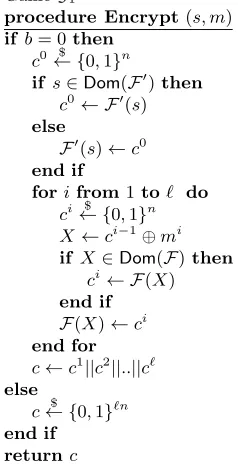
instead. As in the previous security notions, the functionFis generatedviathe lazy sampling method. The gameG1 is given in detail in Fig. 5.
We consider an adversaryB′
attacking the PRF security ofEwhich runsA and simulates these two games by replacing the evaluation ofE orF′
by its own oracle (so that ifB′
is in the real world,Ais in the game G0 but ifB′
is in the random world,A is in the gameG1). IfAmakes q queries to the
Encryptprocedure than B′
makesq′
= q(ℓ+ 1) queries to its own oracle and we have:
P r[G0A⇒1]−P r[G
A
1 ⇒1]≤Adv prf E (B
′
).
GameG1
procedure Encrypt(s, m) if b= 0then
c0 $←{0,1}n
if s∈Dom(F′)then c0←F′(s) else
F′(s)←c0 end if
forifrom1toℓ do X ←ci−1⊕mi ci←E(K, X) end for
c←c1||c2||..||cℓ
else
c←$ {0,1}ℓn end if
returnc
– GameG2: GameG2is identical to gameG1except that instead of the keyed block cipher encryptionE(K,·) with a keyK randomly chosen in the FDE scheme obtained from the CBC-essiv, we use a random functionF instead. As in the previous security notions, the functionFis generatedviathe lazy sampling method. The gameG2 is given in detail in Fig. 6.
Again we consider an adversaryB′′
attacking the PRF security ofE which runs Aand simulates these two games by replacing the evaluation ofE or F by its own oracle (so that ifB′′
is in the real world,Ais in the gameG0 but ifB′′
is in the random world,Ais in the gameG1). IfAmakesqqueries to theEncryptprocedure thanB′′
makesq′
=q(ℓ+ 1) queries to its own oracle and we have:
P r[G1A⇒1]−P r[G
A
2 ⇒1]≤Adv prf E (B
′′
).
GameG1
procedure Encrypt(s, m) if b= 0then
c0 $←{0,1}n
if s∈Dom(F′)then c0←F′(s) else
F′(s)←c0 end if
forifrom1toℓ do ci←$ {0,1}n X ←ci−1⊕mi if X∈Dom(F)then
ci←F(X) end if F(X)←ci end for c←c1||c2||..||cℓ
else
c←$ {0,1}ℓn end if
returnc
Fig. 6.GameG2 CBC-essiv IND-CPA-ufb
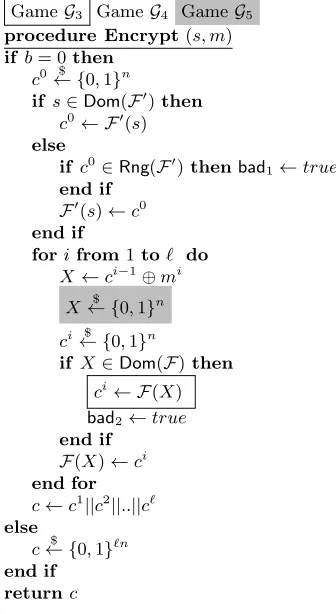
– GameG3: GameG3(see Fig. 7) is identical to gameG1 except that we add Booleanflags in the pseudo-code for the remainder of the proof (see Fig. 7). We have
P r[G2A⇒1] =P r[G
A
– Game G4: The games G3 and G4 (see Fig. 7) are identical except if the Booleanflagbad2 is set totrue. We thus have
P r[G3A⇒1]−P r[G
A
4 ⇒1]≤P r[G
A
3 setsbad2].
GameG3 GameG4 GameG5 procedure Encrypt(s, m) if b= 0then
c0 $←{0,1}n
if s∈Dom(F′)then c0←F′(s) else
if c0∈Rng(F′)thenbad
1←true end if
F′(s)←c0 end if
forifrom1toℓ do X ←ci−1⊕mi
X←$ {0,1}n ci←$ {0,1}n
if X∈Dom(F)then ci←F(X) bad2←true end if
F(X)←ci end for c←c1||c2||..||cℓ
else
c←$ {0,1}ℓn end if
returnc
Fig. 7. GamesG3,G4 andG5 CBC-essiv IND-CPA-ufb. The framed statement is in-cluded in gameG3 only. The statement overlined in gray is included in gameG5 only.
– GameG5: In gameG5(see Fig. 7), the generated ciphertexts in theEncrypt
procedure are independent of the bitband we haveP r[GA
4 ⇒1] = 1/2. Wefirst evaluateP r[GA
5 sets bad1]. For thei-th request to theEncrypt proce-dure, the probability to have a collision for the output of theF′
is at most (i2−n1) then for all the qqueries:
P r[GA
5 sets bad1]≤ q �
i=1 (i−1)
2n =
If the Booleanflagbad1is not set to true, then in the security game, the adversary
Anever queried theEncryptprocedure with two different sector numberssand s′
such thatF(s) =F(s′
). In particular, for each query the valuec0 is random and not revealed toAand by the unique-first-block assumption, it is never used twice with the same plaintext blockm1. We thus have:
P r[GA
4 setsbad2 but notbad1] =P r[GA
5 setsbad2but not bad1] Finally, in gameG5, we have
P r[GA
5 setsbad2]≤
(ℓ+1)q�−1
i=1 i 2n ≤
q2(ℓ+ 1)2 2n+1 .
Summing up, we obtain thatAdvindcbc−−essivcpa−uf b(A) is upper-bounded by
2·AdvprfE (B
′
) + 2·AdvprfE (B
′′
) +q
2(ℓ+ 1)2
2n +
q(q−1) 2n .
Considering an adversaryBattacking the PRF security ofEwhich simply runs B′
with probability 1/2 andB′′
with probability 1/2, we have
AdvprfE (B)≥ 1 2Adv
prf E (B
′
) andAdvprfE (B)≥ 1 2Adv
prf E (B
′′
) and we obtain the claimed bound.
IGE-essiv.The following theorem shows that IGE-essiv achieves IND-CPA-ufb security notion.
Theorem 4 [IND-CPA-ufb Security of IGE-essiv]
Let E:{0,1}k× {0,1}n→{0,1}n be a block cipher. LetAbe an IND-CPA-ufb
adversary against the FDE scheme obtained from the IGE-essiv mode onEsuch that A runs in time t and makes at most q queries to the Encryptprocedure. There exists an adversaryB (attacking the PRF security ofE) such that:
Advindige−−essivcpa−uf b(A)≤2·Adv prf E (B) +
q2(ℓ+ 1)2 2n−1
where B runs in time at most t′
= t+O(q+nq(ℓ+ 1)) and makes at most
q′
=q(ℓ+ 1) queries to its oracle.
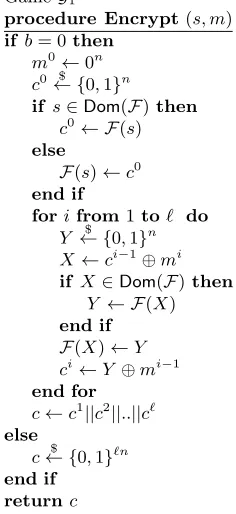
Proof. This proof is similar to CBC-essiv proof. LetG0 be the real-or-random security game as defined in Fig. 3. In the following, we consider a sequences of modified games G1, . . . , G5. We wish to upper bound the advantage of an adversaryAwhich by definition is
Advindige−−essivcpa−uf b(A) = 2·P r[G
A
GameG1
procedure Encrypt(s, m) if b= 0then
m0←0n c0 $←{0,1}n if s∈Dom(F)then
c0←F(s) else
F(s)←c0 end if
forifrom1toℓ do Y ←$ {0,1}n X ←ci−1⊕mi if X∈Dom(F)then
Y ←F(X) end if F(X)←Y ci←Y ⊕mi−1 end for
c←c1||c2||..||cℓ
else
c←$ {0,1}ℓn end if
returnc
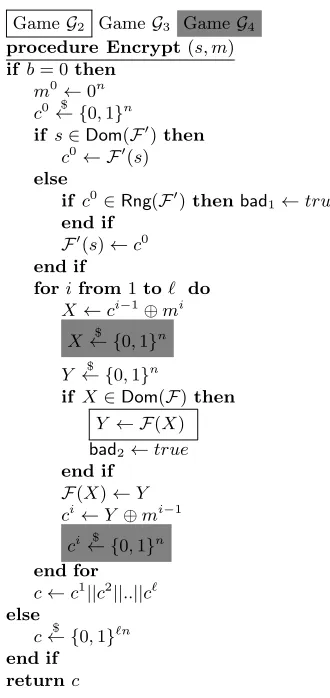
GameG2 GameG3 GameG4 procedure Encrypt(s, m) if b= 0then
m0←0n c0 $←{0,1}n
if s∈Dom(F′)then c0←F′(s) else
if c0∈Rng(F′)thenbad
1←true end if
F′(s)←c0 end if
forifrom1toℓ do X ←ci−1⊕mi
X←$ {0,1}n Y ←$ {0,1}n
if X∈Dom(F)then Y ←F(X) bad2←true end if
F(X)←Y ci←Y ⊕mi−1
ci $
←{0,1}n end for c←c1||c2||..||cℓ
else
c←$ {0,1}ℓn end if
returnc
Fig. 9.GamesG3,G4,G5IGE-essiv IND-CPA-ufb. The statement in box is omitted in gamesG4 andG5. The statement overlined in gray is included in GameG5 only.
– G1 -G3:(see Fig. 8) The only point that changes between CBC-essiv games G0 to G4 is that the ciphertext block is not the output of the PRFΠ but the output XORed with the previous plaintext block.