Available Online atwww.ijcsmc.com
International Journal of Computer Science and Mobile Computing
A Monthly Journal of Computer Science and Information Technology
ISSN 2320–088X
IMPACT FACTOR: 6.017
IJCSMC, Vol. 6, Issue. 12, December 2017, pg.123 – 127
GSM Based Computer Lab Security
System Using PIR Sensors
Chandrakant Bhadranna
Department of P.G Studies and Research in Computer Science Gulbarga University, Kalaburagi, Karnataka, India
_________________________________________________________________________
Abstract— Securing computer lab is very important issue in any college, organization, and computer department. This paper presents a system which uses Arduino and GSM module Global system Mobile communication to monitor and protect the computer lab and various other secure areas. The IP (Internet Protocols) camera is used to capture the images and video, PIR (Passive Infrared Radiating) Sensor is used to detect motions which are produced IR radiating objects. The PIR sensor will detect the IR radiant if security violates on particular place then the PIR sensor will detect the motion and it will intimate through call to the owners to alert about security violation.
Keywords— Arduino, GSM, IP Camera, PIR, Sensors.
______________________________________________________________________________________
I. INTRODUCTION
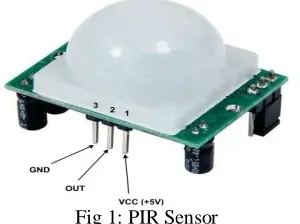
PIR sensors (Fig 1) are widely applied in wireless residential security systems, home alarms systems and many more security circuits as motion detector sensors. A typical PIR sensor detects the Infrared Red (IR) waves from human body and so it is also known as „human sensor‟. When anybody comes in range of PIR sensor, then sensor sends a logic signal to microcontroller and take control and perform a given task.
II. RELATED WORK
Sheikh I. Azid, and Bibhya Sharma [1] has proposed an Intelligent Home which is SMS Based Home Security System with Immediate Feedback for the secure operation. This proposed system will send an emergency SMS to the user and relevant civil authority in an average of 9.16s.
Mahendran.N, Geo Joe Mathai & Veenesh.M.U [2] Proposed Building Automation system which will control the applications based on its time based profile connected via a serial protocol named as I2C communication. This time based profile is modified by user defined. It also has the ability to communicate, organize and manage the time using Zigbee. This BAS can be used for building “Intelligent Automation System” for connecting multiple sensor input/ output unit interconnections with Arduino.
Sadeque Reza Khan, Ahmed Al Mansur, Alvir Kabir, Shahid Jaman & Nahian Chowdhury [3] has designed a Low Cost Home Security System using GSM Network. The proposed system is SMS based and uses wireless technology to revolutionize the standards of living and it provides ideal solution to the problems faced by home owners in daily life.
III. PROPOSED SYSTEM
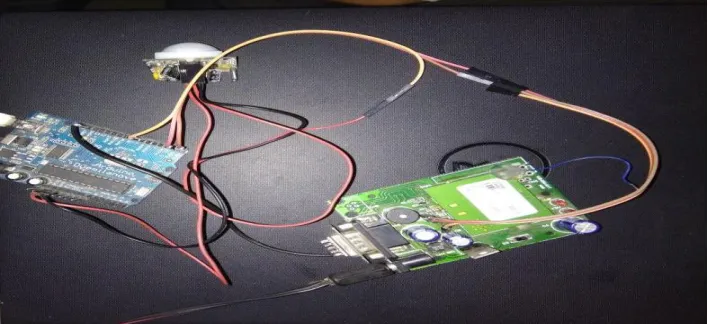
Security has been a major issue where the crime is increasing day by day everyone wants to take proper measures to prevent crime. The arduino GSM module PIR sensors module are attached to main doors of computer labs and the sensor will detect the motion which is produced by humans, animals, other objects, inferred radiation produce to detect the objects, the PIR sensor will send the signals to arduino board inbuilt microcontroller by using microcontroller the devices can operate easily and it will read the signal, the PIR sensor after reading the arduino will send those signals to GSM module. It will act like mobile phone the GSM module use to make call to the registered numbers and will watch the video live on own mobile phone through labs, the IP cameras is essential to watch the lab environment at the time of motion detection. The range of a typical PIR sensor is around 6 meters or about 30 feet. For proper operation of PIR sensor, it requires a warm up time of 20 to 60 seconds. This is required because, the PIR sensor has a settling time during which it calibrates its sensor according to the environment and stabilizes the infrared detector. If the sensor is not given enough calibrating time, the output of the PIR sensor may not be reliable and its output will be high when it detects motion.
The PIR sensor modules usually have 3-pin connection: +Vcc, Output, and Ground. The pinout may vary, and it can be powered through 5-12 Volts power supply as it has its own voltage regulator on board. The output goes high when the motion is sensed.
Besides it also has a 3-pin jumper selection for single or continuous trigger output mode. The two positions have labels H and L. When the jumper is at H position, the output remains high when the sensor is re-triggered repeatedly. In position L, the output goes high and low every time the sensor is triggered. So a continuous motion will give repeated high/low pulses in this mode. The front part of the sensor module has a Fresnel lens to focus the infrared light on to the sensor element.
Figure 2: Circuit Diagram for Motion Detection Using PIR Sensor
As a comparator, the IC741 is set up –which consists of 8 pins. Wherein the pin3 is allocated as the reference input, while the Pin2 as the sensing input. When the collector terminal of the transistor goes low, then the potential pin2 of the IC becomes lower than the potential pin3. Immediately it makes the output of the IC high, triggering the relay driver consisting of another transistor and relay. The relay triggers and switches on the alarm device, which is connected to the circuit.
The capacitor 100uF/25V makes sure that the relay remains on even after the passive infrared sensor is turned off possibly due the exit of the radiation source. The PIR sensor device must be properly enclosed in a Fresnel lens cover to ensure that its efficiency is sufficiently enhanced.
Figure 3: Components used in GSM Based Computer Lab Security System Using PIR Sensors
Algorithm: ”GSM Based Computer Lab Security System Using PIR Sensors”
Step 1: Start
Step 2: To initialize the PIR Sensor
Step 3: To check if (PIR=1) true, go to next step4 if (PIR=0) false, go to step1
Step 4: To Send the signal to the Arduino Device Step 5: To Send the signal to GSM Device Step 6: Call to Registered Mobile Numbers Step 7: Stop
Specifications
GSM SIM900A (MINI V3.9.2)
Arduino Uno Board and USB Cable
IP Camera.
Jumper Wires 8 to 10
Power adapter 5Volts
GSM SIM Card
Features
Allows data transmission and reception across GSM networks at speeds up to 9,600 bps currently.
IV. CONCLUSIONS
Securing computer lab in colleges, organization and other department is important issue today. The proposed GSM based computer lab security system is designed using Arduino, PIR motion detection sensor and GSM module to provide security to such areas. This proposed system will intimate through call to the owners to alert about security violation.
REFERENCES
[1] Sheikh I,Azid, BibhyaSharma, "Intelligent Home: SMS Based Home Security System”, With Immediate Feedback, World Academy of Science, Engineering and Technology,Vol.72, 2012.
[2] Mahendran .N,Geo Joe Mathai, Veenesh.M.U,"Multiplesensor feeding supported, building automation system Using arduino platform”, With Exposure of 802.15.4 Functionalities, International Journal of Engineering Trends and Technology, Vol. 4, Issue 2, 2013.
[3] Sadeque Reza Khan, Ahmed Al Mansur, AlvieKabir, ShahidJaman, Nahian Chowdhury,"Design and Implementation of Low Cost Home Security System Using GSM network", International Journal of Scientific and Engineering Research, Vol. 3, Issue 3, 2012.
[4] R.Piyare, M.Tazil,” Bluetooth Based Home Automation System Using Cell Phone”, 2011 IEEE 15th International Symposium on Consumer Electronics.
[5] G. M. Sultan Mahmud Rana, Abdullah Al Mamun Khan, Mohammad NazmulHoque, Abu FarzanMitul, ”Design and Implementation of a GSM Based Remote Home Security and Appliances Control System” , International Conference on Advances in Electrical Engineering (ICAEE), pp. 291-295, 2013.
[6] N. Shriskanthan, F. Tan, A0. Karande,‟Bluetooth Based Home Automation System‟, Microprocessors and Microsystems, Published by Elsevier,Vol.26, No.6, pp.281-289, 2002.
[7] S. Kanagamalliga, S. Vasuki, A. Vishnu Priya, V. Viji, “AZigbee and Embedded based Security Monitoring and Control System”, International Journal of Information Science and Techniques(IJIST),Vol.4, No.3,pp.173-178, 2014.
[8] Y. Tajika, T. Saito K. Termoto, N. Oosaka, M. Isshiki, “Networked Home Appliances System using Bluetooth Technology integration Appliance Control /Monitoring with Internet Service”,Vol.49, No.49, pp. 1043-1048, 2003.
[9] Wuhan, China, “An Improved Short Message Security Protocol for Home Network”, Industry Applications Society Annual Meeting, Conference Record of the 1994 IEEE Publication, 1994, pp. 2121-2125.