76 |
P a g e
REVIEW OF NUMERICAL SOLUTION TO THE
DETECTION OF CRACK IN STRUCTURE BY USING
FUZZY LOGIC
Mr. Patil Amit V.
1, Prof. Meghna Pathak
2, Dr. P.K. Sharma
3.
1
Research scholar,
2Professor ,
3H.O.D. Mechanical Department,
N.R.I. Institute of Information Science and Technology, Bhopal, M.P.(India)
ABSTRACT
This paper is review of the solution to the crack detection in structure using Fuzzy logic. Crack is the
discontinuation in a body. The presence of crack leads to changes in some of the lower natural frequencies. The
concept of vibration can be applied to identify the crack location.Since most human activities involve vibration
in one form or other. The vibrations having certain amplitude and frequency may be reliable for human being.
Modern non-destructive techniques to detect the cracks are time consuming. Fuzzy logic technique is the
alternative for non-destructive Testing techniques. This technique gives approximate solution for the crack
detection in structure.
Keywords: Crack Detection, Fuzzy Logic, Nondestructive Method, Review Paper.
I INTRODUCTION
For crack detection of structure, vibration based methods make a good approach. Vibration based methods use
the fact that due to the presence of the crack, there is a change in the flexibility which affects the natural
frequency of the structural element.The rule-based fuzzy logic provides a scientific formalism for reasoning and
decision making with uncertain and imprecise information.This proposes online crack detection methodology
embedded with a new intelligent Fuzzy Interface System. In this approach a fuzzy logic controller is designed
and implemented for identifying relative crack depth and location. The designed fuzzy controller has three
inputs and two outputs. The inputs for fuzzy controller are three modes of natural frequencies and two outputs
are relative crack depth and relative crack location.Vibration-based methods have been proved as a fast and
inexpensive means for crack identification. A crack in a structure induces a local flexibility which affects the
dynamic behaviour of the whole structure to a considerable degree. It results in reduction of natural frequencies
and changes in mode shapes. An analysis of these changes makes it possible to determine the position and depth
of cracks. Most of the researches used in their studies are open crack models, that is, they assume that a crack
remains always open during vibration. The assumption of an open crack leads to a constant shift of natural
II LITERATURE REVIEW
Research of different researchers on crack detection in structure is as follows.
Amiya Kumar Dash represents the multi crack detection of structure using fuzzy Gaussian technique.
He derived from thevibration parameters numerical methods of the cracked cantilever beam to set
several fuzzy rules for designing the fuzzy controller used to predict thecrack location and depth.
Dayal R. Parhi and Sasanka Choudhury a cantilever beam with a single crack has been taken into
consideration. Finite element method is used to find out the natural frequencies of the faulty cantilever
beam. A fuzzy controller has been designed using trapezoidal, Gaussian as well as triangular
membership function to find out the crack depth and crack location.
Meysam Siyah Mansoory attempt to evaluate the performance of the SUSAN edged Detector for noisy
images based on fuzzy thresholding. Experimental results have demonstrated that the SUSAN edge
Detector works quite well for digital images noisy with Gaussian noise Because the SUSAN algorithm
uses no derivative too the proposed algorithm is less sensitive to noise than other edge detectors.
Meanwhile this algorithm in comparison with other method had processing time less than other in this
field.
N. V. NarasimhaRao Rao proves the vibration analysis of crack cantilever beam with open transverse
crack. A fuzzy logic interface system is used to analyze the crack in cantilever beam. A series of fuzzy
rules are used finally for prediction of crack depth and crack location.
D.K. Agarwalla concludes crack detection and localization is the main topic of discussion for various
researchers across the globe. It is concluded that results obtained from experiment have a very good
agreement with the results obtained from FEM and the structure vibrates with more frequency in the
presence of a crack away from the fixed end.
R. Tiwari and M. Karthikey developed identification procedure for the detection, localization, and size
of a crack in a beam based on forced response measurements. They used circular beam supported by
rolling bearings at both ends for this experiment.
S Lalonde J Lanteigne, F Leonard, and Y Turcotte studied cracks that occurred in metal beams
obtained under controlled fatigue-crack propagation.
An analytical and experimental approach by H. Nahvi and M. Jabbari et al. to the crack detection in
cantilever beams by vibration analysis. Sensibility analysis of the inverse problem of the crack
parameters (location and depth) determined by M. B. Rosales, C P Filipich and F S Buezas et al. An
efficient numerical technique is necessary to obtain significant results.
III THEROTICAL FORMULATIONS
For crack depth and location,the terms RCD and RCL are considered and calculated by the formula,
78 |
P a g e
RCD = (2)
It is assumed that the natural frequency changes due to the change in moment of inertia only. The beam made up
of structural steel material by extrusion process. The Young’s modulus for the beam material of length 700 mm
is 210 109 N/m2.The beam models no. 1 to 5 is of rectangular cross section while beam model from 6 to 10 are
of square cross section.
IV FUZZY LOGIC TECHNIQUE
Fuzzy logic system is inspired by the remarkable human capability to operate on and reason with
perception-based information. The rule-perception-based fuzzy logic provides a scientific formalism for reasoning and decision
making with uncertain and imprecise information. A general model of a fuzzy inference system (FIS) is shown
in Figure 2. The fuzzifier maps input numbers into corresponding fuzzy memberships. This is required in order
to activate rules that are in terms of linguistic variables. The fuzzifier takes input values and determines the
degree to which they belong to each of the fuzzy sets via membership functions. The inference engine
definesmapping from input fuzzy sets into output fuzzy sets.
Fig:1 Diagram of a Fuzzy Interface System Fig: 2 Block Diagram of Fuzzy Interface System
For a given input, more than one rule may fire. Also, in an FIS, multiple regions are combined in the output
space to produce a composite region. A general schematic of an FIS is shown in Figure1.
Fuzzy rules are fired in parallel, which is one of the important aspects of an FIS. In an FIS, the order in which
rules are fired does not affect the output. The defuzzifier maps output fuzzy sets into a crisp number. Given a
fuzzy set that encompasses a range of output values, the defuzzifier returns one number, thereby moving from a
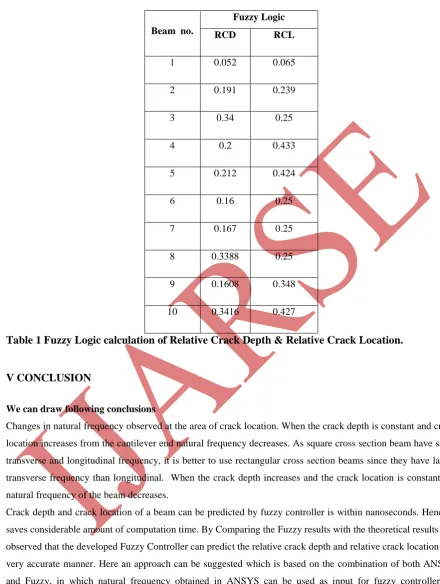
fuzzy set to a crisp number. The result of fuzzy logic or outputs from fuzzy logic has been tabulated in Table 1.
Here input for fuzzy logic is different modes of natural frequency and output will be relative crack depth and
relative crack location. The natural frequency are obtained from finite element formulation are taken for
Beam no.
Fuzzy Logic
RCD RCL
1 0.052 0.065
2 0.191 0.239
3 0.34 0.25
4 0.2 0.433
5 0.212 0.424
6 0.16 0.25
7 0.167 0.25
8 0.3388 0.25
9 0.1608 0.348
10 0.3416 0.427
Table 1 Fuzzy Logic calculation of Relative Crack Depth & Relative Crack Location.
V CONCLUSION
We can draw following conclusions
Changes in natural frequency observed at the area of crack location. When the crack depth is constant and crack
location increases from the cantilever end natural frequency decreases. As square cross section beam have same
transverse and longitudinal frequency, it is better to use rectangular cross section beams since they have larger
transverse frequency than longitudinal. When the crack depth increases and the crack location is constant the
natural frequency of the beam decreases.
Crack depth and crack location of a beam can be predicted by fuzzy controller is within nanoseconds. Hence it
saves considerable amount of computation time. By Comparing the Fuzzy results with the theoretical results it is
observed that the developed Fuzzy Controller can predict the relative crack depth and relative crack location in a
very accurate manner. Here an approach can be suggested which is based on the combination of both ANSYS
and Fuzzy, in which natural frequency obtained in ANSYS can be used as input for fuzzy controller for
80 |
P a g e
VI ACKNOWLEDGMENT
The author would like to thank Prof. Meghna Pathak (Guide) and Dr. P. K. Sharma (HOD), Mechanical
Department, N.R.I. Institute of Information and Technology, Bhopal, Madhya Pradesh. India. I am also thankful
to the blessing of Family, Teacher’s and my friends are the main cause behind the successful completion of this
paper. I wish to acknowledge great moral support given by management of N.R.I. Institute of Information and
Technology, Bhopal, Madhya Pradesh. India.
REFERENCES
Journal Papers:
[1]. M. Chati, R. Rand and S. Mukherjee, “Modal analysis of a cracked beam”, journal of sound and vibration,
vol. 207(2), 1997, pp. 249-270
[2]. A. Dixit, S. Hanagud, “Single beam analysis of damaged beams verified using a strain energy based damage
measure”, International Journal of Solids and Structures, vol. 48, 2011, pp. 592-602.
[3]. Prashant M. Pawar, Ranjan Ganguli, “Genetic fuzzy system for damage detection in beams and helicopter
rotor blades”, Journal of Comput. Methods Appl. Mech. Engrg. Vol. 192, 2003, pp. 2031–2057
[4]. Mohammad R. Jahanshahi, “An innovative methodology for detection and quantification of cracks through
incorporation of depth perception”, Journal of Machine Vision and Applications, Feb 2011, pp. 3-11
[5]. N. V. NarasimhaRao, “Fault diagnosis of dynamic cracked structure using fuzzy interface system”,
International Journal of Emerging Trends and Engineering Development, Vol.5, Jul 2012, pp. 1-10
[6]. Sasanka Choudhury and Dayal Parhi R, “Crack detection of a cantilever beam using Kohonen network
techniques”, Global Advance Research Journal of Engineering, Technology and Innovation, Vol. 2(5),
June 2013, pp. 153-157
[7]. Pankaj Charan Jena, Dayal R. Parhi, GoutamPohit, “Faults detection of a single cracked beam by theoretical
and experimental analysis using vibration signatures”, IOSR Journal of Mechanical and Civil Engineering,
Volume 4, Issue 3 (Nov-Dec. 2012), PP 01-18
[8]. Maosen Cao, Lin Ye, Limin Zhou, Zhongqing Su, RunboBai, “Sensitivity of fundamental mode shape and
static deflection for damage identification in cantilever beams”, journal of Mechanical Systems and Signal
Processing, vol. 25, 2011, pp. 630- 643
[9]. Meysam Siyah Mansoory, “Automatic crack detection in eggshell based on SUSAN Edge Detector using
Fuzzy Thresholding”, Journal of Modern Applied Science, Vol.5 No.6, Dec 2011, pp. 1-9.
[10].Z. A. Jassim, N.N. Ali, F. Mustapha, N.A. Abdul Jalil, “A review on the vibration analysis for a damage
occurrence of a cantilever beam”, Journal of Engineering Failure Analysis, vol. 31, 2013, pp. 442–461 [11].P. K. Jenaa,, D. N. Thatoi, J. Nanda, D. R. K. Parhi, “Effect of damage parameters on vibration signatures
of a cantilever beam”, journal of Procedia Engineering, vol. 38, 2012, pp.3318 – 3330
[13].Kaushar H. Barad, D. S. Sharmaa, Vishal Vyas, “Crack detection in cantilever beam by frequency based method”, journal of Procedia Engineering, vol. 51, 2013, pp. 770-775
[14]. H. Nahvi, M. Jabbari, “Crack detection in beams using experimental modal data and finite element
model”, International Journal of Mechanical Sciences, Vol. 47, 2005, pp. 1477–1497
[15].Dayal R. Parhi And Sasanka Choudhary, “Smart crack detection of a cracked cantilever beam using fuzzy logic technology with hybrid membership functions”, Journal of Engineering And Technology Research, Vol. 3(8), Aug. 2011, pp. 270-300
[16].Marta B. Rosales, Carlos P. Filipich, Fernando S. Buezas, “Crack detection in beamlike structures”, journal
of Engineering Structures, vol. 31, 2009, pp. 2257-2264
[17]. Gilbert Rainer Gillich, Zeno Losif Praisach, “Modal identification and damage detection in beam-like
structures using the power spectrum and time-frequency analysis”, journal of Signal Processing, vol. 96,
2014, pp. 29-44
[18]. Amiya Kumar Dash, “Analysis of adaptive fuzzy technique for multiple crack diagnosis of faulty beam
using vibration signatures”, Journal of Advances in Fuzzy Systems, Vol. 1, 2013, pp. 16 pages.
Books