Available Online atwww.ijcsmc.com
International Journal of Computer Science and Mobile Computing
A Monthly Journal of Computer Science and Information Technology
ISSN 2320–088X
IJCSMC, Vol. 4, Issue. 4, April 2015, pg.137 – 141
RESEARCH ARTICLE
Processing and Enhancement of Palm Vein
Image in Vein Pattern Recognition System
Dipti Verma
Dr. Sipi Dubey
Research scholar RCET,
Dean (R&D) RCET,
Bhilai (C.G) India
Bhilai, (C.G) India
[email protected]
[email protected]
Abstract - Now a day’s biometric is playing a key role in several fields. A captured image from any kind of sensing element must be processed before the extraction of features. This paper discusses about image processing approach for vein pattern. Hand vein patterns are among the biometric traits being investigated today for identification purposes, attracting interest from both the research community and industry. As an important member of biometric family, the vein patterns rely on the interior biological information of the body, and therefore, cannot be easily damaged, changed or falsified. This paper includes filtering techniques, contrast enhancement strategies and segmentation processes. During this work, five different image filtering methods are used to remove noise from the image. This paper presents image enhancement operations and there result when applied on multispectral vein image. The noise removal and enhancement operations are much helpful to extract the vein pattern and features.
Keywords: vein pattern, palm vein, noise removal, image enhancement
I. INTRODUCTION
II. THE FRAMEWORK OF THE PROPOSED METHOD
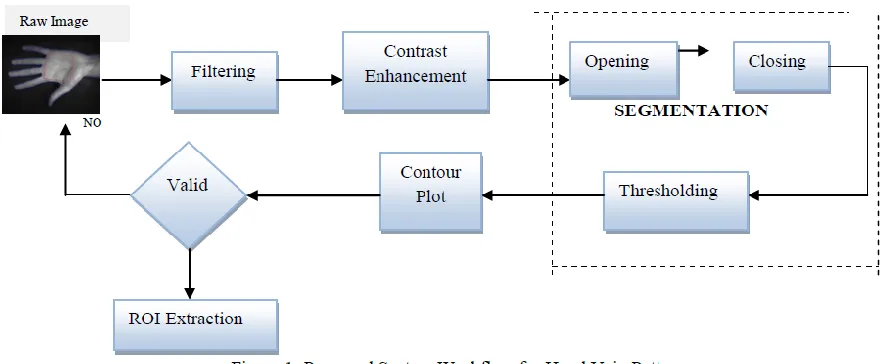
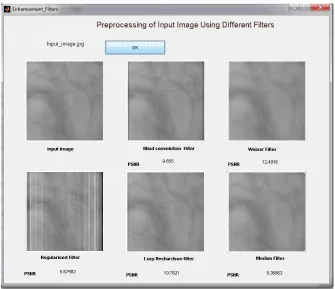
In the proposed method different image processing strategies is discussed. Initially filtering process is applied on the captured vein pattern image to remove the noise from the image. There are a lot of filters but in this paper five filters are used: median filter, blind convolution filter, Weiner filter, Regularised filter and Lucy Rechardson filter[1]. After that contrast is enhanced by methods such as histogram equalization, adaptive method and adjust method. The framework of the proposed method comprises of the following processes:
A. Acquisition of Vein Images
The hand of an individual is placed above the sensing element to obtain the essential features of the vein patterns. Veins are found beneath the skin and thus, it is very difficult to obtain the vein pattern in visible light. To capture the vein images, a CCD camera with near infrared is employed.
Figure 2. ROIs of the front hand vein.
B. Noise Reduction in the Vein Pattern
The clearness of the vein pattern varies from image to image. Thus, there is a need to enhance the quality of the image to obtain the vein structures. Two types of filters are commonly used: linear filters and nonlinear filters to reduce the noise from the vein image. Every filter has its place in image processing functions. A specific filter is used for a particular noise. Which type of filter is to be used, it depends on the nature of noise in it and the image data. In this proposed work Median filter as proposed by S. Zhao, Y. Wang and Y. Wang [3] to suppress noises that exist in the vein pattern is used. This allowed to get noise free vein pattern for further processing. However, it was found that Wang and Leedham [4] applied a 5x5 Median filter to suppress the impact of high frequency noise.
proposed system work noises are removed by five different filters. Weiner and Median filter are more oftenly used for removing the noise from the captured vein image.
1. Averaging Filter/Low Pass Filter:-
One method of reducing noise is pixel averaging. Replace each pixel by the average of pixels in a square window
surrounding this pixel [6]. But there are some problems with Averaging Filter. It blur the edges and details in an
image and also not effective for impulse noise (Salt and pepper). So, one can remove noise by average filter but it will blur the image with some degree of level.
2. Median Filter:-
In the window sort all the neighborhood pixels in an increasing order, take the middle one as median pixel [3]. Instead of a local neighborhood pixel‟s average or weighted average, compute the median of the neighborhood pixels in the window. It removes outliers and doesn‟t average (blur) them into result and also preserve edge, but slow to compute.
When the amount of noise is large in input image data and the magnitude is low, in that case a linear low-pass filter is preferred. Conversely, if amount of noise is low but with relatively high magnitude, in that case a median filter may be more appropriate.
3. Wiener Filter :-
The goal of the Wiener filter is to compute a statistical estimate of an unknown signal using a related signal as an input and filtering that known signal to produce the estimate as an output. For example, the known signal might consist of an unknown signal of interest that has been corrupted by additive noise. The Wiener filter can be used to filter out the noise from the corrupted signal to provide an estimate of the underlying signal of interest[6].From the results of the many images undergone the process of removal of noise only Wiener filters and Median filters are giving effective results w.r.t noise while capturing the vein image.
C. Contrast Enhancement
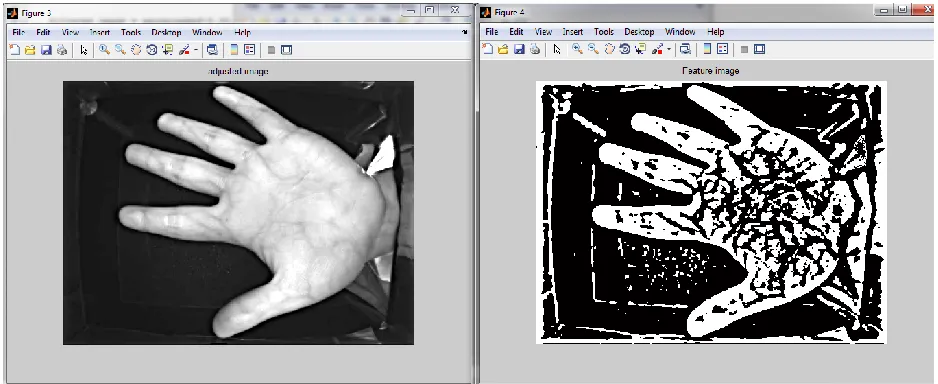
While the use of IR image capturing makes the veins stand out more clearly, it is usually necessary to further improve the contrast before segmenting the image. It can be enhanced by histogram, adjusting or adaptive method. The contrast that varies all over the vein image is adjusted. An image enhancement is one of the key stages of image processing to enhance the contrast of the image. The output of the image after contrast enhancement is shown below.
D. Segmentation of the Hand Vein Pattern
Image segmentation is a process that partitions a digital image into multiple segments. It is used to simplify and change the representation of an image into a form that is more meaningful and easy to analyze. Objects and boundaries (lines and curves) in an image are located by this process. Segmentation is a process of assigning a label to every pixel in an image such that the pixels with the equivalent label share a common characteristic. First, the hand is extracted which is the region of interest, from the background. Then the vein patterns are extracted.
The simplest technique of image segmentation is threshold technique. A threshold value is there to turn a gray-scale image into a binary image. The vein pattern is then thresholded using different threshold values. Thresholding is the most common segmentation method which is computationally quick and inexpensive. Local thresholding is employed to convert the grayscale image into a bi-level representation which are black with „0‟ pixel and white with „255‟ or „1‟ pixel. This technique applied on the vein image in order to extract and outline the vein pattern[7]. After out the various processes, the vein pattern is extracted. The output of the image after segmentation is shown below.
Figure 4. Contrast Enhancement and Segmentation of the palm vein image
III. EXPERIMENTAL RESULTS
An experiment is carried out at MATLAB; which is software computing tool. In the experiment, palm vein image and palm dorsal vein are read which is a captured under near infrared illumination. An experiment is focused on noise removal and enhancement of image. These operations are performed on multispectral palm vein image and useful to extract palm vein pattern from an image for further processing. The experimental work and image enhancement result can be summarized as follows-
3. Vein patterns are extracted and shown in bi-level representation i.e, in 0‟s and 1‟s in the output window as featured image above, figure 4.
IV. CONCLUSION
The image processing is the first step in overall processing for vein recognition system. Image processing is done by some operations such as image enhancement, filtering and segmentation that are performed to make the image with better quality and to extract the region of interest for feature extraction. The result shows to what extent image enhancement operations and filtering operations are useful to trace or highlight the vein pattern that lies in palm of hand and on dorsal hand. From the above type of filters it can be concluded that wiener and median filter performs better than other filter because other filter blur the edges of the image while median filter only removes the noise. The result also shows enhancement in an image that shows palm features in vein structure as well as palm principal lines more enhanced. These features are useful for pattern matching or simply classification of an individual. So the objective of experiment is successful and leads to extract the palm vein pattern from a multispectral image; which are not easily spoofed, observed, damaged, obscured or changed and also vein pattern technology is perceived as secure as it incorporated “aliveness” detection.
REFERENCES
[1] Dipti Verma and Dr.Sipi Dubey, “A survey on biometric authentication techniques using Palm vein feature”, Journal of global research in computer science JGRCS ,vol-5 no-8,ISSN-2229 371X,2014.
[2] Dipti Verma and Dr.Sipi Dubey, “ Two Level Centre of Gravity Computation –An Important Parameter for Offline Signature Recognition” in IJCA 2012,SEPT.VOL54, ISSUE 6.
[3] Shi Zhao, Yiding Wang and Yunhong Wang, “Extracting Hand Vein Patterns from Low-Quality Images: A New Biometric technique Using Low-Cost Devices”, IEEE, 4th International Conference on Image and Graphics, 2007.[2] Wang Lingyu,
[4]Graham Leedham, “Near- and- Far- Infrared Imaging for Vein Pattern Biometrics”, Proceedings of the IEEE International Conference on Video and Signal Based Surveillance, 2006.
[5]Hyeon Chang LEE, Byung Jun KANG, Eui Chul LEE, Kang Ryoung PARK, «Finger vein recognition using weighted local binary pattern,» Journal of Zhejiang University-SCIENCE C (Computers & Electronics), pp. 514-524, 2010.
[6] Rafael, C. Gonzalez and Richard E. Woods “Digital Image Processing” Second Edition.
[7]Wang Kejun, Ding Yuhang, Wang Dazhen, “A Study of Hand Vein-based Identity Authentication Method”, Science & Technology Review, 23(1): 35-37, 2005.
[8]S.K.Im. A Biometric Identification System by Extracting Hand Vein Patterns. Journal of the Korean Physical Society, 38(3): p.268-272, 2003.
[9]T.Tanaka, N.Kubo. Biometric authentication by hand vein patterns. In SICE 2004 Annual Conference. 2004. [10]Miura, N., A. Nagasaka, and T. Miyatake, “Feature extraction of finger-vein patterns based on repeated line tracking and its application to personal identification”, Machine Vision and Applications, 2004.15(4), pp. 194-203. [11]Li, Xueyan, Guo, Shuxu, Gao, Fengli, and Li, Ye, “Vein Pattern Recognitions by Moment Invariants”, The 1st International Conference on Bioinformatics and Biomedical Engineering, 2007, pp. 612-615.
[12]Naoto MIURA, Akio NAGASAKA, and Takafumi MIYATAKE, “Extraction of Finger-Vein Patterns Using Maximum Curvature Points in Image Profiles”, The Institute of Electronics, Information and Communication Engineers, 2007. 90(8), pp. 1185-1194.