Optimization Of Avocado Fruit Pulp Incorporated
Chapati Using Response Surface Methodology
Jobil.J.Arackal, S.Parameshwari
Abstract: The sensory attributes are pivotal in catching buyer's eye and therefore affecting their inclinations and purchasing choices for sustenance items. Foldability, pliability, etc. are sensory attributes which are ordinarily used to depict the chapatis quality, as well as to predict consumer acceptance. The Statistical modeling and optimization approach has been utilized to model and optimize avocado fruit pulp incorporated chapati formulation compression process via response surface methodology. The 3-level central composite design has been selected by avocado fruit pulp; water; wheat flour as input variables and chapati characteristics (tearing strength, eating quality, foldability, overall acceptances) as output variables. Non-linear regression models have obtained concerning output variables (tearing strength, pliability, eating quality, foldability, overall acceptances) with R2 values of 0.79, 0.84, 0.86, and 0.79 for tearing strength, eating quality, foldability, overall acceptances, respectively. An effect of individual, square and interaction terms on the avocado fruit pulp incorporated chapati sensory attributes have been summarized through the significance test and depicted through response surface plots. An optimized chapati sensory characteristic of the best product identified. The good ingredients variation are avocado fruit pulp 150 gm water 35 ml wheat flour 100gm of ratio. The results demonstrated the reliability of the proposed statistical approach to model and optimized the compression studies of avocado pulp incorporated chapati formulation.
Index Terms: Avocado fruit pulp, Central Composite Design, Optimization, Statistical Modelling, Sensory. —————————— ——————————
1.
INTRODUCTION
The market and society mandate for highly nutritional foods and new varieties with low-cost products, such as researchers are concentrating to study different ingredients to produce highly nutritional stable and palatable foods. This is a help to offer different foods to society. Traditionally, Indian foods are classified into three main categories, cooked vegetables, milk, and fresh fruits. The fruit and vegetables are crucial for good health, it is one of the important portions of a healthy diet for all age categories. Importance of nutritional composition of fruits is due to its color, exclusive flavor, odour, and other constructive components. Fruit like avocado, pineapple, apple, lemon, orange, and carrot are the higher source of antioxidants and bioactive compounds also. The avocado fruit popularly known as butter fruit, it is tropical fruit originated from Mexico (Persea Americana).avocado can be gateway fruit to the future in India. It is drenched with a high amount of bioactive components and phytochemicals also, which are responsible for cardiovascular medical advantages, the fruit plays a major role in defending against the advancement of CHD (coronary heart disease) (Weschenfelder, Lorenzon dos Santos, Lopes de Souza, Paiva de Campos, & Marcadenti, 2015). The medicinal properties in obesity, hypertension, hyperlipidemia, and hypercholesterolemia provided by the fruit suggested it be known as a functional food (Pahua-Ramos et al., 2014). The rich sources of good lipids present in avocado, the supreme percentage of lipids profile (MUFA; monounsaturated fatty acids about 15.63 per 100 g of fruit) and 12.4 percent of PUFA (polyunsaturated fatty acids) also. Oleic acid (C18:1), is the most dominant MUFA in the diet the entire fatty acids found in the butter fruit was 58.6 percent. (Gillingham, Harris-Janz, & Jones, 2011). Yahia
and Woolf (2011) stated that butter fruit is regularly consumers consumed by fresh or used as a salad and spread, as well as guacamole. Still, the creamy consistency of avocado flesh recommends being used as fat replacer as to different usage of fruits. Consumers are mandated for nutritious food so the researcher identified butter fruit pulp incorporated chapati satisfy the consumer's demands and also healthy food. Avocado fruit pulp incorporated chapati not available in the market (commercially) in India in this study not carried out on any preservation of the developed chapati. Materials composition of avocado fruit pulp incorporated chapati was optimized (RSM) method to complete good sensory attributes of the products.
The response surface methodology (RSM) is a gathering of measurable and exact strategies accommodating for emerging, improving, and enhancing process (Myers & Montagomery, 2002). The standards of the methodology are clarified by (Henika1972, 1982) and (Giovanni 1983). It is planned relapse investigation intended to foresee the estimation of a needy variable dependent on the controlled estimations of the free factors (Meilgarrd, Civille &Carr; Resurreccion, 1998). The utilization of RSM in the process improvement stage prompts the requirement for a trial structure, which can produce loads of tests for buyer assessment in a brief period, and in this manner, research facility level tests are progressively proficient (Moskowaitz,1994). From the parameters gauges, it very well may be resolved which variable contributes the most to the forecast model, in this manner enabling the items specialist to concentrate on the factors that are most essential to the item response (Schutz, 1983) in the present investigation, RSM was utilized to decide the ideal handling states of creating avocado natural product mash fused chapati and its sensory characteristics.
_______________________
Jobil .J. Arackal-Ph.D. Scholar-Department of Nutrition and Dietetics
Periyar University, India (E-mail:[email protected]) Dr.S.Parmeshwari-Associate Professor- Department of
Nutrition and Dietetics Periyar University, India (E-mail
1368
2. MATERIALS AND METHODS
2.1. Ingredients
The fully matured and ripened Persea Americana (Avocado) fruits were procured from horticulture Research Station (HRS), in Kodaikanal, Tamil Nadu, during June - August 2018. All other ingredients procurement from the local marketplace in Salem district, Tamil Nadu, India.
2.2 Experimental design
The study evaluates of effects and optimizes the proportions of Persea Americana (A), water (B) wheat flour(C) in the chapati based on their nutritional and sensory characteristics. The design and experimental levels for three factors presented in Table 1.
2.3 Preparation of chapati
Chapati was set up from every composite avocado fruit pulp and flour mix by following the strategy revealed by past specialists with slight alterations (Gujral and Gaur, 2002; Rao et al., 1986). Every blend was blended with ideal water in a Hobart benchtop blender (5KPM50, USA) for 3 min. The ideal water was resolved subjectively till smooth, strong, non-sticky mixture which is anything but difficult to deal with and appropriate for constant sheeting without splitting was acquired. The mixture was given a rest for thirty minutes. Mixture (50g) was adjusted, put in the focal point of an exceptionally structured stage. To encourage the moving of batter to a uniform thickness of 2mm, an open rectangular aluminum edge was utilized. The mixture was moved with the assistance of a wooden moving pin. The length of the moving pin surpassed the width of the casing; along these lines, roller power was connected to the mixture just when its thickness surpassed the tallness of the casing. The casing was set ready gave on the level structure. The batter sheet was then cut into a hover of 15 cm in breadth by utilizing a bite the dust with a sharp edge. The crude chapati was deliberately expelled from the stage
and heated on the two surfaces on a thermostatically controlled hot plate. It was permitted to cool for 10 min at 25 °C and utilized for further examination.
2.4 Sensory analysis
Butter fruit incorporated chapati was put away at room temperature. The sensory assessment was directed by a board of judges utilizing 9 points hedonic scale. The evaluations of scale for assessment of sensory characteristics were extremely disliked (1), very dislike (2),moderately dislike(3),slightly dislike (4),not dislike or not like(5),slightly like(6),moderately like(7),very much like(8),and extremely like(9). Sensory properties considered were appearance, tearing quality, malleability, taste and fragrance, eating quality, foldability, and overall acceptability
2.5 Experimental plan for streamlining of detailing
The three ingredients (free factors) of the chapati utilized in the analysis were avocado organic product mash, water, and wheat flour. The level scope of the fixings utilized in the examination was resolved to utilize fundamental preliminaries. The degrees of fixings in coded and un-coded structure for the planning of chapati are exhibited in Table 1. Face-centered central composite structure (CCF) with six imitates at the inside indicate was utilized to create prescient models for examining consequences for tactile properties of chapati. This structure was chosen as it is a cubic plan, contains center focuses that are arranged at a separation of α from the focal point of the plan. Alpha takes an estimation of ± 1 in this structure. The analyses were duplicated in the central point of the plan for the estimation of unadulterated blunder which may emerge because of some deliberate mistakes in the test (Myers, R, 2002). The test configuration as far as real qualities are exhibited in Table 2.
2.6 Statistical analysis of developed products
The main and interaction effects of independent variables on sensory attributes were assessed using analysis of variance (ANOVA). The second-order polynomial equation was fitted to the experimental data of each of the textural attributes as given below:
n n n-1 n Y k = 𝛽k0 + ∑ 𝛽kixi + ∑ 𝛽kiix2i +∑ ∑ 𝛽kij xi xj
i=1 i=1 i=1 j=i+1
Where Yk = Response variable, Y1 = Tearing strength,Y2 = Eating
quality,Y3=Foldability, Y4=Overall acceptances. The xi coded independent variables [x1 = avocado fruit pulp (%), x2 = water (%), x3 = wheat flour (%)]; βko it represented value of the fitted response at the center point of design, βki, βkii and βkij were quartic linear and cross-product regression coefficients, separately. The sign and extent of these coefficients related to an autonomous element depicted this course and level of this relationship of different fixings with sensory attributes. The reaction surfaces were created for the connection of any two ward factors while holding the estimation of the third factor as consistent (at the central value). Such three-dimensional surfaces could give precise geometrical portrayal and give valuable data about the conduct of the framework inside the experimental design. The decency of fit was controlled by the absence of
fit insights and coefficient of assurance. The model was viewed as sufficient when the coefficient of assurance (R2) was more than 0.70 and
investigation of change, and fitting of quadratic models were done by Design-Expert 9.0 (Stat-Ease Inc., Minneapolis). Similar programming was utilized for the
generation of the response surface, contour plots and advancement of chapati detailing.
RESULTS AND DISCUSSION
Ingredients compositions of avocado fruit pulp incorporated chapati, was advanced from 17 separate details dependent on sensory scores .avocado fruit pulp, water, wheat flour were autonomous factors and the general sensory scores of the items were chosen as the reaction .with in house trails, a chapati was made with a high acceptability rating and after that the extent of fixings levels was contemplated by utilizing the central composite design for enhancement. The test scores of the degrees of the real fixings (free
factors ) utilized in RSM with real and coded factors for avocado fruit pulp incorporated chapati are given in table 1.genrally, the coding is accomplished for the consistency inside the plan and to maintain a strategic distance from the inclination .the coding is from - 1 to +1 through 0 for least, greatest, most extreme and the middle point, individually .the genuine levels extended from 50 to 250 gm, 20 to 50 ml and 50-150 gm for avocado fruit pulp, water and wheat
flour separately.
Table1- Coded and un-coded independent variables used in RSM design
Independent variables Coded value
-1 0 +1
Persea americana pulp (A) 50 250 150
Water (B) 20 50 35
Wheat flour (C) 50 150 100
Table 2 - Central composite face-centered design with experimental values of response variables
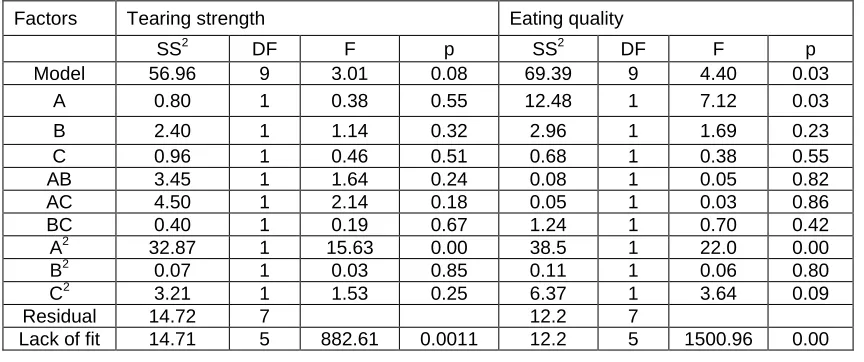
The experimental plan with real degrees of various autonomous factors having 17 mixes and the observed reactions for chapati are given in table 2.the sensory score reactions range between 3.5 to 9.7 The values of the second-order response surface model fitting as ANOVA for tearing quality, eating quality, foldability, overall acceptances are given in table 2. The ANOVA of the quadratic regression model exhibits that the model isn't
significant. The appearance of chapati must bid with light dark-colored spots spread equally over its surface. The equation as far as coded variables can be utilized to make expectations about the reaction for given degrees of each factor. As a matter of sequence, the elevated amounts of the variables are coded as +1 and the low levels are coded as - 1. The coded condition helps recognize the overall effect of the components by looking at the changed factor coefficients. The tearing quality score ran from 4.5 to 9.97 (Table 4).the relapse investigation demonstrated that tactile traits of avocado fused chapati had huge (p< 0.05) positive direct impacts on tearing strength of chapati (Table 3).it was seen from the reaction plots (figure 1-Design- a) it showed Chapatis having moderate tearing quality and more
Run Independent variable (Ingredients) Dependent variable (Sensory attributes) Persea
americana pulp (A)
Water (B)
Wheat flour (C)
Tearing strength
Eating quality Foldability Overall acceptability
1 250 50 50 7.68 6.42 7.91 7.68
2 150 50 100 7.59 6.42 7.38 7.59
3 50 35 100 4.55 2.53 4.47 4.55
4 150 35 100 9.87 8.59 8.66 9.87
5 250 20 50 7.25 5.91 5.93 7.25
6 250 20 100 6.08 4.92 5.77 6.08
7 150 35 50 9.85 8.56 9.44 9.85
8 50 50 50 4.67 4.23 4.25 4.57
9 50 50 150 6.55 5.89 5.74 6.55
10 150 20 100 7.47 5.86 7.44 7.47
11 50 35 50 5.67 3.09 4.45 5.67
12 150 35 100 9.87 8.54 9.22 9.87
13 250 35 100 4.81 3.39 4.31 4.81
14 50 20 50 9.69 3.32 3.93 9.69
15 250 50 150 4.55 9.04 9.74 4.55
16 150 35 150 9.77 8.62 9.12 9.77
1370
flexibility are anything but easy to bite. Tearing qualities of chapatis were additionally seen in chapatis arranged from a combination it depended on the fixings varieties will improve the nature of tearing quality the coefficient of assurance (R2) was 0.79. The "Pred R-Squared" of – 2.60 is in sensible concurrence with the "Adj R-Squared" of 0.53. Adequacy accuracy" was 5.48 demonstrates a lacking sign and it should utilize this model to explore the plan space. The chapati must be malleable with the goal that it tends to
be collapsed into appropriate shapes and size it is profoundly bothersome attributes since it prompts ingredients varieties and item surface moreover. The tearing quality surfaces is smooth it will be easy to swallow. All purchasers, independent of their age and nourishment propensities, as to be all the time in full control of the sustenance in their mouth. The moderate water content sustenance simple to overlap and it is adaptable likewise, Tearing strength =+8.92-0.3370 A-0.7203B-0.4775 C+0.8094 AB-0.9479AC+0.3775BC-3.42A²-0.1585B²+1.13C². (Eq-1) Eating quality and mouthfeel ought to be satisfied with little
chewiness. The score of eating quality ranged from 2.53 to 9.04 (Table 2). The regression investigation demonstrated that components varieties and tangible qualities had critical (p < 0.05)positive direct impact on eating quality relies upon the heating temperature and preparing the time of the items (table 3 ).It was seen from the reaction plots (figure 1- Design-b)that with expanded the eating nature of the item.
The plot surface showed the varieties of fixings and agreeableness score of the eating nature of chapati. The coefficient of assurance (R2) was 0.84. The "Pred R-Squared" of - 1.71 is in sensible concurrence with the "Adj R-Squared" of 0.65. "Adeq Precision" was 6.91 gives a lacking indication and it ought to use this model to investigate the structure space.
Eating quality=+7.49+1.32, A+0.7995B+0.4009C-0.1300AB+0.1030AC+0.6589BC-3.70A²-0.1948B²+1.59C². (Eq-2)
Table -3
Results of regression analysis of Persea americana fruit pulp incorporated chapati
SS2= Sum of squares DF = Degree of freedom F= f values P= probability values A= Avocado fruit pulp B= honey C= Wheat flour
The condition as far as coded variables can be utilized to make forecasts about the reaction for given degrees of each factor. As a matter of course, the abnormal amounts of the components are coded as +1 and the low levels are coded as - 1. The coded condition helped distinguish the overall effect of the variables by contrasting the factor coefficients. Foldability dependent on the chapati was relying upon the fixings the general foldability ran from 3.9 to 9.7 (table 4). The relapse investigation demonstrated that tangible traits had huge (p < 0.05). Positive straight impact on by and large
Agreeableness of chapati (table 3). It was seen from the reaction plot (figure 1-Design-c), the foldability attributes are expanded because of the improvement of fixings varieties and cooking nature of chapati too. The general quality evaluations will change contingent on its degree of response. The general values of sensory properties have the last classifications of item advancement. The coefficient of assurance (R2) was 0.86. The "Pred R-Squared" of - 1.3 is insensible concurrence with the "Adj R-Squared" of 0.69. "Adeq Precision" was 7.0 shows an inadequate sign and it ought to use this model to investigate the arrangement space.
Foldability=+8.23+1.17 A+0.5065B+0.5148C+0.4495AB-0.0533AC+0.1580 BC-3.23A²-0.1685B²+1.29C². (Eq-3) Generally, adequacy decides the last worthiness of the
item. The general adequacy ran from 7.4 to 8.9(table 4). The relapse examination demonstrated that tangible qualities had huge (p < 0.05) positive direct impact on in
general worthiness of chapatti (table 3). It was seen from the reaction plot (figure 1-Design-d), by and large agreeableness likewise expanded because of progress in by and large attributes of chapati. The general quality Factors Tearing strength Eating quality
SS2 DF F p SS2 DF F p
Model 56.96 9 3.01 0.08 69.39 9 4.40 0.03 A 0.80 1 0.38 0.55 12.48 1 7.12 0.03 B 2.40 1 1.14 0.32 2.96 1 1.69 0.23 C 0.96 1 0.46 0.51 0.68 1 0.38 0.55 AB 3.45 1 1.64 0.24 0.08 1 0.05 0.82 AC 4.50 1 2.14 0.18 0.05 1 0.03 0.86 BC 0.40 1 0.19 0.67 1.24 1 0.70 0.42 A2 32.87 1 15.63 0.00 38.5 1 22.0 0.00 B2 0.07 1 0.03 0.85 0.11 1 0.06 0.80 C2 3.21 1 1.53 0.25 6.37 1 3.64 0.09
Residual 14.72 7 12.2 7
appraisals will change contingent on its degree of response. The general credits of sensory traits have the last classes of item improvement. The coefficient of assurance (R2) was 0.79. The "Pred R-Squared" of -2.6 is insensible
concurrence with the "Adj R-Squared" of 0.53. "Adeq Precision" score was 5.48 shows an insufficient sign and it ought to use this model to investigate the structure space. Overall Acceptances=+8.92 -0.3370A-0.7203B-0.4775C+0.8094AB-0.9479AC+0.3775BC-3.42A²-0.1585B²+1.13C². (Eq-4)
Table -3a
Results of regression analysis of Persea americana fruit pulp incorporated chapati
SS2= Sum of squares DF = Degree of freedom F= f values
P= Probability values A= Avocado fruit pulp B= Honey C= Wheat flour The P-values were utilized as a device to check the
essentialness of the coefficients, which, reciprocally. Are important to comprehend the example of common collaborations between the test factors. The littler the extent of the p, the more critical is
The comparing coefficients. Estimation of p under 0.05 demonstrates model terms are huge. The coefficient gauge and comparing p-esteem recommend that, among the test factors utilized in the investigation, An (avocado pulp), B
(water), C(wheat flour) are noteworthy model terms. The p esteems result given in the (table-3a and3b) a few factors are established to be irrelevant. The attack of the model was likewise communicated by the coefficient of assurance R2.which was established to be the most astounding estimations of fluctuation in the reaction could be clarified by the model. The R2 esteems consistently somewhere in the range of 0 and 1 is the closer the R2 was to 1.0.the more grounded the model and the better it predicated the response (Haaland, 1989).
Figure -1-3D design (a to d) of Sensory attributes of development products
Factors Foldability Overall acceptability
SS2 DF F P SS2 DF F P
Model 60.87 9 5.10 0.02 56.96 9 3.01 0.08 A 9.67 1 7.30 0.03 0.80 1 0.38 0.55 B 1.19 1 0.89 0.37 2.40 1 1.14 0.32 C 1.13 1 0.84 0.38 0.96 1 0.46 0.51 AB 1.06 1 0.80 0.40 3.45 1 1.64 0.24 AC 0.01 1 0.01 0.92 4.50 1 2.14 0.18 BC 0.07 1 0.05 0.82 0.40 1 0.19 0.67 A2 29.39 1 22.16 0.00 32.87 1 15.63 0.00 B2 0.08 1 0.06 0.80 0.07 1 0.03 0.85 C2 4.18 1 3.15 0.11 3.21 1 1.53 0.25
Residual 9.28 7 14.72 7
1372 Optimization
Enhancement level of avocado fruit pulp, water, and wheat flour substance was finished by numerical advancement procedures for the definition of chapati, for streamlining avocado chapati was expanded and it is bothersome qualities for chapati, every single sensory characteristic was kept at range esteem. All reaction was given an equivalent
significance of '3' (Table 4). Hence the request to acquire chapati with ideal tactile properties .the ideal arrangements containing avocado organic product mash 150 gm water 35 ml and 100 gm wheat flour was gotten through numerical improvement procedures.
Table -4
Predicted optimization of process parameters by desirability approach
Process Parameters Target Experimental Design
Optimum values
Importance
Avocado fruit pulp Maximize 50 250 150 3
Water Range 5 20 35 3
Wheat flour Range 50 150 100 3
Responses
Tearing strength Range 4.55 9.77 8.9 3
Eating quality Range 2.53 9.04 7.4 3
Foldability Range 3.93 9.74 8.2 3
Overall acceptability Range 4.55 9.97 8.9 3
Fig-1 Design a- Response surface plot on the Tearing strength attributes of Persea americana fruit pulp chapati.
Fig-1 Design b- Response surface plot on the eating quality attributes of Persea americana fruit pulp chapati.
Fig-1 Design c- Response surface plot on the foldability attributes of Persea americana fruit pulp chapati.
CONCLUSION
Diverse exploratory runs were directed to consider the impact of procedure conditions viz all major tactile properties had the quality attributes of avocado organic product mash consolidated chapatti. Every one of the reactions was fundamentally influenced by the procedure conditions. The response surface technique was observed to be fruitful in deciding the ideal procedure conditions for the generation of best quality chapatti with alluring properties of all the response. The newly developed product good for hypercholesterolemia and obesity disease .it helps to reduce bad cholesterol in the human body.
REFERENCES
[1] Cassano A, Drioli E, Galaverna G, Marchelli R, Di-Silvestra G, et al. (2003) Clarification and concentration of citrus and carrot juices by integrated membrane processes. J Food Eng 57: 153-163.
[2] D. Granato, J.C.B. Ribeiro, I.A. Castro, M.L. Masson, Sensory evaluation and physicochemical optimisation of soy-based desserts using response surface methodology. Food Chem. 121(3), 899– 906 (2010)
[3] D. Granato, J.C.B. Ribeiro, I.A. Castro, M.L. Masson, Sensory evaluation and physicochemical optimisation of soy-based desserts using response surface methodology. Food Chem. 121(3), 899– 906 (2010)
[4] Gillingham, L. G., Harris-Janz, S., & Jones, P. J. H. (2011). Dietary monounsaturated fatty acids are protective against metabolic syndrome and cardiovascular disease risk factors. Lipids, 46, 209–228. doi:10.1007/s11745-010-3524-y
[5] Giovanni,M.(1983).Response surface methodology and product optimaization.Food technology,37(Nov),41-45.
[6] Gujral, H. S., & Gaur, S. (2002). Effects of barley flour, wet gluten and liquid shortening on the texture and storage characteristics of chapati. Journal of Texture Studies, 33(5), 461-469. http://dx.doi. org/10.1111/j.1745-4603.2002.tb01360.x.
[7] Gujral, H. S., & Pathak, A. (2002). Effect of composite flours and additives on the texture of chapati. Journal of Food Engineering, 55(2), 173-179. http://dx.doi.org/10.1016/S0260-8774(02)00061-4.
[8] Gujral, H.S. and Pathak, A. (2002) Effect of Composite Flours and Additives on the Texture of Chapatti. Journal of Food Engineering, 55, 173-179. http://dx.doi.org/10.1016/S0260-8774(02)00061-4
[9] H. Rohm, Consumer awareness of food texture in Austria. J. Texture Stud. 21(3), 363–374 (1990) [10]Haaland ,P.D (1989). Statistical problem solving in
P.D Haaland (Ed.), Experimental design in biotechnology (pp.1-18).New York :Marcel Dekker.
[11]Henika,R.G.(1972).Simple and effective system for use with response surface methodology.Cereal science toady,17(10),309-314,334.
[12]Henika,R.G.(1982).Use of response surface methodology in sensory evaluation. Food technology,3696-101.
[13]Indrani, D. and Rao, G.V. (2000) Effect of Chemical Compositions of Wheat Flour and Functional Properties of Dough on the Quality of South Indian Parotta. Food Research International, 33, 875-881. http://dx.doi.org/10.1016/S0963-9969(00)00117-4
[14]K. Suman, D.K. Thompinson, Formulation of functional spread using response surface methodology, in Souvenir, 18th Indian Convention of Food Scientists and Technologists, Innovation in Food Science and Technology, (ICFOST (AFST), Hyderabad 2006), pp. 16–17
[15]Meilgaard,M.,Civille,G.V.,&
Carr,B,T.(1991).Sensory evaluation techniques (2nd ed.).Boca Raton,FL:CRC Press.
[16]Moskowaitz,H.R.(1994).Product optimization approaches and applications. In H.J.H. Macfie& D.M.H.Thomson (Eds.), Measurement of food preference (pp.91 136).Glasgow,UK:Blackie Academic & Professional.
[17]Myers,R.,&Montagomery,D.C(2002).Response surface methodology. New York,USA:John Wiley. [18]Pahua-Ramos, M. E., Garduno-Siciliano, L.,
Dorantes-Alvarez, L., Chamorro-Cevallos, G., Herrera-Martinez, J., Osorio-Esquivel, O., & Ortiz-Moreno, A. (2014). Reduced-calorie avocado paste attenuates metabolic factors associated with a hypercholesterolemic-high fructose diet in rats. Plant Food for Human Nutrition, 69, 18
[19]Pieterse Z. Avocados (monounsaturated fatty acids), weight loss and serum lipids. Energy kJ. 2003; 26:65-71.
[20]Rainey C, Affleck M, Bretschger K, Alfin-Slater RB. The California avocado: a new look. Nutr. Today. 1994; 29:23-25.
[21]Rao, P. H., Leelavathi, K., & Shurpalekar, S. R. (1986). Test baking of chapatti: development of a method. Cereal Chemistry, 63, 297-303
1374
LWT-Food Sci- ence and Technology, 40, 775-784. http://dx.doi.org/10.1016/j.lwt.2006.04.009
[23]Sampath Kumar KP, Bhowmik D, Chiranjib , Biswajit , Chandira MR. Medicinal uses and health benefits of Honey: An overview. J Chem Pharm Res . 2010;2:385–395.
[24]Sanjukta Kundu, Rajita Ghosh, Payal Choudhary and Alok Prakash, Health benefits of various indian culinary herbs and comparative statistical analysis for organoleptic properties of indian teas by using
analysis of variance (ANOVA), International Journal of Pharmacy and Pharmaceutical Sciences; Vol 6, Issue 4, 2014, pp-621-625. [25]Yahia, E. M., & Woolf, A. B. (2011). Avocado