1719
Volume 63 189 Number 5, 2015
http://dx.doi.org/10.11118/actaun201563051719
IS THE FISCAL POLICY
OF THE CZECH REPUBLIC PRO-CYCLICAL?
Martin Rolák
1,
Martin Cigán
11 Faculty of Finance and Accounting, University of Economics, Prague, Nám. W. Churchilla 4, 130 67 Praha, Czech Republic
Abstract
ROLÁK MARTIN, CIGÁN MARTIN. 2015. Is the Fiscal Policy of the Czech Republic Pro-cyclical? Acta Universitatis Agriculturae et Silviculturae Mendelianae Brunensis, 63(5): 1719–1728.
The main goal of this paper is to analyse whether the fi scal policy of the Czech Republic is anti-cyclical. This analysis is carried out through decomposing the government’s balance into its cyclical and structural part. The fi rst diff erences of the structural part are then put in relation to the output gap to determine whether the fi scal policy is pro- or anti-cyclical. Moreover, the correlation of government expenditures and revenues with the business cycle is also subject of our analysis. We also examine whether the fi scal rules which the Czech Republic would have to adhere to once it enters the euro area limit fi scal policy as a stabilizing mechanism.
The paper concludes that the fi scal policy in the Czech Republic was for the most part rather of a random character than anti-cyclical during the examined period 1998–2013. This conclusion has two implications. Firstly, there is still room for improvement in fully and consistently utilizing fi scal policy to stabilise the Czech economy throughout economic cycles. Secondly, fi scal rules would not limit the Czech government to practice anti-cyclical fi scal policy if they have been implemented since 1998.
Keywords: fi scal policy, discretionary fi scal policy, government, structural primary balance, semi elasticity
INTRODUCTION
Having the Czech Republic joined the second stage of the Economic and Monetary Union of the European Union, the fi nal stage in this integration process is to join the euro area. Adapting euro inherently involves disposing of discretional monetary policy in favour of the European Central Bank (ECB). Therefore it is of paramount importance to a possible entrant country to have other adjusting mechanisms in cases of from the entrant’s perspective unfavourable ECB’s monetary policy. The primary mechanisms are the fl exibility of the labour market and fi scal policy, see e.g. Mandel, Tomšík (2009). This paper is focused on the functionality of the later one. Even though fi scal policy as a stabilizing mechanism is to some degree crippled in a small open economy, which is the case of the Czech Republic, it should in principle dampen economic fl uctuations by accumulating surpluses of the government budgets in economic upturns and utilizing them in economic downturns.
The main goal of this paper is to analyse whether the fi scal policy of the Czech Republic is anti-cyclical and thus can be considered as a stabilizing mechanism which helps to stabilise the Czech economy throughout economic cycles. We also examine whether the fi scal rules which the Czech Republic would have to adhere to once it enters the euro area limit fi scal policy as a stabilizing mechanism. The paper does not discuss the effi ciency and legitimacy of the respective fi scal policies. We set our attention to determine the form of the fi scal policy during the years 1998–2013.
the interventions in the economy via deliberate manipulations of government revenues and expenditures to promote macroeconomic goals. While built-in automatic stabilizers are by defi nition anti-cyclical, the cyclicity of discretionary fi scal policy is determined by the competence of the government. Thus, in order to determine the form of fi scal policy, we focused on the discretionary fi scal policy.
Structural Primary Balance
We quantifi ed discretionary fi scal policy by the fi rst diff erences of the structural primary balance. The structural primary balance is calculated according to Tab. I. The primary balance is the actual balance adjusted by debt service cost as the government cannot directly infl uence these expenditures in the current period. The primary balance then includes the built-in automatic stabilizers which are caused by the fl uctuations of the real GDP around its potential. These cyclical eff ects have to be fi ltered out to fi nally reach the structural primary balance.
To fi lter out the cyclical eff ect of economic cycle fl uctuations, we used the semi elasticity of the primary balance of the government’s budget. Semi elasticity in principle gives the percentage change in the primary balance to GDP ratio in response to a one percent divergence of real GDP from its potential (ceteris paribus, i.e. holding
(1) where
output gap = real GDP − potentialGDP, semi elasticity = 0.39.
Equation (1) says that in order to calculate the structural primary balance, the primary balance must be decreased by additional tax revenues and smaller unemployment benefi ts due to positive output gap (i.e. economy working above its potential). Vice versa, the economic recession decreases the primary balance by the amount of the excessive spending on unemployment benefi ts and lower tax revenues. We need to add this sum back to the primary balance to obtain structural primary balance.
We assumed that the semi elasticity is at the constant level of 0.39 for the whole examined period. The assumption that the semi elasticity reasonably oscillates around 0.39 can be supported by the reference from Girouard and André (2005), where the semi elasticity for the Czech Republic is estimated at 0.38 for 1996 and 0.39 for 2000 and 2003. A similar value, 0.35 for the period 1994–2000, is listed in Bezděk et al. (2003). Comparable values may be found in Mourre et al. (2013) as well. The fact that the semi elasticity is in relatively strong positive correlation with the share of the government expenditure on domestic output (Fig. 1) and the stability of this share in the Czech Republic over time imply the stability of the semi elasticity.
The estimations of the primary structural defi cits to GDP are presented in Tab. II. The data of the real GDPs and the output gaps were collected from Eurostat and the OECD Economic Outlook, respectively. All the partial calculations can be found in the annex of this paper.
I: Balance of the government’s1 budget + Total government revenues − Total government expenditures
Actual balance
+ Debt service cost
Primary Balance
+/− Cyclical eff ect of the economic cycle fl uctuation
Structural primary balance
The following information can be inferred from Tab. II:
• The structural balance was in defi cit throughout 1998–2012, no matter whether the government was right or le -wing orientated. Moreover, the structural defi cits of 2005–2008 were notably masked by the positive cyclical component of the primary balance. For example, in 2007 the structural defi cit equalled to −2%, but due to the positive output gap the primary defi cit was positive 0.36%, incidentally the only positive primary defi cit in the observed period. This tells us that the government did not take the advantage of the sound economic situation during 2005–2008 to accumulate surpluses for the bad times, which came later on with the outburst of the fi nancial crisis.
• The primary balance breakdown also displays the fact that the government had a greater impact on the defi cit of the primary balance than the latest fi nancial crisis itself as the primary defi cits were predominantly made up of the structural defi cits. • The right-wing orientated political parties built
their campaign on promoting fi scal responsibility before the elections to the lower house of the Czech parliament in 2010. Moreover, they claimed if we were not fi scal responsible, we might as well end up in the situation of so called “Greek bankruptcy”. Such an aggressive campaign could have been one of the factors which helped the two major right-wing parties win the elections and form the government for 2010–2013. Though the fi scal eff ort of this government is evident, can we 1: The relationship between the semi elasticity and the share of government expenditure in domestic output
Source: Girouard and André (2005)
II: The overview of the defi cits of the government’s budget and its components to GDP
Year Primary defi cit to GDP in %(1)
Estimation of cyclical component of the primary defi cit in %
(2)
Estimation of structural component of the primary defi cit in %
(3)
1998 −3.72% −0.73% −2.98%
1999 −2.63% −1.07% −1.56%
2000 −2.83% −0.58% −2.25%
2001 −4.62% −0.67% −3.95%
2002 −5.38% −1.27% −4.11%
2003 −5.64% −1.29% −4.35%
2004 −1.75% −0.97% −0.78%
2005 −2.15% 0.11% −2.26%
2006 −1.31% 1.42% −2.73%
2007 0.36% 2.37% −2.01%
2008 −1.18% 2.44% −3.62%
2009 −4.52% −0.24% −4.28%
2010 −3.33% 0.09% −3.42%
2011 −1.82% 0.24% −2.06%
2012 −2.73% −0.62% −2.11%
2013 −0.06% −1.68% 1.62%
the real product is above its potential (IV. quadrant). deciding its revenues and expenditures. Even if it
Ͳ4%
Ͳ3%
Ͳ2%
Ͳ1%
0% 1% 2% 3% 4%
Ͳ4% Ͳ3% Ͳ2% Ͳ1% 0% 1% 2% 3% 4%
ܱݑݐݑݐ݃ܽ ܲݐ݁݊ݐ݈݅ܽܩܦܲ
ο
ܵݐݎݑܿݑݐ
ݎ݈ܽ
ݎ݅݉
Ǥܾ݈ܽܽ݊ܿ݁
ܲݐ݁݊ݐ݈݅ܽ
ܩܦܲ
PRO-CYCLICAL
POLICY
decreasing surpluses increasing deficits IV. quadrant
ANTI-CYCLICAL
POLICY
increasing surpluses decreasing deficits I. quadrant
PRO-CYCLICAL
POLICY
increasing surpluses decreasing deficits II. quadrantANTI-CYCLICAL
POLICY
decreasing surpluses increasing deficits III. quadrant
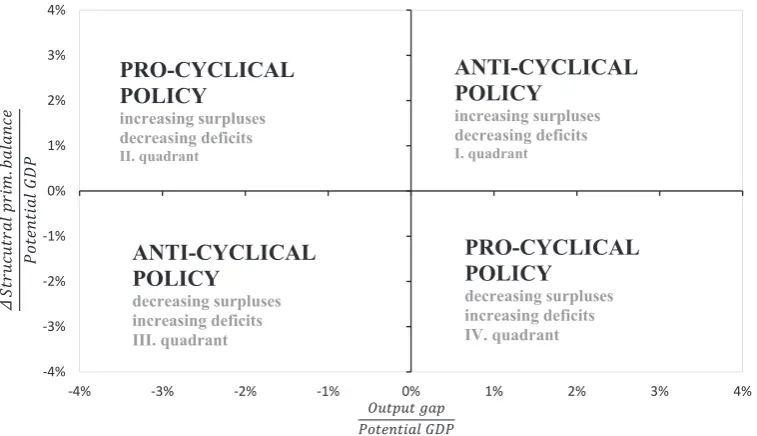
2: Defining pro/anti-cyclical fiscal policy in phase diagram Source: modifi ed from Deroose, Larch, Schaechter (2008)
1998 1999
2000 2001 2002
2003
2004
2005
2006
2007
2008 2009
2010 2011
2012 2013
Ͳ2%
Ͳ1% 0% 1% 2% 3% 4% 5%
Ͳ6% Ͳ4% Ͳ2% 0% 2% 4% 6% 8%
ܱݑݐݑݐ݃ܽ ܲݐ݁݊ݐ݈݅ܽܩܦܲ
ο
ܵݐݎݑܿݑݐ
ݎ݈ܽ
ݎ݅݉
Ǥܾ݈ܽܽ݊ܿ݁
ܲݐ݁݊ݐ݈݅ܽ
ܩܦܲ
had, its interventions would be time-lagged. But since the government makes these decisions, it is responsible for them and thus the strictness is in place.
Due to the sensitivity of the calculations of the output gap and the semi elasticity (both values are estimates), we extended the model from Deroose, Larch, Schaechter (2008) by excluding the observations close to the horizontal and vertical axes. We excluded observations within ±0.5% from each axis (the grey cross in Fig. 3) for two reasons. Firstly, excluding observations in the area of ±0.5% near each axis results in better accuracy – the chance of error, i.e. marking pro-cyclical policy anti-cyclical and vice versa, is lowered. Supposing the correct estimation of the semi elasticity, the observations outside the grey cross would shi to the neighbouring quadrant only if the output gap was substantially misestimated. Secondly, the exclusion also indicates that we include only distinctively pro-cyclical or anti-cyclical fi scal policies in our analysis. When the economy works at its potential (the grey area around the vertical axis), the substantial changes of structural primary balance do not tell us anything about the cyclicity of the fi scal policy. The grey area around the horizontal axis then describes the situations when there might be a big output gap, however the changes of the structural primary balance are small and thus do not give evidence of the cyclicity.
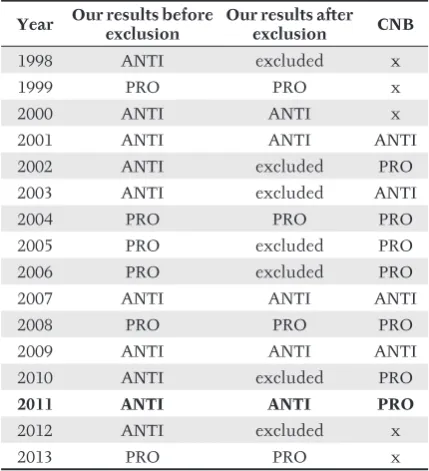
So a er the exclusion, the number of anti-cyclical fi scal policies accounts for 5 (56%) out of 9 during the analysed period. The rest 4 are pro-cyclical. To confront our results, we compared them with the ones of the Czech National Bank (2012), see Tab. III. The results diff er in 2011, which we ascribe to the diff erent estimation of the output gap. When the CNB carried out their analysis in 2012, it worked with the negative output gap, while we worked with the revised estimation of the positive output gap from 2014. The diff erent result might as well be down to a diff erent methodology used for cyclically adjusting the government’s defi cit or diff erent criteria for determining the cyclicity of fi scal policy.
Fig. 3 also well describes the time development of the structural defi cit and fi scal policies. While the observations under the horizontal axis imply the deepening of the structural defi cits and fi scal expansions, the observations above the horizontal axis imply improving structural balances and fi scal restrictions. According to Keynesian economics, see e.g. Newman (1998), the ideal walk on Fig. 2 should be from I. and III. quadrant. Once the fi scal policy ends up in quadrant III. due to an economic downturn, it should then return to quadrant I. when the economy recovers to decrease defi cits. Thus, the observations should ideally fi ll only quadrants I. and III. Such an ideal situation would inherently involve the oscillation of the government debt or savings around zero. As it can be seen from Fig. 3, the Czech government has been unsuccessful in
conducting a proper return walk to quadrant I, failing thus to accumulate proper surpluses.
Decomposition of Fiscal Impulses
We took advantage of the process of adjusting the balance to GDP ratio using the semi elasticity and calculated potential revenues and potential expenditures as percentage of potential GDP. By potential revenues/expenditures we understand revenues/expenditures that would be observed if real GDP was ceteris paribus equal to potential GDP. To calculate these, we used the semi elasticity of revenues (ser) equal to −0.06 and the semi elasticity of expenditures (seg) equal to −0.45 from Mourre et al. (2013), which are used to calculate semi elasticity of overall balance using the following simple formula:
semi elasticity = ser − seg.
We assumed, as previously, these numbers to be valid throughout the whole observed period. Thus we can adjust equation (1):
struct. prim. balance revenues output gap ser×
potential GDP real GDP potential GDP
expenditures seg× output gap debt service
real GDP potential GDP potential GDP
,
where
potential revenues revenues output gap ser×
potential GDP real GDP potential GDP,
potential expenditures expenditures output gap
seg×
potential GDP real GDP potential GDP.
III: Result comparison with Czech National Bank (CNB)
Year Our results before exclusion Our results a er exclusion CNB
1998 ANTI excluded x
1999 PRO PRO x
2000 ANTI ANTI x
2001 ANTI ANTI ANTI
2002 ANTI excluded PRO
2003 ANTI excluded ANTI
2004 PRO PRO PRO
2005 PRO excluded PRO
2006 PRO excluded PRO
2007 ANTI ANTI ANTI
2008 PRO PRO PRO
2009 ANTI ANTI ANTI
2010 ANTI excluded PRO
2011 ANTI ANTI PRO
2012 ANTI excluded x
2013 PRO PRO x
the observations which present the absolute value of The second possible interpretation is focusing
1998 1999
2000
2001 2002
2003
2004
2005
2006
2007 2008
2009 20102011
2012 2013
Ͳ6%
Ͳ4%
Ͳ2% 0% 2% 4% 6% 8%
Ͳ6% Ͳ4% Ͳ2% 0% 2% 4% 6% 8%
Ͳ
ο
௧
௧
௫ௗ
௧௨௦
௧௧
ீ
ܱݑݐݑݐ݃ܽ ܲݐ݁݊ݐ݈݅ܽܩܦܲ
1998 1999
2000 2001 2002
2003
2004
2005 2006
2007
2008 2009
2010 2011 2012
2013
Ͳ4%
Ͳ3%
Ͳ2%
Ͳ1% 0% 1% 2% 3% 4% 5%
Ͳ6% Ͳ4% Ͳ2% 0% 2% 4% 6% 8%
ο
௧
௧
௩
௨
௦
௧௧
ீ
ܱݑݐݑݐ݃ܽ ܲݐ݁݊ݐ݈݅ܽܩܦܲ
on only one fi scal impulse channel, rather than combining both. The results graphically displayed in Fig. 4 are summarised in Tab. IV.
Determination of Policy Using Correlation To look on the matter from another angle we have decided to analyse the correlation of government expenditures and revenues (at prices fi xed at 2005 levels) with the business cycle represented by the output gap as defi ned above. We are aware of the fact that due to given constant government spending to GDP ratio and growing GDP, we do observe an upward dri in expenditures and revenues. This dri problem is clearly visible in the following graphs, where observations from earlier periods are at the bottom of the graph which in response means a weaker correlation. Therefore, we shall be more interested in the sign of the correlation rather than in its actual number.
Again, we need to adjust the actual values of revenues and expenditures to their values when GDP is at its potential. Since unemployment benefi ts form a negligible part of the government expenditures, in the following text we assume the actual expenditures to be equal to the potential expenditures. As we have stated earlier, revenues include the impact of the majority of automatic stabilisers such as decreases and increases in income, corporate and consumption taxes, VAT etc. Therefore the entire cyclical defi cit is made up of cyclical revenues. Thus:
cyclical deficit =
output gap
= semi elasticity × × potential GDP potential GDP
,
potential expenditures = expenditures, potential revenues = revenues − cyclical defi cit. If the economy is working above its potential, we observe a positive cyclical defi cit. In case of expenditures we say that automatic stabilisers have no eff ect. Actual revenues however are larger due to increased tax revenues, so in order to calculate potential revenues, we have to discount excessive revenues. Since we do not assign any part of the cyclical defi cit to expenditures in this section, we discount the whole cyclical defi cit from revenues.
Firstly, we deal with potential expenditures. Governments tend to operate with expenditures in times of crises, which is a logical choice; money le to panicking people by lowering taxes would not be spent. So programs like scrappage, infrastructure (remember construction is usually hit hard), science and development, military, space, etc. are being introduced. Anti-cyclical fi scal policy is therefore characterised by a negative correlation between the output gap and potential expenditures and vice versa. That would imply a restriction in spending during economic booms and an expansion during busts. Correlation close to zero is expected for a-cyclical policy. The actual correlation coeffi cient in the 1998–2013 period, as illustrated by Fig. 5, is 0.241. This fi nding supports the previous conclusion about the character of fi scal policy, i.e. it is for the most part not in strong correlation with the economic cycle.
As for revenues, anti-cyclical fi scal policy is characterised by positive correlation between the output gap and revenues whereas pro-cyclical policy is, on the other hand, characterised by negative correlation. Anti-cyclical policy would imply rising revenues during upturns and decreasing revenues during downturns. A correlation close to zero is again expected for a-cyclical policy. As it is illustrated by Fig. 6, the correlation is still positive, equal to 0.157, and discretionary potential revenues therefore behave a-cyclically since the correlation is almost zero. This supports the previous analysis.
As we have mentioned earlier, the results of regressions suff er from the dri problem. We had therefore replaced the nominal measures of expenditures (only in case of expenditures, since we assumed revenues would behave in the same manner) with percentages of GDP and the fi rst diff erences represented by yearly changes of expenditures. We had calculated correlations and linear regressions for various couples, illustrated by Tab. V. They yield the same results supporting a-cyclical or moderate tendency to a pro-cyclical behaviour of expenditures.
Fiscal Policy and Rules
If the Czech Republic enters the euro area which means that it would no longer be able to practise an isolated monetary policy, the question is whether the fi scal rules embodied in the recently IV: Result summary
Year Fiscal impulse of revenues of expendituresFiscal impulse Overall
1998 ANTI PRO excluded
1999 excluded PRO PRO
2000 ANTI excluded ANTI
2001 excluded ANTI ANTI
2002 PRO ANTI excluded
2003 PRO ANTI excluded
2004 ANTI PRO PRO
2005 excluded excluded excluded
2006 excluded excluded excluded
2007 ANTI excluded ANTI
2008 PRO excluded PRO
2009 excluded excluded ANTI
2010 excluded excluded excluded
2011 ANTI excluded ANTI
2012 excluded excluded excluded
2013 PRO PRO PRO
reformed Stability and Growth Pact (SGP) would limit the Czech fi scal policy as one of its remaining stabilising mechanisms.
The results in this study show that the SGP has not been preventing the Czech government from practicing anti-cyclical discretionary fi scal policy since the discretionary fi scal policy was for the most part a-cyclical. Moreover, the design of the SGP does not even limit the fi scal policy to be anti-cyclical as a whole (discretionary fi scal policy and built-in automatic stabilizers). The 3% limit on the actual defi cit of the government’s budget, which involves
about 1%2 limit on the structural balance prescribed by the reformed SGP presents comfortable room for built-in automatic stabilizers. Suppose the model example where the semi elasticity is 0.39 and the structural primary balance zero. The output gap would then have to exceed negative 7.69% (= 0.03/0.39, see equation 1) of potential GDP to deprive the government of its discretionary policy as the 3% limit of the government’s budget defi cit would be exhausted by built-in automatic stabilizers and would not leave any space for discretionary fi scal policy. If this extreme economic condition Source: authors’ calculation
1997 1998
199920012000 2002
2003 2004
2005
2006 2007 2008
2009 2010 2011 2012
2013
y=0.3048x+1221.8 R²=0.0248
0 200 400 600 800 1000 1200 1400 1600
Ͳ200 Ͳ150 Ͳ100 Ͳ50 0 50 100 150 200 250
Potential revenues
at
prices
fixed
2005 bil CZK
OutputgapbilCZK
6: Regression of discretionary government revenues and economic cycle Source: authors’ calculation
V: Various variables and their correlations
Variable Y Variable X Correlation
Δ expenditures at prices 2005 mil CZK Output gap (% of potential GDP) 0.197
Δ expenditures at prices 2005 mil CZK Output gap CZK 0.228
expenditures index (Yt − Yt−1)/Yt−1 Output gap (% of potential GDP) 0.128 expenditures index (Yt − Yt−1)/Yt−1 GDP index real growth rate 0.223 Δ expenditures at prices 2005 mil CZK Δ GDP at prices 2005 mil CZK 0.196 Source: authors’ calculation
VI:
Anne
x
Year
Revenues mil CZK*
Expenditures mil CZK*
Debt service mil CZK*
GDP mil CZK*
Semielasticity
Output gap in %
t R(t) G(t) D(t) Y(t) e O(t) 1998 786 113 885 611 22 856
2 061 583
0.39 −1.880 1999 830 319 907 393 20 472
2 149 023
0.39 −2.741 2000 862 981 945 255 18 133
2 269 695
0.39
−1.485
2001
938 082
1 074 920
23 792
2 448 557
0.39
−1.712
2002
1 003 019
1 170 746
29 469
2 567 530
0.39
−3.262
2003
1 164 216
1 343 996
28 144
2 688 107
0.39
−3.314
2004
1 184 834
1 267 720
31 619
2 929 172
0.39
−2.481
2005
1 239 031
1 340 123
34 047
3 116 056
0.39
0.280
2006
1 327 765
1 406 993
35 313
3 352 599
0.39
3.633
2007
1 476 428
1 503 113
39 821
3 662 573
0.39
6.069
2008
1 498 574
1 583 527
39 449
3 848 411
0.39
6.248
2009
1 462 139
1 679 551
47 436
3 758 979
0.39
−0.609
2010
1 481 054
1 658 193
51 083
3 790 880
0.39
0.242
2011
1 528 418
1 650 364
52 546
3 823 401
0.39
0.617
2012
1 550 637
1 711 712
55 975
3 845 926
0.39
−1.598
2013
1 588 353
1 644 746
53 896
3 883 780
0.39
−4.317
Year
Primary balance mil CZK*
Prim. bal./GDP
Struct.Prim. bal./GDP
Struct. Prim. bal./GDP in %
Δ
Struct. Prim. bal./GDP
Δ Struct. Pr
im. bal./GDP in %
t
B(t) = R(t) − G(t) + D(t)
F(t) = B(t)/Y(t)
R(t) = F(t) − [e × O(t)]
S(t) = R(t) × 100 (%)
T(t) = R(t) − R(t − 1)
U(t) = T(t) × 100
1998 −76 642 −0.037 −0.030 −2.984 −0.001 −0.088 1999 −56 602 −0.026 −0.016 −1.565 0.014 1.419 2000 −64 141 −0.028 −0.022 −2.247 −0.007 −0.682 2001 −113 046 −0.046 −0.039 −3.949 −0.017 −1.702 2002 −138 258 −0.054 −0.041 −4.113 −0.002 −0.164 2003 −151 636 −0.056 −0.043 −4.349 −0.002 −0.236 2004 −51 267 −0.018 −0.008 −0.783 0.036 3.566 2005 −67 045 −0.022 −0.023 −2.261 −0.015 −1.478 2006 −43 915 −0.013 −0.027 −2.727 −0.005 −0.466 2007 13 136 0.004 −0.020 −2.008 0.007 0.719 2008 −45 504 −0.012 −0.036 −3.619 −0.016 −1.611 2009 −169 976 −0.045 −0.043 −4.284 −0.007 −0.665 2010 −126 056 −0.033 −0.034 −3.420 0.009 0.865 2011 −69 400 −0.018 −0.021 −2.056 0.014 1.364 2012 −105 100 −0.027 −0.021 −2.109 −0.001 −0.054 2013 −2 497 −0.001 0.016 1.619 0.037 3.729
Although the 1% limit on the structural defi cit can limit anti-cyclical discretionary fi scal policy as a stabilizing mechanism in times of long and deep recessions, we conclude that this limit is suitable taken the results of our study. Increasing the limit would probably lead to larger defi cits throughout economic cycles.
Acknowledgement
The paper is an output of the research project “Public fi nance in developed countries” supported by the Internal grant agency of the University of Economics, Prague, No. F1/2/2013.
The contribution is processed as one of the outputs from the research project of the Faculty of Finance and Accounting, University of Economics in Prague, which is carry out within the institutional support of University of Economics in Prague number IP 100040.
REFERENCES
BEZDĚK, V., DYBCZAK, K., KREJDL, A. 2003. Czech Fiscal Policy: Introductory Analysis. Working Paper Series / CNB 7. Praha: Czech National Bank. CZECH NATIONAL BANK. 2012. Zpráva o infl aci
2012/I. [Online]. Available at: www.cnb. cz/miranda2/expor t/sites/www.cnb.cz/cs/ menova_politika/zpravy_o_inflaci/2012/2012_I/ download/zoi_I_2012.pdf. [Accessed: 2014, August 30].
DEROOSE, S., LARCH, M., SCHAECHTER, A. 2008. Constricted, lame and pro-cyclical? Fiscal policy in the euro area revisited. [Online]. Available at: ww.ec. europa.eu/economy_finance/publications/ publication13684_en.pdf. [Accessed: 2014, August 30].
EUROSTAT. 2013. ESA95 manual on government defi cit and debt. [Online]. Available at: www.epp. eurostat .ec.europa .eu/portal/page/portal/ p ro d u c t _ d e ta i l s / p u bl ic at i o n ? p _ p ro d u c t _ code=KS-RA-13-001. [Accessed: 2014, August 30]. GIROUARD, N., ANDRÉ, C. 2005. Measuring
cyclically adjusted Budget Balances for OECD Countries. [Online]. OECD Economics Department Working Papers, No. 434, OECD Publishing. Available at: www.dx.doi.org/10.1787/787626008442. [Accessed: 2014, August 30].
GNIP, A. G. 2013. Stabilization Eff ects of Fiscal Policy in Croatia. [Online]. Available at: www.hnb.hr/ dub-konf/19-konferencija/yes/grdovic-gnip.pdf. [Accessed: 2014, August 30].
IMF. 2014. Czech Republic—2014 Article IV Consultation Concluding Statement of the IMF Mission Prague. [Online]. Available at: www.cnb.cz/miranda2/ ex p o r t / s ite s / w w w. c n b. c z / e n / ab o u t _ c n b / international_relations/imf_wb/download/ imf_2014_june_concluding_statement .pdf. [Accessed: 2014, August 30].
MANDEL, M., TOMŠÍK, V. 2009. Monetární ekonomie – V malé otevřené ekonomice. Management Press. MÁLEK, J. 2011. Sklony fi skální politiky k pro-cykličnosti.
Bakalářská práce. Praha: Univerzita Karlova v Praze.
MINISTRSTVO FINANCIÍ SLOVENSKEJ REPUBLIKY. 2007. Konvergenčný Program Slovenska na roky 2007 až 2010.
MOURRE, G., ISBASOIU, G., PATERNOSTER, D., SALTO, M. 2013. The cyclically-adjusted budget balance used in the EU fi scal framework: an update. [Online]. Available at: www.ec.europa.eu/economy_ fi nance/publications/economic_paper/2013/pdf/ ecp478_en.pdf. [Accessed: 2014, August 30]. NEWMAN, P. 1998. The New Palgrave Dictionary of
Economics and the Law. Palgrave Macmillan.
Contact information Martin Rolák: [email protected]