Effectiveness of Training Program on Knowledge and Practice regarding Basic Life Support (BLS) Among Nursing Student
Ms. ParulSaini, Assistant Professor, Amity College of Nursing, Gurgaon
Ms. ManitaDalal, Assistant Professor, Amity College of Nursing,Gurgaon
ABSTRACT
Basic life support (BLS) is a kind of medical care used for the victims of life-threatening illnesses or injuries until they can be given full medical care at a hospital. It can be delivered by trained medical personnel or by qualified bystanders. CPR provided at the time of cardiac arrest increases the chances of survival. The present study is used to assess the knowledge and practices of nursing students regarding Basic Life Support before and after a training program. This quasi experimental study was conducted among 60 B.Sc. Nursing 2nd year and 3rd year students. Data was collected using self-structured questionnaire by stratified random sampling technique. The mean post test knowledge scores& practice scores (26.7, 13.46) of students related to Basic Life Support (BLS) was higher than the mean pre test knowledge scores & practice scores (12.37, 8.08) which was found to be statistically significant as evident from the "t" value of 34.24 for df 59 at 0.05 level of significance. Hence, the Training Program was effective in improving the knowledge and practice of students related to Basic Life Support (BLS).
INTRODUCTION
Cardiac arrest is an emergent situation both in/out of the hospital settings and carries high risk of mortality, however early CPR plus defibrillation (manual compressions with rescue breaths) improves the survival by 50 to 75%.1 American Heart Association (2015)2,3 mentioned four links in the chain of survival: early recognition and call for help, early performance of cardiopulmonary resuscitation, early defibrillation, and post-resuscitation care. Many researches have shown the marked increase in survival rate at each link in the chain. 4-7
Basic life support refers to the care that heath care providers deliver to the patients who are having respiratory arrest, cardiac arrest and airway obstruction. Knowledge regarding BLS is a major component in the success of resuscitation and in reducing the number of preventable deaths. Cardiopulmonary resuscitation (CPR) is an important lifesaving skill taught to healthcare providers as there is marked and rising demand for CPR training.
In hospitalized patients nurses are generally the first responders to initiate basic life support until the advanced cardiac life support has not been started. In recent years, many nursing researchers reported that despite of having good knowledge students are lacking behind in clinical knowledge and skills. Hence training program on Basic life support will increase the knowledge and improve skills of nursing students to perform BLS at hospital setting whenever required.
METHODS AND MATERIALS
A quasi experimental research was conducted among the B.Sc Nursing students of selected Nursing Colleges of Gurgaon, Haryana. A sample of 60B.Sc. Nursing 2nd year and 3rd year students was drawn using purposive sampling technique. Data was collected through a structured questionnaire, which was distributed among the students through Faculty of Nursing program.
The questionnaire consisted of personal data and background information followed by a Structuredknowledge questionnaire and practice checklist to assess the practices regarding Basic Life Support (BLS). The knowledge questionnaire consisted of 33 questions. Observational Practice checklist was made to assess the practices of BLS which consist of 20 statements assessing the steps to be carried out while performing CPR on adult CPR manikin.
The aspects on which they were questioned were about the abbreviation of BLS, AED and EMS (Emergency Medical Service), sequential steps in BLS, assessment and resuscitation techniques with regard to airway, breathing, circulation in unresponsive victims of different age groups, techniques regarding removal of foreign body obstruction, recognition of early signs of stroke and acute coronary syndrome.
The confidentiality of information and anonymity of subjects were maintained. The data was collected after obtaining the verbal consent of the subjects. Data was analyzed using SPSS version 16 and data was presented using descriptive and analytical statistics.
RESULTS
questionnaire which had 33 questions and practice was assessed with 20 statements observational practice checklist.
In order to find out the difference between the pre test and the post test knowledge scores in the mean, median, standard deviation were calculated. T- test was applied to find out whether the difference in the scores was significant or not.
Table 1: Sample characteristics of the students N= 60
Sample characteristics f (%)
Age in years
18
19
20
≥21
24(40.0)
28 (46.6)
5 (8.3)
3 (5.0)
Gender
Male
Female
34 (56.6)
26 (43.3)
Previous knowledge about Basic Life Support Yes
No
44 (73.3)
16 (26.6)
Source of knowledge Curriculum
Print media
Internet/ broadcasting
34 (56.6)
8 (13.3)
18 (30.0)
Practical exposure to Basic Life Support Yes
No 8 (13.3)
52 (86.6)
TABLE - 2
Mean, Median and Standard Deviation of Pre-Test & Post- Test KnowledgeScores of students related to Basic Life Support
N= 60
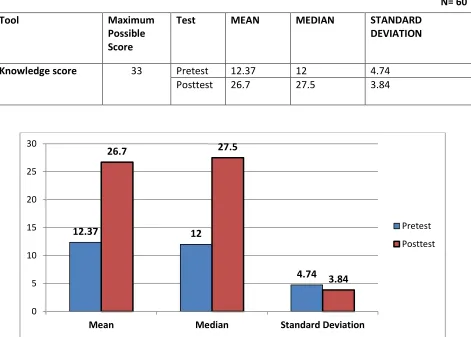
Figure no.1: Bar Graph showing the Mean, Median and Standard Deviation of Pre-Test & Post- Test Knowledge Scores of Students regarding Basic Life Support (BLS)
The data presented in Table 2 and Figure 1 indicate that the mean post-test knowledge scores (26.7) of students regarding Basic Life Support is higher than the mean pretest knowledge scores (12.37). The findings also reveals that the standard deviation of the post-test knowledge scores (3.84) is lower than the standard deviation of pre- test knowledge scores (4.37). Therefore, the trainingprogram on Knowledge Regarding Basic Life Support was effective.
12.37 12
4.74
26.7 27.5
3.84
0 5 10 15 20 25 30
Mean Median Standard Deviation
Pretest
Posttest
Tool Maximum
Possible Score
Test MEAN MEDIAN STANDARD
DEVIATION
Knowledge score 33 Pretest 12.37 12 4.74
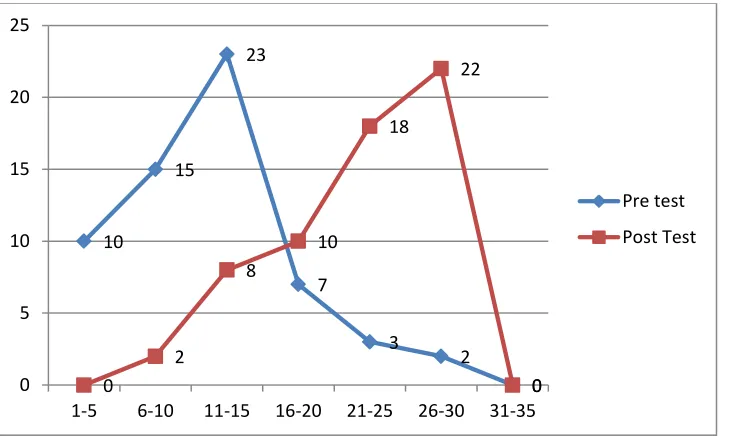
Figure no. 2: Line Graph showing frequency distribution of Pre test and Post Test Knowledge Scores of students
The data presented in Table 2, & fig.1,2 indicates that the mean post test knowledge scores (26.7) of students related to Basic Life Support (BLS) is higher than the mean pretest knowledge scores (12.37) . The findings also show that the standard deviation of the post-test knowledge scores (3.84) is lower than the standard deviation of pre- test knowledge scores (4.74) of the group. Therefore, the group was more homogenous after Training Program.
TABLE- 3
Mean, Mean Difference, Standard Deviation Difference, Standard Error of Mean Difference and "t" value of the Pre- test and Post-test Knowledge Scores
N=60 Test Mean Score Mean
Difference (MD)
Standard Deviation Difference
(SDD)
Standard Error of Mean Difference
(SEMD) "t" Value
Pre Test 12.37
14.35 3.25 0.419 34.24S
Post Test 26.7
df (59) "t" = 1.96 at 0.05 level of significance S= Significant at 0.05 level
The data given in Table-3 shows that the mean post test knowledge scores (26.7) of students related to Basic Life Support (BLS) was higher than the mean pre test knowledge scores (12.37) with a mean difference of 14.35, which was found to be statistically significant as evident from the "t" value of 34.24 for df 59 at 0.05 level of significance.
10
15
23
7
3
2
0 0
2
8
10
18
22
0 0
5 10 15 20 25
1-5 6-10 11-15 16-20 21-25 26-30 31-35
Pre test
Data shows that the obtained mean difference between the pretest and posttest knowledge scores was a true difference and not by chance. Hence, the Training Program was effective in improving the knowledge of students related to Basic Life Support (BLS).
TABLE 4
Mean, Median and Standard Deviation of Pre-Test & Post- Test Practice Scores of students related to Basic Life Support
N= 60
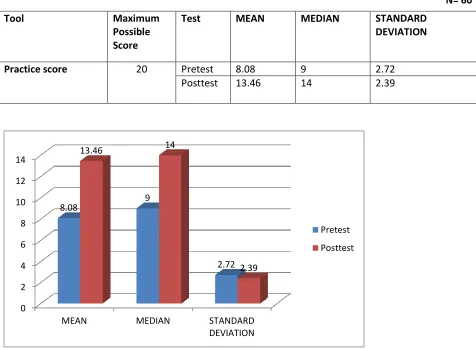
Figure no. 3: Bar Graph showing the Mean, Median and Standard Deviation of Pre-Test & Post- Test Knowledge Scores of Students regarding Basic Life Support (BLS)
The data presented in Table 4 and Figure 3 indicate that the mean post-test practice scores (13.46) of students regarding Basic Life Support is higher than the mean pretest practice scores (8.08). The findings also reveals that the standard deviation of the post-test practice scores (2.39) is lower than the standard deviation of pre- test practice scores (2.72). Therefore, the trainingprogram on practices Regarding Basic Life Support was effective.
0 2 4 6 8 10 12 14
MEAN MEDIAN STANDARD
DEVIATION
8.08 9
2.72
13.46 14
2.39
Pretest
Posttest
Tool Maximum
Possible Score
Test MEAN MEDIAN STANDARD
DEVIATION
Practice score 20 Pretest 8.08 9 2.72
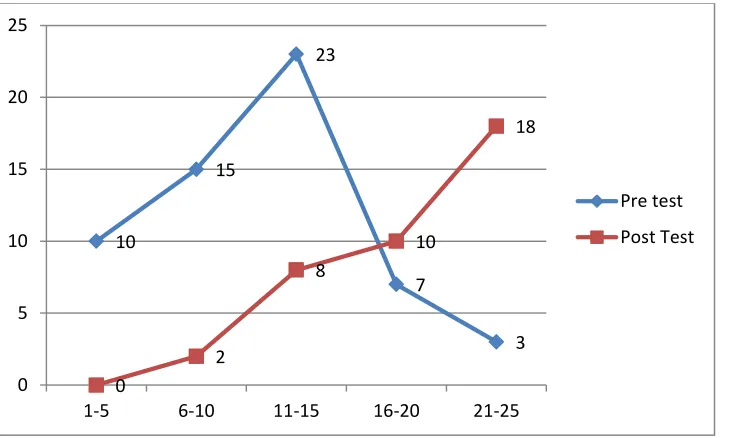
Figure no. 4: Line Graph showing frequency distribution of Pre test and Post Test practice Scores of students
The data presented in Table 4, & fig.3,4 indicates that the mean post test practice scores (13.46) of students related to Basic Life Support (BLS) is higher than the mean pretest practice scores (8.08) . The findings also show that the standard deviation of the post-test practice scores (2.39) is lower than the standard deviation of pre- test practice scores (2.72) of the group. Therefore, the group was more homogenous after Training Program.
TABLE- 5
Mean, Mean Difference, Standard Deviation Difference, Standard Error of Mean Difference and "t" value of the Pre- test and Post-test Practice Scores
N=60 Test Mean Score Mean
Difference (MD)
Standard Deviation Difference
(SDD)
Standard Error of Mean Difference
(SEMD) "t" Value
Pre Test 8.08
5.38 2.15 0.278 19.34S
Post Test 13.46
df (59) "t" = 1.96 at 0.05 level of significance S= Significant at 0.05 level
The data given in Table-5 shows that the mean post test practice scores (13.46) of students related to Basic Life Support (BLS) was higher than the mean pre test practice scores (8.08) with a mean difference of 5.38, which was found to be statistically significant as evident from the "t" value of 19.34 for df 59 at 0.05 level of significance.
10
15
23
7
3
0
2
8
10
18
0 5 10 15 20 25
1-5 6-10 11-15 16-20 21-25
Pre test
Data shows that the obtained mean difference between the pretest and posttest practice scores was a true difference and not by chance. Hence, the Training Program was effective in improving the practice of students related to Basic Life Support (BLS).
DISCUSSION
Sound knowledge about BLS is mandatory for every health care personnel. This study was done to explore the present knowledge of students related to BLS and to give them training based upon their knowledge score. This study reveals that the students have inadequate knowledge about BLS as mean knowledge score of pretest was 12.37 and these findings are consistent with the other studies8, 9.The mean posttest knowledge score was significantly increased to 26.7 after training program showed that the knowledge attained during the training program was helpful for the better performance in the questionnaire. Improvement in knowledge and skills after training program was also demonstrated by Chaudhari A et al10.Elif and et al had also concluded that the knowledge of trained personnel regarding BLS was more than the untrained11. Sudeepet al12also demonstrated the improvement of knowledge and skills of CPR after a BLS training.
So, as the guidelines for CPR changes every 5 years hence repetitive training of students is required. The awareness and basics of ACLS and BLS as the first aid will be the prime responsibility of medical personnel.
Educational institutions should be involved in the training of students and professionals for CPR and other emergencies. Regular workshops for students are mandatory to know the practical aspects of CPR.
CONCLUSION
REFERENCES
1) McNally B, Robb R, Mehta M, Vellano K, Valderrama AL, Yoon PW, et al. Out-of-hospital cardiac arrest surveillance --- Cardiac Arrest Registry to Enhance Survival (CARES), United States, October 1, 2005--December 31, 2010. MMWR SurveillSumm. 2011;60(8):1–19.
2) Kleinman ME, Brennan EE, Goldberger ZD, Swor RA, Terry M, Bobrow BJ, et al. Part 5: Adult Basic Life Support and Cardiopulmonary Resuscitation Quality: 2015 American Heart Association Guidelines Update for Cardiopulmonary Resuscitation and Emergency Cardiovascular Care. Circulation. 2015;132(18 Suppl 2):S414–35.
3) Travers AH, Perkins GD, Berg RA, Castren M, Considine J, Escalante R, et al. Part 3: Adult Basic Life Support and Automated External Defibrillation: 2015 International Consensus on Cardiopulmonary Resuscitation and Emergency Cardiovascular Care Science With Treatment Recommendations. Circulation.2015;132(16 Suppl 1):S51–83.
4) Gates S, Quinn T, Deakin CD, Blair L, Couper K, Perkins GD. Mechanical chest compression for out of hospital cardiac arrest: Systematic review and meta-analysis. Resuscitation. 2015;94:91– 7.
5) 4. Girotra S, Chan PS, Bradley SM. Post-resuscitation care following out-of-hospital and in-hospital cardiac arrest. Heart. 2015
6) 5. Hasselqvist-Ax I, Riva G, Herlitz J, Rosenqvist M, Hollenberg J, Nordberg P, et al. Early
cardiopulmonary resuscitation in out-of-hospital cardiac arrest. N Engl J
Med. 2015;372(24):2307–15.
7) 6. McNally B, Robb R, Mehta M, Vellano K, Valderrama AL, Yoon PW, et al. Out-of-hospital cardiac arrest surveillance --- Cardiac Arrest Registry to Enhance Survival (CARES), United States, October 1, 2005--December 31, 2010. MMWR SurveillSumm. 2011;60(8):1–19.
8) Akritia S, Mayankb M, Arushic D. Basic life support and advanced cardiac life support: knowledge of medical students in New Delhi. Journal of Young Medical Researchers. 2014;1:1–9. 9) Sharma R, Attar NR. Adult basic life support (BLS) awareness and knowledge among medical
and dental interns completing internship from Deemed University. NUJHS. 2012;2:6–13.
10)Chaudhary A, Parikh H, Dave V. Current scenario: Knowledge of basic life support in medical college.National J Med Res. 2011;1:80–82.
11)Elif AA, Zeynep K. Knowledge of basic life supports a pilot study of the Turkish population by Baskent University in Ankara. Resuscitation . 2003;58:187–192.