3496
Characteristics of Students Thinking in
Understanding Geometry in Learning
Ethnomathematics
Wahyu Widada, Dewi Herawaty*, Nilna Ma’rifah, Aida, Serlis, Devi Yunita, Sarwoedi Postgraduate Program of Mathematics Education, Universitas Bengkulu, Indonesia
*
Correspondent Author: [email protected]
Abstract. Geometry is an abstract subject and is difficult for students to learn. Therefore, learning that is close to student culture is needed, namely ethnomathematics. The purpose of this study is to study the thinking characteristics of students in solving geometry problems during learning with the ethnomathematics approach. That is an exploratory descriptive study. The subjects of this study were students of Mathematics Education Curriculum IAIN 2019. There were 17 research subjects that would be presented in depth. The research instrument was the researcher himself guided by the interview sheet and the geometry problem solving task sheet. Data were analyzed qualitatively by genetic decomposition techniques. The results of this study are there are 32% of subjects at the Visualization Level, 36% at the Analysis Level, 15% at the Abstraction Level, and 17% at the Deduction Level, and no subject has reached the Rigor Level. Also, there are 10% of subjects at the Semi-inter Level, 37% at the Inter-Level, 33% at the Semi-trans Level and 20% are at the Trans Level, and no subject is at the Extended Trans Level. The conclusion of this research is that students can do the processes of abstraction, idealization, and generalization about geometric objects based on ethnomathematics. Also, students are able to do interiorization and encapsulation in the form of concepts and principles of geometry. That is done through specialization and generalization.
Key words: Understanding geometry, ethnomathematics
————————————————————
1.
Introduction
Geometry is a compulsory subject for mathematics education students. The objects are abstract, so students often have difficulty understanding them (Widada, Herawaty, Nugroho, & Anggoro, 2019a). Therefore, the teacher must be able to manage learning geometry appropriately. That is done through reflection on the initial abilities of students. The teacher must conduct a needs analysis, concept analysis, and task analysis. This is a technique for determining learning objectives. The teacher can arrange appropriate learning plans. Students reach it easily, if they do horizontal mathematical (Treffers, 1991) using the ethnomathematics approach (D’Ambrosio, 2015). The ability to understand mathematical concepts from students taught with ethnomatematics material and realistic mathematics learning approaches is higher than those taught by direct learning (Dewi Herawaty et al., 2019). The study recommends that mathematics education teachers and researchers continue to apply realistic mathematical learning approaches oriented to ethnomatematics. There are a number of problems in teaching geometry in elementary schools in Indonesia. For example, the approach used to teach geometrical topics is very theoretical, and many abstract concepts and formulas are introduced without regard to many aspects such as logic, reasoning, and understanding (Fauzan, Slettenhaar, & Plomp, 2002). Therefore, it takes learning that is close to the minds of students. That is something contextual. Also, close to the culture of the local people. Mathematics in local culture will make it easier for students to start learning. Mathematics is giving a broad view of mathematics which includes arithmetic, classifying, ordering, modeling, and mathematical practice are cultural products. Therefore, it is necessary to operationalize the concept of ethamathematics. Also, its use from a multicultural perspective and its application in the school curriculum for learning mathematics (Balamurugan, 2015). Ethnomathematics is applied based on cultural contexts, and perspectives on the influence of culture on the contents
of the mathematics curriculum. That is mathematics education using a socio-psychological approach can play a major role. Also, includes his relationship with mathematics found in everyday contexts and in the formal school system (Stathopoulou, Kotarinou, & Appelbaum, 2015). Like the context that occurred in Rejang Lebong, Indonesia, that students using a culture of traditional houses are able to carry out their metacognition process. It is about validating two-dimensional and 3-dimensional geometric formula formulas, including surface area and volume of the pyramid, prisms, rectangular prisms, and cubes (D. Herawaty, Widada, Novita, Waroka, & Lubis, 2018). On the other hand, Rejang Lebong has a culture related to geometry, the Kaganga letter. The script is the name of a collection of several characters that are related in Sumatra (especially in the south), Indonesia (Anonimous, 2019). Learning with ethnomatematics approach can improve students' cognitive processes (Widada, Herawaty, Falaq, et al., 2019). Therefore, efforts to improve the ability to solve open-ended problems can be done through the application of learning. The increase can be known through the characteristics of thinking. It is a cognitive process that is functional, namely the extended triad level (Widada, Herawaty, Nugroho, & Anggoro, 2019b)(Dubinsky & Wilson, 2013). There are seven levels of extended triad ++, namely pre-intra, intra, semi-inter, inter, semi-trans, trans and extended-trans (Widada, 2016a). Also, there are five levels of Van Hiele thinking, namely visualization, analysis, abstraction, deduction, and rigor (Pusey, 2003) (Nisawa, 2018). To find out the characteristics of students' thinking can be analyzed through genetic decomposition (Dubinsky & McDonald, 2000)(Zwanch, 2018)(Widada, 2016b). Thus, we want to know in depth about the characteristics of students' thinking in solving open-ended problems about geometry.
2.
Method
Extended level triad ++ and Van Hiele's Theory. The thought process is in the form of genetic decomposition. It is a collection of physical and mental activities derived from interviews and student work in solving open-ended problems about geometry. This research was conducted at IAIN Curup in the Mathematics Education Study Program. The research was conducted from April to May 2019. The research subjects were selected from 17 students using a purposive sampling technique. The main instrument of the research is the researchers themselves with interview guides and geometry problem-solving test sheets. Data were analyzed by genetic decomposition analysis techniques. Students' thinking processes are classified into seven levels from extended level triad ++, namely Pre-intra, Intra, Semiinter, Inter, Semitrans, Trans, and Extended Trans. Also, it is classified into Van Hiele Levels namely Stage 0 (Visualization), Stage 1 (Analysis), Stage 2 (Formal Deduction), Stage 3 (Deductive), Stage 4 (Rigor).
3.
Results and Discussion
Research subjects were chosen based on their characteristics. It is divided into two groups namely first, the Extended level triad ++ group, and the other Van Hiele
group. The researcher first gives a preliminary test of the geometry oriented to the Lebong Rejang ethnomatematics which has been validated by a team of experts and declared valid. From the test results obtained an overview of the characteristics of the subject's thinking. These characteristics of thinking are obtained from the results of student answers on the answer sheets provided. There are seven students from the Extended Level Triad ++ level of thinking and Van Hiele's Theory. The subjects are DNN, PA, and ANN. Data from the subject are described according to the level of thinking Extended Level Triad ++ which consists of seven levels namely pre-intra level, intra level, semi-inter level, inter level, semi trans level, trans level and Extended trans level and based on Van Hiele theory consists of the level of visualization, level of analysis, level of abstraction, level of deduction, level of rigor. Furthermore, research data will be analyzed based on genetic decomposition analysis. Based on the results of genetic decomposition analysis, not all levels were filled with research subjects. The high levels in the two theories are blank. Look at Figure 1 and Figure 2.
Figure 1. Percentage of Subjects based on Van Hiele Level
Based on Figure 1, there are 32% of subjects at the Visualization Level, 36% at the Analysis Level, 15% at the
Abstraction Level, and 17% at the Deduction Level, and no subject has reached the Rigor Level.
Level 0. Visualization
32%
Level 1. Analysis 36% Level 2.
Abstraction 15%
Level 3. Deduction
17%
Level 4. Rigor 0%
Level Pra-intra 0% Level Intra
0%
Level Semi-Inter 10%
Level Inter 37%
Level Semi-Trans 33%
Level Trans 20%
Level Extended Trans
3498 Figure 2. Percentage of Subjects based on Level Extended Triad ++
Based on Figure 2, there are 10% of subjects at the Semi-inter Level, 37% at the Inter Level, 33% at the Semi-trans Level and 20% are at the Trans Level, and no subject is at the Extended Trans Level. Furthermore, transcripts of interviews of student (DNN ) in answering problems related to the Rejang Lebong traditional house on May 15, 2019 as follows:
Q: Good morning, how are you today? DNN.01:: Thank God,
Q: Are you ready to interview? DNN.02: Yes
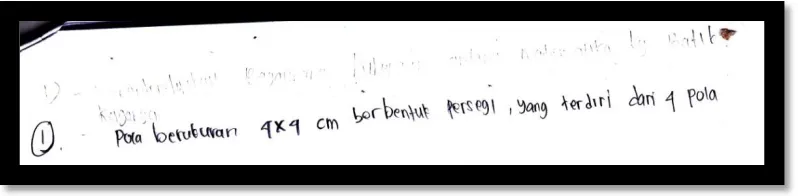
Q: Okay, now try to explain the results of the work to No. 1? DNN.03: At No.1 asked to identify the problem in the image and here I know there is a 4x4 cm pattern that is square and consists of 4 patterns.
Q: Is there only that problem in this story? DNN.04: Yes, , I only understand that
Q: What do you think we are asked in this matter?
DNN.05: Asked to make a handkerchief from batik kaganga Q: What size handkerchiefs are made?
DNN.06: 16 x 16 cm which is filled in with this kaganga pattern
Q: Why is no description of the size of the handkerchief written in this answer?
DNN.07: When I was working yesterday I only found that information and I initially wanted to find a mathematical relationship with batik, but in my opinion it was not a problem so I deleted the book.
Q: Okay fine, then in no. 2, is there any foundation you put a pattern on the handkerchief?
DNN.08: Here at first I thought all cities were filled with patterns but realized when I saw other friends that only filled 4 patterns so that my previous answer was erased. Q: Why do you think that all patterns must be filled in a box?
DNN.09: Because the questions were asked to design all four patterns in the handkerchief and in the handkerchief there were 16 boxes that could be filled so I thought all four patterns had to be placed on all the boxes instead of putting a total of four patterns in the book box.
Q: Okay, well next, here I see you don't make handkerchiefs according to scale and put patterns on a regular basis why is that?
DNN.10: Because the size of 16x 16 is too big to draw and the processing time is short so I divide the scale 1: 2 and for laying out my own pattern I just think that the pattern looks neat book
Q: Do you know the kaganga typeface in the picture? DNN.11: No , I have forgotten this elementary school learning
Q: Okay, do you have the chance to double-check your answers when working on the problem?
DNN.12: No, no, because the processing time is up. Based on interviews with DNN, analyzed by genetic decomposition (APOS theory) results as follows.
1) Action
At this stage students are able to identify problems in the given problem even though they have not perfectly identified the problem obtained from reading the problem. However, in interviews DNN.03, DNN.04, DNN.05 and DNN.6 and see Figure 1 students already knew what was the problem in the problem but were not written in the answers. Here are the answers of students who have questions about Extended Level Triad ++.
Figure 1. Workmanship number 1 on the Extended Level Triad ++ problem
2) Process
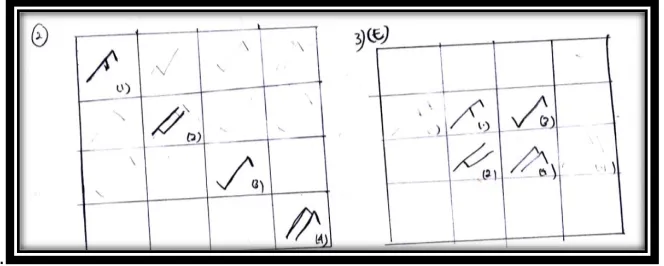
The student's thought process is said to be in the process if the student can explain the process of forming patterns on
the handkerchief. Following are the results of students' answers in answering questions.
.
Figure 2. Process of DNN
Based on interviews DNN.08, DNN.09, DNN.10, and Figure 2 the students explained the flow of completion by designing the pattern of kaha in 16 boxes that had been sketched. The initial idea in determining the pattern is also reflected by making another sketch example in the box provided even though in the initial stages DNN misunderstood the meaning of the problem as in the DNN.09 interview. The thinking process here DNN is seen which is able to expand the answers by giving 5 possible handkerchief sketches that are different from before.
3)The object
The student's thought process is said to be in the Object if the student is able to change the sketch into cartesian coordinates with a certain scale and use the concept of Reflection in it. At the time DNN was working on making patterns into cartesian coordinates, however, it did not use the concept of reflection when determining its shadow. Analysis of genetic decomposition of the geometry of transformation, the DNN can only perform actions and objects which have not been able to establish the relationship of action processes or objects. Based on the analysis that DNN is in the intra level (Level 1).
The Subject of PA
The results of the interview with PA, the transcript is described as follows:
Q: Are you ready to be interviewed? PA.01: Thank God, are you ready?
Q: Good, is this really the result of your work? PA.02: Yes, correct
Q: Now, the mother starts the question, when Patri reads the story, are there things that you don't understand? PA.03: No book, I understand that the question was asked to design a handkerchief
Q: Did you know about ethnomathematics before?
PA.04: I heard about it when I was at the seminar but only as far as I know, but I don't understand
Q: Have you ever known the level of thinking of Extended Triad ++?
PA.05: Not yet, just found out from the matter that you gave me.
Q: Furthermore, in the answer to question no 1 do you think now is there a possibility of identifying another problem? PA.06: In my opinion that's the only problem, about the size in the handkerchief 16x16 cm, the number of patterns and the size of each pattern 4x4 cm
Q: Next for number 2 what size do you use to draw the pattern and why is it made a box like this?
PA.07: Here I use a 16 x 16 size because earlier there were 4 kinds of patterns with a size of 4x4 ... if divided there were 16 boxes in his handkerchief.
Q: In question number 2 you have put patterns into batik, what basis do you put each of those patterns on?
PA.08: Yesterday I only thought of filling in the corners Q: Why don't you draw a pattern here, just give the information?
PA.09: Because I was afraid that there was not enough time to book so I just gave a statement
Q: Do you know what kaganga letters are used in making handkerchief patterns?
PA.10: No, I don't understand.
Q: Next to number 3, why do you put other possible patterns like this?
PA.11: Actually it's the same as number 2 earlier. I only thought of positions that were considered neat,
Q: Why is the scale used by you different from number 2? PA.12: That is to fit in one paper book, plus fear that you don't have enough time to do it
Q: What size scale do you use?
PA.13: Handkerchief size is now 8x8 to 1: 2
Q: In number 4 when told to choose the pattern taken, why choose the pattern in number 2?
PA.14: Because I think this pattern is easier to find in its size
Q: Why did you put the handkerchief in coordinate I and by starting from point (1,1)
PA.15: Because only at coordinate I have no negative dot, so I can more easily calculate the center of gravity of the kaganga pattern.
Q: Furthermore command number 4 only looks for the coordinates of all four patterns, but why here you are looking for other patterns as well?
PA.16: The other pattern is the answer book for question number 5 book, to save time so I combined the book with picture number 4 book
Q: To determine the center of gravity are you having difficulty, how do you find the coordinates?
PA.17: Thank God not, I search by looking at the angle of the squares of each square-shaped pattern then I divide the two books as well as to find the coordinates of the X and Y-axis
Q: Next to Number 5, asked to specify another shadow pattern, what concept did you use?
PA.18: To be honest, Patri did not use any concepts, I think I should fill every box in the Cartesian coordinates and calculate the coordinates.
3500 PA.19: Yes, ...
Q: In this case why don't you look for cartesian coordinates for other patterns?
PA.20: I lack the time to work on it,
Q: But here you have answered the reflection formula for obtaining shadows, why did you delete it?
PA.21: When I finished looking for other patterns, I realized that if I could use the concept of reflection in determining shadows, then I tried to find the formula, but due to lack of time I stopped working on the book
Q: If you try to re-read the question now, what do you think of the reflection formula you can use
PA.22: For example, for this pattern I tried with pattern 2. this is for pattern 2 to pattern 2 'can use reflection line x = 5, then from pattern 2 to pattern 2' 'use x = 9 while from pattern 2 to pattern 2 '' I don't know what reflection book to use.
P: So here you are using the concept from pattern 2 to pattern 2 'then pattern 2 to pattern 2' 'not from pattern 2' to pattern 2 ''
PA.23: Yes , I am from pattern 2 that Patri used to look for other shadows because in the question asked, each pattern has 3 shadow shadows.
Q: Okay so for questions 6 and 7 you can't do it?
PA.24: Yes, you don't have enough time and for shadow number 6 for pattern 2 ’’ ’I don't know what concept to use. whereas for no. 7, I also don't know if maybe it is only translational concepts that can be used.
Q: Can you explain the concept of translation that you mean?
PA.25: For example in pattern 2 it becomes pattern 2 ’, it moves left 4
Based on the transcription of the results of interviews with PA, genetic decomposition analysis was obtained:
1) Action
The process of thinking of students at this stage seems to be able to identify problems in the questions that have been given seen in the interview PA.06 where PA already knows the size in making sketches and patterns used. The action continues again when the PA is able to identify the problem that later in the 16 handkerchief sketch will form 16 boxes for the available patterns.
2) Process
The mathematical thinking process in compiling various strategies is seen in PA.14 where PA is able to choose the thesis used in making handkerchiefs. PA encapsulation process is seen when PA reflects the idea of a handkerchief sketch and extends the scope of the results obtained by changing into cartesian coordinates from the results of the PA interview.
3) Objects
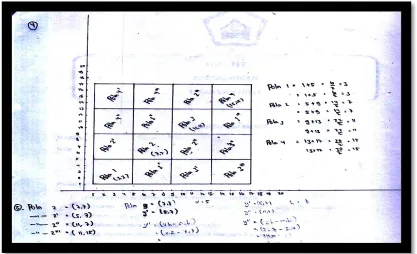
The process of thinking at this stage if students have been able to determine cartesian coordinates for each pattern that PA has made as in the interview PA.17. The object action actions carried out by the PA can be seen clearly where the relationship starts from determining the size of the handkerchief and then filling in the pattern and looking for possible arrangements of other patterns. The answers to student work on Objects can be seen in Figure 3
Figure 3. PA work on Extended Level Triad ++ test questions
Based on the analysis of genetic decomposition, the schema process has not been fully formed because PA has not been able to determine the concept of reflection used in the pattern it has chosen seen in PA.22. Based on the analysis it was found that PA is at the inter level (Level 2).The other subject is AAN. AAN interview transcript in
answering the problems related to the Rejang Lebong traditional house on May 15, 2019 as follows:
Q: Assalamualaikum how are you today? AAN.01: Thank God, fine
AAN.02: I think the conditions are a bit noisy, but it is still conducive to answering questions.
Q: When you read the story, are there things you don't understand?
AAN.03: To read the questions the first time I did not understand, but when reading the second time I just understood
Q: What do you think the questions asked?
AAN.04: Here you are requested to make a handkerchief using the available pattern
Q: Now you try to answer question number 1 again, are there any other possible answers?
AAN.05: Do you think it should be added like the size of the box is 16x 16 cm and a 4x4 cm pattern like that
Q: Do you know ethnomatematics?
AAN.06: Know when the seminar was explained Q: Do you think this problem is ethnomatematic?
AAN.07: In my opinion, yes, because in making patterns there are mathematical concepts used
Q: Next to question number 2 how do you answer this question?
AAN.08: Because the command in the question was asked to make a handkerchief in the size of 16 x 16 cm and each pattern measuring 4x4 cm means that later there will be 16 places to place the pattern, so I made it like this
Q: Why is there an answer you deleted?
AAN.09: I initially misunderstood the meaning of the problem, I thought all of it had to be filled with patterns, but apparently only four of them were sketched. so I delete the other pattern.
Q: In determining the position of each pattern, is there a reason why you put the pattern in the top box?
AAN.10: Nothing, there is no reason to lay a pattern on the box
Q: How to answer number 3, can you please explain? AAN.11: Here I am thinking that the location should not be the same as the previous pattern, so I randomize the position of the pattern.
Q: Next for number 4, you choose the possibility of the same pattern as number 2 why is that?
AAN.12: Because I consider the pattern easier to determine the center of gravity?
Q: Then why did you choose the location of the handkerchief in quadrant I?
AAN.13: Because it is easier to calculate the center of gravity and determine another scale also easier.
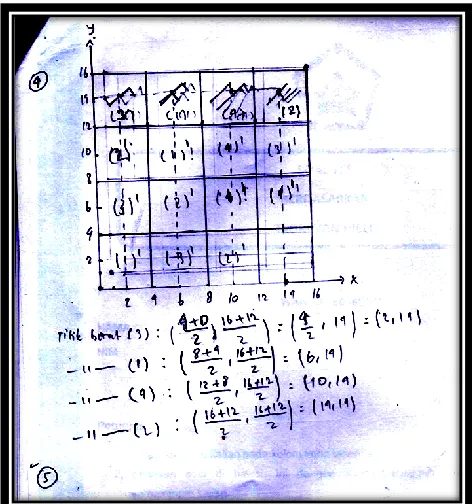
Q: How do you determine the emphasis? can be explained? AAN.14: I consider 16 squares, each square-shaped. so in determining the center of gravity by going through the vertices on the square. As in pattern 1 find the X coordinates with (8 + 4) / 2 = 6, Y coordinates with (16 + 12) / 2 = 14
Q: Can you explain the purpose of coordinate image number 4 that Adjie made?
AAN.15: This is a shadow for another pattern. To answer question number 5. so the I ’is a shadow of 1.
Q: But why are there boxes that are not filled with patterns? AAN.16: Because yesterday I ran out of time working on it? Q: Now try rereading questions number 5 to 7, can you do it?
AAN.17: For number 5 I can because the steps are the same as number 4, and I have put other coordinates. Q: What about other numbers?
AAN.18: For number 6 I do not understand the concept of reflection used, because I have forgotten the concept Q: So in determining the pattern in number 5 you don't use the concept of reflection
AAN.19: No, I only put shadows according to the empty space.
Q: Do you know the types of reflection? AAN.20: Know.
P: Could you please mention?
AAN.21: Reflections on the x, Y, point (0,0) axis, the line y = x is what I remember
Q: Fine, did you have time to double check the answers you made?
AAN.22: No.
P: Alright then, thank you for the interview AAN.23: Yes, you are welcome.
The genetic decomposition analysis from the collection of interviews above is:
1) Action
In the transcript of interviews AAN.04 to AAN.08 AAN takes action repeatedly to identify problems with the problem. However, in the AAN.09 footage, the initial action was wrong, but after repeated actions ANN better understood the problem and was able to determine the size and picture of the handkerchief sketch formed.
2) Process
The interiorization process at AAN was seen in the AAN interview 11 where AAN began to reflect on the action of determining the sketch of another handkerchief. The encapsulation process was seen when ANN was able to convert the sketch into the Cartesian coordinates and calculate the Cartesian intention coordinates seen in the AAN interview.
3) Objects
The student's thought process is said to be on the Object if it is able to determine other shadows on the cartesius coordinates that have been previously designed. The execution of AAN at this stage can be seen in Figure 4.
3502 Process and object action but not yet formed a scheme
because it is seen in the interview transcript of AAN.17 and AAN.18 where AAN has not been able to analogize into the concept of reflection on transformation geometry so that, it can be concluded that AAN is at the inter level (Level 2).Berdasarkan analisis tersebut, Subjek=subjek PA dan ANN sudah berada pada level inter. Subjek-subjek tersebut, memulai proses berpikir dengan mengidentifikasi masalah pada soal yang diberikan. Hal ini terlihat dimana subjek mampu menentukan syarat cukup dan syarat perlu serta mampu menentukan bahwa hal-hal yang diketahui sudah cukup untuk menjawab hal-hal yang ditanyakan. Proses berpikir selanjutnya subjek mampu menentukan hubungan antara hal-hal yang diketahui dengan yang ditanyakan, konsep dan materi yang diperlukan dalam menjawab tetapi belum mampu menggunakan konsep transformasi dalam mencari alternatif jawaban. Hal ini terlihat dimana subjek mampu merefleksikan jawaban dengan membuat berbagai kemungkinan sketsa jawaban. Sesuai dengan penelitian (Dubinsky, Weller, McDonald, & Brown, 2004), sudents try to understand the problems that the teacher asks them to solve. They answer questions raised by teachers or fellow students. Students can improve their understanding of one or another of a concept gradually. They keep doing it, always trying to make more sense, always learning a little more, and sometimes feeling very frustrated. Also, the teacher's role is to help students learn to manage and use it as a tool to improve their own understanding. Hal ini sejalan dengan pendapat (Widada, Herawaty, Nugroho, et al., 2019a)(Widada, Herawaty, Nugroho, et al., 2019b)(D. Herawaty et al., 2018) that the subject does not have a conceptual understanding when solving problems does not take advantage of concepts learned without logical reasons. Subjects at inter level have been in two stages of mathematical thinking process. He is able to do specializing consists of identifying problems and devising various strategies (Widada & Herawaty, 2009)(Widada, 2016b). Also, embarrassing can be generalizing consisting of reflecting on ideas and expanding the possibility of results being made. Other research on the concept of a koset, that all conceptions of a koset together with the traits understood by an individual will be organized in a scheme about a koset, that is, a system of actions, processes, objects and other schemes related to the boarding, and coordination done individually as a form of understanding of the koset. This system becomes coherent, in the sense that the individual will have meaning (either explicit or implicit), maybe a formal definition, and can solve problems about what is related to the concept of the board. (Dubinsky & McDonald, 2000). Based on these descriptions, the characteristics of students in understanding geometry-based ethnomathematics are the process of thinking the subject at the intra level has been at the Specialization stage where the subject can identify the problem and try a strategy in solving the given problem. In the Formal Deduction Stage, the thought process begins to reflect the ideas that have been obtained by grouping problems into the same conditions. This condition shows that in the stages of the thought process after the intra level, the next stage of thinking uses formal deduction. So, it can be concluded in the group one thought process has entered the stage of reflecting on the ideas made which are the initial stages in Generalizing. Inter level students, the
thought process is specializing and generalizing. Whereas the analysis phase only reaches the Specialization stage, which is identifying and trying the strategy in solving problems. This condition shows that the subjects in this group in the Specializing phase will better understand the visible where the subject analyzes the requirements sufficiently and the conditions need to answer a problem. The subject understands giving examples and not examples in answering possible answers.
Conclusions
In understanding geometry, students need better abstract thinking skills. To facilitate students' abstract thinking, learning with an ethnomathematics approach is implemented. Through this learning, students can do the processes of abstraction, idealization, and generalization about geometric objects. It also makes students able to carry out physical and mental activities through a local cultural approach (Kaganga script), to do interiorization and encapsulation in the form of concepts and principles of geometry. High-level students are able to draw up a mature scheme and store it in their memory. The thought process is done through specializing and generalizing.
References
[1] Anonimous. (2019). Aksara Kaganga. Https://Id.Wikipedia.Org/Wiki/Aksara_Kaganga Aksara. [2] Balamurugan, M. (2015). Etnomathematics; An
Approach For Learning Mathematics From Multikultural Perspective. International Journal Of Modern Research And Reviews, 3(6), 716–720.
[3] D’Ambrosio, U. (2015). From Mathematics Education and Society to Mathematics Education and a Sustainable Civilization. Portland, Oregon, United States: Proceedings of the Eighth International Mathematics Education and Society Conference, 2(June).
[4] Dubinsky, E., & McDonald, M. A. (2000). APOS: A Constructivist Theory of Learning in Undergraduate Mathematics Education Research. USA: Georgia State University.
[5] Dubinsky, E., Weller, K., McDonald, M. A., & Brown, A. (2004). Same historical ussues and paradoxes regarding teh concept of intinity: An APOS based analysis, Part 1.
[6] Dubinsky, E., & Wilson, R. T. (2013). High school students’ understanding of the function concept. The Journal of Mathematical Behavior, 32(1), 83–101. https://doi.org/10.1016/s0732-3123(01)00065-7
[7] Fauzan, A., Slettenhaar, D., & Plomp, T. (2002). Traditional Mathematics Education vs . Realistic Mathematics Education : Hoping for Changes. Proceedings of the 3rd International Mathematics Education and Society Conference. Copenhagen: Centre for Research in Learning Mathematics, 1–4. [8] Herawaty, D., Widada, W., Novita, T., Waroka, L., &
Lubis, A. N. M. T. (2018). Students’ metacognition on mathematical problem solving through ethnomathematics in Rejang Lebong, Indonesia. Journal of Physics: Conference Series, 1088. https://doi.org/10.1088/1742-6596/1088/1/012089 [9] Herawaty, Dewi, Widada, W., Umam, K., Nugroho, Z.,
the Understanding of Mathematical Concepts through the Implementation of Realistic Mathematics Learning and Ethnomathematics. Advances in Social Science, Education and Humanities Research, Volume 295, 295(ICETeP 2018), 21–25.
[10]Nisawa, Y. (2018). Applying van Hiele ’ s Levels to Basic Research on the Difficulty Factors behind Understanding Functions. International Electronic Journal Of Mathematics Education, 13(2), 61–65. [11]Pusey, E. L. (2003). The Van Hiele Model Of
Reasoning In Geometry: A Literature Review. North Carolina State University.
[12]Stathopoulou, C., Kotarinou, P., & Appelbaum, P. (2015). Ethnomathematical research and drama in education techniques: developing a dialogue in a Geometry class of 10th grade students. Revista Latinoamericana de Etnomatemática, 8(2), 105–135. [13]Treffers, A. (1991). Didactical background of a
mathematics programm for primary education. In L. Streefland (ed.), Realis tic Mathematics Education in Primary School, CD-ß Press / Freudenthal Institute. Utrecht University,. Utrecht: Freudenthal Institute. [14]Widada, W. (2016a). Profile Of Cognitive Structure Of
Students In Understanding The Concept Of Real Analysis. Journal of Mathematics Education (Infinity), 5(2), 83–98. https://doi.org/10.22460/infinity.v5i2.215 [15]Widada, W. (2016b). Sintaks Model Pembelajaran
Matematika Berdasarkan Perkembangan Kognitif
Peserta Didik. Jurnal Pendidikan Matematika Raflesia, 1(2), 146–154.
[16]Widada, W., & Herawaty, D. (2009). Development of Student Schemes (Level Triad ++) About Real Analysis. In Laporan Hasil Penelitian (pp. 1–20). Bengkulu: FKIP Universitas Bengkulu.
[17]Widada, W., Herawaty, D., Falaq, A., Anggoro, D., Yudha, A., & Hayati, M. K. (2019). Ethnomathematics and Outdoor Learning to Improve Problem Solving Ability. Advances in Social Science, Education and Humanities Research, Volume 295, 295(ICETeP 2018), 13–16.
[18]Widada, W., Herawaty, D., Nugroho, K. U. Z., & Anggoro, A. F. D. (2019a). The ability to Understanding of the Concept of Derivative Functions for Inter-Level Students During Ethnomathematics Learning. Journal of Physics: Conference Series PAPER, 1179(012056), 1–6. https://doi.org/10.1088/1742-6596/1179/1/012056 [19]Widada, W., Herawaty, D., Nugroho, K. U. Z., &
Anggoro, A. F. D. (2019b). The Scheme Characteristics for Students at the Level of Trans in Understanding Mathematics during Etno- Mathematics Learning. Advances in Social Science, Education and Humanities Research, 253(Aes 2018), 417–421.