Transfer Of Technology Skills, Human Resource
Development Skills And Extension Agents’ Work
Performance: The Perceptions Of Cocoa Growers
In Malaysia
Oluwatoyin Olagunju, Salim Hassan, Mohd Yusoff Abd Samad, Ramle Kasin
Abstract: The main goal of extension service is to transfer technology and develop clients’ capacity and potentials to enhance their work performance. This study determines the relationship between technology transfer, human resource development and extension agents’ work performance among cocoa growers in Malaysia. The study used stratified sampling method to select 668 productive cocoa growers who are exposed to extension activities facilitated by the extension agents’ of Malaysian Cocoa Board (MCB) in the three (3) regions of Malaysia. The data were analyzed using descriptive statistics, correlation and regression analysis. Significant and positive correlation (p<0.001) existed between each variables and work performance. Regression analysis results showed that technology transfer skills (technical skill, technology delivery skill) and human resource development skills (leadership skill, decision making support skill and social skill) are significant (p<0.05). The R2 value of 0.602 indicates that all the predictors explain
about 60.2% of the variation in extension agents’ work performance. The highest contribution is attributed by decision making support skill (β=0.215). The study recommended training programmes for extension agents that will focus on technology transfer and human resource development skills, especially technology evaluation skill. Also, Malaysian Cocoa Board and other agricultural extension service agencies should give more attention to delivering consistent technology and human resource development initiatives relevant to the need of farmers and the extension agents by addressing identified skills and knowledge gaps for a continuous performance improvement in their work.
Index Terms: cocoa growers, extension agents, human resource development, technology transfer, Work performance
———————————————————
1. INTRODUCTION
Malaysia is among the top grinding cocoa countries falling into the 5th position globally and also occupies number one position in the whole continent of Asia [1] (Tothmihaly, 2017). Presently, the local cocoa production capacity has reduced drastically to the extent that they cannot sustain the grinding sector and this has resulted to the imbalance between the upstream and the downstream sector [2] (Ramle, 2012). However, the development of the cocoa upstream activities is not keeping pace with the downstream industry by depending on imported cocoa beans to meet the needs of the processing industry [2] (Ramle et al, 2012). This situation arises as cocoa becomes least favourable crop among farmers due to factors such as price of cocoa beans, pest and disease and labour constraints [3] (Lee, 2013), both the plantation sector and smallholder decided to abandon cocoa production for other more profitable crops like oil palm and pepper [4] (Fadzim et al., 2017). This setback has resulted to yearly decline of cocoa production in the country. Meanwhile despite the level of the decline, the grinding sector on downstream shows increasing trends. Therefore, in order to sustain the downstream sector,
The upstream needs to be improved to curtain the problems identified [5,6] (Arshad, 2015; MCB, 2018). The MCB extension agents are responsible for transferring cocoa technology to the farmers in which the processes involved in technology transfer and human resource development will go a long way to ascertain the level of the extension agents’ performance in addition to influencing the cocoa farmers to increase their level of production [2,7] (Ramle, 2012; Motolani et al., 2017). However, the farmers are also responsible for technology acceptance and the application of the technology in the right way in which without a good relationship between extension agents and farmers, the technology transferred will not meet desired expectation [8] (Hassan et al., 2017). Extension agents function is to change the level of decrease in farm production with the aid of technology transfer and findings from research institutes; to cause change in the attitude of the farmers so as to respond to innovations and to be actively involved in the development of agriculture; and agricultural sectors’ contribution to national economy by way of promoting the development of specific crops [9] (Mohd Samsudin, 2012).However, it was earlier reported by [10] Sail (2008) that the accomplishment of any extension programmes relies on the responsibility of extension agents to transfer technology with the required skills and knowledge in enhancing farmers’ capability to increase production. In addition, [11] Shah et al. (2013) revealed that Malaysian agricultural extension service was perceived to be insufficient in developing agriculture on account of concentrating attention on the role of technology transfer with little attention given to developing human capital. This has created a gap between technology transfer, human resource development and work performance of the extension agents. With the objective of enhancing performance of the extension agents’, both technology transfer and human resource development need to be connected by means of functional and effective HRD efforts so as to promote the sharing of technology among farmers to _________________________________
•Oluwatoyin Olagunju Faculty of Agriculture, Universiti Putra Malaysia
(UPM), MalaysiaFaculty of Agriculture, Adekunle Ajasin University (AAUA), Nigeria, (E-mail: [email protected])
•Salim HassanFaculty of Agriculture, Universiti Putra Malaysia (UPM),
Malaysia, (E-mail: [email protected])
•Mohd Yusoff Abd SamadFaculty of Agriculture, Universiti PutrMalaysia
(UPM), Malaysia, (E-mail: [email protected])
•Ramle KasinMalaysian Cocoa Board (MCB), Malaysia, (E-mail:
300 improve their standard of living and sustainable
production.Consequently, extension agents low performance in technology transfer and human resource development has been attributed to problems of poor skills and inadequacies in professional competencies needed to skillfully perform the work assigned to them [12] (Saleh & Man, 2017). It is not common to find research that focuses on specific skills needed by extension agents’ in technology transfer and how they were used in delivering extension services in order to promote the growth of rural development and increase agricultural productivity [13] (Issahaku, 2014). Thus, this study examined perceptions of cocoa growers in Malaysia on the relationship between technology transfer skills, human resource development skills and extension agents’ work performance. Specifically, the objectives to be achieved are as follows:
1. To determine the levels of extension agents’ technology transfer skills, human resource development skills and work performance as perceived by cocoa growers.
2. To determine the relationship between technology transfer skills, human resource development skills and work performance of extension agents.
3. To identify the most important factors contributing to work performance of the extension agents as perceived by cocoa growers.
Six hypotheses were developed based on our literature reviews on transfer of technology skills, human resource development skills and work performance trends in Malaysia at the point of the study. The following research hypotheses were tested with regard to the relationship between technology transfer skills, human resource development skills, and work performance as perceived by cocoa growers:
H1: There is significant relationship between technical skill and extension agents work performance as perceived by cocoa growers in Malaysia.
H2: There is significant relationship between technology delivery skill and extension agents work performance as perceived by cocoa growers in Malaysia.
H3: There is significant relationship between technology evaluation skill and extension agents work performance as perceived by cocoa growers in Malaysia.
H4: There is significant relationship between leadership skill and extension agents work performance as perceived by cocoa growers in Malaysia.
H5: There is significant relationship between decision making support skill and extension agents work performance as perceived by cocoa growers in Malaysia.
H6: There is significant relationship between social skill and extension agents work performance as perceived by cocoa growers in Malaysia.
2 LITERATURE REVIEW
The effectiveness of extension agents in enhancing clients’ performance is directly associated to how familiar they are with their clients’ context and issues. Some scholars have raised some sensitive questions as to how the extension
2.1 Technical Skill and Work Performance
Technical skill is the ability a person has in carrying out a specific activity. Before one can be able to do this, there is a need for technical knowledge and skill about the processes involved, methods and a set sequence of steps intended to achieve result. This is absolutely necessary for frontline officers as they need to be taught by their supervisors on how to carry out different tasks given to them through training and clarifying doubts in work related problems [24] (Jaya, 2016). Some researchers found technical skill to be related and predict work performance of an extension agent [25] (Sail, 2010). Similarly, [7] Motolani et al. (2017) identified technical skill as having relationship to work performance and at the same time a good predictor of extension agents work performance. However, [26] Khan (2017) has identified existence of gap between possessing technical skill and the potentials for smooth performance of their responsibilities.Ha1: There is significant relationship between technical skill and extension agents work performance among cocoa growers in Malaysia.
2.2 Technology Delivery Skill and Work Performance One of the main challenges facing the researchers as far as today’s agricultural development is concerned is the questions on the failure of smallholder farmer’s non-adoption of innovations and technologies designed for improvement in agricultural activities and lives of the farmers? Different point of views has been considered individually in explaining the problem emanated from one technology to the other, but not many assessments were considered on the actions and activities of agricultural extension services on technology delivery mechanism to the farmers in addressing the problem [27] (Odhong, 2017). Agricultural technology can be formed into a planned structure and transfer through different forms. The forms of delivery can contribute to productivity differentiated by changing the magnitude of technology transfer to the clients and increasing their knowledge on how to improve the information flow from farmers to scientist [28] (Alhassan, 2013). However, result of research conducted by [29] Demenongu et al. (2015), indicated that failure linked to extension performance are due to inability of the extension workers to deal with delivery concerns. They established that the effectiveness of extension agents in the area of communication with farmers, because of their deficiencies in the training related to the scientific principles and skills of communication and noted that, to effectively serve their clients, they must be effective in communication and as agents of development. [18] Wasihun et al. (2013) and [30] Maoba (2016) suggested that extension service should have strong delivery mechanism that would lead towards increase participation of farmers and restore confidences in extension activities since every success of extension programmes is a reflection of the roles played by farmers in the programme. Similarly, findings of the study conducted by [31] Ayansina and Adeogun (2017) also recommended a very strong delivery and communication skills as this serves as fundamental principle or practice of extension professionals to communicate needed technologies effectively with the farmers and stakeholders. Ha2: There is significant relationship between technology delivery skill and extension agents work performance among cocoa growers in Malaysia.
2.3 Technology Evaluation Skill and Work Performance The importance of evaluation has long been recognized, but there have been some important shifts in the understanding of its function and significance in the global context [32] (Martin et al., 2011). In advocating for technology evaluation skill, firstly, to understand what evaluation means is very important. Evaluation is characterized by order and planning with an objective to assess a completed or an on-going programme, project, or policy, its design, implementation and results [33] (Christoplos et al., 2012). According to [34] Suvedi and Stoep (2016), evaluation is both an art and a science. The art of evaluation involves identifying purposes and audiences, creating appropriate designs, and interpreting data about a programme or policy. While on the other hand, the science of evaluation involves systematically gathering and analyzing evidence about the outcomes and impacts. However, to improve the performance of the extension agents, [35] Lamm and Israel (2011) call to mind that emphasis should be laid on developing evaluation skill of different professional involved in agricultural extension activities which is very important to determine their level of performance. In similar way, [34] Suvedi and Stoep (2016) recommended that immediate investment are needed to upgrade and strengthen applied research and evaluation skills of mid-level officers who supervise front-line extension officers to mentor and train them in order to gain evaluation skills and subsequently include evaluation into their programme for capacity building to their enhance performance.Ha3: There is significant relationship between technology evaluation skill and extension agents work performance among cocoa growers in Malaysia.
2.4 Leadership Skill and Work Performance
302 leadership skill and extension agents work performance
among cocoa growers in Malaysia.
2.5 Decision-making Support Skill and Work Performance Workers are employed by their employers to be able to solve problems and make effective decisions when the need arises, but employees often do not have skills that meet employers’ expectation [17] (Tiraieyari et al, 2010). [41] Olcum and Titrek (2015) stated that decision has to do with the result of a composite social process and cannot just be an easy and unitary event but take a longer period of time. They opined that taking decision can be characterized by active factors that begin with identifying motivation for action, and end with an interest to take a specific action of commitment. [42] Al-Tarawneh (2012) defined decision as a continuing process of weighing different option attached a particular goal which usually comes about if there is available solution to be implemented. While on the other hand defined decision making as the process of recognizing and making a selection from a number of alternative solutions to a problem based on available situation. Moreover, understanding decision making skills is of great significance as it is evidence in research that good decision making skills are related to superior performance [43] (Steptoe-Warren et al., 2011). Nevertheless, they emphasized the importance of identifying such decision making skill by arguing that to know why an organization is doing what they are doing and why they are performing on the other way, those who represented the decision makers and the skills they have should be studied. Consequently, [44] Al-Zahrani et al. (2016) suggested that agricultural extension needs to be analyzed and redesigned to provide quality agricultural extension education and capacity-building programmes that will improve skills of extension agents to help them create decision making environments for farmers to have an improved productivity and performance. Therefore, active and greater participation and development of farmers in decision making leads to better results as this will encourage farmers to decide on what they needs, demand and get programmes they consider suitable for them [45] (Suvedi & Kaplowitz, 2016). Furthermore, Result of study conducted by [46] Das and Borua (2017) indicated that for extension agents to maintain favourable decision making pattern, there is need for more training. Finally, maximum effects would likely occur as this study will offer a promise that decision making skills are indeed able to bring change into the ability of the extension agents to enhance the decision making skills of the farmers. Ha5: There is significant relationship between decision making support skill and extension agents work performance among cocoa growers in Malaysia.
2.6 Social Skill and Work Performance
A greater part of different occupations involve the use of social skill, which may be in terms of working with the public, coworkers or a particular set of clients. Social skills have always been important in the work place as individual require raising their frequency of skillful interaction with others in order to accomplish their task [17] (Tiraieyari et al, 2010). [47] Hochwarter et al. (2006) revealed that social skill has been very important to organizations in that they are now using more team based arrangement as well as employed more service-oriented jobs. Generally, it was reported that people with strong social skill have high performance rating having experience positive social interactions with people [48] (Wu,
2008). Lately, a theory was constructed about social skill being a moderator that enhances people’s performance [49] (Beheshtifar & Norozy, 2013). [50] Okumura and Usui (2014) earlier confirmed that social skill moderated the relationship between conscientiousness and work performance in such that the relationship was stronger for individuals with higher social skill. In the research conducted by [7] Motolani et al. (2017), result of the study showed high positive correlation between social skill abilities of the extension agents and their performance. The findings of this study also pointed out among all individual variables, social skill is the strongest contributor in explaining the extension agents’ performance.Ha6: There is significant relationship between social skill and extension agents work performance among cocoa growers in Malaysia.
3 METHODOLOGY
This study adopted and used stratified sampling method to select sample 668 productive cocoa growers in the three region of Malaysia. In the first stage, cocoa cultivation was stratified into three (3) existing regions that make up of the whole country and further stratified the regions into nine (9) MCB Management location offices. Using this approach will ascertain each one cases from the stratum is adequately represented in the sample. For this study, the MCB management location office represents the stratum. A quantitative research design was carried out through survey questionnaires and interviews. Questionnaires were designed to evaluate cocoa growers’ perceptions regarding transfer of technology skills and human resource development skill dimensions and work performance. In analyzing cocoa growers perceptions on transfer of technology skills and human resource development skills dimensions, questions on the usage of technical skill, technology evaluation skill, technology delivery skill, leadership skill, decision making support skill and social skill were designed based on [25,51,7] Sail (2010), Saikia et al. (2013) and Motolani et al. (2017). The Pearson correlation analysis was conducted to determine the relationships between technology transfer skills, human resource development skills, and work performance. According to [52] Moore (2015), the primary importance of skills in technology transfer and human resource development arises from its influence on the perception of the extension agent, who believed that skills are a causative factor in their perception that is reflected in their performance at work. Similarly, [53,13,19] (Hoffman, 2014; Issahaku, 2014; Chae et al., 2014) stated that perception levels of skills in technology transfer and human resource development are associated with positive results in organizational such as work performance.
4 RESULTS AND DISCUSSION
4.1 Respondent Demographic Profile
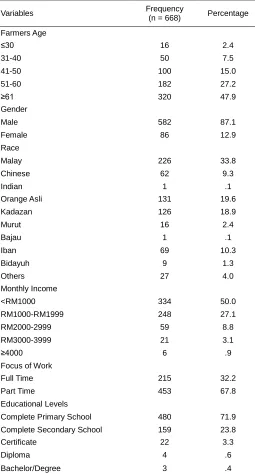
realized less than RM1,000 in a month and more than half of the respondents (67.8%) undertake cocoa farming as a part time job. The descriptive analysis of educational level of the respondents indicated that 71.9% had only completed primary education, 23.8% completed secondary education and only 3.3%, .6% and.4% had Certificate, Diploma and Bachelor/Degree respectively.
TABLE 1 FARMERS DEMOGRAPHIC PROFILE
Variables Frequency
(n = 668) Percentage
Farmers Age
≤30 16 2.4
31-40 50 7.5
41-50 100 15.0
51-60 182 27.2
≥61 320 47.9
Gender
Male 582 87.1
Female 86 12.9
Race
Malay 226 33.8
Chinese 62 9.3
Indian 1 .1
Orange Asli 131 19.6
Kadazan 126 18.9
Murut 16 2.4
Bajau 1 .1
Iban 69 10.3
Bidayuh 9 1.3
Others 27 4.0
Monthly Income
<RM1000 334 50.0
RM1000-RM1999 248 27.1
RM2000-2999 59 8.8
RM3000-3999 21 3.1
≥4000 6 .9
Focus of Work
Full Time 215 32.2
Part Time 453 67.8
Educational Levels
Complete Primary School 480 71.9
Complete Secondary School 159 23.8
Certificate 22 3.3
Diploma 4 .6
Bachelor/Degree 3 .4
4.2 Correlation Analysis
Pearson’s correlation coefficient is used to determine the relationship between independent and dependent variables. Pearson Correlation was conducted between the overall mean scores of work performance with transfer of technology skill and human resource development skill dimensions.
TABLE 2 RESULTS OF PEARSON CORRELATION
ANALYSIS
Variables r p
Technical skill 0.677 0.000
Technology delivery skill 0.651 0.000 Technology evaluation skill 0.618 0.000
Leadership skill 0.660 0.000
Decision making support skill 0.683 0.000
Social skill 0.662 0.000
**Correlation is Significant at the 0.01 Level
The relationships of the six skills (technical, technology delivery, technology evaluation, leadership, decision making support and social) influencing work performance were determined using Pearson correlation coefficients. Exploratory analysis was carried out to ensure that assumptions of normality and linearity were not violated. The result of the correlation analysis showed that all factors were significantly correlated. As indicated in Table 2, the strongest linear relationship was found between decision making support skill and work performance (r = .683; p < .001). The result also showed positive and significant correlations between technical skill and work performance (r = .677; p < .001), social skill and work performance (r = .662; p < .001), leadership skill and work performance (r = .660; p < .001), technology delivery skill and work performance (r = .651; p < .001) and between technology evaluation skill and work performance (r = .618; p < .001). These results indicated that hypotheses H1, H2, H3, H4, H5 and H6 were supported and reject null hypothesis.
4.3 Multiple Regression Analysis
Multiple regression analysis technique was used to measure the degree to which each of the independent variable explains or predicts the value of the dependent variable. Generally, multiple regression analysis is used to test the effect and determine the relationship between several independent variables (technical skill, technology delivery skill, technology evaluation skill, leadership skill, decision making support skill and social skill) and a dependent variable (work performance). The multiple regression equation for work performance is as follows:
Y = b0 + b1(X1) + b2(X2) + b3(X3) + b4(X4) + b5(X5) + … + bn(Xn) + e
Where:
Y = Work performance
b0 = Constant
b1-6 = Estimates (Regression coefficients) X1 = Technical skill
X2 = Technology delivery skill X3 = Technology evaluation skill X4 = Leadership skill
X5 = Decision making support skill X6 = Social skill
304
TABLE 3 COEFFICIENT RESULT OF MULTIPLE
REGRESSION
Variables b Beta t p
Constant .579 4.377
.000 Technical skill (X1) .203 .201 4.455 .000* Technology delivery skill (X2) .108 .112 2.583 .010* Technology evaluation skill (X3) .035 .036 .872 .384 Leadership skill (X4) .118 .127 3.062 .002* Decision making support skill
(X5)
.218 .215 5.339 .000*
Social skill (X6) .196 .212 5.598 .000* Significant; *p<.05, R = 0.776, R2= 0.602, Adj.R2 = 0.598, Std. Error of the Estimate = 0.40817
In order to identify effect of the skills to work performance, Table 3 presents the result of the regression analysis and was based on the contribution of all independent variables to work performance. Five independent variables were supported and statistically significant; Decision making support skill (β = .215; p = .000), social skill (β = .212; p = .000), technical skill (β = .201; p < .000), leadership skill (β = .127; p = .002) and technology delivery skill (β = .112; p = .010). H1, H2, H4, H5 and H6 were supported and reject null hypothesis as they were positive and significantly contributed to work performance. Meanwhile, Technology evaluation skill is not significant to extension agents work performance among cocoa growers in Malaysia. The regression model output as shown in Table 1.3 (β = .036; p = .384) did not support the hypothesis. The standardized coefficients indicated that technology evaluation skill has not significantly contributed to work performance among cocoa growers in Malaysia, hence the study fail to reject null hypothesis. The summary statistics of the regression analysis show the variables for which the coefficients are statistically significant with R2 of .602. The work performances were attributed to the five skills with a combined contribution of 60.2% to variance of work performance.
4.4 Discussion
The above result was supported by [25] Sail (2010) study, he reported that extension agents needs to be equipped with knowledge and skills in human resource development through regular training programmes as this will enhance effectiveness for higher performance in their work. [54] Mengal and Habib (2016) opined that unproductive human resource development activities within organizations would not only affect the extension agent working pattern and practice but also responsible to delay in their operational process and impede performance. According to [38,37] Luvanda (2015); Okwoche and Asogwa (2012), they reported that for any organization to be effective, there is need for an effective leadership, the neglect of leadership aspect and approach will lead to poor performance of individual and organizational performance. Furthermore, there is a general belief that for any set of people or group to be effective, the quality and approach of their leaders matter most. This was confirmed by [39] Tham-Agyekum (2016) that the exhibited behaviour of any leader goes a long way to positively affect their outcomes in an effective and efficient manner as well as facilitates the desires of the followers that results to effective performance. The findings of the relationship between technology transfer skills, human resource development skills and work performance indicate that the correlation coefficient is positively related.
Summarily, among technology transfer skills and human resource development skills, decision making support skill had the strongest relationship with extension agents work performance while technology evaluation skill had the weakest relationship to extension agents work performance. This confirmed the study of [55] Bernet et al. (2001), they found that decision making is a critical aspect of agricultural extension services that requires both extension agents and farmers to be involved, as it enhance the level of technology adoption in the direction of relevant production systems. Also, the findings supported [34] Lamm and Israel (2011) statement which suggested that there should be an increased emphasis on evaluation skill development of extension professionals which is very important to determine their level of performance. In similar way, [33] Suvedi and Stoep (2016) recommended that immediate investment are needed to upgrade and strengthen applied research and evaluation skills of mid-level officers who supervise front-line extension officers to mentor and train them in order to gain evaluation skills and subsequently include evaluation into their programme for capacity building to enhance their performance.Two technology transfer skills (technical skill and technology delivery skill) and three human resource development skills (leadership skill, decision making support skill and social skill) have predictive power of 0.598 which is significant at 0.05. Therefore the five skills are able to predict the outcomes of extension agents work performance with decision making support skill having the strongest effects on extension agents work performance. This is in line with the study conducted by [43] Al-Zahrani et al. (2016), they reported that decision making support skill is the most effective skills that influence the performance of extension agents as it strengthened the agricultural extension service and help farmers to make sustainable production practices decisions on their farms. On the other hand, an estimated regression coefficient for technology evaluation skill is not significant. This might be due to possibility that extension agents are relatively less involved in this aspect of work. For instance, evaluation skill is seldom emphasized in the daily routines of their work, it means technology evaluation is done at the management level and is not within the jurisdiction of the frontline extension agents.
5 LIMITATION, POLICY IMPLICATION AND
CONCLUSION
should be entrenched in training programmes introduced by agricultural extension service agencies in Malaysia, most especially Malaysian Cocoa Board for enhance sustainable cocoa production. This study aimed to find out how extension agents could identify the opportunities and threats for further improvement of their performance in technology transfer and human resource development among cocoa growers. It measure technology transfer and human resource development skills and assessed it effects on work performance of extension agents towards cocoa production as perceived by cocoa growers. The relationship among the six dimensions of ToT and HRD skills, namely, technical skill, technology delivery skill, technology evaluation skill, leadership skill, decision making support skill and social skill with work performance were tested and the results obtained show that all six dimensions had significant and positive relationship with work performance. Of the six, the result indicates that decision making support skill was the most important predictor of work performance, followed by social skill, technical skill, leadership skill and technology delivery skill.More importantly, extension agents should be empowered to solve farmers’ problems in order to increase cocoa production in the country. By having all of these recommendations being implemented, it is hoped that the productivity of the country’s cocoa yield can be increased exponentially.
REFERENCES
[1]. A. Tothmihaly, ―How low is the price elasticity in the global cocoa market‖. Global Food Discussion Papers; 2017.
[2]. K.P. Ramle, ―Contribution of Group Dynamics Factors to Technology Adoption among Malaysia Cocoa Farmers’ Clusters‖. doctoral diss. Universiti Putra Malaysia (Unpublished), 2012.
[3]. C.H. Lee, ―Planting Cocoa-Challenges and Reality in Malaysia‖. Retrieved from the website:(http://www.
iipm. com.
my/ipicex2014/docs/2012/oral/PLANTING%
20COCOA-% 20CHALLENGES% 2 0AND%
20REALITY% 20IN% 20MALAYSIA. pdf). 2013. [4]. W.R. Fadzim, M.I. Aziz, A.Z. Jalil, ―Efficiency of
Smallholder Cocoa Farmers in Malaysia: A DEA Approach‖. Int. J Sup. Chain. Mgt Vol. 2017 Mar;6(1):214.
[5]. F.M. Arshad, and A. Ibragimov, ―Malaysia’s Cocoa Beans Decline: A Prognosis‖. International Journal of Agriculture, Forestry and Plantation. 2015;1:1-4. [6]. MCB (Malaysian Cocoa Board), ―Statistics Export of
Cocoa Beans and Cocoa Products‖, 2018
http://www.koko.gov.my/lkm/industry/statistic/export.cf m. Retrieved 24 September 2018.
[7]. M. Motolani, S. Hassan, O. Olagunju, and R. Kasin, ―ToT and HRD competencies and its relationship to extension agents’ performance among cocoa smallholders‖, IOSR Journal of Agriculture and Veterinary Science (IOSR-JAVS). 2017;10(12):14-21. [8]. S. Hassan, R. Kasin, O. Olagunju, ―Factors
Influencing Cocoa Farmers Smallholder Clusters in Adoption of Technology: A Review Paper‖, IOSR Journal of Agriculture and Veterinary Science (IOSR-JAVS), 2017; 10(7): 34-39.
[9]. A.F. Mohd Samsudin, ―Agriculture extension and its role in ensuring food safety, quality and productivity in Malaysia‖, 2012 (Retrieved on 25 September 2018). http://www.nodai.ac.jp/cip/iss/english/9th_iss/fullpaper /1-2-1upm-Fikri.pdf
[10]. M.S. Rahim, ―Kompetensi dan Amalan Pendidikan Pengembangan (Concept and Practice of Extension Education)‖. Buletin Pengembangan (Extension Bulletin), Bil. 2008;1.
[11]. J.A. Shah, A. Asmuni, A. Ismail, ―Roles of extension agents towards agricultural practice in Malaysia‖. International Journal on Advanced Science, Engineering and Information Technology. 2013 Sep 10;3(1):59-63.
[12]. J.M. Saleh and N.B. Man, ―Training requirements of agricultural extension officers using borich needs assessment model‖, Journal of Agricultural & Food Information. 2017 Apr 3;18(2):110-22.
[13]. A. Issahaku, ―Perceived competencies of agriculture extension workers in extension services delivery in northern region of Ghana: Perspectives from literature‖, Developing Country Studies. 2014;4(15):107.
[14]. M. Suvedi, and R. Ghimire, ―How Competent Are Agricultural Extension Agents and Extension Educators In Nepal?‖. Innovation for Agricultural Training and Education, Feed the Future, USAID, Michigan State University. Accessed December. 2015 Dec;15:2016.
[15]. E.M. Zwane, ―The role of extension as a profession is critical in delivering excellent services: An experience from Limpopo‖, South Africa. Journal of Agricultural Science. 2014 Nov 1;6(11):1.
[16]. M. Mulder, ―Conceptions of professional competence‖, InInternational handbook of research in professional and practice-based learning 2014 (pp. 107-137). Springer, Dordrecht.
[17]. N. Tiraieyari, K. Idris, J. Uli, and A. Hamzah, ―Competencies influencing extension workers’ job performance in relation to the good agricultural practices in Malaysia, American Journal of Applied Sciences, 2010;7(10): 1379-1386.
[18]. B.N. Wasihun, J.A. Kwarteng, and E.L. Okorley, ―Professional and technical competencies of extension agents as perceived by male and female farmers and the extension agents themselves: The need for data source triangulation‖, Journal of Agriculture and Biodiversity Research. 2013;2(1):11-6.
[19]. S.H. Chae, Y.D. Kim, H.J. Lim, ―Analysis of the Association between Competence and Performance-focusing on Farmers and Extension Workers‖ American Journal of Agricultural and Biological Sciences. 2014 Jan 1;9(1):101.
[20]. A.H. Khalil, M. Ismail, T. Suandi, and A.D. Silong, ―Human resource development competencies as predictors of agricultural extension agents'
performance in Yemen‖, Human Resource
Development International. 2009 Sep 1;12(4):429-47. [21]. L. Vandenberg, and K. Foerster, ―Core competencies
306 [22]. D.L. Varner, ―A phenomenological study of millennial
generation cooperative extension educators' development of core competencies‖. Doctoral dissertation. University of Nebraska-Lincoln, 2011. http://digitalcommons.unl.edu /aglecdiss /27.
[23]. R. Namdar, G.P. Rad, and E. Karamidehkordi, ―Professional competencies needed by agricultural and extension program evaluation staff and managers of Iranian Ministry of Agriculture‖, Journal of International Extension and Education. 2010;17(2):17-31.
[24]. G. Jaya, ―Training Program on Managerial Skills for Convergence in Agricultural Extension. National Institute of Agricultural Extension Management (An Organization of the Ministry of Agriculture, Govt. of India) Rajendranagar, Hyderabad – 500 030, Andhra Pradesh, India, 2016.
[25]. R.M. Sail, ―Kompetensi Pembangunan Sumberdaya Manusia dan Pemindahan Teknologi (Human Resource Development and Transfer of Technology Competencies and Their Relationships to Extension Agents’ Job Performance)‖, Akademika. 2010;79(1). [26]. M.Z. Khan, ―Assessment of Extension Agents’
Knowledge and Skills Regarding Pest Management in Khyber Pakhtunkhwa Province -Pakistan, AGROFOR International Journal, 2017; 2(2), 132–141.
[27]. J. Odhong, ―Empowering agricultural extension agents to deliver improved farming technologies, 2017. http:// bulletin.iita.org/ index.php/ 2017/ 10/ 06/ empowering-agricultural-extension-agents-deliver-improved-farming-technologies/. Retrieved 10 April, 2018.
[28]. Z.I. Alhassan, ―Assessment of the Potential of Agricultural Extension Delivery on Guinea Fowl (Numidea Meleagris) Production by Small Scale Farmers in the Upper East Region of Ghana (Doctoral dissertation, University of Ghana), 2013.
[29]. T.S. Demenongu, O.J. Okwu, and V.A. Okwoche, ―Assessment of communication competence of agricultural extension workers in Benue state, Nigeria‖. Journal of Agricultural & Food Information. 2015 Apr 3;16(2):163-73.
[30]. S. Maoba, ―Farmers’ perception of agricultural extension service delivery in Germiston Region, Gauteng Province, South Africa‖, South African Journal of Agricultural Extension. 2016;44(2):167-73. [31]. S.O. Ayansina, and S.O. Adeogun, ―Professional
Competency Needs of Agricultural Extension Agents of Ogun State Agricultural Development Programme (OGADEP)‖. Ife Journal of Agriculture. 2017 Dec 19;29(2):28-38.
[32]. A. Martin, S. Gundel, E. Apenteng, B. Pound, ―Review of literature on evaluation methods relevant to extension. GFRAS–Global Forum for Rural Advisory Services, 2011.
[33]. I. Christoplos, P. Sandison, and S. Chipeta, ―Guide to evaluating rural extension. GFRAS‖; 2012.
[34]. M. Suvedi, and G. V. Stoep, ―Improving the Monitoring and Evaluation of Agricultural Extension Programs, 2016 (July).Retrieved from https:// meas.illinois.edu/ wp.
[35]. A.J. Lamm, and G.D. Israel, ―An Organizational Approach to Understanding Evaluation in Extension‖, Journal of agricultural education. 2011;52(4):136-49. [36]. M.V. Gravina, ―Investigating leadership characteristics
and attitudes toward creativity according to agency context for agriculture extension agents in Uruguay‖. (Doctoral dissertation, Oklahoma State University), 2013.
[37]. R. Karami, and M. Ismail, ―Achievement Motivation in the Leadership Role of Extension Agents‖, Cambridge scholars publishing; 2014 Jul 24.
[38]. V.A. Okwoche, and B.C. Asogwa, ―Analysis of determinants of job performance of extension workers as a leader to farmers in Nigeria‖, Brit. J. Econ., Finance Management Sci. 2012;5(2):1-21.
[39]. M.W. Luvanda, ―Factors affecting the job perfomance of agricultural extension workers in Handeni District, Tanzania (Doctoral dissertation, Sokoine University of Agriculture), 2015.
[40]. E.K. Tham-Agyekum, ―A Review of the Application of Leadership Principles in Agricultural Extension in Ghana‖, 2016; 1–15. https:// www.academia.edu/ 24812942/ A Review of The Application of Leadership Principles in Agricultural Extension in Ghana. Retrieved 16 April 2018.
[41]. D. Olcum, and O. Titrek, ―The effect of school administrators’ decision-making styles on teacher job satisfaction‖ Procedia-Social and Behavioral Sciences. 2015 Jul 25;197:1936-46.
[42]. H.A. Al-Tarawneh, ―The main factors beyond decision making‖, Journal of Management Research. 2012;4(1):1-23.
[43]. G. Steptoe-Warren, D. Howat, and I. Hume, ―Strategic thinking and decision making: literature review‖, Journal of Strategy and Management. 2011 Aug 9;4(3):238-50.
[44]. K.H. Al-Zahrani, F.O. Aldosari, M.B. Baig, M.Y. Shalaby, and G.S. Straquadine, ‖Role of Agricultural Extension Service in Creating Decision-Making Environment for The Farmers to Realize Sustainable Agriculture in Al-Qassim And Al-Kharj Regions-Saudi Arabia‖, The Journal of Animal & Plant Sciences. 2016 Aug 1;26(4):1063-71.
[45]. M. Suvedi, and M.D. Kaplowitz, ―What every extension worker should know: Core competency handbook‖, Michigan State University, Department of Community Sustainability; 2016.
[46]. P. Das, and S. Borua, ―Socio-economic Characteristics of ATMA (Agricultural Technology Management Agency) Extension Functionaries in Assam and Their Relationship to Their Training Needs‖ Asian Journal of Agricultural Extension, Economics & Sociology, 2017;16(4), 1–5. https:// doi.org/ 10.9734/ AJAEES/ 2017/32993
[47]. W.A. Hochwarter, L.A. Witt, D.C. Treadway, and G.R. Ferris. ―The interaction of social skill and organizational support on job performance‖, Journal of Applied Psychology. 2006 Mar;91(2):482.
[48]. Y. Wu, ―Social skill in the workplace: what is social skill and how does it matter?‖ (Doctoral dissertation, University of Missouri--Columbia), 2008.
Academic Research in Business and social sciences. 2013 Mar 1;3(3):74.
[50]. T. Okumura, and E. Usui, ―Do Parents’ Social Skills Influence Their Children’s Sociability?. The BE Journal of Economic Analysis & Policy. 2014 Jul 1;14(3):1081-116.
[51]. P. Saikia, M. Krishnan, P.S. Ananthan, S. Immanuel, and D. Hazarika, ―Delivery Competence and penetration of extension services among fish farmers of Assam‖, Indian Journal of Agricultural Economics. 2013;68(902-2016-66841):402-11.
[52]. K. M. Moore, ―Confronting the challenge of Agricultural Education and Training presented at the MEAS Symposium on: Strengthening Extension and Advisory Services for Lasting Impacts‖, Washington, D.C., 3-5 June 2015.
[53]. V. Hoffman, ―Governmental extension services, their generic problems and potential solutions. Innovations in extension and advisory services: International conference proceeding (pp. 15-18), 2014.
[54]. A. A. Mengal, and H. Shahida, ―Human resource development for an effective agriculture extension tool: an empirical study of Baluchistan Province‖, International Journal of Agricultural Extension. 2016;4(1):71-7.