A previous version of this paper appeared inScience China: Information Science, 2010, 53(3): 593-606
CCA-Secure Unidirectional Proxy Re-Encryption
in the Adaptive Corruption Model without
Ran-dom Oracles
Jian Weng1,2, Minrong Chen3, Yanjiang Yang4, Robert H. Deng2, Kefei Chen5, Feng Bao4
1Department of Computer Science, Jinan University, Guangzhou 510632, China;
2School of Information Systems, Singapore Management University, Singapore 178902;
3College of Information Engineering, Shenzhen University, Shenzhen 518060, China
4Institute for Infocomm Research (I2R), Singapore 119613;
5Department of Computer Science and Engineering, Shanghai Jiao Tong University, Shanghai 200240, China
Abstract. Proxy re-encryption (PRE), introduced by Blaze, Bleumer and Strauss in Eurocrypt’98, allows a semi-trusted proxy to convert a ciphertext originally intended for Alice into an encryption of the same message intended for Bob. PRE has recently drawn great interest, and many interesting PRE schemes have been proposed. However, up to now, it is still an important question to come up with a chosen-ciphertext secure unidirectional PRE in the adaptive corruption model. To address this problem, we propose a new unidirectional PRE scheme, and prove its chosen-ciphertext security in the adaptive corruption model without random oracles. Compared with the best known unidirectional PRE scheme proposed by Libert and Vergnaud in PKC’08, our schemes enjoys the advantages of both higher efficiency and stronger security.
Keywords. unidirectional proxy re-encryption, adaptive corruption model, chosen-ciphertext attack
1 Introduction
Proxy re-encryption (PRE), introduced by Blaze, Bleumer and Strauss[1] in Eurocrypt’98, allows a semi-trust proxy to transform a ciphertext originally intended for Alice into an encryption of the same message intended for Bob. The proxy, however, cannot learn anything about the messages encrypted under either key. PRE turns out to be a very useful tool, and has found many practical applications, such as distributed file systems[2,3], outsourced filtering of encrypted spam[2,3], and encrypted email forwarding[1], etc. According to the direction of transformation, PRE can be categorized into bidirectional PRE and
unidirectional PRE. In bidirectional PREs, the proxy can transform from Alice to Bob and vice versa. In contrast, the proxy in unidirectional PREs cannot transform ciphertexts in the opposite direction. According to another criterion, PRE systems can also be classified into multi-hop PRE, in which the ciphertexts can be transformed from Alice to Bob and then to Charlie and so on, andsingle-hop PRE, in
Received July 16, 2009; accepted September 27, 2009 doi: 10.1007/s11432-010-0047-3
Partially supported by the Office of Research, Singapore Management University. Also partially supported by the National Natural Science Foundation of China (Grant Nos. 60903178, 60970111, 60703030, 60873229), and the National High Technology Research and Development Program of China (863 Program) under Grants Nos 2009AA01Z418, 2008AA01Z403 and 2007AA01Z456.
which the ciphertexts can only be transformed once1.
In their seminal paper, Blaze et al.[1] proposed the first bidirectional PRE scheme. In 2005, Ateniese et al.[2,3] presented unidirectional PRE schemes from bilinear pairings. All of these schemes are only secure against plaintext attack (CPA). However, applications often require security against chosen-ciphertext attacks (CCA). To fill this gap, in ACM CCS’07, Canetti and Hohenberger[4] presented the first CCA-secure bidirectional PRE scheme without random oracles. They left six open questions in ACM CCS’07. One of these questions is to come up with a CCA-secure unidirectional PRE scheme without random oracles. In PKC’08, Libert and Vergnaud[5]partially resolved this problem by presenting a single-hop unidirectional PRE scheme without random oracles. They proved that their scheme is secure against the replayable chosen-ciphertext attack (RCCA)[6] in the non-adaptive corruption model. Here RCCA-security is a weaker variant of the CCA-RCCA-security in the sense that a harmless mauling of the challenge ciphertext is tolerated. In addition, the non-adaptive corruption model is somewhat weak, since the adversary is required to commit ahead of time which public key she wants to challenge. Thus, in their full paper2, Libert and Vergnaud left an open question of constructing a CCA-secure PRE scheme in the adaptive corruption model.
To address this problem, in this paper, we propose a new single-hop unidirectional PRE scheme, and prove its CCA-security (instead of RCCA-security) in the adaptive corruption model without random oracles. In addition to the stronger security, our scheme is more efficient than Libert-Vergnaud’s PRE scheme[5].
1.2 Related Work
In ACM CCS’07, Canetti and Hohenberger[4]left an open question of constructing a CCA-secure PRE scheme without pairings. In CANS’08, Deng et al.[8] successfully presented a CCA-secure bidirectional PRE scheme without pairings in the random oracle model. In PKC’09, Shao and Cao[9] proposed a unidirectional PRE without pairings, and claimed that their scheme is CCA-secure in the random oracle model. However, Chow et al. [24] pointed out that Shao-Cao’s scheme is not CCA-secure by giving a concrete attack. In the same paper, Chow et al. also presented a more efficient CCA-secure unidirectional PRE scheme without pairings in the random oracle model. Recently, Zhang et al.3 further showed that Shao-Cao’s comparisons[9]between their scheme and Libert-Vergnaud’s is unfair, since Shao-Cao’s scheme is even not CPA-secure in Libert-Vergnaud’s security model.
To control the proxy at a fine-grained level, Tang[10]and Weng et al.[11]independently introduced a vari-ant of PRE named conditional proxy re-encryption (C-PRE). In such systems, ciphertexts are generated with respect to a certain condition, and the proxy can translate a ciphertext only if the associated condition is satisfied. Recently, Weng et al.[12] re-formalized the definition and security notions for C-PRE systems, and presented a more efficient C-PRE scheme. Chu et al.[13] introduced a generalized concept named conditional proxy broadcast re-encryption (CPBRE), and proposed a RCCA-secure CPBRE scheme.
Traceable proxy re-encryption, introduced by Libert and Vergnaud[14], attempts to solve the problem of disclosing re-encryption keys, by tracing the proxies who have done so. Proxy re-encryption has also been studied in identity-based scenarios, such as[15,16,17].
2 Preliminaries
1In refs. [2,3,5], for a single-hop unidirectional PRE scheme, the original ciphertext is namedsecond level ciphertext, and the transformed
ciphertext is calledfirst level ciphertext. Through out this paper, we also follow these terminologies.
2Libert, B, Vergnaud, D. Unidirectional chosen-ciphertext secure proxy re-encryption. http://hal.inria.fr/inria-00339530/en/. This is
the extended version of [5].
3Zhang, X, Chen, M.R, Li, X. Comments on Shao-Cao’s proxy re-encryption scheme from PKC 2009. Cryptology ePrint Archive,
2.1 Notations
For a finite setS,x← S$ means choosing an elementxfromS with a uniform distribution. For a string
x, we use |x| to denote its bit-length, [x]ℓ denote its first ℓ bits, and [x]ℓ denote its last ℓ bits. We use A(x, y,· · ·) to indicate thatAis an algorithm with the input (x, y,· · ·). By z← A(x, y,· · ·), we indicate the running of A(x, y,· · ·) letting z be the output. We use AO1,O2,···(x, y,· · ·) to denote that A is an
algorithm with the input (x, y,· · ·) and can access to oracles O1,O2,· · ·. Byz← AO1,O2,···(x, y,· · ·), we denote the running of AO1,O2,···(x, y,· · ·), and lettingz be the output.
2.2 Bilinear Pairings
Let G and GT be two cyclic multiplicative groups with the same prime order p. A bilinear pairing
is a map e : G×G → GT with the following properties: (i). Bilinearity: ∀g1, g2 ∈ G,∀a, b ∈ Zp, we
have e(ga
1, g
b
2) =e(g1, g2)ab; (ii). Non-degeneracy: There exist g1, g2 ∈G such thate(g1, g2) ̸= 1GT; (iii). Computability: There exists an efficient algorithm to computee(g1, g2) for ∀g1, g2∈G.
2.3 Complexity Assumptions
The security of our proposed schemes is based on a complexity assumption named 3-weak Decisional Bi-linear Diffie-Hellman Inversion (3-wDBDHI) assumption4, which has been used by Libert and Vergnaud[5] to construct unidirectional PRE schemes. The 3-wDBDHI problem in groups (G,GT) is, given a tuple
(g, ga, g(a2)
, g(a3)
, gb, Q) ∈ G5×G
T with unknown a, b
$
← Zp, to decide whether Q = e(g, g)b/a. Libert
and Vergnaud[5] has proved that, the above problem is equivalent to how to decide whetherQis equal to
e(g, g)b/a2
or a random value given (g, g1/a, ga, g(a2)
, gb, Q).
A probabilistic polynomial-time (PPT) algorithmBhasadvantage ϵin solving the 3-wDBDHI problem in groups (G,GT), if
Pr
[
B(g, g1a, ga, g(a
2)
, gb, Q=e(g, g)ab2
)
= 1
] −Pr
[
B(g, g1a, ga, g(a
2)
, gb, Q=e(g, g)c
)
= 1]>ϵ,
where the probability is taken over the random choices of a, b, c inZp, the random choice of g in G, and
the random bits consumed by B.
We say that the (t, ϵ)-3-wDBDHI assumption holds in groups (G,GT), if there exists not-time algorithm B that has advantage ϵin solving the 3-wDBDHI problem in (G,GT).
2.4 TCR Hash Function
The notion of target collision resistant (TCR) hash function family of hash functions was shown by Cramer and Shoup[18]. In a TCR hash function family, given a randomly chosen hash function H and a random element x from the definition domain of H, it is infeasible for a PPT adversary H to find
y ̸= x such that H(x) = H(y). Informally, we define the advantage of adversary H in attacking the target collision resistance ofH as AdvTCRH,H,Pr[A succeeds]. A TCR family is said to be target collision
resistant if the advantage AdvTCRH,H is negligible for any PPT adversaryHand any hash functionH chosen
from this TCR hash function family.
In practice, to build a target collision resistant hash function H, one can use a dedicated cryptographic hash function such as SHA-1. For that reason and for simplicity of our presentation, hereinafter, we will consider the hash functionH to be a fixed function.
2.5 Pseudorandom Function Family
We here review the definition of pseudorandom function family[19]. LetF :K ×D→ R be a function family, where K is the set of keys of F, and D is the domain and R is the range. Let G:D → R be a true random function family. LetF be a PPT adversary which outputs a bit. We consider the following
two experiments:
ExperimentExpPRF-1F (F)
K← K$
b← F$ F(K,·) Returnb
ExperimentExpPRF-0F (F)
g←$ G b← F$ g(·) Returnb
We define F’s advantage AdvPRFF,F in attacking the pseudorandomness of the function family F as
Pr
[
ExpPRF-1F (F) = 1
] −Pr
[
ExpPRF-0F (F) = 1].
If for any PPT adversary F, his advantage in attacking the pseudorandomness of the function family F
is negligible, then we say that F is a pseudorandom function family.
3 Model of Unidirectional PRE
In this section, we review the definition and security notions for unidirectional PREs. Since it is still unknown how to construct a secure multi-hop unidirectional PRE scheme under proper security model, we here concentrate on single-hop unidirectional PREs. Formally, a single-hop unidirectional PRE scheme consists of the following algorithms[5]:
Setup(1k): The setup algorithm takes as input a security parameter 1kand outputs the global parameters
param, which includes a description of the message space M.
KeyGen(param): On input of the security parameter 1k , all parties use this randomized algorithm to
generate a public/private key pair (pk, sk).
For brevity, we assume that paramis implicitly included in the input of the other algorithms.
ReKeyGen(ski, pkj): The re-encryption key generation algorithm takes as input a private key ski and
another public key pkj. It outputs a re-encryption key rki→j.
Enc2(pk, m): On input of a public key pk and a message m ∈ M, this encryption algorithm outputs a second level ciphertext CT that can be re-encrypted into a first level one (intended for a possibly different receiver) using the suitable re-encryption key.
Enc1(pk, m): On input of a public key pk and a message m ∈ M, this encryption algorithm outputs a first level ciphertext that cannot be re-encrypted for another party.
ReEnc(rki→j,CTi): On input a re-encryption keyrki→j and a second level ciphertext CTi under public
key pki, this re-encryption algorithm outputs a first level ciphertext CTj under public keypkj.
Dec2(sk,CT): On input a private keysk and a second level ciphertext CT, this decryption algorithm outputs a message m∈ M or the error symbol⊥if CT is invalid.
Dec1(sk,CT): On input a private key sk and a first level ciphertext CT, this decryption algorithm outputs a message m∈ M or the error symbol⊥if CT is invalid.
Next, we review the game-based security definitions for unidirectional PRE systems derived from refs. [4,5]. Before giving these security notions, we consider the following oracles which together model the ability of an adversary:
• Re-encryption key oracle Ork(pki, pkj): Run rki→j ← ReKeyGen(ski, pkj) and return rki→j to A.
Here ski is the private key with respect topki.
• Re-encryption oracle Ore(pki, pkj,CTi): Return CTj ←ReEnc(ReKeyGen(ski, pkj),CTi) to A. • First level decryption oracle O1d(pkj,CTj): Return the result ofDec1(CTj, skj) toA. Here CTj is
a first level ciphertext.
Note that for the last four oracles, we require thatpkiandpkjare generated by oracleOpkbeforehand.
Security of second level ciphertexts. Libert and Vergnaud[5] defined the security notion for a single-hop unidirectional PRE scheme under replayable chose-ciphertext attacks at the second level. We here modify this security notion to allow adaptive corruptions of users. In addition, we consider the CCA-security instead of RCCA-CCA-security. We term this notion asIND-2PRE-CCA.
Definition 1 For a single-hop unidirectional PRE schemeE and a PPT adversaryA running in two stagesfind andguess, we define A’s advantage against theIND-2PRE-CCAsecurity of E as
AdvIND-2PRE-CCAE,A (1k) =
Pr
δ′=δ
param←Setup(1k); (pki∗,(m0, m1),st)← AOpk
,Osk,Ork,Ore,O1d
find (param);
δ← {$ 0,1}; CT∗←Enc2(pki∗, mδ);δ′← A
Opk,Osk,Ork,Ore,O1d
guess (param,CT∗,st). −1
2 ,
where st is some internal state information of adversary A. Here it is mandated that |m0| = |m1|, and the following requirements are simultaneously satisfied: (i). A cannot issue the secret key query
Osk(pki∗); (ii). For any public key pkj, A cannot simultaneously issue the secret key query Osk(pkj)
and the re-encryption key query Ork(pki∗, pkj); (iii). For any public key pkj, A cannot simultaneously
issue the secret key query Osk(pkj) and the re-encryption query Ore(pki∗, pkj,CT∗); (iv). For a
first-level ciphertext CTj output by the re-encryption oracleOre(pki∗, pkj,CT∗), Acannot issue the first level
decryption queryO1d(pkj,CTj). We refer to the above adversaryAas anIND-2PRE-CCAadversary. We
say that a single-hop unidirectional PRE scheme E is (t, qpk, qsk, qrk, qre, qd, ϵ)-IND-2PRE-CCA secure, if for any t-time IND-2PRE-CCAadversary A that makes at most qpk, qsk, qrk, qre and qd queries to oracles
Opk,Osk,Ork,Ore andO1d, respectively, we have Adv
IND-2PRE-CCA
E,A (1 k)6ϵ.
Remark. As said in ref. [5], explicitly providing adversary A with a second level decryption oracle is useless, since (i). for the challenge ciphertext CT∗, A is obviously not allowed to ask the second level decryption oracle to decrypt it; (ii). while for any other second level ciphertext CT′, adversary A can first ask the re-encryption oracle to re-encrypt it into a first level ciphertext, and then ask the first level decryption oracle to decrypt it.
Security of first level ciphertexts. The above definition provides the adversary with a second level ciphertext in the challenge phase. In ref. [5], a complementary definition of security is defined to capture the inability to distinguish first level ciphertexts. We here review this definition (referred as IND-1PRE-CCA) as defined in ref. [5], with a slight modification to allow the adaptive corruptions of users and the CCA-security. In this definition, a first level ciphertext is provided for adversary Ain the challenge phase. Note that, in a single-hop unidirectional PRE scheme, since the first level ciphertext cannot be re-encrypted,A should be allowed to obtain any re-encryption keys, even including those from the target public key pki∗ to other public keys which are generated by oracle Osk. Furthermore, sinceA is allowed
to obtain any re-encryption keys, there is no need to provide the re-encryption oracleOrefor him. As the
aforementioned remark, the second level decryption oracle is also unnecessary.
Definition 2 For a single-hop unidirectional PRE schemeE and a PPT adversaryA running in two stagesfind andguess, we define A’s advantage against theIND-1PRE-CCAsecurity of E as
AdvIND-1PRE-CCAE,A (1k) =
Pr
δ′=δ
param←Setup(1k); (pki∗,(m0, m1),st)← AOfindpk,Osk,Ork,O1d(param);
δ← {$ 0,1}; CT∗←Enc1(pki∗, mδ);δ′← AOpk
,Osk,Ork,O1d
guess (param,CT∗,st). −1
wherestis some internal state information of adversaryA. Here it is mandated that|m0|=|m1|, andA can issue neither Osk(pki∗) nor O1d(pki∗,CT∗). We refer to the above adversaryAas an IND-1PRE-CCA
adversary. We say that a single-hop unidirectional PRE scheme E is (t, qpk, qsk, qrk, qd, ϵ)-IND-1PRE-CCA
secure, if for any t-time IND-1PRE-CCA adversary A that makes at most qpk, qpk, qrk and qd queries to oracles Opk,Osk,Ork and O1d, respectively, we have Adv
IND-1PRE-CCA
E,A (1 k)6ϵ.
Remark. Note that there is no need to explicitly provide the re-encryption oracle for A, since he can obtain any re-encryption key by resorting to oracle Ork, and thus he can re-encrypt any second level
ciphertext himself.
Master Secret Security. In ref. [2], Ateniese et al. defined another important security notion, named delegator secret security, for unidirectional PRE. This security notion captures the intuition that, even if the dishonest proxy colludes with the delegatee, it is still impossible for them to derive the delegator’s private key in full. We define this security notion (referred asMSS-PRE) in the following definition:
Definition 3 For a unidirectional PRE scheme E and a PPT adversary A, we defineA’s advantage against the MSS-PRE security ofE as
AdvMSS-PREE,A (1
k) = Pr[ski
∗is a valid secret keyparam←Setup(1k);ski∗ ← AOpk,Osk,Ork(param)],
where it is mandated that the public key pki∗ with respect to ski∗ is generated by Opk, and A cannot
issue the secret key query Osk(pki∗). We refer to the above adversary as a MSS-PRE adversary. We
say that a unidirectional PRE schemeE is (t, qpk, qsk, qrk, ϵ)-MSS-PRE secure, if for anyt-timeMSS-PRE
adversaryAthat makes at mostqpk, qskand qrk queries to oraclesOpk,Osk andOrk, respectively, we have
AdvMSS-PREE,A (1 k)6ϵ.
As indicated by the following Lemma, for single-hop unidirectional PREs, the master secret security is implied by the first level ciphertext security.
Lemma 1 For a single-hop unidirectional PRE, the master secret security is implied by the first level ciphertext security. That is, if there exists an adversaryA who can break theMSS-PRE security of a single-hop unidirectional PRE scheme E, then there also exists an adversaryB who can also breakE’s
IND-1PRE-CCAsecurity.
The proof for Lemma 1 is straightforward, and hence is omitted here.
4 Our Unidirectional PRE Scheme
In this section, we first present our single-hop unidirectional PRE scheme, and then give the security proofs for our scheme. A comparison between our scheme and Libert-Vergnaud’s scheme is also given.
4.1 Construction
Before presenting our scheme, some important andnecessaryprinciples for designing CCA-secure single-hop unidirectional PRE schemes should be mentioned: (i) the validity of the second level ciphertexts should be publicly verifiable; otherwise, it will suffer from a similar attack as illustrated in [8]5; (ii) it should also be impossible for the adversary to maliciously manipulate the first level ciphertext. In addition, to ensure the first level ciphertext security, another principle should be kept in mind: (iii) for a first level ciphertext CTj re-encrypted from a second level ciphertext CTi, CTj should not containsall
the components of CTi; otherwise, it will inevitably suffer from an attack as applied to Shao’s scheme[7].
We will explain how our scheme follows these principles in the following description of our scheme. Our proposed scheme consists of the following algorithms:
5Weng, J, Deng, R.H, Liu, S, et al. Chosen-ciphertext secure proxy re-encryption without pairings. Cryptology ePrint Archive, Report
Setup(1k): Given a security parameter 1k, this setup algorithm works as follows:
1. Choose bilinear groups (G,GT) of prime orderp >2k.
2. Pick generatorsg, g1, u, v, w $
←G, and setZ =e(g, g).
3. Choose a collision-resistant hash function H :G× {0,1}ℓ →Z∗
p. Choose also a pseudo-random
function (PRF) family F :GT ×G→ {0,1}ℓ−ℓ1∥{0,1}ℓ1 such that, given a seed in GT and an
input in G, it outputs anℓ-bit pseudorandom string. Here ℓand ℓ1 are security parameters.
4. Output the public parameters param= (p,G,GT, g, g1, u, v, w, Z, H, F, ℓ1, ℓ).
KeyGen(param): Useri picksxi←$ Z∗p, and sets his public key aspki =g
xi and private key as ski=xi.
ReKeyGen(ski, pkj): On input user i’s private key ski = xi and user j’s public key pkj = gxj, this
algorithm generates the re-encryption key rki→j =pk
1/ski
j =g
xj/xi.
Enc2(pki, m): To encrypt a messagem∈ {0,1}ℓ1 under the public keypki at the second level, the sender
proceeds as follows:
1. Pick r←$ Z∗p, and setC1=g1r andC2=pkir.
2. ComputeK =Zr and setC
3= [F(K, C1)]ℓ−ℓ1∥([F(K, C1)]
ℓ1⊕
m).
3. Pick t←$ Z∗p, and computeh=H(C1, C3) and C4=
(
uhvtw)r.
4. Output the second level ciphertext CTi = (t, C1, C2, C3, C4).
Note that the validity of the second level ciphertext can be publicly verified as in eqs. (1) and (2) to be given. Hence it is impossible for the adversary to manipulate the second level ciphertext.
Enc1(pkj, m): To encrypt a message m∈ {0,1}ℓ1 under the public keypkj at the first level, the sender
proceeds as follows:
1. Pickr ←$ Z∗p, and setC1=g1r, C2′ =e(pkj, g)
r, K =Zr,C
3= [F(K, C1)]ℓ−ℓ1∥([F(K, C1)]
ℓ1⊕m).
2. Pick t←$ Z∗p, and computeh=H(C1, C3) and C4=
(
uhvtw)r.
3. Output the first level ciphertext CTi = (t, C1, C2′, C3, C4).
Note that the validity of componentst, C1, C3andC4 can be checked as in eq. (1), and the validity of
C2′ can be verified as in eq. (4). So, it is also impossible for the adversary to maliciously manipulate the first level ciphertext.
ReEnc(rki→j,CTi): On input a re-encryption keyrki→j, an second level ciphertext CTi= (t, C1, C2, C3, C4) under public keypki, computeh=H(C1, C3), and then check the validity of CTiby testing whether
the following equalities hold:
e(C1, uhvtw) =e(C4, g1), (1)
e(C1, pki) =e(C2, g1). (2)
If not, output⊥. Otherwise, computeC2′ =e(C2, rki→j), and output the first level ciphertext under
public key pkj as CTj = (t, C1, C2′, C3, C4).
Note that, the verification of eqs. (1) and (2) can be alternately done by picking r1, r2 $
← Z∗ p and
testing if
e(C1, pk
r1
i (u
hvtw)r2)=e(Cr1
2 c
r2
In this way, the verification of the well-formedness of ciphertext CTi reduces two pairings at the cost
of only one more multi-exponentiation. Note that the multi-exponentiation can be computed more efficiently than the pairing.
Dec2(ski,CTi): To decrypt a second level ciphertext CTi = (t, C1, C2, C3, C4), user i with private key
ski proceeds as follows:
1. First check the validity of the ciphertext as in eq. (3). If the verification fails, output “⊥”.
2. ComputeK =e(C2, g)1/ski. If [F(K, C1)]ℓ−ℓ1 = [C3]ℓ−ℓ1 holds, outputm= [F(K, C1)]
ℓ1⊕[C3]ℓ1;
else output “⊥”.
Dec1(skj,CTj): On input a private key skj and a first level ciphertext CTj = (t, C1, C2′, C3, C4), user j with private key skj proceeds as follows:
1. First check the validity of the ciphertext as in eq. (1). If the verification fails, output “⊥”.
2. ComputeK =C′1/skj
2 . Outputm= [F(K, C1)]
ℓ1 ⊕[C3]ℓ1 if the following equality holds:
[F(K, C1)]ℓ−ℓ1 = [C3]ℓ−ℓ1. (4)
Otherwise, output “⊥”.
Remark: Libert-Vergnaud’s scheme applies a technique introduced in Boyen-Boneh’s selective-ID se-cure identity-based encryption scheme[20] (refer to the ciphertext component C
4 = (usvk·v)r in Libert-Vergnaud’s scheme). Thus in the security proofs of Libert-Libert-Vergnaud’s scheme, the adversary must commit ahead of time to the target user that it wants to attack; otherwise, the challenger will be unable to gener-ate the challenge ciphertext for the adversary. In contrast, we use a technique inspired by Hohenberger-Waters’ recent signatures scheme[21] (refer to the ciphertext component C
4 = (uhvtw)r in our scheme)6. As will be seen in our security proofs, this technique enables the challenger to successfully generate the challenge ciphertext for the adversary, even if the adversary is allowed to adaptively corrupt users.
4.2 Security Analysis
The chosen-ciphertext security at the second level for our scheme is asserted by the following theorem.
Theorem 1 Our scheme is IND-2PRE-CCAsecure, assuming the hash functionH is target collision resistant, F is a pseudorandom function family and the 3-wDBDHI assumption holds in groups (G,GT).
Proof Without loss of generality, assume that H is target collision resistant and F is a pseudorandom function family. Then suppose that there is an adversary A who can break the (t, qpk, qsk, qrk, qre, qd, ϵ
)-IND-2PRE-CCAsecurity of our scheme. We can construct an algorithm B which can break the (t′, ϵ′
)-3-wDBDHI assumption in (G,GT) with
ϵ′ > ϵ
2 ˙e(1 +qsk+qrk) −
qd+qre
p −Adv
TCR
H,H−Adv PRF
F,F, t′6t+O(τ(qpk+qrk+ 8qre+ 8qd)),
where τ is the maximum over the time to compute an exponentiation, a multi-exponentiation and a pairing; ˙edenotes the base of the natural logarithm.
Suppose algorithm B is given a 3-wDBDHI instance (g, A−1 = g1/a, A1 =ga, A2 =g(a
2)
, B =gb, Q) ∈
G5×G
T with unknown a, b
$
←Z∗
p. B’s goal is to decide whether Q=e(g, g) b/a2
. B works by interacting with adversary Ain theIND-2PRE-CCAgame as follows:
Initialize. B provides A with public parameters including g1 = A
α0
2 , u= A
α1
1 A
β1
2 , v =A
α2
1 A
β2
2 and
w=Aα3
1 A
β3
2 for randomα0, α1, α2, α3, β1, β2, β3 $
←Z∗ p.
Find Stage. A issues a series of queries as in theIND-2PRE-CCA game. B maintains a listLlist, and answers these queries for Aas follows:
• Public key oracle Opk(i): Bpicksxi
$
←Z∗
p. Next, using the Coron’s technique
[23], it chooses a number
ci ∈ {0,1,‘−′} such that Pr[ci = 0] = P r[ci = 1] = θ and Pr[ci = ‘−′] = 1−2θ, where θ will be determined later. Ifci = ‘−′, it sets pki=gxi; ifci= 0, it setspki=Axi
2 ; ifci = 1, it setspki=A
xi 1 . Next, it adds the tuple (pki, xi, ci) to Llist and returnspki toA.
• Secret key oracle Osk(pki): B first recovers the tuple (pki, xi, ci) from Llist. If ci = ‘−′, it returns ski=xi toA. Otherwise, B outputs a random bit in{0,1} andaborts.
• Re-encryption key oracle Ork(pki, pkj): Bfirst recovers tuples (pki, xi, ci) and (pkj, xj, cj) fromLlist,
and then generate the re-encryption key rki→j forAaccording to the following cases:
– ci = ‘−′: It means thatski=xi. B outputsrki→j =pk
1/xi j .
– ci =cj: B returns rki→j =gxj/xi, which is indeed a valid re-encryption key.
– ci = 1∧cj = 0: It means thatski =axi and skj =a2xj. Breturns rki
→j =A xj xi
1 =g
a2xj
axi , which
is indeed a valid re-encryption key.
– ci = 1∧cj =‘−’: It means that ski =axi andskj=xj. Breturns rki→j =A xj/xi
−1 =g xj
axi, which
is indeed a valid re-encryption key.
– ci = 0∧cj = 1: It means thatski =a2xi and skj =axj. B returnsrki
→j =A xj xi
−1=g axj
a2xi, which
is indeed a valid re-encryption key.
– ci = 0∧cj =‘−’: B outputs a random bit in{0,1}and aborts.
• Re-encryption oracle Ore(pki, pkj,CTi): Bfirst parses CTi as (t, C1, C2, C3, C4), and then checks the validity of the ciphertext as in eq. (3). If the verification fails, it returns “⊥” to A. Otherwise, B proceeds to execute the following steps:
1. Recover tuples (pki, xi, ci) and (pkj, xj, cj) fromLlist.
2. If (ci = 0 ∧ cj = ‘−′) does not hold, first generate the re-encryption key rki→j as in the
re-encryption key oracle Ork, and then returnReEnc(rki→j,CTi) to A.
3. Else (it means that ski = a2xi and skj = xj), from C
1 = gr1 = A
r·α0
2 and C4 = (uhvtw)r =
(
Aα1h+α2t+α3
1 A
β1h+β2t+β3
2
)r
whereh=H(C1, C3), B can compute
Ar1=
C4
C
β1h+β2t+β3
α0 1
1
α1h+α2t+α3
. (5)
Then compute K = e(A−1, Ar1) = e(g, g)
r, set C′
2 = K
xj = e(pkj, g)r, and return CT j =
(t, C1, C2′, C3, C4) to A.
Recall that, in the public parametersu=Aα1
1 A
β1
2 ,v=A
α2
1 A
β2
2 andw=A
α3
1 A
β3
2 ,α1 (α2, α3, resp.) is blinded byβ1(β2, β3, resp.), and hence no information aboutα1, α2andα3is leaked to the adversary. So, in eq. (5), the equalityα1h+α2t+α3= 0 modpinformation-theoretically holds with probability
at most 1
p.
• First level decryption oracle O1d(pkj,CTj): AlgorithmBfirst parses the first level ciphertext CTj as
1. Computeh=H(C1, C3) and check the validity of the ciphertext as in eq. (1). If the verification fails, output “⊥” indicating an invalid ciphertext; else continue to execute the rest steps.
2. Compute Ar
1 =
( C4
C
β1h+β2t+β3
α0 1
) 1
α1h+α2t+α3
and then K =e(A−1, Ar1) =e(g, g)
r. Note that,
simi-larly to the analysis in the re-encryption oracle Ore, the chance ofα1h+α2t+α3 = 0 mod p holds with probability at most 1p.
3. If [F(K, C1)]ℓ−ℓ1 = [̸ C3]ℓ−ℓ1, output “⊥” indicating an invalid ciphertext. Otherwise, output
m= [F(K, C1)]ℓ1⊕[C3]ℓ1.
Note that even for the case of α1h+α2t+α3 = 0 mod p,B is still able to reject invalid first level ciphertexts. For a first level ciphertext CTj = (t, C1, C2′, C3, C4) under public keypkj, the validity of
t, C1, C3 and C4 can be ensured as in eq. (1). So, Bneeds only to check the validity of C2′. Suppose
C1 =g1r, C3= [F(K, C1)]ℓ−ℓ1∥([F(K, C1)]
ℓ1 ⊕m) and C
4 = (uH(C1,C3)vtw)r, whereK =e(g, g)r. To check the validity of C2′,Bneeds to check whetherC2′ =e(pkj, g)
rholds. Fortunately,Bcan do this,
since she can compute e(pkj, g)r according to the following cases:
– cj = 1 (it meas thatpkj =Axj
1 ): Bcan obtain e(pkj, g)
r by computing
e(C1, A−1) xj
α0 = (g1r, A−1)
xj
α0 = (Aα0r
2 , A−1) xj
α0 =e(Axj
1 , g)
r
=e(pkj, g)r.
– cj = 0 (it meas thatpkj =Axj
2 ): Bcan obtain e(pkj, g)r by computing
e(C1, g) xj α0 = (gr
1, g) xj
α0 = (Aα0r
2 , g) xj
α0 =e(Axj 2 , g)
r =e(pkj, g)r.
Challenge. WhenAjudges thatfindstage is over, it outputs a public keypki∗ and messagesm0, m1 ∈
{0,1}ℓ1 with the restrictions specified in the IND-2PRE-CCAgame. B responds as follows:
1. Recover tuple (pki∗, xi∗, ci∗) from Llist. If ci∗ ̸= 0, B outputs a random bit in {0,1} and aborts.
Otherwise, it means that pki∗ =Ax2i∗, and Bproceeds to execute the rest steps.
2. Pick δ ← {$ 0,1}. Define C1∗ = B
α0, C∗
2 = B
xi∗, C∗
3 = [F(Q, C1∗)]ℓ−ℓ1∥([F(Q, C1∗)]
ℓ1 ⊕mδ), t∗ =
−α1h∗+α3
α2 and C
∗
4 =B
(β1h∗+β2t∗+β3)whereh∗=H(C∗
1, C3∗). Return CT∗ = (t∗, C1∗, C2∗, C3∗, C4∗) as the challenge ciphertext to A.
Observe that, if Q =e(g, g)ab2, CT∗ is indeed a valid challenge ciphertext under public key pki∗. To see
this, lettingr∗ = ab2, we have
C1∗ = B
α0 =(ga2)α0·
b a2
= (Aα0
2 )
r∗
=gr1∗,
C2∗ = B
xi∗ =(ga2)xi∗· b a2
= (Axi∗ 2 )
r∗
=pkir∗∗,
C3∗ = [F(Q, C1∗)]ℓ−ℓ1∥([F(Q, C
∗
1)]
ℓ1 ⊕mδ) = [F(Zr∗, C∗
1)]ℓ−ℓ1∥([F(Z
r∗ , C1∗)]
ℓ1⊕mδ),
C4∗ = B
(β1h∗+β2t∗+β3)=
(
Aβ1h∗+β2t∗+β3
2
)r∗
=
( Aα1h∗
1 A
−α1h∗+α3
α2 ·α2
1 A
α3
1 ·A
β1h∗+β2t∗+β3
2
)r∗
=
( Aα1h∗
1 A
t∗·α2
1 A
α3
1 A
β1h∗+β2t∗+β3
2
)r∗
=((Aα1
1 A
β1
2
)h∗ ·(Aα2
1 A
β2
2
)t∗ ·(Aα3
1 A
β3
2 )
)r∗
=
(
uh∗vt∗w )r∗
.
On the other hand, whenQis uniform and independent inGT, the challenge ciphertext CT∗is independent
of δ in the adversary’s view.
the informationα1h∗+α2t∗+α3= 0 toA, it can be seen that the probability ofA’s querying a ciphertext which can cause Bto abort is still at most 1p.
Output. Eventually, Areturns a guessδ′ ∈ {0,1}. Ifδ′ =δ,B outputsβ′ = 1; else, outputsβ′ = 0.
This completes the description of the simulation. We next begin to analyze the simulation. It is clear that the simulations of oracle Opk is perfect. Let Abortdenote the event of B’s aborting during the
simulation of oraclesOsk,Orkor inChallengephase. We have Pr[¬Abort] = (1−2θ)qsk(1−θ(1−2θ))qrkθ>
(1−2θ)qsk+qrkθ, which is maximized at θ opt =
qsk+qrk
2(1+qsk+qrk). Using θopt, the probability Pr[¬Abort] is at
least 1
2 ˙e(1+qsk+qrk). Note that, if evenAbortdoes not happen during the simulation of oraclesOsk,Ork and theChallengephase, the simulation for oracles Osk,Ork and the challenge ciphertext are perfect.
We proceeds to analyze the simulation of the re-encryption oracleOre. The simulation ofOreis perfect,
unless α1h+α2t+α3 = 0 modp happens during the whole simulation (denote this event by ReEErr). However, as argued before, the equalityα1h+α2t+α3= 0 modp holds in each query with probability at most 1p. So we have Pr[ReEErr]6 qre
p .
The simulation of decryptionO1d is also perfect, unless α1h+α2t+α3= 0 modphappens during the whole simulation (denote this event by DecErr). Similarly, we can have Pr[DecErr]6 qd
p.
Combining the above results and counting for the target collision resistant of the hash function H
and the pseudorandomness of F, we can see that B’s advantage against the 3-wDBDHI assumption is at least ϵ′ > 2 ˙e(1+qϵ
sk+qrk) − qd+qre
p −Adv
TCR
H,A −Adv PRF
F,F, and B’s running time can be bounded by t′ 6t+O(τ(qpk+qrk+ 8qre+ 8qd)). This completes the proof of Theorem 1.
The CCA-security at the first level for our scheme is ensured by the following theorem:
Theorem 2 Our scheme is chosen-ciphertext secure at the first level, assuming the hash function
H is target collision resistant, F is a pseudorandom function family and 3-wDBDHI assumption holds in groups (G,GT).
Proof Without loss of generality, assume that H is target collision resistant and F is a pseudorandom function family. Then, suppose there is an adversaryAwho can break the (t, qpk, qsk, qrk, qd, ϵ)- IND-1PRE-CCA security of our scheme, we can construct an algorithm B which can break the (t′, ϵ′)-3-wDBDHI assumption in (G,GT) with
ϵ′ > ϵ
˙
e(1 +qsk) −
qd
p −Adv TCR H,A −Adv
PRF
F,F, t′ 6t+O(τ(qpk+qrk+ 8qd)),
whereτ and ˙ehave the same meaning as in Theorem 1.
Suppose algorithm B is given a 3-wDBDHI instance (g, A−1 = g1/a, A1 =ga, A2 =g(a
2)
, B =gb, Q) ∈
G5×G
T with unknown a, b
$
←Z∗
p. B’s goal is to decide whether Q=e(g, g)
b/a2. B works by interacting
with adversary Ain theIND-1PRE-CCAgame as follows:
Initialize. B provides A with public parameters including g1 = Aα20, u= A
α1
1 A
β1
2 , v =A
α2
1 A
β2
2 and
w=Aα3
1 A
β3
2 for randomα0, α1, α2, α3, β1, β2, β3 $
←Z∗ p.
Find Stage. A issues a series of queries as in theIND-1PRE-CCA game. B maintains a listLlist, and answers these queries for Aas follows:
• Public key oracle Opk(i): B picks xi
$
← Z∗
p, and flips a random coin ci ∈ {0,1}. If ci = 0, it sets pki =Axi
1 ; else it setspki=g
xi. Next, it adds the tuple (pki, xi, ci) to Llist and returns pki toA.
• Secret key oracle Osk(pki): B first recovers (pki, xi, ci) fromLlist. If ci= 1, it returnsski =xi toA;
else it outputs a random bit in {0,1} andaborts.
• Re-encryption key oracle Ork(pki, pkj): Bfirst recovers tuples (pki, xi, ci) and (pkj, xj, cj) fromLlist,
– ci = 1: It means thatski=xi. Boutputsrki→j =pk
1/xi j .
– ci =cj = 0: B returns rki→j =gxj/xi, which is indeed a valid re-encryption key.
– ci = 0∧cj = 1: Breturns rki→j=A xj/xi
−1 .
• First level decryption oracle O1d(pkj,CTj): Algorithm B first parses the first level ciphertext CTj
as (t, C1, C2′, C3, C4). Next, it recovers tuple (pkj, xj, cj) fromLlist. Ifcj = 1, it means thatskj =xj, and algorithm B returnsDec1(skj,CTj) to A. Otherwise,B proceeds as follows:
1. Compute h = H(C1, C3) and then check the validity of the ciphertext as in eq. (1). If the verification fails, output “⊥”; else continue to execute the rest steps.
2. Compute Ar
1 =
( C4
C
β1h+β2t+β3
α0 1
) 1
α1h+α2t+α3
and then K =e(A−1, Ar1) =e(g, g)
r. Note that,
simi-larly to the analysis in the proof of Theorem 1, the chance ofα1h+α2t+α3= 0 modp holds with probability at most 1
p.
3. If [F(K, C1)]ℓ−ℓ1 = [̸ C3]ℓ−ℓ1, output “⊥” indicating an invalid ciphertext. Otherwise, output
m= [F(K, C1)]ℓ1⊕[C3]ℓ1.
Note that even for the case ofα1h+α2t+α3 = 0 modp, challengerBis still able to reject invalid first level ciphertexts. For a first level ciphertext CTj = (t, C1, C2′, C3, C4) under public keypkj =A
xj 1 , the validity oft, C1, C3andC4 can be ensured as in eq. (1). So,Bneeds only to check the validity of the component C2′. Suppose C1 =gr1, C3= [F(K, C1)]ℓ−ℓ1∥([F(K, C1)]
ℓ1⊕m) andC
4=
(
uH(C1,C3)vtw)r,
where K = e(g, g)r. To check the validity of C′
2, B needs to check whether C2′ = e(pkj, g)
r holds.
Fortunately, Bcan obtain e(pkj, g)r by computing
e(C1, A−1) xj
α0 = (gr1, A−1)
xj
α0 = (Aα20r, A−1)
xj
α0 =e(Ax1j, g)r=e(pkj, g)r.
Challenge. When A judges that find stage is over, it outputs a public key pki∗ and two
equal-length messages m0, m1 ∈ {0,1}ℓ1 with the restrictions specified in the IND-1PRE-CCA game. B first recovers tuple (pki∗, xi∗, ci∗) from Llist. If ci∗ = 1, B outputs a random bit and aborts. Otherwise, B picks δ ← {$ 0,1}, defines C1∗ = B
α0, C′∗
2 = e(A−1, B)xi∗, C3∗ = [F(Q, C1∗)]ℓ−ℓ1∥([F(Q, C1∗)]
ℓ1 ⊕mδ),
t∗=−−α1h∗+α3
α2 and C
∗
4 =B
(β1h∗+β2t∗+β3), whereh∗ =H(C∗
1, C3∗), and returns CT∗= (t∗, C1∗, C2′∗, C3∗, C4∗) as the challenge ciphertext to A.
Observe that, ifQ=e(g, g)ab2, CT∗ is indeed a valid challenge ciphertext under public keypki∗. Letting
r∗ = b
a2, the well-formedness of C1∗, C3∗ and C4∗ can be seen as in the proof Theorem 1; while forC2′∗, its well-formedness can be seen as below:
C2′∗=e(A−1, B)
xi∗ =e(g1/a
, gb)xi∗ =e(ga·xi∗, g)ab2 =e(pki∗, g)r∗.
On the other hand, when Q is uniform and independent in GT, the challenge ciphertext CT∗ is
inde-pendent ofδ in the adversary’s view.
Guess Stage. Acontinues to issue the rest queries. B can respond these queries forA as in the find
stage, sinceAhas to follow the restrictions described in theIND-1PRE-CCAgame and the hash function
H is target collision resistant.
Output. Eventually, Areturns a guessδ′ ∈ {0,1}. Ifδ′ =δ,B outputsβ′ = 1; else, outputsβ′ = 0.
This completes the description of the simulation. We next begin to analyze the simulation. It is clear that the simulations of oracles Opkand Ork are perfect. The simulation of decryptionO1d is also perfect,
unless α1h+α2t+α3 = 0 mod p happens during the whole simulation (denote this event by DecErr). Similarly to the proof in Theorem 1, we can have Pr[DecErr] 6 qd
aborting during the simulation of oracleOsk or inChallengephase. Similarly to the proof of Theorem
1, we have Pr[¬Abort]6 e˙(1+1q sk).
Combining the above results and counting for the target collision resistant of the hash functionHand the pseudorandomness ofF, we can easily see thatB’s advantage against the 3-wDBDHI assumption is at least
ϵ′> e˙(1+ϵq sk)−
qd
p− Adv TCR H,A−Adv
PRF
F,F, andB’s running time can be bounded byt′ 6t+O(τ(qpk+qrk+8qd)).
This completes the proof of Theorem 2. From Lemma 1 and Theorem 2, we have
Theorem 3 Our scheme is MSS-PRE secure in the standard model, assuming the 3-wDBDHI as-sumption holds in groups (G,GT).
4.3 Comparisons
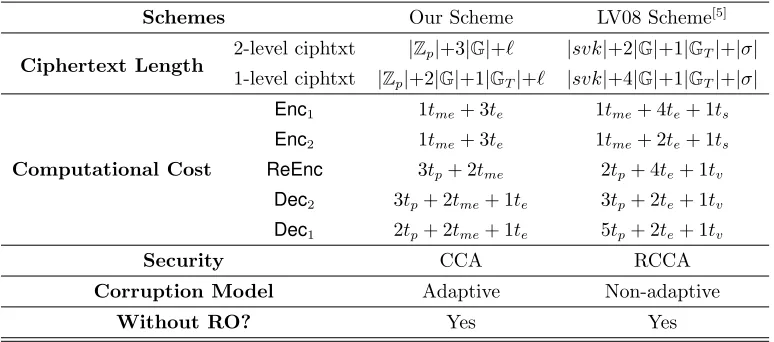
In Table 1, we compare our scheme with Livert-Vergnaud’s scheme[5] (denoted by LV08). We first explain some notations used in Table 1. Here |G|and |GT|denote the bit-length of an element in groups
G and GT, respectively. |M| denotes the bit-length of the plaintext in LV08 scheme, and ℓ denotes
the security parameter in our scheme. |svk| and |σ| denote the bit-length of the verification key and signature of one-time signature used in LV08 scheme[5], respectively. We use tp, te, tme, ts, tv to represent the computational cost of a bilinear pairing, an exponentiation, a multi-exponentiation, one signing and one verifying a one-time signature, respectively.
Table 1: Comparisons between LV08 Scheme and Our Scheme
Schemes Our Scheme LV08 Scheme[5]
2-level ciphtxt |Zp|+3|G|+ℓ |svk|+2|G|+1|GT|+|σ| Ciphertext Length
1-level ciphtxt |Zp|+2|G|+1|GT|+ℓ |svk|+4|G|+1|GT|+|σ|
Enc1 1tme+ 3te 1tme+ 4te+ 1ts
Enc2 1tme+ 3te 1tme+ 2te+ 1ts Computational Cost ReEnc 3tp+ 2tme 2tp+ 4te+ 1tv
Dec2 3tp+ 2tme+ 1te 3tp+ 2te+ 1tv
Dec1 2tp+ 2tme+ 1te 5tp+ 2te+ 1tv
Security CCA RCCA
Corruption Model Adaptive Non-adaptive
Without RO? Yes Yes
The comparison results indicate that our scheme has a better overall performance than LV08 scheme in term of both ciphertext length and computational cost. Most importantly, our scheme achieve the CCA-security, while LV08 scheme only satisfies the RCCA-security. The latter is a weaker variant of CCA-security in the sense that it cannot withstand the attack by re-randomizing the challenge ciphertext. In addition, our scheme can be proved in the adaptive corruption model, while LV08 scheme cannot.
5 Conclusions
We presented a unidirectional proxy re-encryption scheme, and proved its CCA-security in the adaptive corruption model without random oracles. Compared with the best know unidirectional PRE scheme proposed by Libert and Vergnaud, our scheme enjoys the advantages of both higher efficiency and stronger security.
standard model; (3) how to construct a CCA-secure PRE scheme with key privacy[25].
Acknowledgement
We would like to thank Sherman C. M. Chow, Cheng-Kang Chu and Junzuo Lai for the helpful discussions on the topic of proxy re-encryption. We thank Jun Shao for his pointing out a problem in the simulation of the re-encryption key oracle in the proof of our journal version.
1 Blaze M, Bleumer G, Strauss M. Divertible protocols and atomic proxy cryptography. In: Nyberg K, ed. EUROCRYPT. Lecture Notes in Computer Science, Vol 1403. Berlin: Springer-Verlag, 1998. 127-144
2 Ateniese G, Fu K, Green M, et al. Improved proxy re-encryption schemes with applications to secure distributed storage. In: proceedings of NDSS’05, The Internet Society. 2005
3 Ateniese G, Fu K, Green M, et al. Improved proxy re-encryption schemes with applications to secure distributed storage. ACM Trans. Inf. Syst. Secur, 2006, 9(1): 1-30
4 Canetti R, Hohenberger S. Chosen-ciphertext secure proxy re-encryption. In Ning P, di Vimercati S.D.C, Syverson P F, eds. ACM Conference on Computer and Communications Security, ACM, 2007, 185-194
5 Libert B, Vergnaud D. Unidirectional chosen-ciphertext secure proxy re-encryption. In Cramer R, ed. Public Key Cryptography. Lecture Notes in Computer Science, Vol 4939. Berlin: Springer-Verlag, 2008, 360-379 (full paper available at http://hal.inria.fr/inria-00339530/en/)
6 Canetti R, Krawczyk H, Nielsen J B. Relaxing chosenciphertext security. In Boneh D, ed. CRYPTO. Lecture Notes in Computer Science, Vol 2729. Berlin: Springer-Verlag, 2003, 565-582
7 Shao J. Proxy re-cryptography revisited (in chinese). PhD thesis. China Academic Journal Online Publication Integrated Database. 2008.
8 Deng R H, Weng J, Liu S, et al. Chosen-ciphertext secure proxy re-encryption without pairings. In Franklin M K, Hui L C K, Wong DS, eds. CANS. Lecture Notes in Computer Science, Vol 5339. Berlin: Springer-Verlag, 2008, 1-17
9 Shao J, Cao Z. CCA-secure proxy re-encryption without pairings. In Jarecki S, Tsudik G, eds. Public Key Cryptography. Lecture Notes in Computer Science, Vol 5443. Berlin: Springer-Verlag, 2009, 357-376
10 Tang Q. Type-based proxy re-encryption and its construction. In Chowdhury D R, Rijmen V, Das A, eds. INDOCRYPT. Lecture Notes in Computer Science, Vol 5365. Berlin: Springer-Verlag, 2008, 130-144
11 Weng J, Deng R H, Ding X, et al. Conditional proxy re-encryption secure against chosen-ciphertext attack. In Li W, Susilo W, Tupakula U K, Safavi-Naini R, Varadharajan V, eds. ASIACCS, ACM, 2009, 322-332
12 Weng J, Yang Y, Tang Q, et al. Efficient conditional proxy re-encryption with chosen-ciphertext security. In Samarati P, Yung M, Martinelli F, eds. ISC. Lecture Notes in Computer Science, Vol 5735. Berlin: Springer-Verlag, 2009, 151-166
13 Chu C K, Weng J, Chow S S M, et al. Conditional proxybroadcast re-encryption. In Boyd C, Nieto J M G, eds. ACISP. Lecture Notes in Computer Science, Vol 5594. Berlin: Springer-Verlag, 2009, 327-342
14 Libert B, Vergnaud D. Tracing malicious proxies in proxy re-encryption. In Galbraith S D, Paterson K G, eds. Pairing. Lecture Notes in Computer Science, Vol 5209. Berlin: Springer-Verlag, 2008, 332-353
15 Matsuo T. Proxy re-encryption systems for identity-based encryption. In Takagi T, Okamoto T, Okamoto E, Okamoto T, eds. Pairing. Lecture Notes in Computer Science, Vol 4575. Berlin: Springer-Verlag, 2007, 247-267
16 Green M, Ateniese G. Identity-based proxy re-encryption. In Katz J, Yung M, eds. ACNS. Lecture Notes in Computer Science, Vol 4521. Berlin: Springer-Verlag, 2007, 288-306
17 Chu C K, Tzeng W G. Identity-based proxy re-encryption without random oracles. In: Garay J A, Lenstra A K, Mambo M. et al. eds. ISC. Lecture Notes in Computer Science, Vol 4779. Berlin: Springer-Verlag, 2007, 189-202
18 Cramer R, Shoup V. Design and analysis of practical public-key encryption schemes secure against adaptive chosen ciphertext attack. SIAM J. Comput, 2004, 33(1): 167-226
19 Goldreich O, Goldwasser S, Micali S. How to construct random functions. J. ACM, 1986, 33(4): 792-807
20 Boneh D, Boyen X. Efficient selective-ID secure identity-based encryption without Random Oracles. In: Cachin C, Camenisch J, eds. EUROCRYPT. Lecture Notes in Computer Science, Vol 3027. Berlin: Springer-Verlag, 2004, 223-238
21 Hohenberger S, Waters B. Realizing hash-and-sign signatures under standard assumptions. In: Joux A, ed. EUROCRYPT. Lecture Notes in Computer Science, Vol 5479. Berlin: Springer-Verlag, 2009, 333-350
22 Lai j, Deng R H, Liu S, Kou Wei. Efficient CCA-Secure PKE from Identity-Based Techniques. In: Pieprzyk J, ed. CT-RSA. Lecture Notes in Computer Science, Vol 5985. Berlin: Springer-Verlag, 2010, 132-147
24 Chow S.S, Weng J, Yang Y, Deng R H. Efficient unidirectional proxy re-encryption. In Bernstein D J and T. Lang eds. AFRICACRYPT. Lecture Notes in Computer Science, Vol 6055. Berlin: Springer-Verlag, 2010. 316-332