An extended abstract of this paper appears in PKC 2009, S. Jarecki, G. Tsudik (Eds.), volume 5443 of LNCS, pp. 357-376, Sringer-Verlag, 2009.
CCA-Secure Proxy Re-Encryption without Pairings
∗
Jun Shao1,2 Zhenfu Cao1† [email protected] [email protected]
1Department of Computer Science and Engineering
Shanghai Jiao Tong University
2College of Information Sciences and Technology
Pennsylvania State University
Abstract
In a proxy re-encryption scheme, a semi-trusted proxy can transform a ciphertext under Alice’s public key into another ciphertext that Bob can decrypt. However, the proxy cannot access the plaintext. Due to its transformation property, proxy re-encryption can be used in many applications, such as encrypted email forwarding. In this paper, by using signature of knowledge and Fijisaki-Okamoto conversion, we propose a proxy re-encryption scheme without pairings, in which the proxy can only transform the ciphertext in one direction. The proposal is secure against chosen ciphertext attack (CCA) and collusion attack in therandom oracle model based on Decisional Diffie-Hellman (DDH) assumption overZ∗N2 and integer factorization assumption, respectively. To the best of our knowledge, it is thefirst unidirectional PRE scheme with CCA security and collusion-resistance.
Keywords: Unidirectional PRE, DDH, random oracle, CCA security, collusion-resistance
1
Introduction
In 1998, Blaze, Bleumer, and Strauss [6] proposed the concept ofproxy re-encryption (PRE), where a semi-trusted proxy can transform a ciphertext for Alice into another ciphertext that Bob can decrypt.1 However, the proxy cannot get the plaintext. According to the direction of transformation, PRE schemes can be classified into two types, one isbidirectional, i.e., the proxy can transform from Alice to Bob and vice versa; the other isunidirectional, i.e., the proxy can only convert in one direction. Blazeet al. [6] also gave another method to classify PRE schemes: multi-use, i.e., the ciphertext can be transformed from Alice to Bob to Charlie and so on; andsingle-use, i.e., the ciphertext can be transformed only once.
Due to its transformation property, PRE can be used in many applications, including simplification of key distribution [6], key escrow [21], distributed file systems [2, 3], security in publish/subscribe systems [23], multicast [10], secure certified email mailing lists [24, 22], the DRM of Apple’s iTunes [36], interop-erable architecture of DRM [34], access control [35], and privacy for public transportation [19]. Recently, ∗Supported by Research Fund for the Doctoral Program of Higher Education No. 20060248008, National Natural Sci-ence Foundation of China No. 60673079, Special Foundation of Huawei No. YZCB2006001, and National 973 Program No. 2007CB311201.
†Corresponding Author.
1In almost all related papers, the concept of PRE is introduced as “PRE allows a semi-trusted proxy to convert a ciphertext
Hohenbergeret al. got a result of securely obfuscating re-encryption [20], which is the first positive result for obfuscating an encryption functionality and against a series of impossibility results [18, 16, 4].
Since the introduction of PRE by Blaze, Bleumer, and Strauss [6], there have been many papers [6, 21, 2, 3, 17, 9, 11, 25] that have proposed different PRE schemes with different security properties. Some of them are related to chosen ciphertext attack (CCA) security. Ivan and Dodis [21] proposed a CCA security model for PRE and a generic construction of single-use PRE in the security model. Nevertheless, their security model allows the delegatee (Bob) to make use of the proxy as an oracle. As a result, the schemes only secure in their security model are not enough for some applications. For example, in encrypted email forwarding, an adversary (Bob) might hope to gain access to the original encrypted email by re-forming it, sending it to the proxy, and then hoping that the proxy responds with, “Can you forward the following to me again? [Encrypted attachment.]”
To fix the problem, Green and Ateniese [17], Canetti and Hohenberger [9] proposed new CCA secu-rity models for ID-based PRE and PRE, respectively. In these two new secusecu-rity models, it requires that the proxy checks the validity of the ciphertext before transformation, which is called public verifiability. Following this intuition, the first CCA secure, single-use, unidirectional ID-based PRE scheme in the ran-dom oracle model and the first CCA secure, multi-use, bidirectional PRE scheme in the standard model are proposed in [17, 9], respectively. However, the scheme in [17] suffers from the attack in Remark 2. Furthermore, the generic construction of PRE in [21] cannot be proved secure in the CCA security model in [9]. (See Appendix A for details. Hereafter, we refer CCA security to the definition in [9] or Section 2 of this paper.) Chu and Tzeng [11] proposed a multi-use, unidirectional ID-based PRE scheme, and claimed that it was CCA secure in the standard model. However, we showed that it was not true [31], since its transformed ciphertext (Cv1, R, d′1, d2, d′2) can be modified to another well-formed transformed ciphertext
(Cv1, R, d′1F2(vk)
r, d2, d′
2g
r) by anyone, whereris a random number fromZ∗
p. Recently, Libert and Vergnaud
[25] proposed a new unidirectional PRE scheme, which is replayable chosen ciphertext attack (RCCA) secure but not CCA-secure. It is fair to say that there is no CCA-secure unidirectional PRE scheme.2 Further-more, according to the results in [5, 29], the timing of a pairing computation is more than twice of that of a modular exponentiation computation. Hence, the CCA-secure unidirectional PRE schemes without pairings are desired.
Another important security notion on unidirectional PRE is collusion-resistance, which disallows Bob and the proxy to collude to reveal Alice’s (long term) secret key, but allows the recovery of Alice’s “weak” secret key only. In this case, Alice can delegate decryption rights, while keeping signing rights for the same public key. Till now, there are only a few PRE schemes [2, 3, 25] holding this security.3
Though many PRE schemes have been proposed, we find that no unidirectional PRE scheme without pairings but satisfying CCA security and collusion-resistance simultaneously, even in the random oracle model. In this paper, we attempt to propose such a unidirectional PRE scheme.
1.1
Our Contribution
We present a proxy re-encryption scheme without pairings, named scheme U, which is unidirectional and single-use, and proven CCA-secure and collusion resistant in therandom oracle model based on Decisional Diffie-Hellman (DDH) assumption overZ∗N2 and integer factorization assumption, respectively. Here, N is
a safe-prime modulus.
The difficulty in constructing a CCA secure PRE scheme is to add the public verifiability to original ciphertexts. This public verifiability can prevent malicious Bob from gaining some advantage by using the proxy as an oracle. In pairing setting, such as [9], we can use the gap Diffie-Hellman problem (decisional Diffie-Hellman problem is easy, but computational Diffie-Hellman problem is hard) to achieve this. In
2When we prepared the camera-ready version, we found another paper [13] dealing the similar problems, and getting the
similar results with us. In [13], the authors use Schnorr signature [28] to make the original ciphertext be publicly verifiable, while we use signature of knowledge [8, 1]. In our submission version, we have a CCA-secure bidirectional PRE scheme, however, the bidirectional one in [13] beats ours in every aspect. Hence, in the current version, we removed our bidirectional one, which can be found in [30]. Furthermore, the unidirectional scheme in [13] suffers from the attack in Remark 2.
particular, the gap Diffie-Hellman problem allows us to check whether loggA = loghB. In this paper, we usesignature of knowledge [8, 1] to provide loggA= loghB, hence obtaining public verifiability for original ciphertexts. In fact, using the signature of knowledge to provide public verifiability is due to Shoup and Gennaro [33]. Furthermore, we use Fujisaki-Okamoto conversion [14, 15] to provide the validity check of both original ciphertexts and re-encrypted ciphertexts for the decryptor (Alice or Bob).
Following the construction of the public key encryption scheme with double trapdoors in [7], schemeU
holds collusion-resistance. In particular, the factors ofN are the long term secret key, and an exponent is the “weak” secret key, and revealing the exponent does not hurt the secrecy of the factors ofN. To the best of our knowledge, schemeUis the first unidirectional PRE scheme holding CCA security and collusion-resistance simultaneously.
Finally, we extend scheme Uto schemeUT, where the delegator can revoke the proxy’s transformation
ability. In particular, the proxy can only transform the ciphertext during a restricted time interval.
1.2
Organization
The remaining paper is organized as follows. In Section 2, we review the definitions related to our proposals. In what follows, we present schemeUand its security analysis, and schemeUT and its security analysis, in
Section 3 and Section 4, respectively. In Section 5 we compare schemeUwith previous unidirectional PRE schemes. Finally, we conclude the paper in Section 6.
2
Preliminaries
In this section, we briefly review the definitions related to our proposals, some similar content can be found in [8, 1, 17, 9].
2.1
Public Key Encryption
Definition 1 (Public Key Encryption (PKE)) A public key encryption scheme PKE is a triple of PPT algorithms (KeyGen, Enc, Dec):
• KeyGen(1k) → (pk, sk). On input the security parameter 1k, the key generation algorithm KeyGen
outputs a public key pk and a secret keysk.
• Enc(pk, m) → C. On input a public key pk and a message m in the message space, the encryption algorithmEncoutputs a ciphertext C.
• Dec(sk, C)→m. On input a secret keyskand a ciphertextC, the decryption algorithmDecoutputs a messagem in the message space or⊥.
2.1.1 Correctness.
The correctness property is that for any message m in the message space and any key pair (pk, sk) ← KeyGen(1k). Then the following condition must hold: Dec(sk,Enc(pk, m)) =m.
2.2
Unidirectional Proxy Re-Encryption
Definition 2 (Unidirectional PRE) A unidirectional proxy re-encryption schemeUniPREis a tuple of PPT algorithms (KeyGen, ReKeyGen, Enc, ReEnc, Dec):
• KeyGen,Enc,Dec: Identical to those in public key encryption.
• ReKeyGen(sk1, pk2)→rk1→2. On input a secret key sk1 and a public key pk2, the re-encryption key
• ReEnc(rk1→2, C1)→C2. On input a re-encryption key rk1→2 and a ciphertextC1, the re-encryption
algorithmReEnc outputs a re-encrypted ciphertextC2 or⊥.
2.2.1 Correctness.
A correct proxy re-encryption scheme should satisfy two requirements: Dec(sk,Enc(pk, m)) =m,
and
Dec(sk′,ReEnc(ReKeyGen(sk, pk′), C)) =m,
where (pk, sk),(pk′, sk′)←KeyGen(1k), andC is the ciphertext of messagemforpk from algorithmEncor
algorithmReEnc.
2.2.2 Chosen Ciphertext Security for Unidirectional Proxy Re-Encryption.
This security note is a modification of replayable chosen ciphertext security in [25], where the corrupted public keys arenot decided before start of the Uni-PRE-CCA game, and the adversary isallowed adaptive corruption of users4, and proxies between corrupted and uncorrupted users. But unlike [25], we require
that one well-formed ciphertext cannot be modified (but can be transformed) to be another well-formed ciphertext. In [25], anyone can modify the transformed ciphertext, such that (C1, C2′, C2′′, C2′′′, C3, C4, σ)→
(C1, C2′
t
, C2′′t−1, C2′′′t, C3, C4, σ), wheret is a random number fromZp.
Note that this security model is only for single-use scheme.
Phase 1: The adversaryAissues queriesq1,· · · , qn1 where queryqi is one of:
• Public key generation oracle Opk: On input an indexi,5 the Challenger takes a security parameterk,
and responds by running algorithm KeyGen(1k) to generate a key pair (pki, ski), givespki to A and
records (pki, ski) in tableTK.
• Secret key generation oracle Osk: On input pk byA, where pk is from Opk, the Challenger searches
pk in tableTK and returnssk.
• Re-encryption key generation oracle Ork: On input (pk, pk′) by A, where pk, pk′ are from Opk, the
Challenger returns the re-encryption key rkpk→pk′ = ReKeyGen(sk, pk′), where sk is the secret key
corresponding to pk.
• Re-encryption oracle Ore: On input (pk, pk′, C) by A, wherepk, pk′ are from Opk, the re-encrypted
ciphertextC′=ReEnc(ReKeyGen(sk, pk′), C) is returned by the Challenger, whereskis the secret key corresponding to pk.
• Decryption oracle Odec: On input (pk, C), where pk is from Opk, the Challenger returns Dec(sk, C),
where skis the secret key corresponding topk.
These queries may be asked adaptively, that is, each queryqi may depend on the replies toq1,· · ·, qi−1.
Challenge: Once the adversaryAdecides that Phase 1 is over, it outputs two equal length plaintextsm0, m1 from the message space, and a public key pk∗ on which it wishes to be challenged. There are three
constraints on the public key pk∗, (i) it is from Opk; (ii) it did not appear in any query toOsk in Phase 1;
(iii) if (pk∗,⋆) did appear in any query toOrk, then⋆did not appear in any query toOsk. The Challenger
picks a random bitb∈ {0,1}and setsC∗=Enc(pk∗, mb). It sendsC∗ as the challenge toA. Phase 2: The adversaryAissues more queriesqn1+1,· · ·, qn where queryqi is one of:
• Opk: The Challenger responds as in Phase 1.
• Osk: On input pk byA, if the following requirements are all satisfied, the Challenger responds as in
Phase 1; otherwise, the Challenger terminates the game.
– pk is fromOpk;
– pk̸=pk∗;
– (pk∗, pk) is not a query toOrk before;
– (pk′, pk, C′) is not a query toOrebefore, where (pk′, C′) is a derivative6 of (pk∗, C∗).
• Ork: On input (pk, pk′) byA, if the following requirements are all satisfied, the Challenger responds
as in Phase 1; otherwise, the Challenger terminates the game.
– pk,pk′ are fromOpk;
– ifpk=pk∗, thenpk′ is not a query toOsk.
• Ore: On input (pk, pk′, C) byA, if the following requirements are all satisfied, the Challenger responds
as in Phase 1; otherwise, the Challenger terminates the game.
– pk,pk′ are fromOpk;
– if (pk, C) is a derivative of (pk∗, C∗), thenpk′ is not a query toOsk.
• Odec: On input (pk, C), if the following requirements are all satisfied, the Challenger responds as in
Phase 1; otherwise, the Challenger terminates the game.
– pk is fromOpk;
– (pk, C) is not a derivative of (pk∗, C∗). These queries may be also asked adaptively.
Guess: Finally, the adversaryAoutputs a guessb′ ∈ {0,1}and wins the game ifb=b′.
We refer to such an adversary A as a Uni-PRE-CCA adversary. We define adversaryA’s advantage in attackingUniPREas the following function of the security parameterk: AdvUniPRE,A(k) =|Pr[b=b′]−1/2|.
Using the Uni-PRE-CCA game we can define chosen ciphertext security for unidirectional proxy re-encryption schemes.
Definition 3 (Uni-PRE-CCA security) We say that a unidirectional proxy re-encryption schemeUniPRE is semantically secure against an adaptive chosen ciphertext attack if for any polynomial time Uni-PRE-CCA adversaryAthe functionAdvUniPRE,A(k)is negligible. As shorthand, we say that UniPREis Uni-PRE-CCA secure.
Remark 1 In [25], the authors considered this model as a static corruption model, since it does not capture some scenarios, such as the adversary generate public keys on behalf of corrupted parties. However, we think this model is an adaptivecorruption model. Since Adaptive Securityusually refers to the ability of the adversary to choose which parties to corrupt depending on the information gathered so far,butthe Challenger still generates all parties’ key pairs. Allowing adversaries to generate malicious parties’ public keys on their own is usually called “chosen-key model” [26].7
6Derivatives of (pk∗, C∗) are defined as follows [9]:
1. (pk∗, C∗) is a derivative of itself.
2. If (pk, C) is a derivative of (pk∗, C∗) and (pk′, C′) is a derivative of (pk, C), then (pk′, C′) is a derivative of (pk∗, C∗). 3. IfAhas queriedOreon input (pk, pk′, C) and obtained (pk′, C′), then (pk′, C′) is a derivative of (pk, C).
4. IfAhas queriedOrkon input (pk, pk′), andC′=ReEnc(Ore(pk, pk′), C), then (pk′, C′) is a derivative of (pk, C).
Besides CCA security, there is another security notion, collusion resistance, for unidirectional PRE schemes.
Definition 4 (Uni-PRE-CR security) 8We say that a unidirectional proxy re-encryption schemeUniPRE
is collusion resistant if for any polynomial bounded adversaryA, the following probability is negligible:
Pr[(sk1, pk1)←KeyGen(1k),{(sk
i, pki)←KeyGen(1k)}, {rki→1←ReKeyGen(ski, pk1)}, {rk1→i←ReKeyGen(sk1, pki)},
i= 2,· · · , α← A(pk1,{pki, ski},{rk1→i},{rki→1}) : α=sk1].
Due to its similarity with that of unidirectional PRE schemes, we put the definitions of unidirectional PRE schemes with temporary delegation in the Appendix.
2.3
Signature of Knowledge
In our proposal, we apply the following non-interactive zero-knowledge proof of knowledge, named signature of knowledge of equality of two discrete logarithms [8, 1, 32].
Definition 5 Let y1, y2, g, h ∈ G, G be a cyclic group of quadratic residues modulo N2 (N is a
safe-prime modulus), and H(·) : {0,1}∗ → {0,1}k (k is the security parameter). A pair (c, s), verifying c =
H(y1||y2||g||h||gsyc
1||hsyc2||m)is a signature of knowledge of the discrete logarithm of bothy1=gxw.r.t. base
g andy2=hx w.r.t. base h, on a messagem∈ {0,1}∗.
The party in possession of the secret xis able to compute the signature, provided that x= loggy1 =
loghy2, by choosing a random t∈ {0,· · ·,2|N 2|+k
−1} (|n| is the bit-length ofn). And then computing c
andsas:
c=H(y1||y2||g||h||gt||ht||m) ands=t−cx.
We denoteSoK.Gen(y1, y2, g, h, m) as the generation of the proof.
2.4
Complexity Assumption
The security of our proposal is based on the Decisional Diffie-Hellman assumption (DDH) overZ∗N2.
DDH Problem. The DDH problem is as follows: Given⟨g, ga, gb⟩for somea, b∈ord(G) andT ∈G, decide whetherT =gab, whereGis a cyclic group of quadratic residues moduloN2(N is a safe-prime modulus),g
is a random number ofG. An algorithmAhas advantageεin solving DDH problem if|Pr[A(g, ga, gb, gab) = 0]−Pr[A(g, ga, gb, T) = 0]| ≥ ε, where the probability is over the random choices of a, b in ord(G), the
random choices ofg,T inG, and the random bits ofA.
Definition 6 (DDH Assumption) We say that the ε-DDH assumption holds if no PPT algorithm has advantage at least εin solving the DDH problem.
2.5
The Public Key Encryption with Double Trapdoors
The basic public key encryption of our proposal is the public key encryption with double trapdoors in [7], named BCP03.
The following description is from [7]. Let N = pq be a safe prime modulus, such that p = 2p′+ 1,
q= 2q′+ 1, andp, p′, q, q′ are primes. AssumeGis the cyclic group of quadratic residues moduloN2, then we have the order ofGisN p′q′.
• KeyGen(1k) →(pk, sk). Choose a random elementα∈ Z∗
N2, a random value a ∈[1, N p′q′], and set
g=α2 modN2 andh=ga modN2. The public key is (N, g, h), and the secret key isa.
• Enc(pk, m)→C. On input a public keypk and a messagem∈ZN, the ciphertext (A, B) is computed
as
A=grmodN2, B=hr(1 +mN) modN2,
where ris a random number fromZN2.
• Dec(sk, C)→m. There are two methods to decrypt.
– Knowinga, one can computemby
m=B/(A
a)−1 modN2
N .
– Knowingp′, q′, one can computemby
m= D−1 modN
2
N ·πmodN,
whereD= (
B gw1
)2p′q′
, w1=armodN, armodpqp′q′=w1+w2N,πis the inverse of 2p′q′mod
N.
Note the values of amodN and rmodN can be computed when given h =gamodN2, A = grmodN2, andp′, q′, by the method in [27] (Theorem 1 in [27]).
3
New Unidirectional Proxy Re-Encryption Scheme without
Pair-ings
The proposed unidirectional scheme U is based on the CPA secure and collusion resistant unidirectional PRE scheme in [2, 3] (the first attempt scheme in [2, 3]), and with the signature of knowledge [8, 1] and Fujisaki-Okamoto conversion [14, 15]. The basic public key encryption is scheme BCP03.
The intuition in schemeUis as follows. Firstly, since there are two trapdoors (aand the factorization of the modulus) in scheme BCP03, we can use the key sharing technique in [17] to sharea. In particular, let
a=r1+r2, and sent the proxyr1and the ciphertext ofr2under the delegatee’s public key. Knowingacannot hurt the secrecy of the factorization of the modulus, hence, collusion-resistance obtained. Secondly, scheme BCP03 is CPA-secure, hence, we use Fijisaki-Okamoto conversion to make scheme BCP03 be CCA-secure. Thirdly, we use the signature of knowledge to make the original ciphertext be publicly verifiable.
3.1
Scheme
U
with Single-Use
Scheme U contains three cryptographic hash functions for all users: H1(·) : {0,1}∗ → {0,1}k1, H2(·) :
{0,1}∗ → {0,1}n, and H3(·) : {0,1}∗ → {0,1}k2, where k1 and k2 are the security parameter, n is the
KeyGen: Choose a safe-prime modulus N =pq, three random numbersα ∈ZN∗2, a, b∈ [1, pp′qq′], a hash
function H(·), where p = 2p′+ 1, q = 2q′ + 1, p, p′, q, q′ are primes, and H(·) : {0,1}∗ → ZN2.
Furthermore, set g0 = α2modN2, g1 = g0amodN2, and g2 = g0bmodN2. The public key is pk = (H(·), N, g0, g1, g2), the “weak” secret key is wsk = (a, b), and the long term secret key is
sk= (p, q, p′, q′).
ReKeyGen: On input a public key pkY = (HY(·), NY, gY0, gY1, gY2), a “weak” secret key wskX = aX,
and a long term secret key skX = (pX, qX, p′X, qX′ ), it outputs the unidirectional re-encryption key
rkX→Y = (rk
(1)
X→Y, rk
(2)
X→Y), whererk
(1)
X→Y = ( ˙A,B,˙ C˙),and computed as follows: • Choose two random numbers ˙σ∈ZN, ˙β ∈ {0,1}k1.
• Computerk(2)X→Y =aX−β˙ mod (pXqXp′Xq′X).
• ComputerX→Y =HY( ˙σ||β˙), A˙ = (gY0)rX→Y mod (NY)2, C˙ =H1( ˙σ)⊕β,˙
˙
B= (gY2)rX→Y ·(1 + ˙σNY) mod (NY)2. (1)
Enc: On input a public keypk = (H(·), N, g0, g1, g2) and a message m ∈ {0,1}n, the encryptor does the
following performances:
• Choose a random numberσ∈ZN.
• Computer=H(σ||m), A= (g0)rmodN2, C=H2(σ)⊕m, D= (g2)rmodN2,
B= (g1)r·(1 +σN) modN2. (2)
• Run (c, s)←SoK.Gen(A, D, g0, g2,(B, C)), where the underlying hash function isH3.
• Output the ciphertextK= (A, B, C, D, c, s).
ReEnc: On input a re-encryption keyrkX→Y = (rk
(1)
X→Y, rk
(2)
X→Y) and a ciphertextK= (A, B, C, D, c, s)
un-der keypkX = (HX(·), NX, gX0, gX1, gX2),check whetherc=H3(A||D||gX0||gX2||(gX0)sAc||(gX2)sDc||(B||C)).
If not hold, output⊥and terminate; otherwise, re-encrypt the ciphertext to be under keypkY as: • ComputeA′ =Ark(2)X→Y = (g
X0)r(aX− ˙
β)mod (N
X)2.
• Output the new ciphertext (A, A′, B, C, rk(1)X→Y) = (A, A′, B, C,A,˙ B,˙ C˙).
Dec: On input a secret key and any ciphertextK, parseK= (A, B, C, D, c, s), orK= (A, A′, B, C,A,˙ B,˙ C˙).
Case K= (A, B, C, D, c, s): Check whether c = H3(A||D||g0||g2||(g0)sAc||(g2)sDc||(B||C)), if not,
output⊥and terminate; otherwise,
• if the input secret key is the “weak” secret keya, computeσ= B/(Aa)−N1 modN2. • if the secret key is the long term secret key (p, q, p′, q′), computeσ= (B/g
w1 0 )
2p′q′−1 modN2
N ·
π( modN), wherew1is computed as that in scheme BCP03, andπis the inverse of 2p′q′mod N.
Compute m = C⊕H2(σ), if B = (g1)H(σ||m)·(1 +σN) modN2 holds, output m; otherwise,
output⊥and terminate.
Case K= (A, A′, B, C,A,˙ B,˙ C˙): In this case, the decryptor should know the delegator’s (Alice’s) public key (H′(·), N′, g′0, g1′, g′2).
Figure 1: An example of delegation relationship.
• If the input secret key is the long term secret key (p, q, p′, q′), computes ˙σ= ( ˙B/g w1 0 )
2p′q′−1 modN2
N ·
π( modN), wherew1is computed as that in scheme BCP03, andπis the inverse of 2p′q′mod
N.
Compute ˙β = C˙ ⊕H1( ˙σ), if ˙B = (g2)H( ˙σ||β˙) ·(1 + ˙σN) modN2 holds, then compute σ =
B/(A′·Aβ˙)−1 modN′2
N′ ,m=C⊕H2(σ); otherwise, output⊥and terminate. IfA= (g0′)H ′(σ||m)
mod
N′2 and B = (g′ 1)H
′(σ||m)
·(1 +σN′) modN′2 both hold, then output m; otherwise, output⊥
and terminate.
Note that (H(·), N, g0, g1, g2) is the public key of the decryptor.
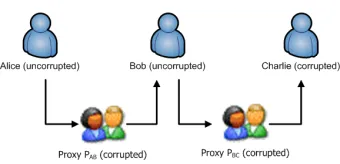
Remark 2 The values of B˙ and B are computed differently, in particular, in equation (1), the base is g1, while in equation (2), the base isg2. This difference aims to resist the following attack: Assume that there is
the delegation relationship as in Fig. 1. Alice delegates her decryption rights to Bob via the proxyPAB, and
Bob delegates his decryption rights to Charlie via the proxy PBC. Alice and Bob are uncorrupted, the rest
parties are corrupted, and the target (challenged) user is Alice. This corruption situation is allowed in the security model in Section 2 (Note that the attacked scheme should be single-use). If the bases in equations (1) and (2) are bothg1, then the adversary can decrypt any ciphertext for Alice as follows. The proxyPBC
and Charlie colludes to get Bob’s weak secret keyaB, and then they collude with the proxyPAB to get Alice’s
weak secret key aA. As a result, the adversary can use aA to decrypt any ciphertext for Alice. However, in
schemeU, the proxyPBC and Charlie cannot get Bob’s weak secret key bB (which is for decrypting partial
re-encryption key), hence, they cannot collude with the proxy PAB to get Alice’s weak secret key aA (which
is for decrypting ciphertexts).
Note that the above attack is also allowed in the security model in [17, 13], since they only disallow the adversary to corrupt the proxy between the target user and the uncorrupted user. The unidirectional schemes in [17, 13] suffer from the above attack. To resist the above attack, we can use the same method in scheme
U, in particular, every user has two public/secret key pairs, one is for decrypting ciphertexts of messages, and the other is for decrypting the partial re-encryption key.
Correctness. The correctness property is easily obtained by the correctness of scheme BCP03 [7] and Fujisaki-Okamoto conversion [14, 15].
Theorem 1 (Uni-PRE-CCA security) In the random oracle model, schemeUis CCA-secure under the assumptions that DDH problem overZ∗N2 is hard, and that the signature of knowledge is secure.
Proof. We show that if there exists an algorithmAthat can breakUwith probabilityϵin timet, then there is another algorithmBthat usesAto solve DDH problem overZ∗N2, i.e., on DDH input (N,g,gu,gv,T),B
decides ifT=guv or not.
B interacts with A in a Uni-PRE-CCA game as follows (B simulates the Challenger for A). In the following, we use starred letters (A∗, B∗, C∗, D∗, c∗, s∗) to refer to the challenge ciphertext corresponding to an uncorruptedpk∗.
OH: One oracle OH is corresponding to a hash function H(·) which is a part of user’s public key. As a
result, there are many such oracles, and they are all constructed in the following method. On input (σi, mi), B first checks whether triple (σi, mi, αi) exists in table TH. If yes, B responds A with αi;
otherwiseBchooses a random numberαi∈ZN2, respondsAwithαi, and records (σi, mi, αi) in table
TH, where N is the corresponding safe-prime modulus and a part of user’s public key.
OH1: On inputσi, B first checks whether pair (σi, βi) exists in table TH1. If yes,B responds A withβi;
otherwise,Bchooses a random numberβi∈ {0,1}k1, respondsAwithβi, and records (σi, βi) in table
TH1.
OH2: On inputσi, B first checks whether pair (σi, γi) exists in table TH2. If yes, B responds Awith γi;
otherwise,B chooses a random numberγi ∈ {0,1}n, responds Awithγi, and records (σi, γi) in table
TH2.
OH3: On input (Ai, Di, gi0, gi2, Ei, Fi, Bi, Ci),Bfirst checks whether tuple (Ai, Di, gi0, gi2, Ei, Fi, Bi, Ci, δi)
exists in tableTH2. If yes,BrespondsAwithδi; otherwise,Bchooses a random numberδi∈ {0,1} k2,
respondsAwithδi, and records (Ai, Di, gi0, gi1, Ei, Fi, Bi, Ci, δi) in tableTH3. Phase 1:
Opk: On input an indexi,Bdecides whetherpki is the attacked public keypk∗.
• If yes,B setsN =N,H(·) :{0,1}∗→ZN2,g0=g,g1=gu, and g2=gw, where w∈ZN2. And
then,B records (H(·), N, g0, g1, g2,⊥,⊥,⊥,⊥, coini) in tableTK.
• Otherwise, B runs KeyGen to get the public key (H(·), N, g0, g1, g2), the long-term secret key (p′, q′), and weak secret key (a, b), and records (H(·), N, g0, g1, g2, a, b, p′, q′) in tableTK.
At last,B returns (H(·), N, g0, g1, g2) toAas pki.
Osk: On inputpkX = (HX(·), NX, gX0, gX1, gX2),Bchecks whetherpkXexists inTK. If not,Bterminates.
Otherwise, ifpkXis the guessed attacked public key,Breportsfailureand aborts; otherwise,Bresponds Awith corresponding (p′X, qX′ ), and recordspkX into tableTsk.
Ork: On input (pkX, pkY),Bchecks whetherpkXandpkY both exist inTK. If not,Bterminates. Otherwise, B checks whether (pkX, pkY, rk
(1)
X→Y, rk
(2)
X→Y) is in tableTrk, or (pkX, pkY, βX→Y, rk
(1)
X→Y, rk
(2)
X→Y) is
in tableTurk, if it exists,B returns (rk
(1)
X→Y, rk
(2)
X→Y) toA; otherwise,
• IfpkXis in tableTskorpkXis not the guessed attacked public key,BrespondsAwith (rk
(1)
X→Y, rk
(2)
X→Y)←
ReKeyGen(skX, pkY), and records (pkX, pkY, rk
(1)
X→Y, rk
(2)
X→Y) in tableTrk.
• If pkX is the guessed attacked public key, and pkY is not in table Tsk,B chooses three random
numbers ˙β∈ {0,1}k1,rk(2)
X→Y ∈ZN2, ˙σ∈ZN, and does
– Compute
rX→Y =HY( ˙σ||β˙),
˙
A= (gY0)rX→Y mod (NY)2,
˙
B= (gY1)rX→Y ·(1 + ˙σNY) mod (NY)2,
˙
C=H1( ˙σ)⊕β,˙
where (HY(·), NY, gY0, gY1, gY2) =pkY.
– Setrk(1)X→Y = ( ˙A,B,˙ C˙).
– Return (rk(1)X→Y, rkX(2)→Y) toA.
– Record (pkX, pkY,β, rk˙
(1)
X→Y, rk
(2)
Because of the security property of scheme BCP03 with Fujisaki-Okamoto conversion, we have that only if we can successfully respond the decryption oracle queried with the re-encrypted cipher-texts re-encrypted by the above re-encryption keys, this step is the undistinguishable from the real execution from the viewpoint of A.
• IfpkX is the guessed attacked public key, andpkY is in tableTsk,Breportsfailure and aborts. Ore: On input (pkX, pkY, K),Bchecks whetherpkX andpkY both exist in tableTK. If not,Bterminates.
Otherwise,BparsesK= (A, B, C, D, c, s), and checks whetherc=H3(A||D||gX0||gX2||(gX0)sAc||(gX2)sDc||
(B||C)), wherepkX = (HX(·), NX, gX0, gX1, gX2), if not,B outputs⊥and terminates; otherwise, do
the following performances.
• IfpkX is the guessed attacked public key, andpkY is in tableTsk,Bdoes:
1. Set two empty lists,S1 andS2.
2. Find all elements (σi, mi, αi) in tableTHX such thatA= (gX0)
αimod (N
X)2, and put them
into listS1. IfS1=∅, then output ⊥and terminate.
This step makes this oracle be distinguishable from the real execution when the adversary can guess the correct value of HX(σi||mi)without queryingOHX. The probability of this event is
qHX/|Z(NX)2|, whereqHX is the number of queries to OHX.
3. For every (σi, mi, αi) in listS1, find all elements in tableTH2such thatσj=σi and put them
(i.e., (σi, mi, αi)||(σj, γj)’s) into listS2. IfS2=∅, then output⊥and terminate.
This step makes this oracle be distinguishable from the real execution when the adversary can guess the correct value of H2(σi) without queryingOH2. The probability of this event is
qH2/2
n, whereq
H2 is the number of queries toOH2.
4. Check inS2if there exists a (σi, mi, αi)||(σj, γj) such that (gX1)αi·(1+σiNX) mod (NX)2=B
andγj⊕mi=C. If it does not exist or more than one exist, then output⊥and terminate.
5. Search (pkX, pkY,β˙) in tableTf rk, if not, choose a random number from{0,1}k1 for ˙β, and
record (pkX, pkY,β˙) in tableTf rk.
6. Choose a random number ˙σ∈ZN.
7. Compute
rX→Y =HY( ˙σ||β˙),
˙
A= (gY0)rX→Y,
˙
B= (gY1)rX→Y ·(1 + ˙σNY) mod (NY)2,
˙
C=H1( ˙σ)⊕βX→Y,
wherepkY = (HY(·), NY, gY0, gY1, gY2).
8. Setrk(1)X→Y = ( ˙A,B,˙ C˙). 9. Return (A,(gX1)αi·(gX0)−
˙
β, B, C, rk(1)
X→Y) toA.
• Otherwise,Bcalls the oracleOrkto get the re-encryption keyrkX→Y, and returnsReEnc(rkX→Y, K). Odec: On input (pkX, K), B checks whether pkX exists in table TK, if not, B terminates. Otherwise, B
does the following performances.
• If pkX is not the guessed attacked public key, then skX is known to B, who responds A with
Dec(skX, K).
• If pkX is the guessed attacked public key and K = (A, B, C, D, c, s), B checks whether c =
H3(A||D||gX0||gX2||(gX0)sAc||(gX2)sDc||(B||C)), if not,Boutputs⊥and terminates; otherwise,
Bdoes:
2. Find all elements (σi, mi, αi) in tableTHX such thatA= (gX0)
αimod (N
X)2, and put them
into listS1. IfS1=∅, then output ⊥and terminate.
This step makes this oracle be distinguishable from the real execution when the adversary can guess the correct value of HX(σi||mi)without queryingOHX. The probability of this event is
qHX/|Z(NX)2|.
3. For every (σi, mi, αi) in listS1, find all elements in tableTH2such thatσj=σi and put them
(i.e., (σi, mi, αi)||(σj, γj)’s) into listS2. IfS2=∅, then output⊥and terminate.
This step makes this oracle be distinguishable from the real execution when the adversary can guess the correct value of H2(σi) without queryingOH2. The probability of this event is
qH2/2 n.
4. Check inS2if there exists a (σi, mi, αi)||(σj, γj) such that (gX1)αi·(1+σiNX) mod (NX)2=B
and γj ⊕mi = C. If none exists or more than one exist, then output ⊥ and terminate;
otherwise, outputmi.
• IfpkXis the guessed attacked public key andK= (A, A′, B, C,A,˙ B,˙ C˙),Bsearches (pkY, pkX,⋆1,
⋆2,⋆3) in tableTurk, such that⋆2= ( ˙A,B,˙ C˙).
If it does not exist,Bdoes: 1. Set two empty lists,S1 andS2.
2. Find all elements (σi, mi, αi) in tableTHX such that ˙A= (gX0)
αimod (N
X)2, and put them
into listS1. IfS1=∅, then output ⊥and terminate.
This step makes this oracle be distinguishable from the real execution when the adversary can guess the correct value of HX(σi||mi)without queryingOHX. The probability of this event is
qHX/|Z(NX)2|.
3. For every (σi, mi, αi) in listS1, find all elements in tableTH1such thatσj=σi and put them
(i.e., (σi, mi, αi)||(σj, βj)’s) into listS2. IfS2=∅, then output⊥and terminate.
This step makes this oracle be distinguishable from the real execution when the adversary can guess the correct value of H1(σi) without queryingOH1. The probability of this event is
qH1/2
k1, whereq
H1 is the number of queries toOH1.
4. Check inS2if there exists a (σi, mi, αi)||(σj, βj) such that ˙B= (gX1)αi·(1+σiNX) mod (NX)2
andβj⊕mi = ˙C. If none exists or more than one exist, then output⊥and terminate.
5. Compute σ= (B/(A′·Ami)−1 mod (NY)2)
NY , m =C⊕H2(σ). If A= (gY0)
HY(σ||m)mod (N Y)2,
output m, where pkY = (HY(·), NY, gY0, gY1, gY2) is the corresponding delegator’s public
key; otherwise, output⊥and terminate.
If it does exist,BchecksA′ =? A⋆3. If not, output⊥and terminate; otherwise, 1. Set two empty lists,S1 andS2.
2. Find all elements (σi, mi, αi) in tableTHY such thatA= (gY0)
αi mod (N
Y)2, and put them
into listS1. IfS1=∅, then output ⊥and terminate.
This step makes this oracle be distinguishable from the real execution when the adversary can guess the correct value ofHY(σi||mi)without queryingOHY. The probability of this event is
qHY/|Z(NY)2|, where qHY is the number of queries to OHY.
3. For every (σi, mi, αi) in listS1, find all elements in tableTH2such thatσj=σi and put them
(i.e., (σi, mi, αi)||(σj, γj)’s) into listS2. IfS2=∅, then output⊥and terminate.
This step makes this oracle be distinguishable from the real execution when the adversary can guess the correct value of H2(σi) without queryingOH2. The probability of this event is
qH2/2 n.
4. Check inS2if there exists a (σi, mi, αi)||(σj, γj) such that (gY1)αi·(1+σiNY) mod (NY)2=B
and γj ⊕mi = C. If none exists or more than one exist, then output ⊥ and terminate;
Challenge: At some point,Aoutputs a challenge tuple (pk∗, m0, m1). Ifpk∗is not the public keyBguessed
in oracleOpk,Breportsfailure and aborts. Otherwise,Bresponds choosing randomd∈ {0,1}, σ∈ZN and
setting:
A∗=gvmodN2, B∗=T(1 +mdN) modN2,
C∗=H2(σ)⊕md, D∗= (gv)wmodN2.
And then B chooses two random numbers c∗ ∈ {0,1}k2, s∗ ∈ {0,· · ·,2L(N2)+k2 −1}, computes E∗ =
(g)s∗A∗c∗
modN2 and F∗ = (gu)s∗D∗c∗
modN2, and checks wether (A∗, D∗,gu,gw, E∗, F∗, B∗, C∗,⋆)
exists in table TH3. If yes, B reports failure and aborts; otherwise,B outputs (A∗, B∗, C∗, D∗, c∗, s∗), and
records (A∗, D∗,gu,gw, E∗, F∗, B∗, C∗, c∗) in tableTH3. Phase 2:
Opk: Bresponds as in Phase 1.
Osk: On inputpki, ifpki=pk∗, or (pk∗, pki) is in table Trk, thenBterminates. Otherwise,B responds as
in Phase 1.
Ork: On input (pki, pkj), ifpki=pk∗, andpkj is in tableTsk,B terminates. Otherwise,B responds as in
Phase 1.
Ore: On input (pki, pkj, K), if (pki, K) = (pk∗, K∗) and pkj is in table Tsk, B terminates. Otherwise, B responds as in Phase 1, except whenpki =pk∗ and (A, B, C, D, c, s) = (A∗, B∗, C∗, D∗, c∗, s∗), B
should record the result (pkj, A′, C, D,A,˙ C,˙ D˙) in table Tder, where the derivatives of the challenge
ciphertext are recorded.
Odec: On input (pki, K), if (pki, K) = (pk∗, K∗), or (pki, K) is inTder, orK=ReEnc(Ork(pk∗, pki), K∗),
thenB terminates. Otherwise,B responds as in Phase 1.
Guess: Finally, the adversary A outputs a guess d′ ∈ {0,1}. If d = d′, then B outputs 1 (i.e., DDH instance), otherwise,Boutputs 0 (i.e., not a DDH instance).
Firstly, we analyze the probability of Bdo not abort due to thefailure events, which are as follows. 1. B did not guess the right attacked public key.
2. The record (A∗, D∗,gu,gw, E∗, F∗, B∗, C∗,⋆) is in tableT
H3 before Challenge phase.
SupposeAmakes a total ofqpkqueries to public key generation oracle, qrk queries to re-encryption key
generation orale, qde queries to decryption orale,qH queries to H hash function oracle, qH1 queries to H1
hash function oracle,qH2 queries toH2 hash function oracle, andqH3 queries toH3hash function oracle.
The probabilities that B does not abort due to the first failure event and the second failure event are 1/qpkand 1−(qH3+ 1)/2
k2, respectively. Therefore, the probability thatBdoes not abort due to thefailure
events during the simulation is (1−(qH3+ 1)/2 k2)/q
pk.
Secondly, oraclesOreandOdec are indistinguishable from the corresponding real executions with
proba-bilities at least (
1 +qmax+ (qmax)2 (1 +qmax)2 +
qmax (1 +qmax)2
(
1− qHX
|ZNmX| ) (
1−qH1 2k1
))qre >
(
1 +qmax+ (qmax)2 (1 +qmax)2
)qre
and (
qmax
1 +qmax
+ 1
1 +qmax (
1− qHX |ZNmX|
)
(1−q2) )qde
>
(
qmax
1 +qmax )qde
,
respectively, whereqHX is the amount of queries to the same kind of oracleOH,NmX is the largest number among users’ public keyN’s, |ZNmX|is the size ofZNmX, andq2= max{
qH1
2k1, qH2
2n}.
As a result, B’s advantage is at least
ϵ·
(
1−(qH3+ 1)/2
k2)·(1 +q
max+ (qmax)2 )qre
·(qmax)qde
qpk·(1 +qmax)2qre+qde −
ξ
and its running time is at most
t+O(3qpk+ (7 +qH)qrk+ (5 +qH)qde)te,
where te is the time of computing one exponentiation in a cyclic group of quadratic residues modulo, and
we only consider the exponentiation computation.
Note that if we modifiesB as computed by H′((g2)r)·(1 +σ·N), whereH′ is another user’s own hash function, H′(·) : {0,1}∗ → ZN2, we can get a new PRE scheme proven secure against chosen ciphertext
based on CDH assumption over Z∗N2 and secure signature of knowledge.9 The proof is almost the same as
that of Theorem 1, but the probability of solving CDH assumption will be 1/qH′ of that of solving DDH
assumption, whereqH′ is the number of queries to oracleH′.
Theorem 2 (Uni-PRE-CR security) In the random oracle, if N is hard to factor, then scheme U is collusion resistant.
Proof. One can easily show that an algorithm for against scheme U’s collusion resistance, i.e., from an algorithm that it is given (N,g0,g1,g2,a, N(=pq), p(= 2p′+ 1), q(= 2q′+ 1), p′, q′, g0, g1, g2), it can compute
p,q,p′,q′, such thatN=pq,p=2p′+1, andq=2q′+1, we can easily get another algorithm for factoring
N.
4
Scheme
U
Twith Temporary Delegation
This section describes schemeUT, a variant of schemeU, supporting temporary delegation. Like the
tempo-rary unidirectional PRE schemes in [2, 3, 25], the proxy is only allowed to transform ciphertexts from the delegator to the delegatee during a limited time period. The point of modifying schemeUto schemeUT is
to make differentg1’s for every time period.
Scheme UT also contains three cryptographic hash functions for all users: H1(·) : {0,1}∗ → {0,1}k1, H2(·) :{0,1}∗ → {0,1}n, andH3(·) :{0,1}∗ → {0,1}k2, where k1 and k2 are the security parameter,n is
the bit-length of messages to be encrypted. The details are as follows.
KeyGen: Choose a safe-prime modulus N =pq,T+ 2 random numbers α∈Z∗N2,a1,· · · , aT, b∈[1, pp′qq′],
a hash function H(·), where p = 2p′+ 1, q = 2q′+ 1, p, p′, q, q′ are primes, T is the number of time intervals, and H(·) : {0,1}∗ → ZN2. Furthermore, set g0 = α2modN2, g1(i) = g0ai modN2
(i= 1,· · ·, T), andg2=g0bmodN2. The public key ispk= (H(·), N, g0, g1(i)(i= 1,· · ·, T), g2), the “weak” secret key is (ai (i= 1,· · ·, T), b), and the long-term secret key issk= (p, q, p′, q′).
ReKeyGen: On input a public keypkY = (HY(·), NY, gY0, g
(1)
Y1,· · ·, g (TY)
Y1 , gY2), a “weak” secret keyaX,j for
time periodj∈ {1,· · · , TX}, and a secret keyskX= (pX, qX, p′X, qX′ ), it outputs the unidirectional
re-encryption keyrkX→Y,j = (rk
(1)
X→Y,j, rk
(2)
X→Y,j) for thej-th time period, which is generated as follows. • Choose two random numbers ˙σj ∈ZN, ˙βj∈ {0,1}k1.
• Computerk(2)X→Y,j =aX,j−β˙j mod (pXqXp′Xq′X). • Compute
rX→Y,j=HY( ˙σj||β˙j), A˙j = (gY0)rX→Y,j mod (NY)2,
˙
• Setrk(1)X→Y,j = ( ˙Aj,B˙j,C˙j).
Enc: On input a public keypk= (H(·), N, g0, g (1) 1 ,· · · , g
(T)
1 , g2), a time periodj∈ {1,· · ·, T}and a message m∈ {0,1}n, the encryptor does the following performances:
• Choose a random numberσj ∈ZN. • Compute
rj=H(σj||m),
Aj = (g0)rmodN2, Bj= (g
(j)
1 )r·(1 +σjN) modN2,
Cj =H2(σj)⊕m, Dj= (g2)rmodN2.
• Run (cj, sj)←SoK.Gen(Aj, Dj, g0, g2,(Bj, Cj)), where the underlying hash function isH3.
• Output the ciphertextKj= (Aj, Bj, Cj, Dj, cj, sj) for thej-th time period .
ReEnc: On input a re-encryption keyrkX→Y,j= (rk
(1)
X→Y,j, rk
(2)
X→Y,j) and a ciphertextKj= (Aj, Bj, Cj, Dj, cj,
sj) under keypkX = (HX(·), NX, gX0, g
(1)
X1,· · · , g (TX)
X1 , gX2), wherej ∈ {1,· · ·, TX}, the proxy checks
whethercj=H3(Aj||Dj||gX0||gX2||(gX0)sj(Aj)cj||(gX2)sj(Dj)cj||(Bj||Cj)).If not hold, output⊥and
terminate; otherwise, re-encrypt the ciphertext to be under keypkY as: • ComputeA′j = (Aj)rk
(2)
X→Y,j = (gX0)r(aX,j−β˙j)mod (N X)2. • Output the new ciphertext
(Aj, A′j, Bj, Cj, rk
(1)
X→Y,j) = (Aj, A′j, Bj, Cj,A˙j,B˙j,C˙j).
Dec: On input a secret key and any ciphertext Kj for the j-th time period, where j ∈ {1,· · ·, T}, the
decryptor parsesKj= (Aj, Bj, Cj, Dj, cj, sj), orKj= (Aj, A′j, Bj, Cj,A˙j,B˙j,C˙j).
Case Kj = (Aj, Bj, Cj, Dj, cj, sj): Check whethercj=H3(Aj||Dj||g0||g2||(g0)sj(Aj)cj||(g2)sjDjcj||(Bj||Cj)),
if not, output ⊥and terminate; otherwise,
• if the input secret key is the “weak” secret keyaj, computeσj=
Bj/((Aj)aj)−1 modN2
N .
• if the secret key is the long term secret key (p, q, p′, q′), computeσj =
(Bj/(g0)w1)2p
′q′−1 modN2
N ·
π( modN), wherew1is computed as that in scheme BCP03, andπis the inverse of 2p′q′mod
N.
Computem=Cj⊕H2(σj), ifBj= (g
(j)
1 )H(σj||m)·(1+σj·N) modN2holds, outputm; otherwise,
output⊥and terminate.
Case Kj = (Aj, A′j, Bj, Cj,A˙j,B˙j,C˙j): In this case, the decryptor should know the delegator’s
(Al-ice’s) public key (H′(·), N′, g0′, g1(i)′,· · · , g1(T′)′, g′2).
• If the input secret key is the “weak” secret keyb, compute ˙σj =
˙
Bj/(( ˙Aj)b)−1 modN2
N .
• If the input secret key is the long term secret key (p, q, p′, q′), computes ˙σj=
( ˙Bj/gw01)
2p′q′−1 modN2
N ·
π( modN), wherew1is computed as that in scheme BCP03, andπis the inverse of 2p′q′mod
N.
Compute ˙βj = ˙Cj ⊕H1( ˙σj), if ˙Bj = (g2)H( ˙σj|| ˙
βj)·(1 + ˙σ
jN) modN2 holds, then compute
σj =
Bj/(A′j·(Aj)βj)−1 modN′2
N′ , m = Cj⊕H2(σj); otherwise, output ⊥ and terminate. If Aj =
(g0′)H′(σj||m)modN′2andB j = (g
(j) 1
′
)H′(σj||m)·(1 +σ
j·N′) modN′2both hold, then outputm;
Note that (H(·), N, g0, g(1i),· · · , g1(T)), g2) is the public key of the decryptor.
Correctness. The correctness property is easily obtained by the same method for schemeU.
Theorem 3 (Uni-PRETD-CCA Security) In the random oracle model, scheme UT is CCA-secure
un-der the assumptions that DDH problem overZ∗N2 is hard, and that the signature of knowledge is secure.
Proof. In this proof,Bdoes not only guess which public key is the attacked public key, but also guess which time period is the attacked time period. We setNas the safe-prime modulus of the target public key,g0=g,
and setguas the public parameters of the attacked time period. The rest of the simulation can be proceeded
by the same method in the proof of Theorem 1.
The probability of this proof is 1/qT of that in the proof of Theorem 1, whereqT is the amount of time
periods of the attacked time period.
Theorem 4 (Uni-PRETD-CR security) In the random oracle, if N is hard to factor, then scheme UT
is collusion resistant.
Proof. It is easy to get this proof, since we can know “weak” secret key which can be used to respond all kinds of queries. Once the adversary outputs the long-term secret key (p, q, p′, q′), we get the factors ofN.
5
Comparison
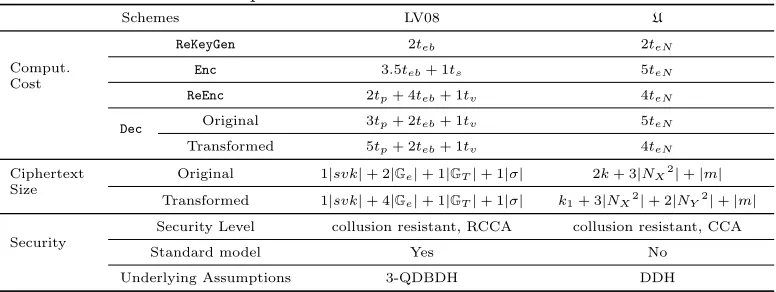
In this section, we compare schemeUwith the previous CCA-secure unidirectional PRE schemes. Since as mentioned above, the unidirectional PRE schemes in [21, 17, 11, 13] are not CCA-secure, we only compare schemeUwith the scheme in [25] (named LV08).
In Table 1, we denotetp,teb,teN,ts, andtv as the computational cost of a bilinear pairings, an
exponen-tiation over a bilinear group, an exponenexponen-tiation overZ∗N2 (N is a safe-prime modulus), a one-time signature
and verification, respectively. Ge and GT are the bilinear groups used in scheme LV08. NX and NY are
the safe-prime modulus corresponding to the delegator and the delegatee, respectively. svk and σ are the one-time signature’s public key and signature. Note that we only consider the case of using weak secret key to decrypt inDecalgorithm of schemeU.
From Table 1, we can see that scheme LV08 is a little bit more efficient than scheme U. In order to guarantee that N is hard to factor, N should be 1024-bit at least, which makes schemeU need more time for an exponentiation and more storage for a ciphertext. However, we emphasize that scheme Uis CCA-secure and based on the well-studied DDH assumption, while scheme LV08 is RCCA-CCA-secure and based on the less-studied 3-quotient decision Bilinear Diffie-Hellman (3-QDBDH) assumption.
6
Conclusions
In this paper, by using signature of knowledge and Fijisaki-Okamoto conversion, we proposed thefirst CCA-secure and collusion resistant unidirectional PRE scheme without pairings, which solves a problem proposed in [9, 25].
There are still many open problems to be solved, such as designing more efficient CCA-secure, collu-sion resistant unidirectional PRE schemes without pairings, and CCA-secure multi-use unidirectional PRE schemes [9, 25].
Acknowledgements
Table 1: Comparison between schemeUand scheme LV08.
Schemes LV08 U
Comput. Cost
ReKeyGen 2teb 2teN
Enc 3.5teb+ 1ts 5teN
ReEnc 2tp+ 4teb+ 1tv 4teN
Dec Original 3tp+ 2teb+ 1tv 5teN
Transformed 5tp+ 2teb+ 1tv 4teN
Ciphertext Size
Original 1|svk|+ 2|Ge|+ 1|GT|+ 1|σ| 2k+ 3|NX2|+|m|
Transformed 1|svk|+ 4|Ge|+ 1|GT|+ 1|σ| k1+ 3|NX2|+ 2|NY2|+|m|
Security
Security Level collusion resistant, RCCA collusion resistant, CCA
Standard model Yes No
Underlying Assumptions 3-QDBDH DDH
References
[1] G. Ateniese, J. Camenisch, M. Joye, and G. Tsudik. A practical and provably secure coalition-resistant group signature scheme. InCRYPTO 2000, volume 1880 ofLNCS, pages 255–270, 2000.
[2] G. Ateniese, K. Fu, M. Green, and S. Hohenberger. Improved proxy re-encryption schemes with appli-cations to secure distributed storage. InInternet Society (ISOC): NDSS 2005, pages 29–43, 2005. [3] G. Ateniese, K. Fu, M. Green, and S. Hohenberger. Improved proxy re-encryption schemes with
applica-tions to secure distributed storage.ACM Transactions on Information and System Security (TISSEC), 9(1):1–30, 2006.
[4] B. Barak, O. Goldreich, R. Impagliazzo, S. Rudich, A. Sahai, S.P. Vadhan, and K. Yang. On the (im)possibility of obfuscating programs. InCRYPTO 2001, volume 2139 ofLNCS, pages 1–18, 2001. [5] H.Y. Lynn B. Scott M. Barreto, P.S.L.M. Kim. Efficient algorithms for pairing-based cryptosystems.
InCRYPTO, volume 2442 ofLNCS, pages 354–369, 2002.
[6] M. Blaze, G. Bleumer, and M. Strauss. Divertible protocols and atomic proxy cryptography. In EU-ROCRYPT 1998, volume 1403 ofLNCS, pages 127–144, 1998.
[7] E. Bresson, D. Catalano, and D. Pointcheval. A simple public-key cryptosystem with a double trapdoor decryption mechanism and its applications. InASIACRYPT 2003, volume 2894 ofLNCS, pages 37–54, 2003.
[8] J. Camenisch and M. Stadler. Efficient group signature schemes for large groups. In CRYPTO 1997, volume 1296 ofLNCS, pages 410–424, 1997.
[9] R. Canetti and S. Hohenberger. Chosen-ciphertext secure proxy re-encryption. In ACM CCS 2007, 2007. Full version: Cryptology ePrint Archieve: Report 2007/171.
[10] Y-P. Chiu, C-L. Lei, and C-Y. Huang. Secure multicast using proxy encryption. InICICS 2005, volume 3783 ofLNCS, pages 280–290, 2005.
[11] C. Chu and W. Tzeng. Identity-based proxy re-encryption without random oracles. InISC 2007, volume 4779 ofLNCS, pages 189–202, 2007.