Mohammad Sabzinejad Farash1, Mahmoud Ahmadian Attari2 and Majid Bayat1
1Department of Mathematics and Computer Sciences, Tarbiat Moallem University, Tehran, Iran 2Faculty of Electrical and computer Engineering, K.N. Toosi University of Technology, Tehran, Iran
Email: [email protected], [email protected], [email protected]
Abstract
Multiple key agreement protocols produce several session keys instead of one session key. Most of the multiple key agreement protocols do not utilize the hash functions in the signature schemes used for identification. Not using hash function in these protocols causes that the protocols do not satisfy some requirement security properties. In this paper we review the multiple key agreement protocols and perform attacks on some of them. Then we introduce a new multiple key agreement protocol and show that the proposed protocol is more secure than the existent multiple key agreement protocols.
1. Introduction
ryptography helps us to make a secure communication in public networks. The secret key plays an essential role in the cryptosystems such that revealing the secret key causes the cryptographic system to be compromised. Therefore how to exchange the secret key is very important in cryptographic applications. One of the considerable methods for secret key exchanging is key agreement protocols. These protocols enable two or more users of any public networks to share a secret common key together.
The first key agreement protocol was introduced by Diffiee and Hellman [4]. But this protocol is vulnerable to man in the middle attack because two participants of the protocol do not verify identity of each other. Typical remedy for this problem is to use public key cryptosystems such as public key infrastructure or identity based cryptography. Menezes et. al. [10] proposed a key agreement protocol named as MQV that does not use a hash function for making digital signature. This protocol was standardized in ANSI X9.42 [1], ANSI X9.63 [2] and IEEE [9]. Harn and Lin [5] introduced the first multiple key agreement protocol that is based on the idea of using the signature without hash functions same as MQV protocol. In multiple key agreement protocols multiple keys are agreed instead of one key in typical key agreement protocols. Multiple key agreement protocols are considerable because cost of computation and communication is less than usual key agreement protocols for one shared key.
Yen and Joye [15] showed that the Harn-Lin protocol is insecure against forgery attack and introduced an improved protocol. Next Wu et. al. [16] showed that the Yen-Joye protocol is as insecure as Harn-Lin protocol and then introduced an enhanced protocol which used hash function in contradiction to Harn-Lin Protocol; nevertheless, the problem still remained in their protocol. Harn and Lin [6] again proposed an improved protocol to overcome the posed weaknesses of their first protocol. After that Zhou et. al. [17] claimed that the second Harn-Lin protocol is insecure against forgery attack.
In this paper we review most of the multiple key agreement protocols that have been introduced until now and perform attacks on some of them. Finally we introduce a new multiple key agreement protocol and show that the proposed protocol is more secure than the existent multiple key agreement protocols.
There are some security properties that are recommended for key agreement protocols [3]. Here we review them as follows. Let A and B are two participants that are intended to share a common secret key by executing a key agreement protocol.
· Known-Key Security: This property says that the adversary who has obtained some previous
session keys cannot compute the next session keys.
· Forward Secrecy: This property implies that revealed one or more long-term private keys
· Key-Compromise Impersonation: This property expresses that if the long-term private key of one entity (e.g. A) is disclosed, the adversary is unable to impersonate the other entity to the compromised entity (e.g. B to A)
· Unknown key security: This property implies that the active adversary C should not enable
to interfere in a key agreement protocol run such that A believes that B is her participant while B believes that he shared the session key with C.
In addition, two essential properties are regarded for key agreement protocols as follows:
· Implicit key confirmation: A key agreement protocol has this property if the both
participants are assured that only the other participant can compute the secret common key.
· Explicit key confirmation: This means that the both participants are assured that the other
participant have computed the secret common key.
2. Review of the multiple key agreement protocols
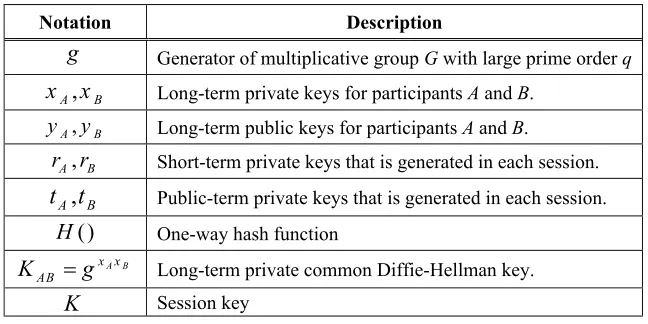
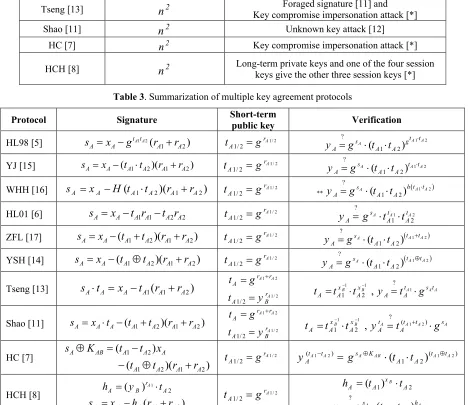
In this section we review certificate based multiple key agreement protocols. In these protocols two participants authenticate each other after sending and receiving a message and agree on multiple secret common keys.The notations used through this paper are presented in Table 1. Because the weaknesses of the key agreement protocols reviewed in this paper are arisen from the utilized digital signature schemes, we only study the digital signature scheme according to
Table 2. Four columns are represented in Table 2, from left hand side, the firs column is the protocol name, the second column is user's short-term public keys, the third column shows the digital signature and the signature verification equation is presented in column 4. In Table 3
weaknesses and the number of shared keys of each protocol are represented. Some of these weaknesses notated by ,*, are introduced by the authors of this paper which are explained in the next sections.
Table 1. The Notations
Description Notation
Generator of multiplicative group G with large prime order q
g
Long-term private keys for participants A and B. ,
A B
x x
Long-term public keys for participants A and B.
,
A B
y y
Short-term private keys that is generated in each session.
,
A B
r r
Public-term private keys that is generated in each session.
,
A B
t t
One-way hash function
()
H
Long-term private common Diffie-Hellman key.
A B x x AB
K =g
Session key
Table 2.Comparison of multiple key agreement protocols
Weaknesses Number of session keys
Protocol
Foraged signature [15]
- 1
2
n
HL98 [5]
Foraged signature [16]
- 1
2
n
YJ [15]
Foraged signature [14] - 1
2 n
WHH [16]
Foraged signature [17]
- 1
2
n
HL01 [6]
Foraged signature [14]
- 1
2
n
ZFL [17]
Unknown key attack [14]
- 1
2
n
YSH [14]
Foraged signature [11] and Key compromise impersonation attack [*]
2 n
Tseng [13]
Unknown key attack [12]
2 n
Shao [11]
Key compromise impersonation attack [*] 2
n
HC [7]
Long-term private keys and one of the four session keys give the other three session keys [*]
2 n
HCH [8]
Table 3. Summarization of multiple key agreement protocols
Protocol Signature Short-term public key Verification
HL98 [5] YJ [15]
WHH [16]
sA =xA -H t( A1×tA2)(rA1+rA2) **
HL01 [6] ZFL [17] YSH [14] Tseng [13] Shao [11] HC [7] HCH [8] 1 2 1 2 ( ) A A t t
A A A A
s =x -g r +r 1 / 2
1/ 2 A
r A
t =g ? 1 2
1 2
( ) A A
A t t
s g
A A A
y =g × t ×t ×
1 2 1 2
( )( )
A A A A A A
s =x - t ×t r +r 1 / 2
1/ 2 A
r A
t =g 1 2
?
1 2
( )
A A A
s t t
A A A
y =g × t ×t ×
1 / 2
1/ 2 A
r A
t =g ( 1 2)
?
1 2
( ) A A
A h t t
s
A A A
y =g × t ×t ×
1 1 2 2
A A A A A A
s =x -t r -t r 1/ 2
1/ 2 A
r A
t =g 1 2
?
1 2
A A A
s t t
A A A
y = g ×t ×t
1 2 1 2
( )( )
A A A A A A
s =x - t +t r +r 1/ 2
1/ 2 A
r A
t =g ( 1 2)
?
1 2
( ) A A
A t t
s
A A A
y =g × t ×t +
1 2 1 2
( )( )
A A A A A A
s =x - t Åt r +r 1/ 2
1/ 2 A
r A
t =g ( 1 2)
?
1 2
( ) A A
A t t
s
A A A
y =g × t ×t Å
1( 1 2)
A A A A A A
s t× =x -t r +r 1 2
1/ 2 1/ 2 A A A r r A r A B t g t y + = = 1 1 1 ?
1B B2 , A A A
x x t s t
A A A A A
t =t - ×t - y =t ×g
1 2 1 2
( )( )
A A A A A A A
s =x t× - t +t r +r 1 2
1/ 2 1/ 2 A A A r r A r A B t g t y + = = 1 1 1 2 ? ( )
1B 2B , A A A A
x x t t t s
A A A A A
t =t - ×t - y =t + ×g
1 2
1 2 1 2
( )
( )( )
A AB A A A
A A A A
s K t t x
t t r r
Å =
-- Å + 1/ 2 A1 / 2
r A
t =g ( 1 2) ( 1 2)
1 2
( )
A A A AB A A
t t s K t t
A A A
y - = g Å × t ×t Å
1 2 1 2 ( ) ( ) A r
A B A
A A A A A
h y t
s x h r r
= ×
= - + 1/ 2 A1 / 2
r A
t =g ? 1 2
1 2 ( ) ( ) B A A x
A A A
s h
A A A
h t t
y g t t
= ×
3. The proposed key compromise impersonation attack on Tseng's protocol
For key compromise impersonation attack on Tseng's protocol [13], the adversary computes
(
tB1,tB2,sB)
as follows:1 1
1 1
2 , 1 , 1 ,
A
B B
x
t t
B B B A B B B B B
t = y - t =y s ×t = -t t = ×g y
-Then he sends
(
)
1, 2,B B B
t t s to A. After receiving these values, A verifies the signature as follow,
1
1 1 1 1 1
1 1
1 1
1 1
1 1 1 1
1 1 2 2
1 2
,
A A
A A A B B
B
B
B B B B B B B B
x x
x x x t t
b B A b B B B
t
B b b B
t
t s t t s t t t
B B B B B
t t y g t t y y
t t t g y
y t g g y g g y g y
-- - - -
--
-æ ö
= = = = =ç ÷ =
è ø
= × = ×
= × = × × = × × =
As we observed in the above equations the user A verifies message
t
B1,
t
B2,
s
B havegenerated by user B while he has not a role in the protocol. Finally A computes the session keys as follows:
Because the adversary knows
(
t
B1,
t
A1,
t
A2)
, he can easily computeK
3 andK
4. So Tseng'smultiple key agreement protocol is vulnerable to key compromise impersonation attack.
4. The propose key compromise impersonation attack on HC protocol
The adversary, for key compromise impersonation attack on protocol HC [7], can select
(
tB1,tB2)
such thatt
B1=
t
B2. So tB1 -tB2 =0, tB1ÅtB2 =0 and the verification equation is as follow:1 2 1 2 1 2
1 2
(
)
(
)(
)
(0)
(0)(
) 0
B AB B B B B B B B
B B B
s
K
t
t
x
t
t
r
r
x
r
r
Å
=
-
-
Å
+
=
-
+
=
1
1 1
1 1 1 1 1
2
1 1
2 2 2 1 1
1 1 3 2 1
2 1 4 2 2
,
,
A
A A A B B
A
A A A B B
r
r r r t t
b b B A
r
r r r t t
b b B A
K t g K t y t
K t g K t y t
-
--
-= = = = =
Therefore the adversary can sign the equal values
(
t tA, B)
by sB =KAB signature and whereashe knows A's long-term private key, it is not difficult for him to compute xA
B AB B
s =K =y . So the HC protocol is insecure against key compromise impersonation attack.
4.1. Review of HCH protocol
As we showed in Table 2, the HCH protocol [8] is the most secure multiple key agreement protocol. But in the following we show that HCH protocol has the same weakness as what Shim [12] proposed on Shao protocol [11]. Let the adversary has obtained long-term private key of the both participants, so he can easily compute the following values:
(
)
(
)
(
)
(
)
1
1 2 1 2
1
1 2 1 2
( )
( )
B
A
x
A A A A A A
x
B B B B B B
r r x s t t
r r x s t t
-+ = - ×
+ = - ×
Then he computes the following equations:
1 2 1 1 2 1
( )
1 A A A B A B 1 3
r r r r r r
B
t + =g ×g =K K× (1)
1 2 1 2 2 2
( )
2 A A A B A B 2 4
r r r r r r
B
t + =g ×g =K K× (2)
1 2 1 1 1 2
( )
1rB rB r rA B r rA B 1 2
A
t + =g ×g =K K× (3)
1 2 2 1 2 2
( )
2 B B A B A B 3 4
r r r r r r
A
t + =g ×g =K K× (4)
So if the adversary can obtain one of the four session keys, he can compute the other three session keys.For example if the adversary knowsK1 he can obtain K2and K3from (1,3) and then computeK4from (2 or 4).
5. The proposed protocol
5.1. Description of the proposed protocol
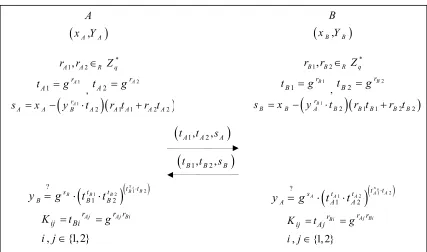
The utilized signature in the proposed multiple key agreement protocol is based on the signature scheme of HCH [8]. Description of the proposed protocol showed in Fig. 1 is as follows:
· A generates two random numbers rA1and rA2 and computes the short-term public keys
1
1 A
r A
t = g , tA1 = grA1and tA. Then she signs
t
A1 andt
A2 as follows:(
1)
(
)
2 1 2
A
r
A A B A A A
s =x - y ×t r +r
She sends
(
t
A1,
t
A2, ,
t s
A A)
to B.· A upon receiving the message from B verifies B's signature by checking the following equation:
(
)
(
1 2)
?
2 A
x B B
B t t
s
B B B
y = g × t t× ×
If the above equation verification fails A terminates the execution, otherwise she computes the session keys rA j r rA j Bi , {1, 2}
ij Bi
K =t =g for i j Î
· Also B upon receiving the message from A verifies A's signature as follows:
(
)
(
1 2)
?
2 B
x A A
A t t
s
A A A
y = g × t t× ×
If the above equation verification fails A terminates the execution, otherwise she computes the session keys rBi r rAj Bi for , {1, 2}
ij Aj
K =t =g i jÎ
Fig. 1. The proposed multiple key agreement protocol 5.2. Security analysis of the proposed protocol
In the following we discuss security analysis of the proposed protocol to show that it is more secure than the existent multiple key agreement protocols.
· Known-Key security: This says that the adversary who has obtained one or more session
keys is unable to compute the next session keys. In the proposed key agreement protocol suppose that the adversary knows the session keys of a session, rAj r rAj Bi
ij Bi
K =t =g for
(
B, B)
B x Y
* 1, 2
B B R q
r r Î Z
1
1 B
r B
t =g , 2
2 B
r B
t = g
(
1)
(
)
2 1 1 2 2
B
r
B B A B B B B B
s =x - y ×t r t +r t
(
)
(
1 2)
1 2
?
1 2
B
x A A
A A A t t
s t t
A A A
y = g × t ×t ×
, {1, 2}
Aj Bi Bi r r
r
ij Aj
K t g
i j
= =
Î
(
tA1,tA2,sA)
(
tB1,tB2,sB)
(
A, A)
A x Y
* 1, 2
A A R q
r r Î Z
1
1 A
r A
t =g , 2
2 A
r A
t =g
(
1)
(
)
2 1 1 2 2
A
r
A A B A A A A A
s =x - y ×t r t +r t
(
1 2)
(
1 2)
?
1 2
A
x B B
B B B t t
s t t
B B B
y = g × t ×t ×
, {1, 2}
Aj Aj Bi
r r r
ij Bi
K t g
i j
= =
, 1, 2
i j = . It does not give adversary any useful information to compute the next session keys. Because for computing the session keys short-term private keys
1 / 2
A
r
and1/ 2
B
r that be changed in each session are used. So the proposed multiple key agreement protocol is secure against Known- Key attack.
· Unknown key security: In the section1 we illustrated this attack. The adversary C for
executing this attack on the proposed protocol intercepts the sent message from A. Then he must sign the values
(
tA1,tA2)
by using his private key as follow:(
1)(
2)
2 1 2
A
r
C C B A A A
s =x - y ×t r +r
It is clear that the adversary cannot make this signature because he does not know the random values
1
A
r
orr
A2and solving discrete logarithm problem is requirement to obtain1
A
r
orr
A2 . This problem is a hard problem, so the proposed protocol is resistant to Unknown key attack.· Key compromise impersonation attack:In this attack the active adversary C who knows A's
long-term private key wants to impersonate B to A. In the proposed key agreement protocol if the adversary who knowsxAwants to execute this attack, he should make the a signature on the
(
tB1,tB2)
as:(
1)(
2)
2 1 2
B
r
B B A B B B
s =x - y ×t r +r
Because he does not know B's private key ,xB , it is clear that he cannot compute the signature
s
B . So the proposed multiple key agreement protocol is not vulnerable to keycompromise impersonation attack.
· Perfect forward secrecy: This property emphasizes that the previous session key should not
be exposed by revealing the long-term private key of both participants. In the proposed protocol the adversary who knows both long-term private keys
x
Aandx
Bcannot compute the previous session keys because computing the session keys depends on knowing one of the short-term private keys of participants and this is equal to solving discrete logarithm problem. In addition the adversary by using both long-term private keys xA and xBcannot obtain the random values
r
Ai or rBj froms
A . The equation of used digital signature scheme is represented in (5).(5)
(
1)
(
)
2 1 2
A
r
A A B A A A
s =x - y ×t r +r
The adversary who knows the values
(
tA1,tA2,x x sA, B, A)
transforms (5) to (6).(6)
(
)
1(
)
(
2)
1B 2 1 2
x
A A A A A A
t ×t - x -s = r +r
Left hand side of (6) is an obvious value for adversary but obtaining 1
A
r or 2
A
r is equal to exhaustive search in the group G and this is equal to solving discrete logarithm problem. So under the intractability of the discrete logarithm problem assumption, the proposed protocol satisfies perfect forward secrecy.
5.3. More precise analysis of the proposed protocol
Let adversary in our protocol multiplies SAand SBas follows:
(
)
(
)
(
)
(
)
(
)
(
)
(
)
(
)
(
)(
)
1
1 1 1
1 1
2 1 1 2 2
2 1 1 2 2
1 1 2 2 2
1 1 2 2 2
1 1 1 1 1 1 2 2
2 2
2 2 1 1 2 2 2 2
A
B
B
A
A B
r
A B A B A A A A A
r
B A B B B B B
r
A B A B B A B B A B
r
A A B A A B B A
A A B B A A B B r r
B A A B
A A B B A A B B
x x s y t r t r t
s y t r t r t
s s s t r s t r y t
t r s t r s y t
t r t r t r t r
y t y t
t r t r t r t r
= - × +
× - × +
= - + ×
- + ×
+
æ ö
+ç ÷ × ×
+ +
è ø
Then we have the following equation:
(
)
(
)
(
)
(
)
(
)
(
)(
)
2 2
1 1
1 1
2 2
1 1
1 1 1 1
1 2 1 2
1 2 3 4
xA xB
A B B B A A
A B A B B A
xA xB
B A
B A
A B A B
s t t s t t
x x s s r r
AB B B A A
t t t t
r r r r
g K g t t t t
K K K K
- × × - ×
× ×
= = × × × ×
× × × ×
(7)
Sides of equation (7) are dependent to the both participant's private key. Therefore if the adversary can obtain all four session keys of a session he cannot compute KAB without owning
one of the both participant's long-term private key and this means that the participants are authorized to use all four(
n
2 in a general case) session keys.Let the adversary has obtained the both participant's long-term private key and wants to make the discussed attack on HCH protocol in section 2.3. In this case he computes the following equations:
(
)
(
)
(
)
(
)
1 2
1 2 1 2
1 2
1 2 1 2
( )
( )
B
A
x
A A A A A A
x
B B B B B B
r r x s t t
r r x s t t
-+ = - ×
+ = - ×
2 2
1 2 1 1 2 1 1
2 2
1 2 1 2 2 2 1
2 2
1 2 1 1 1 2 1
2 2
1 2 2 1 2 2 1
( )
1 1 3
( )
2 2 4
( )
1 1 2
( )
2 3 4
A A A B A B A
A A A B A B A
B B A B A B B
B B A B A B B
r r r r r r r
B
r r r r r r r
B
r r r r r r r
A
r r r r r r r
A
t g g K K
t g g K K
t g g K K
t g g K K
+
+
+
+
= × = ×
= × = ×
= × = ×
= × = ×
According to the above equations the adversary who knows the three session keys cannot compute the fourth session key. Therefore the proposed protocol is more secure than HCH protocol and is the most secure multiple key agreement protocols (See Table 2). Note that in the proposed protocol each party generates two random numbers same as the previous multiple key agreement protocols and the added computation only is computing of
t
Aandt
B for A and Brespectively.
6. Conclusion
In this paper we reviewed multiple key agreement protocols and made attacks on some of them. Then we introduced a new and efficient multiple key agreement protocol and we showed that the proposed protocol is the most secure and efficient multiple key agreement protocols. At the end we concluded that all key agreement protocols that use digital signature schemes without hash function do not completely satisfy all security properties and the proposed protocol that is the best multiple key agreement protocols still has a partial weakness.
References
[1] ANSI X9.42, “Agreement of Symmetric Algorithm Keys Using Diffie–Hellman,” Working Draft, May 1998.
[2] ANSI X 9.63, “Elliptic Curve Key Agreement and Key Transport Protocols,” Working Draft, July 1998.
[3] S. Blake-Wilson, D. Johnson, and A. Menezes, “Key agreement protocols and their security analysis,” In Proc. of Sixth IMA International Conference on Cryptography and Coding, pages 30 – 45. Cirencester, UK, 1997.
[4] W. Diffiee, M. Hellman, “New Directions in Cryptography. In IEEE Transaction on Information Theory,” IT-22 (6), pp. 644-654, 1976.
[5] L. Harn, H.-Y. Lin, “An authenticated key agreement protocol without using one-way function,” In: Proceedings of eighth information security conference, Taiwan, May 1998; p. 155–60.
[6] L. Harn, H.-Y. Lin, “Authenticated key agreement without using one-way hash function,” Electron Lett 2001; 37(10):629–30.
[7] H . Huang and C. Chang, “Enhancement of an Authenticated Multiple-Key Agreement Protocol Without Using Conventional One-Way Function,” In CIS 2005, Part II, LNAI 3802, pp. 554 – 559, 2005. Springer-Verlag (2005).
(dspace.lib.fcu.edu.tw/bitstream/2377/3190/3/ce07ncs001999000185.pdf ), (2006).
[9] IEEE P1363, “Standards Specifications for Public-Key Cryptosystems,” Working Draft, July 1998. [10] A.J. Menezes, M. Qu, and S.A. Vanstone, “Some key agreement protocols providing implicit
authentication,” In: Proceeding of the second workshop on selected areas in cryptography (SAC’95), 1995; pp. 22–32.
[11] Z. Shao, “Security of Robust Generalized MQV Key Agreement Protocol Without Using One-way Hash Functions,” Computer Standards and Interfaces, Vol. 25, (2003) 431–436.
[12] K.-A. Shim, “Vulnerabilities of generalized MQV key agreement protocol without using one-way hash functions,” In: Computer Standards & Interfaces, 29, (2007), 467–470.
[13] Y.-M. Tseng, “Robust Generalized MQV Key Agreement Protocol without Using One-way Hash Functions,” Computer Standards and Interfaces, Vol. 24, (2002) 241–246
[14] H.-T. Yeh, H.-M. Sun, T. Hwang, “Improved authenticated multiple-key agreement protocol,” in: Proceedings of the 11th National Conference on Information Security, TaiNan, Taiwan, May 2001, pp.229–231.
[15] S.-M. Yen, M. Joye, “Improved authenticated multiple-key agreement protocol,” Electronics Letters 1998;34 (18):1738–1739
[16] T.-S. Wu, W.-H. He, C.-L. Hsu, “Security of authenticated multiple-key,” Electronics Letters 35 (5) (1999) 391–392.