Practical ”Signatures with Efficient Protocols” from
Simple Assumptions
Benoˆıt Libert, Fabrice Mouhartem, Thomas Peters, Moti Yung
To cite this version:
Benoˆıt Libert, Fabrice Mouhartem, Thomas Peters, Moti Yung. Practical ”Signatures with
Efficient Protocols” from Simple Assumptions. AsiaCCS 2016, May 2016, Xi’an, China. ACM,
2016,
ACM.
<http://meeting.xidian.edu.cn/conference/AsiaCCS2016/committees.html>.
<10.1145/2897845.2897898>.
<hal-01303696v2>
HAL Id: hal-01303696
https://hal.inria.fr/hal-01303696v2
Submitted on 22 Apr 2016
HAL
is a multi-disciplinary open access
archive for the deposit and dissemination of
sci-entific research documents, whether they are
pub-lished or not.
The documents may come from
teaching and research institutions in France or
abroad, or from public or private research centers.
L’archive ouverte pluridisciplinaire
HAL, est
destin´
ee au d´
epˆ
ot et `
a la diffusion de documents
scientifiques de niveau recherche, publi´
es ou non,
´
emanant des ´
etablissements d’enseignement et de
recherche fran¸
cais ou ´
etrangers, des laboratoires
publics ou priv´
es.
Practical “Signatures with Efficient Protocols” from
Simple Assumptions
Benoît Libert
École Normale Supérieure de Lyon, France
Fabrice Mouhartem
École Normale Supérieure de Lyon, France
Thomas Peters
∗Université Catholique de Louvain, Belgium
Moti Yung
† Snapchat & ColumbiaUniversity, USA
ABSTRACT
Digital signatures are perhaps the most important base for authentication and trust relationships in large scale systems. More specifically, various applications of signa-tures provide privacy and anonymity preserving mech-anisms and protocols, and these, in turn, are becoming critical (due to the recently recognized need to protect in-dividuals according to national rules and regulations). A specific type of signatures called “signatures with efficient protocols”, as introduced by Camenisch and Lysyanskaya (CL), efficiently accommodates various basic protocols and extensions like zero-knowledge proofs, signing com-mitted messages, or re-randomizability. These are, in fact, typical operations associated with signatures used in typical anonymity and privacy-preserving scenarios. To date there are no “signatures with efficient protocols” which are based on simple assumptions and truly prac-tical. These two properties assure us a robust primi-tive: First, simple assumptions are needed for ensur-ing that this basic primitive is mathematically robust and does not require special ad hoc assumptions that are more risky, imply less efficiency, are more tuned to the protocol itself, and are perhaps less trusted. In the other dimension, efficiency is a must given the anonymity applications of the protocol, since without proper level of efficiency the future adoption of the primitives is al-ways questionable (in spite of their need). In this work, we present a new CL-type signature scheme that is re-randomizable under a simple, well-studied, and by now standard, assumption (SXDH). The signature is efficient (built on the recent QA-NIZK constructions), and is, by design, suitable to work in extended contexts that typify privacy settings (like anonymous credentials, group sig-nature, and offline e-cash). We demonstrate its power by presenting practical protocols based on it.
∗
Work done while at ENS, Paris.
†
Work done while in Google
Keywords: Signature; Signature with Efficient Pro-tocols; Privacy; Anonymous Credentials; Group Sig-natures; Efficient Privacy-Enhancing Protocols; Simple Cryptographic Assumptions.
1.
INTRODUCTION
Digital signatures are one of the fundamental crypto-graphic building blocks used in countless applications. The design of privacy-preserving protocols often requires signature schemes that are compatible with other primi-tives, primarily zero-knowledge proofs. Namely, it should be possible to sign messages without affecting their al-gebraic structure (in particular, without hashing them), in a way that maintains a signature holder’s capability of efficiently proving statements about hidden message-signature pairs. Primitives like “structure-preserving sig-natures” [1, 39] or “signatures with efficient protocols” [18] were designed exactly in this spirit. While the for-mer are motivated by security proofs in the standard model via the Groth-Sahai proof systems [32], the latter aim at enabling truly practical schemes.
Signature schemes with efficient protocols by Ca-menisch and Lysyanskaya [18] typically extend the func-tionalities of ordinary digital signatures in two ways: (i) They provide a protocol whereby a signer can obliviously sign a committed message known only to the user; (ii) Users should be able to efficiently prove possession of a hidden message-signature pair in a zero-knowledge man-ner. The latter property has proved extremely useful in the design of many efficient anonymity-related protocols such as anonymous credentials [21, 17], compact e-cash [16], revocable group signatures [43], oblivious transfer with access control [15] or certified private set intersec-tion protocols [20].
The quality of a signature scheme is measured in two dimensions (and interactions thereof): first, the simplic-ity of the cryptographic assumption on which it is based, and secondly, its computational efficiency. So far, regard-ing cryptographic assumptions, most signature schemes with efficient protocols either require groups of hidden order [18] – where elements need a longer representation to keep the group order hidden – or they rely on non-standard hardness assumptions [19,4,45] in groups with a bilinear maps (or both since the Strong RSA assump-tion [5], which [18] relies on, is usually not recognized as standard). Camenisch and Lysyanskaya (CL) [19] showed how to adapt their Strong-RSA-based scheme in pairing-friendly groups. Their scheme, however, relies
on the interactive LRSW assumption [42]. Moreover, as pointed out in [46], it requiresO(n) group elements to sign messages made of`blocks. Pointcheval and Sanders [46] recently modified CL signatures to sign`-block mes-sages usingO(1) group elements, but their scheme is only proven secure in the generic group model. While the first CL signature [18] has a natural counterpart [4,45] based on a non-interactive assumption, it still requires a non-standard “q-type” assumption [13] where the number of input elements depends on the number of adversarial queries. We note that here we call all the above assump-tions “non standard” (whether they are employed in the regular or random oracle models). For the time being, we are only aware of two schemes based on fixed-size as-sumptions. The first one is a variant, due to Gerbush
et al. [33], of Camenisch-Lysyanskaya signatures [19] in composite order groups. Due to its much larger group or-der, it is inherently much less efficient than solutions in prime-order groups: for equivalent security levels, Free-man estimates [29] that computing a pairing over groups of orderN=pqis at least 50 times slower than the same pairing in the prime order setting. The second construc-tion is a scheme, proposed by Yuenet al. [49] under the Decision Linear assumption [14]. Unfortunately, unlike LRSW-based Camenisch-Lysyanskaya signatures [19], it is deficient as it does not provide “randomizable signa-tures,” an important property which – in the context of group signatures, for instance – enables re-randomization of credentials across distinct privacy-preserving authen-tications, and allows for a better efficiency.
Our Contribution. In this paper, we propose a
new signature scheme with efficient protocols and re-randomizable signatures under simple, well-studied as-sumptions. The security of our scheme is proved in the standard model under the Symmetric eXternal Diffie-Hellman (SXDH) assumption, which is a well-established, constant-size assumption (i.e., described us-ing a constant number of elements, regardless of the num-ber of adversarial queries) in groups with a bilinear map. Remarkably, we can sign`-block messages using only 4 group elements under the SXDH assumption.
Our signature length is enabled by the use of efficient Quasi-Adaptive Non-Interactive Zero-Knowledge (QA-NIZK) arguments for linear subspaces. As introduced by Jutla and Roy [34], QA-NIZK arguments are com-putationally sound proofs where the common reference string (CRS) may depend on the language of which mem-bership must be proved. It was shown [40,35,38] that, for the task of arguing that a vector of group elements belongs to some linear subspace, the size of arguments may be independent of the dimensions of the considered subspace. Our signature scheme crucially exploits this observation as`-block messages are signed by generating a QA-NIZK argument for a subspace of dimensionO(`). Our signature natively supports efficient privacy-enhancing protocols. We describe a two-party proto-col allowing a user to obtain a signature on a commit-ted multi-block message as well as a honest-verifier zero-knowledge protocol for efficiently demonstrating knowl-edge of a signature on a committed message revealing nei-ther the message nor the signature. Hence, our scheme readily enables the design of an efficient anonymous cre-dentials system based on the sole SXDH assumption.
As another application of our signature scheme, we
describe a truly practical group signature (for dynamic groups) based on simple assumptions in the random or-acle model. Our scheme is competitive with the best solutions [14, 27] based on non-interactive assumptions (which are those relying on the Strong Diffie-Hellman assumption [13]) in terms of computational cost and signature length. Concretely, at the 128-bit security level, each signature fits within 320 bytes while providing anonymity in the strongest sense (i.e., against adversaries equipped with a signature opening oracle). To the best of our knowledge, the new scheme thus features the short-est group signatures based on standard assumptions.
It seems that our signature scheme has many other potential applications. For example, combining it with the ideas of [16] and a pseudo-random function based on standard assumptions (e.g., [44]) readily gives a compact e-cash system based on simple hardness assumptions.
Related Work. Anonymous credentials were intro-duced by Chaum [21] and efficiently designed by Ca-menisch and Lysyanskaya [17,18]. They involve creden-tial issuers and users who have a long-term secret key and pseudonyms which can be seen as commitments to their secret key. Users can obtain credentials from an is-suer which only knows their pseudonym and obliviously certifies their secret key along with (optionally) a set of associated attributes. Users can subsequently interact with service providers – who know them under a different pseudonym – and demonstrate possession of the issuer’s signature on their secret key without leaking anything else. Anonymous credentials involve a protocol allowing the user to obtain the issuer’s signature on a committed message, a protocol for proving that two commitments open to the same message and a protocol for proving pos-session of a signature on a committed message.
Camenisch and Lysyanskaya gave the first efficient so-lutions based the Strong RSA assumption [17,18]. Vari-ants based on bilinear maps were considered in, e.g., [19,
2]. In the non-interactive setting (i.e., without interac-tive conversations between provers and verifiers) solu-tions in the standard model were given in [7, 6]. As a matter of fact, all truly practical solutions [18,19,2] re-quire non-standardad hocassumptions.
Group signatures are a central privacy primitive, coined by Chaum and van Heyst [22], where members of a group managed by some authority can sign messages messages in the name of the group. Group member’s accountability is enforced by means of an opening au-thority that can identify misbehaving signers. Ateniese, Camenisch, Joye and Tsudik [3] provided the first vi-able solution meeting the natural security requirements of the primitive, although rigorous security definitions were not available yet. These appeared later on in the work of Bellare, Micciancio and Warinschi [9], which [36,
11] subsequently extended to the dynamic setting. In these models, efficient schemes have been put forth in the random oracle model [36,27] and the standard model [31]. As of now, however, a truly practical solution based on constant-size assumptions in the random oracle model remains lacking.
2.
BACKGROUND
Notations. We let G,Gˆ,GT denote groups of prime
order p ≥ 2λ where λ ∈ N is the security parameter. Bold capital letters will denote matrices, like M, and
bold lowercase letters stand for vectors, likev. Finally PPT stands forprobabilistic polynomial time.
2.1
Hardness Assumptions
We use bilinear mapse:G×Gˆ →GT over groups of
prime orderpwheree(g,ˆh)6= 1GT iffg6= 1Gand ˆh6= 1ˆG. We rely on hardness assumptions that are non-interactive and described using a constant number of elements.
Definition 1. TheDecision Diffie-Hellman(DDH) problem in G, is to distinguish the distributions (ga, gb, gab) and (ga, gb, gc), witha, b, c←R Zp. The DDH
assumption is the intractability of the problem for any PPT distinguisher.
The SXDH assumption posits the hardness of DDH inG and ˆG, whenG6= ˆG.
We also rely on the following problem, which generalizes the Discrete Logarithm problem to asymmetric pairings.
Definition 2. In bilinear groups (G,Gˆ,GT) of prime
orderp, the Symmetric Discrete Logarithm(SDL) problem consists in, given (g,ˆg, ga,gˆa) ∈
G×Gˆ where a R
←Zp, computinga∈Zp.
2.2
Quasi-Adaptive NIZK Arguments for
Linear Subspaces
Quasi-Adaptive NIZK (QA-NIZK) proofs [34] are NIZK proofs where the common reference string (CRS) may depend on the language for which proofs have to be generated. Formal definitions are given in [34,40,38]. This section recalls the QA-NIZK argument of [38] for proving membership in the row space of a matrix. In the description below, we assume that all algorithms take as input the description of common public parameters cp
consisting of asymmetric bilinear groups (G,Gˆ,GT, p) of
prime orderp >2λ, whereλ is the security parameter. In this setting the problem is to convince thatvis a lin-ear combination of the rows of a givenM∈Gt×n. Kiltz and Wee [38] suggested the following construction which simplifies [40] and remains secure under SXDH. We stress thatcpis independent ofM= (M1~ · · ·M~t)T.
Keygen(cp, M): Given public parameters cp = (G,Gˆ,GT, p) and the matrixM = (Mi,j)∈Gt×n. Then, choose ˆgz ←R Gˆ. Pick tk= (χ1, . . . , χn) ←R
Znp and compute ˆgj = ˆgzχj, for all j = 1 to n.
Then, fori= 1 tot, computezi=Qnj=1M
−χj
i,j and
outputcrs= {zi}ti=1, ˆgz, {gˆj}nj=1
∈Gt×Gˆn+1.
Prove(crs, v,{ωi}ti=1): To prove that v =
~ Mω1
1 · · ·M~
ωt
t , for some witness ω1, . . . , ωt ∈ Zp,
parsecrsas above and returnπ=Qt i=1z
ωi
i .
Sim(tk, v): In order to simulate a proof for a vectorv∈ Gnusingtk={χi}ni=1, outputπ=
Qn j=1v
−χj
j .
Verify(crs, v, π): Givenπ∈Gandv= (v1, . . . , vn),
re-turn 1 if and only if (v1, . . . , vn)6= (1G, . . . ,1G) and
πsatisfies 1GT =e(π,gˆz)·
Qn
j=1e(vj,ˆgj).
The proof of the soundness of this QA-NIZK argument system requires the matrixMto be witness-samplable. This means that the reduction has to know the discrete logarithms of the group elements ofM. This requirement is compatible with our security proofs.
3.
A RANDOMIZABLE SIGNATURE ON
MULTI-BLOCK MESSAGES
In [41], Libert et al. described an F-unforgeable sig-nature based on the SXDH assumption. We show that their scheme implies an efficient ordinary digital signa-ture which makes it possible to efficiently sign multi-block messages inZ`p while keeping the scheme
compat-ible with efficient protocols. In order to keep the sig-nature length independent of the number of blocks, we exploit the property that the underlying QA-NIZK argu-ment [38] has constant size, regardless of the dimensions of the considered linear subspace. Moreover, we show that their scheme remains unforgeable under the SXDH assumption.
Keygen(λ, `) : Choose bilinear groupscp= (G,Gˆ,GT, p)
of prime orderp >2λwithg←R G, ˆg←R Gˆ.
1. Chooseω, a←R
Zp, and seth=ga, Ω =hω.
2. Choose~v= (v1, . . . , v`, w)
R ←G`+1.
3. Define a matrixM= (Mj,i)j,i∈G(`+2)×(2`+4)
M= g 1`+1 1`+1 h ~ v> gI`+1 hI`+1 1> `+1 ! , (1) where1`+1= (1G, . . . ,1G)∈G`+1.
4. Run Keygen(cp, M) of the QA-NIZK argument of Section2.2to getcrs= ({zi}`i=1+2, ˆgz, {ˆgj}2j`=1+4). The private key issk:=ωand the public key is
pk=
cp, g, h, ˆg, ~v, Ω =hω, crs
.
Sign(sk, ~m= (m1, . . . , m`)) : given the private keysk=
ωand a messagem~ ∈Z`p, chooses
R ←Zp to com-pute σ1=gω·(vm1 1 · · ·v m` ` ·w) s , σ2=gs, σ3=hs. Then, run Prove of the QA-NIZK argument to prove that the following vector ofG2`+4
(σ1, σm1 2 , . . . , σ m` 2 , σ2, σ m1 3 , . . . , σ m` 3 , σ3,Ω) (2) is in the row space of M. This QA-NIZK proof π∈Gconsists ofπ=zω1 ·(z
m1
2 · · ·z
m`
`+1·z`+2)s. Return the signatureσ= σ1, σ2, σ3, π
∈G4.
Verify(pk, σ, ~m) : parse σ as above and m~ as a tuple (m1, . . . , m`) inZ`pand return 1 if and only if
e(Ω,ˆg2`+4)−1=e(π,ˆgz)·e(σ1,g1ˆ) (3) ·e(σ2,ˆgm1 2 · · ·ˆg m` `+1·ˆg`+2) ·e(σ3,ˆgm1 `+3· · ·gˆ m` 2`+2·ˆg2`+3). The signature on`scalars thus only consists of 4 ele-ments inGwhile the verification equation only involves a computation of 5 pairings.
Theorem 1. The above signature scheme is
existen-tially unforgeable under chosen-message attacks (eu-cma) if the SXDH assumption holds in(G,Gˆ,GT). (The proof
4.
COMPANION PROTOCOLS
In this section, we give Σ protocols for issuing a signa-ture on a committed multi-block message and for proving knowledge of a valid message-signature pair.
4.1
Σ
-Protocols
As defined by Cramer [23], Σ protocols are three-move honest-verifier zero-knowledge protocols where the first and last messages are sent by the prover.
Definition 3. [23] A Σ protocol for an NP languageL:
{s| ∃w:L(s, w) = 1}is a pair of interactive algorithms (P, V) that work as follows. On input (s, w) forP ands forV, the following interaction takes place:
1. P outputs a “commitment”comto the verifier. 2. V selects a “challenge”challuniformly at random
from a challenge space and sends it to the prover. 3. P sends a “response”respand halts.
Eventually,V evaluates a predicateVerifyon the state-mentsand the transcript (com,chall,resp) and returns 0 or 1, then halts.
Beyond the completeness requirement (i.e., an honest run betweenP(s, w) andV(s) always accepts ifL(s, w) = 1), the following security properties should be satisfied: Special soundness A matching pair of
tran-scripts w.r.t. a statement s is a pair
trans1 = (com1;chall1;resp1) and trans2 = (com2;chall2;resp2) which are both accepting conversations, com1 = com2 but chall1 6= chall2. A Σ protocol has special soundness if there is an extractorExtractthat takes as input a statements and a matching pair of transcripts (trans1;trans2) and returns a witnesswsuch thatL(s;w) = 1. Special honest verifier ZK A Σ protocol has
spe-cial honest verifier zero knowledge (SHVZK) if there is a simulator Sim that takes as input a statement s (that may or may not be valid) and a challenge chall and outputs a transcript (com;chall;resp) using the challenge provided such that Verify(s; (com;chall;resp)) = 1. Furthermore, transcripts produced by the simulator for correct statementssare indistinguishable from transcripts produced by P and V on input s, where P addi-tionally has any witnesswforsas input.
Several techniques [26, 30] are known to transform Σ protocols (SHVZK) into interactive zero-knowledge proofs which remain secure against malicious verifiers.
4.2
Proof of Knowledge of a Signature on a
Committed Message
We give Σ protocols for proving the knowledge of a signature-message pair (σ, ~m) satisfying the verification equation of the scheme of Section3
e(Ω,g2ˆ`+4) −1 = e(σ1,g1ˆ)·e(σ2,ˆgm1 2 · · ·ˆg m` `+1·ˆg`+2) (4) ·e(σ3,gˆm1 `+3· · ·gˆ m` 2`+2·g2ˆ`+3)·e(π,gˆz), where σ = (σ1, σ2, σ3, π) and m~ = (m1, . . . , m`). We
note that, as shown in the proof of Theorem1, a candi-date signature (σ1, σ2, σ3, π) may satisfy the verification equation although logg(σ2) 6= logh(σ3). In applications
to anonymous credentials, a malicious credential issuer could take advantage of this fact in attempts to break the anonymity of the scheme (e.g., by linking two au-thentications involving the same credential). For this reason, we consider a protocol for proving possession of a possibly maliciously generated signature.
We thus consider the case of arbitrary valid signatures that may have been maliciously computed by a signer who, e.g., aims at tracing provers across different au-thentications. In this setting, we can still obtain a per-fect SHVZK Σ protocol to hedge against such attacks. A first attempt to efficiently build such a protocol is to “linearize” the verification equation (4) by mak-ing sure that two witnesses are never paired together. However, we will still have to deal with (paralleliz-able) intermediate Σ protocols for quadratic scalar rela-tions. Even though a quadratic pairing-product equation e(x1,ˆa)·e(x2,yˆ) – for variablesx1, x2,yˆand constant ˆa – can be linearized by partially randomizing the vari-ables so as to get the equatione(x1·xr2,ˆa)·e(x2,yˆ·ˆa−r) (which allows ˆy0= ˆy·ˆa−r to appear in the clear),
prov-ing knowledge of a valid signature still requires provprov-ing a statement about some representation of ˆy which now appears in committed form. Somehow, going through the randomizing factor ˆa−r involves a quadratic relation between some known exponents to get special-soundness. To ease the entire proof we rather directly commit to the variables inGand ˆGusing their available generatorgand ˆ
gwhich are not among the constants of the verification equation of the signature. We additionally need an extra generatorf ofGwhose discrete logarithm is unknown.
Commit Given (σ, ~m), conduct the following steps. 1. Commit to d1 := ˆgm1 2 · · ·ˆg m` `+1 ·gˆ`+2 ∈ Gˆ and d2 := ˆgm1 `+3· · ·gˆ m` 2`+2 ·ˆg2`+3 ∈ Gˆ. To this end, chooser1, r2←R
Zpand compute ˆD1 =d1·ˆgr1 and
ˆ
D2=d2·ˆgr2.
2. In order to prove knowledge of an opening of com-mitments ˆD1,D2ˆ ∈ Gˆ to the same message m~ = (m1, . . . , m`) ∈ Z`p, choose s1, s2, u1, . . . , u` ←R Zp and compute ˆE1 = ˆgu1 2 · · ·gˆ u` `+1 ·ˆg s1 and ˆE2 = ˆ gu1 `+3· · ·gˆ u` 2`+2·gˆ s2.
3. Using r1, r2 ∈ Zp from step 1, defineσ0 = σ2r1 · σr2
3 and commit to (π, σ0, σ1, σ2, σ3)∈G 5
.For this purpose, choosetz, t0, t1, t2, t3←R Zpat random and
setCz =π·gtz, Ci =σi·gti, for i∈ {0, . . . ,3}, and ˆD0= ˆgtz z ·ˆg t1 1 ·Dˆ t2 1 ·Dˆ t3 2 ·ˆg −t0.
4. In order to prove (partial) knowledge of an opening to (Cz, C0, C1, C2, C3,D0ˆ ), compute ˆE0= ˆgvzz·ˆg v1 1 · ˆ Dv2 1 ·Dˆ v3 2 ·gˆ −v0 for randomv z, v0, v1, v2, v3←R Zp.
5. Prove thatC0is well-formed relatively to the com-mitted values in C1, C2 and the coinsr1, r2 ∈ Zp
used in ˆD1,D2ˆ . To this end, prove knowledge of the representationC0 = Cr1 2 ·C r2 3 ·g t4, where t4 = t0 −r1 ·t2 −r2 ·t3. To do this, compute F0 = Cs1 2 ·C s2 3 ·g v4, for v4 ←R Zp and where
s1, s2∈Zpare the random coins used in ˆE1,E2ˆ .
6. To prove thatt4=t0−r1·t2−r2·t3, (re-)commit tot0, t2, t3, t4∈Zpby pickingx2, x3, x4 ←R Zpand
computing
where x0 = x2 ·r1 +x3 ·r2+x4. Ensure that committed variables coincide with those of previous steps by computing
{Vi=gvi·fyi}i∈{0,2,3,4},
where y0, y2, y3, y4 ←R Zp. To prove the equality
T0 =Tr1
2 ·T
r2
3 ·T4, re-uses1, s2 ∈Zpfrom steps 2
and 5 to computeS0=Ts1
2 ·T
s2
3 .
Finally, keepCz ∈Gand all the random coins inaux, and output com={Ci}3i=0, F0,{(Ti, Vi)}i=0,2,3,4, S0,{( ˆDi,Eˆi)}2i=0 ∈G14×Gˆ6 (5)
Challenge Givencomas per (5), pickρ←R Zpuniformly
at random and returnchall=ρ.
Response On inputscom,auxandchall=ρ, compute: 1. ¯mi=ρ·mi+ui, fori= 1 to`, ¯r1=ρ·r1+s1, and ¯ r2 =ρ·r2+s2; 2. wz=ρ·tz+vz andwi=ρ·ti+vi, fori= 0 to 3; 3. w4=ρ·t4+v4, wheret4:=t0−t1·r1−t2·r2; 4. zi=ρ·xi+yi for eachi∈ {0,2,3,4}. Output resp∈G×Z`p+12as Cz,{m¯i}i`=1,r1¯,¯r2, wz,{wi}4i=0,{zi}i=0,2,3,4.
Verify Given (com;chall;resp) return 0 if it does not parse correctly or if the following relations do not hold: 1. ( ˆD1/gˆ`+2)ρ · E1ˆ = gˆ2m¯1· · ·ˆg ¯ m` `+1 · g ¯ r1 and ( ˆD2/g2ˆ`+3)ρ·E2ˆ = ˆg`m¯+31· · ·ˆg ¯ m` 2`+2·g ¯ r2 ; 2. ˆD0ρ·E0ˆ = ˆgwz z ·ˆg w1 1 ·Dˆ w2 1 ·Dˆ w3 2 ·gˆ −w0 andCρ 0 ·F0= Cr¯1 2 ·C ¯ r2 3 ·g w4.
3. Tiρ·Vi=gwifzi for eachi∈ {0,2,3,4}and
(T0/T4)ρ·S0=Tr¯1
2 ·T ¯
r2
3 . (6)
Then, return 1 if and only if e(C0,ˆg)·e(g,D0ˆ )·e(Ω,g2ˆ`+4)
−1
(7) = e(C1,g1ˆ)·e(C2,D1ˆ )·e(C3,D2ˆ )·e(Cz,gˆz).
It is worth noticing that no pairing evaluation is required until the final step ofVerify, which is almost as efficient as the verification of underlying signatures. Moreover, the prover’s first messagecomis of constant-size and the communication complexity of the protocol exceeds the length of the witness by a constant additive overhead.
Theorem 2. The above interactive scheme is a secure
Σprotocol for the language Lsig induced by the relation
Rsig(pk,(~σ, ~m)) = 1if and only if Verify0(pk, ~σ, ~m) = 1,
where(KeyGen,Sign,Verify0)is the signature of Section3.
Proof. Correctness. Expanding an honestly gener-ated ˆD0 = ˆgtz z ·ˆg t1 1 ·Dˆ t2 1 ·Dˆ t3 2 ·ˆg −t0 in equation (7) and
regrouping the pairing factors gives e(C0·g−t0,gˆ)·e(Ω,ˆg2 `+4) −1 = e(C1·g−t1,g1ˆ)·e(C2·g−t2,D1ˆ ) ·e(C3·g−t3,D2ˆ )·e(C z·g−tz,gˆz).
Now, expanding the commitments to group elements in Greduces this equation to
e(σr1 2 ·σ r2 3 ,ˆg)·e(Ω,ˆg2`+4) −1 = e(σ1,g1ˆ)·e(σ2,D1ˆ )·e(σ3,D2ˆ )·e(π,ˆgz)
which holds true for valid witnesses when ˆD1=d1·ˆgr1
and ˆD2=d2·gˆr2. Remaining verifications of items 1,2,3
follow from the correctness of the built-in Σ protocols.
Special-Soundness. Let us assume two accepting tran-scripts (com, ρ,resp), (com, ρ0,resp0) with ρ 6= ρ0. The special soundness of the sub-protocols involving ˆD1,D2ˆ (with ˆE1,E2ˆ ) – consisting of steps 1 and 2 of Com-mit and step 1 of Verify – ensures the extraction of m1, . . . , m`, r1, r2 satisfying ˆD1 = d1·gˆr1, where d1 = ˆ gm1 2 · · ·gˆ m` `+1 · ˆg`+2, and ˆD2 = d2 ·gˆr2, where d2 = ˆ gm1 `+3· · ·ˆg m`
2`+2·ˆg2`+3. From step 2 of Verify, a similar argument on ˆD0 (with ˆE0) implies the extractability of (tz, t0, t1, t2, t3, t4) such that ˆD0= ˆgztz·ˆg t1 1 ·Dˆ t2 1 ·Dˆ t3 2 ·ˆg −t0.
Moreover, together with previously extracted (r1, r2), step 2 of Verify also guarantees that t4 satisfies C0 = Cr1
2 ·C
r2
3 ·g
t4.
We now state that quantities{σi=Ci·g−ti}i∈{1,2,3}
and π = Cz ·g−tz satisfy (3), so that, together with
~
m = (m1, . . . , m`), they form a valid witness for Rsig.
Namely, (σ, ~m) = ((σ1, σ2, σ3, π),(m1, . . . , m`)) is a valid
message-signature pair.
To see this, define σ0=C0·g−t0. Since equation (7)
holds by hypothesis, if we expand all commitments using extracted values, we find
e(σ0,ˆg)·e(Ω,g2ˆ`+4)−1
= e(σ1,g1ˆ)·e(σ2, d1·gˆr1)·e(σ3, d2·ˆgr2)·e(π,gˆ
z).
We are thus left with showing that σ0 = σr1
2 ·σ
r2
3 or, equivalently, e(σ0,ˆg) = e(σ2,ˆgr1)·e(σ3,ˆgr2).
Re-member that, from step 2 of Verify, we know that ex-tracted (r1, r2, t4) ∈ Z3p form a representation of C0
w.r.t. the base (C0, C2, g): i.e., C0 = Cr1
2 ·C
r2
3 ·g
t4,
which, from the definition ofσ0, σ2, σ3, yieldsσ0·gt0 =
σr1
2 ·σ
r2
3 ·g
t2·r1+t3·r2+t4. Hence, we are done if we can
show that t0 =t2r1+t3r2+t4. But this exactly what step 3 of Verify and the special soundness of the sub-protocol involving (T0, T2, T3, T4) tells us. First, we have a representation of theseTi’s w.r.t. the basis (g, f)∈G2 which guarantees that we are working on the already ex-tracted (t0, t2, t3, t4) involved in the expressions of ˆD0 and C0. Second, the verification equation (6) ensures that T0 =Tr1
2 ·T
r2
3 ·T4 and the final result follows by replacing them by their representation.
Perfect SHVZK.To show this property we must build a simulator that, on input of a challengechall=ρ∈RZp,
emulates a valid transcript without any witness. First, we need to compute a random tupleCz,{Ci}i3=0,{Dˆ}2i=0 constrained to satisfy the verification equation (7).
From the identity e(Ω,ˆg2`+4)−1 = e(Ω−1,ˆg2`+4) we first pick a0, a1, a2, az ← Zp, ˆD1 ← Gˆ and we have e(Ω,ˆg2`+4)−1=e(Ω−1,g2ˆ`+4·ˆga0gˆa11Dˆ a2 1 gˆ az z )·e(Ωa0,gˆ)· e(Ωa1,g1ˆ)·e(Ωa2,D1ˆ )·e(Ωaz,gˆ
z), so that we can set
C0 = Ω−a0, C1 = Ωa1, C2 = Ωa2 andC z = Ωaz. Let ˆ B := ˆg2`+4·ˆga0gˆa11Dˆ a2 1 gˆ az
z . Now, we can introduce the
constantg∈Gin the equation by pickingag ←Zpsince
e(Ω−1,Bˆ) =e(Ω−1·gag,Bˆ)·e(g,Bˆ−ag). Then, we finally set ˆD0= ˆBag, ˆD2= ˆBa3 andC3= (Ω−1·gag)1/a3 for a
randoma3←Zp.
To complete the simulated transcript, we run a paral-lel execution of the simulators of all Σ protocols used as subroutines. More explicitly, first pick ρ ←R
Zp
and ¯m1, . . . ,m¯`,r1,¯ r2, w¯ z, w0, . . . , w4, z0, z2, z3, z4←R Zp.
Also, chooseT0, T2, T3, T4←R
G and do the following: 1. Compute ˆE1= ( ˆD1/ˆg`+2)−ρ·gˆ2m¯1· · ·gˆ ¯ m` `+1·g ¯ r1and, similarly, ˆE2= ( ˆD2/g2ˆ`+3)−ρ·ˆg`m¯+31· · ·gˆ ¯ m` 2`+2·g ¯ r2 ; 2. Compute F0 = C0−ρ·C ¯ r1 2 ·C ¯ r2 3 ·g w4 as well as ˆ E0= ˆD0ρ·gˆwz z ·gˆ w1 1 ·Dˆ w2 1 ·Dˆ w3 2 ·ˆg −w0 ; 3. ComputeVi=T −ρ i ·g vifzi, for eachi∈ {0,2,3,4}, andS0 = (T0/T4)−ρ·Tr¯1 2 ·T ¯ r2 3 . This concludes the proof.
4.3
Signing a Committed Message
At a high level, the protocol involves a committer who wants to get a signature onm= (m1, . . . , m`) and first
computes a commitment of the formcv=vm11· · ·v
m`
` ·u r
, where u is the extra public parameter (with unknown discrete log). The signer gives back elements of the form τ1=gωcsv,τ2 =gs,τ3 =hs which is almost the desired
signature. To get the component σ1 of the right form relatively toτ2, τ3the committer has to remove the factor ursfromτ1. Then, the signer also sendsτ0=usto enable removingτr
0. In the protocol some randomizing steps are included as well as other additional components allowing the committer to extract π, the QA-NIZK part of the signature. In the security proof of the protocol we thus have to show that the additional valueτ0=us does not
affect the unforgeability of the signature.
The protocol. At the beginning of a new run of the protocol, the committer has a vectorm= (m1, . . . , m`),
the public-key of the signature scheme and the extra generator u ∈ G (which can be a hashed point), the signer also has the secret key of the signature scheme but not m. To get a signature on m, the committer picksr R
←Zp and computes a perfectly hiding
commit-mentcv=v1m1· · ·v
m` ` ·u
r∈
G. Besides, it also computes the elementscz=z2m1· · ·z
m`
`+1·u
tz. The signer receives these commitments and they both engage in an inter-active proof of knowledge of an equal representation of cvrelatively to the basis (v1, . . . , v`;u) andcz relatively
to the basis (z2, . . . , z`+1;u), where the signer plays the role of the verifier. Depending on the success of the proof the signer computes what we can call a “pre-signature” consisting of the following group elements
τ1 =gω·(cv·w)s, τ3=hs, π0=zω1 ·c s z·z s `+2, τ2 =gs, τ0=us, for a random s ←R
Zp. In the final step, the user
re-ceived the pre-signature, then picks s0 ←R Zp and
com-putes (σ1, σ2, σ3, π)∈G4 as follows σ1=τ1·τ0−r·(v m1 1 · · ·v m` ` ·w) s0 , σ2=τ2·gs0, π=π0·τ−tz 0 ·(z m1 2 · · ·z m` `+1·z`+2)s 0 , σ3=τ3·hs0. Finally the user checks the validity of the signature. De-pending on the validity, the user outputs the signature or a failure symbol⊥.
We notice that the number of transmitted group ele-ments is constant and no pairing is needed before the signature verification phase. In comparison, the con-struction of [18] requires groups of larger hidden order and their protocol for signing committed message blocks requires a linear number of range proofs.
Security. We briefly sketch the proof of the above proto-col in front of malicious entities since classical arguments can be applied. Assuming that the committer uses se-cure ZKPK and does not output ⊥, a malicious signer which receives perfectly hiding commitmentscv, cz
can-not tell apart an honest proof from a simulated proof. Consequently the signer learns nothing from m during the execution of the protocol. In the other case, we have to show that a corrupted committer remains unable to produce valid signature on a new vectorm?. First, since the generation of u is not under the controlled of the committer but of the random oracle,ucan be made in-dependent of rest of pk. Then, we only need to show that the signature remains unforgeable whenτ0 is given in the signature. Sincem ands can be extracted from the proof of knowledge the reduction can output a signa-ture onm. Moreover it is easy to see from the security proof (in Appendix A) of the signature how this addi-tional element can be simulated. Actually the only place in the reduction whereτ0could not be computed directly asusfor a knownsis when the challengerBhas to
em-bed an SXDH challenge in a simulated signature. Given (g, h, gb, hb+c), B can compute u = gauhbu from ran-domau, bu←Zpand program the random oracle to
out-put this elementuas the specification of the public-key would do. Then to simulateτ0Bsimply has to compute τ0 = (gb)au(hb+c)bv = ubhc·bv which is ub or random.
The rest of the reduction remains unchanged since the valueau, buare completely independent of those already
described in the sketch of proof in AppendixA. Remark. Since a malicious signer may know the sim-ulation trapdoor tk = {χi}2i=1`+4 of the underlying QA-NIZK argument, he could produce valid signature so that loggσ26= loghσ3. Then, if the committer later needs to
proof knowledge of the received signature it then has to use the sigma protocol of Section3where both σ2 and σ3 only appear in committed form.
5.
DYNAMIC GROUP SIGNATURES
We adapt the protocol of section3to build a dynamic group signature [11, 36]. At a high level, each group member obtains a membership certificate consisting of a signature (σ1, σ2, σ3, π) on a message ID ∈Zp which isonly known to the group member. During the joining protocol, each group member thus obtains a signature on a committed message ID ∈ Zp. Here, we use a
security against framing attacks and allows for a better efficiency. When signing a message, each group member verifiably encrypts the components (σ1, π) of his mem-bership certificate that depend on ID (and not σ2, σ3 which can be assumed to be honestly computed here, unlike in the previous section). For the sake of efficiency, we use a randomness re-using [8] variant of the Cramer-Shoup encryption scheme [25] wherebyσ1andπare both encrypted using the same encryption exponentθ ∈ Zp.
For public verifiability purposes, the validity of Cramer-Shoup ciphertexts is demonstrated using Σ protocols and the Fiat-Shamir heuristic [28] (somewhat in the fashion of [48]) rather than designated verifier NIZK proofs [25]. In the join protocol, the user proves knowledge of his membership secretID∈Zpin a zero-knowledge manner,
which restricts the group manager to sequentially inter-act with prospective users. However, this limitation can be removed using an extractable commitment as in [27].
Keygen(λ, N): givenλ∈N, and the maximum number of users N ∈ poly(λ), choose asymmetric bilinear groupscp= (G,Gˆ,GT, p) of orderp >2λ.
1. Generate a key pair (pks,sks) for the scheme of
section3for a one-block message (i.e.,`= 1). The secret key issks=ω, while the public key is
pks= cp, g, h, g, ~ˆ v= (v, w), Ω =h ω , crs , wherecrs= {zj}3j=1,gˆz,{gˆi}6i=1 . 2. Pickxz, yz, xσ, yσ, xID, yID←R Zpand set
Xz=gxzhyz, Xσ=gxσhyσ, XID=gxIDhyID.
3. Choose a hash functionH :{0,1}∗×
G10×GT →Zp
that will be modeled as a random oracle. 4. Define Y =
pks, Xz, Xσ, XID to be the group
public key. The group manager’s private key is
SGM=ω=skswhereas the opening authority’s
pri-vate key consists ofSOA= xz, yz, xσ, yσ, xID, yID
.
Join(GM,Ui): The group manager GM, and the prospec-tive userUirun the following interactive protocol:
1. UichoosesID←R Zpand sends the following toGM:
(VID, ZID,G2ˆ ,ID,G4ˆ ,ID) = (vID, z2ID,gˆID2 ,ˆg4ID)
2. GM checks that VID does not appear in any tran-script ofStand abort if it does. Otherwise (i.e., if VIDis fresh),GMverifies that: fork= 2,4,
e(VID,gˆ)=? e(g,Gˆk,ID), e(ZID,gˆ) ?
=e(g,G2ˆ ,ID). If all tests pass, samples a fresh indexi∈Zp and
sends it toUi, otherwise abort.
3. Ui runs an interactive zero-knowledge proof of
knowledge of ID = logv(VID) in interaction with
GM. For instance, the 4-round protocol of Cramer et al. [24] can be used for this purpose. LetπK(ID) denote the interaction transcript.
4. GM usesVID=vID to signID using the scheme of section3: i.e.,GMpickss R
←Zp, and usesSGM=ω to computeσ1=gω·(VIDw)s=gω·(vID·w)s and
σ2 =gs, σ3=hs.
ThenGMusesZIDto generate the QA-NIZK proof π∈Gas π=z1ω·(ZID·z3) s =zω1 ·(z ID 2 ·z3) s
and finally sendscerti= (i, VID, σ1, σ2, σ3, π)
5. FinallyGMandUirespectively store
transcripti=ZID,G2ˆ ,ID,G4ˆ ,ID
, πK(ID),certi
(8) and (certi,seci) = (i, VID, σ1, σ2, σ3, π),ID.
Sign(Y,seci,certi, M): Given a messageM ∈ {0,1}∗and
a secretseci=ID, the userUidoes the following:
1. Re-randomize the certificatecerti. Namely, choose
r ←R
Zp and compute ˜σ2 = σ2·gr, ˜σ3 = σ3·hr,
˜
σ1 =σ1·(vID·w)r, ˜π=π·(z2ID·z3)r.
2. Encrypt elements ˜π, ˜σ1 and vID from the mem-bership certificate. Specifically, choose θ ←R Zp
and compute the Cramer-Shoup ciphertextCCS = (C1, C2, Cz, Cσ, CID), whereC1=gθ,C2 =hθ,
Cz= ˜π·Xzθ, Cσ= ˜σ1·Xσθ, CID=v
ID· XIDθ. 3. Then, prove knowledge of (ID, θ)∈Z2psuch that
C1=gθ, C2=hθ, CID=vID·XID,θ e(Cz,gˆz)·e(Cσ,g1ˆ )·e(˜σ2,g3ˆ)·e(˜σ3,g5ˆ) = e(Xz,gˆz)·e(Xσ,g1ˆ) θ · e(˜σ2,ˆg2)·e(˜σ3,ˆg4)−ID . Namely, sample randomrID, rθ←R Zp, compute
R1=grθ, R2=hrθ, R3=vrID·Xrθ ID, R4= e(Xz,ˆgz)·e(Xσ,ˆg1)
rθ · e(˜σ2,ˆg2)·e(˜σ3,ˆg4)−rID and thenc=H(M, CCS,σ2,˜ ˜σ3, R1, R2, R3, R4). Fi-nally computesθ=rθ+c·θ,sID=rID+c·IDinZp.
4. Return the signature Σ which consists of
Σ = (CCS,σ2˜ ,σ3, c, sID, s˜ θ)∈G7×Z3p (9)
Verify(Y, M,Σ): Parse the signature Σ as in (9) andCCS as (C1, C2, Cz, Cσ, CID). Then, output 1 if the the
zero-knowledge proof verifies. Namely,
1. Compute the group elementsR1,R2,R3 ∈Gas: R1=gsθ·C−c 1 , R2=h sθ·C−c 2 , R3=vsID·Xsθ ID ·C −c ID; (10) and the elementR4∈GT as
e(Xz,gˆz)·e(Xσ,ˆg1) sθ· e(˜σ2,ˆg2)·e(˜σ3,ˆg4)−sID · e(Cz,ˆgz)·e(Cσ,g1ˆ)·e(˜σ2,ˆg3)·e(˜σ3,ˆg5) −c . (11) 2. Return 1 if c = H(M, CCS,σ2,˜ ˜σ3, R1, R2, R3, R4) and 0 otherwise.
Open(Y,SOA, M,Σ): Given a pair (M,Σ) and the OA’s private keySOA= xz, yz, xσ, yσ, xID, yID
:
1. DecryptCCS = (C1, C2, Cz, Cσ, CID) by computing
σ1 =Cσ·C1−xσ·C −yσ 2 ,π=Cz·C1−xz·C −yz 2 and VID=CID·C−xID 1 C −yID 2 .
2. SearchVIDin the database of joining transcripts (8) and check that it corresponds to a valid signature
˜
σ1,σ2,˜ σ3˜ ,˜π
for the committed valueVID. If so, return the correspondingi, otherwise return⊥.
It is possible to spare one group element in the sig-nature by eliminating the encryption CID of vID which is only used to open signatures in constant time. Then, the opening algorithm has to check for each transcript if (˜σ1,σ2,˜ ˜σ3,π˜) corresponds to the identifierIDembedded in (σ1,G2ˆ ,ID,G4ˆ ,ID) by testing the relation
1=? e(˜π,gˆz)·e(˜σ1,ˆg1)·e(˜σ2,G2ˆ ,ID·ˆg3)·e(˜σ3,G4ˆ ,ID·g5ˆ)·e(Ω,g6ˆ). This results in a modified opening algorithm which takes O(N) in the worst-case. In applications where signature openings are infrequent, this is acceptable.
5.1
Security
Theorem 3. If SXDH holds in (G,Gˆ,GT), the
scheme is CCA-anonymous in the random oracle model.
Proof. We use a sequence of games where, for each i,Wiis the event that the adversaryAwins in Gamei.
At the first transition, we need to rely on the security of the computational soundness of the QA-NIZK argu-ment of Section2.2which relies on the SXDH assump-tion, since ˜σ2and ˜σ3appear un-encrypted in each group signature.
Game 0: This is the real CCA-anonymity game. In the challenge phase, the adversary outputs two valid membership certificates and membership se-crets (cert?0,sec?0),(cert?1,sec?1) and obtains a chal-lenge signature which the chalchal-lenger computes us-ing (cert?d,sec
?
d), where d
R
← {0,1}. We define W0 to be the event that the adversary outputsd0=d. Game 1: This game is as Game 0, except that the challenger B aborts in the event, which we call F1, that A chooses membership certifi-cates cert?
0,cert?1 for which one of the underly-ing signatures σ?1, σ?2, σ?3, π?
correctly verifies but logg(σ
?
2)6= logh(σ ?
3). This implies that the vector (σ?
1, σ?2ID, σ2?, σ3?ID, σ?3,Ω) is outside the row space of the matrix M (1), so that F1 would contra-dict the soundness of the QA-NIZK proof of [38] (via the same arguments as in Theorem 9 of [41] since the matrix can be witness-samplable here) and thus the DDH assumption in ˆG. We have [Pr[W1]−P[W0]| ≤AdvDDH
ˆ
G (λ).
Game 2: We change the way to generate the challenge signature Σ?. Instead of faithfully running the
Schnorr-like protocol, we use the HVZK-simulator to produce the proofs sθ, sID without knowing the
witnesses θ,ID. Namely, we pickc, sθ, sID←R Zp
at random and set R1 = gsθ ·C−c
1 , R2 = h sθ · C−c 2 , R3 = v sID ·Xsθ ID ·C −c ID as well as R4 ∈ GT
as in (11). Then, we program the random or-acle and assign the output c to the hash value H(M, CCS,σ2˜ ,˜σ3, R1, R2, R3, R4). In the unlikely event that this value was previously defined (which only happens with probability at most 1/p3), the challenger aborts. Thus|Pr[W2]−Pr[W1]| ≤1/p3 Game 3: We modify again the generation of the chal-lenge signature Σ?. Namely, the challenger com-putesCz, Cσ, CIDusingSOA as follows
Cz= ˜π·C1xz·C yz 2 , Cσ= ˜σ·C1xσ·C yσ 2 , CID=v ID ·CxID 1 ·C yID 2 .
The distribution of (Cz, Cσ, CID) remains the same
and we have Pr[W3] = Pr[W2].
Game 4: Here, we modify the distribution of the chal-lenge signature and replaceC2 =hθbyC2=hθ+θ0, for a randomly chosen θ0 ←R
Zp. We prove in
Lemma1that|Pr[W4]−Pr[W3]| ≤AdvDDHG (λ). Game 5: We introduce one more change. Instead of
samplingh∈RZp, the challenger chooses a random
α←R Zp at the beginning of the game, setsh=gα
and retains the informationα= logg(h) (note that we are done with the DDH assumption and we can henceforth use α = logg(h)). At each signature
opening query, the challenger returns ⊥ on any signature Σ = (C1, C2, Cz, Cσ, CID,˜σ2,σ3, c, sID, s˜ θ)
such that C2 6= C1α. Game 5 remains the same as Game 4. until the event E5 that A queries the opening of a signature that properly verifies althoughC26=C1α. Lemma2states that Pr[E5]≤ qO·qH/p, whereqOis the number of opening queries
andqH is the number of random oracle queries.
In Game 5, Σ?perfectly hides (˜π,σ1˜ , vID). Indeed, C1=gθ, C2=hθ+θ0, Cz= (˜z·hθ 0·y z)·Xθ z, Cσ = (˜σ1·hθ 0·y σ)·Xθ σ, CID= (v ID ·hθ0·yID)·Xθ ID
and (yσ, yz, yID)∈Z3p are completely independent ofA’s
view. The only way for A to infer information about (yσ, yz, yID) is to make opening queries on signatures such
thatC26=Cα
1. However, all such signatures are declared invalid in Game 5. It comes that Pr[W5] = 1/2.
Finally,A’s advantagePr[W0]−1/2 is bounded by AdvDDHG (λ) + AdvDDHˆG (λ) + qO·qH p + 1 p3, which concludes the proof.
Lemma 1. In Game 4, the adversary A wins the anonymity game with negligibly different probabilities than in Game3if the DDH assumption holds inG.
Proof. Let us assume that an adversaryAwins with noticeably different probabilities in Game 4 and Game 3. We then construct a DDH distinguisherBfromA.
Our reduction B takes as input a DDH instance (ga, gb, η), whereη=ga(b+c)and has to decide with non-negligible probability ε whether c = 0 or c∈R Zp. To
achieve this,B setsh=ga and computes the challenge
signature asC1 =gbandC2 =η. The rest of the game continues like in Game 3 (which is also the same as in Game 2). IfAwins and correctly guessesd0=d∈ {0,1},
Boutputs 1, meaning thatC2 =hb=gab. Otherwise,B
returns 0 meaning that (ga, gb, η)∈RG3.
It is easy to see that B’s advantage as a DDH distin-guisher isεif|Pr[W4]−Pr[W3]|=ε.
Lemma 2. In Game5, we havePr[E5]≤qO·qH/p. Proof. This proof uses idea similar to the security
proof of the Katz-Wang [37] signature scheme. In Game 5, eventE5happens if logg(C1)6= logh(C2) and the
haveR1 =gsθ·C−c
1 andR2 =h
sθ ·
C2−c, which can be interpreted as a linear system with unknowns (c, sθ)∈Z2p
(
logg(R1) =sθ−logg(C1)·c modp,
logh(R2) =sθ−logh(C2)·c modp.
(12) We can assume w.l.o.g. that each opening query is pre-ceded by the corresponding random oracle query (oth-erwise, the reduction can simply make the hash query for itself). The input of each hash query contains a pair (R1, R2) determining the non-homogeneous terms of the linear system (12). Since logg(C1)6= logh(C2), the sys-tem is full-rank, so that for each (R1, R2), there is exactly one pair (c, sθ)∈Z2pthat satisfies (12). The probability
that, in response to a random oracle query, the reduc-tion returns the value ofcwhich is uniquely determined by (12) is at most 1/p. For all hash queries, the prob-ability that one of them be answered with the uniquely determinedc∈Zq isat most qH/p. A union bound over
all opening queries implies that the probability that the eventE4happens is smaller than Pr[E4]≤qO·qH/p.
The proof of security against misidentification attacks requires the reduction to rewind a the proof of knowl-edge ofIDat each execution of the join protocol with the adversary attempting to escape traceability. For this rea-son, we need to assume that users join the system sequen-tially, rather than concurrently. However, this problem can be solved as in [27] by having the user send an ex-tractable commitment toIDand non-interactively prove (via the Fiat-Shamir heuristic) that he did so correctly. This allows the reduction to extractIDwithout rewind-ing the user at each execution ofJoin. Then, the proof of security against framing attacks must be modified by having the reduction simulate the proof of knowledge of
ID(by programming a random oracle) and rely on the hiding property of the extractable commitment.
Theorem 4. In the ROM, the scheme is secure
against mis-identification attacks under the SXDH as-sumption in(G,Gˆ).
Proof. The proof uses the forking technique [47]
which consists in implicitly rewinding the zero-knowledge proof by running the adversary twice and changing the outputs of the random oracle after the hash query that involves the forgery message. The Forking Lemma [47] – more precisely, its generalization given by Bellare and Neven [10] – ensures that, after two runs of the adversary, the reduction can extract witnesses of which knowledge is demonstrated by the signature of knowledge.
Let us assume an attacker A against the mis-identification game that wins with non-negligible prob-abilityε. We build an adversaryB against the chosen-message security of the signature scheme of section3.
Keygen. At the key generation,B invokes its own chal-lenger for the chosen-message security game to obtain the public keypks for the signature scheme. pks is em-bedded in the group public keyY. Except for SGM, all keys are generated as in the normalKeygenalgorithm.
Join. To answer joining queries without knowing sks,
B uses the knowledge extractor of the proof of knowl-edge of ID = logv(VID) to extract the identity to be
signed. Namely, on a Join query, the reduction B
rewinds the adversary A in order to extract the wit-ness ID = logv(VID) of which A demonstrates
knowl-edge at step 3 of the join protocol. Having extracted
ID ∈ Zp, B invokes its own signing oracle on the
mes-sage ID to obtain (σ1, σ2, σ3, z, r). Then, B returns
certi = (i, VID, σ1, σ2, σ3, z, r) as in a normal execution
of the join protocol.
At some point, the attackerAproduces a valid forgery (M?,Σ? = (C1?, C2?, Cz?, Cσ?, CID?,σ˜
?
2,σ˜3?, c?, s?ID, s
? θ)) for
which the opening algorithm does not reveal a prop-erly registered identity. With all but negligible prob-ability, A must have queried the random oracle value H(M?, CCS?,σ˜
?
2,σ˜3?, R?1, R?2, R?3, R?4) which would have been unpredictable otherwise.
Thus, B replays the adversary A with the same input and random tape as in the first run. In the second run, the random oracle is also the same until the hash queryH(M?, CCS,? σ˜?2,σ˜?3, R?1, R?2, R?3, R?4). At this point, the forking occurs and B outputs fresh random oracle values. By the Forking Lemma of [10], B obtains two suitably related forgeries with non-negligible probability ε·(ε/qH−1/p). Namely,Bwill obtain two matching
tran-scripts (CCS?,˜σ ? 2,˜σ3?, c?, s?ID, s ? θ), (C ? CS,σ˜ ? 2,σ˜3?, c†, s † ID, s † θ) of
the Σ protocol for the commitment message com = (C?
CS,σ˜2?,σ˜3?, R?1, R?2, R?3, R4?). From the responsess?IDand s†ID(that necessarily involve the same identifierID?which is uniquely determined byC?
CS= (C1?, C2?, Cz?, Cσ?, CID?)), B runs the knowledge extractor of to obtainID? ∈ Zp.
Namely, given (c?, c0?, s?θ, s 0? θ, s ? ID, s 0? ID)∈Z 6 pwith c?6=c†, s?θ6=s † θ s ? ID6=s † ID which verifies the relation (10) , (11) for the same com-mitment (R1?, R?2, R?3, R?4) ∈ G4, one can compute the secretsID?=s†ID−s?ID
c?−c† modpandθ
?= s†θ−s?θ
c?−c† modp.
Finally B uses SOA to extract ˜σ?1,˜r?,z˜? and outputs
ID?, σ? = (˜σ?
1,σ˜2?,σ˜3?,r˜?,˜z?)
as a forgery for the sig-nature scheme of Section3.
Theorem 5. In the ROM, the scheme is secure against framing attacks under the SDL assumption
Proof. Let us assume that a PPT adversaryA can
create, with advantageε, a forgery (M?, σ?) that opens to some honest useri ∈Ub who did not sign M?. We give a reductionBthat usesAto break SDL.
Algorithm B takes as input an SDL instance (g,ˆg, ga,ˆga) and uses its interaction with the adversary
A to compute a ∈ Zp. To generate the group public
key Y, B runs all the steps of the real setup algorithm
Keygen except step 1. At step 1, B defines the gener-ators g,ˆgin pks to be those of its input and computes h = gαh, v = gαv, w = gαw, ˆg
z = ˆgαz for randomly
chosen scalarsαh, αv, αw, αz←R Zp. In order to compute
{zj}3j=1 ofcrscontained inpks,B choosestk={χj}6j=1 of step 4 of the key generation algorithm of the signa-ture scheme of Section3 with`= 1. (Note that when ` = 1, n = 6 and that {zj}3j=1 are QA-NIZK argu-ment for the vectors (g,1,1,1,1, h), (v, g,1, h,1,1) and (w,1, g,1, h,1). Moreover {ˆgi = ˆgχzi}6i=1 are the veri-fying key.) As a result of this setup phase, B knows
SGM =sks =ω,SOA = xz, yz, xσ, yσ, xID, yIDand even
tk. The adversaryAis run on input of the group pub-lic keyY:= (pks,(Xz, Xσ, XID), H), which has the same
distribution as in the real attack game.
Should A decide to corrupt the group manager or the opening authority during the game, B is able to reveal
SGM=sksandSOAwhen requested. In addition,Bmust be able to answer the following queries.
- Qb-join-queries: At any time A can act as a cor-rupted group manager and introduce a new hon-est user i in the group by invoking the Qb-join or-acle. Then, B runs Juser on behalf of the honest user in an execution of Join. At step 1 of Join,
B picks a random δi ←R Zp and uses tk to
com-pute the tuple (Vi, Zi,G2ˆ ,i,G4ˆ ,i), for an unknown
seci=IDi =a·δi∈ Zp, thatJGM expects at step 1 of the join protocol. Namely, B computes the vector~vi = (Vi, Gi,1, Hi,1,1) = (v, g,1, h,1,1)IDi
as
Vi= (ga)αv·δi, Gi= (ga)δi, Hi= (ga)αh·δi,
and then computes Zi as a simulated QA-NIZK
proof for~vi ∈G6 usingtk. A straightforward cal-culation shows thatZi=z2IDi since the QA-NIZK argument of Section 2.2has a deterministic prov-ing algorithm, so that (Vi, Zi,G2ˆ ,i,G4ˆ ,i)
success-fully passes the test of step 2. As for the last two components, for eachj∈ {2,4},Bcomputes
ˆ Gj,i:= (ˆga)δi(αzχj+αrγj)= (ˆg χj z ˆg γj r )IDi= ˆgjIDi,
At step 3 ofJoin,Bsimulates the interactive proof of knowledge of IDi = logv(Vi) using the
simula-tor. In the rest of the protocol,Bproceeds like the actual run and obtainscerti = (i, Vi, σ1, σ2, σ3, π).
Finally,Bstores (certi, Zi, δi,G2ˆ ,i,G4ˆ ,i).
- Qsig-queries: WhenArequests useri∈Ub to sign
a messageM,Bis able to use the membership cer-tificate certi = (i, Vi, σ1, σ2, σ3, π) to compute the
ciphertextCCSat steps 1-2 of the signing algorithm. WhileBdoes not know the witnessIDi=a·δi∈Zp
to generate a proof at step 3,Bis able to simulate the non-interactive proof (c, sID, sθ), for a randomly
chosen challengec R
←Zpby programming the
ran-dom oracle. More precisely, B re-randomizes the certificatecertiby pickingr←R Zpand computing
˜
σ1=σ1·(Vi·w)r σ2˜ =σ2·gr,
˜
π=π·(Zi·z3)r, σ3˜ =σ3·hr.
Then B encrypts ˜π, ˜σ1 andVi as in the real
sign-ing algorithm to get CCS = (C1, C2, Cz, Cσ, CID).
Then, B chooses c, sID, sθ ∈ Zp and computes
R1, R2, R3, R4 as in (10) and (11) of Verify. Fi-nally, B programs H to return c on inputs (M, CCS,σ2,˜ σ3, R1, R2, R3, R4˜ ). In the event that H is already defined at that point,B aborts. The probability to fail at one signing query is≤qs/p3,
whereqs is the number of signing queries.
WhenA halts, it presumably frames some honest user i?∈Ubby outputting a signature
Σ?= (C1?, C?2, Cz?, Cσ?, CID,? σ˜2?,σ˜3?, c?, s?ID, s?θ),
for some message M?, that opens to i? ∈ Ub although user i? did not sign M?. With high
probability, A must have queried the hash value H(M?, CCS?,σ˜
?
2,σ˜3?, R?1, R?2, R?3, R?4), which would be un-predictable otherwise. Hence, B can run A a second time with the same input and random tape. At the mo-ment whenAqueriesH(M?, CCS?,σ˜
?
2,σ˜3?, R?1, R?2, R?3, R4?) in the second run,Bstarts responding with different ran-dom oracle values which depart from those of the ini-tial run. The Forking Lemma of [10] ensures that, with non-negligible probability the second run will result in a forgery Σ†= (C? 1, C2?, Cz?, Cσ?, CID?,σ˜ † 2,˜σ † 3, c † , s†ID, s†θ) on the same messageM?, with distinct challengesc† 6=c?. From the two responses (s?
ID, s?θ), (s † ID, s † θ),Bcan extract witnesses (θ?,ID?) satisfying CID? =vID ? XIDθ? and which identifiesV? i =vID ?
. At this stage,B can compute and output the sought-after SDL solutiona:=ID?/δi inZp.
This observation tells us that, if A has advantage ε as a framing adversary making qH random oracle queries,
then B implies an algorithm solving the SDL problem with probabilityε(ε/qH−1/p).
We stress that the proofs can be easily adapted to the case where the opening algorithm has linear complexity in the number of users.
5.2
Comparison with Existing Schemes
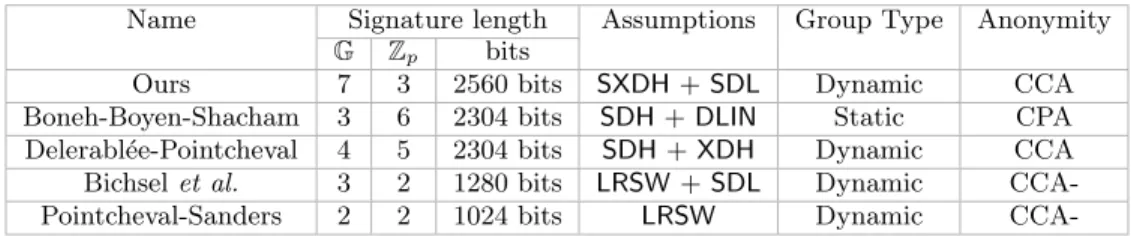
Table 1compares our scheme with previous practical group signatures based on pairing-related assumptions. Since we focus on practical schemes, we only consider those in the random oracle model. To make the com-parison possible, we use 256-bit group orders, so that elements ofGandZpare encoded using 256 bits each.The scheme of Boneh, Boyen and Shacham [14] is the first scheme providing short signatures: each signa-ture is comprised of 3 group elements and 6 elements of Zp. However, this scheme is designed for static groups
only and relies on the Strong Diffie-Hellmann assump-tion, which is a non-standardq-type assumption, and its anonymity is only proved in the CPA sense.
Delerabl´ee and Pointcheval [27] presented a scheme designed for a dynamically growing group and which is also fully (i.e., CCA) anonymous. The security of their scheme is based on the eXternal Diffie-Hellman assump-tion (XDH), which we also use here, and theq-SDH as-sumption. In [27], each signature consists of 4 group elements and 5 scalars inZp, which leads to the same
signature size as previously. They also proposed a vari-ant to get rid of the XDH assumption at the cost of 2 more group elements and one more scalar, but they still rely on theq-SDH assumption.
Bichsel et al. [12] proposed a very short group signa-ture for dynamic groups, where each signasigna-ture consists of 3 group elements and 2 elements inZp. The downsides
are their use the LRSW assumption [42], which is a very
ad-hocinteractive assumption, and their security notion is not fully-anonymous, but is an hybrid security with selfless-anonymity, which is marked “CCA-” in Table 1. Another caveat is that, unlike the two previous systems, the opening complexity of their scheme is linear in the number of group members.
In 2015, Pointcheval and Sanders [46] gave another instantiation of [12] based on a variant of the LRSW as-sumption in the asymmetric setting (meaning using only Type III pairings), which provides even shorter signa-tures than [12] with the same downsides. Their scheme
Name Signature length Assumptions Group Type Anonymity G Zp bits
Ours 7 3 2560 bits SXDH+SDL Dynamic CCA
Boneh-Boyen-Shacham 3 6 2304 bits SDH+DLIN Static CPA Delerabl´ee-Pointcheval 4 5 2304 bits SDH+XDH Dynamic CCA Bichselet al. 3 2 1280 bits LRSW+SDL Dynamic
CCA-Pointcheval-Sanders 2 2 1024 bits LRSW Dynamic
CCA-Table 1: Comparison between different group signature schemes
provides signatures composed of only 2 group elements inGand 2 scalars inZp.
Our main contribution compared to these schemes is to provide size-comparable signatures – we recall that our scheme is composed of 7 group elements and 3 scalars inZp– while relying on standard, constant-size
assump-tions. Moreover, we can notice that we can save one element inGat the expense of a linear-time opening al-gorithm in the numberN of group users (like [12]).
Acknowledgements
The first author was supported by the “Programme Avenir Lyon Saint-Etienne de l’Universit´e de Lyon” in the framework of the programme “Investissements d’Avenir” (ANR-11-IDEX-0007). The third author was supported in part by the European Research Council (FP7/2007-2013 Grant Agreement no. 339563 – Cryp-toCloud) and by the F.R.S.-F.N.R.S. in Belgium.
6.
REFERENCES
[1] M. Abe, G. Fuchsbauer, J. Groth, K. Haralambiev, M. Ohkubo. Structure-Preserving Signatures and Commitments to Group Elements. InCrypto’10, pp. 209–236, 2010.
[2] N. Akagi, Y. Manabe, T. Okamoto. An Efficient Anonymous Credential System. InFC’08, pp. 272–286, 2008.
[3] G. Ateniese, J. Camenisch, M. Joye, G. Tsudik. A practical and provably secure coalition-resistant group signature scheme. InCrypto’00, pp. 255–270, 2000. [4] M.-H. Au, W. Susilo, Y. Mu. Constant-Size Dynamic
k-TAA. InSNC’06, pp. 111–125, 2006.
[5] N. Baric, B. Pfitzmann. Collision-Free Accumulators and Fail-Stop Signature Schemes Without Trees. In Eurocrypt’97, pp. 480-494, 1997.
[6] M. Belenkiy, J. Camenisch, M. Chase, M. Kohlweiss, A. Lysyanskaya, H. Shacham. Randomizable Proofs and Delegatable Anonymous Credentials InCrypto’09, pp. 108-125, 2009.
[7] M. Belenkiy, M. Chase, M. Kohlweiss, and A. Lysyanskaya. P-signatures and non-interactive anonymous credentials. InTCC’08, pp. 356-374, 2008. [8] M. Bellare, A. Boldyreva, K. Kurosawa, J. Staddon.
Multirecipient Encryption Schemes: How to Save on Bandwidth and Computation Without Sacrificing Security.IEEE Trans. on Information Theory53(11), pp. 3927–3943, 2007.
[9] M. Bellare, D. Micciancio, B. Warinschi. Foundations of group signatures: Formal definitions, simplified requirements, and a construction based on general assumptions. InEurocrypt’03, pp. 614–629, 2003. [10] M. Bellare and G. Neven. Multi-signatures in the plain
public-key model and a general forking lemma. In CCS’06, pp. 390-399, ACM, 2006.
[11] M. Bellare, H. Shi, C. Zhang. Foundations of group signatures: The case of dynamic groups. In CT-RSA’05, pp. 136–153, 2005.
[12] P. Bichsel, J. Camenisch, G. Neven, N. P. Smart, B. Warinschi. Get Shorty via Group Signatures without Encryption. InSCN’10, pp. 381-398, 2010.
[13] D. Boneh, X. Boyen. Short Signatures Without Random Oracles. InEurocrypt’04, pp. 56–73, 2004. [14] D. Boneh, X. Boyen, H. Shacham. Short Group
Signatures. InCrypto’04, pp. 41-55, 2004.
[15] J. Camenisch, M. Dubovitskaya, G. Neven. Oblivious transfer with access control. InACM-CCS’09, pp. 131–140, 2009.
[16] J. Camenisch, S. Hohenberger, A. Lysyanskaya. Compact E-Cash. InEurocrypt’05, pp. 302-321, 2005. [17] J. Camenisch, A. Lysyanskaya. An efficient system for non-transferable anonymous credentials with optional anonymity revocation. InEurocrypt’01, pp. 93-118, 2001.
[18] J. Camenisch , A. Lysyanskaya. A Signature Scheme with Efficient Protocols. InSCN’04, pp. 268-289, 2002. [19] J. Camenisch and A. Lysyanskaya. Signature schemes
and anonymous credentials from bilinear maps. In Crypto’04, pp. 56-72, 2004.
[20] J. Camenisch, G. Zaverucha. Private Intersection of Certified Sets. InFC’09, pp. 108-127, 2009. [21] D. Chaum. Security Without Identification:
Transaction Systems to Make Big Brother Obsolete. Commun. ACM 28(10), pp. 1030–1044, 1985. [22] D. Chaum, E. van Heyst. Group Signatures. In
Eurocrypt’91, pp. 257–265, 1991.
[23] R. Cramer. Modular Design of Secure, yet Practical Cryptographic Protocols. PhD Thesis, University of Amsterdam, 1996.
[24] R. Cramer, I. Damg˚ard, P. MacKenzie.Efficient Zero-Knowledge Proofs of Knowledge Without Intractability Assumptions. InPKC’00, pp. 354-372, 2000.
[25] R. Cramer, V. Shoup. A Practical Public Key Cryptosystem Provably Secure Against Adaptive Chosen Ciphertext Attack. InCrypto’98, pp. 13-25, 1994.
[26] I. Damg˚ard. Efficient Concurrent Zero-Knowledge in the Auxiliary String Model. InEurocrypt’00, pp. 418-430, 2000.
[27] C. Delerabl´ee and D. Pointcheval. Dynamic Fully Anonymous Short Group Signatures. InVietcrypt’06, pp. 193-210, 2006.
[28] A. Fiat, A. Shamir. How to Prove Yourself: Practical Solutions to Identification and Signature Problems. In Crypto’86, pp. 186-194, 2003.
[29] D. Freeman. Converting Pairing-Based Cryptosystems from Composite-Order Groups to Prime-Order Groups. InEurocrypt’10, pp. 44–61, 2010.
[30] J. Garay, P. MacKenzie, K. Yang. Strengthening Zero-Knowledge Protocols Using Signatures. In Eurocrypt’03, pp. 177-194, 2003.
[31] J. Groth. Fully anonymous group signatures without random oracles. InAsiacrypt’07, pp. 164–180, 2007. [32] J. Groth, A. Sahai. Efficient non-interactive proof
systems for bilinear groups. InEurocrypt’08, pp. 415–432, 2008.
[33] M. Gerbush, A. Lewko, A. O’Neill, B. Waters. Dual Form Signatures: An Approach for Proving Security from Static Assumptions. InAsiacrypt’12, pp. 25-42, 2012.
[34] C. Jutla, A. Roy. Shorter quasi-adaptive NIZK proofs for linear subspaces. InAsiacrypt ’13, pp. 1–20, 2013. [35] C. Jutla, A. Roy. Switching lemma for bilinear tests
and constant-size NIZK proofs for linear subspaces. In Crypto’14, pp. 295-312, 2014.
[36] A. Kiayias, M. Yung. Secure scalable group signature with dynamic joins and separable authorities.
International Journal of Security and Networks (IJSN) Vol. 1, No. 1/2, pp. 24–45, 2006.
[37] J. Katz and N. Wang. Efficiency improvements for signature schemes with tight security reductions In CCS’03, pp. 155-164, ACM, 2003.
[38] J. Kiltz and H. Wee. Quasi-Adaptive NIZK for Linear Subspaces Revisited InEurocrypt’15, pp. 101-128, 2015.
[39] B. Libert, T. Peters, M. Joye, M. Yung. Linearly Homomorphic Structure-Preserving Signatures and Their Applications. InCrypto’13, pp. 289-307, 2013. [40] B. Libert, T. Peters, M. Joye, M. Yung.
Non-malleability from malleability: Simulation-sound quasi-adaptive NIZK proofs and CCA2-secure encryption from homomorphic signatures. In Eurocrypt’14, pp. 514-532, 2014.
[41] B. Libert, T. Peters, M. Yung. Short group signatures via structure-preserving signatures: Standard model security from simple assumptions. InCrypto’15, pp. 296-316, 2015.
[42] A. Lysyanskaya, R. L. Rivest, A. Sahai, S. Wolf. Pseudonym Systems. InSAC’99, pp. 184-199, 2000. [43] T. Nakanishi, H. Fujii, Y. Hira, N. Funabiki. Revocable
Group Signature Schemes with Constant Costs for Signing and Verifying. InPKC’09, pp. 463-480, 2009. [44] M. Naor, O. Reingold. Number-theoretic constructions
of efficient pseudo-random functions. InFOCS ’97, pp. 458–467, IEEE Press, 1997.
[45] T. Okamoto. Efficient Blind and Partially Blind Signatures Without Random Oracles. InTCC’06, pp. 80-99, 2006.
[46] D. Pointcheval and O. Sanders. Short Randomizable Signatures. To appear inCT-RSA’16, 2016. [47] D. Pointcheval and J. Stern. Security arguments for
digital signatures and blind signatures InJournal of Cryptology 2000, Volume 13, pp. 361-396, 2000. [48] V. Shoup and R. Gennaro. Securing Threshold
Cryptosystems against Chosen Ciphertext Attack. In Eurocrypt’98, pp. 1-16, 1998.
[49] T.-H. Yuen, S. Chow, C. Zhang, Siu-M. Yiu. Exponent-inversion Signatures and IBE under Static Assumptions. Cryptology ePrint Archive 2014: Report 2014/311.
APPENDIX
A.
PROOF OF THEOREM 1
Proof. We will proceed as in [41] to prove that the scheme of section3 is secure under chosen-message at-tacks. Namely we will consider a sequence of hybrid games involving two kinds of signatures.
Type A signatures: These are real signatures: σ1=gω·(vm1 1 · · ·v m` ` ·w) s , σ2=gs, π=z1ω·(z m1 2 · · ·z m` `+1·z`+2) s , σ3=hs. (13) Since (σ1, σm1 2 , . . . , σ m` 2 , σ2, σ m1 3 , . . . , σ m` 3 , σ3,Ω) is in the row space ofM, the QA-NIZK proofπ has
the same distribution as if it were computed as π=σ−χ1 1 · `+1 Y i=2 σ−χimi−1 2 ! ·σ−χ`+2 2 · 2`+2 Y i=`+3 σ−χimi−`−2 3 ! ·σ−χ2`+3 3 ·Ω −χ2`+4 . (14)
We also defineType A0signatures as a generalization of Type A signatures where only condition (13) are imposed and no restriction is given on πbeyond the fact that it should be a valid homomorphic signature on vector (2). Type B signatures: These use a random valueω0∈R
Zp instead of the secret key ω. We pick random
ω0, s, s1 R ←Zp and compute: (σ1, σ2, σ3) = (gω0·(vm1 1 · · ·v m` ` ·w) s , gs, hs+s1),
The QA-NIZK proof π is computed as in (14) by usingtk={χi}2i=1`+4. Note that Type B signatures can be generated without usingω∈Zp.
We consider a sequence of games. In Gamei,Si
de-notes the event thatAproduces a valid signatureσ?on
M? such that (M?, σ?) was not queried before, and by Eithe event thatAproduces a Type A0signature.
Game 0: This is the real game. The challengerB pro-duces a key pair (sk,pk) and sends pktoA. Then
AmakesQsignature queries: Asends messagesMi
toB, andBanswers by sendingσi=Sign(sk, Mi) to
A. FinallyAsends a pair (M?, σ?)∈ {/ (Mi, σi)}Qi=1 and wins ifVerify(pk, σ?, M?) = 1.
Game 1: We change the wayBanswers signing queries. The QA-NIZK proofsπare then computed as sim-ulated QA-NIZK proofs usingtkas in (14). These QA-NIZK proofs are thus simulated proofs for true statements, and then their distribution remains un-changed. We have Pr[S1] = Pr[S1∧E1] + Pr[S1∧ ¬E1]. Lemma 3 states that the event S1 ∧ ¬E1 happens with all but negligible probability: Pr[S1∧ ¬E1]≤AdvDDH
ˆ
G (λ)−1/p. Thus our task is now to
upper-bound the probability Pr[S1∧E1].
Game 2.k (0≤k≤Q): In Game 2.k, the challenger returns a Type B signature for the first k queries. At the lastQ−ksignature queries, the challenger answers a typeAsignature. Lemma4ensures that
Pr[S2.k∧E2.k]−Pr[S2.(k−1)∧E2.(k−1)]
is smaller
thanAdvDDHG (λ) + 1/p.
In Game 2.Q, we know that if SXDH holds,Acan only output a type A0 forgery even if it only obtains type B signatures during the game. Nevertheless, lemma 5
shows that a type A0 forgery in Game 2.Q contradicts the DDH assumptions inG. Therefore we have Pr[S2.Q∧
E2.Q]≤AdvDDHG (λ). Putting the above altogether, the
probability Pr[S0] is upper-bounded by AdvDDHGˆ (λ)+ 1 p+Q AdvDDHG (λ) +1 p +AdvDDHG (λ) <(Q+ 2)· AdvSXDH G,Gˆ (λ) + 1 p .
Lemma 3. InGame 1, if the DDH assumption holds inGˆ,Acan only output a type A0 forgery.