Cryptographic Role-based Security Mechanisms Based on
Role-Key Hierarchy
∗Yan Zhu
† ‡Gail-Joon Ahn
§Hongxin Hu
§Huaixi Wang
♭†
Institute of Computer Science and Technology, Peking University, Beijing 100871, China
‡Key Laboratory of Network and Software Security Assurance (Peking University), Ministry of Education, China
§Laboratory of Security Engineering for Future Computing (SEFCOM),
Arizona State University, Tempe, AZ 85287, USA
♭School of Mathematical Sciences, Peking University, Beijing 100871, China
{yan.zhu,wanghuaixi}@pku.edu.cn; {gahn,hxhu}@asu.edu
ABSTRACT
Even though role-based access control (RBAC) can tremen-dously help us minimize the complexity in administering users, it is still needed to realize the notion of roles at the resource level. In this paper, we propose a practical cryp-tographic RBAC model, called role-key hierarchy model, to support various security features including signature, iden-tification and encryption based on role-key hierarchy. With the help of rich algebraic structure of elliptic curve, we intro-duce a role-based cryptosystem construction to verify the ra-tionality and validity of our proposed model. Also, a proof-of-concept prototype implementation and performance eval-uation are discussed to demonstrate the feasibility and effi-ciency of our mechanisms.
Keywords
Access Control, Role-based Cryptosystem, Role-Key Hier-archy, Pairing-based Cryptosystem
1.
BACKGROUND AND MOTIVATION
Role-based access control (RBAC), as a proven alternative to traditional access control including discretionary access control (DAC) and mandatory access control (MAC), has been widely adopted for various information systems over the past few years [14]. Even though RBAC can tremen-dously help us minimize the complexity in administering users, it is still needed to realize the notion of roles at the resource level. In other words, RBAC systems need to control a user’s access to resources as well as resource-level management based on roles. Consequently, in order
∗Supported by 863 Project of China (No.2006AA01Z434) and NSF of China (No. 10990011). An extended abstract of this paper appears in ACM ASIACCS 2010, pages 314-319, ACM, 2010. Online as IACR ePrint Report 2010/188
Permission to make digital or hard copies of all or part of this work for personal or classroom use is granted without fee provided that copies are not made or distributed for profit or commercial advantage and that copies bear this notice and the full citation on the first page. To copy otherwise, to republish, to post on servers or to redistribute to lists, requires prior specific permission and/or a fee.
Copyright 200X ACM X-XXXXX-XX-X/XX/XX ...$10.00.
to provide effective resource management, it is inevitable to adopt various cryptographic capabilities for managing re-sources in RBAC systems. However, the existing crypto-graphic schemes based on common asymmetric cryptosys-tem have several limitations to address above-mentioned fea-tures since those schemes cannot accommodate access con-trol features of RBAC and have a lack of scalability and interoperability due to inconsistent parameters among cryp-tographic mechanisms.
In distributed environments, we can leverage RBAC mod-els to enforce fine-grained policies for sharing resources [10]. However, the current cryptosystems do not support such shared modes because the encryption/decryption keys can-not be recognized between RBAC systems. As a conse-quence, the resources should be re-encrypted when they are transferred into another domain. Obviously, it is necessary to design an efficient cryptographic mechanism compatible with corresponding access control systems.
schemes are hard to realize some advanced security func-tions such as revocation, digital forensics, undeniability and traceability.
Some new technologies, such as identity-based encryp-tion (IBE) [5], attribute-based encrypencryp-tion (ABE) [11], and public-key broadcast encryption (PBE) [7], lay out a solid foundation for designing an efficient cryptosystem. Inspired by these techniques, in this paper, we propose a practi-cal cryptographic RBAC model, practi-called role-key hierarchy model, to support a variety of security features including signature, identification and encryption based on role-key hierarchy. With the help of rich algebraic structure of ellip-tic curve, we introduce a role-based cryptosystem construc-tion to verify the raconstruc-tionality and validity of our proposed model. This constructions can provide more efficient and flexible control than other hierarchical key assignments [3]. More importantly, some unique security mechanisms, such as role-based signature & authentication and role-based en-cryption are supported by our construction.
The rest of the paper is organized as follows. Section 2 overviews the role hierarchy in RBAC and Section 3 articu-lates our role-key hierarchy structure along with the usabil-ity of this structure in Section 4. In Section 5, we address our RBC construction and application schemes in depth. In Section 6, we evaluate the security and performance of our schemes. Finally, we conclude this paper with our future work.
2.
PRELIMINARIES
2.1
Partial Orders
Let Ψ = hP,i be a (finite) partially ordered set with partial order relationon a (finite) setP. A partial order is a reflexive, transitive and anti-symmetric binary relation. Inheritance is reflexive because a role inherits its own per-missions, transitivity is a natural requirement in this con-text, and anti-symmetry rules out roles that inherit from one another and would therefore be redundant.
Two distinct elementsxandyin Ψ are said to be compa-rable ifxyoryx. Otherwise, they areincomparable, denoted byxky. An order relation onP gives rise to a relation ≺ of strict inequality: x ≺ y in P if and only if (or iff)xy andx6=y. Also, ifxis dominated byy, we denote the domination relation asx ≺d y. In addition, if x≺ y and x z ≺y, it then implies z = x. The latter condition demands that there be no elementz ofP satisfy-ingx≺z≺y. We define the predecessors and successors of elements in Ψ =hP,ias follows: For an element xin P, ↑x={y ∈P|xy}denotes the set of predecessors of x, ↓x={y∈P|yx}denotes the set of successors.
2.2
Role Hierarchy
In an information system, a hierarchy is used to denote the relationships and arrangements of the objects, users, ele-ments, values, and so on. Especially, in many access control systems the users are organized in a hierarchy constructed with a number of classes, called security classes or roles, according to their competencies and responsibilities. This hierarchy arises from the fact that some users have more access rights than others.
In order to manage large-scale systems, the hierarchy in RBAC becomes more complex than other systems. Espe-cially, role hierarchy (RH) is a natural means for
structur-ing roles to reflect an organization’s lines of authority and responsibility. We adopt the definitions from RBAC models proposed by Sandu et al. [13]:
Definition 1. [Hierarchical RBAC model]: TheRBAC
model has the following components:
• U,R,P, andS, users, roles, permissions and sessions respectively,
• P A⊆P×R, a many-to-many permission to role as-signment relation.
• U A⊆U×R, a many-to-many user to role assignment relation.
• RH ⊆R×R is a partial order on R called the role hierarchy or role dominance relation, written as,
• user:S →U, a function mapping each session si to
the single useruser(si), and
• roles: S → 2R, a function mapping each session s i
to a set of roles: roles(si) ⊆ {r ∈ R|∃r′ ∈ R, r
r′ : (user(s
i), r′) ∈U A}and si has the permissions:
S
r∈roles(si){p∈P|∃r
′′
∈R, r′′
r: (p, r′′)
∈P A}.
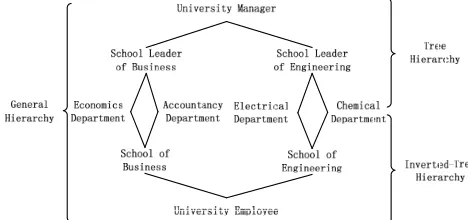
A hierarchy in RBAC is mathematically a partial order that defines an inheritance (or seniority) relation between roles, whereby senior roles acquire the permissions of their juniors. An example of role hierarchy is shown in Figure 1, in which more powerful (senior) roles are shown toward the top of the diagram and less powerful (junior) roles toward the bottom.
Figure 1: Example of role hierarchy with tree, inverted-tree, and general hierarchies.
Based on the specific features of resource management, we divide role hierarchy into three categories:
1. Tree hierarchy: It is useful to support thesharingof resources, in which resources make available to junior roles are also available to senior roles.
2. Inverted-tree hierarchy: It allows theaggregation of resources from more than one role, in which the senior can access resources in all subordinate roles.
3. General hierarchy: It can compose various different structures into a role hierarchy. Thus it facilitates both thesharing and aggregationof resources.
3.1
Role-Key Hierarchy Structure
In order to incorporate cryptographic schemes with RBAC, we propose a new hierarchy structure calledRole-Key Hi-erarchy(RKH). Based on the hierarchical RBAC model, we define RKH as follows:
Definition 2. [Role-Key Hierarchy]: Given a role
hier-archyhR,iin RBAC, role-key hierarchy is a cryptographic partial order relation for the sets of users, keys, and roles, denoted byH=hU, K, R,i, satisfying the following condi-tions:
1. K=P K∪SK, the key setKincludes the role-key set P K and the user-key setSK;
2. U KA⊆U×SK, a one-to-one user to key assignment relation, i.e., each user ui,j∈U is assigned to an
ex-clusive user-keyski,j∈SK;
3. RKA⊆R×P K, a one-to-one role to key assignment relation, i.e., each role ri∈R corresponds to a unique role-keypki∈P K;
4. KH⊆P K×P K, is a partial order onP K called the key hierarchy or key dominance relation, also written as; and
5. Each userui,j can access the resources associated with
rlif and only ifrlri∈RH and(ui,j, ri)∈U A.
where,hK,iis the smallest partially ordered set satisfying the above conditions. The user holds multiple user keys if he is member of multiple roles in role hierarchy.
In RBAC systems, various access control functions are designated by permissionsP. In the same way, the RBAC permissions can be designated by some cryptographical al-gorithms, such asEncryptand Decrypt, which can realize various access control functions by using role keys and user keys in role-key hierarchy. These algorithms can also be used independently to protect files from unauthorized ac-cess while these resources break away from the scope of this RBAC systems or an attacker gains physical access to the computer.
U
U
U
U
U
U
U
U
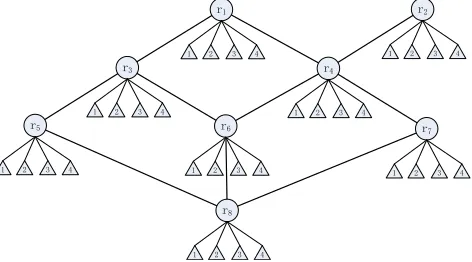
Figure 2: Example of role-key hierarchy
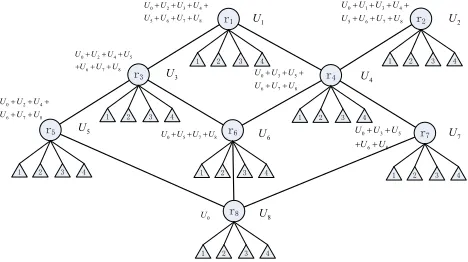
Our main objective is to map the role hierarchy in RBAC into a key management system. According to the condition 3 and 4, the role key setP Kshould have the same structure as the role hierarchy structure. Moreover, each user keyski,j∈
SK also needs to contain necessary information about role
hierarchy for dealing with access functions independently by itself. Figure 2 shows an example of role-key hierarchy, in which the circle denotes the role key and the triangle denotes the user key, respectively. Note that this is a general hierarchy.
3.2
Role-based Cryptosystem
For ease of use, we expect that a system manager assigns the user keyski,j = (labi,j, dki,j) to a user, wherelabi,j is a public label and dki,j is a private key. This label labi,j can be used to realize special functions such as designation, revocation, and tracing.
Given a role hierarchy Ψ = hR,i and a security pa-rameter s, Role-based Cryptosystem (RBC) is a key management system that can construct a role-key hierar-chy H = hU, K, R,i on Ψ and generate all keys on H, which is specified by three randomized algorithms, Setup, KeyRGen, andAddU ser, described as follows:
• Setup(s,Ψ): Takes a security parameter s and a role hierarchy Ψ as an input. It produces a manager keymk and an initial parameterparams, that is,Setup(s,Ψ)→ {H, mk, params}.
• GenRKey(params, ri): Takes the parameterparams and a role indexri. It generates a role keypkiin ri, that is,KeyRGen(params, ri)→pki.
• AddUser(mk, ID, ui,j): Takes a user identity ID, a user index ui,j, and the manager key mk. It out-puts a user secret key, which involves a user label labi,j and a private keydki,j, for the userui,j, that is,
AddU ser(mk, ID, ui,j) → ski,j = (labi,j, dki,j). The user labellabi,jis added to the public encryption key:
params=paramsS
{labi,j}.
In public-key settings, a user does not hold any private information and the permission process is performed only with the help of the public role key {pki} containing the user’s labels{labi,j}, which is also called as ID-based RBC because the user’s public labels can be used to support the various functions.
3.3
Security Goal of RKH
Obviously, security requirements in general cryptosystem are not sufficient enough to reflect the requirements of role-key hierarchy. It is important to consider typical attacks when we try to design key hierarchy and its schemes. In contrast with existing key hierarchy, RKH has several unique features:
1. Each userui,jis assigned to an exclusive user keyski,j, by which certain users can be chosen or identified in the processes of encryption, revocation, and tracing;
2. Public-key cryptography can be introduced to ensure the security of a user’s private key even if the role key makes public in some systems. Therefore the role keys can be stored anywhere by RBAC systems; and
3. The derivation function of a user’s private key is for-bidden even for the cases of partial order relations,
Pr[Delegate(ski,j, cl) =skl,j′]≤ǫ,∀clci. (1)
In order to ensure system security, RKH also needs to satisfy following properties:
• Each user in a role cannot get permissions to access another role’s objects except for its subordinates, Also, a user cannot forge other’s secret keys;
• The role key can be modified to satisfy the require-ments of constraint policy, but it should not interfere with the issued keys of others; and
• To support the capability of audit capability, there ex-ists an efficient tracing algorithm to identify the cor-rupted users or gain the corresponding evidence.
The RKH is a group-oriented cryptography with “1:n” character, where one role key corresponds to many user keys. Hence, in addition to passive cryptanalysis, the collusion at-tack is a major atat-tack, which focuses on changing the priv-ilege of the granted users or getting the other users’ keys. This kind of attack involves the following cases:
• Collusion attack for framing users, in which the cor-rupted users inR={uik,jk}
t
k=1wish to forge a new or unused key inU\ R(called as honest user). The aim of this attack is to avoid tracing and frame innocent users.
• Collusion attack for role’s privilege, in which the cor-rupted users inR={uik,jk}
t
k=1wish to forge a new or unused key inR\{ri1,· · ·, rit}. The aim of this attack
is to change the privilege in partial order hierarchy.
We also present a formal security model for two cases of collusion attacks in Appendix A. It is a challenging task to avoid collusion attack since the traitors (corrupted users) have been granted users before they are detected. Traitor tracing is an efficient method to tackle this attack. However, we must ensure that the traitors cannot forge an ‘unused’ key to avoid tracing but leave some ‘foregone’ clue of evidence to discover them.
The number of colluders|R|=tis an important param-eter. A RBC scheme is to be (t, n, m)-collusion secure if for any subset oftinRwith|U|=nand|R|=m, the adversary can gain the advantage fromRto break this scheme. It is said to be fully collusion secure when it is (n, n, m)-collusion secure.
4.
CRYPTOGRAPHIC SECURITY
MECH-ANISMS BASED ON RKH
4.1
Role-based Signature
The signature is a mathematical scheme for demonstrating the authenticity of a digital message or document. In RBAC model, the roles assigned to a user can be considered as one kind of identities of the user. Hence, a user could use his own roles to sign a resource. In other words, such a signature scheme provides a method to allow a user toanonymously
sign a message on behalf of his roles. We call itRole-based Signature(RBS). The formal definition of RBS is provided as follows:
Definition 3 (Role-based Signature). A role-based
signature scheme is a digital signature consisted of the fol-lowing four procedures:
Initial: Takes role hierarchy hR,i, and returns the role-key hierarchyH=hU, K, R,iaccording to Setup and GenRKey algorithms in RBC model;
Sign: Takes the role-key pki for ri, a user key ski,j, and
a message M ∈ {0,1}∗, and returns a signature σ: Sign(pki, ski,j, M)→σ;
Verify: Takes the role-key pki and a purported signatureσ
on a messageM. It returns the validation result which would be either valid or invalid. The latter response can mean either thatσis not a valid signature, or that the user who generated has been revoked (in a set of re-voked users, RL):V erif y(pki, σ, M)→valid/invalid;
Trace: Takes a user keyski,j then this algorithm can trace
a signatureσto at least one role memberui,jwho
gen-erated it: T race(ski,j, σ)→valid/invalid.
The trace algorithm allows a third party to undo the sig-nature anonymity using a special trapdoor and recognize the original signer. A secure role-based signature scheme must satisfy following properties:
• Correctness: This requires that, for allK= (P K, SK) generated by role-key hierarchy, valid signatures by role members can always be verified correctly, and in-valid signatures should fail in the verification phase:
V erif y(pki, Sign(pki, ski,j, M), M) =valid. (2)
• Unforgeability: Only members of a role can create valid signatures with the role.
• Anonymity: Given a message and its signature, the identity of the individual signer cannot be determined without the manager keymk.
• Traceability: Given any valid signature, the manager or trusted third party should be able to trace who is-sued the signature by the user’s secret key.
• Unlinkability: Given two messages and their signa-tures, we cannot determine whether the signatures were from the same signer or not.
In autonomous systems, role-based signature is used to verify the legality of the source of input data transmitted from other hosts or devices. This is more important for information sharing systems to prevent harmful information flows.
4.2
Role-based Authentication
Authentication allows access control systems to gain suf-ficient assurance that the identity of certain entity is le-gitimate as claimed. Cryptography-based authentication is widely adopted in current systems because it provides a higher level of security than password-based authentication. In addition, a real-time authentication for high-risk opera-tions is necessary to prevent a user from changing roles after logging in. The authentication on RBAC should support two qualitative classes of identifications:
Figure 3: Authentication protocol based on RBC.
• Role-based authentication, which can provide identi-fiable evidences that a given user possesses the at-tributes of a given role.
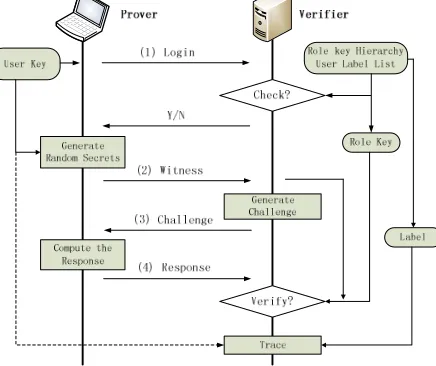
Obviously, role-based authentication is a useful way for anonymous accesses, sharing systems, or off-line devices while the user information (including the user’s public key in PKI) is not maintained by themselves. Furthermore, this ap-proach can help achieve the interoperability as well. Hence, we propose a common framework ofRole-based Authen-tication(RBA) based on a challenge-response protocol as shown in Figure 3.
Definition 4 (Role-based Authentication). A
role-based authentication scheme is a challenge-response identifi-cation protocol between prover (P) and verifier (V), consist-ing of followconsist-ing four procedures:
Initial: Takes role hierarchy hR,i, and returns the role-key hierarchyH=hU, K, R,iaccording toSetupand GenRKey algorithms in RBC model;
Interact: the prover and the verifier execute the protocol:
1. Login: The prover sends the label of identity (in-cluding rolename and username) to the verifier, then the verifier checks the availability by search-ing user-label database or role hierarchy: P →V : ri∨labi,j;
2. Witness: If the check succeeds, the verifier requires the prover to return the witness of the verifier’s private key on a random numberr: P→V :S= Oneway(ski,j, r);
3. Challenge: The verifier selects a challenge (ran-dom number) and sends it to the prover: P ←
V :c=Random();
4. Response: After receiving the challengec, the prover computes the response in terms of his private key ski,j and the random numbers r in the witness,
and sends it back to the verifier: P → V :s = Respose(ski,j, r, c).
Verify: The verifier verifies whether the response is consis-tent with the commitment, the challenge, and the role key: V erif y(pki, S, c, s)→valid/invalid. In the case
of user-based authentication, he can also check the va-lidity of the prover’s label:V erif y(pki, S, c, s, labi,j)→
valid/invalid.
Trace: Takes a prover keyski,j then it can analyze an
ex-isting record re=hS, c, s, rii to verify whether or not this prover generated this record: T race(ski,j, re) →
valid/invalid.
Similarly to role-based signature, role-based authentica-tion protocols must satisfy the following properties: correct-ness, anonymity, traceability, and unlinkability. Moreover, the following attacks should be avoided:
• Impersonation: a deception whereby one entity pur-ports to be another;
• Replay attack: an impersonation or other deception involving information from a previous protocol execu-tion on the same or a different verifier;
• Interleaving attack: an impersonation or other decep-tion involving selective combinadecep-tion of informadecep-tion from one or more previous or ongoing protocol executions; and
• Chosen-text attack: an adversary strategically chooses challenges in an attempt to extract information about the manager key.
4.3
Role-based Encryption
Encryption systems allow users to encrypt resources (files or data) on disk, or synchronously transfer messages among multiple systems. Many encryption file systems have been developed in Windows and Linux environments, e.g., Win-dows Encrypting File System (EFS), SiRiUS [9] and Plu-tus [12]. However, these systems implement some trivial schemes where the number of ciphertexts in the file header grows linearly with the increased number of users who have permissions to access the file. To overcome such a limitation, we introduce a new scheme calledRole-based Encryption
(RBE), which can be used to improve the performance of ex-isting encryption file systems.
Definition 5 (Role-based Encryption). A role-based
encryption scheme is an encryption system consisting of the following three procedures:
Initial: Takes role hierarchy hR,i, and returns the role-key hierarchyH=hU, K, R,iaccording to Setup and GenKey algorithms in RHC model;
Encrypt: Takes the encryption keypkiand a plaintextM.
It produces a ciphertextC: Encrypt(pki, M)→ Ci.
Decrypt: Takes the user keyski,j and the ciphertextC. It
generates the plaintext M: Decrypt(ski,j,Cl) → M,
whererlri.
The relationship between encryption and decryption can be described as follows:
In order to improve the performance, we assume the fol-lowing encrypted file structure: A file M is stored in the formhHdrpkl(S, ek), Eek(M)i, whereekis a session key for
encryptingM via a symmetric encryption methodE, and S denotes the subset of the authorized users or the access control policy of this file. A user in S can use his private keys to decrypt the session keyekfrom Hdrpkl(S, ek) and
then decrypt the fileM fromEek(M). The file system based on this structure is also called as role-based encryption file system (R-EFS) with revocation.
(QFU\SW )LOHV
6HVVLRQ .H\VN
+GU (QFU\SWHG
)LOHV
+GU (QFU\SWHG
)LOHV
6HVVLRQ .H\VN
)LOHV
5+ 5ROH+LHUDUFK\
5.+ 5ROH.H\+LHUDUFK\ 'HFU\SWLRQ
NH\GN
(QFU\SWLRQ NH\SN
8VHU
$VVLJQPHQW 3HUPLVVLRQ$VVLJQPHQW 8VHU.H\$VVLJQPHQW
5ROH.H\$VVLJQPHQW /RJLQ
$XWKHQWLFDWLRQ ,QGLYLGXDO
(QFU\SW
'HFU\SW
'HFU\SW
3HHUPLVVLRQ.H\ $VVLJQPHQW
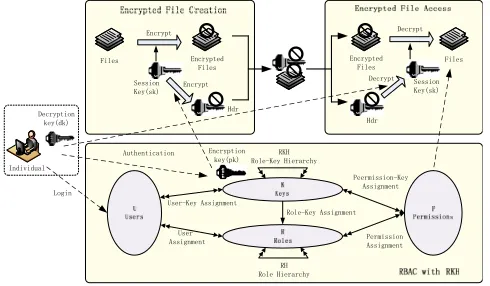
Figure 4: Role-based encryption file system.
Figure 4 illustrates a role-based encryption file system constructed based on role-key hierarchy, where each roleri is assigned to an encryption keypkiand each user has a few decryption keys {ski,j}. An administrator only needs to keep the manager keymk, but thepkicould be saved in the public directory of the system. When a userui,jinriwants to create an encrypted file, the RBAC systems encrypt the file with a session keyek, then encryptekby using the user’s pki. The result is placed in the file headerHdrafter the user gets the permissions from the RBAC systems. The user can also allow an arbitrary subset of the authorized users to de-crypt the file by performing proper assignments or making the access control policy intoS if necessary. When a user ui,j wants to access an encrypted file, the session keyekis recovered by ski,j, and the RBAC systems check whether
ui,j ∈S or the access control policy inS is valid. The file is decrypted byekafter the user gets the permissions from the RBAC systems.
This scheme can provide following security features for file systems:
1. Protection against data leakage on the physical de-vice, possibly caused by an untrusted administrator, a stolen laptop or a compromised server;
2. Detection and prevention of unauthorized data modifi-cations using a syncretic security mechanism based on policy-based access control and dynamic cryptographic technology;
3. Changing users’ access privileges by dynamically con-verging the information of users’ decryption keys to generate one-time role-based encryption keys; and
4. Enabling better scalability because all users are orga-nized into a uniformed role-based cryptographic frame-work. Most of cryptographic operations are performed at role level rather than at user level.
5.
PROPOSED SCHEMES
In this section, we present our role-based cryptosystem scheme with role-key hierarchy based on pairing-based cryp-tosystem. Meanwhile, role-based signature & authentication and role-based encryption mechanisms are addressed based on the proposed role-based cryptosystem construction.
5.1
Bilinear Pairings
We set up our systems using bilinear pairings proposed by Boneh and Franklin [4, 6]. LetG1,G2 andGT be three cyclic groups of large prime order p. G1 and G2 are two additive group andGTis a multiplicative group using elliptic
curve conventions. Let ˆe be a computable bilinear mape:
G1×G2 → GT1 with the following properties: For any G∈G1,H∈G2 and alla, b∈Zp, we have
1. Bilinearity: e([a]G,[b]H) =e(G, H)ab.
2. Non-degeneracy: e(G, H)6= 1 unlessGorH = 1.
3. Computability: e(G, H) is efficiently computable. Where, [a]Pdenotes the multiplication of a pointP in ellip-tic curve by a scalara∈Zp. A bilinear map group systemS
is a tupleS=hp,G1,G2,GT, eicomposed of the objects as described above. Smay also include group generators in its description.
5.2
Role-based Cryptosystem Scheme
LetH={U, K, R,}is a role-key hierarchy with partial-order . Without loss of generality, we assume that the total number of roles ismin H, i.e., R={r1, r2,· · ·, rm}. We construct a RBC scheme as follows:
• Setup(s,Ψ): Let S = (p,G1,G2,GT, e) be a bilinear
map group system with randomly selected generators G ∈ G1 and H ∈ G2, where G1 and G2 be bilinear group of prime order p. This algorithm first picks a random integer τi ∈ Z∗p for each role ri in role-key hierarchy graph.2 We define
Ui = [τi]G∈G1 ∀ri∈R,
V = e(G, H) ∈GT. (4)
Eachτi is called as the secret of a role and Ui is the identity of a role. Further, it definesU0 = [τ0]Gby using a randomτ0∈Z∗p. Thus, public parameter is
params=hH, V, U0, U1,· · ·, Uci (5) and we keepmk=hG, τ0, τ1,· · ·, τmisecret.
• GenRKey(params, ri): This is an assignment algo-rithm for role encryption key from the setup parame-terpp. For a roleri, the role keypkican be computed as follows:
pki = hH, V, Wi,{Uk}rk∈↑rii
Wi = U0+Pri6rkUk,
(6)
1We require that no efficient isomorphismG
2→G1orG1→
G2is known, orG2→G1is known but its invertedG1 →G2
is unknown.
where,{Uk}rk∈↑ri is the set of all roles in↑ri, which
denotes the control domain for the role ri. It is clear thatWi=
h
τ0+Pr
i6rkτk
i
G. For sake of simplicity, letζi=τ0+Pri6rkτk, so that we haveWi= [ζi]G.
• AddU ser(mk, ID, ui,j): Givenmk=hG,{τi}mi=0iand a user index ui,j in the role ri, the manager gener-ates a unique decryption key by randomly selecting a freshxi,j=Hash(ID, ui,j)∈Z∗pand definingdki,j = hAi,j, Bi,jiwhere
labi,j = xi,j ∈Z∗p
Ai,j =
h x
i,j
ζi+xi,j
i
G ∈G1,
Bi,j =
h
1 ζi+xi,j
i
H ∈G2.
(7)
Note that, the total number of users is unlimited in each role.
Finally, the above process outputs the set of role keys {pki}and the set of user keys {ski,j}. More importantly, the security of user keys is not compromised even though role keys are available in public.
Let us now turn to the problem of validity. We know that two arbitrary roles have one of three relations: rirj,
rjri, andri||rj, so that partial order relation in role keys can be defined as
X
ri6rk
Uk=
X
rk∈Ind(ri)
Uk+
X
rk∈Succ(ri)
Uk, (8)
where,Ind(ri) andSucc(ri) denote the set of incomparable roles and successors forri, respectively. This is illustrated in Figure 5 (the top is senior-most roles and the bottom is junior-most roles), with the key representation ofWion the left of the node andUion the right. We first prove that this assignment works as required:
U U U U U U U U 1 U 0 U 2 U 3 U
0 2 4 5
6 7 8
U U U U
U U U
5 U
0 2 4
6 7 8
U U U
U U U
6 U
0 5 7 8
U U U U
0 2 3 4
5 6 7 8
U U U U
U U U U
8 U
4 U
0 3 5
6 7 8
U U U
U U U
7 U 0 3 5
6 8
U U U
U U
0 1 3 4
5 6 7 8
U U U U
U U U U
Figure 5: Example of role-key relationship on RBC.
Theorem 1. Under the above assignment,∪rj6rk{τk} ⊂
∪ri6rk{τk}if and only ifrj≺ri.
Proof. The proof is immediate. First ifrj≺ri, then we
haveri∈ ∪rjrk{rk}, so that∪rirk{rk} ⊂ ∪rjrk{rk}. It
is easy to see that∪rj6rk{rk} ⊂ ∪ri6rk{rk}still holds. In
terms of the corresponding relation betweenri and τi, we have∪rj6rk{τk} ⊂ ∪ri6rk{τk}. Conversely, if∪rj6rk{τk} ⊂
∪ri6rk{τk}, then we know∪rj6rk{rk} ⊂ ∪ri6rk{rk}. This
relation can become∪rirk{rk} ⊂ ∪rjrk{rk}. Sinceri ∈
∪rirk{rk}, we haverj≺ri. Hence, the theorem holds.
Due toUi is chosen at random, this scheme do not per-mit the collision among the role keys, i.e., pki = pkj for
i6=j. The following theorem tells us that this collision is neglectable only if the security parametersis large enough, moreover, the fast sort algorithm can help us to find the collision.
Theorem 2. The collision probability amongnintegers,
which are chosen from p integers at random, is less than
(n+1)2 4p .
Proof. Firstly, the collision probability between t
ran-dom integers{ai}t
i=1andrrandom integers{bi}ri=1,Pti=1ai=
Pr
i=1bi, is 1p, where a1,· · ·, at∈RZ∗p and b1,· · ·, br ∈Z∗p. Secondly, the number of all possible cases oft+r=kis⌊k
2⌋ for 1≤t, r < n, such that the number of all possible cases of 3≤t+r≤nisPn
k=3⌊ k 2⌋<
Pn k=1 k 2 = n(n+1) 4 < (n+1)2 4 . Hence, in terms of Bernoulli’s inequality, the collision
prob-ability is 1−(1−1 p)
(n+1)2
4 ≤ (n+1) 2 4
1 p=
(n+1)2
4p . Note that we do not assume thataiandbj are different for 1≤i≤t and 1≤j≤r.
Since the total number of roles is far less than the size of space of keys, this theorem means that the collision prob-ability is neglectable for n ≪ p, e.g., given n = 1000 and p= 2s = 2160, the collision probability is less than 220
2162 = 2−142. Note that the security of RKH is not related to the combination of the role-keys, but rely heavily on the hard-ness of forging [ξ+x1 ]Gunder the bilinear map group system.
The following theorem indicates that the role hierarchy in RBAC is hidden into role-key hierarchy:
Theorem 3. Under the above assignment, role hierarchy
is in one-to-one correspondence with key hierarchy.
Proof. We show that role hierarchy can be uniquely
rep-resented by key hierarchy: Assume two different roles ri andrjhave the same key representation, i.e.,∪ri6rk{rk}=
∪rj6rk{rk}, such that ∪rirk{rk}=∪rjrk{rk}. This
im-plies that two roles have the same seniors. But we know ri ∈ ∪rirk{rk} and rj ∈ ∪rjrk{rk}. Since ri 6= rj, we
have∪rirk{rk} 6=∪rjrk{rk}, which is a contradiction.
Conversely, we show that key hierarchy may also recover role hierarchy by the following algorithm:
1. For each role ri, it gets the set of roles ∪rj6rk{rk}
from P
ri6rk
Uk, then compute Ri = ∪r
jrk{rk} =
R\ ∪rj6rk{rk}. Finally, it inserts theRiinto a record
in the search tableT.
2. WhileT is not empty, it does the following steps:
(a) It finds the recordsRi’s, which include only one element, as the set of current rolesC, then deletes these records from the tableT;
(b) For each recordRi∈T, ifRi\C={ri}, then it outputsri≺drjfor allrj∈Ri∩C, else it erases the elements inC, i.e.,Ri=Ri\C;
e(Wi, Bi,j)·e(Ai,j, H) = e
τ0+
X
rl6ri
τl
G,
1 τ0+ P
rl6ri
τl+xi,j
H
·e
xi,j
τ0+ P rl6ri
τl+xi,j
G, H
= e(G, H) (9)
R′ =
e(Wi, C2)·e(C1, H)
e(G, H)
−c
·e(Wi, H)s
=
e(W
i, Bi,j+ [β]H)·e(Ai,j+ [α]Wi, H)
e(G, H)
−c
·e(Wi, H)s
=
e(Wi, Bi,j)·e(Wi,[β]H)·e(Ai,j, H)·e([α]Wi, H)
e(G, H)
−c
·e(Wi, H)s
= (e(Wi,[β]H)·e([α]Wi, H))−c·e(Wi, H)s
= e(Wi, H)−c(α+β)·e(Wi, H)s=e(Wi, H)r. (10)
^`
^`
^`
^`
^`
^`
^`
^`
^`
^`
^`
^`
^`
^`
^`
^`
^`
^`
^`
^`
^`
^`
^`
^`
^`
!!!
^`
^`
^`
^`
^`
^`
^`
^`
^`
!! !!
^`
!!!
^`
^`
^`
^`
^`
^`
^`
^`
^`
,QSXW ,WHUDWLRQ ,WHUDWLRQ ,WHUDWLRQ ,WHUDWLRQ
Figure 6: Example of extracting role hierarchy from key hierarchy.
Based on the algorithm in Theorem 3, Figure 6 describes an example of extracting role hierarchy from key hierarchy in Figure 5. It shows that the algorithm is effective.
We show that our scheme is secure against collusion, where two or more users, belonging to different roles, cooperate to discover a user key to which they are not entitled. To dis-cuss the security against collusion, we make use of a hard problem, which is called Strong Diffie-Hellman (SDH) prob-lem:
Definition 6. [k-SDH problem]: GivenhG,[x]G,[x2]G,
· · ·,[xk]Gito compute hc,h 1 x+c
i
Giwhere c∈Z∗pandGbe a generator chosen fromG1 (or G2).
The standard collusion security is based on static collud-ers. Since we consider dynamic user management, we extend the security definition to the one that is a bit more general than in [7]. More specifically, we allow the adversary to see the role key before choosing the corrupted users. Based on this definition, we have the following theorem:
Theorem 4. Under the above assignment, the role-based
cryptosystem (RBC) scheme is fully collusion secure. Given a role-key hierarchy H = {U, K, R,} with |U| = n and
|R| = m, it is (n, n, m)-collusion secure against framing user attack and role’s privilege attack under Strong Diffie-Hellman (SDH) assumption.
We present a proof of this theorem in Appendix B, where the whole proof for framing attack is given and the proof for role’s privilege attack is stated briefly because it can be ob-tained from the former. The proof of this theorem indicates that the security is held even ifGmakes public. Moreover, this theorem clarifies that the security of this scheme is inde-pendent of the number of colluders,k. That is, the scheme can support the infinity users (at most 2s users, wheres is the security parameter) in theory. When k= 1, the proof of this theorem indicates that the security of the scheme against passive adversary (without collusion) is based on the hard problem (G,[ξ]G)→(c,[ 1
ξ+c]G) forc∈RZ
∗
p.
5.3
Role-based Signature/Authencation Scheme
The above construction can be applied to derive a role-based authentication (RBA) and signature (RBS) scheme. We propose a lightweigh signature scheme to realize the anonymity and traceability. Further, this scheme can eas-ily turn into a zero-knowledge RBA scheme. Given H = {U, K, R,}, a user carries out the following process to sign a messageM:
• Sign(pki, ski,j, M): The signing algorithm takes a group public key pki = (H, Wi,{Uk}rk∈↑ri), a user private
key ski,j = (labi,j, Ai,j, Bi,j), and a message M ∈ {0,1}∗, and proceeds as follows:
1. Picks a random nonceα, β←Z∗pand computes
C1 = Ai,j+ [α]Wi
C2 = Bi,j+ [β]H
T = [β]Wi
; (11)
2. Picks blinding valuesr←Z∗pand compute helper valuesS:
S =e(Wi, H)r; (12)
3. Computes a challenge valuec∈Z∗pusingHash:
c=Hash(pk, M, C1, C2, T, S); (13)
4. Computess=r+c(α+β):
• V erif y(pki, σ, M): The verification algorithm takes a role keypki, a purported signatureσ= (C1, C2, T, c, s), and a messageM ∈ {0,1}∗, and proceeds the following
steps:
1. Re-deriveSas:
S′=
e(Wi, C2)·e(C1, H)
V
c
·e(Wi, H)s; (14)
2. Computesc′=Hash(pk, M, C
1, C2, T, S′); 3. Check that the challengecis correct if and only
ifc=c′. If matched, accept and reject otherwise. The correctness of the verification procedure is guar-anteed by using Equation (9) and (10).
• T race(ski,j, σ): The tracing algorithm takes a set of suspicious users RL = {(labi,j, Bi,j)}. For each el-ement (labi,j, Bi,j) ∈ RL, it checks whether Bi,j is encoded in (T, C2) by evaluating if
e(Wi, C2−Bi,j) =e(T, H). (15) The algorithm outputs are valid if this verification is accepted.
The security of the system is guaranteed by the fact that Ai,j andBi,j are kept private. The different witnesses are generated to ensure the unlinkability as a result of the ran-dom parametersαandβ. TheWiin Equation (14) and (15) determines that the role of a user cannot be modified.
The tracing algorithm may be used to realize the check of revoked users: Given a set of revoked usersRL, it first verifies that the signatureσis valid by using V erif y algo-rithm; then it ensures thatσis not generated by a revoked user in terms ofT race algorithm. It accepts only if both conditions are held. We reiterate the user’s secret keyski,j is also secure after (labi,j, Bi,j) ∈RL. The reason is that the tracing or revocation check is based onBi,j, asAi,jstill keeps secret. Hence, the adversary cannot obtain the user’s secret keys from a set of suspicious usersRL.
5.4
Role-based Encryption Scheme
We can also adopt the RBC framework to build a lightweight role-based encryption (RBE) scheme, as follows:
• Encrypt(pki, M): To encrypt the messageM ∈ {0,1}∗, given anypki=hH, V, Wi,{Uk}∇k∈⊥riiand an empty
set of revoked users R =∅, the algorithm randomly pickst∈Z∗pand then computes
C1 = [t]Wi ∈G1
C2 = [t]H ∈G2
C3 = M·Vt ∈GT
U′
k = [t]Uk∈G1 ∃rk∈↑ri
. (16)
Finally, it outputsCi=hC1, C2, C3,{Uk}r′ k∈↑rii.
• Decrypt(skj,k,Ci): Given a ciphertextCifrom the role
ri, the k-th user in the role rj can utilize the fol-lowing equation to recover M from Ci with dkj,k = hAj,k, Bj,ki, whererirj:
Vi,jt =e
C1+
X
rl∈Γ(rj,ri)
Ul′, Bj,k
·e(Aj,k, C2), (17)
Access Control Module
RBC Module Encryption
Service Authentication
Service
Key-label Management Application Module
Figure 7: Cryptographic access control system based on role-key hierarchy.
where Γ(rj, ri) denotes∪rirk≺rj{rk}, and we have
Γ(rj, ri) = ∪rj6rk{rk} \ ∪ri6rk{rk}
= ∪rirk{rk} \ ∪rjrk{rk}
= ∪rirk≺rj{rk} (18)
in terms of Theorem 1. The algorithm outputs the session keyM =C3/Vi,jt .
The validity of this algorithm is guaranteed by Equa-tion (19). Given a fixed role-key hierarchy, this algorithm achieves the constant length of ciphertexts and the optimal length of the user’s secret keys, where the hidden constant relates to a couple of elements of a pairing-friendly group.
6.
PERFORMANCE EVALUATION
An experimental role-based cryptosystem was implemented to test the feasibility of our schemes. This system was developed with a standard C++ language in QT environ-ment, which supports cross-platform deployment. As shown in Figure 7, this system consists of three modules: RBC module, access control module and application module. In RBC module, we adopted GNU multiple precision arith-metic library (GMP) to handle integers of arbitrary preci-sion. Then, a finite fields arithmetic library was constructed to realize the run-time environment of elliptic curve and pairing-based cryptosystems. In addition, a cryptographic access control library was developed based on the finite fields arithmetic library to realize various proposed RBC algo-rithms. Finally, the RBE/RBA/RBS algorithms worked with a lightweight access control module to provide encryp-tion, authentication and key-label management services for the application module.
Vi,jt = e
C1+
X
rl∈Γ(rj,ri)
Ul′, Bj,k
·e(Aj,k, C2)
= e
τ0+
X
rl6ri
τl
t
G,
1 τ0+ P
rl6ri
τl+xi,j
H
·e
xi,j
τ0+ P rl6≺ri
τl+xi,j
G,[t]H
= e(G, H)
(τ0 +Prl6rjτl)·t τ0 +P
rl6rjτl+xj,k ·e(G, H)
t·xi,j τ0 +P
rl6rjτl+xj,k =e(G, H)t. (19)
on. Moreover, our constructions support a large-size of role hierarchy with arbitrary structures. Therefore, we believe our schemes can be applied to large-scale role-based cryp-tosystems, such as healthcare and financial systems.
Table 1: Parameters choosing under different scales.
Parameters Small size Medium size Large size
number of roles 10’s 100’s 1000’s number of users 10-50 50-100 100-200
height of hierarchy 1-4 5-8 9-12
total number of users 100-1,000 1,000-10,000 10,000-100,000
We can consider several degrees to measure the scalability of our method as follows: 1) small scale (10’s), 2) medium scale (100’s), and 3) large scale (1000’s). We estimate dif-ferent parameters under difdif-ferent scales shown in Table 1, in which we assume that the size of relations is proportional to the size of roles.
Computation Cost. The basic operation of our schemes is the computation of a multiple elliptic point in elliptic curve, namely, [k]P, where k is a positive integer and P is an elliptic curve point. We neglect the computation costs of an addition of elliptic points and simple modular arith-metic operations because they run fast enough. Another important operation is the computation of a bilinear map e(·,·) between two elliptic points. Then, we use the costs of multiple operation and bilinear map operation to measure the computation complexity of our schemes.
Table 2: Comparison of computation costs on RBC. (The number of roles ismin RKH.)
RBE RBS/RBA
Setup (m+ 1)/1 (m+ 1)/1 GetRkey 0/0 0/0
AddUser 2/0 2/0
Encrypt/Sign (m+ 3)/0 4/1
Decrypt/Verify 1/2 5/3
/Trace / 1/2
In Table 2, the costs of various algorithms in RBC, RBE, and RBS/RBA schemes are listed, where the valuen/m de-notes the number of multiple operationsn and the number of bilinear map operationsm, respectively. It is quite clear that all schemes have the low computational costs.
Communication Overhead. With the same assump-tion of scalability, we estimate the influence of
communica-tion overloads under the different scales. Suppose the secu-rity parametersis 80-bits, we need the elliptic curve domain parameters overFq with|q|= 160-bits3. This means that the length of integer is l0 = 2s in Zp. Similarly, we have
l1= 4sinG1,l2= 20sinG2, andlT = 10sinGT 4. For RBS/RBA scheme, the communication overloads of Sign/Interact is 2l0+ 2l1 +l2 = 32s = 320 bytes. For RBE scheme, the length of ciphertext is ml1 +l2 +lT = 4ms+ 30s= 300 + 40mbytes. In terms of Table 1, we can easily compute that the overheads are increased from 0.7 KBytes(10 roles) to 40 KBytes(1000 roles).
10 100 1000 0.0
20.0k 40.0k 60.0k 80.0k 100.0k 120.0k 140.0k 160.0k
100,000 1,0000
1,000
C
i
p
h
e
r
t
e
xt
si
ze
System scale (number of roles (up) and users (down)) RBE
R-EFS(1/2) R-EFS(1/3) R-EFS(1/4) R-EFS(1/5)
Figure 8: The ciphertext size under different scales (The size of roles changes from 10 to 1000. The number of revoked users is equal to 1/2, 1/3, 1/4, and 1/5the number of roles.)
Figure 8 shows the change rate of ciphertext size for the RBE scheme and the R-EFS scheme. Moreover, the revo-cation mechanism is considered in R-EFS as well. Figure 8 indicates that the size of revoked users has more impact than other factors. Our results also indicate that the en-cryption based on RBE scheme performs far better than the conventional encryption file systems (EFS) with the follow-ing parameters:
• Even if we deal with a large-scale organization of 500,000 users the header of a file only requires 256 KBytes in theory (using a standard 10-bytes (80-bits) security parameter); and
3Elliptic curve domain parameters overF
pwith⌈log2p⌉= 2t supply approximately t bits of security, which means that solving the logarithm problem on associated elliptic curve is believed to take approximately 2t operations.
• The EFS with our scheme can revoke an approximate 1,000 users (some intermediate data are saved to de-crypt a file faster) or 10,000 users in a compressed form at once.
7.
CONCLUSION
We have proposed a role-key hierarchy structure along with hierarchical RBAC model to accommodate the require-ments of cryptographic access control for large-scale sys-tems. Based on this hierarchy model, we further proposed several practical role-based security mechanisms to support signature, authentication and encryption constructions on elliptic curve cryptosystem. Our experiments clearly demon-strated the proposed schemes are flexible and efficient enough to support large-scale systems. For our further work, we plan to accommodate other access control features of RBAC such as session management and constraints. Also, our promising results lead us to investigate how emerging dis-tributed computing technologies such as service computing, cloud computing and mobile computing can leverage the proposed schemes with possible extensions.
8.
REFERENCES
[1] S. Akl and P. Taylor. Cryptographic solution to a multilevel security problem. InAdvances in Cryptology (CRYPTO’82), 1982.
[2] S. Akl and P. Taylor. Cryptographic solution to a problem of access control in a hierarchy.ACM Transaction Computer System, 1(3):239–248, 1983. [3] E. Bertino, N. Shang, and S. Wagstaff. An efficient time-bound hierarchical key management scheme for secure broadcasting.IEEE Trans. on Dependable and Secure Computing, 5(2):65–70, 2008.
[4] D. Boneh and M. Franklin. Identity-based encryption from the weil pairing. InAdvances in Cryptology (CRYPTO’01), volume 2139 of LNCS, pages 213–229, 2001.
[5] D. Boneh and M. Hamburg. Generalized identity based and broadcast encryption schemes. In
ASIACRYPT, pages 455–470, 2008.
[6] D. Boneh and H. Shacham. Group signatures with verifier-local revocation. InACM Conference on Computer and Communications Security, pages 168–177, 2004.
[7] B. W. D. Boneh, C. Gentry. Collusion resistant broadcast encryption with short ciphertexts and private keys. InAdvances in Cryptology
(CRYPTO’2005), volume 3621 of LNCS, pages 258–275, 2005.
[8] C. Gentry and A. Silverberg. Hierarchical id based cryptography. InAdvances in Cryptology
(ASIACRYPT 2002), volume 2501 of LNCS, pages 548–566, 2002.
[9] E. Goh, H. Shacham, N. Modadugu, and D. Boneh. Sirius: Securing remote untrusted storage. In
Proceedings of the Internet Society (ISOC) Network and Distributed Systems Security (NDSS) Symposium, pages 131–145, 2003.
[10] J. Jing and G.-J. Ahn. Role-based access management for ad-hoc collaborative sharing. InProc. of 11th Symposium on Access Control Models and Technologies (SACMAT), pages 200–209, 2006.
[11] X. Liang, Z. Cao, H. Lin, and J. Shao. Attribute based proxy re-encryption with delegating capabilities. In
ASIACCS, pages 276–286, 2009.
[12] R. S. Q. Mahesh Kallahalla, Erik Riedel and K. Fu. Plutus: Scalable secure file sharing on untrusted storage. InProceedings of the 2nd USENIX
Conference on File and Storage Technologies (FAST), pages 29–42, 2003.
[13] R. Sandhu, E. Coyne, H. Fenstein, and C. Youman. Role-based access control models.IEEE Computer, 29(2):38–47, 1996.
[14] R. Sandhu, D. Ferraiolo, and D. Kuhn. The nist model for role-based access control: Towards a unified standard. InProceedings of 5th ACM Workshop on Role Based Access Control (RBAC’00), pages 47–63, 2000.
[15] W. Tzeng. A time-bound cryptographic key assignment scheme for access control in a hierarchy.
IEEE Trans. on Knowledge and Data Engineering, 14(1):182–188, 2002.
[16] D. Wallner, E. Harder, and R. Agee. Key management for multicast: Issues and architecture. Technical Report IETF RFC 2627, In internet draft draft-waller-key-arch-01.txt, 1999.
[17] C. Wong, M. Gouda, and S. Lam. Secure group communications using key graphs. InProc. ACM SIGCOMM’1998, volume 28 of ACM press, pages 68–79, 1998.
APPENDIX
A.
SECURITY MODEL FOR COLLUSION
We define the security notion against collusion attacks in terms of security games between a challengerBand an ad-versary A. We divide the users into two categories: honest users and corrupted users, so that a set of corrupted users R is built. Moreover, there exists many honest and cor-rupted users in the same role. We first define a general model against collusion attacks:
1. Initial: The challenger B constructs an arbitrary role hierarchy Ψ = hR,i with |R| = m, and then runs Setup(s,Ψ) to generate the partial-order key hierarchy Hand initial public parametersparams, finally sends them toA.
2. Learning: Aadaptively issuesntimes queriesq1,· · ·, qn to learn the information ofH, whereqiis one of the fol-lowing:
• Honest user query (ui,j6∈ R): UsingAddU ser(mk,
ui,j),Bgenerates a new user and sends this user’s labellabi,j toA.
• Corrupted user query (ui,j∈ R): UsingAddU ser (mk, ui,j),Bgenerates a new user and returns this user’s secret keyski,j, includes user labellabi,jand private keydki,j, toA.
In fact, the n users are joined into this system vian times queries. Aends up with a key hierarchyH (in-cludes (params,{labi,j}ui,j6∈R)) and a set of colluders
{ski,j}ui,j∈R, where|R|=t.
• Framing user attack (labi,j : ui,j 6∈ R): B picks a honest user ui,j at random, and then sends his labellabi,j toAas the challenge.
• Role’s privilege attack (ri ∈ R): B picks a role
ri∈Rat random, and then sends the challengeri toA. Note that,rimay be either the honest roles (for avoiding the revocation) or the corrupted roles (for gain the privilege).
4. Guess: Aoutputs a guess of user keyski,j. Awins if
ski,j is valid, and otherwise it loses.
We denote byAdvE,A(t, n, m) the advantage of adversary
Ain winning the game: AdvH,A(t, n, m)
= 1
2|Pr[V(H,AH(Ci)) = 1]−Pr[V(H,AH(Ci)) = 0]| =
Pr[V(H,AH(Ci)) = 1]−1 2
,
where,Ciis thei-th challenge andV is a verification function ofski,j. We say that a construction is (t, n, m)-secure if for a security parametersand all probabilistic polynomial time adversariesA,AdvE,A(t, n, m) is a negligible function ofs.
B.
SECURITY PROOF AGAINST
COLLU-SION ATTACKS
Proof. Firstly, we prove the security of framing attack.
Without loss of generality, we prove the security inG1rather than inG1×G2. It is obvious that the latter is hard-er than the former. The security of frame attack is changed into the problem: given the number of colluderstand
{Wi}ri∈R,{hxil,jl, Ail,jli}uil,jl∈R,
it is infeasible to forge a new keyhx′
i,j, A′i,ji, where|R| ≤t, and{x′
il,jl}uil,jl∈R.
The proof is used by the reduction to absurdity. Suppose an adversary Acan solve the above problem with the ad-vantageǫ, i.e.,AdvH,A(t, n, m)> ǫ. UsingA, we build an
algorithmBto solves thek-SDH problem inG1. Assume the algorithmBis input a random sequence
hG,[ξ]G,[ξ2]G,· · ·,[ξk]Gi and expect to outputhc,[ 1
ξ+c]Gi, whereξ is unknown and
c∈Z∗p. Bworks by interacting withAas follows:
1. Initial: Firstly, B chooses an arbitrary role hierarchy hR,iand assigns a randomτi∈Z∗pfor each roleri∈
R, as well as a randomτ0∈Z∗p. Letζi=τ0+Pri6rkτk
in terms of the proposed scheme. Bselects at mostk−1 roles as the set of corrupted roles{rci}, and use them
to a polynomialf(x) =Qk−1
i=1(ζcix+xi) =
Pk−1 j=0aj·
xj with k −1 degrees, where (x
1, x2,· · ·, xk−1) is a sequence chosen randomly byBinZ∗p. Bdefines
G = [f(ξ)]G= [ k−1
X
i=0
ai·ξi]G= k−1
X
i=0
ai·[ξi]G,
Ui = [τi·ξ]G= [ k−1
X
j=0
τiaj·ξj+1]G= k−1
X
j=0
τiaj·[ξj+1]G.
Finally,Bsends allUi toAin ri∈R.
2. Learning: involves two kinds of query:
• Honest user query (ui,j6∈ R): Bpicks a randomti as the user label, saves it for the label setT, and returns it toA.
• Corrupted user query (ui,j ∈ R): Ifri is the cor-rupted roles{rci}andf(x) has a unassigned item
(ζcix+xi), thenB defineslabi,j=xi,j=xiand
Ai,j=
xi,j
ζciξ+xi,j
G=
xi·f(ξ)
ζciξ+xi
G. (20)
Bcan compute it due tof(x)/(ζcix+xi) is a
com-putational polynomial withk−2 degree. B sends it toA.
Finally, after n times queries, A gets at most k−1 secret keys and a label setT={ti}.
3. Challenge: B picks a random ts from T = {ti}, and then sends it toAas the challenge label. ThenAruns the algorithm to output a new forged keyhlabl,s, Al,si= hts,[ζlξ+tts s]Giin the rolerl.
4. Guess: Bchangeshts,[ζ ts
lξ+ts]Giinto the representation
of the generatorG,ht′
s,[ξ+t1′
s]Gi, as follows:
ts
ζlξ+ts
G = [ts]
f(ξ) ζlξ+ts
G (21)
= [ts]
"k−2
X
i=0
a′i·ξi+
r ζlξ+ts
#
G,
where, we can computea′0,· · ·, a′k−2byf(x) =
Pk−1 i=0ai·
xi= (Pk−2 i=0 a
′
i·xi)(ζlx+ts) +r. Such that ifts6=xl, thenr6= 0. Thus,Bcan compute
1
ξ+t′
s
G= [ζl r] [t
−1 s ]Al,s−
k−2
X
i=0
a′i·
[ξi]G
!
= [ζl r] [t
−1 s ]
ts
ζiξ+ts
G− k−2
X
i=0
a′i·
[ξi]G
!
.
andt′
s=ts/ζl. Finally,Boutputsht′s,[ξ+t1′
s]Gi.
Hence, if the adversaryAcan break RHC scheme at polyno-mial time in non-negligible advantageε, then the algorithm Bcan solvek-SDH problem at the polynomial-time, that is, the advantage of algorithm B is AdvH,A(k−1, n, m) > ε.
This denotes the algorithm B can compute k-SDH with a non-negligible success probability, which would contradict assumption.
Similarly, we also prove collusion security against the role’s privilege attack, only if we change the challenge into an assigned role rl and the adversary A returns a forged key hts,[ζ ts
lξ+ts]Gi in the role rl, as well as the other parts of
this proof remain unchanged.