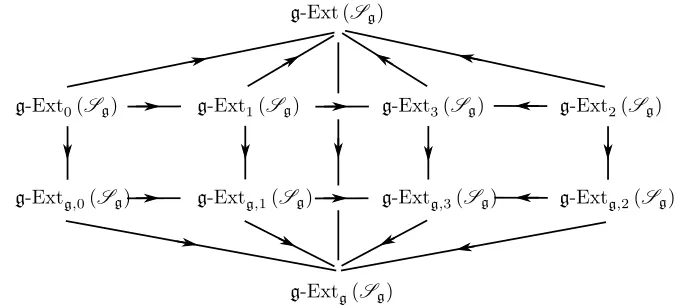
Topology,Exterior and Frontier Operators, Series 2018–2019, №7, Pages 1–59.
— Theory ofg-Tg-Exterior and g-Tg-Frontier Operators —
Definitions, Essential Properties and, Consistent, Independent Axioms
Khodabocus m. i. and Sookia n. u. h.
Department of Mathematics, Faculty of Science, University of Mauritius
Abstract. In a generalized topological spaceTg = (Ω,Tg), generalized
in-terior and generalized closure operators g-Intg, g-Clg : P(Ω) −→ P(Ω),
respectively, are merely two of a number of generalized primitive operators which may be employed to topologize the underlying set Ω in the general-ized sense. Generalgeneral-ized exterior and generalgeneral-ized frontier operators g-Extg, g-Frg : P(Ω) −→ P(Ω), respectively, are other generalized primitive
op-erators by means of which characterizations of generalized operations under g-Intg, g-Clg : P(Ω) −→ P(Ω) can be given without even realizing
gen-eralized interior and gengen-eralized closure operations first in order to topolo-gizeΩ in the generalized sense. In a recent work, the present authors have defined novel types of generalized interior and generalized closure operators g-Intg,g-Clg :P(Ω)−→P(Ω), respectively, inTg and studied their
essen-tial properties and commutativity. In this work, they propose to present novel definitions of generalized exterior and generalized frontier operatorsg-Extg,
g-Frg:P(Ω)−→P(Ω), respectively, a set of consistent, independent axioms after studying their essential properties, and established further characteriza-tions of generalized operacharacteriza-tions underg-Intg,g-Clg:P(Ω)−→P(Ω)inTg. Key words and phrases. Generalized topological space, generalized sets, generalized exterior operator, generalized frontier operator, consistent, inde-pendent axioms
Contents
1. Introduction 2
2. Theory 4
2.1. Preliminaries 4
3. Main Results 5
3.1. Essential Properties 5
3.2. Consistent, Independent Axioms 22
4. Discussion 42
4.1. Categorical Classifications 42
4.2. A Nice Application 45
4.3. Concluding Remarks 50
Appendix A. Pre-preliminaries 52
References 58
Email Address for Correspondence: [email protected]. 1
1. Introduction
Any T-set1 in a T-space or T
g-set in a Tg-space generates a natural
parti-tion of points in itsT-space orTg-space into three pairwise disjoint classes whose union is the underlying set of the T-space or Tg-space. In the T-space, an or-dinary partition is realized by the T-operators int, ext, fr : P(Ω) −→ P(Ω)
(ordinary interior, ordinary exterior and ordinary frontier operators in ordinary topological spaces) [Dix84, Gab64, Kur22, Lev61, Rad80, Wil70] and a generalized partition by theg-T-operators g-Int, g-Ext, g-Fr :P(Ω) −→ P(Ω) (generalized interior, generalized exterior and generalized frontier operators in ordinary topo-logical spaces) [CJK04, Cs8, Cs7, JN19, LZ19]. In theTg-space, an ordinary par-tition is realized by the Tg-operatorsintg, extg, frg :P(Ω) −→P(Ω) (ordinary
interior, ordinary exterior and ordinary frontier operators in generalized topologi-cal spaces) [Cs5, TC16] and a generalized partition by the g-Tg-operators g-Intg, g-Extg,g-Frg:P(Ω)−→P(Ω)(generalized interior, generalized exterior and gen-eralized frontier operators in gengen-eralized topological spaces) [Cs6, Mod17, SKK15]. Thus,int (S)∪ext (S)∪fr (S) =g-Int (S)∪g-Ext (S)∪g-Fr (S)for anyS in the
T-space and likewise,intg(Sg)∪extg(Sg)∪frg(Sg) =g-Intg(Sg)∪g-Extg(Sg)∪
g-Frg(Sg)for anySgin theTg-space. From the first set-theoretic∪-relation, it fol-lows thatg-Ext,g-Fr :P(Ω)−→P(Ω) are also essential primitiveg-T-operators in the study of T-sets in T-spaces, and from the second, it follows that g-Extg,
g-Frg:P(Ω)−→P(Ω)are also essential primitiveg-Tg-operators in the study of Tg-sets inTg-spaces.
Intuitively, the images of any T-set in a T-space under the T, g-T-exterior operators ext, g-Ext :P(Ω) −→P(Ω), respectively, are the complements corre-sponding to the images of the T-set under the T, g-T-closure operators cl, g-Cl : P(Ω) −→P(Ω) [Gab64, LZ19]. The images of the T-set in theT-space under theT,g-T-frontier operatorsfr,g-Fr :P(Ω)−→P(Ω), respectively, are the inter-sections of its image undercl :P(Ω)−→P(Ω)with the image of its complement under cl : P(Ω) −→ P(Ω) and, its image under g-Cl : P(Ω) −→ P(Ω) with the image of its complement under g-Cl :P(Ω)−→P(Ω) [Gab64, LZ19]. When
(T,T,g-T) 7−→ (Tg,Tg,g-Tg
)
, the intuitive descriptions as to the images of any Tg-set in a Tg-space under theTg,g-Tg-exterior operatorsext,g-Ext :P(Ω)−→ P(Ω)and theTg,g-Tg-frontier operatorsfr,g-Fr :P(Ω)−→P(Ω), respectively,
follow.
Hence, in aT-space, the ordinary topologization of a set can be characterized by specifying aT-exterior operatorext :P(Ω)−→P(Ω)or aT-frontier operatorfr : P(Ω)−→P(Ω), and the generalized topologization of a set can be characterized by specifying a g-T-exterior operator g-Ext : P(Ω) −→ P(Ω) or a g-T-frontier operator g-Fr :P(Ω)−→ P(Ω) [Gab64]. Similarly, in aTg-space, the ordinary
1Notes to the reader: The structuresT= (Ω,T)andT
g = (Ω,Tg), respectively, are called
ordinary and generalized topological spaces (briefly, T-space and Tg-space). The symbols T
andTg, respectively, are called ordinary topology and generalized topology (briefly, topology and g-topology). Subsets ofTandTg, respectively, are calledT-sets andTg-sets; subsets ofT and Tg, respectively, are calledT-open andTg-open sets, and their complements are calledT-closed andTg-closed sets. Generalizations ofT-sets,T-open andT-closed sets inT, respectively, are
calledg-T-sets,g-T-open andg-T-closed sets; generalizations ofTg-sets,Tg-open andTg-closed
sets inTg, respectively, are called g-Tg-sets, g-Tg-open and g-Tg-closed sets. By a Λ-operator
is meant an operator using Λ-sets to characterize its argument, whereΛ ∈ {T,T,g-T,g-T} ∪
{
Tg,Tg,g-Tg,g-Tg
}
g g
topologization of a set can be characterized by specifying a Tg-exterior operator extg :P(Ω)−→P(Ω) or aTg-frontier operator frg :P(Ω)−→P(Ω), and the
generalized topologization of a set can be characterized by specifying ag-Tg-exterior
operator g-Extg :P(Ω)−→P(Ω) or ag-Tg-frontier operatorg-Frg :P(Ω)−→ P(Ω) [LZ19]. Of all such primitive operators ext, fr, g-Ext, g-Fr : P(Ω) −→ P(Ω) in T-spaces andextg, frg, g-Extg, g-Frg : P(Ω)−→ P(Ω) in Tg-spaces,
ext,fr :P(Ω)−→P(Ω)are the oldest, andg-Extg,g-Frg:P(Ω)−→P(Ω)are the newest. Thus, the studies of primitive operators of these kinds have evolved from the studies of ordinary exterior and ordinary frontier operators in ordinary topological spaces to the studies of generalized exterior and generalized frontier operators in generalized topological spaces.
In the literature of Tg-spaces ong-Tg-exterior andg-Tg-frontier operators, few
Mathematicians have introduced some new types of one-valued mapsg-Extg,g-Frg: P(Ω)−→P(Ω), studied and related to one another someg-Tg-exterior andg-Tg
-frontier operators properties inTg-spaces similar in descriptions tog-T-exterior and g-T-frontier operators properties inT-spaces [Kle77, Mod17].
In studying the properties ofµ˜-open sets in Tg-spaces, [SKK15] have also used these g-Tg-sets to define new g-Tg-exterior and g-Tg-frontier operators called µ˜
-exterior and µ˜-frontier operators and characterized by extµ˜, bdµ˜ : P(Ω) −→
P(Ω), respectively, and studied some of their properties. In studying the proper-ties ofλκ-closed sets inTg-spaces, [JJV14] have also used theseg-Tg-sets to define
newg-Tg-exterior andg-Tg-frontier operators calledλκ-exterior andλκ-frontier op-erators and characterized byEλκ,Fλκ :P(Ω)−→P(Ω), respectively, and studied some of their properties. In a paper on base for Tg-spaces, [KM11] have defined a newg-Tg-frontier operator which may be called∂-operator and characterized by
∂ :P(Ω)−→P(Ω) and studied some of its properties. In the paper of [Boo18], the author gave the definition ofg-Tg-frontier operator called(ζ, δ(µ))-frontier
op-erator and characterized by Fr(ζ,δ(µ)) : P(Ω) −→P(Ω) and utilized it to study the properties ofζδ(µ) and(ζ, δ(µ))-closed sets in strong Tg-spaces.
In view of the above few references, it follows that the subject-matter was given little attention. In this paper titled Theory of g-Tg-Exterior and g-Tg-Frontier
Operators and subtitled Definitions, Essential Properties and, Consistent, Inde-pendent Axioms, the authors attempt to add, in as unique and unified a way as possible so as to offer a unified approach to manyg-Tg-exterior andg-Tg-frontier
operators properties, a further contribution to the field with these two research objectives in mind:
• i. To present the definitions and the essential properties of a new class of g-Tg-exterior andg-Tg-frontier operators inTg-spaces.
• ii. To discuss the consistency, independency of some sets of axioms for the g-Tg-exterior andg-Tg-frontier operators inTg-spaces.
These two research objectives form properly two separate sections and the rest of this paper is structured in this manner: In Sect. 2, preliminary notions are described in Subsect. 2.1 (Appx. A contains pre-preliminary notions extracted from the pre-preliminary and preliminary sections of our sixth work titledTheory of g-Tg-Interior and g-Tg-Closure Operators) and the main results of the theory
ofg-Tg-exterior andg-Tg-frontier operators inTg-spaces are reported inSect. 3:
3.2. InSect. 4, the establishment of the various relationships between theseg-Tg
-operators are discussed inSects4.1. To support the work, a nice application of the g-Tg-exterior and g-Tg-frontier operators in a Tg-space is presented inSubsect.
4.2. Finally, Subsect. 4.3 provides concluding remarks and future directions of the theory ofg-Tg-exterior and g-Tg-frontier operators inTg-spaces.
2. Theory
2.1. Preliminaries. Foreign terms employed below are extracted from the pre-liminary section of our sixth work titledTheory ofg-Tg-Interior andg-Tg-Closure
Operators and are presented inAppx. A.
The discussion starts by introducing the definitions of the notions ofg-Tg-exterior
andg-Tg-frontier operators of categoryνinTg-spaces. Takingg-Intg,ν:P(Ω)−→
P(Ω)as the primitiveg-ν-Tg-operator, they may be defined as thus.
Definition 2.1 (g-ν-Tg-Exterior, g-ν-Tg-Frontier Operators). Let Tg = (Ω,Tg)
be aTg-space. Then:
• i. The one-valued map g-Extg,ν :P(Ω) −→P(Ω) on P(Ω) ranging in
P(Ω)is called a ”g-Tg-exterior operator of categoryν” if and only if
(
∀Sg ∈P(Ω))[g-Extg,ν:Sg7−→g-Intg,ν◦g-Opg(Sg)
]
.
(2.1)
• ii. The one-valued map g-Frg,ν : P(Ω) −→ P(Ω) on P(Ω) ranging in
P(Ω)is called a ”g-Tg-frontier operator of categoryν” if and only if
(
∀Sg∈P(Ω))[g-Frg,ν:Sg7−→g-Opg
( ∪
Rg=Sg,g-Opg(Sg)
g-Intg,ν(Rg)
)]
.
(2.2)
The classes g-E [Tg] def= {g-Extg,ν : ν ∈ I0 3 }
and g-F [Tg] def= {g-Frg,ν : ν ∈ I0 3 }
are called, respectively, the class of allg-Tg-exterior operators and the class of all
g-Tg-frontier operators inTg.
The g-Tg-operators g-Extg,ν, g-Frg,ν : P(Ω) −→ P(Ω) may be chosen, evi-dently, as primitiveg-Tg-operators of category ν in Tg.
Remark 2.2. Observing that, for every ν ∈ I3∗, the g-ν-Tg-exterior and g-ν-Tg
-frontier operators g-Extg,ν, g-Frg,ν : P(Ω) −→ P(Ω) are based on the g-ν-Tg
-interior andg-ν-Tg-closure operatorsg-Intg,ν,g-Clg,ν:P(Ω)−→P(Ω), it follows that:
• i. (g-Extg,ν,g-Frg,ν)def= (extg,frg)if based on the Tg-operators intg, clg : P(Ω)−→P(Ω);
• ii. (g-Extg,ν,g-Frg,ν
) def
= (g-Extν,g-Frν
)
if based on the g-T-operators g-Intν,g-Clν:P(Ω)−→P(Ω);
• iii. (g-Extg,ν,g-Frg,ν
) def
= (ext,fr) if based on the T-operators int, cl : P(Ω)−→P(Ω).
In this way,(extg,frg)is called a pair ofTg-exterior andTg-frontier operators in a Tg-spaceTg= (Ω,Tg);
(
g-Extν,g-Frν), a pair of g-T-exterior andg-T-frontier op-erators of categoryνin aT-spaceT= (Ω,T)and(ext,fr), a pair ofT-exterior and
g g
ν ∈I0 3 }
and g-F [T]def= {g-Frν : ν ∈I0 3 }
. Then,g-E [T] and g-F [T], respectively, denote the classes of all g-T-exterior operators and g-T-frontier operators in the
T-spaceT= (Ω,T).
3. Main Results
Using the foregoing definitions, some essential properties as well as the consis-tency, independency of some sets of axioms for theg-Tg-exterior andg-Tg-frontier
operators inTg-spaces are presented below.
3.1. Essential Properties. The discussion begins by giving some of the basic consequences resulting from the foregoing definition.
In a Tg-space, the g-Tg-closure operator may also be used to define theg-Tg -exterior andg-Tg-frontier operators as proved in the following proposition.
Proposition3.1. If(g-Extg,g-Frg
)
∈g-E [Tg]×g-F [Tg]be a pair ofg-Tg-exterior
andg-Tg-frontier operatorsg-Extg,g-Frg:P(Ω)−→P(Ω), respectively, in aTg -spaceTg= (Ω,Tg), then
(
∀Sg∈P(Ω))[(g-Extg(Sg)←→g-Opg◦g-Clg(Sg)) ∧(g-Frg(Sg)←→∩Rg=S
g,g-Opg(Sg)g-Clg(Rg) )]
.
(3.1)
Proof. Let (g-Extg,g-Frg) ∈ g-E [Tg]×g-F [Tg] be a pair of g-Tg-exterior and
g-Tg-frontier operators g-Extg, g-Frg : P(Ω) −→ P(Ω), respectively, in a Tg
-space Tg = (Ω,Tg) and, let Sg ∈ P(Ω) be arbitrary. Then, by virtue of the
definition of g-Extg : P(Ω) −→ P(Ω) together with the relation g-Intg ←→
g-Opg◦g-Clg◦g-Opg, it results that
g-Extg :Sg 7−→ g-Intg◦g-Opg(Sg)
←→ g-Opg◦g-Clg◦g-Opg◦g-Opg(Sg) ←→ g-Opg◦g-Clg(Sg).
Hence,g-Extg(Sg)←→g-Opg◦g-Clg(Sg). Likewise, by virtue of the definition of g-Frg:P(Ω)−→P(Ω)together withg-Intg ←→g-Opg◦g-Clg◦g-Opg, it results
that
g-Frg:Sg 7−→ g-Opg
( ∪
Rg=Sg,g-Opg(Sg)
g-Intg(Rg)
)
←→ g-Opg
( ∪
Rg=Sg,g-Opg(Sg)
g-Opg◦g-Clg◦g-Opg(Rg)
)
←→ ∩
Rg=Sg,g-Opg(Sg)
g-Opg◦g-Opg◦g-Clg◦g-Opg(Rg)
←→ ∩
Rg=Sg,g-Opg(Sg)
g-Clg(Rg).
Hence,g-Frg(Sg)←→∩R
g=g-Opg(Sg),Sgg-Clg(Rg). The proof of the proposition
is complete. Q.e.d.
That theg-Tg-frontier operator may be considered to establish theg-Tg-interior
Theorem 3.2. If g-Frg ∈ g-F [Tg] be a g-Tg-frontier operator g-Frg : P(Ω) −→ P(Ω) in aTg-spaceTg = (Ω,Tg), then:
• i. Sg∩g-Opg◦g-Frg(Sg)←→g-Intg(Sg) ∀Sg∈P(Ω), • ii. Sg∪g-Frg(Sg)←→g-Clg(Sg) ∀Sg∈P(Ω).
Proof. Letg-Frg∈g-F [Tg]be ag-Tg-frontier operatorg-Frg :P(Ω)−→P(Ω)
in a Tg-space Tg = (Ω,Tg)and, letSg ∈P(Ω) be arbitrary. Then, since Sg ⊇
g-Intg andSg∩g-Intg◦g-Opg(Sg) =∅, it follows that
Sg∩g-Opg◦g-Frg(Sg) ←→ Sg∩
( ∪
Rg=Sg,g-Opg(Sg)
g-Intg(Rg)
)
←→ ∪
Rg=Sg,g-Opg(Sg) (
Sg∩g-Intg(Rg)
)
←→ Sg∩g-Intg(Sg)←→g-Intg(Sg).
Thus,Sg∩g-Opg◦g-Frg(Sg)←→g-Intg(Sg). On the other hand, sinceg-Intg←→
g-Opg◦g-Clg◦g-Opg, it follows that
Sg∪g-Frg(Sg) ←→ Sg∪g-Opg
( ∪
Rg=Sg,g-Opg(Sg)
g-Intg(Rg)
)
←→ Sg∪
( ∩
Rg=Sg,g-Opg(Sg)
g-Opg◦g-Intg(Rg)
)
←→ ∩
Rg=Sg,g-Opg(Sg) (
Sg∪g-Clg(Rg))
←→ Sg∪g-Clg(Sg)←→g-Clg(Sg).
Thus, Sg ∪g-Frg(Sg) ←→ g-Clg(Sg). The proof of the theorem is complete. Q.e.d.
Observing that, for anySg∈P(Ω), it holds that
Sg∩g-Opg◦g-Frg(Sg) ←→ g-Intg(Sg)
←→ (Sg∩g-Intg(Sg))∩(Sg∩g-Intg◦g-Opg(Sg)) ←→ Sg∩(g-Intg(Sg)∪g-Intg◦g-Opg(Sg)),
and, for anyRg∈P(Ω), it also holds that
Rg∪g-Frg(Rg) =g-Clg(Rg) ←→(Rg∪g-Intg(Rg)
)
∪g-Frg(Rg) =Rg∪g-Clg(Rg) ←→Rg∪(g-Intg(Rg)∪g-Frg(Rg))=Rg∪g-Clg(Rg),
an immediate consequence of the above theorem is the following corollary.
Corollary 3.3. If g-Frg∈g-F [Tg] be a g-Tg-frontier operator g-Frg:P(Ω)−→ P(Ω) in aTg-spaceTg = (Ω,Tg), then:
• i. g-Opg◦g-Frg(Sg)←→g-Intg(Sg)∪g-Intg◦g-Opg(Sg) ∀Sg∈P(Ω),
g g
For any Tg-set in a Tg-space, its image under g-Extg : P(Ω) −→ P(Ω) is a
super-imageof its image under extg :P(Ω) −→P(Ω) whereas, its image under g-Frg:P(Ω)−→P(Ω)is asub-imageof its image underfrg:P(Ω)−→P(Ω). These are embodied in the theorem that follows.
Theorem 3.4. If (extg,g-Extg)∈E [Tg]×g-E [Tg] be a pair of Tg, g-Tg-exterior
operatorsextg,g-Extg:P(Ω)−→P(Ω), respectively, and
(
frg,g-Frg
)
∈F [Tg]×
g-F [Tg] be a pair of Tg, g-Tg-frontier operators fr, g-Fr : P(Ω) −→ P(Ω),
re-spectively, in a Tg-spaceTg= (Ω,Tg), then: • i. g-Extg(Sg)⊇extg(Sg) ∀Sg∈P(Ω), • ii. g-Frg(Sg)⊆frg(Sg) ∀Sg∈P(Ω).
Proof. Let(extg,g-Extg)∈E [Tg]×g-E [Tg]and (frg,g-Frg)∈F [Tg]×g-F [Tg]
be pairs of Tg, g-Tg-exterior operators and Tg, g-Tg-frontier operators,
respec-tively, in aTg-spaceTg = (Ω,Tg)and, let Sg ∈P(Ω) be arbitrary. Then, since
g-Intg(Sg)⊇intg(Sg), it results that
g-Extg:Sg 7−→ g-Intg◦g-Opg(Sg)⊇intg◦g-Opg(Sg)←→extg(Sg).
Thus, g-Extg(Sg)⊇extg(Sg). On the other hand, sinceg-Intg(Sg)⊇intg(Sg)
impliesg-Opg◦g-Intg(Sg)⊆g-Opg◦intg(Sg), it follows that
g-Frg:Sg 7−→ g-Opg
( ∪
Rg=Sg,g-Opg(Sg)
g-Intg(Rg)
)
⊆ g-Opg
( ∪
Rg=Sg,g-Opg(Sg)
g-Intg(Rg)
)
←→frg(Sg).
Hence,g-Frg(Sg)⊆frg(Sg). The proof of the theorem is complete. Q.e.d.
Remark3.5. If the relation ”g-Extg%extg” stands for ”g-Extg(Sg)⊇extg(Sg)” and ”g-Frg - frg,” for ”g-Frg(Sg) ⊆ frg(Sg),” then the outstanding facts are:
g-Extg : P(Ω) −→ P(Ω) is finer (or, larger, stronger) than extg : P(Ω) −→ P(Ω) or, extg : P(Ω) −→ P(Ω) iscoarser (or, smaller, weaker) thang-Extg : P(Ω)−→P(Ω); g-Frg :P(Ω)−→P(Ω) is coarser (or, smaller, weaker) than
frg :P(Ω)−→P(Ω)or,frg:P(Ω)−→P(Ω)isfiner(or,larger,stronger) than
g-Frg:P(Ω)−→P(Ω).
The images of∅ ∈P(Ω)under g-Extg, g-Frg:P(Ω)−→P(Ω) in aTg-space
are, respectively, the underlying set and itself as proved in the following proposition.
Proposition3.6. If(g-Extg,g-Frg
)
∈g-E [Tg]×g-F [Tg]be a pair ofg-Tg-exterior
and g-Tg-frontier operators g-Extg, g-Frg : P(Ω) −→ P(Ω), respectively, in a strongTg-spaceTg = (Ω,Tg), then:
• i. (g-Extg:∅ 7−→g-Opg(∅))∧(g-Frg:∅ 7−→ ∅),
• ii. (g-Extg◦g-Opg :∅ 7−→ ∅)∧(g-Frg◦g-Opg :∅ 7−→ ∅).
Proof. Let (g-Extg,g-Frg) ∈ g-E [Tg]×g-F [Tg] be a pair of g-Tg-exterior and g-Tg-frontier operatorsg-Extg, g-Frg :P(Ω) −→P(Ω), respectively, in a strong
Tg-spaceTg= (Ω,Tg). Then:
i. SinceTg is a strongTg-space, implyingg-Intg(Ω) =g-Opg(∅), it follows that
Therefore, g-Extg : ∅ 7−→g-Opg(∅). On the other hand, since Tg is a strong Tg
-space, implying g-Clg(∅) = ∅, by the relations g-Clg ←→ g-Opg◦g-Intg◦g-Opg
and∪R
g=∅,g-Opg(∅)g-Intg(Rg) =g-Intg◦g-Opg(∅), it follows that
g-Frg:∅ 7−→ g-Opg
( ∪
Rg=∅,g-Opg(∅)
g-Intg(Rg)
)
←→ g-Opg◦g-Intg◦g-Opg(∅)←→g-Clg(∅) =∅.
Hence,g-Frg :∅ 7−→ ∅.
ii. Sinceg-Intg(∅) =∅in Tg,
g-Extg◦g-Opg:∅ 7−→g-Intg◦g-Opg◦g-Opg(∅)←→g-Intg(∅) =∅.
Thus,g-Extg◦g-Opg :∅ 7−→ ∅. On the other hand,
g-Frg◦g-Opg:∅ 7−→ g-Opg
( ∪
Rg=g-Opg(∅),∅
g-Intg(Rg)
)
←→ g-Frg(∅) =∅.
Hence,g-Frg◦g-Opg :∅ 7−→ ∅. The proof of the proposition is complete. Q.e.d.
For any Tg-set in aTg-space, its image underg-Extg:P(Ω)−→P(Ω) is the
image of the complement of this image underg-Extg :P(Ω)−→P(Ω)whereas,
its image under g-Frg : P(Ω) −→ P(Ω) is the image of its complement under g-Frg:P(Ω)−→P(Ω). In the following theorem are proved these facts.
Theorem 3.7. If (g-Extg,g-Frg)∈ g-E [Tg]×g-F [Tg] be a pair of g-Tg-exterior
and g-Tg-frontier operators g-Extg, g-Frg : P(Ω) −→ P(Ω), respectively, in a Tg-space Tg= (Ω,Tg), then:
• i. g-Extg(Sg)←→g-Extg◦g-Opg◦g-Extg(Sg) ∀Sg∈P(Ω),
• ii. g-Frg(Sg)←→g-Frg◦g-Opg(Sg) ∀Sg∈P(Ω).
Proof. Let (g-Extg,g-Frg) ∈ g-E [Tg]×g-F [Tg] be a pair of g-Tg-exterior and g-Tg-frontier operators g-Extg, g-Frg : P(Ω) −→ P(Ω), respectively, in a Tg -space Tg = (Ω,Tg) and, let Sg ∈ P(Ω) be arbitrary. Then, the g-Tg-exterior
operation on g-Opg◦g-Extg(Sg) ∈ P(Ω) under g-Ext ∈ g-E [Tg], taking into
account the definition ofg-Extg:P(Ω)−→P(Ω), gives
g-Extg:g-Opg◦g-Extg(Sg) 7−→ g-Intg◦g-Opg◦g-Opg◦g-Extg(Sg) ←→ g-Intg◦g-Extg(Sg)
←→ g-Intg◦g-Intg◦g-Opg(Sg)
←→ g-Intg◦g-Opg(Sg)←→g-Extg(Sg).
Thus,g-Extg(Sg)←→g-Extg◦g-Opg◦g-Extg(Sg). In a similar fashion, theg-Tg
-frontier operation ong-Opg(Sg)∈P(Ω)underg-Fr∈g-F [Tg] gives
g-Frg◦g-Opg(Sg) ←→ g-Opg
( ∪
Rg=g-Opg(Sg),g-Opg◦g-Opg(Sg)
g-Intg(Rg)
)
←→ g-Opg
( ∪
Rg=Sg,g-Opg(Sg)
g-Intg(Rg)
)
g g
Hence,g-Frg(Sg)←→ g-Frg◦g-Opg(Sg). The proof of the theorem is complete. Q.e.d.
For an arbitrarySg∈P(Ω) containing another arbitraryRg⊆Sg, the state-ments given in the following theorem holds.
Theorem 3.8. If (g-Extg,g-Frg)∈ g-E [Tg]×g-F [Tg] be a pair of g-Tg-exterior
and g-Tg-frontier operators g-Extg, g-Frg : P(Ω) −→ P(Ω), respectively, in a
Tg-space Tg= (Ω,Tg)then:
• i. Rg⊆Sg∈P(Ω)−→g-Extg(Rg)⊇g-Extg(Sg),
• ii. Rg⊆Sg∈P(Ω)−→g-Frg(Rg)⊆Sg∪g-Frg(Sg).
Proof. Let (g-Extg,g-Frg
)
∈ g-E [Tg]×g-F [Tg] be a pair of g-Tg-exterior and
g-Tg-frontier operators g-Extg, g-Frg : P(Ω) −→ P(Ω), respectively, in a Tg -space Tg = (Ω,Tg) and, let (Rg,Sg) ∈ P(Ω)×P(Ω) such that Rg ⊆ Sg be
arbitrary. Then, since condition Rg ⊆Sg implies g-Intg(Rg) ⊆g-Intg(Sg) and g-Opg(Rg)⊇g-Opg(Sg), it follows that
g-Extg:Rg7−→g-Intg◦g-Opg(Rg)⊇g-Intg◦g-Opg(Sg)←→g-Extg(Sg).
Therefore,g-Extg(Rg)⊇g-Extg(Sg). On the other hand, sinceRg⊆Sg implies
g-Clg(Sg) ⊇ g-Clg(Rg) and Sg ∪g-Frg(Sg) ←→ g-Clg(Sg) ⊇ g-Frg(Sg), it results that
Sg∪g-Frg(Sg)←→g-Clg(Sg)⊇g-Clg(Rg) ←→ Rg∪g-Frg(Rg) ⊇ g-Frg(Rg).
Thus,g-Frg(Rg)⊆Sg∪g-Frg(Sg). The proof of the theorem is complete. Q.e.d.
For anyTg-set in aTg-space, the union of its images underg-Extgg-Frg,g-Intg: P(Ω)−→P(Ω)is the underlying set itself as proved in the following proposition.
Proposition 3.9. If (g-Ext,g-Fr,g-Int)∈g-E [Tg]×g-F [Tg]×g-I [Tg] be a triple
of g-Tg-exterior, g-Tg-frontier and g-Tg-interior operators g-Extg, g-Frg, g-Intg : P(Ω)−→P(Ω), respectively, in aTg-spaceTg = (Ω,Tg), then:
(
∀Sg∈P(Ω))[g-Extg(Sg)∪g-Frg(Sg)∪g-Intg(Sg) = Ω
]
.
(3.2)
Proof. Let(g-Ext,g-Fr,g-Int)∈g-E [Tg]×g-F [Tg]×g-I [Tg]be a triple ofg-Tg
-exterior,g-Tg-frontier andg-Tg-interior operatorsg-Extg,g-Frg,g-Intg:P(Ω)−→ P(Ω), respectively, in a Tg-spaceTg= (Ω,Tg)and, letSg∈P(Ω)be arbitrary.
Then, since the relationg-Clg←→g-Opg◦g-Intg◦g-Opgimpliesg-Clg◦g-Opg ←→
g-Opg◦g-Intg andg-Opg◦g-Clg←→g-Intg◦g-Opg, it follows that
∩
Rg=Sg,g-Opg(Sg)
g-Clg(Rg)←→g-Opg
( ∪
Rg=Sg,g-Opg(Sg)
g-Intg(Rg)
and consequently,
Ω = g-Opg◦g-Clg(Sg)∪g-Clg(Sg)
←→ g-Intg◦g-Opg(Sg)∪
(( ∩
Rg=Sg,g-Opg(Sg)
g-Clg(Rg)
)
∪g-Intg(Sg)
)
←→ g-Extg(Sg)∪g-Opg
( ∪
Rg=Sg,g-Opg(Sg)
g-Intg(Rg)
)
∪g-Intg(Sg)
←→ g-Extg(Sg)∪g-Frg(Sg)∪g-Intg(Sg).
Hence,g-Extg(Sg)∪g-Frg(Sg)∪g-Intg(Sg) = Ω. The proof of the proposition is
complete. Q.e.d.
For a Tg-set in a Tg-space to be a g-Tg-set, it is necessary and sufficient that
its image under g-Frg : P(Ω) −→ P(Ω) be contained either in itself or in its complement. The proof of this statement is contained in the following lemma, which will be helpful in the proof of the next theorem.
Lemma 3.10. Let g-Frg : P(Ω) −→ P(Ω) be a g-Tg-frontier operator and let Sg∈P(Ω) be arbitrary in aTg-space Tg= (Ω,Tg). Then:
• i. Sg ∈g-O [Tg] ←→ g-Frg(Sg)⊆g-Opg(Sg), • ii. Sg∈g-K [Tg] ←→ g-Frg(Sg)⊆Sg.
Proof. Let g-Frg : P(Ω) −→ P(Ω) be a g-Tg-frontier operator and suppose Sg∈P(Ω) be arbitrary in aTg-spaceTg= (Ω,Tg). Then:
i. The supposition Sg∈g-O [Tg]impliesg-Opg(Sg)∈g-K [Tg]. Consequently,
g-Opg(Sg) = g-Extg(Sg)∪g-Frg(Sg) ⊇ g-Frg(Sg) and hence, g-Opg(Sg) ⊇
g-Frg(Sg). Conversely, suppose the relationg-Frg(Sg)⊆g-Opg(Sg)hold. Then,
Sg ⊆ g-Opg(g-Extg(Sg)∪g-Frg(Sg) ⊇ g-Frg(Sg)). By virtue of the rela-tionsg-Extg(Sg)∪g-Frg(Sg)∪g-Intg(Sg) = Ωandg-Opg(Sg)⊆g-Extg(Sg)∪
g-Frg(Sg), it follows, obviously, thatSg ⊆g-Intg(Sg). Hence,Sg =g-Intg(Sg)
andSg=g-Opg
(
g-Extg(Sg)∪g-Frg(Sg)
)
∈g-O [Tg].
ii. The supposition Sg ∈ g-K [Tg] implies g-Opg(Sg) ∈ g-O [Tg]. Conse-quently, g-Opg(Sg) = g-Extg(Sg). But, g-Extg(Sg) = g-Opg
(
g-Intg(Sg)∪
g-Frg(Sg)
)
⊆ g-Opg◦g-Frg(Sg). Therefore, g-Opg(Sg) ⊆ g-Opg◦g-Frg(Sg)
and hence, Sg ⊇ g-Frg(Sg). Conversely, suppose g-Frg(Sg) ⊆ Sg. Then, g-Frg(Sg) ⊆ Sg is equivalent to g-Intg(Sg) ∪g-Frg(Sg) ⊆ Sg. By virtue of the relations g-Extg(Sg)∪g-Frg(Sg)∪g-Intg(Sg) = Ω and g-Extg(Sg) ⊆
g-Opg(Sg), it follows, consequently, that Sg ⊆ g-Frg(Sg)∪g-Intg(Sg). Thus, Sg = g-Frg(Sg)∪g-Intg(Sg) and Sg = g-Opg◦g-Extg(Sg) ∈ g-K [Tg]. The
proof of the lemma is complete. Q.e.d.
In connection with the lemma just proved, the theorem follows.
Theorem 3.11. Let g-Frg : P(Ω)−→P(Ω) be ag-Tg-frontier operator and let Sg∈P(Ω) be arbitrary in aTg-space Tg= (Ω,Tg). Then:
g g
Proof. Let g-Frg : P(Ω) −→ P(Ω) be a g-Tg-frontier operator and suppose Sg∈P(Ω) be arbitrary in aTg-spaceTg= (Ω,Tg). Then:
i. The suppositionSg∈g-O [Tg]is equivalent tog-Frg(Sg)⊆g-Opg(Sg). But sinceg-Opg◦g-Intg(Sg)⊇g-Opg(Sg), it follows that
g-Frg(Sg) ←→ g-Frg(Sg)∩g-Opg(Sg)
←→ (g-Opg◦g-Intg(Sg)∩g-Clg(Sg)
)
∩g-Opg(Sg) = g-Clg(Sg)∩g-Opg(Sg).
Thus,g-Frg(Sg)←→g-Clg(Sg)∩g-Opg(Sg).
ii. The suppositionSg ∈g-K [Tg] is equivalent tog-Frg(Sg)⊆Sg. But since
Sg⊇g-Clg(Sg), it follows that
g-Frg(Sg) ←→ g-Frg(Sg)∩Sg
←→ (g-Opg◦g-Intg(Sg)∩g-Clg(Sg))∩Sg = Sg∩g-Opg◦g-Intg(Sg).
Thus,g-Frg(Sg)←→Sg∩g-Opg◦g-Intg(Sg). The proof of the theorem is
com-plete. Q.e.d.
In connection with the theorem just proved, notice that the statement given below holds:
g-Frg(Sg) ←→ g-Frg(Sg)∩g-Frg(Sg)
←→ (g-Clg(Sg)∩g-Opg(Sg))∩(Sg∩g-Opg◦g-Intg(Sg))=∅.
Accordingly, an immediate consequence of the above theorem is the following corol-lary.
Corollary 3.12. If g-Frg : P(Ω) −→ P(Ω) be a g-Tg-frontier operator in a Tg-space Tg= (Ω,Tg), then:
(
∀Sg ∈P(Ω))[Sg∈g-O [Tg]∩g-K [Tg] −→ g-Frg(Sg) =∅
]
.
(3.3)
For any Tg-set in a Tg-space, the images of its g-Tg-interior and g-Tg-closure
points under g-Frg : P(Ω) −→ P(Ω) are both contained in its image under g-Frg:P(Ω)−→P(Ω). Such statement is proved in the theorem that follows. Theorem 3.13. If g-Fr ∈ g-F [Tg] be a g-Tg-frontier operator g-Frg : P(Ω) −→ P(Ω) in aTg-spaceTg = (Ω,Tg), then:
• i. g-Frg(Sg)⊇g-Frg◦g-Intg(Sg) ∀Sg∈P(Ω), • ii. g-Frg(Sg)⊇g-Frg◦g-Clg(Sg) ∀Sg∈P(Ω).
Proof. Letg-Fr∈ g-F [Tg]be a g-Tg-frontier operator g-Frg :P(Ω)−→ P(Ω)
in aTg-spaceTg= (Ω,Tg)and, letSg ∈P(Ω)be arbitrary. Then, the following
proofs follow.
i. Since Sg ⊇ g-Intg(Sg) implies g-Intg(Sg) ←→ g-Intg◦g-Intg(Sg) and g-Intg◦g-Opg(Sg)⊆g-Intg◦g-Opg◦g-Intg(Sg), it follows that
g-Frg:g-Intg(Sg) 7−→ g-Opg
( ∪
Rg=g-Intg(Sg),g-Opg◦g-Intg(Sg)
g-Intg(Rg)
)
⊆ g-Opg
( ∪
Rg=Sg,g-Opg(Sg)
g-Intg(Rg)
)
Thus,g-Frg(Sg)⊇g-Frg◦g-Intg(Sg)for every Sg ∈P(Ω).
ii. Since Sg ⊆ g-Clg(Sg) implies g-Intg(Sg) ←→ g-Intg◦g-Clg(Sg) and g-Intg◦g-Opg(Sg)⊆g-Intg◦g-Opg◦g-Clg(Sg), it results that
g-Frg:g-Clg(Sg) 7−→ g-Opg
( ∪
Rg=g-Clg(Sg),g-Opg◦g-Clg(Sg)
g-Intg(Rg)
)
⊆ g-Opg
( ∪
Rg=Sg,g-Opg(Sg)
g-Intg(Rg)
)
=g-Frg(Sg).
Hence, g-Frg(Sg) ⊇ g-Frg◦g-Clg(Sg) for everySg ∈ P(Ω). The proof of the
theorem is complete. Q.e.d.
Theorem 3.14. If g-Frg :P(Ω) −→P(Ω) be a g-Tg-frontier operator in a Tg
-spaceTg= (Ω,Tg), then:
• i. g-Frg(Rg∩Sg)⊆ ∪
(Ug,Vg)=(Rg,Sg),(Sg,Rg) (
g-Clg(Ug)∩g-Frg(Vg)),
• ii. g-Frg(Rg∪Sg)⊆ ∪
Ug=Rg,Sg
g-Frg(Ug),
for any (Rg,Sg)∈P(Ω)×P(Ω).
Proof. Let g-Frg : P(Ω) −→ P(Ω) be a g-Tg-frontier operator and suppose (Rg,Sg)∈P(Ω)×P(Ω)be arbitrary in aTg-spaceTg= (Ω,Tg). Then,
g-Frg:Rg∩Sg 7−→ g-Opg
( ∪
Ug=Rg∩Sg,g-Opg(Rg∩Sg)
g-Intg(Ug)
)
←→ ∩
Ug=Rg∩Sg,g-Opg(Rg∩Sg)
g-Clg(Ug)
⊆
( ∩
Ug=Rg,Sg
g-Clg(Ug)
) ∩
( ∪
Vg=Rg,Sg
g-Clg◦g-Opg(Vg)
)
←→ ∪
Vg=Rg,Sg
(( ∩
Ug=Rg,Sg
g-Clg(Ug)
)
∩g-Clg◦g-Opg(Vg)
)
←→ ∪
(Ug,Vg)=(Rg,Sg),(Sg,Rg) (
g-Clg(Ug)∩g-Frg(Vg)).
Thus,
g-Frg(Rg∩Sg)⊆ ∪
(Ug,Vg)=(Rg,Sg),(Sg,Rg) (
g g
On the other hand,
g-Frg:Rg∪Sg 7−→ g-Opg
( ∪
Ug=Rg∪Sg,g-Opg(Rg∪Sg)
g-Intg(Ug)
)
←→ ∩
Ug=Rg∪Sg,g-Opg(Rg∪Sg)
g-Clg(Ug)
←→
( ∪
Ug=Rg,Sg
g-Clg(Ug)
) ∩g-Clg
( ∩
Vg=Rg,Sg
g-Opg(Vg)
)
⊆
( ∪
Ug=Rg,Sg
g-Clg(Ug)
) ∩
( ∩
Vg=Rg,Sg
g-Clg◦g-Opg(Vg)
)
⊆ ∪
Vg=Rg,Sg
( ∩
Ug=Vg,g-Opg(Vg)
g-Clg(Ug)
)
←→ ∪
Vg=Rg,Sg g-Opg
( ∪
Ug=Vg,g-Opg(Vg)
g-Intg(Ug)
)
←→ ∪
Vg=Rg,Sg
g-Frg(Vg).
Hence, g-Frg(Rg∪Sg) ⊆ ∪U
g=Rg,Sgg-Frg(Ug). The proof of the theorem is
complete. Q.e.d.
If Rg ∩g-Clg(Sg) = ∅ = Sg∩g-Clg(Rg) be taken as additional condition, then g-Clg(Rg∩Sg) = g-Frg(Rg) ∩g-Frg(Sg) instead of g-Clg(Rg∩Sg) ⊆
g-Frg(Rg)∩g-Frg(Sg). Accordingly, the following corollary is an immediate con-sequence of the above theorem.
Corollary 3.15. If g-Frg : P(Ω) −→ P(Ω) be a g-Tg-frontier operator in a Tg-space Tg = (Ω,Tg) andRg∩g-Clg(Sg) =∅ =Sg∩g-Clg(Rg) holds for any (Rg,Sg)∈P(Ω)×P(Ω), then:
• i. g-Frg(Rg∩Sg) = ∪
(Ug,Vg)=(Rg,Sg),(Sg,Rg) (
g-Clg(Ug)∩g-Frg(Vg)),
• ii. g-Frg(Rg∪Sg) = ∪
Ug=Rg,Sg
g-Frg(Ug),
for any (Rg,Sg)∈P(Ω)×P(Ω).
Theorem 3.16. If g-Extg : P(Ω) −→ P(Ω) be a g-Tg-exterior operator in a Tg-space Tg= (Ω,Tg), then:
• i. g-Extg(Rg∩Sg)⊇ ∩
Ug=Rg,Sg
g-Extg(Ug) ∀(Rg,Sg)∈P(Ω)×P(Ω),
• ii. g-Extg(Rg∪Sg)⊆
∪
Vg=Rg,Sg
g-Extg(Vg) ∀(Rg,Sg)∈P(Ω)×P(Ω).
i. SinceUg⊆Vg impliesg-Extg(Ug)⊇g-Extg(Vg)for any(Ug,Vg)∈P(Ω)× P(Ω), it follows, consequently, that g-Extg(Rg∩Sg)⊇g-Extg(Sg) and the re-lation g-Extg(Rg)∩g-Extg(Sg) =g-Extg(Sg)hold. Hence,g-Extg(Rg∩Sg)⊇
∩
Ug=Rg,Sgg-Extg(Ug).
ii. SinceUg⊆Vg impliesg-Extg(Ug)⊇g-Extg(Vg)for any(Ug,Vg)∈P(Ω)× P(Ω), it follows that Rg ⊆ Rg∪Sg and Sg ⊆ Rg∪Sg imply g-Extg(Rg) ⊇
g-Extg(Rg∪Sg)and g-Extg(Sg)⊇g-Extg(Rg∪Sg), respectively. Thus, it fol-lows thatg-Extg(Rg∪Sg)⊆∪Vg=R
g,Sgg-Extg(Vg). The proof of the theorem is
complete. Q.e.d.
Proposition 3.17. If g-Extg:P(Ω)−→P(Ω) be a g-Tg-exterior operator in a Tg-space Tg= (Ω,Tg), then:
g-Extg(Rg∪Sg)←→ ∩
Ug=Rg,Sg
g-Extg(Ug).
(3.4)
for any (Rg,Sg)∈P(Ω)×P(Ω).
Proof. Let g-Extg : P(Ω) −→ P(Ω) be a g-Tg-exterior operator and suppose (Rg,Sg)∈P(Ω)×P(Ω)be arbitrary in aTg-spaceTg= (Ω,Tg). Then:
g-Extg:Rg∪Sg 7−→ g-Intg◦g-Opg
( ∪
Ug=Rg,Sg
Ug
)
←→ g-Intg
( ∩
Ug=Rg,Sg
g-Opg(Ug)
)
←→ ∩
Ug=Rg,Sg
g-Intg◦g-Opg(Ug) = ∩
Ug=Rg,Sg
g-Extg(Ug).
Hence,g-Extg(Rg∪Sg)←→∩V
g=Rg,Sgg-Extg(Vg). The proof of the proposition
is complete. Q.e.d.
Proposition 3.18. If g-Extg:P(Ω)−→P(Ω) be a g-Tg-exterior operator in a Tg-space Tg= (Ω,Tg), then:
(
∀Sg ∈P(Ω))[Sg∩g-Extg(Sg)←→ ∅].
(3.5)
Proof. Let g-Extg : P(Ω) −→ P(Ω) be a g-Tg-exterior operator and suppose Sg ∈ P(Ω) be arbitrary in a Tg-space Tg = (Ω,Tg). Then, g-Extg(Sg) ←→
g-Intg◦g-Opg(Sg)⊆g-Opg(Sg). ThusSg∩g-Extg(Sg)←→ ∅. The proof of the
proposition is complete. Q.e.d.
In aTg-space,g-topologies can be constructed by means of theg-Tg-exterior and
g-Tg-frontier operators g-Extg, g-Frg : P(Ω) −→P(Ω), respectively as
demon-strated in the following theorem.
Theorem 3.19. If (g-Extg,g-Frg)∈g-E [Tg]×g-F [Tg] be a pair of g-Tg-exterior and g-Tg-frontier operators g-Extg, g-Frg : P(Ω) −→ P(Ω), respectively, in a
Tg-space Tg = (Ω,Tg), then the one-valued maps Tg,E, Tg,F : P(Ω) −→ P(Ω) onP(Ω) ranging inP(Ω) defined as
• i. Tg,E(Ω) def
g g
• ii. Tg,F(Ω) def
= {Og∈P(Ω) : g-Frg◦g-Opg(Og)⊆g-Opg(Og)}, respectively, form g-topologies on Ωin theTg-space Tg.
Proof. Let (g-Extg,g-Frg) ∈ g-E [Tg]×g-F [Tg] be a pair of g-Tg-exterior and
g-Tg-frontier operators g-Extg, g-Frg : P(Ω) −→ P(Ω), respectively, in a Tg
-spaceTg = (Ω,Tg), and supposeTg,E,Tg,F:P(Ω)−→P(Ω) known. Then, for
Tg,E,Tg,F:P(Ω)−→P(Ω)to beg-topologies onΩ, both must satisfy the axioms for a g-topology on Ω: Tg,A(∅) = ∅, Tg,A(Og) ⊆ Og and Tg,A
(∪
ν∈I∞∗ Og,ν
)
=
∪
ν∈I∗
∞Tg,A(Og,ν)for everyA∈ {E,F}; evidently, {
Og,ν: ν∈I∞∗
}
⊆P(Ω). The corresponding proofs follow.
i. Since g-Extg ←→g-Intg◦g-Opg and, g-Intg(Og)⊆Og for anyOg ∈P(Ω), it follows that
g-Extg◦g-Opg(Og)←→g-Intg◦g-Opg◦g-Opg(Og) =g-Intg(Og)⊆Og,
implying g-Extg◦g-Opg(Og) = Og holds when Og = ∅. Thus, Tg,E(∅) = ∅. Since Tg,E(Ω) ⊆
{
Og ∈ P(Ω) : g-Extg◦g-Opg(Og) = Og}, it results that, for every (Og,Tg,E(Og)
)
∈ P(Ω)×Tg,E(Ω), the relation Tg,E(Og)⊆Og holds. Suppose {Og,ν : ν ∈ I∞∗
}
⊆ P(Ω) such that, for every ν ∈ I∞∗, the relation g-Extg◦g-Opg(Og,ν) = Og,ν holds. Then, since
∪
ν∈I∞∗ g-Extg◦g-Opg(Og,ν) =
∪
ν∈I∞∗ g-Intg(Og,ν) =g-Intg
(∪
ν∈I∗∞Og,ν
)
, it results that
∪
ν∈I∞∗Og,ν =
∪
ν∈I∗ ∞
g-Extg◦g-Opg(Og,ν)
= g-Intg( ∪
ν∈I∞∗
Og,ν
)
=g-Intg◦g-Opg◦g-Opg( ∪
ν∈I∗∞
Og,ν
)
=g-Extg◦g-Opg( ∪
ν∈I∗ ∞
Og,ν
)
.
Hence, Tg,E (∪
ν∈I∞∗ Og,ν
)
=∪ν∈I∗
∞Tg,E(Og,ν) and Tg,E : P(Ω) −→ P(Ω) is a g-topology onΩin the Tg-spaceTg.
ii. Since g-Frg←→g-Frg◦g-Opg and, g-Intg(Og)⊆Og for anyOg ∈P(Ω), it
follows that
g-Frg◦g-Opg(Og)←→g-Opg
( ∪
Rg=Og,g-Opg(Og)
g-Intg(Rg)
)
⊆g-Opg(Og),
implying Og∪g-Opg(Og) ⊇ ∪R
g=Og,g-Opg(Og)g-Intg(Rg) ⊇ Og. Consequently,
Og∪g-Opg(Og)⊇Og and this relation holds whenOg=∅. Hence,Tg,F(∅) =∅. On the other hand, because Tg,F(Ω) ⊆
{
Og ∈ P(Ω) : g-Frg◦g-Opg(Og) ⊆
g-Opg(Og)}, it follows that, for every (Og,Tg,F(Og) )
∈ P(Ω)×Tg,F(Ω), the relation Tg,F(Og) ⊆ Og holds. Suppose
{
Og,ν : ν ∈ I∞∗
}
⊆ P(Ω) such that, for every ν ∈ I∞∗ , the relation g-Frg◦g-Opg(Og,ν) ⊆ g-Opg(Og,ν) holds. Then, sinceg-Frg←→g-Frg◦g-Opg and∩ν∈I∗
∞g-Opg(Og,ν)←→g-Opg (∪
ν∈I∗∞Og,ν
results that
g-Opg
(∪
ν∈I∗∞Og,ν
)
⊇ ∩
ν∈I∞∗
g-Frg◦g-Opg(Og,ν)
←→ ∩
ν∈I∞∗
g-Frg(Og,ν)
←→ ∩
ν∈I∞∗
g-Opg
( ∪
Rg,ν=Og,ν,g-Opg(Og,ν)
g-Intg(Rg,ν)
)
←→ g-Opg
( ∪
(ν,Rg,ν)∈I∗∞×{Og,ν,g-Opg(Og,ν)}
g-Intg(Rg,ν)
)
←→ g-Opg
( ∪
Rg=∪ν∈I∗∞Og,ν,g-Opg
(∪
ν∈I∞∗ Og,ν
)g-Intg(Rg)
)
←→ g-Frg( ∪
ν∈I∗ ∞
Og,ν
)
←→g-Frg◦g-Opg( ∪
ν∈I∗ ∞
Og,ν
)
Hence, Tg,F (∪
ν∈I∗ ∞Og,ν
)
=∪ν∈I∗
∞Tg,F(Og,ν)and Tg,F : P(Ω) −→P(Ω) is a g-topology onΩin theTg-spaceTg. The proof of the theorem is complete. Q.e.d.
Proposition 3.20. If g-Extg : P(Ω) −→ P(Ω) be a g-Tg-exterior operator
in a Tg-space Tg = (Ω,Tg), then the following logical implications hold for any (Rg,Sg)∈P(Ω)×P(Ω):
(
g-Extg◦g-Opg◦g-Extg(Rg)⊇g-Extg(Rg))
∧(g-Extg(Rg∩Sg)⊇g-Extg(Rg)∩g-Extg(Sg))
−→
g-Extg(Sg∩g-Opg◦g-Extg(Sg))⊇g-Extg(Sg)
(3.6)
−→
g-Extg
(
Sg∩g-Opg◦g-Extg(Sg)
)
⊇g-Opg(Sg)∩g-Extg(Sg). Proof. Letg-Extg:P(Ω)−→P(Ω) be ag-Tg-exterior operator in aTg-space
Tg= (Ω,Tg)and, for any(Rg,Sg)∈P(Ω)×P(Ω), suppose the following logical
conjunction holds: (
g-Extg◦g-Opg◦g-Extg(Rg)⊇g-Extg(Rg))
∧(g-Extg(Rg∩Sg)⊇g-Extg(Rg)∩g-Extg(Sg)).
SetRg =g-Opg◦g-Extg(Sg). Then, by virtue of the logical statement following
∧, it results that
g-Extg(Sg∩g-Opg◦g-Extg(Sg))⊇g-Extg(Sg)∩g-Extg◦g-Opg◦g-Extg(Sg).
g g
follows that
g-Extg(Sg∩g-Opg◦g-Extg(Sg))⊇g-Extg(Sg)⊇g-Opg(Sg)∩g-Extg(Sg).
Hence,g-Extg(Sg∩g-Opg◦g-Extg(Sg))⊇g-Opg(Sg)∩g-Extg(Sg). The proof
of the proposition is complete. Q.e.d.
Proposition 3.21. If g-Extg : P(Ω) −→ P(Ω) be a g-Tg-exterior operator
in a Tg-space Tg = (Ω,Tg), then the following logical implication holds for any (Rg,Sg)∈P(Ω)×P(Ω):
(
g-Extg(Rg)⊆g-Extg◦g-Opg◦g-Extg(Rg))
∧(g-Extg(Rg∪Sg) =g-Extg(Rg)∩g-Extg(Sg))
−→
g-Opg◦g-Extg(Rg)∩g-Extg(Rg∪g-Opg◦g-Extg(Rg))=∅
(3.7)
−→
(
Rg∪g-Opg◦g-Extg(Rg))∩g-Extg(Rg∪g-Opg◦g-Extg(Rg))=∅.
Proof. Letg-Extg:P(Ω)−→P(Ω) be ag-Tg-exterior operator in aTg-space
Tg= (Ω,Tg)and, for any(Rg,Sg)∈P(Ω)×P(Ω), suppose the following logical
conjunction holds: (
g-Extg(Rg)⊆g-Extg◦g-Opg◦g-Extg(Rg))
∧(g-Extg(Rg∪Sg) =g-Extg(Rg)∩g-Extg(Sg)
)
.
Set Sg = g-Opg◦g-Extg(Rg). Then, by virtue of the logical statements
follow-ing and precedfollow-ing the logical connective ∧, g-Extg
(
Rg∪g-Opg◦g-Extg(Rg)
)
=
g-Extg(Rg)∩g-Extg◦g-Opg◦g-Extg(Rg) =g-Extg(Rg). Therefore,
g-Opg◦g-Extg(Rg)∩g-Extg(Rg∪g-Opg◦g-Extg(Rg)) =g-Opg◦g-Extg(Rg)∩g-Extg(Rg).
But,g-Opg◦g-Extg(Rg)∩g-Extg(Rg) =∅. Thus,
g-Opg◦g-Extg(Rg)∩g-Extg
(
Rg∪g-Opg◦g-Extg(Rg)
)
=∅.
SinceRg∩g-Extg(Rg∪g-Opg◦g-Extg(Rg))←→Rg∩g-Extg(Rg) =∅obviously, g-Opg◦g-Extg(Rg)∩g-Extg(Rg∪g-Opg◦g-Extg(Rg))=∅implies
(
Rg∪g-Opg◦g-Extg(Rg)
)
∩g-Extg
(
Rg∪g-Opg◦g-Extg(Rg)
)
=∅.
The proof of the proposition is complete. Q.e.d.
Proposition 3.22. If g-Extg : P(Ω) −→ P(Ω) be a g-Tg-exterior operator
in a Tg-space Tg = (Ω,Tg), then the following logical implication holds for any (Rg,Sg)∈P(Ω)×P(Ω):
(
Rg∩g-Extg(Rg) =∅)∧(g-Extg(Rg)⊆g-Extg◦g-Opg◦g-Extg(Rg)) ∧(g-Extg(Rg∪Sg) =g-Extg(Rg)∩g-Extg(Sg))
−→
(3.8)
Proof. Letg-Extg:P(Ω)−→P(Ω) be ag-Tg-exterior operator in aTg-space
Tg= (Ω,Tg)and, for any(Rg,Sg)∈P(Ω)×P(Ω), suppose the following logical
conjunction holds: (
Rg∩g-Extg(Rg) =∅)∧(g-Extg(Rg)⊆g-Extg◦g-Opg◦g-Extg(Rg)) ∧(g-Extg(Rg∪Sg) =g-Extg(Rg)∩g-Extg(Sg)).
Then, by virtue of the logical statement preceding the first logical connective ∧, g-Opg◦g-Extg(Rg)∩g-Extg◦g-Opg◦g-Extg(Rg) =∅. Taking into account the setting Sg = g-Opg◦g-Extg(Rg) in the logical statement following the second logical connective∧yields
g-Extg(Rg∪g-Opg◦g-Extg(Rg))=g-Extg(Rg)∩g-Extg◦g-Opg◦g-Extg(Rg).
Consequently,
g-Opg◦g-Extg(Rg)∩g-Extg
(
Rg∪g-Opg◦g-Extg(Rg)
)
=g-Opg◦g-Extg(Rg)∩g-Extg(Rg) ∩g-Extg◦g-Opg◦g-Extg(Rg) =∅.
Hence,g-Opg◦g-Extg(Rg)∩g-Extg(Rg∪g-Opg◦g-Extg(Rg))=∅. The proof of
the proposition is complete. Q.e.d.
Proposition 3.23. If g-Extg : P(Ω) −→ P(Ω) be a g-Tg-exterior operator
in a Tg-space Tg = (Ω,Tg), then the following logical implication holds for any (Rg,Sg)∈P(Ω)×P(Ω):
(
g-Opg◦g-Extg(Rg)∩g-Extg(Rg∪g-Opg◦g-Extg(Rg))=∅) ∧(g-Extg(Rg)⊆g-Extg◦g-Opg◦g-Extg(Rg)) ∧(g-Extg(Rg∪Sg) =g-Extg(Rg)∩g-Extg(Sg))
−→
(3.9)
Rg∩g-Extg(Rg) =∅.
Proof. Letg-Extg:P(Ω)−→P(Ω) be ag-Tg-exterior operator in aTg-space
Tg= (Ω,Tg)and, for any(Rg,Sg)∈P(Ω)×P(Ω), suppose the following logical
conjunction holds: (
g-Opg◦g-Extg(Rg)∩g-Extg(Rg∪g-Opg◦g-Extg(Rg))=∅) ∧(g-Extg(Rg)⊆g-Extg◦g-Opg◦g-Extg(Rg)
)
∧(g-Extg(Rg∪Sg) =g-Extg(Rg)∩g-Extg(Sg)).
Then, by virtue of the logical statements preceding the first and following the last logical connective∧, it follows that
g-Opg◦g-Extg(Rg)∩
(
g-Extg(Rg)∩g-Extg◦g-Opg◦g-Extg(Rg)
)
=∅.
By virtue of the logical statement following the first logical connective∧, it results that Rg ⊇g-Opg◦g-Extg(Rg) and g-Extg(Rg)∩g-Extg◦g-Opg◦g-Extg(Rg) =
g-Extg(Rg). Consequently,
g g
Hence,Rg∩g-Extg(Rg) =∅. The proof of the proposition is complete. Q.e.d.
Theorem 3.24. If (g-Extg,g-Frg)∈g-E [Tg]×g-F [Tg] be a pair of g-Tg-exterior
and g-Tg-frontier operators g-Extg, g-Frg : P(Ω) −→ P(Ω), respectively, in a Tg-space Tg= (Ω,Tg), then:
• i. g-Extg◦g-Extg(Rg)⊆g-Opgg-Extg(Rg) ∀Rg∈P(Ω),
• ii. g-Frg◦g-Frg(Sg)⊆g-Frg(Sg) ∀Sg ∈P(Ω).
Proof. Let (g-Extg,g-Frg) ∈ g-E [Tg]×g-F [Tg] be a pair of g-Tg-exterior and
g-Tg-frontier operatorsg-Extg,g-Frg:P(Ω)−→P(Ω), respectively, and suppose Sg∈P(Ω)be arbitrary in aTg-spaceTg= (Ω,Tg). Then, sinceUg⊇g-Intg(Ug)
for any Ug ∈ P(Ω), by virtue of the definition of g-Extg : P(Ω) −→ P(Ω) it results that
g-Extg:g-Extg(Sg) 7−→ g-Intg◦g-Opg◦g-Extg(Sg) ⊆ g-Opg◦g-Extg(Sg).
Thus, g-Extg◦g-Extg(Sg)⊆ g-Opg◦g-Extg(Sg). On the other hand, by virtue of the definition ofg-Frg:P(Ω)−→P(Ω)it follows that
g-Frg :g-Frg(Sg) 7−→ g-Opg
( ∪
Ug=g-Frg(Sg),g-Opg◦g-Frg(Sg)
g-Intg(Ug)
)
←→ ∩
Ug=g-Frg(Sg),g-Opg◦g-Frg(Sg)
g-Clg(Ug)
⊆ g-Clg◦g-Frg(Sg)←→g-Frg(Sg).
Hence,g-Frg◦g-Frg⊆g-Frg(Sg). The proof of the theorem is complete. Q.e.d.
Proposition3.25. If(g-Extg,g-Frg)∈g-E [Tg]×g-F [Tg]be a pair ofg-Tg-exterior
andg-Tg-frontier operatorsg-Extg,g-Frg:P(Ω)−→P(Ω), respectively, in aTg
-spaceTg= (Ω,Tg), then:
• i. g-Intg(Sg)⊆g-Extg◦g-Extg(Sg)⊆g-Clg(Sg) ∀Sg∈P(Ω),
• ii. g-Intg(Sg)⊆Sg∪g-Frg◦g-Frg(Sg)⊆g-Clg(Sg) ∀Sg ∈P(Ω).
Proof. Let (g-Extg,g-Frg) ∈ g-E [Tg]×g-F [Tg] be a pair of g-Tg-exterior and
g-Tg-frontier operatorsg-Extg,g-Frg:P(Ω)−→P(Ω), respectively, and suppose Sg∈P(Ω) be arbitrary in aTg-spaceTg= (Ω,Tg). Then,
g-Extg◦g-Extg(Rg) =g-Intg◦g-Opg◦g-Intg◦g-Opg(Rg) =g-Intg◦g-Clg(Rg).
Therefore, g-Extg◦g-Extg(Rg) = g-Intg◦g-Clg(Rg). But, for any Ug ∈ P(Ω), it holds that g-Intg(Ug)⊆g-Intg◦g-Clg(Ug)⊆g-Clg(Ug). Thus, g-Intg(Sg)⊆
g-Extg◦g-Extg(Sg)⊆g-Clg(Sg). On the other hand, the following relation holds:
g-Intg(Rg)⊆Rg ⊆Rg∪g-Frg◦g-Frg(Rg)⊆Rg∪g-Frg(Rg)⊆g-Clg(Rg).
Hence,g-Intg(Rg)⊆Rg∪g-Frg◦g-Frg(Rg)⊆g-Clg(Rg). The proof of the