DOI: 10.1051/epjconf/20158401003
C
Owned by the authors, published by EDP Sciences, 2015
Three-body mechanisms in plasma recombination of H
+3and
D
+3Ions
Rainer Johnsen
University of Pittsburgh, Pittsburgh, PA 15260, USA
Abstract.The low-temperature plasma recombination of H+3 and D+3 ions with electrons partially occurs by three-body assisted (ternary) mechanisms that need to be better understood. Intermediate high Rydberg states are expected to play an important role, but it remains unclear which of their interactions with ambient neutrals and electrons enhance their decay into neutral products. This contribution discusses several proposed models, collisional radiative, collisional dissociative recombination, resonant electron capture, and angular momentum l-mixing. It appears that none of them provides a satisfactory explanation. There is one observation that points to a possibly efficient route to long-lived collision complexes that may play a role: Several of the so far unassigned peaks in storage ring data occur at energies where rotational resonances have long lifetimes. A tentative model, based on complex formation and collisional stabilization, leads to qualitative agreement with experiments.
1. Introduction
The history of H+3 and D+3 recombination studies has been recounted earlier [1] and there is no need to do so again. From the perspective of someone who has been working on this process for about 40 years, the current state of affairs is quite satisfactory, but as Oka [2] pointed out at this meeting, H+3 plays a crucial role in astrophysical diffuse clouds and the agreement between high-resolution storage-ring data and the most advanced theory is not as perfect as one would like to see. Hence, further theoretical work would be desirable. It is true that the ambiguities in the para/ortho and rotational distributions of the recombining H+3 now look more serious than had been thought. On the other hand, the agreement between data measured in two different storage rings is nearly perfect. It remains to be seen, whether or not the next generation of merged-beam machines will lead to a significant re-evaluations.
Great advances have also been made using the plasma afterglow methods, largely as a result of the exhaustive work by the Prague [3] group. Afterglow and storage-ring measurements should be viewed as complementary rather than and plasma recombination deserves just as much attention as that in the rarefied interstellar clouds. While partial thermal equilibrium can be assumed in afterglow plasmas and it is possible to characterize rotational and para/ortho by optical absorption, the plasma environment can also modify the recombination mechanisms in several ways. This paper discusses such “complicating” or “interesting” effects in an attempt to reconcile results of afterglow experiments, storage-ring data, and theory. Rydberg states play a central role as intermediate states in the recombination of H+3 and D+3
ions with electrons. Section 3 provides some background on their interaction with ambient charged and neutral plasma particles.
2. Experimental data on third-body effects
Many afterglow measurements of the recombination of H+3 ions gave no indications of three-body contributions due to neutrals or electrons. The apparent absence of such effects, however, does not rule out that they made a contribution. As a case in point, consider one of the earliest measurements, the microwave afterglow experiment of Leu et al. [4] The authors obtained a consistent 300 K rate coefficient of 2.4×10⁻⁷cm3/s that did not vary when the neutral helium density was changed from
4×1017cm−3 to twice that value. Neither did they observe a dependence on electron density in the
range from 5×109cm−3to less than one tenth of that value. Their conclusion that the recombination was purely binary was strengthened by the observedT−1/2 temperature dependence that is typical for DR. Later measurements in storage rings and low-pressure afterglows gave much smaller 300 K rate coefficients of∼7×10⁻⁸cm3/s. The question then is: What was wrong with Leu’s data? The situation became clearer as a result of the systematic afterglow work by the Prague group [3,5]. It was found that the effective recombination rate coefficient has two parts, a binary and a three-body (ternary) part so that
eff =bin+K3(T)n(H e). (1) where n (He) is the density of the helium buffer gas. The three-body coefficient K3(T) depends on temperature. At 300 K it is ∼2×10⁻²⁵cm3/s at, so that the second term is on the order of 8×
10−8cm3/s to 1.6×10⁻⁷cm3/s in the density range of Leu’s experiments. This reduces the discrepancy
somewhat but does not explain the lack of pressure dependence in Leu’s data. One explanation is that the recombination increases first with helium density and then saturates. This is not unreasonable: A reaction that proceeds via two consecutive steps, one of which depends on some reagent density, cannot proceeds faster than the slower of the two steps. We will see later that saturation is to be expected.
There is also evidence that the recombination of H+3 can be enhanced by ambient electrons. In the afterglow experiments of Spanel and Smith [6] and of Gougousi et al [7] it was found that the recombination rate slowed down in the late afterglow when the electron density is low. This effect may be due to a ternary reaction with electrons but alternate explanation exist (vibrationally excited ions) that complicate matters. The discussion is limited to temperatures near 300 K and omits effects arising from rotational and para/ortho distributions.
3. Interactions of H
3* Rydberg molecules with plasma particles
I will begin with some general remarks. The Inglis-Teller broadening [8,9] due to charged particles limits the range of quantized Rydberg states to principal quantum numbers below n= ∼60 at ne=
1010[cm−3]. Neutral particles are much less important. Several thousand neutral gas particles reside in
the classical Rydberg volume at pressures of 10 Torr, but except for changing the dielectric constant, their effect is quite small. Such neutral or electron densities are fairly typical in many afterglow experiments. A random electric field (Holtsmark field) is present at any point in a plasma. At electron densities of 1010cm−3is on the order of 0.4 V/cm (most probable value of the distribution).
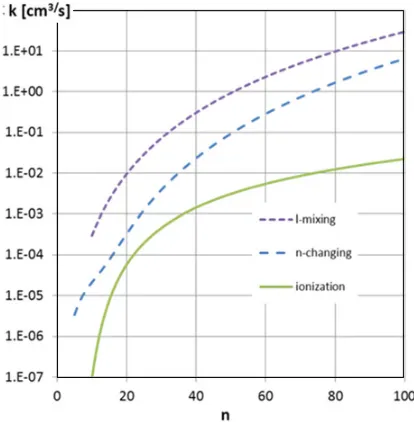
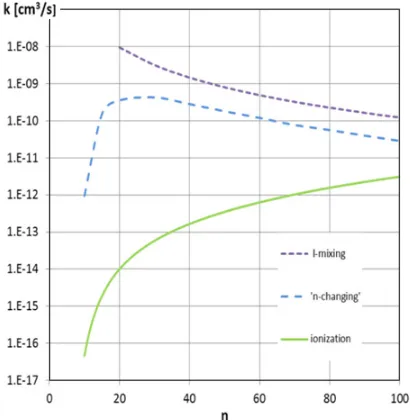
Rydberg atoms and molecules are subject to collisional interactions with both charged and neutral particles. The following two figures compare the relative rate coefficients for Rydberg collisions with electrons and helium atoms at a temperature of 300 K. Some simplifications have been made in scaling data but the magnitudes should be realistic.
coefficients are for changes ofn=1. Changes byn >1 are less frequent but not negligible at highn. Also, the small differences betweenn= +1 andn= −1 changes have been ignored. The ionization coefficients refer to single collisions with Rydberg atoms of principal quantum numbern.
The data were compiled from the following sources: Ionization and n-changing by electrons: Vriens and Smeets [10] and by Pohl et al. [11].l-mixing by electrons: Dutta et al. [12]. Ionization by helium atoms: Lebedev [13].n-changing by helium: Flannery [14].l-mixing by helium: Hickman [15].
Two observations stand out: a) l-mixing tends to be faster than both n-changing and ionization for both electron and helium collisions. b) Electron collisions are more efficient by many orders of magnitude. This has implications for models of third-body effects on recombination. For instance,l -mixing of high Rydberg states with n >40 by helium cannot be a rate limiting process unless the ionization degree is below∼10−9, which is hardly ever the case in experiments.
The collisions of heavy particles are thought to proceed by short-range interactions with the Rydberg electron. Collisions with the ionic core are likely to be less important but may not be negligible. Such interactions have been suggested by Gallagher and Cooke [16].
4. Possible mechanisms of third-body assisted recombination of H
+3The collision processes in the preceding section are nearly the same for atomic and for molecular ions. However, Rydberg molecules have several sets of vibrational and rotational core-excited states and some of those may be capable of dissociating into products that cannot be re-ionized. If they do so sufficiently rapidly, or are “stabilized” by some other interaction, the recombination rate would be enhanced. A rigorous theory requires knowledge of a huge number of parameters of which nearly all are poorly known. In the construction of approximate models one is faced with the problem of identifying the dominant process that limits the recombination rate. The limit could be the rate at which Rydberg molecules are formed, the rate at which they predissociate, or the rate at which the molecules are converted to predissociating states, for instance by l-mixing. The following sections examine the approximate models that have been proposed.
4.1 Collisional radiative and collisional dissociative recombination
Collisions of two free electrons in the Coulomb field of an atomic or molecular ion can leave one electron in a bound state. If the electron is bound by much less than kT, the capture ratecapis very large, but the collisional ionization coefficientkionis also very large. In the following, it is always assumed that the electron temperature is equal to the gas temperatureT. The population of high Rydberg states is then nearly in Saha equilibrium with the free electrons. Detailed balancing implies a capture rate of
cap(n)=n23thenkionne [cm3/s] (2) whereis the electron thermal de Broglie length
3
th=h2/(2mekT)3/2 (3)
and n= 13.6
n2kT · (4)
The ionization coefficient is closely given by [10]:
kion=
9.56×10⁻⁶(kT)−1.5exp(−n) 2.33
n +4.381.72n +1.32n
[cm3/s]. (5)
Figure 1. Rate coefficients forl-mixing,n-changing, and ionization by electron collisions with Rydberg atoms at 300 K, as function of principal quantum numbern.
(E-CRR), a well understood process for atomic ions. At high electron densities and low temperature the rate coefficient is given by
E−CRR=2.7×10⁻²⁰(T /300)−4.5ne [cm3/s] (6) [=2.7×10⁻¹⁰cm3/s atT =300 K andn
e=1010cm−3]. This is much too slow to affect measurements at 300 K, but may be important at very low temperatures. When the ion core is molecular rather than atomic the recombination, in principle, can be greatly enhanced by dissociation of the Rydberg states into particles that cannot be re-ionized. That is known as the [Electronassisted] Collisional Dissociative Recombination (E-CDR) mechanism of Collins [17]. If a large fraction of the high Rydbergs predissociates rather than being reionized, then the net recombination rate could approach the capture rate, which can be very large and compete with binary dissociative recombination. AtT =300 K andne=1010cm−3, the sum of the capture rate coefficient into states from n=40 to n=80 would be∼1×10⁻⁶cm3/s, about 5×10³ larger than E-CRR. In order to be competitive with reionization,
predissociation would have to have a rate of greater than 107/sec atn=40, as estimated from the
ionization coefficients in Fig.1.
It is not obvious and probably not true that dissociation is rapid for such a large range of principal quantum numbers, and the vast majority of electrons will be captured into states with large angular electronic momenta of much higher statistical weights. These tend to dissociate slowly since they interact with ion core very weakly. Hence, E-CDR probably has little effect on recombination of H+3. However, at very low temperatures collisional radiative recombination (E-CRR) can be important.
Similar arguments lead to the conclusion that neutral assisted CDR (N-CDR) is not likely to be important. In this case, capture and re-ionization involves multiple collisions with small energy changes. The energy diffusion model yields the result that helium stabilized collisional radiative recombination (N-CRR) occurs with a rate coefficient of
Figure 2. Rate coefficients forl-mixing,n-changing, and ionization by helium collisions with Rydberg atoms at 300 K, as function of principal quantum numbern.
This evaluates to 6.3×10⁻¹⁰cm3/s at T =300 K andn(H e)=3×1017cm−3. If one now assumes
that predissociation of a range of Rydberg states enhances this rate coefficient by a factor of 5×10³,
the resulting He-CDR coefficient could be quite large, 3.1×10⁻⁶cm3/s. Again, this estimate makes
the questionable assumption that all angular momentum states predissociate rapidly. If only p-states dissociate, the coefficient would be smaller by 3/n2, a number on the order of 10−3.
One might consider a combination of E-CDR and N-CDR in which Rydberg states are populated by E-CRR and stabilized byl-mixing by helium atoms. This has been tried [1] but the assumption of Saha equilibrium now seems questionable. There may be another variation of the collisional dissociative mechanism. It is possible that some of the H∗3Rydberg molecules, regardless of angular momentum, are stabilized by some unknown reactions with neutral atoms, helium for instance. It is difficult to assess the relevance of this without knowing the mechanism and rate coefficients.
4.2 Capture by ro-vibrational excitation followed byl-mixing
Resonant capture of electrons into autoinizing Rydberg states is a more promising mechanism that could enhance recombination (Gougousi et al. [7], Glosik et al. [3]). Here the capture of electrons of low angular momentum (mainlyp) occurs in binary collisions and reionization mainly by autoionization. If these autoionizing states predissociate immediately before autoinizing, one has the same as binary recombination. However, if these resonances are long-lived,l-mixing collisions may transform them into high-lstates that could predissociate or be stabilized by some other reactions.
Electron capture into rotationally excited Rydberg molecules is a likely “doorway” to long-lived “complexes”, but their nature and decay modes may be more complicated. In the paper of Glosik et al. it is assumed that they autoionize rapidly and contribute relatively little to the two-body recombination of H+3. If this were true, one would not expect to see peaks in the storage ring cross sections at energies corresponding to rotational resonances, unless the resonances in storage-rings are also perturbed in some way, for instance by residual electric fields. Actually, the storage-ring data show several pronounced peaks that have not been previously assigned. It is not clear whether these peaks make the dominant contribution to the rate coefficient at low energies or if they sit on top of a substantial smooth background.
4.3 Low-energy structure of the storage-ring H+3 recombination rates
The storage-ring data (Petrignani et al. [18]) show four, currently unassigned, peaks in the range around 5 to 20 meV. In their Fig. 5 they are labeled A, C, and E. The next unlabeled peak should be “G”. It is peculiar that the positions of peaks C (13 meV), E(16 meV), and G(19 meV) coincide with those where the lifetimes (see Glosik et al. [3] Fig. 8) of the rotational resonances for (1,1) to (2,1) excitation exhibit maxima. The energies correspond to resonant capture into Rydbergs withn=40 to 80. It looks like these resonances actually do lead to dissociative recombination, even in the absence of third-body interactions!
The largest and broad experimental peak in that energy range (at 6 meV, labeled “A”) does not have a counterpart in the lifetime graph. It is possible that it should be assigned to a different rotational state. There are some experimental indications (pointed out by A. Wolf at the meeting), that the “A” peak more likely also originates from capture by H+3 in (1, 1).
This correlation suggests that some states formed by rotational capture couple to vibrational states and ultimately lead to recombination. Their lifetimes could be much larger than the values calculated from the lifetime matrix by Glosik et al. If the dissociation rates of these intermediate “complexes” can be enhanced by stabilizing collisions with electrons or neutral particles (such as helium), this would open additional third-body stabilizing mechanisms. In the following, I will explore the consequences of a highly simplified “exploratory” model. Similar models are employed to explain three-body electron attachment.
5. Tentative model of third-body effects
The model makes the following assumptions: The complexes formed by rotational capture can autoionize, dissociate in the absence of third-body interactions, and the dissociation rate can be enhanced by third bodies.
The effective recombination coefficient
eff(H e)=cap kH en
(H e)+kene+νdiss,0 kH en(H e)+kene+νdiss,0+νa
(8) is given by the capture ratecap multiplied with the ratio of the decay rates by dissociation to those into all channels.kH e andke denote the net rate coefficients for complex stabilization (i.e. leading to predissociation rather than collisional ionization) by helium atoms or electrons, respectively. νdiss, 0
is the predissociation rate in the absence of third bodies and νa is the autoionization frequency. The coefficients are not known but it is easy to find values that approximately reproduce the experimental data. In reality, of course, one should consider many complexes and add their effects. This would require a large set of parameters, all essentially unknown.
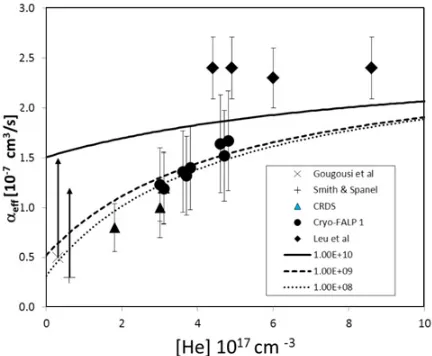
Figure3shows a fit of Eq. (8) atT =300 K for three different electron densities to data. The ratio
Figure 3. Comparison of the model to experimental data at T =300 K. Fitting parameters: cap=2.6× 10⁻⁷cm3/s,
kH e=2×10⁻⁹cm3/s, ke=1×10⁻¹cm3/s,νdiss, 0=1×10⁸ 1/s,νa =8×10⁸ 1/s. Data: Gougousi et al. [7], Smith and Spanel [6], CRDS and Cryo-FALP I from Glosík et al. [3], and Leu et al. [4].
In the limits of highneand n (He) the rate coefficient approaches the limiting capture coefficient. That agrees with the data of Leu et al. but not very well with the Prague data. A linear extrapolation of the Prague data ton(H e)=0 seems permissible in view of experimental uncertainties but the data can also fit the model curve.
The arrows attached to the data of Smith and Span˘el and by Gougousi et al. indicate the range of values that they observed at lowne(late afterglow) and at highne(early afterglow). The model covers a similar range. It should be kept in mind that the small experimental coefficients have large uncertainties. Are the numbers in this model reasonable? Stabilization by electrons seems to have a large coefficient on the order of then-changing coefficient atn=50 (see Fig. 1). The stabilization rate by helium is∼10 times faster than then-changing rate in Fig. 2. However, changes by more than one principal quantum number can be important at high nand may help. [14] It is also possible that n -changing by helium is not limited to short-range interactions with the Rydberg electron, but also occurs by helium collisions with the ion core.
6. Conclusions
This discussion was intended to draw attention to recombination in plasmas and the processes that may occur in addition to binary recombination. It is still too early to draw definite conclusions about three-body mechanisms in the H+3 recombination. The best one can do at this time is to suggest some dedicated studies. Among those, it would be helpful to carry out measurements at low buffer gas densities and at different electron densities to see if there really is a dependence on electron density. It would also be beneficial to use buffer gases other than helium.
Finally, additional theoretical work on the origin of the low-energy peaks seen in storage rings is of interest not only for our understanding of binary but also of ternary recombination of H+3.
References
[2] T. Oka, elsewhere in this volume
[3] J. Glosík, R. Plašil, I. Korolov, T. Kotrík, O. Novotny, P. Hlavenka, P. Dohnal, J. Varju, V. Kokoouline, C.H. Greene, Phys. Rev. A 79, 052707 (2009)
[4] M. T. Leu, M. A. Biondi, and R. Johnsen, Phys. Rev. A 8, 413 (1973)
[5] R. Johnsen, P. Rubovic, P. Dohnal, M. Hejduk, R. Plasil, and J. Glosik, J. Phys. Chem. A 117, 9477 (2013)
[6] D. Smith, and P. Spanel, Int. J. Mass Spectrom. 129,163 (1993)
[7] T. Gougousi, R. Johnsen, and M. F. Golde, Int. J. Mass Spectrom. 149/150, 131 (1995) [8] D.R. Inglis and E. Teller, Astrophys. Journal 90, 439 (1939)
[9] A.V. Mitrafanov, Soviet Astronomy-AJ 16 , 867 (1973) [10] L. Vriens and H.M. Smeets, Phys. Rev. A 22, 940 (1980)
[11] T. Pohl, D. Vrinceanu and H.R. Sadeghepour, Phys. Rev. Lett. 100, 223201 (2008)
[12] S. K. Dutta, D. Feldbaum, D., A. Walz Flannigan, J.R. Guest, and G. Raithel, Phys. Rev. Lett. 86, 3993 (2001)
[13] V.S. Lebedev, J. Phys. B: At. Mol. Opt. Phys. 24, 1977 (1991) [14] M.R. Flannery, Annals of Physics 61, 465 (1970)
[15] A.P. Hickman, Phys. Rev. A.18, 1339 (1987)
[16] T.F. Gallagher and W.E. Cooke, Phys. Rev. A 19, 2161 (1979) [17] C.B. Collins, Phys. Rev. A 140, 1850 (1965)