A Large Database of Hypernymy Relations Extracted from the Web
Julian Seitner1, Christian Bizer1, Kai Eckert2, Stefano Faralli1, Robert Meusel1, Heiko Paulheim1, Simone Ponzetto1
1Data and Web Science Group, University of Mannheim, Germany
[email protected],{chris,stefano,robert,heiko,simone}@informatik.uni-mannheim.de
2Stuttgart Media University
Abstract
Hypernymy relations (those where an hyponym term shares a “isa” relationship with his hypernym) play a key role for manyNatural Language Processing (NLP) tasks, e.g. ontology learning, automatically building or extending knowledge bases, or word sense disambiguation and induction. In fact, such relations may provide the basis for the construction of more complex structures such as taxonomies, or be used as effective background knowledge for many word understanding applications. We present a publicly available database containing more than 400 million hypernymy relations we extracted from the CommonCrawl web corpus. We describe the infrastructure we developed to iterate over the web corpus for extracting the hypernymy relations and store them effectively into a large database. This collection of relations represents a rich source of knowledge and may be useful for many researchers. We offer the tuple dataset for public download and an Application Programming Interface (API) to help other researchers programmatically query the database.
Keywords:Hearst patterns, hypernym extraction, big data, Web crawling, Application Programming Interface.
1.
Introduction
Hypernymy relations are important in many Artificial In-telligence (AI) and Natural Language Processing (NLP) ap-plications, and in general in data-intensive applications pro-cessing large amounts of unstructured and semi-structured information in order to interpret data and text that are not already semantically annotated, assigning types to entities (be it named entities in text, or entities in semi-structured data) represents a crucial step to understanding the data. For instance, in Paulheim and Fürnkranz (2012), it has been shown that adding precise types of instances (in that case taken from Semantic Web resources such as DBpedia and YAGO) to a data mining problem can lead to a significantly improved performance in many data mining tasks. Also when performing data integration, e.g., of a large collection of tabular datasets, into a large knowledge base, first un-derstanding whether the entities in a table are, e.g., cities, states, or mountains, is a very important step towards a high quality integration result (Ritze et al., 2015).
While there are quite a few named entity recognition and disambiguation tools that do serve that purpose and exploit knowledge bases such as Wikipedia, DBpedia, or Freebase, a common problem is dealing with the long tail of less popular entities that are not contained in such knowledge bases. Most of the existing wide-coverage knowledge bases have no problems in identifying, e.g., major cities (“New York is a city”) or celebrities (“Madonna is a singer”), but they show limitations with respect to small villages and less known people. However, the potential of web-scale intel-ligent, data-intensive applications can only be unlocked if they are capable of dealing with the most prominent enti-ties, as well as the long tail. Hence, the necessity of extend-ing existextend-ing knowledge bases with hypernymy relations that cover also the long tail entities.
In this paper we present a novel, open resource consisting of more than 400million tuples extracted from the
Com-monCrawl1, each also containing a rich set of attributes
such as: the set of patterns matching the pair, the set of the pay-level domains on which the patterns were matched, etc. We released both the dataset and an API (the two can
be downloaded athttp://webdatacommons.org/isadb/)
to let other researchers work at large scale in many NLP task (restricted not only on ontology learning).
The rest of this paper is structured as follows. In Section 3., the process of creating the database is described. Section 4. describes bot the released dataset and Java API to program-matically access to the tuples database; and in Section 5., we trace some conclusions about the released resource/API and we discuss about the impact on potential new applica-tions in the field of text understanding.
2.
Related work
In the past, many different methods have been developed for hypernym extraction, ranging from simple lexical pat-terns (Hearst, 1992; Oakes, 2005) to statistical and machine learning techniques (Dolan et al., 1993; Caraballo, 1999; Agirre et al., 2000; Ritter et al., 2009), to name a few. Snow et al. (2004) first search sentences that contain two terms which are known to be in a taxonomic relation (term pairs are taken from WordNet (Miller et al., 1990)), then parse the sentences, and automatically learn patterns from the parse trees. Finally, they train a hypernym classifier based on these features. Lexico-syntactic patterns are gen-erated for each sentence relating a term to its hypernym, and a dependency parser is used to represent them. For the ontology learning task, Velardi et al. (2013) induce taxonomies from scratch by extracting hypernyms from a domain corpus and the Web. Definitional sentences such as “lion is a dangerous animal” (where “animal” is the type of“lion”) are recognized by the Word Class Lattices classifier (Navigli and Velardi, 2010) trained on a large set of Wikipedia definitions.
Kozareva and Hovy (2010) induce a taxonomy using a par-ticular kind of Hearst-like (Hearst, 1992) lexico-syntactic patterns, i.e. so-called Doubly Anchored Patterns (DAP). The hypernymy relations extraction consist of two phases. First the authors bootstrap the terminology harvesting with DAP of the kind“animals such as lions and *”, so it is possible to discover new terms such as“cats”. Next, for each pair of terms in the discovered terminology e.g. (“li-ons”,“cats”) they automatically create a DAP−1 of the kind“* such as lions and cats”and discover new hyper-nyms e.g.“felines”. The above mentioned works focus on domain-specific hypernymy relations extractions and due to their need of domain constraints - a specific defined term in (Navigli and Velardi, 2010) or a seed pair (Kozareva and Hovy, 2010) - they may not be used to collect the whole set of hyponym-hypernym pairs from a large scale corpus such as the Web.
The Linked Hypernym Dataset (Kliegr, 2015) is similar to the work presented in this paper. The authors try to add missing types to DBpedia, which is a common task
in knowledge graph completion (Paulheim, 2016). The
dataset contains types for DBpedia entities that have been extracted from the corresponding Wikipedia articles using Hearst patterns. In contrast, the work presented in this pa-per uses the whole Web as a corpus, not only Wikipedia, and hence, it is not limited to find hypernymy relations to entities that are represented by a Wikipedia page, but be-tween arbitrary entities.
Microsoft’sProbase (Song et al., 2011) is the work clos-est to ours, albeit not freely accessible. The authors used Hearst-like lexico-syntactic patterns to extract hypernymy relations from1.68billion web pages in Microsoft Bing’s web corpus, instead of focusing on domain specific hyper-nymy relations. Probase’s main purpose was to create a universal taxonomy containing more than 2.7 million con-cepts. To this end, the methods underlying Probase are able to extract approximately 25 million pairs.
3.
Hypernymy relations extraction
In this section we describe the methodology we applied to extract hypernymy relations from the Web.
3.1.
Relation representation
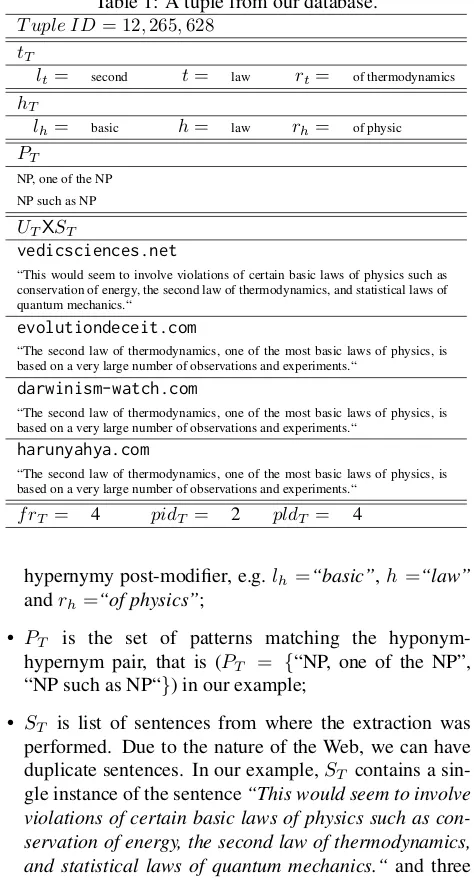
We designed and modeled an hypernymy relation as a tu-ple, where different attributes related to each extracted ”isa“ relation can be stored (e.g. statistics, provenance etc.). A tupleT(with reference to Table 1, where we show a real tu-ple from our dataset) which in wath follow is our data struc-ture which store an hypernymy relation, is defined as(tT = (lt, t, rt), hT = (lh, h, rh), PT, ST, UT, f rT, pidT, pldT) where:
• lt, t, rt are the elements of the hyponym component of the“isa”relation. Specifically,lt is the hyponym pre-modifier,tis the hyponym head noun andrtis the hy-ponym post-modifier, e.g.lt=“second”,t=“law”and rt=“of thermodynamics”;
[image:2.595.304.541.82.522.2]• lh, h, rhare the elements of the hypernym component of the“isa”relation. Specifically,lhis the hypernymy pre-modifier, his the hypernymy head noun andrh is the
Table 1: A tuple from our database. T uple ID= 12,265,628
tT
lt= second t= law rt= of thermodynamics
hT
lh= basic h= law rh= of physic
PT
NP, one of the NP NP such as NP
UTXST
vedicsciences.net
“This would seem to involve violations of certain basic laws of physics such as conservation of energy, the second law of thermodynamics, and statistical laws of quantum mechanics.“
evolutiondeceit.com
“The second law of thermodynamics, one of the most basic laws of physics, is based on a very large number of observations and experiments.“
darwinism-watch.com
“The second law of thermodynamics, one of the most basic laws of physics, is based on a very large number of observations and experiments.“
harunyahya.com
“The second law of thermodynamics, one of the most basic laws of physics, is based on a very large number of observations and experiments.“
f rT = 4 pidT = 2 pldT = 4
hypernymy post-modifier, e.g.lh =“basic”,h=“law” andrh=“of physics”;
• PT is the set of patterns matching the
hyponym-hypernym pair, that is (PT = {“NP, one of the NP”, “NP such as NP“}) in our example;
• ST is list of sentences from where the extraction was performed. Due to the nature of the Web, we can have duplicate sentences. In our example,ST contains a sin-gle instance of the sentence“This would seem to involve violations of certain basic laws of physics such as con-servation of energy, the second law of thermodynamics, and statistical laws of quantum mechanics.“ and three instances of“The second law of thermodynamics, one of the most basic laws of physics, is based on a very large number of observations and experiments.“;
• UT is the set of pay-level domains from where the pair comes, that is, the patterns’ provenance (in our example UT = {vedicsciences.net, evolutiondeceit.com,
darwinism-watch.com,harunyahya.com});
• f rT is the absolute number of hyponym-hypernym pair occurrences (in our examplef rT = 4);
• pidT:is equal to|PT|(in our examplepidT = 2);
• pldT:is equal to|UT|(in our examplepldT = 4)2.
3.2.
Extraction workflow
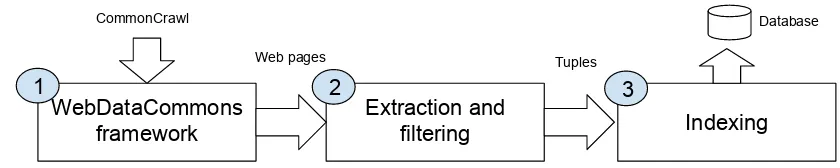
We depict our approach in Figure 1, which consists of three main modules, and corresponding tasks:
1. WebDataCommons framework: a framework to access the CommonCrawl dataset;
2Note that a pair may occur multiple times within the same
WebDataCommons
framework
Extraction and
filtering
Indexing
CommonCrawl
Web pages Tuples
Database
[image:3.595.86.506.69.153.2]1
2
3
Figure 1: Overview of our method for the tuples extraction.
2. Extraction and filtering: is the component of the frame-work which given a Web page, searches for pattern matches (see Section 3.4.) and generate tuples;
3. Indexing: to easily access the large set of extracted tu-ples, we populated a MongoDB database also released together with a Java Application Programming Interface (see Sections 4.1. and 4.2.).
3.3.
WebDataCommons Framework
In order to efficiently parse all websites, we used the
framework of the WebDataCommons project3, which was
already used to extract one of the largest hyperlink graphs (Meusel et al., 2015) from the crawl corpora
pro-vided by the CommonCrawl Foundation4 (see Figure 1
block 1), as well as corpora of harvested structured data annotations (Meusel et al., 2014) and HTML tables with relational content (Lehmberg et al., 2015).
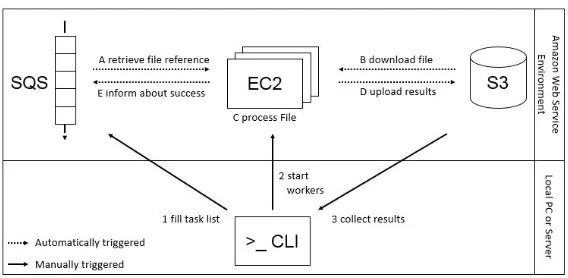
The framework is written in Java and tailored towards the Amazon Web Service (AWS) environment. The frame-works allows an efficient parsing of large document col-lections, like crawl corpora. This workflow is described in Figure 2. In general (1) a queue (SQS) is filled with the references to all documents which needs to be processed. Then (2) a number of servers is requested and is started automatically, which perform all the same process on all available cores:
(A) ask the queue for the next file;
(B) download the file to the server;
(C) process the file using a custom parsing method;
(D) the output is written back to the storage (in the default case S3);
(E) the queue is notified that the file is parsed and can be removed from the queue.
After the queue is empty, (3) the results can be collected from S3. In this process only three actions need to be trig-gered manually via a command line interface, the remain-ing actions, includremain-ing the communication between the dif-ferent components, is done automatically.
The framework is designed to process a large amount of documents in parallel, but does not allow a communication between the servers, which means that in our case the sort-ing, aggregation, and cleaning of the extracted tuples needs
3http://webdatacommons.org/framework/ 4http://commoncrawl.org
to be done in a post-processing step, and cannot be done directly within the framework. The original corpus con-tains over2.1billion crawled web pages, consisting of over 38,000 WARC5 files with a total packed size of 168TB. The corpus is provided by the Common Crawl Foundation on AWS S3 as free download.6The extraction of the tuples
took around2,200computing hours and was realized using 100servers in parallel in less than 24 hours. The next sec-tion describes with details the tuple extracsec-tion approach, the implementation of which is also avaliable as source code at
http://webdatacommons.org/isadb/) and can be used to repeat the tuple extraction for different or newer Com-mon Crawl releases.
3.4.
Tuple Extraction approach
The tuple extraction is a complex phase where preliminary methodology design decisions have a great impact on the resulting output. We divided this section into three main subsections, each describing few important aspects of the methodology.
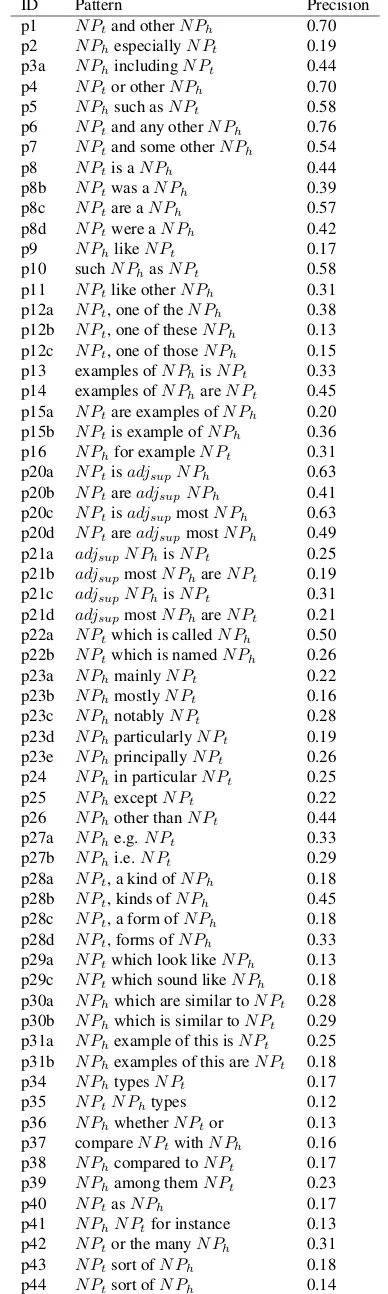
Lexico-syntactic patterns. To extract tuples (see Figure 1, block 2) a number of Hearst-like (Hearst, 1992) lexico-syntactic patterns are used. Frequent lexico-lexico-syntactic pat-terns are easily recognizable and indisputably indicate the lexical relation of interest. In particular we focused on59 patterns that we collected from the past literature. In Table 2 we show the full list of patterns we used for the extrac-tion phase. Eight patterns come from Ponzetto and Strube (2011), where isa patterns were used to induce a
taxon-omy from Wikipedia. Other isa-patterns were collected
from Orna-Montesinos (2011), where patterns for the term “building” were extracted on a set of specialized textbooks in the field of construction engineering. Remaining pat-terns were finally collected from Klaussner and Zhekova (2011) where the authors extractisarelations from selected Wikipedia pages.
The patterns identified in literature are then translated into regular expressions. For example, (with respect to Table 2) the patternp5(i.e. “N Phsuch asN Pt” whereN Pt indi-cates the hyponym andN Phthe hypernym) was translated into the following regular expression:
(\p{L}|\d)[\"\']?\,?\ssuch\sas\s[\'\"]?(\p{L}|\d)
As the corpus is read line by line, the length of line has an impact on the performance of a regular expression. Lines
5Web ARChive, ISO 28500:2009
Figure 2: Overview of our workflow of the Web Data Commons Extraction framework.
longer than 100,000 characters are rather frequent in the corpus and therefore the lines have to be split before a regex can be matched. To cope with the line length issue we adopted a sentence splitter strategy; in other words we splitted a line into sentences to analyze each single sentence with regular expressions. For this purpose we defined other regular expressions to split a line of text into sentences. In order to test the quality of the above defined regular ex-pressions we extracted a random 1% portion of the entire corpus and analyzed 100 matches per pattern. With that evaluation, we estimated the precision of each pattern, as shown in Table 2. Patterns with a very low precision have then been excluded before performing the subsequent steps.
Noun phrase identification: In order to identify noun phrases we used the Stanford POS Tagger (Toutanova et al., 2003) to obtain the mapping of words to lexical categories. The noun phrase identification basically entails a selection of allowed part of speech (POS) tags for the pre/post mod-ifiers and for the head noun.
We defined as head noun allowed tags: singular noun or mass (NN), plural noun (NNS), singular proper noun (NNP), plural proper noun (NNPS). For the premodifier, we added the following tags we selected for the previous set: adjective (JJ), comparative adjective (JJR), superlative adjective (JJS) and past participle verb (VBN).
The allowed tags for the postmodfier include: adjective (JJ), comparative adjective (JJR), superlative adjective (JJS), past participle verb (VBN), gerund or present participle verb (VBG), singular or mass noun (NN), plural noun (NNS), singular proper noun (NNP), plural proper noun (NNPS), preposition or subordinating conjunction (IN), cardinal number (CD) and determiner (DT).
Filtering: Since none of the patterns are perfect (neither is content on the Web), some post-processing and filtering is required to reduce the amount of noise in the database. We try to facilitate a sensible trade-off between coverage and precision. In general, we try to remove only the ob-vious noise, while keeping as much coverage as possible. This strategy comes from the idea that some task may need “less precise” but “more covering” data. In use cases where more precision is required, we provide metadata for each tuple that allows for additional filtering techniques on the client side. Our filtering strategy may be summarized as follows:
• Removal of duplicates: due to the implementation of the crawler used by the CommonCrawl foundation and the nature of content on the Web, the same web page may be replicated in the corpus. To reduce the impact of spam and to decrease the size of the ex-tracted tuples, tuples that occur more than once under the same pay level domain are removed. We also made a duplication removal at sentence level (based on exact match).
• Tuple normalization: At this stage we apply a post-processing tuple normalization: i) we transform all the capital letters to lower case and removed all leading and trailing punctuations. ii) we remove all quota-tion marks and apostrophes, since apostrophes are fre-quently used as replacement for quotation marks;7iii) we analyze different kinds of punctuation occurrences. This step does not only target the optional commas or the commas of co-ordinations, but also full stops, ex-clamation marks, question marks, colons, and semi-colons. These usually occur at the end of a word and are followed by a space. If this is the case these punc-tuations are removed. However, sentences on the web are not always written with the proper syntax and the space behind a punctuation is simply left out. This has an adverse effect on the POS tagger and consequently the noun phrase extraction. After the removal of inter-punctuated symbols we performed a length check. If one entity of a tuple is longer than 50 characters, it is regarded as noise and the tuple is removed from the processing pipeline. This length is the result of empir-ical tests (a check of 100 tuples with an entity longer than 50 characters, showed that only 8 percent of these were correct); iv) we lemmatized each word of a noun phrase. With the lemmatized entities a further refac-toring step is taken, which targets noun phrases that contain multiple nouns. To be more specific, this re-gards noun phrases, which are located in front of the pattern and contain nouns separated by a preposition (complex NPS). The issue regarding these entities is, that it is not trivial to determine, which of these nouns is in a hyponymy relation with the entity behind the pattern. For example given a pattern “* such as *”:
7
Table 2: The list of patterns used for the tuples extraction (N Ptindicates the hyponym andN Phthe hypernym).
ID Pattern Precision
p1 N Ptand otherN Ph 0.70
p2 N PhespeciallyN Pt 0.19
p3a N PhincludingN Pt 0.44
p4 N Ptor otherN Ph 0.70
p5 N Phsuch asN Pt 0.58
p6 N Ptand any otherN Ph 0.76
p7 N Ptand some otherN Ph 0.54
p8 N Ptis aN Ph 0.44
p8b N Ptwas aN Ph 0.39
p8c N Ptare aN Ph 0.57
p8d N Ptwere aN Ph 0.42
p9 N PhlikeN Pt 0.17
p10 suchN PhasN Pt 0.58
p11 N Ptlike otherN Ph 0.31
p12a N Pt, one of theN Ph 0.38 p12b N Pt, one of theseN Ph 0.13
p12c N Pt, one of thoseN Ph 0.15
p13 examples ofN PhisN Pt 0.33
p14 examples ofN PhareN Pt 0.45
p15a N Ptare examples ofN Ph 0.20
p15b N Ptis example ofN Ph 0.36
p16 N Phfor exampleN Pt 0.31
p20a N PtisadjsupN Ph 0.63
p20b N PtareadjsupN Ph 0.41
p20c N PtisadjsupmostN Ph 0.63
p20d N PtareadjsupmostN Ph 0.49
p21a adjsupN PhisN Pt 0.25
p21b adjsupmostN PhareN Pt 0.19
p21c adjsupN PhisN Pt 0.31
p21d adjsupmostN PhareN Pt 0.21
p22a N Ptwhich is calledN Ph 0.50
p22b N Ptwhich is namedN Ph 0.26
p23a N PhmainlyN Pt 0.22
p23b N PhmostlyN Pt 0.16
p23c N PhnotablyN Pt 0.28
p23d N PhparticularlyN Pt 0.19
p23e N PhprincipallyN Pt 0.26
p24 N Phin particularN Pt 0.25
p25 N PhexceptN Pt 0.22
p26 N Phother thanN Pt 0.44
p27a N Phe.g.N Pt 0.33
p27b N Phi.e.N Pt 0.29
p28a N Pt, a kind ofN Ph 0.18 p28b N Pt, kinds ofN Ph 0.45 p28c N Pt, a form ofN Ph 0.18
p28d N Pt, forms ofN Ph 0.33
p29a N Ptwhich look likeN Ph 0.13
p29c N Ptwhich sound likeN Ph 0.18
p30a N Phwhich are similar toN Pt 0.28 p30b N Phwhich is similar toN Pt 0.29 p31a N Phexample of this isN Pt 0.25 p31b N Phexamples of this areN Pt 0.18
p34 N PhtypesN Pt 0.17
p35 N PtN Phtypes 0.12
p36 N PhwhetherN Ptor 0.13
p37 compareN PtwithN Ph 0.16
p38 N Phcompared toN Pt 0.17
p39 N Phamong themN Pt 0.23
p40 N PtasN Ph 0.17
p41 N PhN Ptfor instance 0.13
p42 N Ptor the manyN Ph 0.31
p43 N Ptsort ofN Ph 0.18
p44 N Ptsort ofN Ph 0.14
Table 3: Statistics of the released dataset.
number of used patterns 58
|{T}| 401,150,041
|{tT}| 120,992,255
|{hT}| 107,691,822
|{tT} ∩ {hT}| 16,528,348
Avg. patterns matches per tuple 1.1
Avg. pay level domain matches 1.3
Avg.(tT, hT)count 1.5
Max. patterns per(tT, hT) 52
1) “Works of artists such as Vivaldi”, where the last noun is in hyponymy relation with the entity be-hind the pattern. Consequently it would be wrong to take the first noun as head noun;
2) “Works of artists such as The Four Seasons”, where this example depicts the opposite, as it is the first noun that is correct. In this case the noun in the post-modifier is - as intended - a special-ization of the first noun;
3) “A variety of works such as The Four Seasons”, where it appears to be similar to the first one; However, the leading noun is a so called collec-tive noun, as it refers to a group of entities.
To find resolution for the latter problem, we inspected a random sample of 100 tuples with multiple nouns. Out of those, there were21 starting with a collective noun. In all of these21instances the latter noun was the correct one. Therefore, the decision was made to remove collective nouns and the subsequent preposi-tion from the tuple.
• Tuple aggregation: The tuple aggregation is the last step in the pipeline, before the tuples database cre-ation. Two tuplesxandyare aggregated iftxequal to tyand ifhxequal tohy, in other words, if the two tu-ples share the same hyponym and the hypernym head nouns. In this phase we not only reduce the data vol-ume significantly, but also generate three useful statis-tics: i) the count of the occurrences f rT of a tuple T; ii) the amount of distinct patternspidT, which ex-tracted a tupleT; iii) the number pldT of pay-level domains from where the pair was extracted.
3.5.
Statistics
In Table 3 we show some statistics about the resulting dataset. Thanks to our approach, we are able to extract 401,150,041 isarelations, and identify120,992,255and
107,691,822 unique hyponyms and hypernyms,
respec-tively. Table 4 shows the10most frequent matching pat-terns. As expected with 242,370,719 matches the list is dominated by the “N Ptis aN Ph” pattern.
Since there are more than 120M hyponyms, i.e., concepts which we can assign at least one type, the number of entities is by one to two orders of magnitude larger than that of other freely available knowledge graphs, such as DBpedia, YAGO, or Wikidata.8
8
[image:5.595.73.267.122.769.2]Table 4: Top10frequent patterns.
count pattern
242,370,719 N Ptis aN Ph
80,640,885 N PhincludingN Pt
70,337,543 N Phsuch asN Pt
45,900,092 N Ptand otherN Ph
20,872,227 N PhespeciallyN Pt
13,392,348 N Ptor otherN Ph
[image:6.595.68.273.258.411.2] [image:6.595.108.235.600.792.2]11,656,254 N Ph(mainly|mostly|notably|particularly|usually |principally|especially)N Pt
11,080,276 N PhtypesN Pt
10,360,953 adjsupN PhbeN Pt
9,648,662 N Ph(like|except)N Pt
Table 5: Excerpt from the top1,000frequent(tT, hT).
tT hT
worldcat linked data resources
telephone number basic information
chainmail form of spam
video content
phone number datum
united states country
estimate datum special algorithm
gsview pdf viewer
english language
socialcam video app for iphone
copper conductive material
social security number personal information
In Table 5 we show some examples for interesting hyper-nymy relations from the top occurring on the entire web. Please note how the meaning of “most interesting” may vary across uses, for example some study may be more in-terested on analyzing domain specific hypernymy relations which are assumed to be in the “long tail” and not between the most frequent.
We also report in Table 6 the15pay level domains contain-ing the highest number of extracted hypernymy relations. We noticed that this list contains: i) the most important blog sites (i.e.blogspot.com,wordpress.com, etc.); ii) Google
Table 6: Top15frequent URLs.
count urls
32,114,019 blogspot.com 31,230,507 google.com 11,220,307 wordpress.com
4,542,604 google.es 3,334,085 docstoc.com 3,153,578 google.fr 3,015,504 wikipedia.org 2,975,284 google.com.au 2,752,864 google.ca 2,574,356 faqs.org 2,490,576 slideshare.net 2,488,768 archive.org 2,425,906 issuu.com 2,230,084 google.co.uk 2,184,607 typepad.com
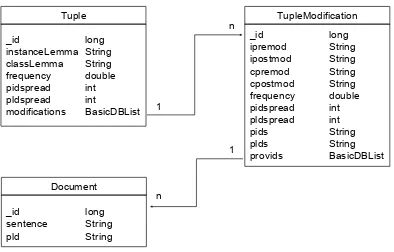
_id long instanceLemma String classLemma String frequency double pidspread int pldspread int modifications BasicDBList
Tuple
_id long ipremod String ipostmod String cpremod String cpostmod String frequency double pidspread int pldspread int pids String plds String provids BasicDBList
TupleModification
_id long sentence String pld String Document
1
n
n
1
Figure 3: The Tuples database schema.
sites in different languages; iii) reference Web content (e.g.,
wikipedia.org).
4.
Resources
We offer the tuple dataset for public download and an Application Programming Interface (API) to help other researchers programmatically query the tuple dataset.
The dataset and the API are available at http://
webdatacommons.org/isadb/. At the same URL it is pos-sible to download:
• the tuple dataset in the form of a MongoDB-based database;
• the tuple dataset in the form of tables, as compressed tab separated values (TSV) files;
• the Java API package, to programmatically access the tuple from the MongoDB dataset;
• the Java implementation of the tuple extraction ap-proach (see Section 3.4.).
A quick guide on how to install the downloaded software and how to use the Java API is also available.
4.1.
Tuple MongoDB
To store and access all the extracted tuples we created a database (see Figure 1, block 3). During prototyping we experimented with many database management sys-tems (DBMS) and found MongoDB (Plugge et al., 2010) (a NoSQL DBMS) as the most suitable technology to store our large set of tuples. NoSQL technologies are designed to scale with “big data” and such databases support dynamic schema design, offering the potential for increased flexibil-ity, scalability and customization.
• Pattern: the set containing the patterns which matched the “isa” relation;
• Pay-level domain: the Urls of the Web documents from where the relation was extracted;
• Documents: entities of the kind (pay-level domain, sen-tence) from which the relation was extracted.
4.2.
Java API to access the MongoDB
We next describe the Java Application Programming In-terface to programmatically query the database. The class ”TuplesDb“ is the main class from where access the tuples database and can be instantiated as follows:
...
TuplesDb tDb= TuplesDb . getInstance (); ...
To query the database and to iterate through all the tu-ples, the class ”TuplesDb“ has a public method ”getAllTu-ples()“ to retrieve an instance of the ”AllTuplesResultIter-ator“ class, which implements the standard Java ”Iter”AllTuplesResultIter-ator“ interface:
AllTuplesResultIterator qri=tdb. getAllTuples ();
while (qri. hasNext ()) {
for ( Tuple t:qri.next ()) System .out. println (t); }
The class ”TuplesDb“ has also public methods to express many kinds of queries. All of them return specialized a class instance which implements the standard Java iterator interface. For example, if we want to print all the hyper-nyms hT of the tupleT where the instance lemma tT is equal to ”gaga“:
TupleQueryResultIterator tqri=
tdb. getAllTuplesWhereInstanceLemma ("gaga");
while (tqri. hasNext ()){
for ( Tuple T:tqri.next ())
System .out. println (T. getClassLemma ()); }
Other queries can be more sophisticated and include:
• thresholds for the minimum and maximum values of the tuple frequencyf rT, number of matching patterns pidTand number of pay-level domainpldT attributes;
• a specific set of pattern idsP IDs, each resulting tuple T has to include inPT;
• a specific set of pay-level domain ids, each resulting tupleThas to include inUT;
5.
Conclusion
We presented an overview of a database of isa relations automatically extracted from the CommonCrawl, the largest existing repository of Web content. This is, to the best of our knowledge, the largest publicly available resource of hypernymy relations from textual resources. We described the resource with some statistics and the database schema designed for storing the data, as well
as the Java API we developed to let programmatically query the tuples database. Our database represents a first step towards a more complex semantic resource such as full-fledged taxonomies. In fact, we already used it as part of a SemEval competition on taxonomy induction (Bordea et al., 2015), where we achieved a competitive performance by leveraging ourisarelations harvested from the Web (Panchenko et al., 2016).
The WebIsaDatabase and the Java API can be downloaded athttp://webdatacommons.org/isadb/.
Acknowledgements
This work was partially funded by the Deutsche Forschungsgemeinschaft within the JOIN-T project (search grant PO 1900/1-1). Part of the computational re-sources used for this work were provide by an Amazon AWS in Education Grant award.
References
Agirre, E., Ansa, O., Hovy, E. H., and Martínez, D. (2000). Enriching very large ontologies using the WWW. In Proceedings of the ECAI Workshop on Ontology Learn-ing.
Bordea, G., Buitelaar, P., Faralli, S., and Navigli, R. (2015). Semeval-2015 task 17: Taxonomy extraction evaluation. InProceedings of the 9th International Workshop on Se-mantic Evaluation.
Caraballo, S. A. (1999). Automatic construction of a hypernym-labeled noun hierarchy from text. In Proceed-ings of ACL-99, pages 120–126.
Dolan, W., Vanderwende, L., and Richardson, S. D. (1993). Automatically deriving structured knowledge bases from on-line dictionaries. In Proceedings of PACLING-93, pages 5–14.
Hearst, M. A. (1992). Automatic acquisition of hyponyms from large text corpora. InProceedings of COLING ’92, pages 539–545.
Klaussner, C. and Zhekova, D. (2011). Pattern-based on-tology construction from selected wikipedia pages. In Proceedings of the RANLP-11 Student Research Work-shop.
Kliegr, T. (2015). Linked hypernyms: Enriching DBpe-dia with Targeted Hypernym Discovery.Web Semantics: Science, Services and Agents on the World Wide Web, 31(1):59 – 69.
Kozareva, Z. and Hovy, E. (2010). A semi-supervised method to learn and construct taxonomies using the web. InProceedings of EMNLP-10, pages 1110–1118. Lehmberg, O., Ritze, D., Ristoski, P., Meusel, R.,
Paul-heim, H., and Bizer, C. (2015). The Mannheim Search
Join Engine. Web Semantics: Science, Services and
Agents on the World Wide Web, 35(3):159 – 166. Meusel, R., Petrovski, P., and Bizer, C. (2014). The
Meusel, R., Vigna, S., Lehmberg, O., and Bizer, C. (2015). The Graph Structure in the Web - Analyzed on Differ-ent Aggregation Levels. The Journal of Web Science, 1(1):33–47.
Miller, G. A., Beckwith, R., Fellbaum, C. D., Gross, D., and Miller, K. (1990). WordNet: an online lexical database. International Journal of Lexicography, 3(4):235–244. Navigli, R. and Velardi, P. (2010). Learning word-class
lattices for definition and hypernym extraction. In Pro-ceedings of ACL-10, pages 1318–1327.
Oakes, M. P. (2005). Using Hearst’s rules for the auto-matic acquisition of hyponyms for mining a pharmaceu-tical corpus. InProceedings of the RANLP Text Mining Workshop, pages 63–67.
Orna-Montesinos, C. (2011). Words and patterns: lexico-grammatical patterns and semantic relations in domain-specific discourses. Revista Alicantina de Estudios In-gleses, 24:213–233.
Panchenko, A., Faralli, S., Ruppert, E., Remus, S., Naets, H., Fairon, C., Ponzetto, S. P., and Biemann, C. (2016). Taxi: a taxonomy induction method based on lexico-syntactic patterns, substrings and focused crawling. In Proceedings of the 10th International Workshop on Se-mantic Evaluation.
Paulheim, H. and Fürnkranz, J. (2012). Unsupervised Gen-eration of Data Mining Features from Linked Open Data. InProceedings of WIMS’12.
Paulheim, H. (2016). Knowlegde Graph Refinement: A
Survey of Approaches and Evaluation Methods.
Seman-tic Web Journal. To appear.
Plugge, E., Hawkins, T., and Membrey, P. (2010). The
Definitive Guide to MongoDB: The NoSQL Database for Cloud and Desktop Computing. Apress, Berkely, Cal.„ 1st edition.
Ponzetto, S. P. and Strube, M. (2011). Taxonomy induc-tion based on a collaboratively built knowledge reposi-tory.Artificial Intelligence, 175(9-10):1737–1756. Ritter, A., Soderland, S., and Etzioni, O. (2009). What is
this, anyway: Automatic hypernym discovery. In
Pro-ceedings of the 2009 AAAI Spring Symposium on Learn-ing by ReadLearn-ing and LearnLearn-ing to Read, pages 88–93. Ritze, D., Lehmberg, O., and Bizer, C. (2015). Matching
HTML tables to DBpedia. InProceedings of WIMS-15.
Snow, R., Jurafsky, D., and Ng, A. Y. (2004). Learning syntactic patterns for automatic hypernym discovery. In Proceedings of NIPS-04, pages 1297–1304.
Song, Y., Wang, H., Wang, Z., Li, H., and Chen, W. (2011). Short text conceptualization using a probabilis-tic knowledgebase. In Proceedings of IJCAI-11, pages 2330–2336. AAAI Press.
Toutanova, K., Klein, D., Manning, C. D., and Singer, Y. (2003). Feature-rich part-of-speech tagging with a
cyclic dependency network. InProceedings of
NAACL-03, pages 173–180.