ISSN Online: 2328-4870 ISSN Print: 2328-4862
DOI: 10.4236/jhrss.2019.73028 Sep. 18, 2019 416 Journal of Human Resource and Sustainability Studies
Team Decision-Making and
People-Organization Matching—Based on the
Adjustment of Implicit Coordination and Task
Interdependence
Yuhua Sheng, Fan Xu
*Business School, Nanjing Normal University, Nanjing, China
Abstract
Talents are the core competitiveness of enterprises. In high-tech enterprises with team work as the mainstay, the recruitment and selection of team mem-bers has always been a concern of enterprises. As the first module of human resource management, recruitment is an important task of human resource management and development. Whether a company can recruit the people it needs is the key to the success or failure of the company. This paper analyzes 300 valid samples using stepwise regression analysis, and analyzes team work characteristics to study team self-determination within the team. The re-cruitment effect is measured in this paper using human-organization match-ing. The research results show that team independent decision-making posi-tively affects human-organization matching. Task interdependence and im-plicit coordination have a significant positive adjustment effect on the rela-tionship between the two. The research provides a new way for enterprise personnel recruitment.
Keywords
People-Organization Matching, Team Decision, Task Interdependence, Recruitment Decision
1. Introduction
With the changes in the market environment, the demand for new technologies and social individualization is increasing since the high-tech enterprises have emerged. The working methods of high-tech enterprises are the way of team work, and the selection of staff in the team is always a big problem for high-tech How to cite this paper: Sheng, Y.H. and
Xu, F. (2019) Team Decision-Making and People-Organization Matching—Based on the Adjustment of Implicit Coordination and Task Interdependence. Journal of Hu-man Resource and Sustainability Studies, 7, 416-437.
https://doi.org/10.4236/jhrss.2019.73028
Received: August 26, 2019 Accepted: September 15, 2019 Published: September 18, 2019
Copyright © 2019 by author(s) and Scientific Research Publishing Inc. This work is licensed under the Creative Commons Attribution International License (CC BY 4.0).
DOI: 10.4236/jhrss.2019.73028 417 Journal of Human Resource and Sustainability Studies enterprises. Today’s talent market has a typical “Matthew effect”, but the service industry and other talents are crowded, while the technical personnel in high-tech enterprises are seriously lacking, and the supply of talent market is far from meeting the talent demand of emerging technology companies. High-paying technology companies need professional, thoughtful, forward-looking people and high-tech talents to determine the future of the company, and such people are often not found in the general talent market. Based on this, this paper pro-poses the new ideas and recruitment angles of high-tech enterprises by studying the working methods and recruitment strategies of Bell Labs and proposing the relationship between team decision-making and people-organization matching.
DOI: 10.4236/jhrss.2019.73028 418 Journal of Human Resource and Sustainability Studies the company.
As an important part of human resource management, the recruitment of employees shows mainly two perspectives such as job analysis and individual ability test. Job analysis can provide job requirements and individual ability to examine candidates. The degree of individual ability test, that is, the requirement of “requirement-capability” complementation is an important criterion for per-sonnel selection decision-making. The recruitment principle based on the match-ing of people and work focuses on the integration of individual and work. The enterprise value is the knowledge of employees, skills, abilities and job suitabili-ty. However, in the actual recruitment of enterprises, there is still much room to improve something in the matching of people and work. As the jargon of the re-cruitment industry said, “the enterprise recruits skills and dismisses them”. Businesses usually hire someone because of someone’s skills, but they don’t take into account the quality of the recruited person or the ability of the team to work. This creates hidden dangers for future work, because it is not suitable for the company’s strategy, culture and value and ended up with dismissal. This kind of limited recruitment method is more obvious in industries with rapid changes in technology and market environment, such as high-tech enterprises. Therefore, it is necessary to propose new recruitment methods for high-tech en-terprises such as rapidly changing enen-terprises. According to the recruitment method proposed by people-organization matching, enterprises should also pay attention to the matching between the inherent characteristics of individuals and the organizational culture of enterprises. In today’s high-tech enterprises, the R&D team is the main way of working. For recruiters, selecting talents is not only to match people and positions, but also to match people and teamwork in small groups. The recruitment strategy has undergone a fundamental change. From the previous unified recruitment to the team’s own decision-making re-cruitment, the company decentralizes the power to the specific team work. The team members find the most needed talents in the team that can speed up the team. The efficiency of the work and the motivation to motivate the team’s work are a good way to do it. At present, the research on team work is more focused on team work efficiency and team creation. It also mentions the advantages and disadvantages of team decision-making power in team work, and decentralizes the power of human resource management to the team. As far as the current team work style is concerned, the decision of the new team members through team decision-making can alleviate the exclusionary pressure that new members will face and improve team work efficiency.
devel-DOI: 10.4236/jhrss.2019.73028 419 Journal of Human Resource and Sustainability Studies opment situation of each region, because of the characteristics of the team work content are differences between the teams are also essential. In this paper, there is no specific research on the differences between different work content teams. More influencing factors should be considered in future studies to achieve more accurate results.
2. Literature Review and Theory
2.1. The Autonomy of Personnel Decision-Making in Team Work
Research on team decision-making has been studied from small groups of tradi-tional social psychology, as well as group studies in organizations. Social psy-chologists study team decisions through teamwork in the lab; With the organi-zational structure built around the team work style in the organization, the focus of psychologists is gradually shifting to team decisions in the enterprise. The team work form is constructed into an organizational structure, the team work form replaces the individual work form, and the corresponding team decision becomes the decision-making method generally adopted by the organization [1]. The traditional personnel management work is more prominent in “manage-ment”, and the opinions of leaders of enterprises and institutions can often play a decisive role. The reason is mainly that the power is more concentrated in the administrative structure, but the specific implementation is blocked at the same level. On the one hand, the personnel management department within the en-terprise is responsible for decision-making, but the management personnel know little about the characteristics of the posts and employees; On the other hand, the functional division in the enterprise can bring convenience to the op-eration, and at the same time, the functional departments cannot participate in the personnel deployment. In the decision-making, this has caused the use of human resources to differ from the actual needs of the enterprise, and failed to give full play to the personal strengths of the employees. In addition, the exces-sive concentration of decision-making power will make the traditional personnel department lack autonomy and be seriously out of touch with the employment of employees. These factors will hinder the introduction and cultivation of tal-ents in enterprises, which is not conducive to the formation of effective mechan-isms for entry, management and exit. Yuanming (2014), who has many years of management experience, once said in “Let’s do the best in recruiting”: “Recruit-ment is like a puzzle. We find a picture that is closely and seamlessly connected with the corresponding parts of the company, so that we can complement each other.” [2].mem-DOI: 10.4236/jhrss.2019.73028 420 Journal of Human Resource and Sustainability Studies bers’ discussion on the final group decision [3]. Project sorting tasks, team members independent Project sorting [4]. Sampling model is based on the task design of shared information and non-shared information [5]. Multi-level team decision theory, which differs from the other three models in that it considers the complex environment in which the team is located [6], this is a dynamic team decision model.
The core of team decision-making lies in the different general personnel deci-sion-making bodies of decideci-sion-making bodies. The main body of personnel se-lection in team decision-making is the team members who participate in team work. The main body of such recruitment decision-making can clarify the crite-ria for candidates’ recruitment and the candidates in terms of skills. The re-quirements are more in line with the work content, and the team’s autonomy decision-making takes into account the teamwork ability, and the team deci-sion-making body is bound to be able to select the person who is suitable for the team work. Recruitment decisions based on team decision-making are different from traditional recruitment methods in China. This kind of recruitment me-thod reflects that part of the human resources responsibility is dispersed into the work team, and on the other hand, it reflects the selection of high-tech enter-prises such as rapid development of enterprise personnel. Particularity and the improvement of the strategic can use position of human resources.
Wan Hao (2012) had different understanding of recruitment In the traditional concept, he regards recruitment management as the following management ac-tivities in the organization: recruitment, screening, hiring and evaluation [7]. On this basis, planning, organizing, directing and controlling to ensure a certain number of research teams to meet the needs of organizational development. The traditional recruitment is for the recruitment of personnel lacking in corporate positions [8].
DOI: 10.4236/jhrss.2019.73028 421 Journal of Human Resource and Sustainability Studies recruitment costs, employee turnover rate, employee satisfaction, employee mo-rale and risk of recruitment [11]. In the study on how to improve the effective-ness of recruitment, Liu Weihua (2006) put forward the importance of coopera-tion between the human resources department and the linear department, and proposed a feasibility study to enhance the recruitment plan; Career skills train-ing and innovations that focus on recruitment methods to improve the effec-tiveness of corporate recruitment. By recruiting talents through recruitment, we will promote the rational use of internal resources of the company, and make the employees’ internal structure more in line with the strategic development needs of the organization.
McGregor (1960) proposed the management principle of “target integration”, which is to create conditions for the members of the organization not only to achieve their goals, but also to pursue the success of the organization, indicating that the organization is in a win-win situation. Although the goal fusion concept has been proposed for more than half a century, there are not many companies that can truly integrate organizational goals and employee goals (Scott & Davis, 2007). At the same time, in the management of many enterprises, the traditional formal organization management model essentially hinders the individual de-velopment and self-realization of employees. In the long run, it will dispel the competitive advantage of the organization and it is difficult to achieve the orga-nizational goals. Solutions to the consistent realization of individual goals and organizational goals have suggested that corporate training can strengthen orga-nizational goals, orgaorga-nizational climate can affect employees in a subtle way, but companies have to consider the costs and benefits. As far as the actual situation is concerned, the efficiency of training is low, and the subtle influence of the at-mosphere is difficult to guarantee the realization of the ultimate goal. Therefore, paying attention to the similarity between the candidate’s goal and the organiza-tional goal when recruiting personnel is a worthy consideration, and on this ba-sis, it is more in line with the human-organizational match. The organizational goal refers to the state of development that the enterprise as the operating entity is eager to achieve in the future. The employee goal refers to the valuable, rela-tively stable future state that the individual desires to achieve [11]. Therefore, this paper studies the impact of the team’s self-determined recruitment model on human-organizational matching.
2.2. People-Organization Matching
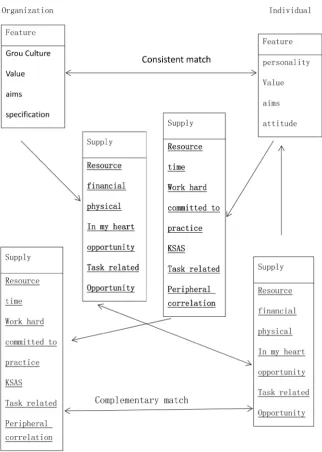
re-DOI: 10.4236/jhrss.2019.73028 422 Journal of Human Resource and Sustainability Studies sources. These unique resources can be used to fill the gaps in the organization, and complementary matching is often used as a criterion in individual career choices and organizational selection studies. In some studies, the demand-supply perspective and the demand-capacity perspective are different. From the pers-pective of the organization, the demand supply perspers-pective is put forward and the organization meets the needs and preferences of the individual. The demand is matched. The point of view is that when an individual has the capabilities that an organization needs, the match is achieved. Kristof (1981) written “task per-formance should be distinguished from contextual perper-formance” in summariz-ing previous studies based on the followsummariz-ing, the followsummariz-ing model of matchsummariz-ing people with the organization is proposed, as shown in Figure 1.
DOI: 10.4236/jhrss.2019.73028 423 Journal of Human Resource and Sustainability Studies The model integrates the concepts of consistency matching, complement matching, demand-supply matching, and demand-capability matching. It be-lieves that consistency is achieved when the basic characteristics of the organiza-tion and the individual are similar. The basic characteristics of the organizaorganiza-tion are organizational culture, values, goals and norms. Individual characteristics are individuality, values, goals and attitudes. There are similarities in these respects based on individuals and organizations. The matching between people and or-ganizations mainly covers two aspects, such as the organization provides finan-cial, physical and psychological resources, provides opportunities for work de-velopment and interpersonal interaction; the individual provides its own time, effort, commitment and other resources to meet the requirements of the organi-zation in these aspects. Kristof (1981) believes that matching people with organ-izations requires at least that people and organorgan-izations can provide the resources that one party needs. Similar features, or both, are achievable.
The ultimate goal of recruitment is attributed to the matching of people and organizations, and compared with the purpose of recruitment and the matching of people’s work. Selecting talents that focus on matching people and work is more concerned with finding employees than retaining them. However, in the development of the company, we understand that talent is the top priority, not only to discover employees, but also to cultivate enterprises. This is not what human work can do. The advantages brought by the matching between people and organizations reflect the improvement of employees’ work attitude, lower turnover rate and improve employee performance. Some related studies have provided evidence for this. For example, in most studies, human-to-organization matching has a positive impact on individual-level outcome variables. Closely related to the employee’s work attitude is the consistency of values and the con-sistency of goals. The concon-sistency of values brings about the cohesiveness of in-dividual incentives and perceived work teams [13].
DOI: 10.4236/jhrss.2019.73028 424 Journal of Human Resource and Sustainability Studies to see the impact on human-organizational matching.
2.3. Task Interdependence
So far, there are two different viewpoints on the study of task interdependence. “Essence” is one of them. It is considered that task interdependence is the essen-tial attribute of work tasks [15]. That will not be influenced by humans. The other is “behavior theory”, which means that task interdependence reflects how people behave when they complete tasks. According to which, by designing tasks of different task interdependence levels, the degree of interaction of members is in completing a task [16].
Currently, research indicates that team work processes and team outputs are related to task interdependence. In the process of team work, task interdepen-dence has a positive impact on helping behavior, prosocial behavior, and orga-nizational citizenship behavior. In addition, some studies have found that task interdependence also helps to promote team communication [17]. The Mediat-ing Effect of Cross-functional Communication on the Relationship between Task Interdependence and New Product Development Speed: A Proposed Mod-el shows that there is a nonlinear rMod-elationship between task interdependence and team performance. The nonlinear relationships found will follow The difference in the type of task changes. In addition, there are many studies that demonstrate the impact of task interdependence on other team outputs from an empirical or theoretical inference perspective. Flood believes that perceived task interdepen-dence can positively influence team loyalty. Ren et al. using a questionnaire sur-vey method, found that task interdependence can be positive commit to the im-pact team. Darawong (2013) believes that task interdependence can affect new product development Speed and put forward the concept of inter-functional communication [18]. Through the research of 70 work teams, Wang Yanzi’s (2014) research shows that task interdependence will influence the team’s crea-tivity through the team’s learning ability. From the current research, one of the important input variables of team research is task interdependence, which has a significant impact on the team work process and team output. In addition, re-searchers such as Sambasivana extended the definition of task interdependence and defined the degree of interdependence between businesses. The research shows that task interdependence can positively influence the relationship capital of enterprises in strategic alliances, which is enough to show that task interde-pendence is not only related to the team or individual level, but also to the orga-nizational level.
DOI: 10.4236/jhrss.2019.73028 425 Journal of Human Resource and Sustainability Studies particular job and other work. The second is resources, that is, a specific job. To what extent is it providing and receiving important resources with other work. The third is critical, which refers to the extent to which a particular job perfor-mance can be affected by other related job perforperfor-mance. Campion (1993) indi-cates that interdependence is an inherent feature of the team and also forms a team. The reason, therefore, interdependence will affect the efficiency of work completion. Wagenna (1995) considers interdependence there are two types, one is task interdependence, which indicates the degree of existence dependence be-tween work input and workflow distribution [20]. The other is result interpendence, which refers to the achievement of work goals and the degree of de-pendence between rewards. Position the task interdede-pendence as the task that each member needs to accomplish in completing a task. It can be seen that the work can be divided into high work response. A highly interdependent work requires more people to complete the task, each of whom has to perform his or her own tasks to complete the work; A highly independent work is a work that can be done by individuals, such as research and development. Work is not only personal research and development, but also team research and development. Slocum shows that task interdependence can determine to some extent the de-gree of control and autonomy given at work.
In the case of high interdependence of tasks, an employee cannot complete all the work by relying on the resources and resources from other members. The collision and recombination of the knowledge structure of the innovation dif-ferences generated in the team. It enables the staff to clearly understand the ad-vantages and disadad-vantages of the work content, which can improve the effi-ciency of the independent decision-making in the work team. To maximize the efficiency of the team work, the team is rooted in the organization, thus further deepening the match between people and organizations. Wittenbaum (1996) considers task interdependence to be the degree of communication and depen-dence between employees required to complete a task. In summary, this article will draw on Zhang Yixiang’s (2010) definition of task interdependence, and be-lieve that task interdependence is the degree of mutual exchange and depen-dence of team members at work.
2.4. Implicit Coordination
DOI: 10.4236/jhrss.2019.73028 426 Journal of Human Resource and Sustainability Studies behavior, more scholars believe that implicit coordination can also achieve tacit cooperation and division of labor. The difference between implicit coordination and explicit coordination is that implicit coordination is more an unconscious and subtle self-adjustment process. Studies have shown that implicit coordina-tion also affects the effectiveness of explicit coordinacoordina-tion, and also positively af-fects the cooperative effect of team members. Therefore, many scholars intend to study the operation mechanism of implicit coordination, in order to improve the efficiency of team work from implicit coordination. Wittenbaum, Stasser and Merry (1996) believe that implicit coordination arises from the correct percep-tion of the task by employees. From the perspective of knowledge, Nrico (2008) found that implicit coordination is constantly developing and improving in the context of team work. However, these studies do not take into account the dy-namic coordination of implicit coordination of cognitive structure and opera-tional processes. With the fierce market competition, the emergence of implicit coordination provides a new way of thinking for the team to gain competitive advantage.
Team members’ perceptions of tasks, expertise, and people’s matching are key factors for implicit coordination, or they can be expressed as three key elements that are both related to each other: task evaluation, member expectations, and resource allocation. The task evaluation includes “what is the task” and “how to complete”. The three main contents are the performance standard of the task, the expertise required by the task, the strategy to complete the task, and the task evaluation can effectively guide the interaction between the team members. The performance criteria of a task can determine the degree of interdependence be-tween team members. In addition, the individual’s expectations of others and their own resource allocation are influenced by the expertise required for the task. Implicit coordination is based on whether the team is able to accurately identify a member’s expertise, and the member’s actions in the task depend on the expertise and competencies of other members of the same group. Therefore, implicit coordination is used in this paper to adjust the relationship between team autonomy decision-making and person-organization matching, so as to verify that the recruitment work in high-tech enterprises should not only pay at-tention to the characteristics of outside talents, but also pay atat-tention to the work groups.
DOI: 10.4236/jhrss.2019.73028 427 Journal of Human Resource and Sustainability Studies adjustment model of team independent decision-making and person-organization matching under implicit coordination and task interdependence is established. The hypothesis between variables proposed in this paper is verified by SPSS2.0. The verification results show that the team’s independent decision-making in-fluences the person-organization matching. The implicit coordination and task interdependence play a regulatory role in the team’s independent decision-making and human-organization matching.
3. Research Hypothesis
3.1. Team Self-Determination and Human-Organization Matching
Team self-determination is very likely to achieve the fit between people and or-ganizations, and this kind of fit can improve the level of team operation under the joint effect of member characteristics and organizational environment. From the perspective of value matching, individuals’ role orientation and task orienta-tion increase with the improvement of value level. At the same time, members are more willing to pay more energy to their team. Hulsheger and other methods through meta-analysis yielded five categories of factors that have the strongest predictive effect on team innovation. Among them, the first condition for achiev-ing organizational innovation is the common goal of team formation. From the perspective of capability-requirement matching, the degree of matching is the individual’s skills in related fields. In high-tech enterprises, members who have mastered a variety of unique knowledge gather in one team and can play the ad-vantage of team heterogeneity resources. The key is to highly integrate the di-verse skills of different members. Team work style is the core work mode of high-tech enterprises. As a core competitiveness, team members further reveal why high-tech enterprises are the primary choice for most staff with unique ca-pabilities.enthu-DOI: 10.4236/jhrss.2019.73028 428 Journal of Human Resource and Sustainability Studies siasm of employees and encourage them to contribute more to the organization. The social exchange theory further proves that under the above-mentioned sce-narios, members can have a actively return the organization where the em-ployees are located, and improve the efficiency of the team. Based on this, this paper proposes the following assumptions.
H1: Team self-determination is positively related to people-organization match-ing.
3.2. Task Interdependence
Task interdependence refers to the degree of interdependence of team members in terms of work tasks, which reflects how much team members think they need to rely on others to complete their work. The interaction of team members and the behavior of cooperation are the basic characteristics of the team’s operation. The interdependence of tasks specifically illustrates this basic feature. In a task-oriented team, team members have a basic understanding of each other’s abilities and expertise, so team members can coordinate their behavior to better accomplish tasks with others. Extremely, when the various tasks in the team are highly interdependent, members naturally need to share all kinds of information and knowledge to complete the task quickly and accurately. At this time, there will be certain requirements for the staff in the same team. When the team members are at the same level, they can understand each other’s shared know-ledge or can quickly learn the core knowknow-ledge, which will inevitably work for the team. Bring high efficiency. At this point, it is necessary to consider the structure of the team, the composition of the team members, and the uniqueness of the team work in high-tech enterprises requires a high degree of professionalism and tacit understanding. This requires new selection methods in selecting team members, which involves recruitment. Checking the relevant literature and analyzing the unique domestic and foreign enterprises, founding that Bell Labs of the United States participated in the selection of newcomers who chose to work with themselves. The domestic Haier Group was able to fully select the self-selection of the work team. The selection of the right to the relevant work groups can greatly improve the efficiency of recruitment, reduce the rejection and competition awareness of the new members when they enter, thus saving time and cost and related coordination of labor costs, so that new and old em-ployees can interact with each other as soon as possible. Adapt and integrate into the work. At the same time, the benchmark of recruitment decision based on team members is the embodiment of team work appeal. The selection of new employees must be demand-matching, and the formation of team is also the orientation of organizational value. The new employees also meet the comple-mentary needs. Interdependence has a regulatory effect on team independent decision making and human-organization matching. Based on the above review, the following hypothesis is proposed:
DOI: 10.4236/jhrss.2019.73028 429 Journal of Human Resource and Sustainability Studies
3.3. Implicit Coordination Regulation
Implicit coordination is a tacit understanding of team member cooperation. Team members form this rapport with accurate, shared understanding and ex-pectations of relevant key elements. Therefore, the cognition at the team level indicates that the following characteristics are necessary for the key elements of implicit coordination: First, whether members can accurately recognize key ele-ments, that is, the degree of similarity between members’ expectations and facts; Whether to share key elements, if not, the team will have difficulty meeting the tacit understanding of working together. On this basis, the continuous updating of key elements by team members can achieve the accuracy and sharing of im-plicit coordination.
A series of interactions that team members build and evaluate when they do not apply key elements are called implicit coordination operations. For a build of knowledge about task, expertise, and human matching, what team members need is a combination of relevant tasks, members, and cognitive segments of re-lated expertise. The ability to facilitate the construction of this cognition is all about team members, such as member materials, collaborative experience, for-mal task assignments, or communication between members. Promoting coordi-nation among members of the team is a key element of high reliability. Con-versely, team members take measures to promote coordination within the team, such as re-analysing relevant clues and updating cognition of key elements. In the end, the team members will adjust their behavior according to the key ele-ments of matching, directly hand over the relevant tasks to the other party or re-trieve knowledge from the relevant personnel. This is called implicit coordina-tion applicacoordina-tion. Implicit coordinacoordina-tion is expressed as whether the employees in the team have a work tacit understanding. The effectiveness is that the members of the team can clearly understand the information of the team tasks and coope-rate with each other. More researchers use the implicit coordination of the team as a mediator variable. This is due to the mechanism of implicit formation. The implicit coordination of the team does not exist when the team starts to be built. The implicit coordination exists in the team members. At the same time, implicit coordination will in turn affect the performance of team work. In this respect, it also has an impact on the team’s decision-making. The team decision is derived from the joint decision of the team members. The decision is influenced by the personality characteristics of the decision makers and the environmental in-formation. Influence, Simon’s decision theory shows that there is no best deci-sion, only better decideci-sion, because of the limited rationality of man. In today’s fast-growing industry, the decision-making is dynamic, not only because of the limited rationality of people, but also because of the rapid changes in the market that enterprises face. Therefore, team decision-making not only compensates for the limited rationality of individual decision-making, but also makes appropriate adjustments to the team structure under the influence of implicit coordination within the team. Based on this, the paper proposes the following assumptions.
DOI: 10.4236/jhrss.2019.73028 430 Journal of Human Resource and Sustainability Studies
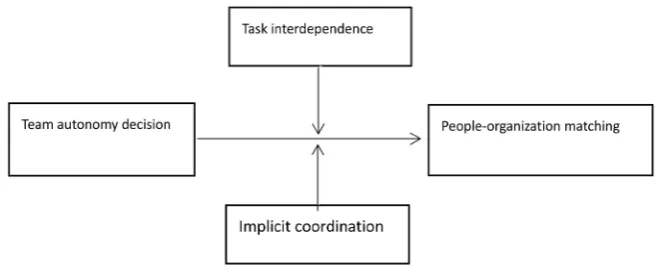
Figure 2. Research model.
and human-organization.
Based on the above assumptions, the research model of this paper can be ex-pressed as the following form (Figure 2).
4. Research Method
4.1. Sample and Data Collection
According to the hypothesis and theoretical statement of this paper, this paper selects 41 high-tech enterprises with innovative and large-scale enterprises, and interviews the work teams of the selected enterprises through interviews. A total of 80 work teams are selected to fill out the questionnaire. Through the online questionnaire survey, the questionnaire was collected from 2018.9. A total of 415 questionnaires were collected. Through the analysis and screening process, 115 invalid questionnaires were deleted. The effective questionnaire was 300, and the effective rate was 72%.
4.2. Variable Measurement
In order to ensure the reliability and validity of the questionnaire, this paper draws on the mature scales at home and abroad and makes reasonable adjust-ments through the actual problems in the team survey, using a seven-level scale (1 means completely disagree, 7 means complete agreement). The team’s crea-tivity is measured by the mature scales used by Luo, Y., Li, G., & Liu, H. The scale includes three items: “team output is creative”. The internal consistency coefficient is 0.73, which can be used. The implicit coordination of the team is measured by a scale developed by Khan et al., which means that the total of im-plicit coordination includes eight items such as “the behavior of team members can predict other members without communication”. The internal consistency coefficient is 0.87. The group’s decision-making is based on the scales used by Gonzalez-Mule, E., Courtright, SH, Degeest, D., Seong, JY, & Hong, DS, etc. The study also showed that it can be applied. The scale includes five items such as “our boss let my team make decisions”. The internal consistency coefficient of the scale is 0.62, which has good reliability.
DOI: 10.4236/jhrss.2019.73028 431 Journal of Human Resource and Sustainability Studies includes three items, “I can’t get the job done without work information or ma-terials from other members.”. The internal consistency coefficient is 0.894. The matching between human and organization is a scale developed by Cable et al. The scale includes four items, such as matching human and organizational val-ues, and requires ability matching. The internal consistency coefficient of the scale is 0.81, which has good reliability. In addition, the age group, company size, education, and number of team members are selected as control variables.
5. Empirical Analysis
5.1. Reliability and Validity Analysis
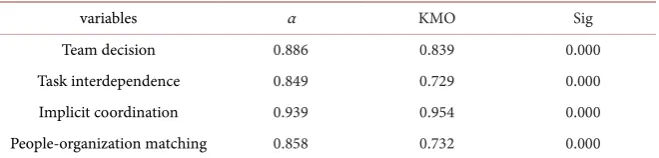
The data collected by the questionnaire was analyzed by SPSS.20 for the reliability and validity of the questionnaire. The results are shown in Table 1. The results show that the alpha values of team autonomy decision scale, human-organization matching scale, task interdependence and team implicit coordination are all greater than 0.7, indicating that the internal consistency of the research scale is high and the reliability is good. The results show that the KMO values of the Team Creation Power Table, Human and Organization Matching Scale, Task Interdependence Scale, and Team Implicit Coordination Scale are both greater than 0.5, and Bartlett’s Sig value is 0.000, indicating the amount of research. The validity of the table is good. The reliability and validity of the scale in this paper are in line with the research requirements, which provides data support for the next research.
5.2. Confirmatory Factor Analysis of Variables
[image:16.595.210.540.581.660.2]Using Amos to perform confirmatory factor analysis on the main variables in this study, the data processing results show that the four-factor model has the best fit, with /df being 1.079 < 3, RMSEA being 0.016 < 0.08, and NIF being 0.788. The CFI and TLI are 0.975 and 0.981, respectively. The data of these two indicators are close to 1, indicating that the prediction model is ideal. Except that the RMSE is 0.016, it obviously meets the requirements of pattern fitting, indicating that there is a comparison between these four variables. A good dis-tinction further indicates that the following study can be continued in Table 2.
Table 1. Reliability and validity analysis of each variable scale.
variables α KMO Sig
Team decision 0.886 0.839 0.000
Task interdependence 0.849 0.729 0.000
Implicit coordination 0.939 0.954 0.000
People-organization matching 0.858 0.732 0.000
Table 2. Verify line factor analysis.
Variables x2/df RMSEA NIF CFI TLI
DOI: 10.4236/jhrss.2019.73028 432 Journal of Human Resource and Sustainability Studies
5.3. Correlation Analysis of Individual Variables
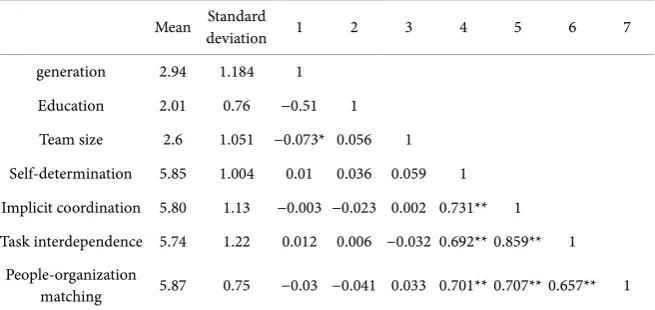
Correlation analysis was performed on each variable by SPSS20.0, and the results were as shown. The results show that team creativity, team implicit coordination and task interdependence are significantly positively correlated with the match-ing of people and organizations. Therefore, through the correlation analysis of variables, it is preliminarily verified that hypothesis 1 is established. Control va-riables and human-to-organization match are less significant correlations, and there may be reasons for insufficient sample size, but studies have shown that control variables have a significant effect on models with little influence. At the same time, in order to prevent the occurrence of multi-collinearity problem, the VIF test is further carried out. The highest variance expansion of each variable is 7.730 < 10, which indicates that the model and the research hypothesis are rea-sonable, and the variables can be further verified in Table 3.
5.4. Main Effect Test
In order to test the relationship between team autonomy and human-organization matching, linear regression is performed by Spss. According to the steps of li-near regression, the control variables, namely employee age, gender, education, team size and independent variable team decision-making, are introduced into the model 1 to verify the relationship between the team’s self-determination and the person-organization matching. It shows that the independent variable has a significant positive correlation with the dependent variable, which proves the establishment of H1. The specific results can be seen in Table 4. It also shows that when the high-tech enterprise team has higher autonomy in personnel deci-sion-making, it will help people-organization match.
5.5. Adjustment Effect Test
[image:17.595.211.539.555.710.2]For the test of the regulatory variables, this paper adopts the hierarchical regression method. On the basis of model 1, the adjustment variables—task interdependence and implicit coordination are introduced into model 2. Secondly, centralize the
Table 3. Person correlation coefficient of study variables.
Mean Standard deviation 1 2 3 4 5 6 7
generation 2.94 1.184 1 Education 2.01 0.76 −0.51 1 Team size 2.6 1.051 −0.073* 0.056 1 Self-determination 5.85 1.004 0.01 0.036 0.059 1 Implicit coordination 5.80 1.13 −0.003 −0.023 0.002 0.731** 1 Task interdependence 5.74 1.22 0.012 0.006 −0.032 0.692** 0.859** 1
People-organization
matching 5.87 0.75 −0.03 −0.041 0.033 0.701** 0.707** 0.657** 1
DOI: 10.4236/jhrss.2019.73028 433 Journal of Human Resource and Sustainability Studies
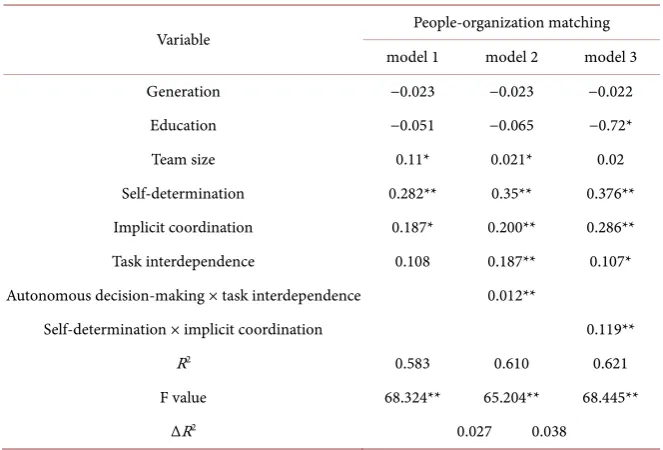
Table 4. Test of adjustment effect.
Variable People-organization matching model 1 model 2 model 3
Generation −0.023 −0.023 −0.022
Education −0.051 −0.065 −0.72*
Team size 0.11* 0.021* 0.02
Self-determination 0.282** 0.35** 0.376** Implicit coordination 0.187* 0.200** 0.286** Task interdependence 0.108 0.187** 0.107* Autonomous decision-making × task interdependence 0.012**
Self-determination × implicit coordination 0.119**
R2 0.583 0.610 0.621
F value 68.324** 65.204** 68.445**
ΔR2 0.027 0.038
team’s independent decision-making, task-dependent variables and implicit coordination, and multiply the implicit and task-dependent variables after cen-tralization and the team’s independent decision to form two interactive terms. The team independent decision-making and task-interdependence interaction items are added to the model 2. In Table 4, it can be seen that the task interdependence has a significant positive adjustment effect between the team self-determination decision and the person-organization match (β = 0.012, P < 0.05). That is to say, the research hypothesis that H2 is proved to be established, that is, the higher the interdependence of tasks, the stronger the relationship between team autonomy and human-organization matching. Task interdependence indicates that in the team work situation, the connection between the work content of the employee’s home is tight, requiring the staff to achieve the connection of the work content, and the selection of the new person is not only capable of having the ability to match the organization. The trait, and the ability to understand the ability of the work in the team to understand the ability to work and the ability to complete the cooperation is the team staff, this level determines the team’s decision-making is far more than other Decision makers are more effective.
mod-DOI: 10.4236/jhrss.2019.73028 434 Journal of Human Resource and Sustainability Studies erator to study the relationship between team autonomy and human-organization matching is based on the principle of goal fusion. In a very distinctive way of working—teamwork, implicit coordination can not only promote the efficient completion of work tasks, but also make employees more effective. From the perspective of social psychology, it can be seen that the human being needs to be stimulated and stimulates a person’s deeper desire for expression. This proves the establishment of H3.
In order to further understand the effect of the adjustment variable on the re-lationship between the independent variable and the dependent variable, by making two adjustment variables on the main effect of the adjustment effect di-agram.
6. Research Conclusions and Management Recommendations
This paper starts from the typical team work level of high-tech enterprises, chooses the subject of recruitment for this kind of post with special require-ments, and proposes the recruitment model based on the research confirmed by this paper-team independent decision-making. The research results show that in the existing high-tech industry, the high-tech enterprises in the way of team work, the team’s self-determined recruitment decision will make the per-son-organization matching more efficient, reduce the employee’s turnover ten-dency and motivate the employees’ work enthusiasm. The mechanism of action is discussed from the characteristics of team work. Task interdependence and implicit coordination require the professionalism of the staff in the work. Task interdependence excepts the professional requirements of the work which should reflect the heterogeneity requirements of the team staff; that do not need too much field consistency Professionals, but also need professional talents in other related fields. Recruitment strategies based on the above work require-ments not only avoid blind “talent pools”, but also purify and make the best use of the “talent pool” within the enterprise. The cost of the recruitment method has higher capital cost and labor cost than the traditional recruitment. However, using the “learning by doing” principle in economics, the company will get more return profits in the future talent value.DOI: 10.4236/jhrss.2019.73028 435 Journal of Human Resource and Sustainability Studies has already delegated the decision-making power of personnel to each individual work team, and research shows that this new management method brings Haier unlimited vitality and motivates employees to develop their potential.
Enterprises with mature domestic scale and high-tech industries should adapt to the changes of the times and the needs of talents. They should not only motivate employees economically, but also identify and motivate the in-ner potential of employees after identifying their existing capabilities. The re-search by Peter Kapelley, a professor of management at Wharton School of the United States, found that “what do you value most about a job?” is the first thing that “gets something helpful for the next job”. This is enough to prove that the needs of employees are not only economic satisfaction, but also more opportunities for “self-learning”. According to the 2017 data, the common traits of the top three companies, Alibaba, Huawei, and Bank of China, are to provide “learning opportunities”, and this is a magic weapon for them to attract more talents.
This paper studies the decision-making problem of recruitment from the perspective of team work and people-organization matching, which is more in line with the working mode of the current enterprise, but the research is still not complete enough. First, in the sample acquisition, we have not studied various types of enterprise characteristics, but only select high-tech enterprises, although from the theoretical point of view, traditional enterprises are not suitable for team-based decision-making recruitment methods, when the suitability of en-terprises in other industries is still for further discussion. Second, this paper mainly considers the effectiveness and influencing factors of recruitment from the perspective of enterprises. It is not possible to consider recruitment me-thods or decision-making from the perspective of employee characteristics. It is a level worthy of attention for future research. Third, the market is dynamic, and the enterprise is also advancing in the process of change. The future of re-cruitment research should focus on dynamic decision-making and changes in methods. In research, more research should be added to the factors that lead to corporate change, as well as candidates. Research should be paired with re-search, and such research can make its conclusions more theoretical and prac-tical.
Therefore, this paper makes the following recommendations for future re-search on this aspect. The recruitment model, the status of human resources, or the value orientation of employees can be studied from other levels. Get more microscopic data to further explore the use of recruitment models in different organizational structures and the use of tiered research for different levels of re-cruitment.
Conflicts of Interest
DOI: 10.4236/jhrss.2019.73028 436 Journal of Human Resource and Sustainability Studies
References
[1] Jiang, L., Yu, G.T. and Li, Y.J. (2007) Team Decision and Its Influencing Factors.
Advances in Psychological Science, 15, 358-365 [2] Ming, Y. (2014) Make the Recruitment to the Extreme.
[3] Davis, J.H., Kameda, T., Parks, C., et al. (1989) Some Social Mechanics of Group Decision Making: The Distribution of Opinion, Polling Sequence, and Implications for Consensus. Journal of Personality and Social Psychology, 57, 1000-1012. https://doi.org/10.1037/0022-3514.57.6.1000
[4] Ganster, D.C., Williams, S. and Poppler, P. (1991) Does Training in Problem Solv-ing Improve the Quality of Group Decisions? Journal of Applied Psychology, 76, 479-483.https://doi.org/10.1037/0021-9010.76.3.479
[5] Stasser, G., Taylor, L.A. and Hanna, C. (1989) Information Sampling in Structured and Unstructured Discussions of Three- and Six-Person Groups. Journal of Perso-nality and Social Psychology, 57, 67-78.https://doi.org/10.1037/0022-3514.57.1.67
[6] Ilgen, D.R. (1999) Teams Embedded in Organizations: Some Implications. Ameri-can Psychologist, 54, 129-139.https://doi.org/10.1037/0003-066X.54.2.129
[7] Wan, H. (2012) A Preliminary Study on China’s Green Human Resource Manage-ment from the Perspective of AMO Theory—A Micro-Research Perspective. China Human Resources Development, No. 10, 9-13.
[8] Wu, W.Y. (2005) On the Establishment of Recruitment Team in Modern Enterpris-es. China Human Resources Development, No. 9, 35-37.
[9] Ang, Q.R., Li, Y.J., Wang, J.F. and Feng, J.Z. (2008) College Laboratory Construc-tion and Innovative Talent Training. Science and Technology Management Re-search, 28, 227-234.
[10] Zhang, K. (2003) New Explanation of Incentive Theory. Scientific Management Re-search, No. 2, 89-92+98.
[11] Kristof, A.L. (1996) Person-Organization Fit: An Integrative Review of Its Concep-tualizations, Measurement, and Implications. Personnel Psychology, 49, 1-49. https://doi.org/10.1111/j.1744-6570.1996.tb01790.x
[12] Vancouver, J.B. and Neal, W.S. (1991) An Exploratory Examination of Per-son-Organization Fit: Organizational Goal Congruence. Personnel Psychology, 44, 333-352.https://doi.org/10.1111/j.1744-6570.1991.tb00962.x
[13] Wageman, R. (1995) Interdependence and Group Effectiveness. Administrative Science Quarterly, 40, 145-180.https://doi.org/10.2307/2393703
[14] Wang, Y.Z., Luo, W. and Shi, J.T. (2014) Research on the Influence Mechanism of Task Interdependence on Team Creativity. Science and Technology Progress and Countermeasures.
[15] Wang, Y.Z., Luo, W. and Shi, J.T. (2014) Tasks Research on the Influence Mechan-ism of Team Effectiveness on Team Creativity. Science and Technology Progress and Countermeasures.
[16] Stewart, G.L. and Barrick, M.R. (2000) Team Structure and Performance: Assessing the Mediating Role of Intrateam Process and the Moderating Role of Task Type.
Academy of Management Journal, 43, 135-148.https://doi.org/10.5465/1556372
DOI: 10.4236/jhrss.2019.73028 437 Journal of Human Resource and Sustainability Studies
[18] Kiggundu, M.N. (1981) Task Interdependence and the Theory of Job Design.
Academy of Management Review, 6, 499-508. https://doi.org/10.5465/amr.1981.4285795
[19] Campion, M.A., Papper, E.M. and Medsker, G.J. (1993) Relations between Work Team Characteristics and Effectiveness: A Replication and Extension. Personnel Psychology, 46, 823-850.https://doi.org/10.1111/j.1744-6570.1993.tb01571.x