A Prototype Automatic Simultaneous Interpretation System
Xiaolin Wang Andrew Finch Masao Utiyama Eiichiro Sumita
Advanced Translation Research and Development Promotion Center National Institute of Information and Communications Technology, Japan
{xiaolin.wang, andrew.finch, mutiyama, eiichiro.sumita}@nict.go.jp
Abstract
Simultaneous interpretation allows people to communicate spontaneously across language boundaries, but such services are prohibitively expensive for the general public. This paper presents a fully automatic simultaneous interpretation system to address this problem. Though the development is still at an early stage, the system is capable of keeping up with the fastest of the TED speakers while at the same time delivering high-quality translations. We believe that the system will become an effective tool for facilitating cross-lingual communication in the future. 1 Introduction
Interpretation is the oral translation of speech from one language to another. Simultaneous interpreta-tion is one type of real-time interpretainterpreta-tion where the interpreter performs the translainterpreta-tion within the time permitted by the pace of source speech. Compared to another type of interpretation – consecutive inter-pretation – where the speaker pauses after completing one or two sentences, simultaneous interinter-pretation has the advantages of saving time, and also not interupting the natural flow of the speaker1.
Simultaneous interpretation is an effective way to bridge language gaps. A good example of events where simultaneous interpretation is used are the United Nations and European Union conferences. The interpreter sits in a soundproofed booth and speaks into a microphone, while clearly seeing and hearing the speaker. The delegates in the meeting room select the relevant channel to hear to interpretation in the his or her native language2
Simultaneous interpretation is an expensive service due to the cost of interpreters. First, the number of simultaneous interpreters is small, because the job requires many years of experience and subject matter expertise. Second, for a real-world event, employing one interpreter is normally insufficient, because the task demands so much concentration that any individual can only hope to be effective for periods of 20 minutes or less. Several interpreters are required for continuous service of more than two hours3.
Inspired by both the merits and the demands of simultaneous interpretation, we have developed a fully automatic simultaneous interpretation system, as presented in this paper. Recently some other simul-taneous interpretation systems such as (M¨uller et al., 2016) have also been presented. Unfortunately, cross-comparison is currently not possible without access to these systems, and will hopefully become interesting future work. This paper first explains how the system works (Section 2), then describes how to use the system (Section 3), then shows how well the system works (Section 4), then presents an exam-ple of the system’s performance on a TED talk (Section 5), and finally concludes with a description of future work (Section 6).
2 The System in a Nutshell
The simultaneous interpretation system is a fully automatic speech-to-speech system that is currently capable of English-Japanese bidirectional interpretation. The method is general, and can be applied to other language pairs directly.
1https://en.wikipedia.org/wiki/Language_interpretation
2http://ec.europa.eu/dgs/scic/what-is-conference-interpreting/simultaneous/index_
en.htm
3http://www.londontranslations.co.uk/our-services/simultaneous-interpreters/
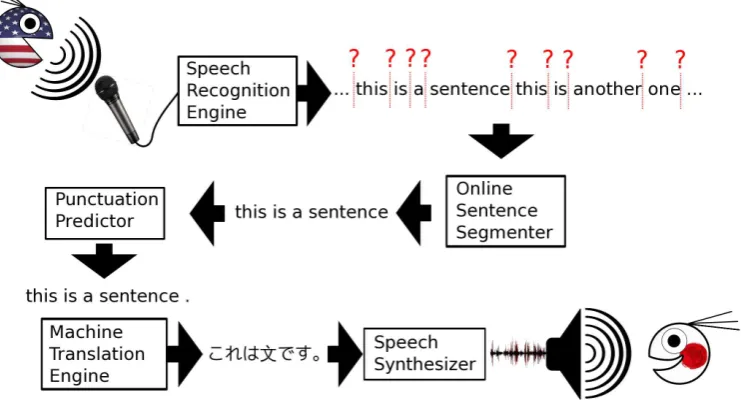
Figure 1: Architecture of the Simultaneous Interpretation System
Figure 1 illustrates the architecture of the system. The key element in the design is an online sentence segmenter that bridges the speech recognition engine and the machine translation engine. The whole system is a pipeline of six components: a speech recognition engine, a sentence segmenter, a punctuation predictor, a machine translation engine, and a speech synthesizer.
TheSpeech Recognition Engineconverts audio signals into a stream of words. The current imple-mentation is an online decoder based on the Kaldi open source toolkit (Povey et al., 2011)4. We plan to
integrate our own in-house speech recognition engine – SprinTra (Shen et al., 2014) in the future. Our system is able to perform speech detection. That is to say the system is always listening, and will respond to any speech it hears (see Section 3 for details). Speech detection is done by applying a threshold to the energy of the input audio signals. We determined empirically that this heuristic works well in actual use. In the case when loud noises exceed the threshold and trigger the system, the speech recognition engine normally outputs no words, thus little damage is caused.
TheOnline Sentence Segmenterconverts the stream of words into sentences. The implementation is based on the method proposed in (Wang et al., 2016a). The implementation uses a linear combination of a language model, a length model and a prosodic model to calculate the confidence of segmentation boundaries, and uses a threshold-latency-based heuristic to make decisions.
The Punctuation Predictor converts an un-punctuated sentence into a punctuated sentence. The implementation is based on the findings in (Wang et al., 2016b). It uses a hidden N-gram model (Stolcke et al., 1998; Matusov et al., 2006), which is available in the toolkit of SRILM (Stolcke, 2002), to insert punctuation.
TheMachine Translation Enginetranslates a source-language sentence into a target-language sen-tence. The implementation is our in-house pre-ordering translation system, called the General Purpose Machine Translation (GPMT) engine. The system is publicly accessible through a Web API5
TheSpeech Synthesizer converts sentences into speech. The implementation is based on the HTS open-source toolkit (Tokuda et al., 2013)6
4https://github.com/kaldi-asr/kaldi
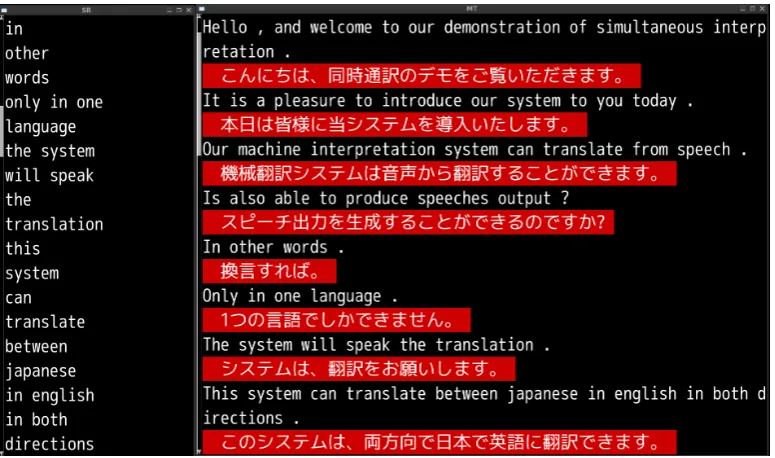
Figure 2: Logs of Simultaneous Interpretation System: Speech Recognition (left) and Machine Transla-tion (right).
3 Usage
The system is designed to work in exactly the same manner as a human interpreter working in multi-lingual conferences. Once launched, the system can work continuously for hours or days without inter-vention. In operation, it receives audio signals constantly from its microphone. If no one is speaking, the system will produce no output. If someone is speaking, the system will speak out the translation, normally, in only a few seconds.
In addition to the speech output, two logs can be used to monitor the running of the system: the speech recognition log and the machine translation log (Figure 2). The speech recognition log shows the recognized words from the speakers. The machine translation log shows the recognized sentences and their translations. The content of both logs is updated in realtime.
4 Performance
The performance of our method was measured in (Wang et al., 2016a). Experiments were performed on translation between Japanese and English in both directions. The time efficiency was measured by average latency per source word using the definition given in (Finch et al., 2014). The translation quality was measured by the BLEU of end-to-end translation. Because the segmented source sentences did not necessarily agree with the oracle, translations were aligned to reference sentences through edit distance in order to calculate BLEU (Matusov et al., 2005).
The results of the measurement are presented in table 1. Different sentence segmentation methods were compared. Our system adopted the threshold-latency method which generally outperformed the other methods on both time efficiency and translation quality.
5 Example Analysis
Here is an example of interpreting a TED talk from English to Japanese by the system. The talk is ”Your elusive creative genius “ given by Elizabeth Gilbert in 20097. The oracle transcript is,
I am a writer. Writing books is my profession but it’s more than that, of course. It is also my great lifelong love and fascination. And I don’t expect that that’s ever going to change. But, that said, something kind of peculiar has happened recently in my life and in my career ...
Sentence Segmenter Dev. Set Test Set
Threshold-latency (our System) 13.38 12.98 13.28 12.89
English-to-Japanese
Threshold-latency (our System) 13.18 10.01 13.42 10.11
Table 1: Performance of interpretation systems that use different sentence segmenters. The confidence scores in threshold-based, latency-based and threshold-latency-based segmenters were calculated using Equation 4 in (Wang et al., 2016a). † Employed the segment tool from the SRILM toolkit (Stolcke, 2002).‡The method is not online since it operates on a whole sequence of words, thus the measurement of latency is not applicable.
Recognized Sentence Translation Post Edited Lat.(s)
I am a writer . 私は作家です。 私は作家です。 1.5
writing books is my profession . 書く仕事です。 本を書くのが私の仕事です。 3.3
but , it’s more than that of course it is also my great lifelong love and fascination .
and I don’t expect that that’s ever going to change .
but that said , something kind of pe-culiar has happened recently in my life , and in my career .
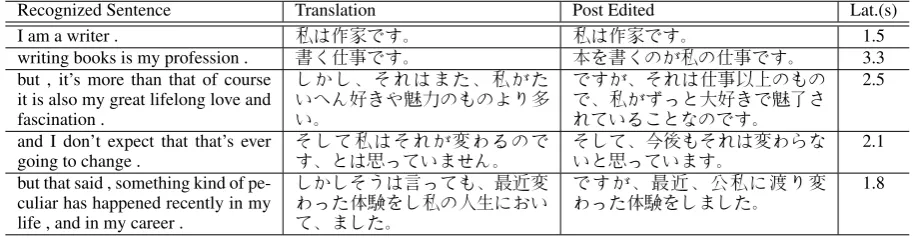
Table 2: Example of Simultaneous Interpretation System Working on an TED Talk
The result of the system is shown in Table 2. The system works rapidly, and can easily keep with up the speaker, with a latency ranging from 1.5 to 3.3 seconds for these sentences.
For analysis, the output was corrected by a professional translator (‘Post Edited’ in Table 2). The first sentence was translated perfectly; the second was good but omitted the translation for the wordbooks. The third sentence’s translation resolved the pronouns incorrectly, and this was subjectively the worst translation. The fourth sentence was semantically correct, but it is more natural to say: ‘I expect notX’ rather then ‘I didn’t expectX’ in Japanese. The fifth sentence was also quite good but the wordcareerwas not translated. Overall, the translation quality is impressive, given the difficulty of translation between English and Japanese.
Note that although speech recognition errors rarely happen on this speech. Recognition error rate is speaker dependent and proved to be one of the main sources of errors in our tests. Therefore we believe that further improvements in speech recognition are vital for the future development of simultaneous interpretation systems.
6 Conclusion
This paper presents a prototype automatic simultaneous interpretation system. The system adopts a robust and effective pipeline framework. It is designed to behave like a human interpreter, and is very easy to use. In real-world use it is capable of producing useful translations while keeping up with the fastest of speakers.
both academic research and industrial development in this field. In the future, we will constantly improve the system with an emphasis on the quality of final output. Future efforts may include handling disfluen-cies, applying neural networks to the task of sentence segmentation, integration with our in-house speech recognition engine of SprinTra, and improving our GPMT in-house machine translation engine.
References
Andrew Finch, Xiaolin Wang, and Eiichiro Sumita. 2014. An Exploration of Segmentation Strategies in Stream Decoding. InIWSLT.
Evgeny Matusov, Gregor Leusch, Oliver Bender, Hermann Ney, et al. 2005. Evaluating machine translation output with automatic sentence segmentation. InIWSLT, pages 138–144. Citeseer.
Evgeny Matusov, Arne Mauser, and Hermann Ney. 2006. Automatic sentence segmentation and punctuation prediction for spoken language translation. InProceedings of 3rd International Workshop on Spoken Language Translation, pages 158–165.
Markus M¨uller, Thai Son Nguyen, Jan Niehues, Eunah Cho, Bastian Kr¨uger, Thanh-Le Ha, Kevin Kilgour, Matthias Sperber, Mohammed Mediani, Sebastian St¨uker, and Alex Waibel. 2016. Lecture translator - speech translation framework for simultaneous lecture translation. InProceedings of the 2016 Conference of the North American Chapter of the Association for Computational Linguistics: Demonstrations, pages 82–86, San Diego, California, June. Association for Computational Linguistics.
Daniel Povey, Arnab Ghoshal, Gilles Boulianne, Lukas Burget, Ondrej Glembek, Nagendra Goel, Mirko Hanne-mann, Petr Motlicek, Yanmin Qian, Petr Schwarz, Jan Silovsky, Georg Stemmer, and Karel Vesely. 2011. The Kaldi speech recognition toolkit. InIEEE Workshop on Automatic Speech Recognition and Understanding, December.
Peng Shen, Xugang Lu, X Hu, N Kanda, M Saiko, and C Hori. 2014. The NICT ASR system for IWSLT 2014. InProceedings of the 11th International Workshop on Spoken Language Translation.
Andreas Stolcke, Elizabeth Shriberg, Rebecca A Bates, Mari Ostendorf, Dilek Hakkani, Madelaine Plauche, G¨okhan T¨ur, and Yu Lu. 1998. Automatic detection of sentence boundaries and disfluencies based on rec-ognized words. InProceedings of 5th International Conference on Spoken Language Processing, pages 2247– 2250.
Andreas Stolcke. 2002. SRILM - an extensible language modeling toolkit. InProceedings of the 7th International Conference on Spoken Language Processing.
Keiichi Tokuda, Yoshihiko Nankaku, Tomoki Toda, Heiga Zen, Junichi Yamagishi, and Keiichiro Oura. 2013. Speech synthesis based on hidden markov models.Proceedings of the IEEE, 101(5):1234–1252.
Xiaolin Wang, Andrew Finch, Masao Utiyama, and Eiichiro Sumita. 2016a. An efficient and effective online sentence segmenter for simultaneous interpretation. In(to appear).