Linear PrDgramming
Bas~line
Blending
CONTENTS
INTRODUCTION. . . .
PROBLEM PROFILE AND ECONOMICS .
LP MODEL FORMULATION
Input Data ReqUirements. .
Sample Problem - Two-Blend Model . The Cost Constraint (Objective
FWlction) • • . . . • Availability Constraints . Specification Constraints •• Input Listing • • . • 0 0 • •
Summary of Sample Problem
OUTPUT REPORTS 0 0 0 0 0 0 0 0 0 0
Basis Variables and Slacks Reports 0 •
© 1965 by International· Business Machines Corporation
1
1
1
2 2
6 8 8 9 9 9
11
Re-Solution . . . DO. D/J Report. 0 • •
Cost Range Report. . Output Report Summary . .
MODEL REFINEMENT TECHNIQUES
Linear Approximations for TEL Susceptibility 0 • • • • • • • • • •
Linear Formulation of Composite Quality Specifications • . . • 0 0 •
Linear Formulation of Process Yield Components, 0 0 0 0 0 0 • 0 0 0 0 • 0
Sample Problem - Three-Blend Model 0 0
CONCLUSION 0 0 0
BIBLIOGRAPHY 0 0
Copies of this and other IBM publications can be obtained through IBM branch offices. Address comments concerning the contents of this publication to
IBM, Technical Publications Department, 112 East Post Road, White Plains, N. Y. 10601
15 16 18 18
19
19
25
25 26
27
INTRODUCTION
The introduction of linear programming (LP) has produced remarkable benefits in many industries - notably those that involve blending materials to manufacture a finished product, such as meat pack-ing, ice cream blendpack-ing, cotton blendpack-ing, animal feed mixing, and primary metals alloying. Almost from its inception LP has been employed in the re-fining segment of the petroleum industry, and most large refineries currently use LP to plan daily and long-range operations. Considerable savings have been reported by the use of LP in the petroleum in-dustry. (See reference 1 in the Bibliography.)
The purpose of this manual is to demonstrate the application of LP to the blending of gasoline, a process which, because it involves complex quality control, is particularly responsive to LP techniques. The immediate and most obvious LP results enable the gasoline producer (whether a refinery operator or a jobber) to minimize the cost of gasoline and the frequency of off-compositions and permit him to purchase and sell most economically.
The basis of the LP technique is the formulation of a mathematical model of the allocation problem. For problems of any practical size, this model is entered into a computer, and the computer LP sys-tem rapidly calculates the optimal (least-cost or maximum profit) solution. The system may also produce reports which indicate the effect on the op-timal solutions of possible changes in the given prices, availabilities, product specifications, etc.
Contrary to popular belief, little mathematical knowledge or skill is required to formulate an LP model. Nor do the operation of the computer and the analysis of computer results require any ad-vanced technical skill. Linear programming re-quires nothing more than the expreSSion of all the factors in the process - blend specifications, com-ponent availabilities, costs - in the form of simple linear equations (or inequalities). The general principles of linear programming are discussed in the IBM data processing application manual An
Introduction to Linear Programming (E20-8171), which should be read in conjunction with this manual.
To demonstrate the methods and advantages of LP in gasoline blending, we will develop an LP model for the solution of a typical (though simplified) production problem. This model will be solved by the mM 1620/1311 Linear Programming System (1620-CO-04X); with minor modifications, it can be solved by any of mM's LP systems. After estab-lishing the basic technique for model formulation, we will describe a larger general model which
in-corporates a number of more sophisticated methods for linearizing essentially nonlinear processes. We
may note that the techniques described in this manual may serve as a guide for blending not only gasoline but other products as well.
PROBLEM PROFILE AND ECONOMICS
The basic gasoline blending process involves the mixing of a number of available. products, having different costs and physical characteristics, in order to achieve a specified gasoline quality. fur-ther, additives, such as tetraethyllead, are also used to control the product octane. The obvious economic problem is to determine the blend of com-ponents and the tetraethyllead level which will pro-duce the specified gasoline at least cost or maximum profit. The high volume typically involved in gaso-line blending. argues powerfully for the use of LP, since even slight per-unit savings will produce addi-tional profit on a scale that amply justifies computer cost.
Manual determination of a maximum -profit blend is extremely difficult and laborious. To begin with, the complex interrelation among the qualities of the several components in the blends to be produced must be considered. Fluctuations in the prices and availabilities of components further compound the difficulty. Manual calculation to determine blend recipes often gives away costly quality in order to meet all specifications. An increasing number of gasoline blenders are profiting from the application of linear programming, which enables the producer to examine all possible combinations and quickly determine the most economical blend. Further, the standard use of LP to predict optimal blends con-tributes to the improvement of purchasing practices and inventory control.
LP MODEL FORMULATION
A linear programming model for gasoline blending is a mathematical representation, in the form of linear equations, or inequalities, of all known and estimated factors relevant to the production of the specified-quality gasoline. To demonstrate the method for formulating such a model, we postulate a specific problem: the production of two different gasolines regular quality and premium quality -from a variety of materials each of which is avail-able in limited supply.
INPUT DATA REQUIREMENTS
The following basic data is required to formulate the LP model:
• Blend specifications
• Inventory level of each raw material available • Quality analysis of each raw material (at appro-priate tetraethyl lead levels)
• Cost of each raw material
• Projected selling price of fini~hed products This input will provide a model for which maximum profit is computed. We might, instead of projected selling price, use an additional constraint - quantity of blend required. (For such a model, minimum cost is computed.)
The blend specifications for the final products are probably the most certain elements of the input data. Inventory levels, though fairly certain for the jobber, may be quite uncertain for the refiner oper-ating continuously and with different grades of crude. (Specific yield requirements, if included in the model, may also be based on uncertainties.) In the sample problem, however, we shall assume specific inventory restrictions on each of the principal mate-rials available for the blend.
Again, determining the cost of each component material is often a difficult problem when formu-1ating a valid gasoline blending model. Fairly accurate prices may be determined from engineering projections, manufacturing costs, purchaSing, or sales agreements which fix a market value for raw blend stocks. When accurate costing is impossible,
estimates based on the comparative value of each fraction should be used so that at least a realistic ranking of material costs is incorporated.
SAMPLE PROBLEM - TWO-BLEND MODEL
We wish to produce two blends, regular and pre-mium, from components which are available in specified amounts. Though in practice we can easily fix minimum or maximum amounts of blend to be produced, in this case the amounts are to be computed subject only to the limitations on com-ponent availability. Further, we shall establish tetraethyllead (TEL) levels at 0.7 gm/gal. for regular and 2.0 gm/gal. for premium, and limit the alkylate and high severity reformate to the premium blend. Figure lUsts the quantity of each material available together with its quality analysis and octane numbers at the established TEL levels. (Blending volatilities at 1580, 2150, and 2400F in
Figure 1 were computed from the ASTM distillation of the components using the graphs of Naquin and Milwee, reference 2. Octane numbers at 0.7 and 2. 0 gm/ gal. in Figure 1 were obtained from tests at 0 and 3.0 gm/gal. and the DuPont TEL suscepti-bility chart A-21412, 8/61, which will be discussed in a subsequent section.)
The blend specifications and tolerances are listed in Figure 2. In the model matrix, we shall introduce the specification tolerances as safety fac-tors. That is, we shall add the tolerance to a
mini-mum specification and subtract it from a maximini-mum
Availability ASTM Blending Volatility* (0/0) Research Octane + TE L*
Component (bbl/day) RVP @158°F @215°F @240°F @300°F @0.7 gm/gal. @2 gm/gal.
Sour light virgin 13,830 6.2 7.5 38 77 96 79.5 80.5
Low severity reform ate 4320 6.0 -5 19 35 56 90.5 93.6
High severity reformate 2410 6.2 -5 19 35 56
-
100.8Light cat naphtha 16,400 4.5 11 50 74 88 95.5 97.9
Heavy cat naphtha 5250 0.0 -27 -20 -7 20 91. 0 94.0
\
Alkylate 4000 4.5 10 27 97 100
-
103.3Polymer 1900 8.0 7 25 62 87 99.5 100.5
Butane As needed 72.0 130 101 100 100 101. 5 104.0
*See text for sources of these values.
Quality Regular
RVP maximum =IF 12.0
158°F volatility 33.0 maximum %
215°F volatility 39.0 minimum %
215°F volatility 51. 0 maximum %
240°F volatility 58.0 minimum %
300 minimum % 78.0
Octane, minimum 88.5
TEL gm/gal. 0.7
Premium
11. 9
29.0
45.0
56.0
68.0
88.0
97.5
2.0
Blending Tolerance
0.3
3.0
2.0
2.0
2.0
2.0
0.5
---specification. Thus, in the regular blend, the per-centage volatility specification at 2150F, which is 39% minimum and 51% maximum with a tolerance of 2%, will be stated in the matrix as 41% minimum and 49% maximum.
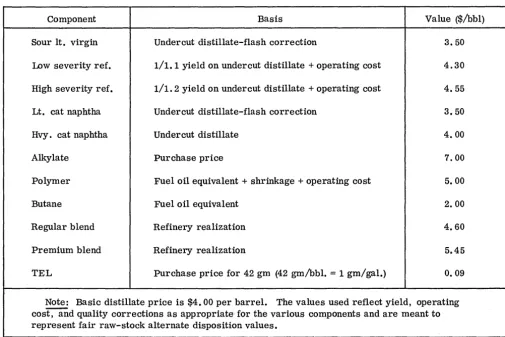
We shall assume, for our sample problem, a basic distillate price of $4.00 per barrel and use the values listed in Figure 3 as the material costs in the model matrix. The information provided in Figures 1, 2, and 3 may be used to formulate a model matrix which can be solved for a maximum-profit blending of the available components into the two specified gasolines. The specifications, avail-ability levels, TEL levels, and price data could, of course, be altered to reflect any new conditions.
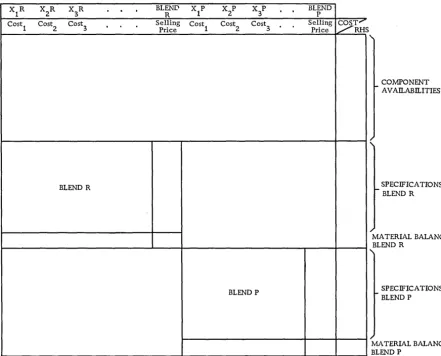
A schematic of the LP model matrix is shown in Figure 4. The first row, which incorporates costs and anticipated selling prices, represents the ob-jective function to be optimized and is designated COST (its exact meaning will be discussed below). The next several rows are used to establish inven-tory availability constraints. The rest of the rows
Figure 2. Blend specifications and tolerances
Component Basis Value ($/bbl)
Sour It. virgin Undercut distillate-flash correction 3.50
Low severity ref. 1/1.1 yield on undercut distillate + operating cost 4.30
High severity ref. 1/1.2 yield on undercut distillate + operating cost 4.55
Lt. cat naphtha Undercut distillate-flash correction 3.50
Hvy. cat naphtha Undercut distillate 4.00
Alkylate Purchase price 7.00
Polymer Fuel oil equivalent + shrinkage + operating cost 5.00
Butane Fuel oil equivalent 2.00
Regular blend Refinery realization 4.60
Premium blend Refinery realization 5.45
TEL Purchase price for 42 gm (42 gm/bbl.
=
1 gm/gal.) 0.09Note: Basic distillate price is $4.00 per barrel. The values used reflect yield, operating cost, and quality corrections as appropriate' for the various components and are meant to represent fair raw-stock alternate disposition values.
Figure 3. Costs and prices
[image:6.618.78.323.52.324.2] [image:6.618.78.584.356.693.2]X
1R X2R X3 R BLEND R X1P Cost
1 Cost2 Cost3 Selling Price Cost1
BLEND R
Xl
xl
BLENDP Cost
2 Cost3 Selling Price I~T'" RHS
COMPONENT AVAILABILITIES
SPECIFICA TIONS BLEND R
MA TERIAL BALANCE BLEND R
BLEND P SPECIFICA nONS
BLEND P
Figure 4. Schematic of a gasoline blending model matrix
provide the specification and material balance con-straints for each of the blends to be produced. Since this schematic represents a two-product model, it includes two submatrices, each consisting of appropriate constraint rows to express the blend specifications for the corresponding gasoline. The raw materials are the same for both blends; hence, two activity columns are established for each material, with distinguishing mnemonics for each blend. For example. a material Xl in Figure 4 is represented by a column designated XIR for use in regular blend, and a column designated Xl P for use in premium blend.
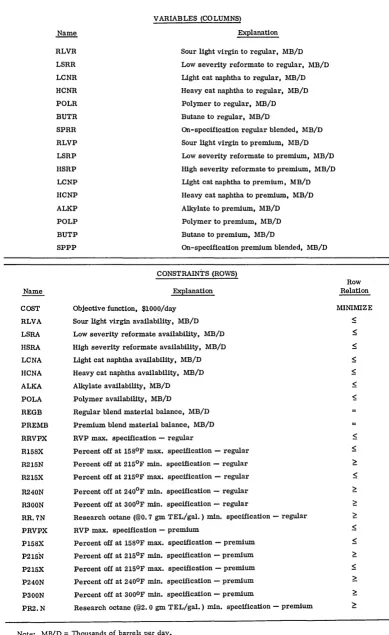
It is conv~nient to use symbolic names (mnemon-ics) for the variables (material activity columns) and constraints (rows) which form the model. Hence, instead of identifying the variables as Xl' X2, X3, etc., we employ recognizable abbreviations. Sour light virgin used in the regular blend is desig-nated RLVR. The same material used in premium
MATERIAL BALANCE BLEND P
blend is designated RLVP. A table of all the mne-monics that will be employed in the model matrix of our sample problem appears in Figure 5.
In Figure 5 ~ the symbol in the row relation column indicates the type of constraint equation or inequality - that is, whether the sum of the terms to the left of the symbol in the row is equal to (=),
less j:han or equal to (~), or greater than or equal to (~) the amount on the right-hand side. Minimize associated with the obj ective function (COST) row in the matrix indicates that the LP system will find the solution that minimizes this function while meeting all of the constraints.
Having established the input data (Figures 1, 2, and 3) and the mnemonics for the variables in our problem (Figure 4), we may now develop the
[image:7.620.31.473.56.412.2]Name
COST
RLVA
LSRA
HSRA
LCNA
HCNA
ALKA
POLA
REGB
PREMB
RRVPX
R15SX
R215N
R215X
R240N
R300N
RR.7N
PRVPX
P15SX
P215N
P215X
P240N
P300N
PR2.N RLVR
LSRR
LCNR
HCNR
POLR
BUTR
SPRR
RLVP
LSRP
HSRP
LCNP
HCNP
ALKP
POLP
BUTP
SPPP
VARIABLES (COLUMNS)
Explanation
Sour light virgin to regular, MB/D
Low severity reformate to regular, MB/D
Light cat naphtha to regular, MB/D
Heavy cat naphtha to regular, MB/D
Polymer to regular, MB/D
Butane to regular, MB/D
On-specification regular blended, MB/D
Sour light virgin to premium, MB/D
Low severity reformate to premium, MB/D
High severity reformate to premium, MB/D
Light cat naphtha to premium, MB/D
Heavy cat naphtha to premium, MB/D
Alkylate to premium, MB/D
Polymer to premium, MB/D
Butane to premium, MB/D
On-specification premium blended, MB/D
CONSTRAINTS (ROWS)
Explanation
Objective 'function, $1000/day
Sour light virgin availability, MB/D
Low severity reformate availability, MB/D
High severity reformate availability, MB/D
Light cat naphtha availability, MB/D
Heavy cat naphtha availability, MB/D
Alkylate availability, MB/D
Polymer availability, MB/D
Regular blend material balance, MB/D
Premium blend material balance, MB/D
RVP max. specification - regular
Percent off at 15SoF max. specification - regular
Percent off at 2150F min. specification - regular
Percent off at 2150F max. specification - regular
Percent off at 2400F min. specification - regular
Percent off at3000F min. specification - regular
Research octane (@O.7 gm TEL/gal.) min. specification - regular
RVP max. specification - premium
Percent off at 15SoF max. specification - premium
Percent off at 2150F min. specification - premium
Percent off at 2150F max. specification - premium
Percent off at 2400F min. specification - premium
Percent off at 3000F min. specification - premium
Research octane (@2. 0 gm TEL/gal.) min. specification - premium
Note: MB/D = Thousands of barrels per day.
Figure S. Mnemonic tables
Row Relation
MINIMIZE
~
~ ~
:S :S :S
$
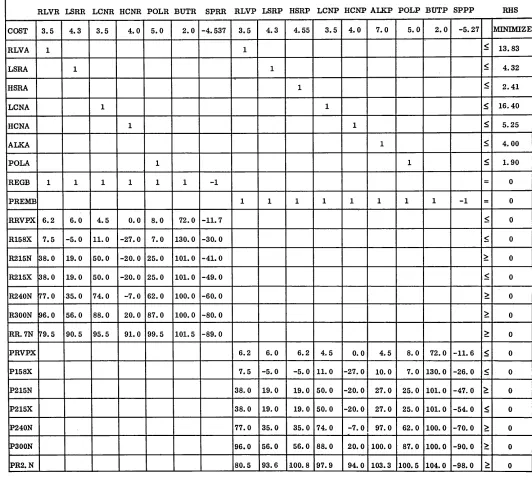
[image:8.613.62.451.42.677.2]The following sections discuss each constraint in detail. (The complete matrix~ incorporating all the constraints to be discussed, is shown in Figure 6.)
Cost Constraint (Obj ective Function)
As discussed earlier, the objective function in this problem expresses total profit from production of the two gasoline blends. This is to be maximized.
The objective function may be stated:
(SPRR per barrel regular x selling priCe) + (SPPP per barrel premlUm x selling p.riCe)
- (total cost of materials used) = MAXIMUM
where:
SPRR = number of barrels of regular blend produced
SPPP = number of barrels of premium blend produced (total cost of materials used)
= (RLVR x cost per barrel of sour It.
virgin. ) + (LSRR x cost per barrel of low. sev. ref.) + • • • and so on for all the materials listed as variables in Figure 5, with each mnemonic repre-senting the number of barrels used in the blends.
For reasons which are not detailed here, it is more efficient, in terms of computer time, to mini-mize the objective function than to maximize it. -Taking advantage of this, we shall reverse the sign of each term in the above equation; to do this we merely enter each material cost per barrel as a positive value and the selling price per barrel of
each blend as a negative value. The LP system will then solve for a minimum value of this equation which will be a negative number whose absolute value represents the total profit. (Since it would sound illogical to minimize a function called profit, we shall name the objective function COST; it need only be remembered that reducing cost to the lowest
feasible negative value is equivalent to raising profit to the highest feasible positive value.)
The objective function, COST, will be the first row in the matrix (Figure 6). The terms repre-senting material cost are formed quite simply: the cost per barrel for each material from (Figure 3) is merely entered as a coefficient in the COST row under the column for that material. Now, for. each of the two blends (regular and premium), we estab-lish a total-blend-produced column (SPRR and SPPP, respectively). In the COST row under these columns, we must enter a coefficient representing the antici-pated selling price of each blend. As Figure 3
indicates, the basic selling price (refinery realiza-tion) of the regular blend is $4.60 per barrel. But we established that the TEL level for regular must be 0.7 gm/gal., and that it costs $0.09 per barrel to produce a TEL level of 1 gm/gal. Hence the net realization per barrel of regular blend produced will be
$4.60 - 0.7 ($0.09) = $4.537.
Similarly, the net realization per barrel of premium blend with a 2 gm/gal. TEL level is
$5.45 - 2 ($0.09)
=
$5.27.Thus, the terms representing net realization from production are incorporated in the objective func-tion by entering - 4.537 and - 5.27 as COST coef-ficients in the SPRR and SPPP columns,
respectively.
The complete obj ective function shown in the COST row of the matrix can then be expressed as:
3.50 RLVR + 4.30 LSRR + 3.50 LCNR
+ 4.00 HCNR + 5.00 POLR + 2.00 BUTR
- 4.537 SPRR + 3.50 RLVP + 4.30 LSRP
+ 4.55 HSRP + 3.50 LCNP + 4.00 HCNP
+ 7.00 ALKP + 5.00 POLP + 2.00 BUTP
- 5.27 SPPP
=
COST (MINIMIZ E)RLVR LSRR LCNR HCNR POLR BUTR SPRR RLVP LSRP HSRP LCNP HCNP ALKP POLP BUTP SPPP RHS
COST 3.5 4.3 3.5 4.0 5.0 2.0 -4.537 3.5 4.3 4.55 3.5 4.0 7.0 5.0 2.0 -5.27 MINIMIZE
RLVA 1 1 S 13.83
LSRA 1 1 S 4.32
HSRA 1 S 2.41
LCNA 1 1 S 16.40
HCNA 1 1 S 5.25
ALKA 1 S 4.00
POLA 1 1 S 1. 90
REGB 1 1 1 1 1 1 -1
=
0PREMB 1 1 1 1 1 1 1 1 -1
=
0RRVPX 6.2 6.0 4.5 0.0 8.0 72.0 -11.7 S 0
R158X 7.5 -5.0 11.0 -27.0 7.0 130.0 -30.0 S 0
R215N ~8. 0 19.0 50.0 -20.0 25.0 101.0 -41.0 ~ 0
R215X ~8.0 19.0 50.0 -20.0 25.0 101.0 -49.0 S 0
R240N ~7.0 35.0 74.0 -7.0 62.0 100.0 -60.0 ~ 0
R300N ~6.0 56.0 88.0 20.0 87.0 100.0 -80.0 ~ 0
RR.7N ~9.5 90.5 95.5 91.0 99.5 101.5 -89.0 ~ 0
PRVPX 6.2 6.0 6.2 4.5 0.0 4.5 8.0 72.0 -11.6 S 0
P158X 7.5 -5.0 -5.0 11.0 -27.0 10.0 7.0 130.0 -26.0 S 0
P215N 38.0 19.0 19.0 50.0 -20.0 27.0 25.0 101. 0 -47.0 ~ 0
P215X 38.0 19.0 19.0 50.0 -20.0 27.0 25.0 101. 0 -54.0 S 0
P240N 77.0 35.0 35.0 74.0 -7.0 97.0 62.0 100.0 -70.0 ~ 0
1P300N 96.0 56.0 56.0 88.0 20.0 100.0 87.0 100.0 -90.0 ~ 0
jpR2. N 80.5 93.6 100.8 97.9 94.0 103.3 100.5 104.0 -98.0 > 0
[image:10.792.202.734.77.557.2]COST - that is, yield a negative COST value with the largest feasible absolute magnitude. With the sign changed from negative to positive, this COST value represents the maximum feasible profit.
Availability Constraints
We have formulated this example so that the total amount blended will depend on the availability and cost of each component. In practice, we might also establish upper or lower limits on the desired yield for each blend (as is done in the more complex example described in later sections of this manual). The formulation used for this Simple example, how-ever, will result in a solution providing the ratio between regular and premium blends (within the specification and availability constraints) which produces the largest profit.
The inventory availability constraints can be formulated in the matrix very simply. For example, the total amount of sour light virgin available is limited to 13, 830 barrels per day (from Figure 1). This amount may be distributed between the regular blend and the premium blend. Thus, the total num-ber of barrels of sour light virgin used in the reg-ular blend (RL VR) and in the premium blend (RLVP) must not exceed 13. 83 thousand barrels per day, or:
RLVR + RLVP ~ 13.83 MB/D.
To express this limitation in the matrix, we estab-lish a sour light virgin availability constraint row (RLVA) with 13.83 as its right-hand side and the coefficient 1 in the RLVR and RL VP columns.
Each of the remaining materials (except butane) is Similarly bounded by summing the quantities used in regular and premium and setting the total equal to or less than the quantity available in MB/D (note that high severity reformate and alkylate are used only in the premium blend):
Low severity reformate availability (LSRA): High severity reformate
availability (HSRA): Light cat naphtha
availability (LCNA): Heavy cat naphtha
availability (HCNA): Alkylate availability
(ALKA):
Polymer availability (POLA):
LSRR + LSRP ~ 4.32
HSRP
5
2.41LCNR + LCNP ~ 16. 40
HCNR + HCNP ~ 5.25
ALKP ~ 4.00
POLR + POLP ~ 1. 90
It should be mentioned that the IBM 1620 LP sys-tem (and other IBM LP syssys-tems) actually. provides for the bounding of column activities (variables) without the use of constraint rows. This feature reduces the effective size of a matrix, conserVing computer time and storage capacity, and thus per-mits the processing of very large problems which would otherwise be impossible or uneconomical.
(The use of bounded variables is illustrated in the three-blend sample problem to be discussed in a subsequent section.)
Having established the availability constraints for the components, we must now formulate a material balance expression for each blend which will
con-strain the quantity of final blend to the availability of components. We employ the total-blend-produced variables (SPRR and SPPP) which were established for the profit formulation. The sum of all compo-nents used in regular equals the total regular blended
(SPRR), and the sum of all components used in premium equals the total premium blended (SPPP). Solving for a zero right-hand Side, we obtain the following material balance equations:
RLVR + LSRR + LCNR + HCNR + POLR
+ BUTR - SPRR == 0 and
RLVP + LSRP + HSRP + LCNP + HCNP + ALKP
+ POLP + BUTP - SPPP == O.
These appear in the matrix as rows REGB and PREMB, respectively.
The foregoing availability and material balance formulations, when combined with speCifications formulations, insure a solution which will meet specifications within availability limits. We now need to consider the somewhat more complex spec-ification formulations.
Specification Constraints
We
shall assume for this sample problem that the various quality factors of each of the components blend linearly; that is, if one barrel of quality 10 is blended with one barrel of quality 20, the result will be two barrels of quality 15. The variations from such results observed in practice. are treated later in the section devoted to model refinement techniques.tolerance of 0.3 (from Figure 2); therefore, we shall establish the maximum RVP for regular in the model matrix as 12 - 0.3, or 11. 7. When a blend tolerance is associated with a minimum spec-ification, as for the 215°F, 240°F, and 300°F volatility percentages, the blend tolerance is added to the minimum as a safety factor. Hence the min-imums for 215°F, 240°F, and 300°F regular
volatility percentages are 39 + 2, 58 + 2, and 78 + 2, or 41, 60, and 80, respectively.
Linear expressions serving to constrain the final blend to specifications can be formulated quite eas-ily. For each quality factor (such as RVP number), the analysis values listed in Figure 1 may be multi-plied by the quantities of the corresponding compo-nents in the blend, and the sum of these products expresses the total value of that quality factor in the final blend, which must meet the specification listed in Figure 2. Recall that there is a matrix column to represent the quantity of each raw material to be included in the blend recipe, and one to represent the total quantity of each blend. Using the column mnemonics as the variables, then, we may express the RVP maximum specification for regular (cor-rected for tolerance) as:
6.2 RLVR + 6.0 LSRR+ 4.5 LCNR+ 0 HCNR + 8.0 POLR + 72.0 BUTR - 11. 7 SPRR ~ 0 This specification constraint is then incorporated in the matrix by establishing a row (RRVPX) with the above coefficients in the appropriate columns and 0 as the right-hand side. Applying the same method to each of the blend specifications, we pro-duce the necessary set of matrix rows. Thus, the maximum specification for volatility percentage at 158°F for regular is expressed as:
7.5 RLVR - 5.0 LSRR + 11. 0 LCNR - 27.0 HCNR + 7.0 POLR + 130.0 BUTR - 30.0 SPRR
S
0,which appears in the matrix as row R158X. For premium blend, the maximum 158°F volatility per-centage specification is expressed as:
7.5 RLVP - 5.0 tsRP - 5.0 HSRP + 11.0 LCNP - 27.0 HCNP + 10.0 ALKP + 7.0 POLP +130.0 BUTP - 26.0 SPPP ~ 0,
which appears in the matrix as row P158X. When all the blend specification and material availability constraints have been incorporated into the matrix, the problem formulation is complete.
Input Listing
Once the model matrix is formulated, the data are keypunched, and an input listing is prepared. The
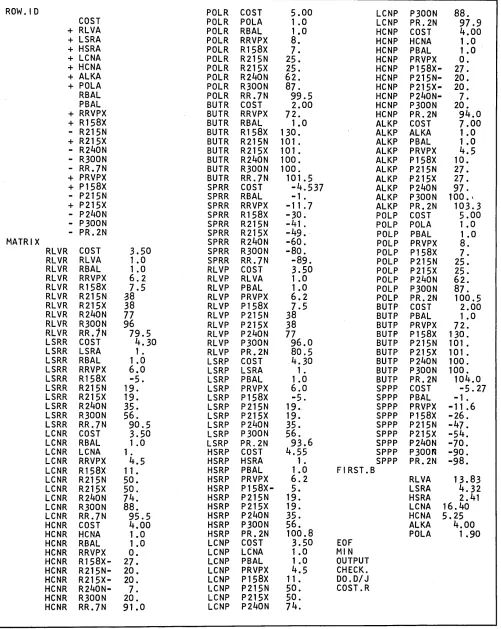
input listing for the formulated two-blend problem matrix appears in Figure 7.
The first section of the listing (ROW. ID) identi-fies the constraint rows and the type of row rela-tion: "+" indicates an equal-to-or-Iess-than
relation, "-" indicates an equal-to-or-greater-than relation, and
"0"
(blank) indicates an equality.The second section (MATRIX) lists the coeffi-cients, identified by column and row names. The right-hand sides for each constraint are listed in the third section (FmST .B); where no entry appears values are assumed zero.
Summary of Sample Problem
In the foregoing discussion, we have demonstrated the application of linear programming techniques to gasoline blending by constructing an LP model designed to solve a typical production problem. In the following section we shall describe the output reports produced by the computer LP system, upon solution of our sample problem, and discuss the interpretation and analysis of these reports.
The sample problem was simplified by stating that only two blends are required, and by assuming linear octane blending and predetermined TEL levels. However, the LP model formulated here can be readily expanded to include several blends, octane weighting techniques, and TEL formulations as well. Indeed, the usefulness of the LP technique increases with the complexity of the problem. In a later sec-tion, we shall formulate and solve a larger and more complex problem as a further illustration of LP capabilities.
,Construction of the basic LP model entails little more than organizing, in' a special format, the data historically used in calculating gasoline blends. Once formulated and converted to input media for com-puter processing, the model becomes a master record. It can be updated regularly to account for new conditions such as the addition or deletion of activities, changes in inventory constraints, changes in costs, and changes in specifications.
OUTPUT REPORTS
The linear programming system may employ the input data to compute a variety of output reports. We are here principally concerned with four basic re-ports which the system produces:
• Basis variables report • Slacks report
• DO. D/J report • Cost range report
ROW.ID
POLR
COST
5.00
LCNP
P300N
88.
COST
POLR
POLA
1.0
LCNP
PR.2N
97.9
+
RLVA
POLR
RBAL
1.0
HCNP
COST
4.00
+
LSRA
POLR
RRVPX
8.
HCNP
HCNA
1.0
+
HSRA
POLR
R158X
7.
HCNP
PBAL
1.0
+
LCNA
POLR
R215N
25.
HCNP
PRVPX
o.
+
HCNA
POLR
R215X
25.
HCNP
P158X-
27.
+
ALKA
POLR
R240N
62.
HCNP
P215N-
20.
+
POLA
POLR
R300N
87.
HCNP
P215X-
20.
RBAL
POLR
RR.7N
99.5
HCNP
P240N-
7 •
PBAL
BUTR
COST
2.00
HCNP
P300N
20.
+
RRVPX
BUTR
RRVPX
72.
HCNP
PR.2N
94.0
+
R158X
BUTR
RBAL
1.0
ALKP
COST
7.00
- R215N
BUTR
R158X
130.
ALKP
ALKA
1.0
+
R215X
BUTR
R215N
101.
ALKP
PBAL
1 .0
- R240N
BUTR
R215X
101.
ALKP
PRVPX
4.5
- R300N
BUTR
R240N
100.
ALKP
P158X
10.
- RR.7N
BUTR
R300N
100.
ALKP
P215N
27.
+
PRVPX
BUTR
RR.7N
101 .5
ALKP
P215X
27.
+
P158X
SPRR
COST
-4.537
ALKP
P240N
97.
- P215N
SPRR
RBAL
-1 .
ALKP
P300N
100. '
+
P215X
SPRR RRVPX
-11 .7
ALKP
PR.2N
103.3
- P240N
SPRR
R158X
- 30
~POLP
COST
5.00
- P300N
SPRR
R215N
-41.
POLP
POLA
1.0
- PR.2N
SPRR
R215X
-49.
POLP
PBAL
1.0
MATRIX
SPRR
R240N
-60.
POLP
PRVPX
8.
RLVR
COST
3.50
SPRR R300N
-80.
POLP
P158X
7.
RLVR
RLVA
1.0
SPRR
RR.7N
-89.
POLP
P215N
25.
RLVR
RBAL
1.0
RLVP
COST
3.50
POLP
P215X
25.
RLVR
RRVPX
6.2
RLVP
RLVA
1.0
POLP
P240N
62.
RLVR
R158X
7.5
RLVP
PBAL
1.0
POLP
P300N
87.
RLVR
R215N
38
RLVP
PRVPX
6.2
POLP
PR.2N
100.5
RLVR
R215X
38
RLVP
P158X
7.5
BUTP
COST
2.00
RLVR
R240N
77
RLVP
P215N
38
BUTP
PBAL
1.0
RLVR
R300N
96
RLVP
P215X
38
BUTP
PRVPX
72.
RLVR
RR.1N
79.5
RLVP
P240N
77
BUTP
P158X
130.
LSRR
COST
4.30
RLVP
P300N
96.0
BUTP
P215N
101.
LSRR
LSRA
1.
RLVP
PR.2N
80.5
BUTP
P215X
101.
LSRR
RBAL
1.0
LSRP
COST
4.30
BUTP
P240N
100.
LSRR
RRVPX
6.0
LSRP
LSRA
1.
BUTP
P300N
100.
LSRR
R158X
-5.
LSRP
PBAL
1.0
BUTP
PR.2N
104.0
LSRR
R215N
19.
LSRP
PRVPX
6.0
SPPP
COST
-5.27
LSRR
R215X
19.
LSRP
P158X
-5.
SPPP
PBAL
-1 .
LSRR
R240N
35.
LSRP
P215N
19 •.
SPPP
PRVPX
-11 .6
LSRR
R300N
56.
LSRP
P215X
19.
SPPP
P158X
-26.
LSRR
RR.7N
90.5
LSRP
P240N
35.
SPPP
P215N
-47.
LCNR
COST
3.50
LSRP
P300N
56.
SPPP
P215X
-54.
LCNR
RBAL
1.0
LSRP
PR.2N
93.6
SPPP
P240N
-70.
LCNR
LCNA
1.
HSRP
COST
4.55
SPPP
P300rq
-90.
LCNR
RRVPX
4.5
HSRP
HSRA
1.
SPPP
PR.2N -98.
LCNR
R158X
11.
HSRP
PBAL
1.0
FIRST.B
LCNR
R215N
50.
HSRP
PRVPX
6.2
RLVA
13.83
LCNR
R215X
50.
HSRP
P158X-
5.
LSRA
4.32
LCNR
R240N
74.
HSRP
P215N
19.
HSRA
2.41
LCNR
R300N
88.
HSRP
P215X
19.
LCNA
16.40
LCNR
RR.7N
95.5
HSRP
P240N
35.
HCNA
5.25
HCNR
COST
4.00
HSRP
P300N
56.
ALKA
4.00
HCNR
HCNA
1.0
HSRP
PR.2N
100.8
POLA
1 .90
HCNR
RBAL
1.0
LCNP
COST
3.50
EOF
HCNR
RRVPX
o.
LCNP
LeNA
1.0
MIN
HCNR
R158X-
27.
L,CNP
PBAL
1.0
OUTPUT
HCNR
R215N-
20.
LCNP
PRVPX
4.5
CHECK.
HCNR
R215X-
20.
LCNP
P158X
11.
DO.D/J
HCNR
R240N-
7.
LCNP
P215N
50.
COST.R
HCNR
R300N
20.
LCNP
P215X
50.
HCNR
RR.7N
91.0
LCNP
P240N
74.
[image:13.612.40.541.59.688.2]Each of these reports is discussed and illustrated below.
BASIS VARIABLES AND SLACKS REPORTS The basis variables report (Figure 8) provides a list of all the activities in the "basis" (that is, the set of all materials appearing at a nonzero level in the optimal blends) and indicates the quantity of ,each material used for each of the blends. The
slacks report (Figure 9) provides a list of all the row mnemonics -- that is, all the inventory availability and specification constraints -- and indicates how much of each available material was not used and the amount by which each quality specification was exceeded. If the maximum quantity of a material was used, or if a specification was met at a bound, the slacks report provides a figure called the ~
plex multiplier, which is Significant in the DO. D/J report discussed later.
The letters in the TYPE column of these reports indicate the condition of the variables. The letter "F" indicates solution at an intermediate level, 'WIt indicates solution at a lower bound, and "G" indicates solution at an upper bound. The signs have been taken from the input listing.
The standard solution printout given in Figures 8 and 9 can be more readily interpreted when re-organized. One such reorganization is shown in Figure 10. In this figure, values in the regular and premium "Component Disposition" columns, representing amounts used, have been taken from the ACTIVITY LEVEL column of the basis variables report (Figure 8); the "Unused" component values are taken from the ACTIVITY LEVEL column of the slacks report (Figure 9); and the "Marginal Value" items are from the SIMPLEX MULT. column of Figure 9.
The component marginal values given in Figure 10 may be interpreted as the premium that could be
VARBLS
TYPE NAME ACTIVITY LEVEL
F
RLVR
1 3. 164
F
LSRR
4.320
F
LCNR
10.789
F
HCNR
2.764
F
BUTR
3.434
F
SPRR
34.471
F
RLVP
.666
F
LCNP
5.611
F
ALKP
.412
F
POLP
1 .900
F
BUTP
.881
F
SPPP
9.469
Figure 8. Basis variables report
SLACKS TYPE NAME ACTIVITY LEVEL SIMPLEX MULT.
F COST
49.849-+W RLVA .907
+W LSRA .198
+F HSRA 2.410
+W LCNA 2.156
+F HCNA 2.486
+F ALKA 3.588
+W POLA .574
G RBAL .000 .107
G PBAL .000 9.464
+W RRVPX .078
+F R158X 466.560
-W R215N
.025-+F R215X 275.764
-F R240N 219.012
-F R300N 96.107
-W RR.7N
.051-+W PRVPX .075
+F P158X 47.575
-F P215N 8.362
+F P215X 57.923
-F P240N 49.445
-W P300N
.069--W PR.2N
.096-Figure 9. Slacks report
paid for additional stocks. For example, since the marginal value of light cat naphtha is $2.16 per bbl. , and its cost in the model was set at $3. 50 per bbl. , the refinery could pay up to $5.66 per bbl. for ad-ditional light cat naphtha over and above its present availability of 16.4MB/D. Such a high marginal value indicates that a new running plan which makes more light cat naphtha available for gasoline blend-ing would undoubtedly be profitable.
The basis variables and slacks reports also provide important data which enables the producer to determine the cost of quality and the amount of quality giveaway. The chart of Figure 11 tabulates the cost of specified quality (taken from the SIM-pLEx MULT. column of the slacks report), the slack in qUality-MB/D (which has little physical interpretation and which was taken from the ACTIVITY LEVEL column of the slacks report) and the true quality of the blend. This last is determined as follows: the slack is divided by the total amount of the grade blended, and the result is either subtracted from or added to the tolerance-adjusted specification, depending on whether the specification is a maximum or a minimum, re-spectively. For example, the 1580
F maximum volatility specification for regular of 30% was ex-ceeded by 467 quality-MB/D. Since 34.471 MB/D
[image:14.620.339.580.53.270.2] [image:14.620.78.287.517.662.2]Component Disposition
Regular
Component (MB/D)
Sour light virgin 13.164
Low severity reformate 4.320
High severity reformate
---Light cat naphtha 10.789
Heavy cat naphtha 2.764
Alkylate
---Polymer
---Butane 3.434
TOTAL 34.471
Figure 10. Component disposition
Regular
Cost of Specs. Slack
($/Q-bbl) (Q-MB/D)
RVP - 0.078
158 MAX 467
215 MIN -0.025
240 MIN 219
300 MIN 96
Octane -0.051
Figure 11. Quality
of regular was blended, the true quality of the blend for 158°F maximum volatility is
30 - 467/34.471
=
16.5.The costs of the octane specifications are the most interesting figures in this table. The cost of octane from components is 5.1,s per Q-bbl. for regular and 9. 6,s per Q-bbl. for premium, at TEL levels of 0.7 and 2.0 gm/gal., respectively. We should calculate the cost of octane from TE~ in
order to determine whether the TEL levels chosen
Premium Unused Marginal Value
(MB/D) (MB/D) ($/bbl)
0.666
---
0.91---
---
0.20---
2.410---5.611
---
2.16---
2.486---0.412 3.588
---1.900
---
0.570.881
---
---9.469
---
---Premium
Qual. Cost of Specs. Slack Qual.
(Q) ($/Q-bbl) (Q-MB/D) (Q)
11.7 0.075 11. 6
16.5 48 20.9
41. 0 8 47.8
66.4 49 75.2
82.8 -0.069 90.0
89.0 -0.096 98.0
for the model contribute to a maximum profit blend. If they were well chosen, there will be little differ-ence in the cost of octane from components and the cost of octane from TEL. If the TEL levels are too low, then the cost of octane from TEL will be substantially less than the cost of octane from components, and, of course, the reverse will be true if the TEL levels are too high.
[image:15.615.29.536.53.317.2] [image:15.615.32.535.360.554.2]the amount of each component used in each blend by its octane at 0 and 3 gm/gal. TEL, and dividing by the total amount of each blend produced. In
short, we calculate, by averaging each of these component octanes, the octane of the two specified
blends at 0 and 3 gm/gal. TEL levels. These val-ues, plotted on the DuPont TEL susceptibility chart and joined by lines, provide the octane-versus-TEL relationships over the range from 0 to 3 gm/gal.
(Figure 12).
TETRAETHYL LEAD, MILLILITERS PER GALLON
0.0 0.5 1.0 1.5 2.0 2.5 3.0 3.5 4.0
I I I I
I
I I I I I I I I II I 111JJ
I110
105
0 w
a:
I
100
Vi w
0 -~ ~~ I-I-~
99
w
l!l
z
<
a:
>-z
~
~ ~ ~ 1- ....
~ I -...
r
---
~ ~~ ~
-""'"'" ~
0::
lJJ
m
95 ::E
:J Z
~ 92.8 , I'--' lJJ
lJJ
m
::E :J
Z
lJJ
Z
«
t3
860
~ 0
I--I-1-1--I"' I"' R,
-~ 1- ....
0.-1-~ I -~ ~
.-...
-..--
~ --~~ ~
~
---91.8 Z
«
90
t3
0
0::
0 I-0
::E
85
~
0
J:
0 U
::E ~
«
0::0 80
lJJ (f) lJJ
J: 0::
U 0::
«
lJJ (f)
lJJ 75
0::
70
65
0.0 0.5 1.0 1.5 2.0 2.5 3.0 3.5 4.0 4.5
GRAMS OF LEAD PER GALLON
Figure 12. TEL motor antiknock susceptibility chart.
Form, courtesy of E. I. du Pont de Nemours & Co. (Inc.)
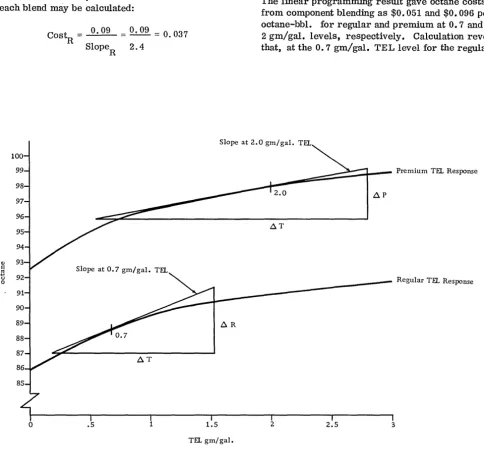
[image:16.626.74.566.117.680.2]The lines on the TEL susceptibility chart are replotted in linear rectangular coordinates in Figure 13. If we take the partial derivative of octane with respect to TEL at the specific TEL concentrations used in each blend, we determine the slope of the octane-versus-TEL curves at those levels (indicating the rate of octane appreciation per gm/gal. TEL). The cost of octane from TEL, then, can be determined easily as follows: We divide the cost of TEL per barrel at 1 gm TEL/gal. ($0. 09), by the rate of octane appreciation at the given TEL levels.
The slope of the TEL response curve for regular at 0.7 gm/gal. TEL (~R/ ~T) = 2.4. The slope of the TEL respense curve for premium at 2.0 gm/gal. TEL
=
1. 2. Hence, the cost of octane from lead for each blend may be calculated:Cos~
=
~=
0.09=
0.037 SlopeR 2.4where
0.09 _ 0.09 - 0 075
Cost
= - - - .
p Slope
p 1. 2
Cost
R
=
cost of octane from lead (regular),$ per octane-bbl.
Costp = cost of octane by lead (premium),
$ per octane-bbl.
Slope
=
slope of octane-versus-TEL graph at R specified lead level (regular).Slopep = slope of octane-versus-TEL graph at specified lead level (premium). The linear programming result gave octane costs from component blending as $0.051 and $0.096 per octane-bbl. for regular and premium at 0.7 and 2 gm/gal. levels, respectively. Calculation reveals that, at the 0.7 gm/gal. TEL level for the regular
Slope at 2. a gm/ gal. TEL 100
99
a .5
Figure 13. TEL response curves
TEL gm/gal.
--.... ;;:::::::::::::::::::::::::;.-1--
Premium TEL ResponseL\P
_ _ - - - - Regular TEl. Response
[image:17.618.35.520.237.696.2]blend, octane appreciation from lead costs $0.037, while at 2 gm/gal. TEL (premium), octane appre-ciation from lead costs
o.
075 per octane-bbl. Clearly, higher TEL levels for both regular and premium would result in specified octane numbers at less cost. The amount of upward adjustment remains a matter of judgment since new component qualities will result in alternative blend composi-tions. Desirable changes in component availability can be introduced into the model matrix at the same time.RE-SOLUTION
The data provided by the basis variables and slacks reports and the TEL calculations suggests a
re-solution with the following changes in the model matrix:
Component Availabilities LCNA
S
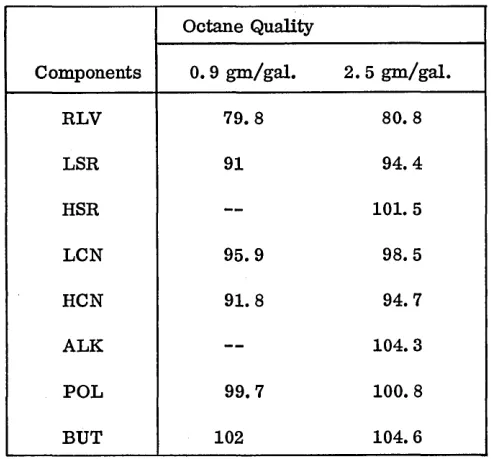
18.40 MB/D RLVA S 14.83 MB/DTetraethyl lead levels were established at O. 9 gm/gal. -for regular and 2.5 gm/gal. for premium. The component octane numbers at these levels are given in Figure 14.
The re-solution can be accomplished quite rapidly by punching new cards only for the altered values and introducing the new values into the computer-" stored problem. The altered input listing appears in Figure 15. The new COST
Octane Quality
Components 0.9 gm/gal. 2.5 gm/gal.
RLV 79.8 80.8
LSR 91 94.4
HSR
--
101. 5LCN 95.9 98.5
HCN 91. 8 94.7
ALK
--
104.3POL 99.7 100.8
BUT 102 104.6
Figure 14. Octane numbers at 0.9 gm/gal. and 2.5 gm/gal. TEL levels
REVISE
MATRIX
RLVR
RR.7N
79.8
LSRR
RR.7N
91 .
LCNR
RR.7N
95.9
HCNR
RR.7N
91 .8
POLR
RR.7N
99.7
BUTR
RR.7N
102.
SPRR
COST
-4.519
RLVP
PR.2N
80.8
LSRP
PR.2N
94.4
HSRP
PR.2N
101 .5
LCNP
PR.2N
98.5
HCNP
PR.2N
94.7
ALKP
PR.2N
104.3
POLP
PR.2N
100.8
BUTP
PR.2N
104.6
SPPP
COST
-5.225
FIRST.B
RLVA
14.83
LCNA
18.40
EOF
MIN
OUTPUT
CHECK.
DO.D/J
COST.R
[image:18.613.332.515.51.356.2]Figure 15. Revisions for re-solution of the model matrix
figures for regular (SPRR) and premium (SPPP) reflect the increase'd cost due to additional TEL. Re-solution with new availabilities and new TEL levels prOduces the output tabulation of Figure 16.
The new overall profit is $55,255 per day (substantially higher than the $49, 849 profit of the first solution). If we multiply the quantity of each component used in regular by its cost, sum the costs, divide by the quantity of regular produced, and subtract the result from the selling price of regular, we determine the profit per barrel
-which, in this case, is $1. 03. Premium was blended at a profit of $1.57 per barrel. Further, in the re-solution, the cost of octane from lead is close to the cost of octane from component allocation. The high marginal value associated with light cat naphtha indicates that a second re-solution with even more of that component available will produce a more profitable blend. Additional information is produced by the LP output in the DO. D/J and cost range reports discussed below.
[image:18.613.66.312.447.677.2]Component Disposition
Regular
Component (MB/D)
Sour light virgin 13.662
Low severity reformate 4.320
High severity reformate
---Light cat naphtha 9.760
Heavy cat naphtha 2.452
Alkylate
---Polymer
---Butane 3.296
TOTAL 33.490
Regular
Cost of Specs. Slack
($/Q-bbl) (Q-MB/D)
RVPMAX 0.079
158 MAX 454
215 MIN -0.026
240 MIN 228
300 MIN 111
Octane -0.051
Figure 16. Component disposition and quality from re-solution
DO. D/J REPORT
The DO. D/J report (Figure 17) consists of two parts. The first part (VBLS) lists all the column activities - raw materials in this case - which are solved at a bound. When the material is at a lower bound, ordinarily zero, the report indicates for each
16
Premium Unused Marginal Value
(MB/D) (MB/D) ($/bbl)
1.168 0.904
---
0.199---
2.4108.640 2.170
---
2.7980.326 3.674
I. 900 0.560
1.272
---
---13.305
Qualities
Premium
Qual. Cost of Specs. Slack Qual.
(Q) ($/Q-bbl) (Q-MB/D) (Q)
11. 7 0.074 11. 6
16.4 60 21. 5
41 36 49.7
66.8 74 75.6
83.3 -0.065 90
89 -0.094 98
[image:19.613.37.538.52.322.2]DO.D/J
VBLS
TYPE
NAME
CURRENT COST
REDUCED COST
BASIS VALUE
W POLR
5.000
W LSRP
4.300
W HSRP
4.550
W HCNP
4.000
ROWS
TYPE
NAME
INCR B VALUE
DECR
+
RLVA
.904
+
LSRA
. 199
+
HSRA
+
LCNA
2. 170
+
HCNA
+
ALKA
+
POLA
.560
RBAL
.166
PBAL
9.006
+
RRVPX
.079
+
R158X
- R215N
+
R215X
- R240N
- R300N
- RR.7N
+
PRVPX
.074
+
P158X
- P215N
+
P215X
- P240N
- P300N
- PR.2N
Figure 17. DO. D/J report from re-solution
Referring to Figure 17, we see, for example, that no polymer (POLR) is us,ed in the regular blend, and that polymer will not enter the regular blend un-less its cost falls below $4.381 per barrel.
Similarly, no low severity reformate (LSRP) is used in the premium blend, and none will be used unless its cost falls below $2.881 per barrel. High severity reformate (HSRP) will not enter the blend unless its price falls below $3.732 per barrel.
The second part of the DO. D/J report (ROWS) provides a list of all the row (right-hand-side) mnemonics, and for each equation (and each inequality solved at a bound) indicates the "cost" of changing the right-hand side by one unit. (This "cost" is the value of the simplex multiplier in the slacks report, Figure 9.) If, for example, additional sour light virgin (RLVA) were available, the total profit would increase by 90. 4~ per barrel of sour light virgin added in the neighborhood of .. the optimal solution.
.619
4.381
1 .419
2.881
.818
3.732
2.801
1.199
B VALUE
.026
.051
.065
.094
This report also reveals the price of specified quality. In effect, it "costs" 7. 9~ per unit of RVP per barrel to meet the RVP specification for regular (RRVPX). Re-solution with a relaxed specification would doubtless produce a more profitable blend. Such indications alert the pro-ducer to those specifications which are mo'st costly and provide good indications of where permissible quality changes should be made.
Thus, the DO. D/J report establishes the price of quality, by indicating the cost of meeting a specification at a bound. Where these costs are high, re-solution with a slight relaxation of
specification may produce considerable savings. In actual practice, the producer may also find it desirable to force the allocation of certain materials in order to exercise proper inventory control. The DO. D/J report indicates the penalties which would result from such forcing of components into a blend, rendering it nonoptimal. However, since these
[image:20.615.61.448.53.382.2]costs hold only in the neighborhood of the optimal solution, the producer should re-solve, using a revised matrix input.
COST RANGE REPORT
the most economical blending would produce no premium at all.) Note that the cost range figures for sour light virgin allocated to premium (RLVP) indicate that the reverse occurs. That is, above the price of $5.342, premium octane giveaway is economical, while below the price of $2. 859, The cost range (COST. R) report (Figure 18)
indicates for each component that is included in the basis (optimal blends) the following data: current cost, highest cost before its quantity in the optimal solution changes, what other component would enter the solution at that highest cost, lowest cost before its quantity in the optimal solution changes, what other component would enter the solution at that lowest cost.
much of the component will be employed in the regular blend and high severity reformate (HSRP) will enter the premium blend.
The quantity of each component in the optimal solution (given by the basis variables report) will remain unchanged within the cost range indicated by the cost range report. For example, 13. 662 MB/D of sour light virgin (RLVR) would be allocated to regular even if it cost $4. 141 per barrel instead of $3.50. Were sour light virgin to exceed $4. 141 per barrel, the allocation ratio between regular and premium would change through a complex shifting of blend components which would result in high severity reformate (HSRP) entering the optimal premium blend. Were its price to drop below $1. 658 per barrel, a slack (PR. 2N) would appear in the premium octane specification. This indicates that so much of the sour light virgin would be used in the regular blend, that, given -the component availabilities and prices of this model, the most economical blending would allow octane giveaway in the premium. (In
practice, however, a re-solution might reveal that
COST.R
COST.R NAME
CURRENT COST
HIGHEST COST
RLVR
3.500
4. 141
LSRR
4.300
4.499
LC~R
3.500
4.200
HCNR
4.000
5.164
BUTR
2.000
4.670
Particularly in multiblend models of this kind, actual price changes which exceed the cost range indications justify a re"'solution of the problem, since the complexity of allocation shifts within and between the blends are not revealed in the cost range report. The cost range report, however, does give a good indication of when such re-solutions are desirable.
OUTPUT REPORT SUMMARY
The various output reports furnished by the LP system thus not only provide a detailed listing of the specific optimal solution but also alert the producer to a variety of relationships, anyone of which may profoundly influence the total profit from the blends. The computer enables the producer to re-solve the problem rapidly with a number of variations suggested by the output reports. He can, in effect, use the LP model as an aid in the solution of a series of different problems. What if the price of each of the components varies? What if certain inventory purchases are possible at
specific prices? What if quality controls vary? The LP solutions provide information which enables the producer to make the most judicious policy
HI -VAR
LO-VAR
LOWEST COST
HSRP
PR.2N
1 .658
LSRA
INFINITY-POLR
RR.7N
3.014
POLR
LSRA
3.480
HSRP
RR.7N
.538-SPRR
4.519-
4.240-
HSRP
RR.7N
4.821-RLVP
3.500
5.342
PR.2N
HSRP
2.859
LCNP
3.500
3.986
RR.7N
POLR
2.800
ALKP
7.000
13.978
POLA
HSRP
6.636
POLP
5.000
5.560
POLA
INFINITY-BUTP
2.000
5.809
RR.7N
HSRP
.593
SPPP
5.225-
4.878-
POLA
HSRP
[image:21.613.46.510.473.635.2]decisions in matters of refinery operation,
purchasing, quality control, inventory control, and product research. LP techniques make possible continuous management study - resulting in
decreased costs, increased efficiency, and maximum profits.
MODEL REFINEMENT TECHNIQUES
A number of refinements which contribute to more efficient and profitable operation can be introduced into the LP model for gasoline blending. These refinements, which generally increase accuracy, may be used to introduce methods for:
1. Linear approximations of TEL susceptibility 2. Linear formulation of composite quality specifications
3. Linear formulation of process yield compo-nents
We shall employ a number of these refinements in the construction of a large illustrative model matrix.
LINEAR APPROXIMATIONS FOR TEL SUSC EPTIBILITY
Tetraethyl lead does not linearly affect the octane of gasoline components." To evaluate with reason-able accuracy the effects on octane of a number of different TEL levels, we must empirically deter-mine the octane of the component without TEL and with TEL at a fairly high level, say 3 gm/gal. The empirically determined octanes provide the basis for interpolation (permitting a close estimate of response over a range of TEL levels). This is accomplished by plotting the empirically determined values on standard TEL graph paper (see Figure 12); a straight line interconnecting the two values on this paper then indicates the approximate octane of the component at practical TEL levels.
7
~ 6
~ S
n
~u u
o .5 4
2
TFl.. (gm/ gal. )
Figure 19. Estimated TFL curve for blend
3
In the sample problem, for which the model of Figure 6 was developed, the nonlinear effect of TEL on octane was handled by successive approx-imations. First the components were blended at specified TEL levels for regular and premium, and then the output reports were analyzed in order to compare. the cost of octane from compo-nents to the cost of octane from lead. The analysis suggested that higher TEL levels would produce the specified octane at less cost, and the problem was re-solved for higher specific TEL levels. Again, analysis of the output reports is required to determine the relationship between the cost of octane from components and the cost of octane from lead. It is possible, however, to formulate linear expressions which approximate the TEL susceptibility curves for the blend, and include them in the model matrix, which then can be solved for the TEL level required in each of the specified blends. Three methods of different sensitivities will be discussed.
The first, simplest, and least sensitive method is based on an estimated TEL susceptibility curve for the finished blend. For example, assume the blend TEL response curve shown in Figure 19.
The octane number appreciates at approximately the rate of 4 numbers per gm/gal. between 0 and 1 gm/gal. TEL, at approximately 2 numbers per gm/gal. between 1 and 2 gm/gal. TEL, and at approximately 1 number per gm/ gal. between 2 and 3 gm/gal. TEL. (Choosing closer intervals would result in more precise octane-versus-TEL relationships; however, since this method is based on an estimated TEL curve to begin with, it does not warrant closer intervals.) We can formulate three new activity columns L , L , L3 which
1 2
represent the amounts of tetraethyl lead added (in gm/gal.) between 0 and 1 gm/gal., between 1 and 2 gm/gal., and between 2 and 3 gm/gal. Each of these new variables has the same price, $0.09 per bbl. for 1 gm/gal. (or. in other words, the price of 42 grams).
~: The reader should be on guard against possible misunderstanding as a result of the various units used in discussing TEL. Gram-per-gallon (gm/gal.) units are used on charts and in discussions of TEL. In the matrix formulations. however, TEL is measured in per-barrel "units" of 42 grams. Since there are 42 gal. /bbl, concentrations in either case are numerically the same (for example,
1 gm/ gal.
=
1 unit/bbl) though the actual amounts and prices of TEL involved are different. [image:22.621.59.289.545.685.2]Octane of each component, then, is introduced into the octane specification row at a zero TEL level, but added to the octane specification row are three new terms:
4L
+
2L+
L 1 2 3signifying that the octane number is increased at the rate of 4 per gm/gal. for any TEL added between 0 and 1 gm/ gal., at the rate of 2 per gm/
gal. for any TEL added between 1 and 2 gm/gal., and at the rate of 1 per gm/gal. for any TEL added between 2 and 3 gm/gal. Since the TEL price is the same for L
1, L2, and L3, all the L1 (which adds most octane per dollar) will be used before any L , and similarly all L will be used
2 2
before any L
3. But, in order to establish proper limits on the TEL activities in the matrix, we must include constraints in the matrix which limit L
1, L
2, and L3 to 1 unit/bbl. (42 gm/bbl. or 1 gm/gal:) each. That is, if SPRR turns out to be 10,000 bbl. (10 MB/D) , then L
1, L and L are each limited to 2 3 10,000 units or 420,000 gms. for the entire blend. Thus:
L - SPRR 1
<
- 0L - SPRR 2
<
- 0L - SPRR 3
<
- 0If this method were employed for TEL computation, then the octane specification for the regular blend
RLVR LSRR LCNR HCNR POLR
COST 3.5 4.3 3.5 4.0 5.0
OCTR.O 75.5 86 .. 5 91. 5 87 95.5
REGB 1 1 1 1 1
LeadB
Figure 20. Matrix formulation for three-segment TEL approximation
in the sample model matrix (Figure 6) would appear as shown in Figure 20. This formulation would
gi~e the optimum TEL level for the desired blend if the estimated blend TEL response curve and the linearization of it were reasonably accurate.
A second method for formulating a linear approx-imation of the TEL response curve (developed by Healy - see reference 3) .makes use of a related but slightly different technique. In this method, the quality for each component is introduced into the matrix at two distinct levels - say 1 and 3 gm/gal. Thus, two rows are required to establish the octane specification, one summing the octane of the components at 1 gm/gal. levels and one summing the octane of the components at 3 gm/ gal. levels. Figure 21 shows the matrix formulation of the TEL approximation and Figure 22 illustrates its derivation.
In Figure 22 a linear approximation of TEL . response at the two levels is established by
determining the slope of a typical TEL. response curve for the blend at the two TEL levels. The slope at 1 gm/gal. is 4, and at 3 gm/gal. the slope is 1. The model matrix formulation will result in a TEL approximation lying along the cross-hatched portion of the slope lines. It can be shown that the variation in slope for most TEL curves is sufficiently small so that these values can be used as reasonable approximations to cover the TEL response curves, averaged, of all the components. We can then establish the formulations, consisting of two rows, as follows:
BUTR
2.0
97.5
1
79.5 RLVR
+
90.5 LSRR+
95.5 LCNR+
93 HCNR
+
97.5 POLR+
101. 5 BUTR -(89+
(1 x 4) ) SPRR+
4 L ~ 0 ,SPRR L1 L2 L3
-4.6 0.09 0.09 0.09
-89 4 2 1
-1 -1 1
-1 1
-1 1
RHS
= MIN
~ 0
= 0
S
0S
0 [image:23.621.50.545.508.682.2]RLVR LSRR LCNR HCNR
COST 3.5 4.3 3.5 4.0
OCTR:l 79.5 90.5 95.5 93
OCTR:3 82.5 93.5 98.5 97
REGB 1 1 1 1
LEADB
Figure 21. Matrix formulation for two-level TEL approximation
POLR BUTR
5.0 2.0
97.5 101.5
99 104.5
1 1
SPRR
-4.6 -93 -92 -1 -3
L
• 09 4' 1
1
=Min •
~o
~o
=0
:So
Slope at 1 gm/ gal. = 4
2
TEL (gm/ gal. )
Figure 22. TEL response curve for two-level approximation
for octane at 1 gm/gal. where the slope (that is, rate of octane increase from additional TEL) is 4 (octane per gm/gal. TEL): and
82.5 RLVR
+
93.5 LSRR+
98.5 LCNR+
97 HCNR+
99 POLR+
104.5 BUTR -(89+
(3 x 1) ) SPRR+
1 L ~ 0for octane at 3 gm/ gal. where the slope is 1. The interesting parts of this formulation are the blend specification (SPRR) and lead (L) terms. In
the first row, the tolerance-adjusted blend
specification of 89 is increased by (1 gm/gal. TEL) times (rate of octane appreciation at 1 gm/gal.
=
4). Since we have listed the components at 13
gm/gal. TEL levels, and we wis.h to determine how much TEL to add, we must indicate the impact of 1 gm/gal. TEL on the specification as well. The increase in the magnitude of the octane spec-ification, in effect, cancels the increase in the magnitude of each component's octane number resulting from the addition of 1 gm/gal. TEL. Hence, the computation will indicate how much TEL is required to raise the octane of the components from zero TEL levels to the specified octane.
Similarly, the expression for octane at 3 gm/ gal. TEL adds :{'times the rate of octane increase, or (3 gm/ga,t. :TEL) times (octane appreciation at 3 gm/gal. :;:1). The first expression assumes that octane increases by 4 for each gm/gal. TEL
[image:24.615.74.562.52.193.2] [image:24.615.67.561.76.486.2]added. The value of L (in gm TEL/gal. /bbl.) will be determined on a maximum profit basis, again within the errors inherent in the approximations used.
A final formulation bounds the total TEL and ensures that no more than 3 gm/gal. TEL is used:
L/3 ~ SPRR L - 3 SPRR $ 0
where L is TEL in gm/gal. /bbl. and SPRR is total blend produced in bbls.
This two-level approximation method is more sensitive than the first method, because the latter depends on an unalterable estimate of the final blend TEL response curve, while this method computes two pOints actually on the blend TEL
response curve. Thus, in the first method, both the TEL response curve and the slope of the chords joining the key points on that curve introduce error, while in the second method, since the points on the curve are computed, only the estimated slopes may introduce error.
A third method for formulating a linear approx-imation of TEL susceptibility (developed by Kawaratani, et ale - see reference 4) provides even more sensitivity to the lead response curve as the blend composition varies. In this method, we first plot the octane of each component at 0 and 3 gm/gal. TEL (Figure 23).
Q)
96
;:::
ri
u 0
93 ...
t'lI
[image:25.615.40.487.432.691.2]bl)
...
S
bl)
C'1
84 81 78
The envelope formed by joining the points defines the feasible area for the octane of any blend of these components. (Since LSRR and LCNR lie inside the feasible area, we need not employ them to form the feasible envelope.) Now, if we wish to meet a spe-cific octane spespe-cification, say 90, we can overlay a chart of TEL-octane lines as in Figure 24. Each of the TEL-octane lines represents the quantity of TEL in gm/gal. required to raise the octane to 90. Thus, the illustration in Figure 24 indicates that material
A (with 85 octane at 0 TEL and 90 octane at 3 gm/gal. TEL) requires 3. 0 gm/gal. TEL to reach 90; mate-rial B (with 87 octane at 0 TEL and 93 octane at 3 gm/gal. TEL) requires 2.5 gm/gal. ; material C (with 88 octane at 0 TEL and 96 octane at 3 gm/gal. TEL