P o r t a b l e K n o w l e d g e S o u r c e s for M a c h i n e T r a n s l a t i o n
Koi<'hi ']~ake.d a
T o k y o R e s e a r c h L a l > o r a t o r y , I B M R e s e a r c h 1 6 2 3 - 1 4 S h i m o t s u r u m ~ t , Yam;~to, K~ulaga,wa. 242, Ja, pa,n
P h o n e : 8 1 - 4 6 2 - 7 3 - 4 5 6 9 , 8 1 - 4 6 2 - 7 3 - 7 4 1 3 ( F A X ) t a k e d a g ~ t r l . v m ~ t . l b m . c o m
A B S T R A C T
in this paper, we describe the acquisition iuld (Irga- nization of knowledge sources fur machine translation (MT) systems. It has heen liointed out by many users t h a t one of the most annoying things idmtlt M T sys-- terns is tim repeated occurrence of identical errors in word sense and a t t a c h m e n t dlsambiguation. We show the limitations of a conventional user-dictionary method and explain how our approach solves the prol/lem.
1. I n t r o d u c t i o n
In the last d e c a l % more and more commercia.l ma- chine translation (MT) systems have lmcome available for a wide variety (if languag, e Iiairs. An M T system is a very h a n d y tool: trot one quickly Iinds out thai, it Irlakes tt, e same errors over and over again even if a user dictio- nary is carefully maintained. T h e r e are sew, ral re;mons for such repeated errors.
1. Commercial M T systems are not tmilt in a c t o r dance with a powerful h;xical semantic formalism. T h e user dictionary alone cannot (llsamlfiguate word senses and phrasal icttitelimei/ts satisNmtorily. 2. M T systems c a n n o t h a n d l e the domain and context dei)endency of word sm,se, ph rasal atl, aeh men L an d word selection.
3. In a shared environment, each user has a differ-. ent user dictionary, and must therefore redumhmtly correct the same errors ms all the other users. A powerful lexieal semantic apl)roaeh [s] couhl give more accurate translatiml~ but it might be. too Inuch to ask users to develop their dictionaries within t h a t formal- ism. Tl, e simple s t r u c t u r e of a user dieti(mary also re- stricts the learning ability of M ' r systems during the post-editing process. T h e second of the almw~ re;kstms t l ~ motivated recent exanlple-ba~ed and case-b~med ma- chine translation re.search [9, s, 10]. However, a method for finding the b e s t - m a t e h l n g eases hi a cime. base., where cases (or exalnples) are collected from different dmna.ins or contexts~ has not been studied well. Nor is it kllown w h e t h e r considering the frequency of eases gives a bet- ter result. T h e third reason is rarely <liscussed> hut it is riot desirable sirnply to share a single user dictionary,
since the dictionary may become inconsistent by reflect- ing multil>le users' updates. McRoy [s] discussed word sense disambiguation using multlph; knowledge sources, but her method is still dictionary-b~med.
Some of the eoolmerclal systems for h u m a n - a i d e d trailslatlm h such as the Translation M a n a g e r / 2 [~1~ can provide the user with nmre Ilexible access to multilile dictionaries and the Iranslation memory (a repository of pairs of smlrce and target sentences). This organiza- tion of knowledge cmdd lie quite useful for selecting cor- rect transhttlons of vvords~ lint the types of knowledge awdlable from the dictionaries and translation memo. ries are rather limited> and are certainly not enough for resolving strueturaJ ambiguities in sentences.
In this paper, we propose Porhtble Knowledge Sources (PKSs) for machine translatlou. A PKS consists of preference infi~rmatitm o n word sense, l)hrasal attach- ment, and word selection for translation. It is acquired through user lift.erection in the post-editing process, and is stored with the d o c u m e n t being translated. W h e n translating a d o c u m e n t by using an Mq' system, a user can specify a llst (if already-translated documents, and the system will ma.ke use of the PKSs included in the specilied documents. We show how Sltch a collectimt of I)KSs is organized, used for translation~ and inte- grated into a user dictionary, and how the problem stated aliow~ can he solved by using PKSs.
2 . P o r t a b l e K n o w l e d g e S o u r c e s
A Portabh~ Knowledge Source (PKS) consists of pref- erence infornlation on three kinds of ambiguity:
1. Word sense
2. Phrasal attachelnent 3. Word selection
The preference inf'ormatiou is acquired from the ilser through post-.edlting or interactlw; translation [% i ] iuld is paired with the docu lnelit t h a t the user is working till. That is, a t'KS is stored and managed 1,[)gether with the d o c u m e n t flit which it is created.
l,et PKI~ PK~> and PK3 be PKSs for the respective types of ambiguity mentioned above. T h e following is ~n e×ample of word sense ~mbig~fity:
The word "line" could be (1) a single row of letters, (2) a geometric mark, (3) a hardware wire, and so on, for each of which a different translation is usually required in a target language. When tile user specifies that a particular occurrence of tile word "line" in a document D means a single row, the PI(S
(Pgl ("line"
(cat
n))(sense I))
is created, and is stored with D.
An example of phrasal attachment ambiguity is as fol- lows:
Order the publication through the IBM branch serving your locality.
The present participle phrase can be either attached to the main verb "order," or to tile noun "branch." If the user specifies that it modifies the noun as a post- nominal adjective phrase (ADJP), the PKS
(PK2 ("serve" (cat v) (~orm p r s p r t ) ) ADJP ("branch" (cat n)))
is created) The preference of prepositional phrase at- tachment is also represented by PK2.
Finally, an example of word selection arnbiguity is (1) " ~ ' 1 - - . ¢ ' y ~ " ' and (2) " ~ E ¢ ~ : J ' - " fl, r the com- pound noun "memory chip", where tile first translatinn can often be found in P C documents, while the second one, which ha.a the same meaning, is typically used in textbooks. When the user specifies that the second one should be used, the PKS
(PK3 ("memory
chip"(cat
n)) ( " I t ~ N ~ "(cat n)))
is created. If word sense is to be included in the defini- tion of word selection, such that the word W1 is used in sense S and should be translated by the word W2~ it is separately represented by (PK1 W1 S) and (PK3 W1
w2).
Each PKS collected through user interactim~ has an age, based on the time and (late of its creation. The younger the PKS, the stronger its preferM)ility in one document, since it could have been used to overrule the preceding PKSs. Note that the age of a PI(S is valid only among other PKSs in the same set. Two sets of PKSs are not comparable if they are paired with differ- ent documents.
3. O r g a n i z i n g P o r t a b l e K n o w l e d g e S o u r c e s
Once the user has translated several documents, tile sets of PKSs paired with them begin helping tile MT system to resolve the three kimls of ambiguity described
( T h e r e p r e s e n t a t i o n of t h e P K £ can v a r y d e p e n d i n g on t h e M T s y s t e m t h a t uses t h e P K S . For examl)le, t h e modifier and modillee p h r a s e s c a u be r e p r e s e n t e d by s y n t a c t i c s t r u c t u r e s ; word senses and s e m a n t i c case relations can be associated; a n d so eli.
D i c t i o n a r y - b a s e d M T S y s t e m
ill i i;; ;iii!ili i i]~i: [i]?i !:i i ii {iiii~ i Till ill if i i i: i]ii ;i]ii i i]~ :~i~i]i~ili ::!i Y l
I
i::!i:;- worO # O OCt on!!il)i; i::!)
~::!!~;~!ii!i~;i!i~iiii::~iis:iii~i~!i::ii!i;i~::i~:sii::i~i~i~::iii~!::~i!~!iii~ii~;!~ii!ii~!i~:i!~:i;~]
d o c u m e n t s
P K S - b a s e d M T S y s t e m
:::::::::::::::::::::::::::::::::::::::::::::::::::::::::::::::::::::::::::::::::::::::::::::::
core dlctlorlar [iiiili ... ... y,..i,ti?ii!iiiSi]
P K S ~
d o c u m e n t s
P K S
Figure 1: l)ictionary-based and PKS:based MT Sys:
t e m s
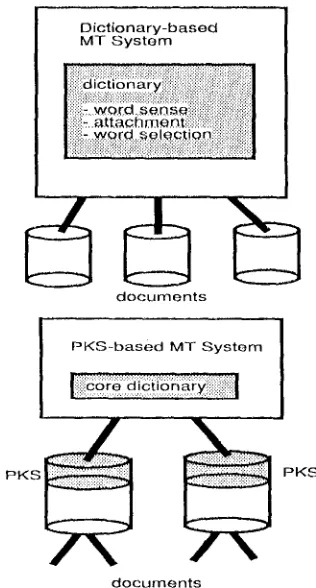
in the previous section. When a new document is to be translated, the user either specifies a list of previously translated documents as a source of available PKSs, or lets the M T system automatlcMly choose them. Such a list of documents is cMled a document list.
Figure 1 compares a PKS-based MT system with that of a conventional dietionaryd~ased MT system.
l",ven though a logical document (llay not be identified with a physical lile, it is the e:~siest and n|ost practical way to organize the hierarchy of documents. In prac- tlce, when transl~d.lng technical documents, it is usual to translate the glossary first, agree tm the translations of technical terms, and then work on individuM chapters. This gives us a natural ordering of documents~
glossary -+ chapter 1 ---+ chapter 2 ...
[image:2.612.346.504.66.360.2]O n e i m p o r t a n t chltracteristic of tills P K S Ol'ganiza.- tlon is t h a t it can be d y n a m i c M l y r e a r r a n g e d . \Ve clxn invMidate s o m e P K S s by s h n p l y removing ix d o c u n l e n t from tile d o c u m e n t list, or validate a new set (if P K S s tJy a d d i n g its paired d o c u m e n t to tile list. T h i s is e x t r e m e l y nseflil fur d o m a l n - s e n s i t i v e a n d context-sensitiw~ tri~ns latlon, since a close look at d o c u m e n t s ill a seemingly similar d o m a i n will show t h a t t h e r e are t o o m a n y con- tlicting word senses a n d word selections to build it single c o n s i s t e n t d o m a i n dictionary. 2 In t h e worst ca.~e, the, user has to keep oil asking t h e systenl to prefer olte ('if several word senses ,'ks lnally t h n e s ms ix new doculilent arrives to be t r a n s l a t e d .
A n o t h e r i m p o r t a n t o b s e r v a t k l o is tlu~t tim s y s t e m can calculate tile quallty of p r e f e r e n c e inhlrrnittion a.s fol- lows:
1. Given a d o c u m e n t list, find ~dl the PI(Ss ill tho
d o c n m e n t
list,
a M c r e a t e aPIqS graph I
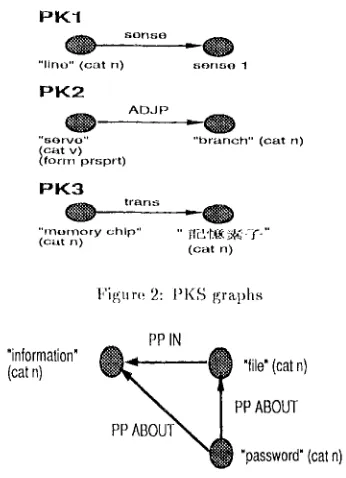
which is ad i r e c t e d gr~q)h, for each t y p e of P K S (see Figure 2):
* If t h e P K S is of type. (I'KI
'w('rrdi sens%),
crelxte a no(h'.
Nwl
for'mo'rdi,
a n . d eNsj
for sen.s'ej, a n d a directe.d arc a U (lal)(;led
%ense")
fromNwi
toNsj.
• If t h e P K S is of t y p e ( P K 2 word; role
wordj)
c r e a t e a n o d e N r l for
wordi~ a
n o d eNlj
forwordj,
and a d i r e c t e d a.rc aij (lal~eled with asyntactic role)
fromN'ri
toNlj.
e If t h e P K S is of t y p e ( P K 3
'lvo'rd; transj)
c r e a t e a n o d e
Nsl
for"wordi,
a n o d eNtj
fl)r
transj,
and it d i r e c t e d iu'c(tij
(hdmh~d"Irons")
from N s i toNtj.
2. C o u n t t h e n u m b e r C1 of'
conJlicling arcs
far t h eP K 1 a n d P K 3 graphs, T h a t is, find t h e n u m b e r (if
arcs leaving tim saille node but gohig to dlffermit
nodes.
3. C o u n t t h e n u m b e r CP~ of
conJlicting ilalii,s ;~
for eachpair of nodes n l and n2, connected by an arc al in
t h e P K 2 trap} b Sllt:h t h a t for solill! ltodl~ I13, t h e r e
are two arcs a2 from n] to n3, and ix3 rronl n3 ttl n2,
wile.re a2 a n d a3 }lave t h e s a m e label (see Figure 3).
Intuitively, CI shows a ll/llll}'Jo.r of alillli{{llOtlS word
senses a n d word selections, and OR shows possibh.' i t t t a e h m e n t a m b i g u i t i e s hi t h e giwm d o c u m e n t list. 4
=I~ecall tile word senses of the word "lh~e" in Section 2. All
of t h e m ~ p p e a r i n t h e c o n l p u t e r d o t n i t i l l I not&l)ly i n t h e Itrelts of text editors, graphics, find hardwtu'e marauds, respectively. O u r ~pproach ~dlows tile user to lid j u s t the sense dynttndcedly for each type of nlgrtu~tl.
aA p a t h is ~ sequence of directed arcs. (;ontllcting pMhs are two or store distinct sequellCe8 of p a t h s hetween it giveil pair of nodes.
4SIlppose t h a t n l is *l prepositional llllrltse~ 112 is it verb I,hrlise: anti n3 is Itnother prepositimud phrttse, T h e n , we have au ambi- guity in tile nl u t t a d l m e n t . Multiple o u t g o i n g arcs from ~L ,lode in the P K 2 g r a p h do not necessarily imply ambiguities.
PK1
, 0
__,0
" l l n o " ( c a t rl) t ~ o r l a o 1
PK2
A D J P
" s a r v o . . . . b r a n c h " ( c a t n)
c a t v )
f o r m p r s p r t )
P K a
" m o m o r v c h i p . . . . ~,[2~. ~ . T J '
( c u t n )
( c a t n)
Figure. 2: P K S g r a p h s
"information"
(cat n)
PP
IN
%
' '~ "file"(catn)
PP ABOUT~IPP ABOUT
"password"
(cat n)
l"it~ure 3: C,o,itli(:tiiig lmths hi a PK,q gra.ph
T h e r e h / r e , a d o c u m e n t lisL with hwge C1 a n d / o r C2
gonerally should be divided into smaller lists for consls- Lent t r a n s l a t i o n . Ill all ideal s i t u a t i o n , C1 a n d C2 botll
should be 0. Cole et id. [:q and Nasukawafl 71 suggest that
t h e r e is a s t r o n g telidellcy for C] to be very slna[l in a
reiLSOllal)le s p o i l Of g o x t .
It is easily s h o w n t h a t for any two docllmellt lists I,l iUld 1/2 (1,1 N [,2 -- (/)), t h e m t m b e r s of conllieting
arcs and [)al, ilS~ U l l , C121 (~'21, a n d C22, respectlve]y,
are
memogonir.
T l m t is, the n u m b e r s C,1 and C2 of contlieting arcs and Inxths of t h e c o m b i n e d d o c u m e n tlist L ( = l,i U 1,2) satisfy C I > C t t + C 2 1 and C2 >
C2, + C~...
4 . ] ) i s a m b i g u a t i o n M e t h o d
The Imsis of disanihiguation of the three t.ylms of itin- hignlty discussed in ~ection '.). is to prefer the host PKS hi the do(:ilmel/{ llst. tlutL matches the anihig/lity~ alid to
h l t e r p r e t ~}ie. P K S as ~t rule for selecting a word SellSe i
phrasld
attitchlttellt l oF word traitsh~thln.i f there is lto matching PKS, either the. ambiguity is
properly hiuidled I>y the systenl, which results in no tlS(!r
corre.('.tioll in the dtiCltllielits~ ()r it is l l e w t o t h e s y s t c l n .
In tim fornler case, t h e riser will p r o b a b l y be satisfied wit.h t h e transhttim, by t h e s y s t e m . In t h e l a t t e r case~
t h e translattlon m a y }litve t o })e c o r r e c t e d hy t i l e riser,
but the interaction will be recorded its a lleW l l l ( S and
usexl for [llttlri! d i s ; t m } / i g u a t i o n .
I
[image:3.612.318.491.65.304.2]two or more PKS rules m a t c h the ambiguous word, the ages of the rules and the ordering o1" d o c u m e n t s in the d o c u m e n t llst uniquely d e t e r m i n e the most preferable PKS. T h e PK2 rules, however, can be used with a more flexible m a t c h i n g algorithmIe, 12] since the coverage of PK2 rules would be very limited if two phra.ses (the modifier and modifiee phrases) had to m a t c h the rule exactly.
Once the d o c u m e n t list has been given, the PK1 and PK3 rules can be polynomlally converted into a shrq)le lookup table, where t h e key is an ambiguous ward, and only the most preferable rules itre stored mr retriew~d, s PK2 rules can be organized similarly as a ternary lookup table.
It should be noted t h a t sentences in a d o c u m e n t list can be utilized as an example base [9] since the docu- ments in the d o c u m e n t list has already been translated, and t h e translation of the source sentence is readily available. Indeed~ t h e conventioual m a t c h i n g algorithm for a flat example base has to be extended into a hierar- chicM one, where the latest translation has the highest priority, and PKSs must be equally tllken into cons[d: eration.
5.
Knowledge Source Compilation
W h e n a set of d o c u m e n t s in one domain grows con- siderably, or when the M T system is to be transporte(I to a different environment, it is convenient to be able to compile PKSs into a single, portable user dictionary. T h e compilation is similar to the creation of lookup ta- bles, described in the previous section. T h e numbers of conflicting arcs and p a t h s should be carefully examined to see w h e t h e r a given d o c u m e n t list yields a cousistent user dictionary. "['he user can rearrange t h e ordering of documents, and choose the most preferable among con- flicting PKS rules to make the optimal user dictionary for t h e domain.
T h e r e a r r a n g e m e n t of d o c u m e n t s in the d o c u m e n t
llst does not change the resulting PKS graphs. It j u s t changes the preferences among the conflicting arcs or paths. Therefore, the optimal construction of ~t user dic- tionary does not have to consider an e x p o n e n t h d num- ber of possible d o c u m e n t orderlngs, but only a polyno- mial n u m b e r of t h e following palrwise constraints:
* If there are conflicting arcs ttl~ a2~ .. "1 ak iu the PK1 (or PK3) graph, and the most i)referable arc is a;, the d o c u m e n t di having the PK1 (or PK3) rule for ai must be preceded by each d o c u m e n t dj having t h e arc a a" (j = 1 , . . . , k. j 7~ i).
• If there are conflicting paths Pl, P2, . . , l)k in the P K 2 graph, and t h e moat preferable path is Pl, the
5Alternatively, all the conflicting P K S rules c a n I)e stored to give tire user as m a n y candida.tes as possible.
d o c u m e n t di having the PK2 rule f~r the ~irst arc in Pl must be preceded by each d o c u n m n t dj having tile I)1(2 rule for the first arc ill pj (j = 1 , . . . , k. j T~ i).
It is polynomlally decidable w h e t h e r there is an mr- dering of d o c u m e n t s t h a t satisfies all of the above con- straints. An ordering of d o c u m e n t s exists if[" the con- straints are not cyclic ( t h a t is, iff there is a d o c u m e n t D t h a t must precede itself). ],]yen if there is no linear or- dering of such documents, the user dictionary can still be cre~ted from the user-selected arcs and paths. In this case, however, t h e r e is no natural carrespoudence between the user dictionary and a d o c u m e n t list. Such a eorrespomtence is indispensable if the user wishes to up- d a t e the user dictionary when a new d o c u m e n t is :tdded at ;to arbitrary imsition in a d o c u m e n t list. If the user dictionary is equivalently reducible to a d o c u m e n t list, recompilation of the d o c u m e n t list into the user dictio- nary is straightforward. W h e n no such equlvMent list exists~ a docunmnt may only be added to the tail of the list, thus ow'.rruling all the conflicting PKSs.
6. A l t e r n a t i v e V i e w s o f K n o w l e d g e O r g a n i z a t i o n
In Section 3, we took a simplified view of the PKS or- ganization~ which we may call an "optimistic organiza- tion." It was implicitly i~ssumed ti,at only the elements in PKSs can conflict with each other. Howew~r, the sys- t e m ' s default choice of word senses, may haw~ satisfied a user, b u t may eon[lict with a PKS newly added to the d o c u m e n t list. Thus, PKSs need to be more carefully organized if the user thinks t h a t th~ translation by the system is adequate without the PKSs. This view may be called a "pessimistic organization" of PKSs. T h e op~ timlstic orga.niza.tion is easier to implement, while the pessimistic organization can provide users with more consistm~t translation.
7.
Conclusions
In this paper, we have proposed it new machine trlcns- l i t t o n mechanism based on portable, kn(~wledge sonrees. It provides M T systems with an efficient way of acqulr- ing ar,(l utilizing the vital inR~rmlttion from the nser in order to gradually achieve correct translation in at multi-domain, multi-user environment. Since the dOCll- men) lint (or a lint of previously t r a n s l a t e d documents) is usually read-only, it is not only a convenient unit for storing domain-oriented tlisamblguation knowledge, I,ut also an ideal resource for machine translation t h a t can be shared by many nse.rs.
We have started organizing our knowledge sources into a d o c u l n e l l t list. T h e c)trrent d o c . n l l l e i | t s c o n - sist of four IBM AS/400 c o m p u t e r IuanllalS with about, 2'2,000 sentences and a CAD manual with a b o u t 10,000 sentences. Currently only a l m a ) 1,200 sentences have been t r a n s l a t e d by using our prototype M T system S h a l t 2 [ t l ] and corrected by the use.r for knowlpdge atc- qulsition. T h e PKS rules art.' therefore few and not ready for q n a n t i t a t i v e analysis. Some interesting oc- cnrrences of words, however~ have already been found. In one of the above, manuals, for example, the noun " p a r t " was used in two different word senses: as a hard-- ware c o m l m n e n t and ms an a b s t r a c t lmrtion of a whole. 'Phe first usage of this noun, howew~r, seemed more re~ stricted: it was always modiIied by a prolmr noun. In one manual, the word "llne" wa.~ clearly acnd consis- tently used to mean a specific mw on the screen, while in a n o t h e r it wins always used to mean at geometric c o m - p o n e n t .
T h e iuteraetion of P K S rules has not been discussed in this paper) although it is a very interesting topic. Suppose t h a t PI(2 rnles can also inch)de the word senses for each word. It is not clear w h e t h e r the word senses in the rules shonld be considered its conditional (valid only if the pair of mo/lilier and modifiee is present) or
absolute (no m a t t e r w h a t the modifier and mtnlitiee acre). Only the latter case is handled by the PK1, and the former cases could be the exceptions to the PK 1 rules.
If the "one sense per d o e n m e n t " assnmption see)as too strong~ we can modify the PK1 aud 1'I;3 rules by adding contextual d e p e n d e n c y to the rules so t h a t at word sense or a word translation is valid only if the word appears with a certain modifier or modifiee, has at certain syntactic role~ and st) on.
A c k n o w l e d g e m e n t
I would like to t h a n k Tetsuya N~sukawa and Naa- hike Urarnoto for many discussions which haw; gr~c<l- ually materialized into the idea of portable knowledge sources. T h e c o m m e n t s from tl[ideo W a t a n a b e and Ili- roshi N o m i y a m a also c o n t r i b n t e d to the refinement (If
the technical cmltents. Michael McDo~lMd, a.s usual, proofread the paper, and helped me write tim final ver- slO)l.
References
1) C. Boitet and II. Blanehon. "l)ialogue-13ased M'F for nmnolingual authors and the I,II)[A projecC. In l'roe. of the Natural Langua9e Proeessi~g Pacific Rim S'yrapo-
sium '93, pages 208-222, I,'ukuoka, Japan, Dee. 1993. 2) |IIM Corp. "IBM SAA Al)/Cyele Translation Man-
ager/2 l{elease 1.0". q'echnleal report, S1112-5900, 1992. 3) W. (bile, 1¢.. (_:hatch, and I). Ynrowsky. "One Sense I'er l)iseourse", ht Prec. of lhe ~lh I)A RPA Speeeh a n d
NaturM Language Workshop, 1992.
4) 11. Maruyama, 1I. Watanabe, and S. Ogino. "An In-- teractive dap~tnese l'arser for Machine q'ranslation", ht
Proe. of the 13lh htlernalional Conference on Computa- tional Linguislies, pages 257-262, tlelsinki, Aug. 1990. 5) S. W. Mcltoy. "Using Multiple Knowledge Sources for
Word Sense I)iserhnination'. Computational Liguislies,
18(1):1-30, Mar. 1992.
6) K. Nagao. "Dependency Analyzer: A Knowledge-Based Alq)t.oach ta Strut%m'al l)isamblguatlon'. In Prec. of the 131h lnlernalional Conference on Compulalional Linguislies, pages 282-?87, llelsinki, Aug. 1990. 7) '1'. Nasukawa. "l)iscource Constraint in COmlmter Man-
uals". In l'roe, of lhe 51h lnlernalional Conference on !lTteorelieal and Methodological Issues in Machine Translation, pages 183 194, Kyot(~, Japan, July 1993. 8) J. l~usl.ejovsky. "The Generative I,exieon". Compula-
lional Linguistics, 17(4):409-4'tl, December 1991. 9) S. Sat.o and M. Nag,re. "Toward Memory-based Trans-
lation". In 1'roe. of Ihe 13lh International Conference on Cmapvlalional Linguislic.~ pages 247 252, tlelsinki, Aug. 1990.
] 0) E. Sumita and 1I. lida. "l,',xperiments and Prospects of l';xample-lb~sed Ivlachine Translation". In Prec. of the 291h Annual Meeting of the Association for Computa- tional Linguistics, pages 185- 192, Berkeley, June 1991. 11) K. Takeda, N. Ursine,o, T. Nasnkawa, and T. 'l'snt-
snmi. "Shalt2 - A Symmetric Machine Translation Sys- l.em with Conceptual Transfer". In Prec. of lhe t # h International Conference on Computational Linguistics,
pages 1034 1038, July 1992.
12) N. Urarnoto. "Lexical and Structural l)isambiguation IJsing an Examph~-Fl:t~e'. In l'rae, of the 2 n d Japan- Au.stralia Joint Syrrtposi'um on NLP, pages 150 160, Oct. 1991.