Moving TIGER beyond Sentence-Level
Agnieszka Falenska, Kerstin Eckart, Jonas Kuhn
Institute for Natural Language ProcessingUniversity of Stuttgart
{falenska, eckartkn, jonas}@ims.uni-stuttgart.de
Abstract
We present TIGER 2.2-doc – a new set of annotations for the German TIGER corpus. The set moves the corpus to a document level. It includes a full mapping of sentences to documents, as well as additional level and document-level annotations. The sentence-level annotations refer to the role of a sentence in the document. They introduce structure to the TIGER documents by separating headers and meta-level information from article content. Document-level annotations recover information which has been neglected in the intermediate releases of the TIGER corpus, such as document categories and publication dates of the articles. Additionally, we introduce new document-level annotations: authors and their gender. We describe the process of corpus annotation, show statistics of the obtained data and present baseline experiments for lemmatization, part-of-speech and morphological tagging, and dependency parsing. Finally, we present two example use cases: sentence boundary detection and authorship attribution. These use cases take the data from TIGER into account and illustrate the usefulness of the new annotation layers from TIGER 2.2-doc.
Keywords:Corpus Annotation, Treebank, Document Structure
1.
Introduction
The TIGER corpus (Brants et al., 2004) is an important treebank for German. It has been frequently employed over the years: for several shared tasks on multilingual de-pendency parsing (Buchholz and Marsi, 2006) and pars-ing morphologically rich languages (Seddah et al., 2013; Seddah et al., 2014); as part of the HamleDT compilation (Zeman et al., 2012); and as training data for processing pipelines for variety of tasks, including coreference and bridging resolution (Björkelund et al., 2014), theoretical linguistics (Haselbach et al., 2012), and building morpho-logical word-embeddings (Cotterell and Schütze, 2015). TIGER consists of roughly 900,000 words or 50,000 sen-tences from German newspaper articles and its focus is on token and sentence level: For the first release of the TIGER treebank, the corpus was semi-automatically annotated and corrected with part-of-speech tags and constituent struc-tures. The following versions enhanced the corpus with respect to the number of sentences and introduced morpho-logical and lemma annotations. Additionally, parts of the corpus were released as dependency treebanks, e.g. a de-pendency version of TIGER 2.2 (Seeker and Kuhn, 2012). During the early development of the corpus parts of the in-formation about document boundaries were lost. The cur-rent distribution 2.2 does not contain any grouping of sen-tences into documents, i.e., the corpus consists of one long sequence of sentences. Therefore, it is not possible to anno-tate this dataset with any document-level information, such as anaphora and coreference relations, or discourse trees.1 However, as opposed to datasets where contiguous docu-ments are not available due to technical design or copyright reasons (Faaß and Eckart, 2013; Schäfer, 2015), TIGER does contain full documents and the only information lost is a mapping between sentences and documents to which they belong.
1
Cf. guidelines like Riester and Baumann (2017) and Riester et al. (to appear) which have been applied to German text, taking documents into account.
The purpose of this paper is to overcome shortcomings of the current TIGER distribution and to enable application of document-level tasks to it. We present TIGER 2.2-doc2, a new set of annotations that divides the sentences of the cor-pus into documents, i.e., newspaper articles, and realigns articles with their categories and approximate publication dates using original sources. We also semi-automatically enrich documents with structure annotations (differentiat-ing meta-level information from article’s real content), au-thors, and authors’ genders. Additionally, we release a new split into training, development and test sets.3
A corpus containing gold-standard syntactic annotations and document boundaries serves as a thorough platform for further annotations and applications, such as the fre-quently used German treebank TüBa-D/Z (Telljohann et al., 2015). We believe that adding new annotations to TIGER and introducing TIGER 2.2-doc will make the corpus an interesting resource for NLP researchers working on a va-riety of tasks. The wide range of annotations – from sen-tence boundaries, through syntax, to authors and categories – makes it possible to answer new questions. For exam-ple, document categories can be used to examine which types of articles are the most difficult to parse. Similarly, having gold syntax trees and gender of authors allows to analyze if some syntactic constructions are used more of-ten by women than men. In this paper we present base-line experiments on lemmatization, part-of-speech (POS) tagging, morphological analysis, and dependency parsing for the new training/development split of TIGER. We also show pilot experiments on sentence boundary detection and authorship attribution in TIGER.
2
Persistent identifier (PID):http://hdl.handle.net/ 11022/1007-0000-0000-8E50-6
3In TIGER 2.2 one additional consequence of the
2.
(Re-)introducing TIGER Documents
TIGER is provided in several representation formats, the set of which differs among the releases. In the Negra Ex-port format (Brants, 1997), some metadata was encoded in a section calledORIGIN. An entry in this section consists of a numeric identifier, which we call the ORIGINID, infor-mation on an approximate publication time and, partially, information on article categories (news, feuilleton, etc.). According to the dates from the metadata, the corpus can be split into articles from years 1992, 1995 and 1997. A sentence is related to the metadata via the ORIGINID. We consider a set of consecutive sentences annotated with the same ORIGINID an article and would like our documents to contain exactly one article each. However, the information in the corpus releases was not sufficient to comprehensively identify the document boundaries: (1) For the 1992 part, the metadata shows a different granularity by subsuming all articles under one ORIGINID, so no document bound-aries could be extracted from the metadata for this part. (2) Part of the mapping between sentences and ORIGINID got lost during processing, such that several blocks of sen-tences were assigned a fall-back ORIGINID 0, which does not contain any information. (3) Some presumed articles contain more than one or only parts of articles, maybe due to extraction errors when the articles were selected from the newspaper data.To introduce a full sentence to document mapping we used additional resources and some old work files from the cre-ation phase of the corpus. Since the additional informcre-ation usually referred only to one of the corpus parts (1992, 1995 or 1997), we treated each part separately. However, some common guidelines were applied:
1. TIGER 2.1 sentence numbers and segments are kept; 2. ORIGINIDs are kept to align the metadata;
3. When applying additional resources with article markup their boundaries should be reflected in the an-notation as long as they do not conflict with the bound-aries introduced by the ORIGINIDs.
TIGER 2.2-doc thus introduces DOCUMENTIDs X_Y whereX contains an ORIGINID andY is an addition to mark several documents within one ORIGINID.4
For the 1992 part we automatically extracted article bor-ders from ECI/MC1 (European Corpus Initiative, 1994). After minimal manual post-processing all documents were read by a native speaker who also compared the proposed boundaries to the ECI/MC1 data.
For the 1995 part we applied an old work file. The file con-tained a full mapping of the ORIGINIDs but different sen-tence numbers and sensen-tence segmentation. For each range with ORIGINID 0 the ORIGINIDs from the work file were automatically mapped when the sentences were identical and unique. Afterwards all documents were read by native speakers. Taking the work file into account, they assigned and corrected DOCUMENTIDs where necessary.
For the 1997 part we applied an old work file and a part of the DeReKo (Institut für Deutsche Sprache, nd). Again, identical and unique sentences with ORIGINID 0 were
au-4Both parts are four digit values with leading zeros,
i.e. 0001_0005 is the fifth article found under ORIGINID 1.
tomatically mapped to the work file. Afterwards all doc-uments were read by native speakers. Taking the work file and DeReKo into account, they assigned and corrected documentIDs where necessary. A range of sentences with ORIGINID 0 remained, for which only the metadata infor-mation was available. The missing DOCUMENTIDs were assigned manually based on the number of ORIGINIDs left for this part and the respective article categories.
During the process of (re-)introducing document bound-aries, the annotators found special cases in the corpus. Some of these can be explained as processing artifacts, such as where a sentence from one article was copied acciden-tally into another article, while others reflect peculiarities of the newspaper, such as collection articles, where a set of in-dependent newsflashes is combined under one heading and consequently marked with the same ORIGINID in the cor-pus. Collection articles however influence document-level applications such as coreference annotations, because one document consists of several small parts which usually do not share any referents. Based on Guideline 3 mentioned above, these collection articles were handled according to their markup in the external resources and treated either as one or as several documents. Respective comments are re-leased with the annotation of TIGER 2.2-doc to let users decide to e.g. exclude some article types.
3.
Further Annotations
TIGER 2.2-doc includes a mapping from sentences to 2,263 documents, with on average 22 sentences per document. The documents are split into training/development/test sets with 1,863/200/200 documents. An example document with 21 sentences is shown in Figure 1. Clearly the doc-ument in its original published form contained an inter-nal structure – the first sentence was a title, followed by a subtitle, meta information about the author, and place and date of release. We introduce the structure to the docu-ments and annotate them on sentence and document level. However, we exclude from this annotation process 100 col-lection documents, i.e., documents consisting of more than one article, since they have their own structure.
3.1.
Sentence-level Annotations
We introduce a new sentence-level layer of annotations with three possible values (see Figure 1 for examples): (i) HEADERfor all sentences which act as titles (in this ver-sion we do not distinguish titles from subtitles); (ii) META
for all sentences which contain meta-level document infor-mation, as author, date of release of the article, notes for the reader; (iii) BODYfor the actual content of the article. We annotated all sentences with HEADER, META, or BODY
1 SPD-Spitze stimmt Bosnien-Einsatz zu HEADER
Head of SPD [Social Democratic Party of Germany] agrees to Bosnia mission
2 Parteitag soll Engagement deutscher Soldaten “ ohne Kampfauftrag ” beschließen HEADER
Party convention is to give consent on German troops engaging in "non-combat" mission
3 Von Helmut Lölhöffel META
By Helmut Lölhöffel
4 MANNHEIM , 13. November . META
5 Die SPD ist bereit , dem Einsatz von Bundeswehr-Transport- und Aufklärungsflugzeugen bei der Umsetzung eines Bosnien-Friedensplanes zuzustimmen .
BODY
The SPD is willing to go along with having German Federal Defense Forces operate transport and reconnaissance aircraft in implementing a road map for peace for Bosnia.
6 Damit folgt die Partei der sozialdemokratischen Bundestagsfraktion , die dies schon vorher beschlossen hatte . BODY
By doing so, the party follows the social democratic members of German parliament, who have already agreed on this.
. . . .
21 Leitartikel auf Seite 3 META
Editorial on page 3
Figure 1: An example document (0834_0001) and its translation to English (translation is not a part of the treebank). Document-level annotations for this document are: category – NAC, author – Helmut Lölhöffel, author’s gender – male, approximate date of publication – 1995-11-14. The publication date may differ from the one in the article ("13. November" v. "1995-11-14") because it is approximate and refers to the week in which the article was published.
In the final version 6% of all sentences is annotated with METAand 9% with HEADER.
3.2.
Document-level Annotations
Document-level annotations are categories, approximate dates of publication, and authors. The first two types were recovered from the metadata of the original TIGER sources, while authors were annotated semi-automatically (see de-tails below). The distribution of document-level annota-tions across all documents is presented in Figure 2. Ap-proximate publication dates are available for all documents, categories for 2,016 of them, and authors for 541. For 506 documents all three types of annotations are available.
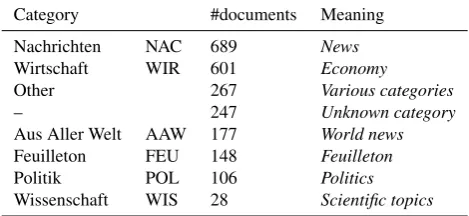
Categories The document categories were recovered from existing sources – see Table 1 for details. For six big categories (news, economy, world news, feuilleton, politics, and scientific topics) both the category ID and meaning of it were recovered. 1,749 documents received one of these categories. For additional 267 documents (under ”Various categories” in the Table 1) only the category ID was re-stored. For 247 documents category is unknown.
Category #documents Meaning
Nachrichten NAC 689 News Wirtschaft WIR 601 Economy Other 267 Various categories
– 247 Unknown category
Aus Aller Welt AAW 177 World news Feuilleton FEU 148 Feuilleton Politik POL 106 Politics Wissenschaft WIS 28 Scientific topics
Table 1: Document categories.
Publication Dates The publication dates available in the metadata are approximate publication dates for the articles, probably referring to the week in which an article was
pub-lished. By means of the ORIGINID this information is available for all documents.
Authors Information about the author of the document comes from the article’s content – see for example Sen-tence 3 in Figure 1. We used senSen-tence-level annotations to collect two types of meta annotations: the author of the article and the gender of the author. First we found all sentences with METAannotations. Then we used gold POS tags to filter phrases with NE tags. These phrases were manually checked and the correct authors were col-lected. Finally we used morphological features to mark genders of the authors. For example, token level annota-tions for Sentence 3 from Figure 1 are: Von/APPR/- Hel-mut/NE/case=nom|num=sg|gender=masc Lölhöf-fel/NE/case=dat|num=sg|gender=masc. We used POS tags to filter "Helmut Lölhöffel" as a possible author and values of the gender morphological feature to set the gender of the document’s author to "male".
The information about authors is available for 541 TIGER documents: 8 of the articles were written by more than one author, all the other 533 articles were written by 243 differ-ent authors, among which 87 wrote more than one article. We present the distribution of authors in Figure 3.
4.
Baseline Experiments
The TIGER corpus has been widely employed to evaluate methods predicting token-level annotations, as POS tags or dependency trees (Buchholz and Marsi, 2006; Seddah et al., 2014, among others). These token-level annota-tions do not differ between TIGER 2.2 and TIGER 2.2-doc. However, TIGER 2.2-doc is released with a new split into training, development, and test sets. To enable future comparisons, we present baseline results for lemmatization, part-of-speech tagging, morphological analysis, and depen-dency parsing for the new split.
212
35
506
1510
Authors
Categories
Publ. Dates
Figure 2: Number of documents annotated with different document-level annotations. Publication dates are available for all 2,263 documents. 2,016 of them (1510 + 506) are an-notated with categories and 541 (506 + 35) with authors. For 506 documents all three types of annotations are available.
1
2
3
4
5
6
7
8+
Number of documents written by an author
0
20
40
60
80
100
120
140
160
Number of different authors
87
156
31
14 10 11 6
2
13
female
male
Figure 3: Distribution of authors of TIGER articles and gender of the authors. 8 articles which were written by more than one author are not included in the plot. Re-maining 533 articles were written by 243 different au-thors, among which 87 wrote more than one article.
CRF-based tagger (Müller et al., 2013). We use the mate-tools for lemmatization.5For dependency parsing we apply a transition-based beam search parser by Björkelund and Nivre (2015) which uses the ArcStandard system extended with a Swap transition (Nivre, 2009). We train the parser on 10-fold jackknifed POS and morphological tags.
Results We provide results for the new development and test sets in Table 2.
Lemma POS Morph Parsing
F1 F1 F1 LAS
Dev 97.96 97.78 90.68 91.27 Test 97.91 97.86 90.63 92.53
Table 2: Baseline results for lemmatization, part-of-speech tagging, morphological analysis, and dependency parsing on the development and test sets.
5.
Use cases
To illustrate the usefulness of the new annotations, we present two use cases: sentence boundary detection and authorship attribution. Both tasks take document borders into account and could not have been applied on TIGER before introducing the new annotation layers. While gold-standard sentence boundaries were available in TIGER 2.2, TIGER 2.2-doc introduces the distinction between sentence boundaries and document boundaries. The new informa-tion allows to train and evaluate sentence segmenters only on meaningful instances of sentence borders, and not the ones at the end of documents.
5https://code.google.com/archive/p/
mate-tools/
5.1.
Case Study: Sentence Boundary Detection
The logical structure of a document describes of what units (e.g., titles, enumerations, tables) the document consists. Such information is useful for automatic document process-ing tasks, such as information extraction or summarization. Document structure reconstruction is the task of automati-cally recovering the logical structure of documents, for ex-ample from the results of an OCR process.
The original newspaper versions of TIGER articles were structured and contained visually distinguishable titles, subtitles, author’s footnotes, etc. In the current version some of this information was reconstructed and marked with sentence level annotations, making TIGER 2.2-doc a possible experimental field for document structure recon-struction. In this paper we present pilot experiments for the first step of automatic document structure reconstruction: sentence boundary detection. We leave the next steps (e.g., prediction of sentence-level annotations) for future work.
Methodology Sentence boundary detection is often re-garded as a solved task, at least in the domain of well-edited texts. Therefore, typical sentence boundary detectors fo-cus on orthographic clues, as punctuation and capitalization marks. However, when moving to non-standard texts basic assumptions about punctuation and capitalization may be violated, thus rendering sentence segmentation more chal-lenging task (Evang et al., 2013).
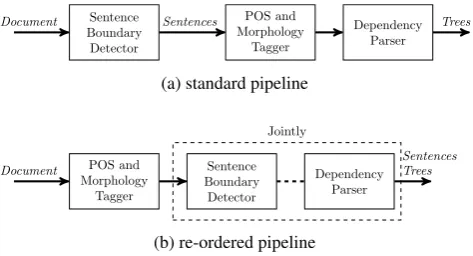
Sentence
Figure 4: Schematic view of pipelines applied in the exper-iments.
performed sentence segmentation and parsing jointly (see Figure 4b). We showed that syntax is useful for sentence segmentation and that the joint method detects sentence boundaries better.
TIGER is built from newspaper articles which are usually considered well-edited texts and common sentence seg-menters should perform well for them. However, TIGER documents also contain meta-level sentences and headers which are not straightforward to segment. We perform pi-lot experiments for sentence segmentation in TIGER, apply state-of-the art tools and investigate if the joint method of Björkelund et al. (2016) is a better choice for this dataset.
Tools We apply state-of-the-art sentence segmenters to establish baseline results:
UDPIPE(Straka et al., 2016): is a toolset performing, i.a., sentence segmentation, POS tagging, and dependency parsing. From all the functionalities of UDPIPEwe employ only the sentence segmenter. It uses a single-layer bidirec-tional GRU network. The segmenter works on character level, i.e., for each character in text it predicts if a sentence ends after it. We use UDPIPE as a baseline following the recent CoNLL Shared Task 2017 (Zeman et al., 2017).
MARMOT:is the best performing baseline from Björkelund et al. (2016). It augments POS tags with in-formation if a token starts a new sentence. Then, it trains the sequence labeler of Müller et al. (2013) on whole doc-uments annotated with the augmented tags. The method applied to new documents jointly predicts sentence bound-aries and POS tags.
For POS tagging, morphological analysis and parsing we apply the methods from Section 4 – namely CRF-based tag-ger by Müller et al. (2013) and transition-based parser by Björkelund and Nivre (2015).
For the re-ordered pipeline we train the same POS tagger but on whole documents instead of sentences. We em-ploy the aforementioned parser extended to predict sen-tence boundaries (Björkelund et al., 2016) (referred to as JOINT). It predicts sentence boundaries and dependency trees jointly. For both pipelines we train parsers on 10-fold jackknifed POS and morphological tags. We calculate the results with the evaluation script from the CoNLL Shared Task 2017 (Zeman et al., 2017).
Results The results of the experiments are presented in Table 3 in the first column. We find that MARMOT
out-Segm. POS Morph Parsing
F1 F1 F1 LAS
Standard pipeline
UDPIPE 82.34 97.66 90.45 87.42 MARMOT 89.21 97.74 90.58 88.47
Re-ordered pipeline
JOINT 93.26 97.73 90.19 88.53
JOINT-REPARSED 88.92
Table 3: Results on the development set for two pipelines and three sentence segmenters.
performs the UDPIPEbaseline by a big margin of almost 7 points. JOINTsurpasses both baselines – by 4 points for MARMOT and almost 11 points for UDPIPE, making it a better choice for the first step of document structure recon-struction in the TIGER dataset.6
We also investigate how the next pipeline steps are in-fluenced by different sentence segmentation results. POS tagging and morphological analysis are almost not influ-enced by the selection of the pipeline, i.e., regardless if they are applied to sentences or documents their results are very similar. When comparing parsing results we see that sentence boundary detection errors propagate through the pipeline. The final parser loses one point when ap-plied to sentences predicted by UDPIPEinstead of MAR -MOT. Interestingly, syntactic features in the JOINTmethod help the sentence boundary detection but not the other way around, i.e., its parsing result outperforms both base-lines only slightly. To assess the influence of error prop-agation through the pipeline we follow Björkelund et al. (2016) and parse the sentences once again (denotedJOINT -REPARSED). In this scenario JOINTserves only as a sen-tence segmenter and parsing is performed separately. We find that the better sentence segmentation translates to bet-ter parsing results and JOINT-REPARSEDoutperforms both MARMOT and UDPIPE.
5.2.
Case Study: Authorship Attribution
Authorship attribution is the task of determining the author of a document. TIGER is built from short newspaper texts which mostly belong to categories related to news. It is an interesting question if it is possible to track documents’ au-thors in this domain. And if yes, if it is due to stylometric differences or content of the documents (e.g. authors tend-ing to write documents on the same topics). We present pilot experiments for two authorship attributions tasks: pre-dicting the author of the text and gender of the author.
Methodology and Tools In both of the tasks we use only sentences not labeled as META, as they contain implicit in-formation on authors (names, surnames and cities). For gender prediction we use all 533 documents with author id (for a detailed distribution of documents and their authors
6
see Figure 3). For author attribution we use only authors who wrote at least two documents (87 authors and 377 doc-uments). We use two classification methods:
DELTA:the Burrows’s Delta (Burrows, 2002) is the most established method for capturing stylometric differ-ences. We calculate DELTAand perform classification with the R stylo package (Eder et al., 2013) with default param-eters. To establish if the method captures stylometric or content differences we follow Schulz et al. (2016) and cal-culate DELTA in two ways: on all the words in the doc-uments (DELTA–STYLE) and on content words (DELTA– CONTENT). As content words we select nouns, verbs and adjectives and filter them by gold-standard POS tags.
VERETAL:we copy the experimental setup from Ver-hoeven et al. (2016). We use LinearSVC from sklearn7 with default parameters and use unigrams and bigrams of words and trigrams and tetragrams of characters as features.
We compare the two methods to two control baselines: weighted random baseline (WRB), which predicts a strat-ified random class, and majority baseline (MAJ), which predicts the most frequent class. We evaluate the accuracy with 10-fold cross-validation.
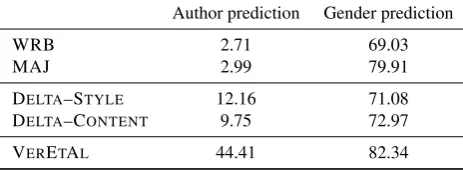
Results Table 4 presents results of the experiments. In the task of gender prediction documents are assigned only two classes and the methods achieve higher accuracy. Among all the methods, WRB is the worst and is able to correctly predict authors’ gender only for 69.03% of the documents. DELTAslightly outperforms WRB, especially when using content words. This might be an indicator that the ”au-thor signal” in the TIGER documents is weak and classifi-cation methods capture more content than stylometric dif-ferences. Generally, DELTAis not able to outperform the simple MAJ baseline, which achieves accuracy of 79.91%. But VERETAL, a classifier with a richer set of features, proves to be the best method and outperforms MAJ by a margin of 2.43 points.
Results for author prediction are generally lower than for gender prediction because the task is harder – it involves as-signing one of 87 classes. In this case DELTAis able to out-perform both control baselines. Interestingly, this time style features give a small boost over the content ones. Again, VERETALsurpasses all the other methods with a big mar-gin of more than 32 points.
Author prediction Gender prediction
WRB 2.71 69.03
MAJ 2.99 79.91
DELTA–STYLE 12.16 71.08 DELTA–CONTENT 9.75 72.97
VERETAL 44.41 82.34
Table 4: Accuracy (10-fold cross-validated) for predict-ing author (87 authors, 377 documents) and gender (fe-male/male, 533 documents).
7scikit-learn.org/
6.
Conclusion
We presented TIGER 2.2-doc, a new set of annotations for the frequently used German corpus TIGER. Prior re-leases of TIGER already contained token and sentence boundaries. TIGER 2.2-doc adds explicit document bor-ders based on the newspaper articles, and a suggested split into training, development and test sets. We presented new document- and sentence-level annotations which broaden the range of possible applications of TIGER. We showed two example use cases which employ the new annotations: sentence boundary detection (as a part of document struc-ture reconstruction) and authorship attribution. TIGER 2.2-doc is available by means of a persistent identifier.
7.
Acknowledgements
We would like to thank Amir Zeldes and Florian Zipser for discussions on the (re-)introduction of the document bor-ders and for help with finding the old work files, and our student annotators for patiently mapping and reading lots of old news. This work was supported by the German Federal Ministry of Education and Research (BMBF) via CLARIN-D and the German Research Foundation (CLARIN-DFG) via SFB 732, projects D8 and INF.
8.
Bibliographical References
Björkelund, A. and Nivre, J. (2015). Non-deterministic or-acles for unrestricted non-projective transition-based de-pendency parsing. InProceedings of the 14th Interna-tional Conference on Parsing Technologies, pages 76– 86, Bilbao, Spain. Association for Computational Lin-guistics.
Björkelund, A., Eckart, K., Riester, A., Schauffler, N., and Schweitzer, K. (2014). The extended DIRNDL corpus as a resource for coreference and bridging resolution. In Proceedings of the Ninth International Conference on Language Resources and Evaluation (LREC 2014), pages 3222–3228, Reykjavik, Iceland. European Lan-guage Resources Association (ELRA).
Björkelund, A., Fale´nska, A., Seeker, W., and Kuhn, J. (2016). How to train dependency parsers with inexact search for joint sentence boundary detection and parsing of entire documents. InProceedings of the 54th Annual Meeting of the Association for Computational Linguis-tics (Volume 1: Long Papers), pages 1924–1934, Berlin, Germany. Association for Computational Linguistics. Brants, S., Dipper, S., Eisenberg, P., Hansen-Schirra, S.,
König, E., Lezius, W., Rohrer, C., Smith, G., and Uszko-reit, H. (2004). TIGER: Linguistic interpretation of a German corpus. Research on Language and Computa-tion, 2(4):597–620.
Brants, T. (1997). The NEGRA export format. CLAUS Report 98, Universität des Saarlandes, Computerlinguis-tik, Saarbrücken, Germany.
Burrows, J. (2002). â ˘AŸDeltaâ ˘A ´Z: a measure of stylistic difference and a guide to likely authorship. Literary and linguistic computing, 17(3):267–287.
Cotterell, R. and Schütze, H. (2015). Morphological word-embeddings. In Proceedings of the 2015 Conference of the North American Chapter of the Association for Computational Linguistics: Human Language Technolo-gies, pages 1287–1292, Denver, Colorado. Association for Computational Linguistics.
Eder, M., Kestemont, M., and Rybicki, J. (2013). Stylom-etry with R: a suite of tools. InDigital Humanities 2013: Conference Abstracts, pages 487–489. University of Ne-braska, Lincoln Lincoln, NE.
Evang, K., Basile, V., Chrupała, G., and Bos, J. (2013). Elephant: Sequence labeling for word and sentence seg-mentation. In Proceedings of the 2013 Conference on Empirical Methods in Natural Language Processing, pages 1422–1426. Association for Computational Lin-guistics.
Faaß, G. and Eckart, K. (2013). SdeWaC – a corpus of parsable sentences from the web. In Iryna Gurevych, et al., editors, Language Processing and Knowledge in the Web, volume 8105 ofLecture Notes in Computer Sci-ence, pages 61–68. Springer Berlin Heidelberg.
Haselbach, B., Eckart, K., Seeker, W., Eberle, K., and Heid, U. (2012). Approximating theoretical linguistics classi-fication in real data: the case of German “nach” particle verbs. In Proceedings of COLING 2012, pages 1113– 1128. The COLING 2012 Organizing Committee. Müller, T., Schmid, H., and Schütze, H. (2013). Efficient
Higher-Order CRFs for Morphological Tagging. In Pro-ceedings of the 2013 Conference on Empirical Methods in Natural Language Processing, pages 322–332, Seat-tle, Washington, USA. Association for Computational Linguistics.
Nivre, J. (2009). Non-projective dependency parsing in expected linear time. InProceedings of the Joint Con-ference of the 47th Annual Meeting of the ACL and the 4th International Joint Conference on Natural Language Processing of the AFNLP, pages 351–359, Suntec, Sin-gapore. Association for Computational Linguistics. Riester, A. and Baumann, S. (2017). The RefLex Scheme –
Annotation Guidelines, volume 14 ofSinSpeC. Working Papers of the SFB 732. University of Stuttgart.
Riester, A., Brunetti, L., and Kuthy, K. D. (to appear). Annotation guidelines for questions under discussion and information structure. In Katharina Haude Evan-gelia Adamou et al., editors, Information Structure in Lesser-Described Languages. Benjamins, Amsterdam. Schäfer, R. (2015). Processing and querying large web
corpora with the COW14 architecture. In Piotr Ba´nski, et al., editors,Proceedings of Challenges in the Manage-ment of Large Corpora 3 (CMLC-3), Lancaster. UCREL, IDS.
Schulz, S., Kuhn, J., and Reiter, N. (2016). Authorship attribution of mediaeval German text: Style and con-tents in Apollonius von Tyrland. InDigital Humanities 2016: Conference Abstracts, pages 883–885, Krakøsw, Poland.
Seddah, D., Tsarfaty, R., Kübler, S., Candito, M., Choi, J. D., Farkas, R., Foster, J., Goenaga, I., Gojenola Gal-letebeitia, K., Goldberg, Y., Green, S., Habash, N., Kuhlmann, M., Maier, W., Nivre, J., Przepiórkowski, A., Roth, R., Seeker, W., Versley, Y., Vincze, V., Woli´nski, M., Wróblewska, A., and de la Clergerie, E. V. (2013). Overview of the SPMRL 2013 shared task: A cross-framework evaluation of parsing morphologically rich languages.
Seddah, D., Kübler, S., and Tsarfaty, R. (2014). In-troducing the SPMRL 2014 shared task on parsing morphologically-rich languages.
Seeker, W. and Kuhn, J. (2012). Making ellipses explicit in dependency conversion for a German treebank. In Nico-letta Calzolari (Conference Chair), et al., editors, Pro-ceedings of the Eight International Conference on Lan-guage Resources and Evaluation (LREC 2012), pages 3132–3139, Istanbul, Turkey. European Language Re-sources Association (ELRA).
Seeker, W. and Kuhn, J. (2014). An out-of-domain test suite for dependency parsing of German. In Nicoletta Calzolari (Conference Chair), et al., editors,Proceedings of the Ninth International Conference on Language Re-sources and Evaluation (LREC 2014), pages 4066–4073, Reykjavik, Iceland. European Language Resources As-sociation (ELRA).
Straka, M., Hajiˇc, J., and Straková, J. (2016). UDPipe: trainable pipeline for processing CoNLL-U files per-forming tokenization, morphological analysis, POS tag-ging and parsing. In Nicoletta Calzolari (Conference Chair), et al., editors,Proceedings of the Tenth Interna-tional Conference on Language Resources and Evalua-tion (LREC 2016), pages 4290–4297, PortoroÅ¿, Slove-nia. European Language Resources Association (ELRA). Telljohann, H., Hinrichs, E. W., Kübler, S., Zinsmeister, H., and Beck, K. (2015). Stylebook for the Tübingen treebank of written German (TüBa-D/Z). In Seminar fur Sprachwissenschaft, Universität Tübingen, Tübingen, Germany.
Verhoeven, B., Daelemans, W., and Plank, B. (2016). TwiSty: A multilingual twitter stylometry corpus for gender and personality profiling. In Nicoletta Calzo-lari (Conference Chair), et al., editors,Proceedings of the Tenth International Conference on Language Resources and Evaluation (LREC 2016), pages 1632–1637, Por-toroÅ¿, Slovenia. European Language Resources Asso-ciation (ELRA).
Zeman, D., Mareˇcek, D., Popel, M., Ramasamy, L., Štˇepánek, J., Žabokrtský, Z., and Hajiˇc, J. (2012). Ham-leDT: To Parse or Not to Parse? In Nicoletta Calzo-lari (Conference Chair), et al., editors,Proceedings of the Eighth International Conference on Language Resources and Evaluation (LREC 2012), pages 2735–2741, Istan-bul, Turkey. European Language Resources Association (ELRA).
Mis-silä, A., Manning, C. D., Schuster, S., Reddy, S., Taji, D., Habash, N., Leung, H., de Marneffe, M.-C., Sanguinetti, M., Simi, M., Kanayama, H., dePaiva, V., Droganova, K., Martínez Alonso, H., Çöltekin, c., Sulubacak, U., Uszkoreit, H., Macketanz, V., Burchardt, A., Harris, K., Marheinecke, K., Rehm, G., Kayadelen, T., Attia, M., Elkahky, A., Yu, Z., Pitler, E., Lertpradit, S., Mandl, M., Kirchner, J., Alcalde, H. F., Strnadová, J., Baner-jee, E., Manurung, R., Stella, A., Shimada, A., Kwak, S., Mendonca, G., Lando, T., Nitisaroj, R., and Li, J. (2017). CoNLL 2017 shared task: Multilingual parsing from raw text to universal dependencies. InProceedings of the CoNLL 2017 Shared Task: Multilingual Parsing from Raw Text to Universal Dependencies, pages 1–19, Vancouver, Canada. Association for Computational Lin-guistics.
9.
Language Resource References
European Corpus Initiative. (1994). European CorpusIni-tiative Multilingual Corpus 1 (ECI/MC1). Linguistic Data Consortium, ELRA, 1.0, ISLRN 511-168-567-582-5.