Text Type Structure and Logical Document Structure
Hagen Langer
Justus-Liebig-Universit¨at/ Universit¨at Osnabr¨uck [email protected]
Harald L ¨ungen
Justus-Liebig-Universit¨at Gießen, Germany [email protected]
Petra Saskia Bayerl
Justus-Liebig-Universit¨at Gießen, Germany [email protected]
Abstract
Most research on automated categorization of doc-uments has concentrated on the assignment of one or many categories to a whole text. However, new applications, e.g. in the area of the Semantic Web, require a richer and more fine-grained annotation of documents, such as detailed thematic informa-tion about the parts of a document. Hence we in-vestigate the automatic categorization of text seg-ments of scientific articles with XML markup into 16 topic types from a text type structure schema. A corpus of 47 linguistic articles was provided with XML markup on different annotation layers repre-senting text type structure, logical document struc-ture, and grammatical categories. Six different fea-ture extraction strategies were applied to this corpus and combined in various parametrizations in differ-ent classifiers. The aim was to explore the contribu-tion of each type of informacontribu-tion, in particular the logical structure features, to the classification ac-curacy. The results suggest that some of the topic types of our hierarchy are successfully learnable, while the features from the logical structure layer had no particular impact on the results.
1 Introduction
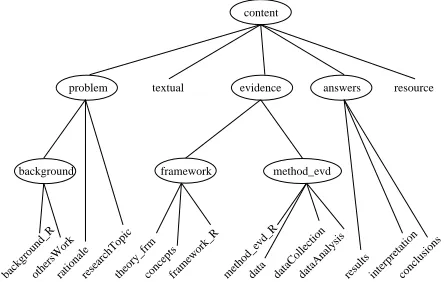
Our project Semantics of Generic Document Struc-tures is concerned with the text type structure of sci-entific articles and its relations to document gram-mars and markup. One of its goals is to explore the feasibility of an automatic categorization of text segments of scientific articles which are an-notated with logical structure tags (e.g.section, paragraph, appendix) into topic types such as background, researchTopic, method, and results de-fined in a hierarchical text type schema. The schema representing the text type structure (or, thematic structure) of scientific articles is shown in Figure 1 (explained more fully in section 2). It is as-sumed that authors to some degree adhere to such a schema when creating a logical structure for their documents for instance by XML markup, and that
therefore such markup bears clues as to the thematic structure of scientific articles.
content
evidence
background framework method_evd
problem answers
theory_frmconceptsframework_R method_evd_Rdata dataCollectiondataAnalysis results interpretationconclusions
textual
researchTopic rationale othersWork background_R
[image:1.612.315.537.252.393.2]resource
Figure 1: Text type schema
classi-fier for semi-structured documents (e.g. XML doc-uments) based on a document representation that combines terms with path expressions. This clas-sifier was shown to reduce classification error rates considerably in comparison with a purely term-based classifier when run on US patent documents provided with XML markup and r´esum´e documents in HTML. Our aim is to explore similar methods to classify thematic segments of scientific articles in XML.
2 Text type ontology for scientific articles
Previous approaches to the text type structure of sci-entific articles have been developed in the context of automatic text summarization. In Teufel and Moens (2002), a categorization scheme of seven ”rhetori-cal zones” including background, other, own, aim, textual, contrast, basis is used for the classification of the sentences of a scientific article according to their rhetorical status and subsequently finding the most suitable ones for a summary. The schema we employ (see below) is more fine-grained, consist-ing of 16 categories that are hierarchically ordered (although in the present experiments we did not make use of this hierarchical order). These 16 cat-egories refer to the dimension that is discussed un-der problem structure in (Teufel and Moens, 2002), rather than to exclusively rhetorical zones and are viewed as types of topics. A topic “is the semantic-pragmatic function that selects which concept of the contextual information will be extended with new information” (van Dijk, 1980, p.97). Thus while the concept The daily newspaper Neue Z¨urcher Zeitung is the topic of several sentences in the ar-ticle B¨uhlmann (2002), it is an instance of the topic type ’data’which in turn is part of the text type structure of many scientific articles. This text type structure is captured in our text type schema with 16 bottom-level topic types (Figure 1) that were ob-tained by evaluating articles from the disciplines of linguistics and psychology. Kando (1997) presented a similar hierarchical schema with 51 bottom-level categories, which were employed for manually an-notating sentences in Japanese scientific articles. Her ”text constituents” resemble our topic types, but we have aimed at sorting out functional categories such as ’Reason for...’, including only purely the-matic categories and keeping the number of cate-gories lower for the experiments described in this paper.
In Figure 1, the arcs represent the part-of rela-tion such that a type lower in the hierarchy is a part of the immediately dominating, more general type in terms of text type structure. The schema is
sup-posed to represent the typical thematic structure of research papers. The order of the categories repre-sents a canonical, expected order of topic types in a scientific article. The text type schema was initially encoded as an XML Schema grammar where topic types are represented by elements that are nested such that the XML structure reflects the structure of the text type structure tree (Figure 2).
<xs:element name="problem"> <xs:complexType>
<xs:sequence>
<xs:element name="background" minOccurs="0"> <xs:complexType>
<xs:sequence>
<xs:element name="othersWork" type="xs:string" minOccurs="0"/> <xs:element name="background_R"
type="xs:string" minOccurs="0"/> </xs:sequence>
</xs:complexType> </xs:element>
...
Figure 2: XML Schema grammar (extract) for the text type schema
3 Data and annotation levels
We carried out the experiments on a corpus of 47 linguistic research articles, taken from the German online journal ’Linguistik Online’,1 from the vol-umes 2000-2003. The selected articles came with HTML markup and have an average length of 8639 word forms, dealing with subjects as diverse as the syntax of adverbs, chat analysis, and language learning.
Taking a text-technological approach, this cor-pus was prepared such that all required types of in-formation, including the target classification cate-gories and the classification features to be extracted, are realized as XML annotations of the raw text. Thus, XML markup was provided for the thematic level, a logical structure level, and a grammatical level. As described in Bayerl et al. (2003), anno-tation levels are distinguished from annoanno-tation lay-ers. An annotation level is an abstract level of infor-mation (such as the morphology and syntax levels in linguistics), originally independent of any anno-tation scheme. The term annoanno-tation layer, in con-trast, refers to the realization of an annotation level as e.g. XML markup. There need not be a 1:1-correspondence between annotation levels and lay-ers. As for the three annotation levels in our setting,
one (the structural level) was realized as an inde-pendent layer, and two (thematic and grammatical) were realized in one single annotation layer. Each annotation layer of an article is stored in a separate file, while it is ensured that the PCDATA of each layer are identical.
3.1 Annotation of text type structure
The order of topic types in a specific scientific ar-ticle may deviate from the canonical order repre-sented in the XML schema grammar of the text type structure shown in Figure 2. Thus a flat version of the hierarchical XML schema was derived by means of an XSLT style sheet, exploiting the fact that XML schema grammars, unlike DTDs, are XML docu-ments themselves. In the derived flat XML schema, topic types are represented as attribute values of el-ements called <group> and <segment>, instead
of names of nested elements. Empty <group> el-ements represent topic types that corresponded to the nodes in the original tree of topic types, while
<segment>elements correspond to leaves
(termi-nal categories). The origi(termi-nal hierarchical structure is still represented via the ID/IDREF attributes id andparent, similar to O’Donnell’s (2000) repre-sentation of rhetorical structure trees.
For the annotation, the raw text of each arti-cle was automatically partitioned into text segments corresponding to sentences, but the annotators were allowed to modify (join or split) segments to yield proper thematic units. The problem of finding the-matic boundaries other than sentence boundaries automatically (e.g. Utiyama and Isahara (2001)) is thus not addressed in this work. The annotator then provided the values of the attribute topic using the XML spy editor, choosing exactly one of the 16 terminal topic types for each segment, or alter-natively the category void meta for metadata such as acknowledgements. If more than one topic type could in principle be assigned, the annotators were instructed to choose the one that was most central to the argumentation. An extract from a THM annota-tion layer is shown in Figure 3.2
The two annotators were experienced in that they had received intense training as well as annotated a corpus of psychological articles according to an extended version of the schema in Figure 1 earlier (Bayerl et al., 2003). We assessed inter-rater reli-ability on three articles from the present linguistics corpus, which were annotated by both annotators in-dependently according to the topic type set shown in Figure 1. (Prior to the analysis the articles were
2The extract, which is also shown in Figure 4, is taken from
B¨uhlmann (2002).
<segment id="s75a" parent="g19" topic="dataAnalysis">
Die obige Reihenfolge ver¨andert sich etwas,
wenn nicht die gesamte Anzahl der
Personenbezeichnungen ausschlaggebend ist, sondern die Anzahl unterschiedlicher Personenbezeichnungen (das heisst, eine Personenbezeichnung wie z.B. Jugendliche, die acht Mal verwendet wurde, wird trotzdem
nur einmal gez¨ahlt):
</segment>
<segment id="s76" parent="g4" topic="results"> Im ganzen kommen in den untersuchten Artikel 261 verschiedene Personenbezeichnungen vor.
Davon sind ¨uber 46,7% generische Maskulina,
und nur 31% sind Institutions- und Kollektivbezeichnungen. Es folgen die geschlechtsneutralen und -abstrakten Bezeichnungen mit 18,4%, und nach wie vor stehen die Doppelformen mit 3,8% Bezeichnungen am Schluss.
</segment>
Figure 3: THM annotation (extract)
resegmented manually so that segment boundaries were completely identical.) An average agreement of Kappa = 0.73 was reached (min: .63, max: .78), which can be interpreted as ’substantial’ agreement (Landis and Koch, 1977). In order to test for anno-tation biases we also performed a Stuart-Maxwell Test (Stuart, 1955; Maxwell, 1970), leading to the conclusion that marginal homogeneity must be re-jected on the 1% level (χ2 = 61.24; df = 14). The McNemar Tests (McNemar, 1947) revealed that the topic types textual, results, interpretation, others-Work, and conclusions were the problematic cate-gories. Subsequent log-linear analyses revealed that annotator1 systematically had assigned background where annotator2 had assigned framework. Also interpretation was regularly confused with conclu-sions, and concepts with either background or oth-ersWork (model-fit: χ2 = 173.14, df = 155, p =
.15).
3.2 Annotation of syntax and morphology
and the grammatical tagging, because all tags pro-vided by Machinese Syntax pertain to word forms. The grammatical annotations could therefore be in-tegrated with the THM annotations, forming the XML annotation layer that we call THMCNX. An XSLT stylesheet is applied to convert the THM annotations into attribute-free XML by integrating the information from attribute-value specifications into the names of their respective elements. Af-ter the grammatical tagging, a second stylesheet re-converts the resulting attribute-free XML repre-sentations into the original complex XML enriched by the grammatical tags. Besides, we re-formatted the original Machinese Syntax tags by omitting, merging, and renaming some of them, again using XSLT. The <cmp-head-lemma> tag (containing
the lemma of the head of the present word form), for example, was derived from the original <lemma>
tag, the value of which contains compound segmen-tation information. On the THMCNX layer, a sub-set of 15 grammatical tags may appear at each word form, including <pos> (part of speech), <aux>
(auxiliary verb), and <num> (number feature for nominal categories).
3.3 Logical document structure annotation
Since HTML is a hybrid markup language including a mixture of structural and layout information, we chose to convert the original HTML of the corpus into XML based on the DocBook standard (Walsh and Muellner, 1999). DocBook was originally de-signed for technical documentation and represents a purely logical document structure, relying on style sheets to interpret the logical elements to produce a desired layout. We did not employ the whole, very large official DocBook DTD, but designed a new XML schema that defines a subset with 45 Doc-Book elements plus 13 additional logical elements such astablefootnoteandnumexample, which appear in the annotations after the namespace pre-fix log.3 The annotations were obtained using a perl script that provided raw DocBook annotations from the HTML markup, and the XML spy editor for validation and manually filling in elements that have no correspondences in HTML. Figure 4 shows the DocBook annotation of the extract that was also given in Figure 3.
Moreover, structural position attributes were added to each element by means of an XSLT style sheet. These ’POSINFO’ attributes make explicit the position of the element in the XML DOM tree of
3
This XML schema was designed in collaboration with the HyTex project at the University of Dortmund, http://www.hytex.info
<sect2> ...
<log:figure> <log:mediaobject>
<xhtml:img src="buehlmann20.gif"/> </log:mediaobject>
</log:figure>
<para>Die obige Reihenfolge ver¨andert sich
etwas, wenn nicht die gesamte Anzahl der Personenbezeichnungen ausschlaggebend ist, sondern die Anzahl unterschiedlicher Personenbezeichnungen (das heisst, eine Personenbezeichnung wie z.B. Jugendliche, die acht Mal verwendet wurde, wird trotzdem nur
einmal gez¨ahlt): Im ganzen kommen in den
untersuchten Artikel 261 verschiedene
Personenbezeichnungen vor. Davon sind ¨uber
46,7% generische Maskulina, und nur 31% sind Institutions- und Kollektivbezeichnungen. Es folgen die geschlechtsneutralen und
-abstrakten Bezeichnungen mit 18,4%, und
nach wie vor stehen die Doppelformen mit
3,8% Bezeichnungen am Schluss. ...
</para> ... </sect2>
Figure 4: Annotation according to DocBook (ex-tract)
the document instance in an XPATH-expression as shown in Figure 5.
<para POSINFO1=
"/article[1]/sect1[4]/sect2[1]/para[10]">
Die obige Reihenfolge ver¨andert sich etwas,
... </para>
Figure 5: Structural position path on the doc layer
As pointed out above, XML document structure has been exploited formerly in the automatic classi-fication of complete documents, e.g. in (Yi and Sun-daresan, 2000; Denoyer and Gallinari, 2003). How-ever, we want to use XML document structure in the classification of thematic segments of documents, where the thematic segments are XML elements in the THM annotation layer. The THM and DOC layers cannot necessarily be combined in a single layer, as we had refrained from imposing the con-straint that they always should be compatible, i.e. not contain overlaps. Still we had to relate element instances on the DOC layer to element instances on the THM layer.
For this purpose, we resorted to the Prolog query toolseit.pldeveloped at the University of Biele-feld in the project Sekimo4 for the inference of
re-4see (Goecke et al., 2003; Bayerl et al., 2003) and
lations between two annotation layers of the same text. seit.pl infers 13 mutually exclusive rela-tions between instances of element types on sep-arate annotation layers on account of their shared PCDATA. In view of the application we envisaged, we defined four general relations, one of which was Identity and three of which were defined by the union of several more specificseit.plrelations:
Identity: The original identity relation from seit.pl.
Included: Holds if a thematic segment is prop-erly included in a DocBook element in terms of the ranges of the respective PCDATA, i.e. is de-fined as the union of the originalseit.pl-relations included A in B, starting point B and end point B. This relation was considered to be significant be-cause we would for example expect THM segments annotated with the topic type interpretation to ap-pear within /article[1]/sect1[5] rather than /article[1]/sect1[1] elements (i.e. the fifth rather than the firstsect1element).
Includes: Holds if a thematic segment prop-erly includes a DocBook element in terms of the ranges of the respective PCDATA, i.e. is defined as the union of the original seit.plrelations in-cluded B in A, starting point A, end point A. This relation was considered to be significant because we would for example expect logical elements such as numexampleto be included preferably in segments labelled with the topic type data.
Overlap: Holds if a thematic segment prop-erly overlaps with a DocBook element in terms of the ranges of the respective PCDATA. This relation was considered less significant because the overlap-ping portion of PCDATA might be very small and seit.pl so far does not allow for querying how large the overlapping portion actually is.
The Prolog code ofseit.plwas modified such that it outputs XML files that contain the THM an-notation layer including structural positions from the DOC layer within each segment as values of el-ements that indicate the relation found, cf. Figure 6.
4 Automatic text segment classification experiments
We applied different classification models, namely a KNN classifier (cf. section 4.1) and, for purposes of comparison, a simplified Rocchio classifier to text segments, in order to evaluate the feasibility of an automatic annotation of scientific articles according to our THM annotation layer. One important moti-vation for these experiments was to find out which kind of data representation yields the best
classifi-cation accuracy, and particularly, if the combination of complementary information sources, such as bag-of-words representations of text, on the one hand, and the structural information provided by the Doc-Book path annotations, on the other hand, produces additional synergetic effects.
4.1 KNN classification
The basic idea of the K nearest neighbor (KNN) classification algorithm is to use already categorized examples from a training set in order to assign a cat-egory to a new object. The first step is to choose the Knearest neighbors (i.e. theKmost similar objects according to some similarity metric, such as cosine) from the trainings set. In a second step the cate-gorial information of the nearest neighbors is com-bined, in the simplest case, by determining the ma-jority class.
The version of KNN classification, adopted here, uses the Jensen-Shannon divergence (also known as information radius or iRad) as a (dis-)similarity metric:
iRad(q, r) = 12[D(qkq+2r) +D(rkq+2r)]
D(xky) is the Kullback-Leibler divergence (KL divergence) of probability distributionsxandy:
D(xky) = n P
i=1
x(i)(log(x(i))−log(y(i)))
iRad ranges from 0 (identity) to 2log2 (no simi-larity) and requires that the compared objects are probability distributions.
Let NO,C = {n1, . . . , nm} (0 ≤ m ≤ K) be
the set of those objects among the K nearest neighbors of some new object O that belong to a particular category C. Then the score assigned to the classificationO ∈Cis
score(O, C) = Pm j=1
iRad(O, nj)E.
<segment id="s75a" topic="dataCollection"> <included>/article[1]</included>
<included>/article[1]/sect1[4]</included>
<included>/article[1]/sect1[4]/sect2[1]</included>
<includes>/article[1]/sect1[4]/sect2[1]/log:figure[5]</includes>
<includes>/article[1]/sect1[4]/sect2[1]/log:figure[5]/log:mediaobject[1]</includes>
<includes>/article[1]/sect1[4]/sect2[1]/log:figure[5]/log:mediaobject[1]/xhtml:img[1]</includes> <included>/article[1]/sect1[4]/sect2[1]/para[10]</included>
<text>Die obige Reihenfolge ver¨andert sich etwas, wenn nicht die gesamte Anzahl
der Personenbezeichnungen ...
</text> </segment>
<segment id="s76" topic="results"> <included>/article[1]</included>
<included>/article[1]/sect1[4]</included>
<included>/article[1]/sect1[4]/sect2[1]</included>
<included>/article[1]/sect1[4]/sect2[1]/para[10]</included>
<text>Im ganzen kommen in den untersuchten Artikel 261 verschiedene Personenbezeichnungen vor. Davon sind ...
</text> </segment>
Figure 6: Generated THMDOC layer
4.2 Bigram model
The bigram model gives the conditional probability of a topic typeTn+1, given its predecessorTn.
For a sequence of segments s1. . . sm the total
scoreτ(T, si)for the assignment of a topic typeTto
siis the product of bigram probability, given the
pu-tative predecessor topic type (i.e. the topic typeT0 with the highest τ(T0, si−1) computed in the
pre-vious step), and the normalized score of the KNN classifier. The total score of the topic type sequence is the product of itsτ scores.
4.3 Information sources
In our classification experiments we used six differ-ent represdiffer-entations which can be viewed as differdiffer-ent feature extraction strategies or different levels of ab-straction:
• word forms (wf): a bag-of-words represen-tation of the segment without morphologi-cal analysis; special characters (punctuation, braces, etc.) are treated as words.
• compound heads (ch): stems; in case of com-pounds, the head is used instead of the whole compound. These features were extracted from the THMCNX layer (cf. section 3.2).
• size (sz): number of words per segment (calcu-lation based on the THM annotation layer, cf. section 3.1).
• DocBook paths (dbp): the segment is repre-sented as the set of the DocBook paths which include it (the segment stand in the the In-cluded relation to it as explained in section 3.3).
• selected DocBook features (df): a set of 6 Doc-Book features which indicate occurrences of block quotes, itemized lists, numbered exam-ples, ordered lists, tables, and references to footnotes standing in any of the four relations listed in section 3.2.
• POS tags (pos): the distribution of part-of-speech tags of the segment taken from the THMCNX layer (cf. section 3.2).
4.4 Training and Evaluation
For each test document the bigram model and the classifier were trained with all other documents. The overall size of the data collection was 47 docu-ments. Thus, each classifier and each bigram model has been trained on the basis of 46 documents, re-spectively. The total number of segments was 7330.
4.5 Results
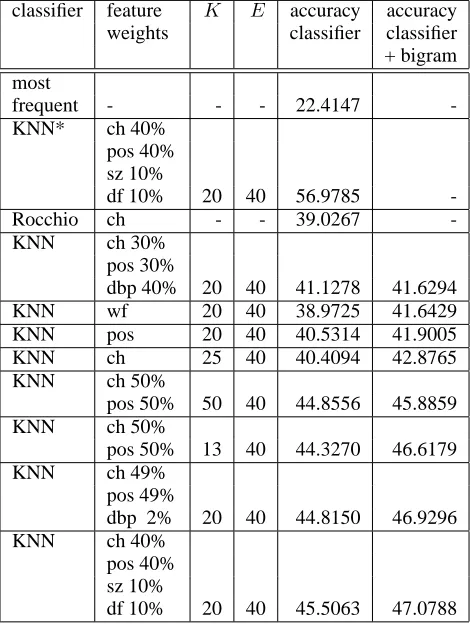
We performed several hundred classification tests with different combinations of data representation, classification algorithm, and classifier parameter setting. Table 1 summarizes some results of these experiments. The baseline (a ’classifier’ guessing always the most frequent topic type) had an accu-racy of 22%.
in-classifier feature K E accuracy accuracy weights classifier classifier + bigram most
frequent - - - 22.4147 -KNN* ch 40%
pos 40% sz 10%
df 10% 20 40 56.9785 -Rocchio ch - - 39.0267 -KNN ch 30%
pos 30%
dbp 40% 20 40 41.1278 41.6294 KNN wf 20 40 38.9725 41.6429 KNN pos 20 40 40.5314 41.9005 KNN ch 25 40 40.4094 42.8765 KNN ch 50%
pos 50% 50 40 44.8556 45.8859 KNN ch 50%
pos 50% 13 40 44.3270 46.6179 KNN ch 49%
pos 49%
dbp 2% 20 40 44.8150 46.9296 KNN ch 40%
pos 40% sz 10%
[image:7.612.72.307.73.386.2]df 10% 20 40 45.5063 47.0788
Table 1: Results
cluding a 2% portion of DocBook path structure features had similar results. In all experiments the KNN algorithm performed better than the simplified Rocchio algorithm. For illustrative purpose, we also included a configuration, where all other segments (i.e. including those from the same document) were available as training segments (’KNN*’ in the sec-ond line of table 1).
The variation of classification accuracy was very high both across the topic types and across the doc-uments. In the best configuration of our classifica-tion experiments the average segment classificaclassifica-tion accuracy per document had a range from 22% to 77%, reflecting the fact that the document collec-tion was very heterogeneous in many respects. The topic type resource had an average recall of 97.56% and an average precision of 91.86%, while several other topic types, e.g. rationale and dataAnalysis were near to zero both w.r.t. precision and recall. The most frequent error was the incorrect assign-ment of topic type othersWork to segassign-ments of topic types framework, concepts, and background.
4.6 Discussion
The task of classifying small text segments, as op-posed to whole documents, is a rather new
ap-plication field for general domain-independent text categorization methods. Thus, we lack data from previous experiments to compare our own results with. Nevertheless, there are some conclusions to be drawn from our experiments.
Although the results probably suffer from limita-tions of our data collection (small sample size, re-stricted thematic domain), our main conclusion is that at least some of the topic types of our hierarchy are successfully learnable. It is, however, question-able if an overall accuracy of less than 50% is suffi-cient for applications that require a high reliability. Moreover, it should be emphasized that our classifi-cation experiments were carried out on the basis of manually segmented input.
The usage of structural information improved the accuracy results slightly, but the impact of this infor-mation source was clearly below our expectations. The effect of adding this kind of information was within the range of improvements which can also be achieved by fine-tuning a classifier parameter, such asK.
A somewhat surprising result was that a pure part-of-speech tag representation achieved nearly 42% accuracy in combination with the bigram model.
The usage of a bigram model improved the results in almost all configurations.
5 Conclusion
The best combination of data representation and classifier configuration included ch (40%), pos (40%), sz (10%) and df (10%), combined with a topic type bigram model, which yielded an accu-racy of 47%. However, almost the same accuaccu-racy could be achieved by selecting ch and pos features only. Other test runs showed that the dbp features could not improve the results in any combination, although these features are the ones that indicate where a segment is situated in an article. An in-spection of data representations revealed that, for a particular test document (i.e. text segment), the ma-jority of training documents with an identical dpb representation are often assigned the desired topic type, but this majority is so small that many other test documents with identical dbp representation are mis-classified. An accuracy improvement might therefore be achieved by running different (local) KNN classifiers trained on different feature sets and combine their results afterwards.
al-ternative algorithms (e.g. support vector machines), feature selection methods and at enlarging our train-ing set. Besides, we will investigate the question, inhowfar our results are generalizable to scientific articles from other disciplines and languages.
References
Petra S. Bayerl, H. L¨ungen, D. Goecke, A. Witt, and D. Naber. 2003. Methods for the semantic anal-ysis of document markup. In Proceedings of the ACM Symposium on Document Engineering (Do-cEng 2003).
Regula B¨uhlmann. 2002. Ehefrau Vreni haucht ihm ins Ohr... Untersuchungen zur geschlechtergerechten Sprache und zur Darstellung von Frauen in Deutschschweizer Tageszeitungen. Linguistik Online, 11. http://www.linguistik-online.de. Ludovic Denoyer and Patrick Gallinari. 2003.
Us-ing belief networks and fisher kernels for struc-tured document classification. In Proceedings of the 7th European Conference on Principles and Practices of Knowledge Discovery in Databases, Cavtat-Dubrovnik, Croatia.
Susan T. Dumais and Hao Chen. 2000. Hierarchi-cal classification of web content. In Proceedings of SIGIR-00, 23rd ACM International Conference on Research and Development in Information Re-trieval, pages 256–263, Athens, Greece. ACM press, New York.
C. Lee Giles, Kurt Bollacker, and Steve Lawrence. 1998. CiteSeer: An automatic citation index-ing system. In Ian Witten, Rob Akscyn, and Frank M. Shipman III, editors, Digital Libraries 98 - The Third ACM Conference on Digital Libraries, pages 89–98, Pittsburgh, PA. ACM Press.
Daniela Goecke, Daniel Naber, and Andreas Witt. 2003. Query von Multiebenen-annotierten XML-Dokumenten mit Prolog. In Uta Seewald-Heeg, editor, Sprachtechnologie f¨ur die multilin-guale Kommunikation. Beitr¨age der GLDV-Fr¨uhjahrstagung, K¨othen 2003, volume 5 of Sprachwissenschaft Computerlinguistik Neue Medien, pages 391–405, Sankt Augustin. gardez!-Verlag.
Noriko Kando. 1997. Text-level structure of re-search papers: Implications for text-based infor-mation processing systems. In Proceedings of the British Computer Society Annual Colloquium of Information Retrieval Research, pages 68–81. J.R. Landis and G. G. Koch. 1977. The
measure-ment of observer agreemeasure-ment for categorical data. Biometrics, 33:159–174.
A. Maxwell. 1970. Comparing the classification of subjects by two independent judges. British Jour-nal of Psychiatry, 116:651 – 655.
Q. McNemar. 1947. Note on the sampling error of the difference between correlated proportions or percentages. Psychometrika, 12:153 – 157. A Stuart. 1955. A test for homogeneity of the
marginal distributions in a two-way classifica-tion. Biometrika, 42:412 – 416.
Pasi Tapanainen and Timo J¨arvinen. 1997. A non-projective dependency parser. In Proceedings of the 5th Conference on Applied Natural Language Processing, pages 64–71, Washington D.C. As-sociation for Computational Linguistics.
Simone Teufel and Marc Moens. 2002. Summariz-ing scientfic articles: Experiments with relevance and rhetorical status. Computational Linguistics, 28(4):409–445.
Masao Utiyama and Hitoshi Isahara. 2001. A sta-tistical model for domain-independent text seg-mentation. In Meeting of the Association for Computational Linguistics, pages 491–498. Teun A. van Dijk. 1980. Macrostructures: An
in-terdisciplinary study of global structures in dis-course, interaction, and cognition. Lawrence Erlbaum Associates, Hillsdale, New Jersey. Norman Walsh and Leonard Muellner. 1999.
Doc-Book: The Definitive Guide. O’Reilly.
Jeonghee Yi and Neel Sundaresan. 2000. A classi-fier for semi-structured documents. In Proceed-ings of the Conference on Knowledge Discovery in Data, pages 190–197.