8
Consumers Perception towards Paytm with Special
Reference to Karur District
M.Usha 1, Dr.K.Ramesh Kumar 2
1 Assistant Professor, Department of Computer Science, Valluvar College of Science and Management, Karur [email protected]
2 HoD, Department of Commerce, Valluvar College of Science and Management, Karur [email protected]
Abstract: As shopping pattern continue to grow, the payment platform and payment gateway industry drive the previous patterns. Mobile point of sales machines have existed for a long time. Fintech’s utmost role in ecommerce is it alters and improves the online payment system. When consumers do not have credit or debit cards, fintech has offered alternative payment methods. The emergence of payment platforms integrate with ecommerce platforms has improved effectiveness and safety for ecommerce. As technology evolves, digital wallets are becoming majority mode of online payment system. There are many digital wallet applications in India and Paytm is one such application. It offers its customers a digital wallet to store money and make fast payments. The aim of this research paper is to analyse the customer perception towards Paytm and the factors influencing the customers to use Paytm in Karur District.
Keywords: Paytm, Digital Wallet, E-Commerce, Fintech, Mobile Commerce I. INTRODUCTION
Digital payments give the liberty of making payment of phone bills, insurance, electricity bill, gas bill, credit card bills at anytime and anywhere by just using Smartphone. Most payment apps give large discounts for financial transactions and deal on different recharges and payments. One such example is Paytm. Paytm is the most popular app for online recharges and bill payments. This digital wallet and Unified Payment Interface (UPI) app offers numerous services on its platform which include payments, money transfer, shopping, recharge facilities, bill payments, and movie, bus and air tickets. PayTM made its means into the e-commerce marketplace in the year 2014. Now it offers multiple products ranging from mobile recharges to buying apparels or electronics. It is enabling customers to get everything at one place. As a result over a period of time it has grown to be both a payment platform as well as the marketplace. It has even acquired the license from Reserve Bank of India to run a Payments Bank. The aim of this research paper is to investigate the satisfaction level and factors influencing the customers to use Paytm. Respondents are categorized on the basis of age, Frequency of usage, Purpose of usage, average monthly spending on Paytm and factors such as ease of use, fast service, multi-utility and convenience.
Statement of the Problem
Paytm stands for Payment through mobile. It is an E-Commerce payment system and E-Wallet company based in Noida, Uttarpradesh, India. This study analyses the user’s perception towards Paytm in Karur District.
Significance of the Study
The present study was conducted to analyse the customer’s satisfaction level and factors influencing the usage of Paytm based on various factors namely, Simple to use and Download Paytm App, Convenience, fast service, multi-utility, Security, Privacy and Customer Service.
Objectives of the Research
To study the customer perception towards Paytm apps and factors influencing customers to use Paytm in Karur district. To find out the acceptance level of Paytm
as an alternative to the cash and card transactions.
To study the role played by Paytm in supporting growth towards Digital India. To analyse the flexible services provided
by the Paytm
To study the opinion among people in accepting Paytm as a solution to the Indian Demonetization.
II. REVIEW OF LITERATURE
9 maximum customers. Paytm is currently doing well
in terms of privacy but it has to work upon discounts and offers, transaction time and bring modernization to increase customer satisfaction.
S. NazimSha and Dr. M. Rajeswari (2018) did a study to learn the importance given to Paytm by people in their daily regular life and success of Paytm in promoting the Cashless economy. The aim of this paper is to study the flexible services presented by Paytm promoting the Cashless economy and also supporting the Digital India and to study the opinion among people in adopting Paytm as a solution to the Indian Demonetization, to examine the importance of Paytm in day to day life and to study the role played by Paytm in making India Digital.
Abhilasha Seam et.al., presented a paper titled as “Factors Affecting Consumer’s Choice to use Mobile Wallet to access M-Commerce Industry in India” (2017). In this paper they did a study with the context of incredible growth of mobile commerce industry in India. An experimental research was undertaken to find out factors impacting consumers’ preference to use mobile wallet service. This paper portrays how the factors were determined using Logistic Regression, and Structural Equation Modelling.
III. RESEARCH METHODOLOGY
Research Area
Research Area is Karur District. Respondents
Respondents are Paytm users in Karur District. Population and Sample
In this study, 50 samples are selected for the study. Data Collection
Primary data collection is used in this study. A simple questionnaire has been used to collect data from respondents.
Data Analysis
The collected data are analysed with the help of MS-Excel. The statistical tools used in this study are Percentage Analysis, Correlation Analysis and Chi-Square Test.
Hypothesis Testing
H0 = There is no significant relation between gender and acceptance level of Paytm supports Digital India.
H1 = There is significant relation between gender and acceptance level of Paytm supports Digital India.
IV. RESULTS AND DISCUSSIONS
The results of the collected data are based on the following analyses.
Age of Respondents
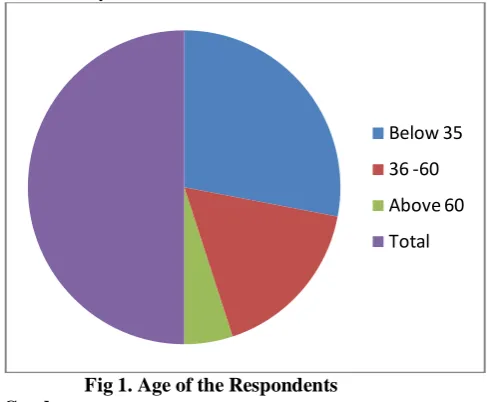
The age of a person weights the level of knowledge and working experience which in turn would influence their views on Paytm services. Hence, it is incorporated as one of the profile variables. The age of the respondents is classified as below 35 years, 36 to 60 years and above 60 years. The distribution of respondents based on the age is shown in Table 1.
Table 1: Age of the Respondents Age in Years Frequency Percentage
Below 35 28 56
36 -60 17 34
Above 60 5 10
Total 50 100
Source: Primary Data From the Table 1, it is observed that majority of the respondents are below 35 years of age and the least age group among the respondents is above 60 years.
Fig 1. Age of the Respondents Gender
The gender of the respondents is included as one of the profiles in the present study. Since the gender shapes knowledge and ability to deliver Paytm services and also their expectations of the Paytm services, it is included as one of the profiles. The classification of the respondents based on gender is shown in Table 2.
Table 2: Gender of the Respondents Gender Frequency Percentage
Male 34 68
Female 16 32
Total 50 100
Source: Primary Data
From Table 2, it is inferred that majority of the respondents (8%) are male and (32%) of the respondents are female.
Below 35
36 -60
Above 60
10 Fig. 2. Gender of the Respondents
Frequency of Paytm usage
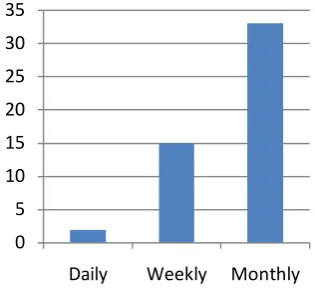
The frequency of usage of Paytm is categorized as daily, weekly and monthly. The distribution of respondents is presented in Table 3.
Table 3: Frequency of Paytm usage
Usage Frequency Percentage
Daily 2 4
Weekly 15 30
Monthly 33 66
Total 50 100
Source: Primary Data From Table 3, it is observed that the majority (66%) of the respondents use the Paytm monthly and 4% of the respondents use it daily.
Fig 3. Frequency of Paytm usage Purpose of using Paytm
The Purpose of using Paytm by the respondents in the present study is classified as recharge, ticket booking, bill payment and
shopping. The distribution of respondents based on the purpose of using Paytm is shown in Table 4.
Table 4: Purpose of using Paytm Purpose Frequency Percentage
Recharge 18 36
Ticket
booking 10
20
Bill payment 12 24
Shopping 8 16
Others 2 4
Total 60 100
Source: Primary Data
From Table 4, it can be inferred that Majority of the respondents (36%) use Paytm for recharge since it is very convenient to recharge your phone anytime anywhere without being dependent on the recharge shops. 24% of the respondents pay their bills through Paytm because it saves time and it prevents the respondents from standing in long queues. Generally public use Paytm for Recharge, Ticket booking, Bill payment and Shopping.
Fig 4. Purpose of using Paytm Factors influencing to use Paytm
To find out the factors on which customer make their decision for suggesting Paytm service, Different parameters have been taken for evaluation. Even though, there are many variables this study limits itself to six, which the respondents are asked to rate. The results are shown in Table5.
Table 5: Factors influencing to use Paytm
Fac tor
High ly Influ
ence d
Influ ence
d
Neu tral
Not Influ ence
d
High ly Not Influ ence d
Tot al
5 0
1 0 0
5 0
1 0 0
5 0
1 0 0
5 0
1 0 0
5 0
1 0 0
5 0
1 0 0 Mul
ti utili ty
6 1 2
2 0
4 0
1 3
2 6 8
1
6 3 6 5 0
1 0 0 Male
Female
0 5 10 15 20 25 30 35
Daily Weekly Monthly
0 5 10 15 20
11
Source: Primary Data
The high level of influence was recorded in No need to carry debit or credit card followed by Ease of use, Convenience, Fast service, Multi utility and Promotions and Offers. The neutral value was recorded in Multi utility. The highly dissatisfied variable was recorded in Promotions and Offers.
Fig 5. Factors influencing to use Paytm Acceptance Level of Various Factors
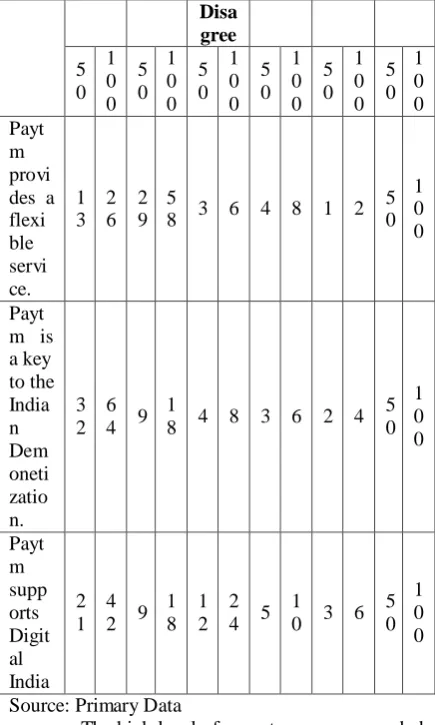
To find out the Acceptance Level of Various Factors for suggesting Paytm service, Different parameters have been taken for evaluation. The results are shown in Table 6.
Table 6: Acceptance Level of Various Factors
Fact
Source: Primary Data
The high level of acceptance was recorded in Paytm is a key to the Indian Demonetization followed by Paytm supports Digital India and Paytm provides a flexible service. The highly disagree value recorded in Paytm supports Digital India is 6%.
By applying chi-square test, the calculated value (p) is 0.2801. Similarly table value for chi-square with degree of freedom 12 at 5% significance level is 0.991062. The obtained result is not significant at level p < .05. As calculated value is less than table value, hypothesis stating, there is no significant relation between gender and acceptance level of Paytm supports Digital India. Correlation Analysis
12 positive correlation, the relationship between these
two variables is weak.
Fig.1 Scatter Plot Major Findings
It is observed that majority of the respondents are below 35 years of age and the least age group among the respondents is above 60 years.
It is inferred that majority of the respondents (8%) are male and (32%) of the respondents are female.
It is experiential that the majority (66%) of the respondents use the Paytm monthly and 4% of the respondents use it daily.
It can be inferred that Majority of the respondents (36%) use Paytm for recharge since it is very convenient to recharge your phone anytime anywhere without being dependent on the recharge shops. 24% of the respondents pay their bills through Paytm because it saves time and it prevents the respondents from standing in long queues. Generally public use Paytm for Recharge, Ticket booking, Bill payment and Shopping. The high level of influence was recorded in
No need to carry debit or credit card followed by Ease of use, Convenience, Fast service, Multi utility and Promotions and Offers. The neutral value was recorded in Multi utility. The highly dissatisfied variable was recorded in Promotions and Offers.
The high level of acceptance was recorded in Paytm is a key to the Indian Demonetization followed by Paytm supports Digital India and Paytm provides a flexible service. The highly disagree value recorded in Paytm supports Digital India is 6%.
There is no significant relation between gender and acceptance level of Paytm supports Digital India.
V. CONCLUSION
Paytm supports their customers to transfer their payments in the simplest method. It is a good digital wallet application to download because of its wide network of partners and this feature makes it convenient while travelling. From the data analysis, it has been observed that convenience, ease of use, security, multi-utility and fast service are satisfactory. These factors significantly affect the satisfaction level and use of Paytm application. Majority of the respondents accept that Paytm as an alternative to the cash and card transactions and it plays an important role in supporting growth towards Digital India. Flexible services provided by the Paytm are satisfactory and it is a solution to the Indian Demonetization.
REFERENCES
[1] Abhijit M. Tadse, Harmeet Singh Nannade., A Study On Usage Of Paytm, Pune Research Scholar, An International Multidisciplinary Journal, Vol.03 Issue-02.
[2] S. NazimSha, Dr. M. Rajeswari, A Study On Paytm Services In Promoting Cashless Economy After Demonetization In IndiaAnd An Outline On Its Support Towards MakingIndia Digital, International Journal of Pure and Applied Mathematics, Volume 119 No. 7 2018, 263-278
[3] Abhilasha Seam, Raja Sekhar Reddy, Snehil Agrawal, Behara Krishna Chaitanya, Himanshu Bist, Suleman Safdar, Pranav Ranjan Patil, Purba Halady Rao,Factors Affecting Consumer’s Choice to use Mobile Wallet to access M-Commerce Industry in India, International Journal on Customer Relations, Volume 5 Issue 1 March 2017. [4] Shukla, T. N., Mobile wallet: present and the
future, Vol. 5, No. 3, June 2016 (ISSN 2278
5973). Available:
ssijmar.in/vol5no3/vol5no3.6.pdf.
[5] Shwetu Kumar, Vijay Yadav, Atiqu Aditi Bansal (2014), “A study on Paytm” Guru Gobind Singh Indraprastha University, Delhi. [6] https://www.Paytm.com
0 5 10 15 20 25 30 35