Detecting semantic relations between terms in definitions
Véronique MALAISÉ1,21 STIM/AP-HP, ERM 202 INSERM
& CRIM-INaLCO 91, boulevard de l’Hôpital
75013 Paris, France,
{vma,pz}@biomath.jussieu.fr
Pierre ZWEIGENBAUM1 Bruno BACHIMONT2
2DRE de l’INA
Institut National de l’Audiovisuel 4, avenue de l’Europe 94366 Bry-sur-Marne Cedex,
France,
{vmalaise,bbachimont}@ina.fr
Abstract
Terminology structuring aims to elicit semantic re-lations between the terms of a domain. We propose here to exploit definitions found in corpora to ob-tain such semantic relations. Definition typologies show that definitions can be introduced by differ-ent semantic relations, some of these relations be-ing likely to structure terminologies. Our aim is therefore to mine “defining expressions” in domain-specific corpora, and to detect the semantic rela-tions they involve between their main terms. We use lexico-syntactic markers and patterns to detect at the same time both a definition and its main se-mantic relation. 46 markers and 74 patterns have been designed and tuned on a first corpus in the field of anthropology. We report on their evaluation on a second corpus in the field of dietetics, where they obtained4%to36%recall and from 61 to66% pre-cision, and discuss the relative accuracy of different subclasses of markers for this task.
1 Introduction
A terminology is an artifact structuring terms ac-cording to some semantic relations. Grabar and Hamon (2004) present the different semantic rela-tions likely to be found in terminologies. These can be divided into lexical (synonymy), vertical (hypernymy, meronymy) and transversal relations (domain-specific relations). A study of definition typologies, like the one of (Auger, 1997), shows that these different relations are also present in def-initions. We can then hypothesise that mining defi-nitions along with the detection of their inherent se-mantic relation can help to organise terms according to the relations used in structured terminologies. We focus in this paper on the detection of terms related by hypernymy and synonymy in definitions.
The automatic detection of definitions can rely on different types of existing works. We can, first, consider the studies describing what definition is, and more particularly what definition in corpus is like. In this respect, we can cite the work of
Trim-ble (1985), Flowerdew (1992), Sager (2001) and Meyer (2001). Another type of interesting exist-ing work is about typologies of definitions: Mar-tin (1983), Chukwu and Thoiron (1989) and Auger (1997), amongst others, provide, in their classifica-tions of definiclassifica-tions, linguistic clues to find defin-ing statements in corpus. We propose to integrate the typologies that we mention in section 2.2, along with the linguistic clues they give: the definition markers. And, at last, some works have already fo-cused on mining definitions from corpora, including Cartier (1997), Pearson (1996), Rebeyrolle (2000) and Muresan and Klavans (2002), mostly through the use of lexical definition markers. These works provide us with methodological guidelines and an-other set of lexical markers for our own experiment. As (Pearson (1996); Rebeyrolle (2000)), our method is based on lexico-syntactic patterns, so that we can build on the work on French language by Rebeyrolle (2000). We extended her work in two respects: an analysis of the parenthesis as low-level linguistic clue for definitions, and the concomitant extraction of the semantic relation involved in a “defining expression”, along with the extraction of the definition itself. Previous works have, for in-stance, mined definitions to find terms specific to a particular domain of knowledge (Chukwu and Tho-iron (1989)), and to describe their meaning (Rebey-rolle, 2000); we focus on the detection of the seman-tic relations between the main terms of a definition in order to help a terminologist to build a structured terminology following these relations.
other hand, to detect if the semantic relation associ-ated with each pattern was the same as the one ob-served in the first corpus. The markers and patterns showed to be comparable to the other experiments mentioned in terms of definition extraction: the pre-cision reached from 61 to66%. As for the seman-tic relation associated with the patterns, it obtained different scores, depending on the marker. But, in most cases, one main semantic relation is associ-ated with a pattern in the scope of a single domain, event though a few patterns convey the same rela-tion across our two corpora.
The remainder of this paper is organised as fol-lows: we first present previous work (section 2), de-scribe our method and experiment (section 3), then present and discuss results (section 4) and conclude with directions for future work (section 5).
2 Previous work
2.1 Description of definitions in corpus
As a first approach for detecting and extracting defining statements in corpora, we have to... de-fine this object. In the literature (Trimble (1985); Flowerdew (1992),. . . ), three categories of defini-tions are often mentioned: the formal definition, the semi-formal and the “non-formal” one. The formal definition follows the Aristotelian schema: X = Y + specific characteristics, where X is the defined term (the“definiendum”), “=” means an equivalence re-lation, Y stands for the generic class to which X belongs (the “Genus”), and specific characteris-tics detail in which respect X is different from the other items composing the same generic class. A semi-formal definition relates the definiendum only with specific characteristics, or with its attribute(s) (Meyer, 2001). Formal and semi-formal definitions can be of simple type (expressed in one sentence), or complex (expressed in two, or more sentences). A non-formal definition aims “to define in a gen-eral sense so that a reader can see the familiar el-ement in whatever the new term may be”(Trimble, 1985). It can be an association with a synonym, a paraphrase or grammatical derivation.
The common point between all these points of views on the same linguistic object, or between all these different objects sharing the same appellation “definition”, is that they all follow the same didac-tic purpose of disambiguating the meaning of a lex-ical item, that is to distinguish it from the others in the general language, or inside a specific vocabu-lary. These definition descriptions present them as the association between a term and its hypernym (its
“genus”), or between a term and its specific charac-teristics. But there are yet other ways to express
definitions, as the works on their typology shows.
2.2 Typology of definitions
Existing definitions typologies are all dedicated to a specific purpose. We are particularly interested in those which aim at eliciting linguistic clues that can be used to mine defining contexts from corpora. We work on French, for which Martin (1983) has classi-fied dictionary definitions in order to give guidelines for a consistent (electronic) dictionary. In the con-text of corpus-based research, Chukwu and Thoiron (1989) gave another classification, aiming at finding domain-specific terms in corpora. A unified typol-ogy is provided by Auger (1997), compiling both cited typologies along with three others, and from which we draw the following three categories:
• Definitions expressed by “low level” linguistic markers: punctuation clues such as parenthe-sis, quote, dash, colon;
• Definitions expressed by lexical markers: lin-guistic or metalinlin-guistic lexical items;
• Definitions expressed by “high level” linguistic markers: syntactic patterns such as anaphora or apposition.
The definitions introduced by lexical means are di-vided in two branches, characterised by the lexi-cal markers in table 1. We added elements from other studies ((Rebeyrolle, 2000) and (Fuchs, 1994) amongst others), and augmented this typology with
Definitions introduced by linguistic markers Copulative “a X is a Y that”
Equivalence “equivalent to”
Characterisation “attribute of ”, “qual-ity”,. . .
Analysis “composed of ”, “equipped with”,“made of ”,. . . Function “to have the function”,“the
role of ”, “to use X to do Y”,. . .
Causality “to cause X by Y”,“to ob-tain X by”,. . .
Definitions introduced by metalinguistic mark-ers
Designation “to designate”, “to mean”,. . .
Denomination “to name”
[image:2.595.315.541.474.724.2]Systemic “to write”,“to spell”,“the noun”,. . .
new markers, including some items introducing re-formulation contexts (“that is”, “to say”, “for in-stance”, . . . ).
The Aristotelian definition type is presented here as a “copulative” definition, as it is linguistically marked by the copula “être” (to be). It involves a hypernymic relation (and specific differences) to de-scribe the meaning of a term, so we consider it as a “hypernymic definition”. But we can see in table 1 that other semantic relations can also be used to de-fine a term: synonymy (definition of “equivalence” type), meronymy (“analysis” type), causality and other domain-specific transversal relations (“func-tion”, “characterisation” types). Mining a defini-tion of “synonymic type” provides different denom-inations for the same concept; one of “hypernymy type” can help modelling the vertical structure be-tween the “definiendum” and the first term of the
“definiens”(conceptual “father” and “son” associa-tion); and definitions following transversal relations allow the expression of specific knowledge. We fo-cus in this paper on the extraction of definitions in-volving hypernymy and synonymy, which are the most generally considered relations in terminology building.
2.3 Automatic definition mining
Automatic definition mining from corpora can be divided in different groups, according to the methodologies followed. We will illustrate them by describing three recent families of works: (i) Cartier (1997), (ii) Pearson (1996) and Rebeyrolle (2000), (iii) Muresan and Klavans (2002). They have used respectively “contextual exploration”, lexico-syntactic patterns and linguistic analysis and rules.
The former one extracts defining statements on the basis of the match of linguistic clues, when they are relayed in the sentence by some linguistic rules. These rules are developped by the author, withing the schema defined in the “contextual exploration” methodology (Desclés, 1996).
Pearson (1996) and Rebeyrolle (2000) have fol-lowed the methodology described by Hearst (1992), up to now mainly applied to discover hyponymous terms. It consists in describing the lexico-syntactic context of an occurrence of a pair of terms known to share a semantic relation. Modelling the context in which they occur provides a “pattern” to apply to the corpus, in order to extract other pairs of terms con-nected by the same relation. Pearson and Rebeyrolle have modelled lexico-syntactic contexts around lex-ical clues interpreted as “definition markers”. Re-beyrolle, working on French, evaluated the different pattern types she modelled, across different corpora:
she obtained a precision range of17.95 –79.19%, and a recall of 94.75 – 100%. The difference be-tween the two numeric boundaries of the precision range is due to the kind of markers involved in the lexico-syntactic pattern evaluated: metalinguis-tic markers obtained a high precision rate, but not linguistic lexical markers.
The latter pair of authors have based their system DEFINDER (http://www1.cs.columbia. edu/~smara/DEFINDER/) on the lexical and syntactic analysis of a medical corpus, with semi-automatic definition acquisition. Their evaluation is focused on the usefulness of the system, as compared with existing specialised medical dictio-naries. They reach a86.95%precision and75.47% recall, following their evaluation methodology.
We chose to follow the first methodology in our experiment (see section 3), in which we additionally explore definition mining in some cases where the definition is not introduced by lexical items. Fol-lowing this methodology enables us to build on ex-isting work dedicated to French, which showed to be interesting and efficient. The lexico-syntactic pattern methodology also enables us to access the different linguistic elements we were interested in mining: the definition itself, the main terms of the definition and the semantic relation between them. We focus this experimentation more particularly on identifying the semantic relations of synonymy and hypernymy involved in the different definitions likely to be found in corpora. We aim at testing whether a stable link can be established between the definition extraction pattern and a specific semantic relation.
3 Detecting Semantic Relations
different corpus.
3.1 Description and preparation of the corpora
Our training corpus (76 Kwords) is focused on childhood, from the point of view of anthropolo-gists. It is composed of different genres of docu-ments (documentary descriptions, thesis report ex-tracts, Web documents). Documentary descriptions were humanly collected, whereas electronic doc-uments were automatically collected from Inter-net via the tools of (Grabar and Berland, 2001). Our evaluation corpus (480 Kwords), in the do-main of dietetics, is composed of Web documents indexed by the CISMeF quality-controlled cata-log of French medical Web sites (http://www. chu-rouen.fr/cismef/) in the subtrees “Di-etetics” and “Nutrition” of the MeSH thesaurus. It is mainly composed of medical courses and Web pages presenting information about nutri-tion in different medical contexts. Both cor-pora were morpho-syntactically analysed by Cor-dial Analyser (Synapse Developpement,http:// www.synapse-fr.com/). Cordial tags, lem-matises and parses a corpus, yielding grammatical functions (subject, object, . . . ) between chunks.
3.2 Lexico-syntactic patterns
A given linguistic marker (see,e.g., table 1) can oc-cur in different contexts, some of which are defini-tions, and can be a clue for different semantic rela-tions. Lexico-syntactic patterns aim at reducing this ambiguity by specifying more restricted contexts in which a definition is found, and, furthermore, in which one specific semantic relation is involved.
Unlike (Hearst, 1992), we started the pattern de-sign by analysing marker occurrences in our train-ing corpus. We designed and tuned our lexico-syntactic patterns on this corpus, patterns dedicated to the extraction of definitions and specific relations: hypernymy and synonymy. Our patterns use the in-formation output by the parser, including lemma, morpho-syntactic category and grammatical func-tion. For instance:“N (N)”specifies that the marker
“(”has to be preceded by a noun, and immediately followed by a single common noun, followed by a closing parenthesis. In this specific case,“(” intro-duces a hypernymic definition.
Each pattern drives different kinds of processing:
• extraction of the defining sentence on the basis of the whole pattern;
• selection of one “preferred” relation associated with the specific pattern, among the set of pos-sible relations associated with the marker; this
relation stands between the interdefined terms of the definition;
• extraction of the interdefined terms following two strategies (contextual or based on depen-dencies around the marker), depending on the morphosyntactic category of the marker. When the marker is a punctuation or a noun, we usu-ally extract its left and right syntactic contexts1 (roughly the first chunk before the marker, and the first chunk after the marker in the sen-tence). When the marker is a verb, we extract its subject and object if they exist in the sen-tence, otherwise we extract its left and right chunks, as in the previous case.
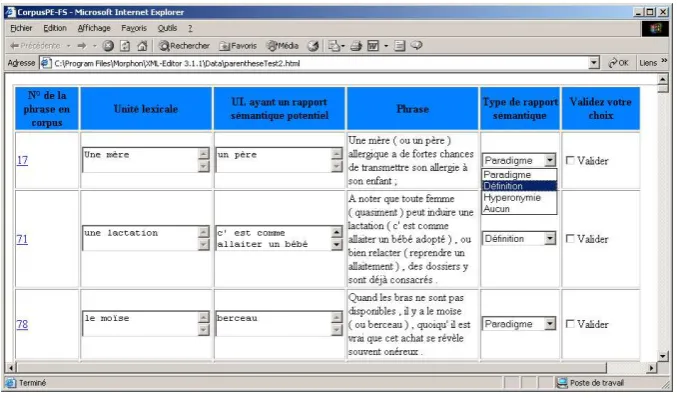
Our patterns are implemented in XSLT and the re-sulting extractions are shown to a human validator through a Web interface (figure 1): an HTML form allowing the validator to complete and correct the extractions. It is possible for the validator to correct the terms extracted from the definition, in particu-lar because the chunk often includes punctuation, which is usually not considered as part of the term, and it is possible to select a different semantic rela-tion than the one proposed when it happens not to be the correct one. A combo box shows all the pos-sible relations related to the marker involved in the lexico-syntactic pattern which provided the extrac-tion of the defining sentence.
3.3 Experimental setup
We tuned our lexico-syntactic patterns to extract definitions from the test corpus. We associated with each pattern a “preferential” semantic relation, which human corpus analysis showed to be the more likely to be connected to the definitions extracted by the means of this pattern. The aim of the experiment is to test the stability of this connection, by applying the patterns to the evaluation corpus.
A random sample of the test corpus (13 texts among 132) was manually processed to tag its def-initions, in order to have a standard measure for the evaluation of recall. Table 2 shows the number of definitions of synonymic and hypernymic types found in that sample, and provides the percentages of these definitions among all the different kinds of tagged definitions (“% definitions”) in that sample. Some definitions involved more than one semantic relation, so we also present the percentage of hyper-nymic and synohyper-nymic relations among all the se-mantic relations (“% relations”).
1Depending on the position of the marker in the sentence, it
Figure 1: Human validation interface for definitions extracted with the parenthesis marker
Hypernymy Synonymy
# definitions 90 22
% definitions 44,5% 10,8% % relations 39,1% 9,5%
Table 2: Number and percentages of hypernymic and synonymic definitions in a random sample of the test corpus, according to the human evaluator
In our experiment, we evaluate in turn the quality of the extracted definitions, then that of semantic relations (hypernymy and synonymy).
[image:5.595.319.538.631.712.2]4 Results and discussion
Table 3 shows the number of markers and patterns prepared and tuned on the training corpus to extract definitions based on hypernymy or synonymy. Note that a given marker can be used in different patterns to extract different semantic relations. Some mark-ers were also associated in one pattern: the met-alinguistic nouns and verbs. We combined them because their individual recall was not lowered by this association and their precision score was im-proved. The sentences below are examples of
sen-Hypernymy Synonymy
# markers 3 43
# patterns 4 70
Table 3: Number of markers and patterns
tences extracted by our system; the underlined part is the marker:
• Hypernymic relation:
“Les acides gras de la série omega-3 ( MAX-epa ) peuvent également être prescrits .”, “[. . . ]les fromages à pâte cuite ( tels que par exemple le fromage de Hollande ).”
• Synonymic relation:
“L’ activité physique est définie comme tout mouvement corporel produit par la contraction des muscles squelettiques ,[. . . ]”,
“une relation inverse entre l’ activité physique et l’ insulinémie ou la sensibilité à l’ insuline est habituellement observée .”
Table 4 presents the evaluation results: we divide them according to the semantic relation extracted. It shows the number of definitions retrieved, and the associated precision and recall. Precision is divided in two measures.
Hypernymy Synonymy # extracted
sentences
270 585
Precision (def) 61% 66% Precision (rel) 26% 15%
Recall (rel) 4% 36%
[image:5.595.78.293.682.726.2]• the proportion of extracted sentences that cor-responded to definitions (def), and
• the proportion of correct semantic relations found in retrieved definitions (rel).
Recall is the proportion of retrieved definitions which correctly display the semantic relation iden-tified in the sample corpusamong all the definitions present in this sample which were tagged as having this semantic relation by the human evaluator.2
The precision of extracted definitions is compara-ble to Rebeyrolle’s results. The precision of seman-tic relations is much lower, but a global evaluation does not show the particular behavior of some of the markers. We list below the markers which were ac-tually involved in the extraction of definitions in the test corpus.
• Markers implied in hypernymic definition re-trieval: “parenthèse” (parenthesis), “par ex-emple”(for instance),“sorte de”(a kind of); • Markers implied in synonymic definition
re-trieval: “parenthèse” (parenthesis),“il s’agit de”(as for), “indiquer”(to indicate), “soit”
(that is),“expliquer”(to explain), “préciser”
(to specify), “marquer” (to mark), “enfin”
(say), “ou” (or), “comme” (as), “à savoir”
(that is),“autrement dit”(in other words),“au sens de”(meaning),“équivaloir”(to be equiv-alent), “c’est-à-dire” (that is), “définir” (to define),“désigner”(to designate), “nommer”
(to name),“dénommer” (to name),“référer”
(to refer),“expression”(expression),“terme”
(term).
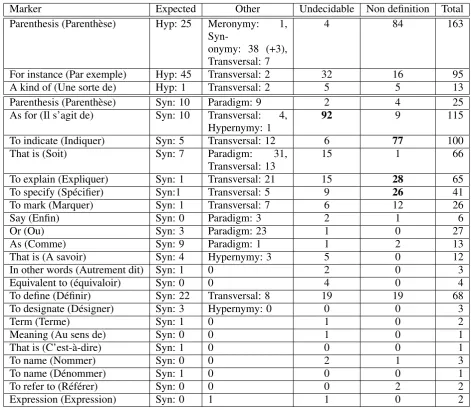
Table 5 presents the different semantic relations found in the definitions retrieved by each marker. The first column references the markers involved in the extraction of the definition, the second ( “Ex-pected”) presents the number of definitions, ex-tracted by each marker, following the expected re-lation. “Other” gives the number of retrieved def-initions following another semantic relation, “Un-decidable”represents the number of definitions for which we could not determine the semantic rela-tion,3and“Non definition”presents the number of retrieved sentences that were not definitions.4
2
The percentage of definitions of hypernymic and syn-onymic type among all definitions in the sample of the test cor-pus is given in table 2.
3
Because our system extracts only one sentence, and a larger context was necessary to understand the semantic rela-tion involved, or because of a problem in the conversion of some HTML documents to texts for the evaluation corpus.
4Except sentences presenting terms in a paradigm context,
which is also interesting for terminology structuring. We
in-Definitions retrieved with the hypernymy patterns involved very generic markers, and they introduced a number of other semantic relations. The pattern around“for instance”, for which 16 extracted sen-tences out of 95 were not definitions, can still be specified to discriminate defining contexts from oth-ers. We can notice, though, that it is one of the most productive patterns (95 extractions) and that it reaches a47,3%precision. But the patterns around the parenthesis show that the same syntactic con-text can introduce different kinds of relations: in this case, the lexico-syntactic pattern cannot disam-biguate the relation any further. The pattern “N (N)”introduced “hypernymic definitions”, as well as “synonymic” or “meronymic” ones, the same syntactic context being even likely to be interpreted as a transversal relation between a treatment and a disease, for instance. It is the sentence as a whole that has to be interpreted in order to be able to define the relevant semantic relation between the terms in that syntactic context.
Some linguistic markers (as “comme”) are re-liable for detecting a semantic relation: 9 sen-tences out of 13 were “synonymic definitions”. But surprisingly enough, some metalinguistic verbs (“définir”, for instance) were not as effective as them in that purpose. “Définir” introduced only 22 “synonymic definitions” out of 68 sentences re-trieved. One could think that a verb with metalin-guistic function could be less polysemic than an-other of more “generic purpose”. This naive hope happens to be wrong: “Définir” means “to fix (a limit)” as often as “to define”. Some markers steadily introduced a semantic relation, but not the one they were supposed to: this variation is prob-ably due to the change in domains across our two corpora. And some patterns obviously introduced a definition, but the defined element was in the previ-ous sentence (this is the case of 92 extractions with patterns involving the marker“Il s’agit de”). As our system, up to now, extracts only one sentence, we could not determine whether the semantic relation was the one expected. We must address this prob-lem, and we can hope that the precision rate will then be better than the one presented here: some sentences for which we could not interpret the se-mantic relation might convey the one we expected. The best precision score is reached by patterns in-volving two markers: a metalinguistic noun associ-ated with a metalinguistic verb. In a more general way, analysing the defining sentences extracted, we could see that sentences that were the “best” defi-nitions (the closest to dictionary defidefi-nitions) often
Marker Expected Other Undecidable Non definition Total Parenthesis (Parenthèse) Hyp: 25 Meronymy: 1,
Syn-onymy: 38 (+3), Transversal: 7
4 84 163
For instance (Par exemple) Hyp: 45 Transversal: 2 32 16 95
A kind of (Une sorte de) Hyp: 1 Transversal: 2 5 5 13
Parenthesis (Parenthèse) Syn: 10 Paradigm: 9 2 4 25
As for (Il s’agit de) Syn: 10 Transversal: 4, Hypernymy: 1
92 9 115
To indicate (Indiquer) Syn: 5 Transversal: 12 6 77 100
That is (Soit) Syn: 7 Paradigm: 31,
Transversal: 13
15 1 66
To explain (Expliquer) Syn: 1 Transversal: 21 15 28 65
To specify (Spécifier) Syn:1 Transversal: 5 9 26 41
To mark (Marquer) Syn: 1 Transversal: 7 6 12 26
Say (Enfin) Syn: 0 Paradigm: 3 2 1 6
Or (Ou) Syn: 3 Paradigm: 23 1 0 27
As (Comme) Syn: 9 Paradigm: 1 1 2 13
That is (A savoir) Syn: 4 Hypernymy: 3 5 0 12
In other words (Autrement dit) Syn: 1 0 2 0 3
Equivalent to (équivaloir) Syn: 0 0 4 0 4
To define (Définir) Syn: 22 Transversal: 8 19 19 68
To designate (Désigner) Syn: 3 Hypernymy: 0 0 0 3
Term (Terme) Syn: 1 0 1 0 2
Meaning (Au sens de) Syn: 0 0 1 0 1
That is (C’est-à-dire) Syn: 1 0 0 0 1
To name (Nommer) Syn: 0 0 2 1 3
To name (Dénommer) Syn: 1 0 0 0 1
To refer to (Référer) Syn: 0 0 0 2 2
[image:7.595.69.541.69.479.2]Expression (Expression) Syn: 0 1 1 0 2
Table 5: Semantic relations in retrieved definitions
involved two or even three markers. This underlines the interest of introducing a relevance measure that takes into account the number of markers present in the sentence.
5 Conclusions
Our experiment tried to link the semantic relation inherent to different kinds of definitions with the marker (the heart of our lexico-syntactic patterns) and more specifically with the lexico-syntactic pat-terns at the origin of the extraction of the definition itself. Having a close look at some of the mark-ers, we can observe that some linguistic items can be very reliable markers for definition extraction as-sociated with a semantic relation. We can also find out that the polysemy of some markers is related to the domain of the corpus. In that respect, the reusability of the lexico-syntactic patterns is limited
defini-tions of one type of semantic relationinsidea given domain. Moreover, given a new corpus, applying the existing patterns to a sub-corpus could lead to the elicitation of the associated semantic relations for that corpus, which could be a relevant method-ology to discover pairs of terms following these as-sociated relations.
References
A. Auger. 1997. Repérage des énoncés d’intérêt définitoire dans les bases de données textuelles. Thèse de doctorat, Université de Neuchâtel. E. Cartier. 1997. La définition dans les textes
scientifiques et techniques : présentation d’un outil d’extraction automatique de relations défini-toires. 2e Rencontres "Terminologie et In-telligence Artificielle" (TIA’97), Equipe de Recherche en Syntaxe et Sémantique. Toulouse, 3-4 avril 1997:127–140.
U. Chukwu and P. Thoiron. 1989. Reformulation et repérage des termes. La Banque des Mots, Numéro spécial CTN - INaLF - CNRS:23–53. J.-P. Desclés. 1996. Systèmes d’exploration
con-textuelle. Table ronde sur le Contexte, avril 1996, Caen.
J. Flowerdew. 1992. Definitions in science lectures.
Linguistics, vol.13 (2):202–221.
C. Fuchs. 1994. Paraphrase et énonciation. Paris, Ophrys.
N. Grabar and S. Berland. 2001. Construire un corpus web pour l’acquisition terminologique.
4e rencontres Terminologie et Intelligence Arti-ficielle (TIA 2001), Nancy:44–54.
N. Grabar and T. Hamon. 2004. Les relations dans les terminologies structurées : de la théorie à la pratique. Revue d’Intelligence Artificielle (RIA), 18-1:57–85.
M. Hearst. 1992. Automatic acquisition of hy-ponyms from large text corpora. 15th Interna-tional Conference on ComputaInterna-tional Linguistics (COLING 1992), Nantes:539–545.
R. Martin. 1983. Pour une logique du sens. Paris, PUF.
I. Meyer. 2001. Extracting knowledge-rich con-texts for terminography. In D. Bourigault, edi-tor,Recent advances in Computational Terminol-ogy, pages 279–302. John Benjamins Publishing Company, Philadelphia, PA.
S. Muresan and J. L. Klavans. 2002. A method for automatically building and evaluating dic-tionary resources. the language Resources and Evaluation Conference (LREC 2002), Las Pal-mas, Spain:231–234.
J. Pearson. 1996. The expression of definitions in specialised texts: a corpus-based analysis. In M. Gellerstam, J. Järborg, S. G. Malmgren, K. Norén, L.Rogström, and C. Papmehl, edi-tors,7th International Congress on Lexicography (EURALEX’96), pages 817–824. Göteborg Uni-versity, Göteborg, Sweden.
J. Rebeyrolle. 2000. Forme et fonction de la défi-nition en discours. Thèse de doctorat, Université de Toulouse II - Le Mirail.
J. C. Sager. 2001. Essays on Definition. John Ben-jamins, Amsterdam.