Structure Design Quality Analysis in
Improving Building Design Performance in
Batam, Indonesia
Manlian Ronald A. Simanjuntak
1, Hansel Fatah Khorasani
2Professor in Construction Management, Pelita Harapan University, Jakarta, Indonesia1
Department of Master of Civil Engineering, Pelita Harapan University, Jakarta, Indonesia 2
ABSTRACT: Quality management is a whole activity of functional management which determine quality policy, purpose and responsibility, and implementation by quality planning, quality control, quality assurance and quality improvement in a quality system. This research aims to describe how the building structure design quality recently in Batam, analysing what are the factors that affects the building structure design quality, and the result of regression analysis. Several theories reviewed in this research are quality management, planning and design consultant. Research instruments used in this research are interview and questionnaire to collect primary data in this research. Variables used in this research obtained from literature studies are 65 independent variables and 1 dependent variable, these variables will be confirmed by 5 professional respondent. Questionnaire is spread to 30 chosen respondents as building structure designer in Batam. This research is using qualitative study for interview, and quantitative study for questionnaire.
KEYWORDS: Structure design quality, Design performance, Building.
I. INTRODUCTION
Batam is an industrial city that is developing in several sectors, including construction. But in practice, building structure designs in Batam majorly still using design services from out of town and overseas. With a 35 random samples of projects in Batam, noted that only 15 of them are using services from Batam, wherein more than 50% are using out of town and overseas services. This occurs due to the owner perception for the structure designer in Batam which incompetent in accomplishing their work. This guides to the option of using out of town and overseas services although with a higher cost and less flexible time.
policy, purpose and responsibility, and its implementation with quality planning, quality control, quality assurance and quality improvement [7]. Quality is a behaviour and characteristic of a product of service itself to fulfil client’s or customer’s needs[8].
Quality management is divided into 4 major parts: quality definition, quality assurance, quality control and quality improvement[9]. Quality definition is defining the quality that is needed. Quality assurance is a process of confirming to the client or stakeholder as the product has fulfilled their needs, expectation and other requirements. Quality control in an activity or technique to compare the actual quality to the planned quality, and to act if there is any deficiency. And quality improvements is the activity to improve the quality that refers to the application of reducing gap between present quality and the expected quality.
Quality assurance (QA) is a series of procedure and standards used to ease that particular document design and documentation. With implementing a good QA, can effects to a better design & drawings, more efficient design process, less mistakes, less change order, increase in customer satisfaction, to raise reputation and increase profit[10].
Planning
Project design-engineering is for fulfilling product or installation function with the consideration of several aspects such as reliability, constructability and maintainability. Design-engineering is done step by step: conceptual design, is out lining the technical basic thinking about the system to be realized and suggest several alternatives based on rough ideas; introductory design, is defining the main purpose from a product or installation to compile cost estimation with better accuracy; and detailed design is preparing the complete description from engineering aspects about the required product or installation [8].
Project is a temporary effort to obtain a certain unique result [11]. In performing this effort, several steps have to be done, as we know it as project life cycle. Project life cycle is a series of phases from initiation to closing of a project [11]. Therea are 6 phases in project life cycle [12] which consist of: concept & feasibility study, planning & engineering, procurement, construction, starting & executing and operational. This research is focused on the planning & engineering phase.
Unfortunately, there is yet no standard in Indonesia that gives a detailed description about the ideal planning should be. With that said, in this researched we will point out the important part of building structure design based on tha applicable regulations, construction requirements and international standards. Regulations that are used as reference in this research are Indonesian Constitution no. 2/2017 about construction service and Presidential Decree no. 54/2010 about material/service procurement for government. Construction requirements is taken from SNI 2847:2013 about building reinforced concrete requirements and SNI 1729:2015 about specification for steel structur e building. International standard that is used is ISO 9001:2008 quality management system.
Table 1. Project Stakeholder [13]
Phases Risk events Internal stakeholders External stakeholder
Clients Consultants Contractors Public Private
Pre-design stage
Conflicts of requirements of
interest groups
Vague client’s requirements
Errors in cost estimation
Market envirentment changes
Incorrect assumption
Sketch design stage
Delay of management approval
Inaccurate cost data
Change of client requirements
Change of market environment
Detailed design stage
Conflicts between different
drawing
Delay of approval from
government department
As seen from project stakeholder table above, consultants are holding a big role in each of the project phases. Consultants are responsible in project starting from pre-design stage until detailed design stage. Relationship with the client is about the requirements that are needed, including initial request and revisions.
Building design documents are a bundle of documents required for building activities that consist of specification, technical drawing, guidance for maintenance and other relevant documents such as explanation diagram, tables & graphics, survey report, etc. [14]. Building design documents must be well prepared so that it will not contradict, ambiguous, and can be understood by all stakeholders.
Design Consultant
Professional consultant is a company or individual that has the expertise, proficiency and special talent that is available for the client, with remuneration [8]. Construction consultant is an overall or in part services including assessment, planning, design, supervise and building construction execution [15].
design document quality is the dominant factor in assessing design consultant performance, followed by time aspect, term of reference and cost aspect.
I Gede Astawa Diputra[18] conducts a research to evaluate design consultant performance in handling building design project. The primary data is obtained from questionnaire that are distributed to experts in their filed, and processed with AHP method. The result of this research is that the design document quality is the most important to evaluate design consultant performance, followed by term of reference, design duration aspect, and design cost aspect.
Variables Used in This Research
In this research, 11 factors are gathered from several literature with each factor consist as the following variables: Factor 1 (designer’s competence): civil engineering knowledge (X1), professional standard (X2), ecperiences in relevant project (X3), working load (X4), communication with different discipline (X5), understand ing owner’s instruction (X6); Factor 2 (planning and constructability consideration): consideration in material availability on site (X7), consideration in human resource ability (X8), consideration in technology availability (X9), using modular shape and sizes (X10), consideration in design impact to environment (X11), consideration in operational and maintenance simplicity (X12); Factor 3 (influence from owner): coordination between owner and designer (X13), owner experience in relevant project (X14), ability to review design documents (X15); Factor 4 (personnel qualification): conformity in the number of required personnel in project (X16), conformity between discipline and project handled (X17), conformity in working experience and project handled (X18), personnel quantity (X19), personnel certification (X20), personnel exchange (X21), junior personnel supervision (X22); Factor 5 (design document consistency): consistency between document, working plan & requirements and engineer’s estimate (X23), consistency between architecture, structure and M&E drawings (X24), consistency in symbols, notations and units usage (X25); Factor 6 (design document completeness): tools and materials requirement (X26), design quality certificate (X27), execution procedure (X28), quality control standard (X29), archive and documentation (X30); Factor 7 (design document accuracy): drawing scale accuracy (X31), conformity between design and regulation (X32), BoQ and cost estimate calculation (X33), information from owner (X34), quality control and procedure (X35), design review (X36); Factor 8 (design document simplicity): systematic design documents (X37), uses in 3D visualisation (X38), uses in supporting programs (X39); Factor 9 (design duration aspect): systematic schedule (X40), rational time allocation (X41), in time document design completion (X42), in time document submission (X43), urgency of planning time to begin construction immediately (X44); Factor 10 (design cost aspect): suitability in cost type to project (X45), suitability in cost calculation method to regulations (X46); Factor 11 (term of reference): gathering information (X47), design concept (X48), design work program (X49), changes in client needs (X50), site planning (X51), space arrangement program (X52), license arrangement cost estimation (X53), global cost estimation (X54), feasible in architectural design (X55), feasible in structural and utility design (X56), materials usage description (X57), cost details (X58), technical specification details (X59), detailed drawing (X60), design report (X61), working plan & requirements (X62), working volume details (X63), engineer’s estimate (X64), and final design report (X65).
III.RESEARCH METHODOLOGY
Research Process
Research Respondent
Respondent is an individual or organization that become the source of information for the conducted research and can provide information and answers to the questionnaire given. The method that is used to determine the respondent is using purposive sampling, where researcher have to decide who is considered competent for their opinion. The chosen respondent must understand or having experiences in the analysis topic.
Respondents chosen for this research are divided into 2 categories: expert respondent and research respondent. Expert respondent is a respondent who has a master degree in civil engineering and has a minimal of 10 years of experience in designing building structure. The expert respondent’s role is to validate the variables that are going to be used in this research and as a party for discussion. Research respondent is the respondent to answer the provided questionnaires. These research respondents consist of building structure designer in Batam with minimum of 1 year of experience in building structure design and a bachelor degree in civil engineering.
Research Instrument
Primary data are the data that are going to be processed to answer the problem raised in this research. The primary data are obtained from questionnaire’s answers and from interview with the respondents. Questionnaires are arranged based on literature study and the relevant previous researches.
Secondary data are the data used as supporting information in doing the research. The secondary data are obtained from literature studies, but not limited to journals, books and articles that are related to building structure design quality.
Research Method
To answer the first research purpose which is to describe how the building structure design quality recently in Batam, a qualitative method is used. The structure designer condition in Batam is known from questioned that are asked in interviews with construction perpetrators in Batam. This is expected to be a consideration in giving improvement recommendation to be more precise.
To answer the second research purpose which is factors that affects the building structure design quality, is using a quantitative approach. This quantitative approach is done to gather the data from questionnaire from the chosen respondent and to be processed statistically. Statistic calculation from the questionnaire answer will be processed with correlation analysis, intercorrelation analysis, factor analysis and regression analysis with SPSS v.22 as the tool.
To answer the third research purpose which is the result of the regression analysis, data will be processed quantitatively with SPSS v.22 as the tool.
IV.ANALYSIS AND RESULTS
Building Structure Design Quality in Batam
From the owner’s perspective, found that the structure design done by Batam’s structure designer is less convincing especially for high rise building projects, so that they prefer a well-known structure designer from out of town such as Jakarta, or overseas such as Singapore. This is cause by previous experiences where the design was found difficult to be implemented on site, the lack of detail drawings that cause project delays, and the structure designer from overseas who has a better value engineering.
From the structure designer, found that they did not find any difficulties in structure designing, various problems can be overcome with no serious problem. The main problem that they often encounter is that time pressure from the client to finish a certain project in a short amount of time, and a low design fee.
Factors Affecting the Building Structure Design Quality
There are 5 expert respondents in this research, 2 of them are academics and 3 of them are practitioners where these expert respondent is not limited by certain city. This approach is using a questionnaire with the questions similar to the questionnaire for the research respondent, but only with yes or no answer.
Variables are chosen to be used in the research if 3 out of 5 answered yes in a certain question. Based on the questionnaire’s answer from the expert respondent, found that 2 out of 65 variables are omitted, which is X21 and X53.
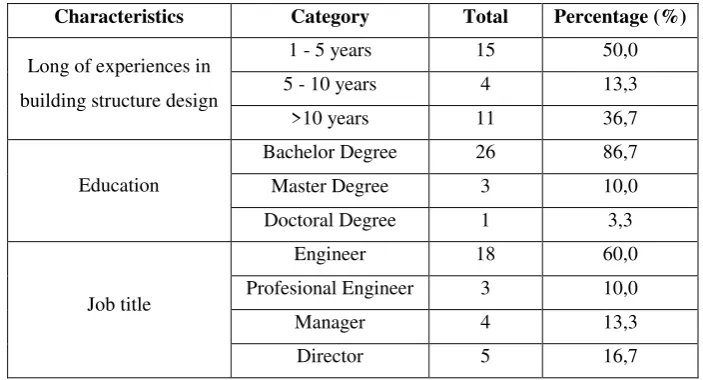
These 63 variables left will be the questions for the research respondent’s questionnaire. This questionnaire is distributed to building structure designer in Batam. 30 out of 46 questionnaires distributed is answered and given back to the researcher. These are the data that will be analysed in this research. Characteristics of the respondents are described, such as long of experiences in building structure design, education and job title:
Table 2. Respondent’s Characteristics
Characteristics Category Total Percentage (%)
Long of experiences in
building structure design
1 - 5 years 15 50,0
5 - 10 years 4 13,3
>10 years 11 36,7
Education
Bachelor Degree 26 86,7
Master Degree 3 10,0
Doctoral Degree 1 3,3
Job title
Engineer 18 60,0
Profesional Engineer 3 10,0
Manager 4 13,3
Director 5 16,7
As shown from table 2, is shown the characteristics of the respondents used in this research. The majority of the respondents have 1 -5 years of experience in structure design, the majority of bachelor degree in civil engineering, and spreaded from engineer to director of structure consultant department.
From 65 independent variables that are analysed, found that 29 variables have a strong relationship with the dependent variable. These variables are from 2 indicators: human resources, and contract document quality; and distributed from 11 factors that are used in this research: designer’s competence, planning and constructability consideration, influence from owner, personnel qualification, design document consistency, design document completeness, design document accuracy, design document simplicity, design duration aspect, design cost aspect and term of reference.
In intercorrelation analysis, variables with correlation value >0.4 with the number greater than half of total variables, will be omitted from the model. From 29 variables analysed, to pass to the next analysis shall has minimal of 15 variable partner with correlation value <0.4. With that being said, 19 variables met this criteria: X2, X3, X6, X14, X16, X19, X23, X26, X28, X29, X31, X32, X36, X37, X42, X46, X52, X59 and X61 that will proceed to the next analysis.
Factor analysis is done to form several new group from the chosen variables from the intercorelation analysis that considered valid to describes the factors that effects building structure design quality in Batam. Factor analysis starts with Barletlett of Sphericity and Keiser Meyer Olkin Measure of Sampling Adequacy (KMO) tests. These tests is to measure the level of intercorrelation between variables whether or not the analysis can be performed, with the criteria of KMO > 0.5 and Barltlett’s test of Sphericity at <0.05 significance level.
Obtained KMO’s value is 0.645 which is >0.5 and Barltlett’s significance level at 1.364x10⁻¹¹
which is <0.05, so the factor analysis can be performed and no significant relationship accours between independent variables in or out of the model. These values is obtained after omitting 4 variables with the correlation value <0.5, which is X3, X14, X29 and X42.
From 15 independent variables that analysed, will form 4 factor components. Independent variables included in component factor 1 are X2 and X6. Independent variables included in component factor 2 is X16. Independent variables included in component factor 3 are X19, X23, X26, X28, X31 and X32. Independent variables included in component factor 4 are X36, X37, X46, X52, X59 and X61.
Multiple Linear Regression Analysis
The regression method used in this research is multiple linear regression analysis with stepwise method. With this method, all of the independent variables analysed will be filtered until the variables that able to describe the dependent variable are obtained. These variables that are called as predictor variables.
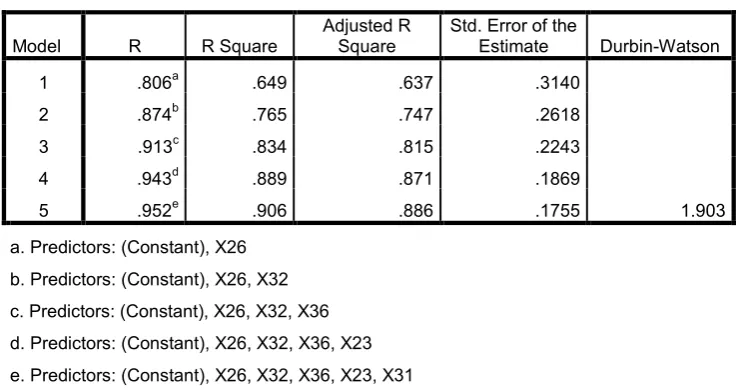
Table 3. Regression Model Analysis
Model R R Square
Adjusted R Square
Std. Error of the
Estimate Durbin-Watson
1 .806a .649 .637 .3140
f. Dependent Variable: Y
From the table 3 above, 5 regression models are formed. The first model only consist of 1 variable, X26, a predictor variable with R2 score of 0.649, wherein X26 giving 64.9% contribution to the dependent variable. The second model, consist of 2 variables with R2 score of 0.765, X26 and X32. To calculate the contribution of X32, the R2 value difference is calculated. That gives 11.6% of X32 contribution to the dependent variable. This calculation continues so that have each independent variable contribution to dependent variable: X36 = 6.9%, X23 = 5.5%, X31 = 1.7% and 9.4% left is described with variables other than the one described in these model.
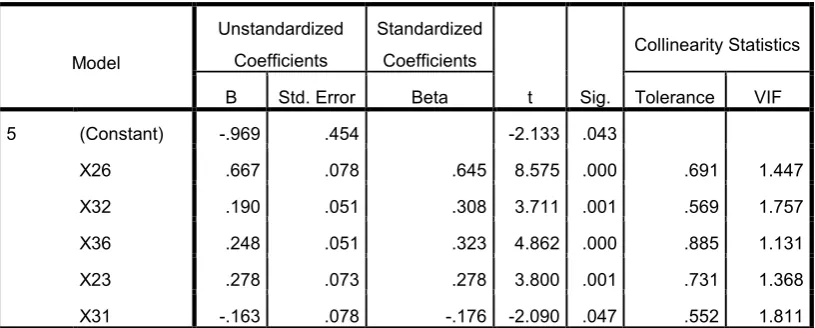
Table 4. Regression Equation Analysis
Model
Unstandardized
Coefficients
Standardized
Coefficients
t Sig.
Collinearity Statistics
B Std. Error Beta Tolerance VIF
5 (Constant) -.969 .454 -2.133 .043
X26 .667 .078 .645 8.575 .000 .691 1.447
X32 .190 .051 .308 3.711 .001 .569 1.757
X36 .248 .051 .323 4.862 .000 .885 1.131
X23 .278 .073 .278 3.800 .001 .731 1.368
X31 -.163 .078 -.176 -2.090 .047 .552 1.811
From the table above, constants for the regression equation is -0.969, coefficient for X26 is 0.667, coefficient for X32 is 0.190, coefficient for X36 is 0.248, coefficient for X23 is 0.278 and coefficient for X31 is -0.163. with that being said, the regression formula is as following:
Y = -0.969 + 0,667 X26 + 0,190 X32 + 0,248 X36 + 0,278 X23 – 0,163 X31
V. CONCLUSION
The quality of building structure design in Batam considered still not optimal, this is due to the majority of building projects in Batam still uses structure design services for out of town and overseas. This is proven by the answers from the interviews from contractors and owners as a service user that states the design outcome from Batam’s structure designer, flaws often still occur such as not considering constructability, design document deficiency, and lack of efficiency in cost.
Factors that affect the building structure design quality in Batam are: designer’s competence, influence from owner, personnel qualification, design document consistency, design document completeness, design document accuracy, design document simplicity, design duration aspect, design cost aspect and term of reference which are obtained from the following variables: X2, X3, X6, X14, X16, X19, X23, X26, X28, X29, X31, X32, X36, X37, X42, X46, X52, X59 and X61.
REFERENCES
[1] Tilley, P. A., “Causes, Effects and Indicators of Design and Documentation Deficiency”, Proceedings of the First International Conference on Construction Industry Development: Building the Future Together, Vol. 2, pp. 388-395, 1997
[2] Suyatno, “Analisis Faktor Penyebab Keterlambatan Penyelesaian Proyek Gedung”, Universitas Diponegoro, Semarang, 2010
[3] Pinori, M., Sompie, B. F., and Willar, D., “Analisis Faktor Keterlambatan Penyelesaian Proyek Konstruksi Gedung Terhadap Mutu, Biaya dan Waktu di Dinas Pekerjaan Umum Kota Manado”, Jurnal Ilmiah Media Engineering Vol.5 No.2, 2015
[4] Bakhtiyar, A., Soehardjono, A., and Hasyim, M. H., “Analisis Faktor-Faktor yang Mempengaruhi Keterlambatan Proyek Konstruksi Pembangunan Gedung di Kota Lamongan”. Jurnal Rekayasa Sipil Vol. 6 No. 1, 2012
[5] Prianto, K., “Analisa Faktor Penyebab Pekerjaan Ulang Pada Proyek Konstruksi di Kota Malang”, Jurnal Ilmu-Ilmu Teknik - Sistem, Vol. 10 No. 2, 2014
[6] Soeharto, I.,”Manajemen Proyek (Dari Konseptual Sampai Operasional) Jilid 1”, Jakarta: Erlangga Publishing, 1999
[7] European Commision, “The European Quality Assurance Standards EN ISO 9000 and EN 45000 in the Community’s New Approach Legislation” Brussels: Directorate-General III, 1996
[8] Soeharto, I., ”Manajemen Proyek (Dari Konseptual Sampai Operasional) Jilid 2”, Erlangga Publishing, Jakarta, 2001 [9] PM4DEV, “Project Quality Management, Project Management for Development Organizations”.
[10] Schwinger, C., “Quality Assurance for Structural Engineering Firms”. AISC, 2008
[11] Project Management Institute, “Guide to the Project Management Body of Knowledge (PMBOK Guide) Fifth Edition”, 2013
[12] Simanjuntak, M. R. A and Firmansyah, I., “Rekomendasi Hasil Analisis Waktu Pelaksanaan Konstruksi Bangunan Gedung Pemerintah di Lingkungan Kota Serang Provinsi Banten”. Jurnal Ilmiah Media Engineering Vol. 4 No. 4, 2014
[13] Chinyio, E. and Olomolaiye, P., “Construction Stakeholder Management”, England: Wiley-Blackwell, 2010 [14] Anonymous, “Requirements for the Building Design Documentation”, Estonia: Riigi Teataja, 2010
[15] Ministry of Law and Human Rights, “Undang-Undang Republik Indonesia Nomor 2 Tahun 2017 Tentang Jasa Konstruksi”, Jakarta, 2017 [16] Ervianto, W. I., “Manajemen Proyek Konstruksi Edisi Revisi”, ANDI Publishing, Yogyakarta, 2006
[17] Wala, M., Sompie, B. F. and Mandagi, R. J., “Penilaian Kinerja Konsultan Perencana Bangunan Dengan Metode Analytic Hierarchy Process (Studi pada Perencana Bangunan di Manado)”, Jurnal Ilmiah Media Engineering Vol. 3 No. 2, 2013
![Table 1. Project Stakeholder [13]](https://thumb-us.123doks.com/thumbv2/123dok_us/1574772.1193721/3.595.88.513.225.456/table-project-stakeholder.webp)