S T U D Y P R O T O C O L
Open Access
Evaluation of differential effects of
metformin treatment in obese children
according to pubertal stage and genetic
variations: study protocol for a randomized
controlled trial
Belén Pastor-Villaescusa
1, Javier Caballero-Villarraso
2, M. Dolores Cañete
3, Raúl Hoyos
4, José Maldonado
5,
Gloria Bueno
6,9, Rosaura Leis
7,9, Ángel Gil
1,9,10, Ramón Cañete
8,9and Concepción M. Aguilera
1,9,10*Abstract
Background:Overweight and obesity are considered to be serious public health problems. In pediatric populations, insulin resistance, dyslipidemia, and hypertension associated with obesity occur with increased frequencies. Metformin is an oral anti-hyperglycemic agent that has been demonstrated to be efficacious in the treatment of diabetic and non-diabetic obese adults. A considerable amount of pharmacogenetic research has demonstrated that genetic variation is one of the major factors affecting metformin response. Additionally, potential microbiota-mediated mechanisms of metformin effect have been recently described. However, scant work has been conducted in children, with no attention being paid to the potential effects of pubertal development. Thus, the main objective of the present study is to evaluate the effect of metformin treatment together with lifestyle recommendations in a randomized control trial (RCT) of obese children according to pubertal stage, genetic variants and signature of gut microbiota.
Methods/design:This is a randomized, prospective, double-blind, placebo-controlled, multicenter trial, which is stratified by puberty and sex. Eighty pre-pubertal (40 boys and 40 girls) and 80 pubertal non-diabetic obese children (40 boys and 40 girls) are being recruited in four Spanish Clinical Hospitals. The inclusion criteria to participate in the RCT include a Body Mass Index (BMI) above the 95th percentile and age 7–14 years. The pubertal stage is determined based on the Tanner criteria. Participants are assigned to two groups in accordance with a randomization schedule and receive 1 g of metformin or placebo for six months in combination with healthy lifestyle recommendations in both groups. The primary outcomes include changes in the BMI Z score and the biomarkers associated with the early appearance of insulin resistance syndrome, inflammation, cardiovascular risk according of the presence of genetic determinants of metformin response, as well as possible modifications in microbiota.
Discussion:This study will assess the differential response of metformin treatment at six months in pre-pubertal and pubertal obese children.
Trial registration:Registered by European Clinical Trials Database (EudraCT, ID: 2010-023061-21) on 14 November 2011. Keywords:Metformin, Children, Obesity, Puberty, Lifestyle intervention, Microbiota, Polymorphisms
* Correspondence:[email protected]
1Department of Biochemistry and Molecular Biology II, Institute of Nutrition
and Food Technology, Center of Biomedical Research Laboratory 123, University of Granada, Avenida del Conocimiento s/n. 18006 Armilla, Granada, Spain
9CIBER Fisiopatología de la Obesidad y la Nutrición (CIBEROBN), Madrid,
Spain
Full list of author information is available at the end of the article
Background
The increased prevalence of obesity in pediatric popula-tions is a public health problem [1]. Insulin resistance, impaired glucose tolerance, dyslipidemia, and hyperten-sion are increased in children [2–4]. These metabolic alterations, which primarily result from obesity, begin in childhood and may manifest during adolescence or young adulthood, with diet and a sedentary lifestyle playing decisive roles [5]. In addition to a lifestyle inter-vention program, pharmacological treatments have been explored. Several drugs have been approved by the Food and Drug Administration (FDA) for the treatment of adult obesity. Currently, orlistat and sibutramine remain widely used in clinical practice in adults. Only orlistat has been approved for use in adolescents [6].
Metformin is an oral anti-hyperglycemic agent approved by the FDA to treat type 2 diabetes (T2D) in adults and children older than 10 years of age. Significant weight loss induced by metformin treatment has been demonstrated in both diabetic and non-diabetic obese adult patients [7]. In contrast, there is insufficient evidence regarding the effects of metformin in pediatric obesity. Several clinical trials have identified modest improvements following metformin treatment in insulin sensitivity in obese chil-dren with normal glucose tolerance [8–10], as well as a decrease in the BMI of obese adolescents [11]. In addition, metformin appears to improve lipid profiles in obese children [12, 13]. However, little is known regarding the effects of metformin, along with diet and exercise, on other measures associated with cardiovascular risk and inflammatory biomarkers. Six studies have evaluated the effects of doses of between 1000 and 2000 mg/day for 3–36 months in obese children and/or adolescents on inflammatory biomarkers related to obesity [10, 14–18]. These studies identified promising results, but did not follow a homogeneous distribution according to pubertal stage. Puberty is a very relevant confounding factor with a potential influence on insulin resistance development. Thus, randomized control trials (RCTs) with adequate statistical power appear necessary to enable the examin-ation of these potential confounders [19], apart from a methodology based on a completely homogeneous distri-bution of factors, such as puberty and sex.
Furthermore, the composition of gut microbiota during early life has been proposed to influence the development of obesity and metabolic disease in chil-dren [20]. The scientific community emphasizes the need to disentangle gut microbiota signatures of specific human diseases from medication treatment success. Interestingly, the microbial mediation of the thera-peutic effects of metformin through short-chain fatty acid production, as well as the potential microbiota-mediated mechanisms behind known intestinal ad-verse effects in the form of a relative increase in the
abundance of Escherichia species have been
demon-strated [21].
On the other hand, studies have shown variability in the therapeutic response of metformin treatment in T2D or obese patients. Variations in metformin response may reflect phenotypic differences in drug action or drug distribution. Genetic polymorphisms in drug uptake transporter genes have been increasingly recognized as a possible mechanism accounting for variation in drug response [22–24]. Therefore, the inclusion of genetic analyses in RCTs could be determinant to elucidate the variations in metformin response.
Methods
Objectives
In accordance with the previously discussed background, the present study has four main objectives: the first objective is to determine the efficacy of metformin in combination with a lifestyle intervention in reducing BMI in obese children compared with placebo after 6 months; the second objective is to evaluate the effects on insulin resistance inherent to metabolic syndrome; the third objective is to identify its effects on inflamma-tory, cardiovascular risk and oxidative stress biomarkers; the fourth objective is to evaluate the change of gut micro-biota composition after treatment. Additionally, metfor-min differential response will be analyzed according to genetic polymorphisms in drug uptake transporter genes.
Study design
The study is a multicenter investigation, stratified by sex and puberty (40 pre-pubertal girls, 40 pre-pubertal boys, 40 pubertal girls, and 40 pubertal boys). The patient dis-tribution among groups is indicated in Fig. 1. The puber-tal stage is determined based on the Tanner criteria [25]. This randomized, prospective, double-blind, placebo-controlled, multicenter trial is being conducted at four Spanish Hospitals: Córdoba, Granada, Santiago de Com-postela and Zaragoza (Table 1).
Children are randomly assigned to receive metformin or placebo for six months. Both treatments are adminis-tered during meals (to minimize gastrointestinal side effects and the risk of hypoglycemia). The participants’ parents are given a coded vial of pills that contains either metformin or placebo pills for two months. The concealed allocation process ensures that the partici-pants and all investigators are unaware of the allocated treatment. All participants are offered lifestyle interven-tion advice at all visits.
In accordance with the “International Conference on Harmonization of Technical Requirements for Registration
of Pharmaceuticals for Human Use”Guide (ICH):“CPMP/
ICH/291/96 Note for Guidance on General Considerations for Clinical Trials,”this is a phase III clinical trial because it involves a commercialized drug for which a new indica-tion that is not included in its technical specificaindica-tions will be investigated.
The CONSORT statement (Consolidated Standards of Reporting Trials) has been taken into account in the study design report, as well as for the abstract and the flow diagram (Fig. 1), thereby increasing the reporting quality for the RCT. Moreover, the Standard Protocol
Items: Recommendations for Interventional Trials
(SPIRIT) guidelines for this study protocol are attached in Additional file 1.
Assessed for eligibility
Randomized (n= 160)
40 PPG, 40 PPB, 40 PG, 40 PB
Allocated toplacebointervention (n=80)
Allocation
Enrollment
Allocated tometforminintervention (n=80)
Lost to follow-up (n=?)
Analyzed (n=?)
Excluded for analysis (n=?)
Completed trial (n=?)
Follow-Up
(6 months) Lost to follow-up (n=?)
Analyzed (n=?)
Excluded for analysis (n=?)
[image:3.595.58.540.86.505.2]Fig. 1Participant flow diagram.PPGpre-pubertal girls;PPBpre-pubertal boys;PGpubertal girls;PBpubertal boys
Table 1Distribution of patients according to center
Hospital Total (160)
Reina Sofía (Córdoba) 20 pre-pubertal girls 20 pre-pubertal boys Virgen de las Nieves (Granada) 10 pre-pubertal girls
10 pre-pubertal boys 10 pubertal girls 10 pubertal boys Clínico Universitario (Santiago de Compostela) 10 pre-pubertal girls
10 pre-pubertal boys 10 pubertal girls 10 pubertal boys Lozano Blesa (Zaragoza) 20 pubertal girls
[image:3.595.56.290.550.731.2]Participants
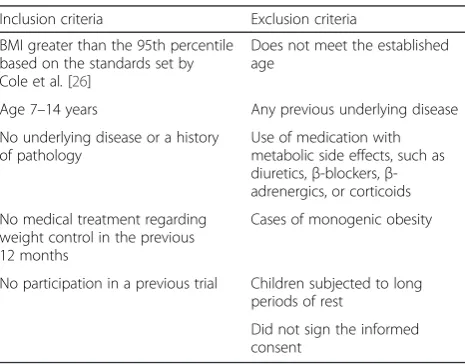
The study subjects comprise patients referred from the Pediatric Endocrinology Unit of the corresponding study centers. Children are eligible for this RCT if they meet the inclusion criteria (Table 2). The data are collected in the pediatric outpatient clinics by dieticians. The data and samples are codified according to each center and subse-quently centralized at the Institute of Nutrition and Food
Technology“José Mataix”(INYTA) in Granada, Spain.
Randomization
The participants are assigned to metformin or placebo in accordance with a randomization schedule generated by the Pharmacy Service of the Virgen de las Nieves University Hospital in Granada, with MAS 100 version 2.1 software (Glaxo-Welcome, Madrid, Spain) by the Support Consortium to Biomedical Research Network (CAIBER). At each center, 50 % of the children are assigned to each group.
The drug presentation format for the metformin and placebo groups has the same appearance. The local physician responsible for the procedure is only aware of the box/bottle codes of the tablets (as well as the regis-tration number of the participating child). These codes have a corresponding equivalent available only to the coordinating investigator who has the other data of pharmaceutical interest, such as the origin, lot number and manufacturing and packaging dates (as well as whether the drug is metformin or placebo). The afore-mentioned local physician is not aware of these data and thus assigns the participant to one study group, without knowledge of the primary treatment administered.
Breaking of the study blind
All research staff are blinded for both the treatment allocation during the time of the study and the data
analysis. The study blind will be broken after all analyses are completed. In the case of emergencies (e.g., serious adverse events, potentially unexpected serious adverse re-actions), the blind will be broken following consultation with the principal investigator. These events will subse-quently be reported to the Medical Ethics Committee.
Interventions
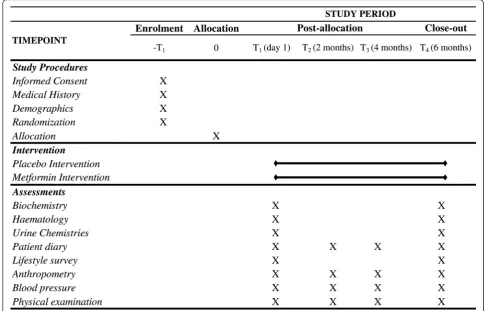
The patients are instructed to taking a initial dose of 50 mg twice daily for 10 days, followed by 500 mg twice daily until the end of the treatment. The presentation comprises tablets in opaque, white plastic containers and a side label with 28 units. The dietician centers administer a food frequency questionnaire (FFQ) and a physical activ-ity survey to all participants at the beginning and at the end of the trial. All participants are provided with stan-dardized healthy lifestyle advice at the start of a one-on-one session, including a healthy diet and exercise advice sheet. The participants attend an initial trial baseline visit, followed by three additional visits at 2-month intervals (Fig. 2), which include anthropometric parameter and blood pressure (BP) assessments, as well as a physical examination. A medical history is obtained for each participant, including documentation of the family history.
To ensure the traceability of the treatments, a system-atic record of the name of the pharmaceutical preparation, and the quantity and lot number dispensed to each subject are maintained in the corresponding data collection book. The data are updated according to the standard working procedures (SWPs) for the preparation and control of 500-mg metformin tablets and according to the SWPs for the control of pills, which are provided by the Hospital Pharmacy Department.
At the first visit, an extensive history is obtained. The duration of pregnancy, birth weight, neonatal feeding, use of medication, tobacco and alcohol, and the presence of maternal gestational diabetes are reported. Regarding family history, data on hypertension, obesity, hypercholes-terolemia, cardiovascular disease, anddiabetes mellitusin first-degree (parents) and second-degree (grandparents) family members are collected. Girls are asked whether and when they experienced menarche. The parental education level is recorded, as well as height and weight.
Adverse effects and co-medication
[image:4.595.57.290.542.724.2]To assess the safety of metformin administration, the primary evaluation criteria are the absence of the adverse effects (AEs) described. The patients are assessed regard-ing all symptoms at each visit to identify potential AEs and the use of co-medication in the previous two months. A contact number is provided to enable enquiries regard-ing any symptom perceived as adverse. At this number, the patient is informed about what to do in the event of Table 2Inclusion and exclusion criteria
Inclusion criteria Exclusion criteria BMI greater than the 95th percentile
based on the standards set by Cole et al.[26]
Does not meet the established age
Age 7–14 years Any previous underlying disease No underlying disease or a history
of pathology
Use of medication with metabolic side effects, such as diuretics,β-blockers,β -adrenergics, or corticoids No medical treatment regarding
weight control in the previous 12 months
Cases of monogenic obesity
No participation in a previous trial Children subjected to long periods of rest
Did not sign the informed consent
an adverse reaction. They are also requested to suspend the medication. The following information is recorded: description, date of onset and end date, severity, assess-ment of relation to the study medication, other suspect drug or device and action taken. Follow-up information should be provided as necessary. The prominent AEs are as follow: diarrhea, nausea, blood in the stools, headache, dizziness, general discomfort, sleepiness, cold or flu, pha-ryngitis, otitis, allergic episode, lactic acidosis, urea incre-ment, hypercreatininemia, hypertransaminasemia and vitamin B12deficiency, as well as any other symptoms
re-ported by the participants. The relationships of the AEs to the study medication will be assessed by a quali-fied medical investigator.
Physical examination
The Clinical Units conduct a complete medical examin-ation, which is performed with pubertal assessment. Measurements of arterial BP, calibrated by hand and in duplicate, and heart rate are obtained with the subjects in a seated position using a cuff appropriate for the arm circumference. The average BP values are expressed in mmHg, and the percentiles are determined and adjusted for sex and age according to the chart published by the National Heart, Lung and Blood Institute.
At every visit, an extended physical examination is performed by the research physician. This examination includes auscultation of the heart, lungs and abdomen and also abdominal palpation. Clinical signs may be iden-tified, including the presence of acanthosis nigricans, hypertrichosis, striae, acne, adipomastia or hypogonadism.
Monitoring of lifestyle
The dietician centers administer a FFQ and a physical ac-tivity survey to all participants at the beginning and at the end of the trial. Both questionnaires have been normalized by the IDEFICS and HELENA European Projects [26] and validated by the CTS-02203 Excellence Project of the Re-gional Government of Andalucía. The HELENA Study de-veloped and tested a questionnaire for use among adolescents, based on the long format of the Inter-national Physical Activity Questionnaire (IPAQ) [27], which provided internationally comparable data [28].
Blood, urine and fecal sampling
General biochemical analyses are performed at the participating hospitals following internationally accepted protocols.
[image:5.595.54.539.89.400.2]Three milliliters of blood are collected at the beginning and at the end of the trial. The blood is drawn via the antecubital vein. Peripheral white blood cells (buffy coat) are taken for deoxyribonucleic acid (DNA) extraction. Moreover, a 1-ml urine sample is obtained for oxidation marker analysis. Children should not eat for 12 hours before the sampling. All samples are collected and stored frozen by the research staff. The samples will be analyzed in the clinical laboratory of each hospital, as well as the INYTA.
In order to studying the childrens’ gut microbiota,
100–200 g of fecal sample is collected in a sterile container by parents at the beginning and at the end of the trial. Immediately, all samples are stored frozen until to be analyzed at the INYTA.
Adherence and tolerance
Adherence will be measured as a percentage using the following formula:
Quick¼ ððPillsingestedpillsreturnedÞ=PillspredictedÞ
100
These data will also be taken into account for statistical analysis as fixed effects. Tolerance is reported as the descriptive statistics of the adverse effects in relation to the achieved dosage level.
Sample size
As previously indicated, the principal variable is the BMI
Zscore, on which the sample size calculation was based. Its standard deviation is 2.29 in the least favorable case (according to the tables by Cole et al. [29]), and a de-sired minimum difference of 2 points is expected. With
an α error of 0.05, a β error of 0.20 and an estimated
follow-up loss of 20 %, four groups in total are planned for the study: two groups of obese children (pre-pubertal and pubertal) treated with metformin and two groups of obese children (pre-pubertal and pubertal) treated with a placebo; there is a requirement of at least 40 patients per group (× four groups = 160 children total).
The clinical argument for the choice of the principal variable adheres to the fact that the obesity concept is based on the BMI, as the bibliography endorses. However, it should be noted that the BMI in childhood changes sub-stantially with age [30]. Thus, age- and sex-specific cut-off points are needed to define pathology in children via means of aZscore [29] to obtain a more accurate value.
Statistical analysis
Data will be analyzed using SPSS software version 22 for Windows. Descriptive statistics for all outcomes will be determined. A Kolmogorov-Smirnov test will be used to test data normality. Data that are not normally
distributed will be transformed by means of a log10 or square root for analysis. The homogeneity of variances will be determined with a Levene’s test. Normally dis-tributed data will be reported as mean ± standard devi-ation (SD) and nonparametric data as median (range). The analysis selected to determine the effect of treat-ment is a linear mixed effects model (LMM), for which the center is considered covariance to adjust the statis-tical analysis. The fixed effects include time, treatment,
adherence, puberty, sex, the interactions time ×
treat-ment,time × treatment × puberty and time × treatment × sex. A Bonferroni test will be used to assess the specific differences between the treatments.
Regarding genetic variations, linear regression will be performed to analyze differences in principal variable changes between genotypes and to evaluate independent associated factors.
Moreover, the raw microbiologic data are reported as relative abundances. Differences among times, treatments
and puberty are compared using the Mann-WhitneyUtest.
Finally, the clustering of the colonic microbiota in both of groups is calculated by a principal component analysis.
Interim analyses and stopping rules
Interim or preliminary analyses during the course of this RCT are not planned. In the event of subject withdrawal, a replacement or substitution is not planned; thus, these par-ticipants will be considered lost. The data associated with these subjects will subsequently be excluded from the stat-istical analysis. For this reason, the calculation of the sample size has included a potential loss of up to 20 %.
Outcome measures Anthropometry
Body weight (kg), height (cm) and waist circumference (cm) are measured via standardized procedures. The BMI
and BMI Z score are calculated based on Spanish
refer-ence standards published by Sobradillo et al. [31]. Obesity is defined according to the BMI, with the age and sex-specific cut-off points proposed by Cole et al. [29] (BMI >95th percentile). Anthropometric measurements are ob-tained by a single examiner with the children barefoot and in their underwear. To obtain data on body composition, fat mass, lean mass and total body water are measured via bioimpedance technology using Tanita B18.
Biochemical analysis
to auto-analyzers with standardized methods and both intra- and inter-laboratory control using internal and external quality control programmers at the Clinical Analysis Laboratory of each hospital. The Quantitative Insulin Sensitivity Check Index (QUICKI) and the homeostasis model assessment for insulin resistance (HOMA-IR) are calculated using the fasting plasma glucose and insulin values:
HOMA ¼Fasting insulinðμU=mlÞ
fasting glucoseðmmol=lÞ=22:51=
ðLog fasting insulinðμU=mlÞ
þlog fasting glucoseðmg=dlÞÞ
Inflammation and cardiovascular risk biomarkers
Specific biomarkers of inflammation and cardiovascular risk, including adiponectin, leptin, resistin, myeloperoxi-dase (MPO), plasminogen activator inhibitor-1 (PAI-1),
tumor necrosis factor-alpha (TNF-α), monocyte
chemo-attractant protein-1 (MCP-1), interleukin-6 (IL-6),
interleukin-8 (IL-8), soluble intercellular adhesion
molecule-1 (sICAM-1), soluble endothelial selectin (sE-Selectin) and soluble vascular adhesion molecule-1 (sVCAM-1) are analyzed in duplicate on a Luminex 200 system with the XMap technology (Luminex Corporation, Austin, TX, USA) and using human monoclonal anti-bodies (Milliplex Map Kit, Millipore, Billerica, MA, USA).
Oxidation biomarkers
The plasma total antioxidant capacity (TAC) is assessed with a spectrophotometric commercial antioxidant assay kit (Cayman, Ann Arbor, MI, USA), which is based on a colorimetric reaction. The oxidized LDL (Cayman, Ann Arbor, MI, USA), as well as the oxidative stress biomarkers isoprostane (Oxford Biomedical Research, Oxford, UK) and 8-hydroxy-2-deoxyguanosine (JaICA (Japan Institute for the Control of Ageing), Fukuroi, Shizuoka, Japan) are determined in duplicate via enzyme-linked immunosorbent assay (ELISA) in urine using a microplate reader BioTeK synergy HT.
Microbiota analysis
The fecal samples are subjected to extracting and purifying microbial DNA by a specific commercial DNA kit for purification (QIAamp DNA Stool Mini Kit, Quiagen, Barcelona, Spain). Quantification is conducted with a NanoDrop ND-1000 spectrophotometer (Thermo Fisher Scientific, Newark, DE, USA) in the Department of Micro-biology, University Hospital San Cecilio (Granada, Spain). Polymerase chain reaction (PCR) is performed in a FastStart High Fidelity PCR System, dNTP Pack (Roche Applied Science). After PCR, amplicons are further purified using AMPure XP beads (Beckman-Coulter) to remove smaller fragments. DNA concentration and quality
are measured using a Quant-iT™PicoGreen® dsDNA Assay
Kit. Afterwards, pyrosequencing of the PCR amplicons is performed using a Roche/454 GS Titanium technology platform (Roche, Branford, CT, USA). The MG-RAST (metagenomics analysis server) and the Ribosomal Data-base Project are used for the taxonomic analysis. Metage-nomics data will be deposited in the publicly available repository MG-RAST (http://metagenomics.anl.gov/).
DNA isolation and genotyping
Genomic DNA is extracted from peripheral white blood cells (buffy coat) using the Zymo ZR-96 Quick-gDNA kit (Zymo Research Corporation, Irvine, CA, USA) ac-cording to the manufacturer’s instructions. Eleven single nucleotide polymorphisms (SNPs) previously described as being involved in the success of metformin treatment are being selected along several genes: the ataxia telangiectasia mutated (ATM, rs11212617); the glucoki-nase regulatory protein (GCKR, rs1260326); the serine-threonine kinase 11 (STK11, rs8111699); the peroxisome proliferator-activated receptor gamma, coactivator 1 alpha (PPARGC1A, rs2970852); the insulin-induced gene 2 (INSIG2, rs7566605); the neuronal growth regulator 1 (NEGR1, rs2815752); the solute carrier family 22 (organic cation transporter), member 1 (SLC22A1, rs622342); the solute carrier family 47 (multidrug and toxin extrusion),
member 1 (SLC47A1, rs2289669); the transmembrane
protein 18 (TMEM18, rs6548238), the potassium channel
tetramerization domain containing 15 (KCTD15,
rs29941); and the fat mass- and obesity-associated protein (FTO, rs9939609). Genotyping will be performed in dupli-cate using TaqMan® OpenArray® Genotyping Plates (Ther-moFisher Scientific, Madrid, Spain).
Discussion
The studies of the efficacy of metformin treatment in obese children and adolescents have been small, of short duration, or have used nonstandard doses of metformin and have produced inconclusive results. McDonagh et al. [19] examined the literature regarding obese children via a systematic review and meta-analysis and indicated the need for investigations of the effects of metformin treatment that consider the influence of potential con-founding factors, such as puberty and sex. Similarly, tri-als with adequate statistical power that enable an
examination of these potential confounders are
mandatory. Nine trials mention the pubertal stage in their publications [8, 10, 11, 14, 16, 18, 32–34]. Although puberty has been considered in the study design by a limited number of authors, none of these authors used a
homogenized sample division. Wilson et al. and
Wiegand et al. predominantly recruited children who
early puberty (Tanner I–III) [34], whereas Burgert et al. and Evia-Viscarra et al. only included adolescent volunteers [10, 14] and Freemark et al. included those at Tanner III [32]. Furthermore, the sample size has also been an important element: Srinivasan et al. recognized that the patient numbers were insufficient to statistically assess the effect of pubertal stage on the response to metformin therapy (n= 28, 14 pre-pubertal; 14 pubertal) [8]. Mauras et al. [16] evaluated metformin treatment with individual lifestyle coaching in pre- and pubertal children compared with a control group for six months. However, differences between the puberty groups based on metformin treatment were not identified. Furthermore, Kendall et al. [18] also examined the effects of metformin on obese children for six months. They did not identify a differential response to metformin according to the pubertal stage when they used a multifactorial regression analysis. This finding may also be explained by the small number of valid cases in the analysis segmented by puberty.
Additionally, during the last years the importance has been demonstrated of determining the specific contribu-tion of the human gut microbiome to the pathogenesis of obesity to allow for the development of effective treat-ment strategies. Recently, an elegant study by Forslund et al. published in Nature identifies specific disease and drug signatures in the human gut microbiome of T2D patients treated with metformin [21]. By analyzing the dataset without stratifying for treatment regimens, they replicated the majority of previously reported results and showed a large divergence between the study popula-tions. However, composition of gut microbiota from children treated with metformin has not been studied. Taking into account the proven role of the microbiota on childhood obesity development [20], the development of RCTs adjusting the effects according to the human gut microbiome is necessary.
Finally, a considerable amount of pharmacogenetic research has demonstrated that genetic variation is one of the major factors affecting metformin response [35]. Moreover, it has become increasingly clear that the pharmacokinetics of metformin are primarily deter-mined by membrane transporters, including the plasma membrane monoamine transporter, the organic cation transporters (OCTs), the multidrug and toxin extrusion-1 transporter (MATE1), and the critical AMPK. In this RCT, we will analyze the genetic variants previously proved to determine the pharmacokinetics of metformin [36] and a differential response after treatment in obese subjects. Genes included are related to metformin
transporters (SLC22A1 and SLC47A1), AMPK and the
gluconeogenesis pathway (ATM,STK11andPPARGC1A),
insulin sensitivity(GCKRandINSIG2) and weight loss or
weight regain predictors (FTO, TMEM18, NEGR1 and
KTCD15) Understanding how genetic variation affects metformin response will help to promote more effective use of the drug for the treatment of childhood obesity.
In view of this situation, our research could provide consolidated evidence regarding metformin’s effects on obese children, considering the pubertal stage via homo-geneous Tanner stratification, as well as finding possible lines of action by metformin. Nevertheless, the study has several limitations, including the difficulty of assessing treatment compliance in children, as well as lifestyle changes. Moreover, the supervision of dietary habits and physical activity proves rather complicated. We are con-trolling for medication taken by means of the delivery and return of the bottles; however, we are aware that this strategy does not ensure accuracy regarding intervention compliance information.
Trial status
Currently, the trial is ongoing and recruitment of partici-pants continues.
Additional file
Additional file 1:SPIRIT 2013 Checklist (17.05.2016). File outlining how this study protocol meets the different guidelines from the SPIRIT 2013 Checklist. (PDF 48 kb)
Abbreviations
AEs, adverse events; ALT, alanine aminotransferase; AMPK, AMP-activated protein kinase; Apo-A1, apolipoprotein A1; Apo-B, apolipoprotein B; AST, aspartate aminotransferase;ATM, ataxia telangiectasia mutated; BMI, Body mass index; CFQ, Consumption Food Questionnaire; CMIA, chemiluminescent microparticle immunoassay; ELISA, enzyme-linked immunosorbent assay; FDA, Food and Drug Administration; GGT, gamma-glutamyltranspeptidase;
GCKR, glucokinase regulatory protein; HDLc, high-density lipoprotein cholesterol; HOMA-IR, homeostasis model assessment for insulin resistance; IL-6, interleukin-6; IL-8, interleukin-8;INSIG2, insulin-induced gene 2; IPAQ, Physical activity questionnaire;KCTD15, potassium channel tetramerization domain containing 15; LDLc, low-density lipoprotein cholesterol; LMM, linear mixed effects model;
MATE1, multidrug and toxin extrusion-1 transporter; MCP-1, monocyte chemoattractant protein-1; MG-RAST, metagenomics analysis server; MPO, myeloperoxidase;NEGR1, neuronal growth regulator 1; OCTs, organic cation transporters; PAI-1, plasminogen activator inhibitor-1; PPARGC1A, peroxisome proliferator-activated receptor gamma, coactivator 1 alpha; QUICKI, Quantitative Insulin Sensitivity Check Index; RCT, randomized clinical trial; sE-Selectin, soluble endothelial selectin; sICAM-1, soluble intercellular adhesion molecule-1; sVCAM-1, soluble vascular adhesion molecule-1; T2D, type 2 diabetes; TAC, total antioxidant capacity; TNF-α, tumor necrosis factor-alpha;TMEM18, transmembrane protein 18
Acknowledgements
Pastor Villaescusa’s doctorate, which is being performed within the
“Nutrition and Food Sciences Program”at the University of Granada.
Authors’contributions
BPV is responsible for all the data and sample collection, as well as for the development of the FFQ and a physical activity survey in Granada; BPV wrote the manuscript; JCV designed the study and obtained grant funding; MDC designed the study and administers the FFQ and a physical activity survey to all participants in Reina Sofía Hospital (Córdoba); RH is responsible for child recruitment and RCT management in the Virgen de las Nieves University Hospital (Granada); JM is responsible for, and coordinator of, child recruitment and RCT management in the Virgen de las Nieves University Hospital (Granada); GB is responsible for, and coordinator of, child recruitment and RCT management in the Lozano Blesa University Hospital (Zaragoza); RL is responsible for, and coordinator of, child recruitment and RCT management in the Clinic University Hospital of Santiago (Santiago de Compostela); AG designed the study and obtained grant funding, reviewed and edited the manuscript; RC is the trial promoter, designed the study and obtained grant funding; CMA created the sampling and analysis protocols, and reviewed and edited the manuscript. All authors take full responsibility for the manuscript contents. All authors have read and approved the final manuscript.
Competing interests
Belén Pastor-Villaescusa, Javier Caballero-Villarraso, M. Dolores Cañete, Raúl Hoyos, José Maldonado, Gloria Bueno, Rosaura Leis, Ángel Gil, Ramón Cañete, and Concepción M. Aguilera declare that they have no conflict of interest that could be perceived as prejudicing the impartiality of the research reported. The funding organization has no role in the conception, design, or conduct of the study, or in the writing of the manuscript or the decision to submit it for publication. CAIBER monitors the allocation sequence and ensures that the compliance is double-blind. It is independent from the sponsor and has no conflict of interest to report.
Author details
1Department of Biochemistry and Molecular Biology II, Institute of Nutrition
and Food Technology, Center of Biomedical Research Laboratory 123, University of Granada, Avenida del Conocimiento s/n. 18006 Armilla, Granada, Spain.2Clinical Analysis Services. IMIBIC/Reina Sofía Hospital,
Córdoba University, Córdoba, Spain.3PAIDI CTS-329. Maimonides Institute of
Biomedical Research of Córdoba (IMIBIC), Córdoba, Spain.4Pediatric
Department, Virgen de las Nieves University Hospital, Andalusian Health Service, Granada, Spain.5Pediatric Gastroenterology and Nutrition Unit,
Virgen de las Nieves University Hospital, Pediatric Department, University of Granada, Granada, Spain.6Pediatric Department, Lozano Blesa University
Clinical Hospital, University of Zaragoza, Zaragoza, Spain.7Unit of Investigation in Nutrition, Growth and Human Development of Galicia, Pediatric Department, Clinic University Hospital of Santiago, University of Santiago de Compostela, Santiago de Compostela, Spain.8Unit of Pediatric
Endocrinology, Reina Sofia University Hospital, Córdoba, Spain.9CIBER Fisiopatología de la Obesidad y la Nutrición (CIBEROBN), Madrid, Spain.
10Instituto de Investigación Biosanitaria ibs, Granada, Spain.
Received: 19 February 2016 Accepted: 12 May 2016
References
1. Centers for Disease Control and Prevention (CDC). Self-reported influenza-like illness during the 2009 H1N1 influenza pandemic—United States, September 2009–March 2010. MMWR Morb Mortal Wkly Rep. 2011;60:37–41. 2. Freedman DS, Dietz WH, Srinivasan SR, Berenson GS. The relation of
overweight to cardiovascular risk factors among children and adolescents: the Bogalusa Heart Study. Pediatrics. 1999;103(6 Pt 1):1175–82.
3. Reilly JJ, Methven E, McDowell ZC, Hacking B, Alexander D, Stewart L, Kelnar CJH. Health consequences of obesity. Arch Dis Child. 2003;88:748–52. 4. Weiss R, Dziura J, Burgert TS, Tamborlane WV, Taksali SE, Yeckel CW, Allen K,
Lopes M, Savoye M, Morrison J, Sherwin RS, Caprio S. Obesity and the metabolic syndrome in children and adolescents. N Engl J Med. 2004;350:2362–74.
5. Cañete R, Gil-Campos M, Aguilera CM, Gil A. Development of insulin resistance and its relation to diet in the obese child. Eur J Nutr. 2007;181–187.
6. Rogovik AL, Chanoine J-P, Goldman RD. Pharmacotherapy and weight-loss supplements for treatment of paediatric obesity. Drugs. 2010;70:335–46. 7. Golay A. Metformin and body weight. Int J Obes (Lond). 2008;32:61–72. 8. Srinivasan S, Ambler GR, Baur LA, Garnett SP, Tepsa M, Yap F, et al.
Randomized, controlled trial of metformin for obesity and insulin resistance in children and adolescents: improvement in body composition and fasting insulin. J Clin Endocrinol Metab. 2006;91:2074–80.
9. Love-Osborne K, Sheeder J, Zeitler P. Addition of metformin to a lifestyle modification program in adolescents with insulin resistance. J Pediatr. 2008;152:817–22.
10. Burgert TS, Duran EJ, Goldberg-gell R, Dziura J, Yeckel CW, Katz S, Tamborlane WV, Caprio S. Short-term metabolic and cardiovascular effects of metformin in markedly obese adolescents with normal glucose tolerance. Pediatr Diabetes. 2008;9:567–76.
11. Wilson DM, Abrams SH, Aye T, Lee PD, Lenders C, Lustig RH, Osganian SV, Feldman HA, Glaser Pediatric Research Network Obesity Study G. Metformin extended release treatment of adolescent obesity: a 48-week randomized, double-blind, placebo-controlled trial with 48-week follow-up. Arch Pediatr Adolesc Med. 2010;164:116–23.
12. Kay JP, Alemzadeh R, Langley G, D’Angelo L, Smith P, Holshouser S. Beneficial effects of metformin in normoglycemic morbidly obese adolescents. Metabolism. 2001;50:1457–61.
13. Atabek ME, Pirgon O. Use of metformin in obese adolescents with hyperinsulinemia: a 6-month, randomized, double-blind, placebo-controlled clinical trial. J Pediatr Endocrinol Metab. 2008;21:339–48.
14. Evia-Viscarra ML, Rodea-Montero ER, Apolinar-Jiménez E, Muñoz-Noriega N, García-Morales LM, Leaños-Pérez C, Figueroa-Barrón M, Sánchez-Fierros D, Reyes-García JG. The effects of metformin on inflammatory mediators in obese adolescents with insulin resistance: controlled randomized clinical trial. J Pediatr Endocrinol Metab. 2012;41–49.
15. Gómez-Díaz RA, Talavera JO, Pool EC, Ortiz-Navarrete FV, Solórzano-Santos F, Mondragón-González R, Valladares-Salgado A, Cruz M, Aguilar-Salinas CA, Wacher NH. Metformin decreases plasma resistin concentrations in pediatric patients with impaired glucose tolerance: a placebo-controlled randomized clinical trial. Metabolism. 2012;61:1247–55.
16. Mauras N, Delgiorno C, Hossain J, Bird K, Killen K, Merinbaum D, Weltman A, Damaso L, Balagopal P. Metformin use in children with obesity and normal glucose tolerance—effects on cardiovascular markers and intrahepatic fat. J Pediatr Endocrinol Metab. 2012;25:33–40.
17. Rynders C, Weltman A. Lifestyle intervention improves fitness independent of metformin in obese adolescents. Med Sci Sports Exerc. 2012;44:786–92. 18. Kendall D, Vail A, Amin R, Barrett T, Dimitri P, Ivison F, Kibirige M, Mathew V,
Matyka K, McGovern A, Stirling H, Tetlow L, Wales J, Wright N, Clayton P, Hall C. Metformin in obese children and adolescents: the MOCA Trial. J Clin Endocrinol Metab. 2013;98:322–9.
19. McDonagh MS, Selph S, Ozpinar A, Foley C. Systematic review of the benefits and risks of metformin in treating obesity in children aged 18 years and younger. JAMA Pediatr. 2014;168:178–84.
20. Sanz Y, Olivares M, Moya-Pérez Á, Agostoni C. Understanding the role of gut microbiome in metabolic disease risk. Pediatr Res. 2014;77:236–44. 21. Forslund K, Hildebrand F, Nielsen T, Falony G, Le Chatelier E, Sunagawa S,
Prifti E, Vieira-Silva S, Gudmundsdottir V, Krogh Pedersen H, Arumugam M, Kristiansen K, Yvonne Voigt A, Vestergaard H, Hercog R, Igor Costea P, Roat Kultima J, Li J, Jørgensen T, Levenez F, Dore J, MetaHIT consortium, Bjørn Nielsen H, Brunak S, Raes J, Hansen T, Wang J, Dusko Ehrlich S, Bork P, Pedersen O. Disentangling type 2 diabetes and metformin treatment signatures in the human gut microbiota. Nature. 2015;528(7581):262–6. 22. Becker ML, Visser LE, van Schaik RHN, Hofman A, Uitterlinden AG, Stricker BHC.
Genetic variation in the organic cation transporter 1 is associated with metformin response in patients with diabetes mellitus. Pharmacogenomics J. 2009;9:242–7.
23. Becker ML, Visser LE, van Schaik RHN, Hofman A, Uitterlinden AG, Stricker BHC. Genetic variation in the multidrug and toxin extrusion 1 transporter protein influences the glucose-lowering effect of metformin in patients with diabetes: a preliminary study. Diabetes. 2009;58:745–9.
24. Becker ML, Visser LE, van Schaik RHN, Hofman A, Uitterlinden AG, Stricker BHC. Interaction between polymorphisms in the OCT1 and MATE1 transporter and metformin response. Pharmacogenet Genomics. 2010;20:38–44.
26. Vyncke K, Cruz Fernandez E, Fajó-Pascual M, Cuenca-García M, De Keyzer W, Gonzalez-Gross M, et al. Validation of the Diet Quality Index for Adolescents by comparison with biomarkers, nutrient and food intakes: the HELENA study. Br J Nutr. 2012;25:1–12. Epub 30 Oct 2012.
27. Craig CL, Marshall AL, Sjöström M, Bauman AE, Booth ML, Ainsworth BE, Pratt M, Ekelund U, Yngve A, Sallis JF, Oja P. International physical activity questionnaire: 12-country reliability and validity. Med Sci Sports Exerc. 2003;35:1381–95.
28. Moreno LA, González-Gross M, Kersting M, Molnár D, de Henauw S, Beghin L, Sjöström M, Hagströmer M, Manios Y, Gilbert CC, Ortega FB, Dallongeville J, Arcella D, Wärnberg J, Hallberg M, Fredriksson H, Maes L, Widhalm K, Kafatos AG, Marcos A. Assessing, understanding and modifying nutritional status, eating habits and physical activity in European adolescents: the HELENA (Healthy Lifestyle in Europe by Nutrition in Adolescence) Study. Public Health Nutr. 2008;11:288–99.
29. Cole TJ, Bellizzi MC, Flegal KM, Dietz WH. Establishing a standard definition for child overweight and obesity worldwide: international survey. BMJ. 2000;320:1240–3.
30. Rolland-Cachera MF, Sempé M, Guilloud-Bataille M, Patois E, Péquignot-Guggenbuhl F, Fautrad V. Adiposity indices in children. Am J Clin Nutr. 1982;36:178–84.
31. Sobradillo B, Aguirre A, Aresti U, Bilbao A, Fernández-Ramos C, Lizárraga A, Lorenzo A, Madariaga L, Rica I, Ruiz I, Sáchez E, Santamaría E, Serrano JM, Zabala A, Zurimend B, Hernández M. Curvas y tablas de crecimiento, Instituto de Investigación sobre Crecimiento y Desarrollo. Fund Faustino Orbegozo Madrid Editor Garsi. 2004.
32. Freemark M, Bursey D. The effects of metformin on body mass index and glucose tolerance in obese adolescents with fasting hyperinsulinemia and a family history of type 2 diabetes. Pediatrics. 2001;107:E55.
33. Wiegand S, L’Allemand D, Hübel H, Krude H, Bürmann M, Martus P, Grüters A, Holl RW. Metformin and placebo therapy both improve weight management and fasting insulin in obese insulin-resistant adolescents: a prospective, placebo-controlled, randomized study. Eur J Endocrinol. 2010;163:585–92. 34. Yanovski JA, Krakoff J, Salaita CG, McDuffie JR, Kozlosky M, Sebring NG,
Reynolds JC, Brady SM, Calis KA. Effects of metformin on body weight and body composition in obese insulin-resistant children: a randomized clinical trial. Diabetes. 2011;60:477–85.
35. Chen S, Zhou J, Xi M, Jia Y, Wong Y, Zhao J, Ding L, Zhang J, Wen A. Pharmacogenetic variation and metformin response. Curr Drug Metab. 2013;14:1070–82.
36. Maruthur NM, Gribble MO, Bennett WL, Bolen S, Wilson LM, Balakrishnan P, Sahu A, Bass E, Kao WHL, Clark JM. The pharmacogenetics of type 2 diabetes: a systematic review. Diabetes Care. 2014;37:876–86.
• We accept pre-submission inquiries
• Our selector tool helps you to find the most relevant journal
• We provide round the clock customer support
• Convenient online submission
• Thorough peer review
• Inclusion in PubMed and all major indexing services
• Maximum visibility for your research
Submit your manuscript at www.biomedcentral.com/submit