ABSTRACT
HO, CHIH-WEI. Performance Requirements Improvement with an Evolutionary Model. (Under the direction of Dr. Laurie A. Williams).
Performance is an important property for a software system. Performance requirements should be specified and validated before detail design starts. However, some factors that can affect the system performance may not be available during early phases of software development. This dissertation proposes Performance Refinement and Evolution Model (PREM), an evolutionary model for performance requirements specification. A development team may use PREM to specify simple PRs early in the software development process, and add more details when the team gains more knowledge of the system performance.
Two performance requirements improvement approaches were designed based based on PREM. The first approach, called Performance Requirement Improvement from Failure Reports (PRIFF), uses the field failure reported by the customers to improve performance requirements. PRIFF was applied on the requirements and field failure reports for a commercial distributed software system. The results demonstrate that the information in the field failure reports was integrated into the requirements that could be used for the next release. The resulting performance requirements are more complete and more specific than the original ones.
Performance Requirements Improvement with an Evolutionary Model
by Chih-Wei Ho
A dissertation submitted to the Graduate Faculty of North Carolina State University
In partial fulfillment of the Requirements for the degree of
Doctor of Philosophy
Computer Science
Raleigh, North Carolina August, 2008
APPROVED BY:
_______________________________ ______________________________
Dr. Annie I. Antón Dr. Tao Xie
________________________________ ______________________________
Dr. Mladen A. Vouk Dr. Laurie A. Williams
DEDICATION
BIOGRAPHY
Chih-Wei Ho was born on October 25th, 1973 in Taichung, Taiwan. He grew up in Taipei, a colorful and overcrowded city. Ever since he saw the first computer in his life, an Apple II with a cassette recorder, he has been in love with computers. He wrote his first computer game, which ran in a low-resolution graphical mode on an IBM PC XT, at the age of 12. He received his Bachelor of Education in Computer Education in 1997 from National Taiwan Normal University. After graduation, he served in the Taiwanese Army for two years. Then he taught mathematics and computing languages in Tam-Shui Vocational High School for two years.
Not satisfied with his teaching career, Chih-Wei changed track to the software industry in 2000. He worked for a mid-sized start-up, starting as a programmer. Within one year, he rapidly climbed up to the position of the Chief Architect. This job allowed him to save the funding to pursue a higher degree in United States. He joined the Software Engineering RealSearch group at North Carolina State University under the advisement of Dr. Laurie Williams in 2002. His research interests include software testing, software development process, object-oriented design, and software performance. In 2004, Chih-Wei earned his M.S. on the way to his Ph.D. in 2008. During his study, he also had internships at EMC Corporation, IBM Corporation, and ABB Inc.
ACKNOWLEDGMENTS
This dissertation would not been accomplished without the support of many people. Over the past six years, Dr. Laurie Williams has been a continual support and inspiration for me. Ever since I read her books and papers before I came to the United States, she has become one of the software heroines/heroes in my mind. Working with her is a dream come true. I still remember the thrill when I first met her and talked with her. I am grateful to Laurie for her great patience and support during my studies.
Dr. Annie Antón has been a strict and influential committee member. She offered me great advice when we worked on papers. I would also like to thank my other committee members, Dr. Tao Xie and Dr. Mladen Vouk, for their comments and guidance over the course of research.
This research was conducted with multiple industrial partners. I would like to thank Robert Trawick, Amit Rotem, Brian Robinson, Karen Smiley, and Yasutaka Hirosawa. They are the best in the field. This dissertation would not be possible without the their collaboration.
I would also like to thank my research buddies in RealSearch group: Michael Gegick, Sarah Heckman, Neha Katira, Lucas Layman, Andy Meneely, Meiyappan Nagappan, Nachiappan Nagappan, Mark Sherriff, Yonghee Shin, Ben Smith, Hema Srikanth, Stephen Thomas, and Jiang Zheng. They share my “joy of research” along the way. When I feel stressed, they give me encouragement -- sometimes with beers, bowling, and games. Without them, my path to Ph. D. would have been 100 times rougher.
TABLE OF CONTENTS
LIST OF TABLES ... viii
LIST OF FIGURES ... x
CHAPTER 1 INTRODUCTION ... 1
CHAPTER 2 RELATED WORK ... 7
2.1. Requirements Specification ... 7
2.2. Requirements Completeness and Specificity via Requirements Refinement .. 9
2.3. Software Performance Engineering (SPE) ... 11
2.4. Defect Analysis ... 13
CHAPTER 3 PERFORMANCE REFINEMENT AND EVOLUTION MODEL (PREM) ... 15
3.1. Performance Types ... 18
3.2. Performance Requirement Elements ... 18
3.3. Model Structure ... 20
3.4. Model Description ... 21
3.5 PREM Application ... 28
CHAPTER 4 PRIFF: Performance Requirements Improvement with Field Failures ... 30
4.1. Approach Foundation ... 31
4.2. PRIFF Procedure ... 33
4.3. Industrial Case Study ... 41
4.4. Results and Discussion ... 43
CHAPTER 5 DeNaP: Performance Requirements Improvement with “Not A Problem”
Defect Reports ... 52
5.1. Approach Foundation ... 55
5.2. DeNaP Performance Requirements Improvement Approach ... 58
5.3. Improvement Advisory (IA) ... 60
5.4. Specification Advisory (SA) ... 65
5.5. Case Study Context ... 73
5.6. Study Methods ... 77
5.7. Results and Discussion ... 81
5.8. Limitations ... 94
5.9. Threats to Validity ... 95
5.10. Conclusion ... 96
CHAPTER 6 COMPARING THE COST AND BENEFIT OF PRIFF AND DeNaP . 98 CHAPTER 7 CONTRIBUTIONS AND FUTURE WORK ... 101
REFERENCES ... 105
APPENDICES ... 115
APPENDIX I AN EXAMPLE OF PERFORMANCE REQUIREMENT EVOLUTION WITH PREM ... 116
I.1. PREM-0: Identify the Subject ... 116
I.2. PREM-1: Specify a Quantitative Measure ... 118
I.3. PREM-2: Specify Workloads and Environments ... 119
LIST OF TABLES
Table 1. The goals of PREM at each level ... 3
Table 2. Three types of case studies ... 5
Table 3. PREM levels for SPE models and techniques ... 13
Table 4. Difference between DeNaP and PRIFF ... 29
Table 5. Subjects relationships ... 33
Table 6. PRIFF procedure ... 33
Table 7. PRIFF measure estimation Rule 2 ... 36
Table 8. PRIFF measure estimation Rule 3 ... 37
Table 9. PRIFF case study: performance information found in the requirements and the selected field failures ... 47
Table 10. PRIFF case study: the difference between the performance requirements before and after applying PRIFF ... 48
Table 11. Performance element specificity rating scheme ... 57
Table 12. An example of specificity comparison table ... 63
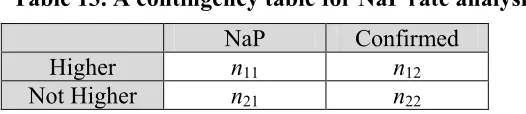
Table 13. A contingency table for NaP rate analysis ... 63
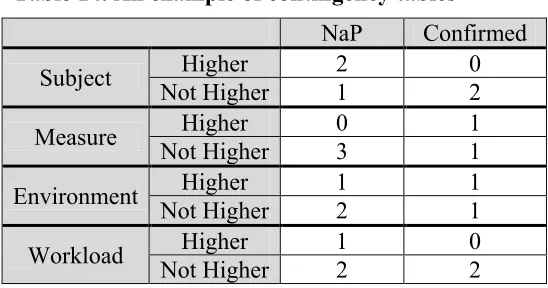
Table 14. An example of contingency tables ... 64
Table 15. Specification Advisory procedure ... 66
Table 16. DeNaP: Notations used in SA description ... 66
Table 17. DeNaP: Measure improvement in SA ... 69
Table 18. DeNaP case studies: Defect report summary ... 81
Table 19. DeNaP case study effort ... 82
Table 21. DeNaP case study: Case B NaP and confirmed defect reports comparison ... 85 Table 22. DeNaP case study: Contingency tables for Case A ... 86 Table 23. DeNaP case study: the difference between the performance requirements before
and after applying SA in Case A ... 88 Table 24. DeNaP case study: the difference between the performance requirements before
LIST OF FIGURES
Figure 1. Performance Refinement and Evolution Model ... 15
Figure 2. DeNaP and PRIFF integrated into software lifecycle ... 29
Figure 3. PRIFF case study: components in the monitoring software ... 42
Figure 4. An example of requirement improvements with PRIFF ... 49
Figure 5. DeNaP integrated into a development process ... 50
Figure 6. DeNaP: Flowchart for SA Step 4 ... 70
Figure 7. DeNaP case study: Annotations used in survey design ... 78
Figure 8. NFR types used in PREM ... 117
Figure 9. Goal tree for Time[Add(User)] ... 117
Figure 10. Execution graph for the “Add User” example ... 118
CHAPTER 1
INTRODUCTION
Performance is an important property for a software system. If an on-line shopping Web site does not offer responsive experience, a user may lose his patience and shop with its competitor [77]. Even NASA had to delay the launch of a satellite for more than eight months because the Flight Operations Segment software had unacceptable response times for developing satellite schedules [32]. Failure to achieve some expected performance may damage customer relationship or lead to an unstable system. The project might delay or get cancelled if the system performance objective is not met [71].
Performance requirements (PRs) describe the expected performance of the software system. Ideally, PRs should be specified and validated before detail design starts [27]. However, some factors that can affect the system performance may not be available during early phases of software development. For example, performance models, such as queueing network models [48], are widely used for performance prediction, and the output of the models can be used to validate the feasibility of PRs [70]. Performance models are usually based on the architectural design. Therefore, only after preliminary architectural design is complete does a development team have the necessary information to specify and validate reasonable PRs.
may have his/her own assumptions if the PRs are not specific. For example, a performance tester may execute a performance test case with a workload that is different from what the management has in mind if the workload is not specified in the requirements. Therefore, the development team may gain further information for PRs during performance testing, or even after the software is released.
Because the information required for PRs may not be available in early software development stages, a development team needs a way to integrate PRs information into requirements specification when the information becomes available. The goal of this research is to build and validate an evolutionary model for performance requirements specification.
In empirical studies of software engineering, theory should be an integral part to advance the body of knowledge [31]. Type V theory, i.e. theory for design and action, says “how to do” something [30]. Design and action theory describes the principles, methods, and justificatory theoretical knowledge that are used in information system development [30]. The design theory built and evaluated through this research is:
An evolutionary model helps a development team integrate the information throughout the software lifecycle into performance requirements. Specifying performance requirements for response time, throughput, and resource consumption following an evolutionary model leads to higher requirements coverage and more specific performance requirements than the initially specified requirements.
1. Completeness: The PRs specified following an evolutionary model can point out the PRs that were missing from the original requirements, thereby improving requirements coverage.
2. Specificity: The PRs specified following an evolutionary model provide more information under which the specified performance shall be achieved than the original requirements.
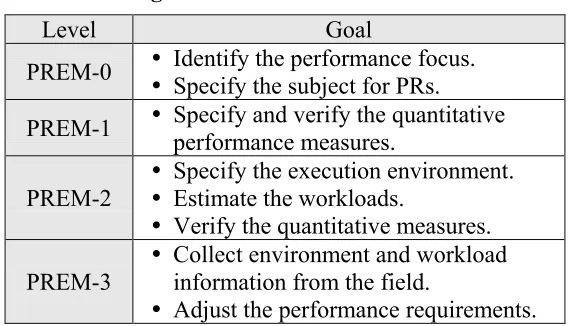
The evolutionary model proposed in this research for PRs specification is Performance Refinement and Evolution Model (PREM) [34, 35, 37-40]. PREM is a four-level model based on the information to be specified in PRs. The PREM four-levels are summarized in Table 1. PREM is designed to specify the requirements for response time, throughput, and resource consumption. A higher PREM level shows additional properties and constraints that need to be specified in software PRs. At each level, the model describes the properties to be specified with PRs and proper approaches to analyze the performance. A development team may use PREM to specify simple PRs early in the software lifecycle, and add more details when the team gains more knowledge of the system performance.
Table 1. The goals of PREM at each level
Level Goal
PREM-0 Identify the performance focus. Specify the subject for PRs. PREM-1 Specify and verify the quantitative
performance measures. PREM-2
Specify the execution environment.
Estimate the workloads.
Verify the quantitative measures. PREM-3
Collect environment and workload information from the field.
Two systematic PRs improvement approaches were developed based on PREM. These two approaches differ in the input for the approaches. The first approach, called Performance Requirement Improvement from Failure Reports (PRIFF), uses the field failure reported by customers to improve PRs [39]. Failure reports from customers show the areas of the software that the customers think do not provide sufficient performance, and may also provide information about how the customers use the software. A development team may use PRIFF to integrate the knowledge learned from customer failure reports into the requirements for future releases.
The other approach improves the PRs with defect reports1 that are designated as not a problem (NaP) [40]. Any defect report investigation takes time. However, if a defect report turns out to be NaP, the development team does not do anything to improve the software, and the time spent on investigation is wasted. The development team could have saved the time spent on investigation if the NaP defect report had not been submitted. The development team may use the PRs improvement approach, called DeNaP, during development or after software release to improve the PRs and reduce the occurrence rate of NaP defect reports.
To evaluate the efficacy of PRIFF and DeNaP for realistic software development projects, the dissertation author applied both approaches in industrial case studies. Case studies can be time-consuming and difficult [33]. However, case studies are “research in the typical” [26, 47] and are a technique to evaluate approaches carried out by realistic subjects in realistic environments [66]. Another option is to conduct the research in a controlled environment, such as a classroom. However, a survey conducted on course materials and students from 24 research-oriented schools shows that the majority of students are not
familiar with software performance [22]. Applying PRIFF and DeNaP on industrial projects provides the insights of how both approaches affect software development in the real world.
Cunningham classifies case studies into three categories [18], as shown in Table 2. The purpose of case studies in this research is to build a design theory. Therefore, the dissertation author employed the type of intensive case study. A researcher may use an intensive case study to “develop intensive understanding of the events and practice of one person, group, or organization [18].” Intensive case studies can be further classified into four types [18]. A narrative case study is used to summarize qualitative information, such as interviews and meetings. In a tabulation case study, a researcher classifies the information gathered in a study into several categories and counts the frequency for each category. The goal of a tabulation case study is to develop appropriate categories to describe the most important information. In an explanatory case study, a researcher draws inferences from the observation. An interpretative case study, such as a biography, describes histories or approaches observed from the case study subject. The case studies described in this dissertation are explanatory case studies that show how the application of PRIFF and DeNaP affected the PRs for the software projects.
Table 2. Three types of case studies (adapted from [18]) Type of Case Study
Intensive Case Study Comparative Study Action Research Purpose To build theory from intensive exploration To develop concepts based on case
comparisons
PRIFF was applied on an enterprise-scale system health monitor developed by a large corporation2. The monitor keeps track of the “health” of the managed computers, and reports any abnormal situation, such as low disk space or low available memory, to the administrators. DeNaP was applied in two different software development projects. The first one is a firmware development project for a real-time embedded control module from ABB Inc. The control module can control several devices, such as motors or sensors, and overall processes, such as power generation. The second one is a file processing system from EMC Corporation. The file processing system analyzes the content and properties of a file, and executes some actions predefined by the users. The detailed description of the processes and the results of the case studies will be provided in this dissertation.
The rest of this dissertation is organized as follows. Chapter 2 provides the related work for requirements specification and performance engineering. The description of PREM and how PREM is used for requirements improvement is shown in Chapter 3. PRIFF and DeNaP are presented in Chapter 4 and Chapter 5, respectively. Both chapters provide detailed description of the requirements improvement approaches, and discuss the result of the case study. Chapter 6 shows the cost and benefit comparison between PRIFF and DeNaP. Chapter 7 concludes the dissertation with contributions and future work.
CHAPTER 2
RELATED WORK
This chapter provides related works for software requirements specification. Software Performance Engineering (SPE) [67, 70] integrates performance engineering techniques into software development process. An overview of SPE is provided in this chapter. Both of the PRs improvement approaches, PRIFF and DeNaP, use the defect reports to improve PRs specification. This chapter describes other uses of defect report analysis. The related work for the analysis and estimation techniques used in PREM is provided in Chapter 3: Performance Refinement and Evolution Model (PREM).
2.1. Requirements Specification
Most software requirements are specified in natural languages [21]. Understanding natural language specifications does not require special training. Therefore, all the stakeholders of the software project can understand the requirements specified in a natural language. The wide acceptance of specification in a natural language promotes the communication among the stakeholders, and reduces the risk that the stakeholders have different views of the problems that are to be solved with the software under development [52]. However, requirements specified in a natural language can be imprecise [10, 11]. Some approaches have been proposed to detect imprecision in natural language specifications (for example, [25]) or to prevent the introduction of imprecision (for example, [58]).
Formal specifications are precise, and the specified behaviors can be proven mathematically. Among the formal specification languages, the Z notation [43] Vienna Development Method [42] are suitable for functional requirements, and temporal logics are used in time reasoning for real-time, reactive systems [63]. To read or specify formal requirements, one must be familiar with the specification language. Furthermore, even if the reader knows the specification language, reading or writing formal requirements specification can still be difficult [23]. Several specification patterns are proposed (for example, [24, 49]) as guidance for formal specifications. Still, formal requirements specifications are more suitable for automated verification than for human eyes
Cortellessa generalizes a software performance concept into three areas: software behavior, workload data, and resources data. Software behavior describes the dynamics of software execution, such as steps and scenarios. Workload describes the demand intensity for the software. Resources describe the computation resources available for the software. The elements specified with PREM fit into Cortellessa’s generalization. PREM-0 and PREM-1 focus on the subject and measure for a PR, which should be modeled in the software behavior area. PREM-2 and PREM-3 focus on the workload and environment for a PR, which should be modeled in the workload and resources areas.
In PREM, the choice of language for requirements specifications does not matter. PREM points out the elements that are necessary for precise PRs, i.e. subjective efficiency description, performance measurements, workloads and environment. Any language that describes these four elements can be used with PREM. In this research, all case studies use natural language to specify PRs. The PRs examples in this dissertation are also presented in natural language.
2.2. Requirements Completeness and Specificity via Requirements
Refinement
rationale that justify the requirements [4]. Goal refinement can reduce the risk of incomplete requirements by analysis of the tangible relationships among the goals. For example, in Goal-Based Requirements Analysis Method (GBRAM) [4-6], a development team may elaborate the goals and obstacles identified from multiple requirements sources, including requirements documents, policies, etc, to construct scenarios that uncover hidden goals. The goals discovered in the process are translated into requirements for the final specification, thereby improving requirements completeness. Alspaugh improves requirements completeness with a scenario management strategy extended from GBRAM [2]. In Alspaugh’s scenario management strategy, similarity measures among the scenarios are used to improve the coverage of scenarios. A similarity measure between two scenarios is the ratio of the number of identical attributes to the number of total attributes, such as actors, actions, and events. As a requirements engineer specifies more scenarios, if the similarity measures stabilizes near a certain number, then scenarios may be reaching sufficient coverage [2].
PRIFF and DeNaP, the PRs improvement approaches designed based on PREM, can be viewed as special applications of goal-based analysis for PRs. PREM explicitly points out four PR elements: subject, measure, environment, and workload. A requirement engineer may focus on these four elements to identify the goals and obstacles for system performance. Additionally, PRIFF and DeNaP provide specific and systematic procedures that help a requirement engineer analyze the information from multiple requirements sources, including field failure reports, defect reports, and requirements documents.
propose a systematic method to reduce requirements ambiguity by refining requirements [28]. In Gaus and Weinberg’s approach, the requirements refinement process starts with defining the functions a software system provides. After functions are defined, a requirements engineer then identifies the desired attributes for the functions, and the constraint and preference for the attributes. PRs describe the performance attributes of the functions to be provided in a software system. PREM explicitly points out the environment and workload elements as the constraint or preference for an expected performance measure. These PR elements provide specific directions for PRs refinement for a requirements analyst.
2.3. Software Performance Engineering (SPE)
SPE [67, 70] is an approach to integrate performance engineering into the software development process. SPE uses two types of models: software execution model, and system execution model. The software execution model characterizes the resource and time requirements. Factors related to multiple workloads, which can affect the software performance, are specified in the system execution model. The software execution model can be easily built, and provides quick feedback on software performance. On the other hand, the system execution model provides analytical results of the system performance under multiple workloads.
Simple-Model Strategy: Early SPE models should be simple and easy to solve.
Simple models can provide quick feedback on whether the proposed software is likely to meet the performance goals.
Best- and Worst-Case Strategy: Early in the development process, many details
are not clear. To cope with this uncertainty, SPE uses best- and worst-case estimation for the factors (e.g., resource constraints) that have impact on the performance of the system. If the prediction from the best-case situation is not acceptable, the team needs to find alternative design. If the worst-case performance is satisfactory, the design should achieve the performance goal, and the team can proceed to the next stage of development. If the result is somewhere in between, the model analysis provides information as to which part of the software plays a more important role in performance.
Adapt-to-Precision Strategy: Later in the development process, more software
details are obtained. If the information has impact on the performance, it can be added to the SPE models to make the models more precise.
The results from the software execution models are used to derive the parameters for the system execution models. The system execution models describing the hardware and software components in a system are based on queueing network models. Performance metrics, including the resource utilization, throughput, and waiting time for the requests, can be evaluated from the system execution models. Automatic tools are available for model analysis (for example, SPE·ED [69]).
Table 3 shows how SPE models and techniques fit in PREM. SPE focuses on quantitative performance evaluation, so no PREM-0 techniques are suggested.
2.4. Defect Analysis
A defect report describes anomalies found in a software system. Defect analysis can provide insights into the problems of the software development process. In the Orthogonal Defect Classification (ODC) [14] approach, the defects are classified into several non-overlapping categories based on some particular defect properties. The classification can provide in-process feedback on the development process. For example, the analysis of the defect types, such as function defect and timing defect, shows the progress of a software project in the development process. Another example is the classification based on defect triggers, which is a condition that allows the development team to find a defect [12]. This
Table 3. PREM levels for SPE models and techniques Level SPE Models and Techniques
PREM-0 N/A
type of classification provides the information on the effectiveness and completeness of the verification process.
CHAPTER 3
PERFORMANCE REFINEMENT AND EVOLUTION MODEL (PREM)
PREM [35-38] is a guideline for evolutionary PRs improvement. PREM defines four levels of detail for a PR. Figure 1 shows the evolution and refinement of PRs for each PREM level. A development team may use PREM to specify simple PRs early in the software lifecycle, and add more details in the PRs when the team gains more knowledge of the system performance. PREM is designed for the specification of three categories of requirements: response time, throughput, and resource consumption.
The levels of PREM do not enforce a development team to specify the details of PRs in any particular order. For example, if the workload and quantitative measure is known to a development team during requirements elicitation, the development team may specify both pieces of information in the PR, making the PR PREM-2 or PREM-3. However, the order of
PREM-1
PREM-0
PREM-2 PREM-3
Specify subjects for performance requirements Specify quantitative
measures for performance requirements
Estimate workload and environment
Collect workload and environment
the four levels shows how the information becomes available in a typical new project. The workload or environment information usually requires a lot of time to collect [74] and may not be available during in the beginning of the development process. Additionally, in a post-hoc examination of the performance testing approach for a point-of-sale system, Johnson et al. observed that the workload and environment information was introduced into the PRs and performance test cases after the quantitative measures had been specified [45].
In PREM, the specification of a PR starts at PREM-0, which points out the subject of the PR with a qualitative description. For example, “the response time for adding a user shall not be too long” is a PREM-0 PR. The qualitative descriptions point out the performance focus in the software. They serve as the starting points for requirements. The stakeholders will refine or evolve the requirements to more precise specifications throughout the software development lifecycle.
The development team refines a PREM-0 requirement to the PREM-1 level by including a quantitative measure. For example, “the response time for adding a user shall be within 1,750 milliseconds” is a PREM-1 PR. The performance measure needs to be meaningful and obvious to the customer. After quantitative requirements are specified, the development team can discuss with the customer whether the specified performance is feasible and acceptable.
can be verified with performance prediction models such as a queueing network model. If the performance expectation of a requirement is not feasible, the development team needs to negotiate with the customer for a more reasonable and practical requirement. Following is an example of a PREM-2 PR:
Hardware Requirement:
The Web server runs on a [Brand Name] server with 4GB main memory.
The Web server runs in [Operating System].
The database server runs on a [Brand Name] server with 4 GB main memory.
The system runs with [Database Server Brand Name].
…
The average response time for adding a user shall not be more than 1.87 seconds when, on average, the server receives 0.07 “Add User” requests per second.
This chapter provides a detailed description of PREM, and the techniques to validate the correctness and feasibility of the requirements at each PREM level. Appendix I provides an example of the evolution of a PR following PREM.
3.1. Performance Types
PREM is designed to be applied to the following types of PRs:
Response or elapsed time: the time required to finish an action or an operation. For example, the authentication process shall be finished within five seconds.
Resource utilization: the rate or quantity of resource consumption, such as CPU utilization rate or memory usage, including main and secondary memory. For example, the Web server process shall not consume more than 1GB of the main memory.
Throughput: the rate for a certain process. For example, the server shall be capable of process 1,000 files per hour.
Let r be a PR specification or a field failure report. T(r) denotes the performance type that is described in r.
3.2. Performance Requirement Elements
Subject for which a PR is specified or a defect report is described, e.g. the elapsed time for the authentication process. In PREM, PREM-0 requirements identify the subject. S(r) denotes the subject for r.
Measure that describes the expectation for the performance of the software in a
PR or the observed performance in a defect report, e.g. 30 seconds. In PREM, PREM-1 requirements specify the measure. M(r) denotes the measure for r.
Environment that describes the computational resources available in the runtime
environment, e.g. the recommended hardware configuration. In PREM, PREM-2 and PREM-3 requirements specify the environments. E(r) denotes the environment for r.
Workload that specifies the demand intensity for the software, e.g. 20 devices
that send 10 messages per second. In PREM, PREM-2 and PREM-3 requirements specify the workloads. W(r) denotes the workload for r.
To give an example, consider the following requirement r:
With 10 concurrent users connected via the client program, and 100 managed computers, where each agent is sending data on a one-minute level, a user shall be able to move between screens in less than five seconds.
The following information can be extracted from r:
S(r) = response time for moving between screens.
E(r) = nil – the requirement does not describe the environment for the client
W(r) = 10 concurrent users; 100 managed computers with agents sending data on
a one-minute level.
M(r) = five seconds.
A PR in its simplest form, i.e. a PREM-0 PR, has one subject that describes one performance type. Other elements may not be available in a PR. In the case studies described in this dissertation, these four PR elements were sufficient to describe the observed PRs, performance defect reports, and test cases.
3.3. Model Structure
In PREM, a development team may apply appropriate techniques based on PRs at each PREM level. Each PREM level is described with the following properties:
Starting criteria: A PREM level has one or more starting criteria. The starting
criteria show the required properties of the requirements before the techniques at the PREM level can be applied.
Goal criteria: A PREM level has one or more goal criteria. The goal criteria
show the required properties of the requirements for them to be classified as being at a certain PREM level. If a PR satisfies all the goal criteria of PREM level n, the requirement is called a PREM-n requirement.
Techniques: When a requirement satisfies all the entry criteria of a PREM level,
PREM level. However, the list is by no means complete. A development team may choose one or more appropriate PRs analysis techniques at each PREM level.
3.4. Model Description
This section provides the description of PREM, including the starting criteria, goal criteria, and activities for each PREM level. A review of the techniques for PREM is available in [37]. Appendix I also shows how some of the techniques can be applied.
3.4.1. PREM-0
Starting Criteria Related functional requirements are defined in requirements documents. Goal Criteria Identify subjects for performance requirements. Performance
requirements are qualitatively specified in requirements documents.
Informal Approach: Qualitative PREM-0 requirements can be gathered from the discussion with stakeholders such as the user representatives or the marketing department. The development team may ask the users to prioritize the requirements with respect to performance and performance types. The prioritization information shows the parts of the system of which the performance is important to the users.
Performance Requirements Framework (PeRF): PeRF [56] is a framework for PRs management for information systems based on the Non-Functional Requirements Framework (NFR Framework) [57]. PeRF provides a systematic way to organize and refine PRs, resolve conflicts among requirements, and justify requirements decisions. PeRF uses goal trees to assist the development team to incorporate the performance of certain functionalities into requirements specification documents.
A PR may be specified in a comparative manner, for example, “In Version 2.0, the page rendering time shall be at least as short as observed in Version 1.0” or “The processing time for a PDF file shall not be longer than the processing time for a plain text file.” In PREM, a PR specified in a comparative manner is classified as PREM-0 because the specificity of a comparative PR depends on the specificity of the comparative target. For example, suppose a development team specified the following requirements:
The processing time for a PDF file shall not be longer than the processing time for a plain text file.
development team can only determine whether the processing time for a plain text file is satisfactory to the customer based on assumptions of the expected performance. Consequently, whether the processing time for a PDF file is satisfactory to the customer is also based on assumptions. Even if the development team has a quantitative requirement for the processing time for a plain text file, such as “the processing time for a plain text file shall be less than one second,” the comparative requirement may still cause confusion. If the processing time for a plain text file is two seconds, the performance of the software system does not achieve the PR. If the processing time for a PDF file is also two seconds, the processing time achieves the comparative requirement. However, the processing time of two seconds may not be satisfactory for a PDF file since the processing time for a plain text file does not satisfy the requirement. To avoid the confusion, the development team should determine the quantitative measures for the processing time requirements for both file types. Since a comparative PR does not necessarily provide more specific information than a quantitative PR, a comparative PR is classified as PREM-0.
3.4.2. PREM-1
Starting Criteria Performance requirements are defined qualitatively in requirements documents.
Goal Criteria Identify quantitative measures. Quantitative performance requirements are specified in requirements documents.
The focus of PREM-1 is to specify quantitative expected performance level for the functionalities identified in PREM-0. Several sources or approaches can help the team estimate the performance expectations:
user expectations for the response time of a Web page based on his experience [8]. He suggests that the response time of a Web page should be lower than eight seconds, or the user starts feeling frustrated. Sevick provides the page loading time collected by three leading measurement services in the United States: Matrix NetSystem, Keynote Systems, and Gomez [65]. The data collected by these measurement services show that about 82% of the web pages can be loaded within 10 seconds in the United States. Sevcik also conducted a survey in his consulting firm on the user satisfaction of page loading time based on the number of items visible on the page and the repetitiveness of the interaction with the Web application [47]. Sevcik shows if a Web page has many items and the interaction repetitiveness is very low, a user may tolerate 16 seconds of page loading time. On the other hand, if a page only contains one item and requires no interaction, a user feels satisfied only when the page loading time is lower than one second. These anecdotal experiences provide a general idea of user’s expectation, and can be used as a rough approximation for the performance of a Web application. However, the development team should have more realistic estimations for the system under development, based on their own team’s experiences and the environments for the software.
estimate software performance. Although the presentation of the UML sequence diagram with MSC and the execution models in SPE are different, the analysis methods for both models are similar.
3.4.3. PREM-2
Starting Criteria Quantitative performance measurements are specified with the requirements.
Goal Criteria Estimated workloads are specified in the requirements documents.
Estimated environment is described in the documents.
The main activity for PREM-2 is to estimate workloads and runtime environment for the software system. Several techniques can be used to estimate the system workloads.
Ad-hoc approach: Workloads can be estimated based on the software deployment environment or configuration. For example, suppose a software system is deployed in an environment with 120 users who arrive at their offices between 8:30 to 9:00 and immediately log in. Therefore, a reasonable estimation of the request rate for the Log In page is four requests per minute. Runtime environment can be estimated based on the team’s experience.
for the input. The worksheet approach is more systematic than the ad-hoc approach.
Using existing data: Sometimes the workloads or environment information for a previous release or other similar systems is available. Such information is a good source of workloads and environment estimation for the system under development. Although the system under development may not have exactly the same functionalities as the existing systems, the existing data can provide a good picture of how the system might be used.
3.4.4. PREM-3
Starting Criteria Quantitative performance measurements are specified with the requirements.
Goal Criteria Workloads and environment information is collected from the production environment and specified in the requirements documents.
PREM-3 represents quantitative PRs with workloads and environment from collected data. The following sources may provide such information:
Existing business data: Market or industrial research reports are available from the government3 or private research companies. Those research reports can provide a rough picture of how the software system might be used. The marketing or customer service department in the client organization might have similar data.
Data from previous release or similar applications: If the workload or environment information from a previous release or similar applications is available, with a little modification, the information can be used in the requirements for the software under development. From this point of view, implementing operational profile collection mechanism in the software is worthwhile for the development team.
Prototyping or intermediate releases: If no existing data are available, the development team can develop a quick prototype and collect workload data from the prototype. Experiences show that the time required to collect representative data ranges from two to twelve months [7]. Therefore, the prototype should be
3 For example, the market research reports available at the U.S. Government Export Portal
available as early as possible in the software development cycle. In addition to prototypes, a development team can also use information from intermediate releases, such as alpha or beta ones. However, the development team needs to know who the users are for the intermediate releases, and how differently they use the system compared to the target customers [55].
3.5. PREM Application
This dissertation presents two requirements improvement approaches based on PREM: DeNaP and PRIFF. These two approaches differ from each in the source for PRs improvement. DeNaP uses the NaP defect reports to improve PRs. The majority of defect reports are submitted by professional testers. Additionally, development team members add the information learned during defect investigation to the defect report. Therefore, performance defect reports usually provide detailed information regarding system performance. A NaP performance defect report shows acceptable performance. A requirements analyst may use the information from NaP performance defect reports, with little change, to refine PRs.
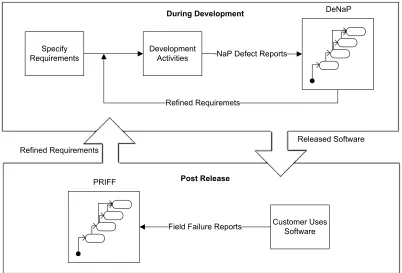
Figure 2 shows how a development team can integrate DeNaP and PRIFF into software lifecycle. During development, a development team may use DeNaP to refine the PRs from NaP performance defect reports. The resulting requirements from DeNaP are added to the requirements set to guide further development activities. After the software is released, customers may report field failures if the software does not satisfy their expectation. PRIFF refines the PRs based on the information from field failure reports. The resulting PRs from PRIFF are used for future releases of the software.
Development Activities Specify
Requirements
DeNaP
PRIFF
NaP Defect Reports
Refined Requiremets
During Development
Post Release
Customer Uses Software Field Failure Reports
Released Software Refined Requirements
Figure 2. DeNaP and PRIFF integrated into software lifecycle Table 4. Difference between DeNaP and PRIFF
Source Specificity Performance
Information Information Use DeNaP NaP defect reports High Acceptable Direct use of information
CHAPTER 4
PRIFF: Performance Requirements Improvement with Field Failures
The performance field failures reported by customers are an important resource for understanding the factors contributing to unacceptable performance. This information can help the development team in making informed requirements decisions. However, the field failure reports usually provide only the customers’ observation of the unacceptable performance. Important factors that can contribute to the performance problem may still be missing in the field failure reports. For example, consider the response time requirements for a Web application. In the requirements, the development team may specify the response time for certain workloads. Suppose the development team has tested the response time for a certain scenario, but still a field failure shows that the response time for the scenario is unacceptable. If the software is running within a similar environment as specified in the requirements, a plausible reason for the slow response time may be that the workloads are heavier than expected. When specifying the requirements for the next release, the development team can use a heavier workload in the requirements along with an acceptable response time for the users. Before doing so, the development team needs to estimate what level of workload is more reasonable for the system, and analyze how the newly-specified workload affects other parts of the system and whether the desired performance is feasible under the workload. Such retrospective analysis provides valuable information about the PRs for the next release.
Improvement with Field Failures (PRIFF). The purpose of PRIFF is to improve the PRs with the PR elements extracted from field failure reports and the original requirements specifications. In PRIFF, the PR element extraction is based on PREM, which includes the subject of the requirement, quantitative performance measure, environment, and workload. Once the PR elements are extracted, new PRs are created by merging pieces of PR elements from related subjects. The original requirements may also be refined to apply to a more specific scope.
PRIFF was applied on a commercial distributed system developed by a large corporation, which chose not to reveal its name in this dissertation, to demonstrate the applicability [39]. The software was a system health monitor for the servers and network of an enterprise-scale software system. During a one-year period, 739 failures were reported for this software system. The case study and its results will be presented in Sections 4.3 and 4.4, respectively.
4.1. Approach Foundation
PRIFF is based on the relationships between two subjects that are found in PRs specifications or in the field failure reports. In PRIFF, a subject is categorized into one of the three types:
Scenario: A scenario is a linear series of events that lead to the specified
Function: A function is functionality the software system provides. A function
describes one or more software behaviors or user/software interactions. For example, “upgrading the firmware in the controller.”
Scope: A scope can be any subset of the software system and may including the
whole system. A scope is a software component used in the system, e.g. “the firmware upgrade program.” The whole system, if used as the subject of a requirement, is considered as a scope.
For any two subjects, one of the following relationships is defined:
Two subjects are equivalent if both subjects describe the same scenario, function, or property. Two equivalent scenarios contain exactly the same ordered events [2]. The notation a ≡ b shows that subject a is equivalent to subject b.
Subject a is a subset of subject b if (1) b is a description of the function and a is a specific scenario for b; (2) a and b are both functions and a presents a smaller set of function than b; (3) b is a scope, and a is a specific scenario or a software function; or (4) a and b are both scopes and a presents a smaller scope than b. The notation ab shows that subject a is a subset of subject b. For example “moving between the log-in page and the main page” is a subset of “moving between two pages.” If a is a subset of b, b is a superset of a.
Subject a is a subsequence of subject b if both a and b are scenarios, and the event sequence in a forms part or whole of the scenario described in b [2]. The notation
b
calls the authentication service → the Web server loads the Main page → the Web server renders the Main page.” If scenario a is a subsequence of scenario b, scenario b is a composite of scenario a.
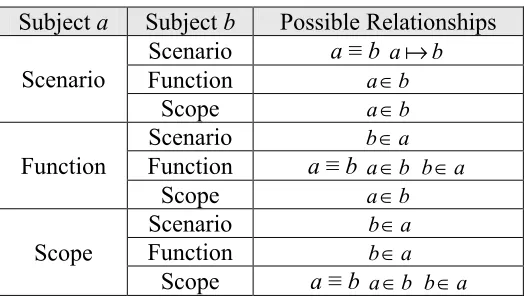
Table 5 shows all possible relationships between two related subjects.
4.2. PRIFF Procedure
In PRIFF, the PR elements are specified in an evolutionary fashion based on PREM. PRIFF consists of five steps: select field failures, specify subjects, specify quantitative measures, specify workloads and environments, and remove conflicts. Table 6 summarizes the activity and target PREM levels for each step of PRIFF. This section provides a detailed description of PRIFF.
Table 5. Subjects relationships
Subject a Subject b Possible Relationships Scenario
Scenario a ≡ b ab
Function ab
Scope ab
Function
Scenario ba
Function a ≡ b ab ba
Scope ab
Scope
Scenario ba
Function ba
Scope a ≡ b ab ba
Table 6. PRIFF procedure
PRIFF Step Activity Target PREM Levels
Step 1 Select field failures NA
Step 2 Specify subjects PREM-0
Step 3 Specify quantitative measures PREM-1 Step 4 Specify workloads and environments PREM-2 or PREM-3
4.2.1. Step 1: Select field failures
In PRIFF, a field failure f is selected for requirements improvement if:
1. The reported field failure does not have any traceable requirement, i.e. a requirement that describes the performance for a subject that is a superset of S(f) using performance type T(f) is not found.
2. Field failure f has a traceable PR r. However, some PR elements in f is more specific than those in r.
Not all field failures are useful for requirements improvement. For example, a tester might identify a performance failure during development. The performance requirements are already specific enough for the tester to make the judgment that a performance failure exists. If the development team chooses not to fix this failure before release, the users might encounter the same failure and file a field failure report. Improving the traceable requirement because of this field failure is not necessary since the requirement is already specific enough, but the development team has not yet implemented the software so the performance specified in the requirement is achieved. If all the traceable PRs for a field failure are verifiable, but no performance test cases are specified to verify these requirements, the cause of the failure is the lack of performance verification. Such failures are excluded from the following steps.
4.2.2. Step 2: Specify subjects
may use a qualitative description for the new requirement. For example, if a field failure reports that the response time is too long for the authentication process, the new requirement can be specified as “The response time for the authentication process shall be short enough.” The purpose of this requirement is to highlight the subject for which a PR needs to be specified. More specific information for this requirement is gathered from the subsequent steps of PRIFF. The new requirement may be redundant at the end of the improvement process. In that case, the new requirement is removed at Step 5.
4.2.3. Step 3: Specify quantitative measures
After the subjects for the new requirements are defined in Step 2, the next step is to specify quantitative measures to make the requirements satisfy PREM-1 criteria. If a field failure report provides a quantitative measure for the expected performance, the development team may use the measure to specify the new requirement that is traceable to the field failure report. However, field reports usually describe the measure for unacceptable, not desirable, performance. Additionally, a performance specialist may be required to get accurate performance measures. We cannot expect the measure for desired performance be accurately reported with field failure reports. Therefore, the development team needs to estimate the quantitative measures if field failure reports do not provide the information.
For a field failure f, consider the set of the original requirements, denoted as R, that have the same performance type as f. Apply the following five rules to estimate the performance measure for the requirements created in Step 2.
the new requirement if the value is lower than M(f). If both M(r) and M(f) are not available, the development team needs to work with the customer or a domain expert to specify the measure of the new requirement. This rule attempts to specify a measure in the new requirement that describes a better performance than the failure report, since the failure report describes the unacceptable performance.
Rule 2: If S(f) is a scenario, select all the requirements r from R such that )
( )
(r S f
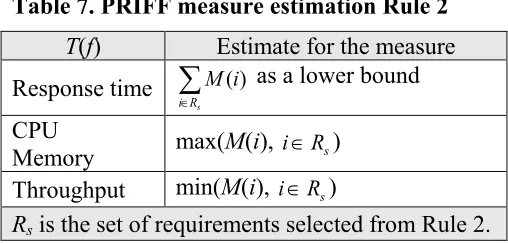
S and no two scenarios in the selected requirements has the same event. Use the selected requirements to estimate the measure for the new requirement. The subject from the selected requirements form some subsequences for the scenario described in the field failure. Even if not all the subsequences of S(f) can be found in the existing requirements, the measures of the subsequences can be used to estimate the measure for S(f). For example, for a response time requirement, the sum of the response time specified in the selected requirements can be used as a lower bound for the response time of the new requirement. Table 7 provides the estimation for measure for different performance types. This step estimates the measure
Table 7. PRIFF measure estimation Rule 2 T(f) Estimate for the measure Response time
s R i
i
M() as a lower bound CPU
Memory max(M(i), iRs) Throughput min(M(i), iRs)
for the new requirement based on all the existing requirements that describe the subsequences of the subject of the new requirement.
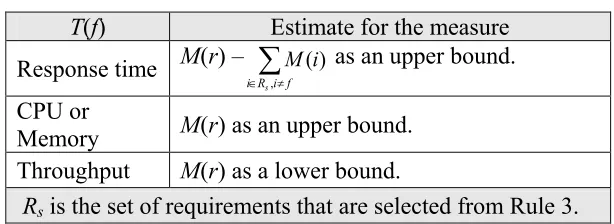
Rule 3: For each requirement r in R, if S(f)S(r), select all the requirements q from R such that S(q)S(r) and no two scenarios in the selected requirements has the same event. To specify a new response time requirement based on f, the difference between M(r) and the sum of all response time in the selected requirements poses an upper bound for the response time of the new requirement. For CPU and memory utilization requirements or throughput requirements, M(r) can be used as an upper bound and lower bound, respectively, for the measures to be specified in the new requirement. Table 8 provides the estimation of performance measure for different performance types. This step ensures that the measure of the new requirement is within the limit of all existing requirements that forms a composite of the failure report.
Rule 4: If for all requirements r in R, S(r)S(f), remove the new requirement. In this case, the subject described in the failure report is more abstract than those specified in the original requirements. However, the field failure Table 8. PRIFF measure estimation Rule 3
T(f) Estimate for the measure Response time M(r) –
R i f i s
i M
,
)
( as an upper bound. CPU or
Memory M(r) as an upper bound. Throughput M(r) as a lower bound.
report should be as specific as possible. The development team needs to work with the customer to find out the actual performance problem that was reported as the field failure, and use the information from the customer to improve the requirements.
Rule 5: For each of the new requirements created in Step 2, of which the subject is not related to the subject of any original requirement or field failure report, the development team needs to work with customer or domain expert to find out the measure for the new requirement. The measure can be specified with the new requirement.
After examining all the field failures with the estimation rules, the development team can have the estimations of the performance measures for the new requirements created in Step 2. The quantitative performance measures can be specified based on the estimations. After this step, the new requirements become PREM-1. PREM-1 techniques, such as SPE software execution model [70], can help the team to validate the estimated measure for the new requirements.
4.2.4. Step 4: Specify workloads and environments
reports. These rules attempt to find the strictest environment and the heaviest workload found in the original requirements or in the failure reports for the new requirements.
Rule 1: Select all requirements specifications and failure reports i in I such that )
( ) (f S i
S . Use min(E(i)) as the upper bound for the environments and min(W(i)) as the upper bound for the workload.
Rule 2: If S(f) is a scenario, select all the requirements specifications and failure reports i from I such that S(i)S(f) or S(f)S(i). Use min(E(i)) as the upper bound for the environments and max(W(i)) as the lower bound for the workload.
Rule 3: For a requirement r where C(r) = nil or W(r) = nil, if S(f)S(r), use E(f) to specify the environments for r, and W(f) as a upper bound of W(r).
Rule 4: For a requirement r where E(r) = nil or W(r) = nil, if S(f) is a scenario and
) ( )
(r S f
S or S(f)S(r), use E(f) to specify the environments for r,
and W(f) to specify the workload for r.
Rule 5: For each of the new requirements created in Step 2, of which the subject is not related to the subject of any original requirement or field failure report, and if the related failure report does not provide any information for the workload or environment, the development team needs to work with customer or domain expert to find out such information, and specify it in the new requirement.
requirement does not specify the workload or environment, Rule 3 and Rule 4 can be used to retrieve the information for field failures to refine the original requirements to PREM-3 level. Other rules refine the new requirements to PREM-2 level. After the environment and workload are specified, the development team can use PREM-2 techniques, such as a queueing network model, to analyze whether the performance described in the new requirement is feasible. If the analysis result shows that the performance is not achievable, the development team may need to negotiate with the customer to use more powerful computation resources or to settle on worse but feasible performance.
4.2.5. Step 5: Remove conflicts
After the Step 4, some of the newly created requirements are special cases of the original requirements. These are the new requirements whose subject is a subset of the subject in an original requirement. The new requirement is an exception of the original one, because it specifies performance based on a more specific subject. The exception information should be added to the original requirement. For example, consider the following two requirements:
Original: The response time for moving between two pages shall be less than 5 seconds.
New: The response time for moving from the main page to the log-in page shall be less than 9 seconds.
Refined original: Except for moving from the main page to the log-in page, the response time for moving between two pages shall be less than 5 seconds.
Additionally, some requirements may provide the same performance information. These requirements are redundant and should be removed.
4.3. Industrial Case Study
To evaluate the efficacy of PRIFF, the dissertation author employed an intensive, explanatory case study design [18, 75]. An intensive, explanatory case study helped developing an understanding of the effects of applying PRIFF in an organization. The dissertation author served as the primary investigator (PI) for this case study. This section provides the context of the subject in this case study.
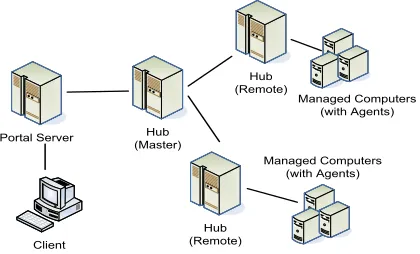
administrator may use the client programs to monitor the status of the hardware and software components via the portal server. This product works alongside with other software programs that provide the services of the software system. Any performance issue with this product will affect the quality of service of the software system. Therefore, the development team paid a great deal of attention to performance during development.
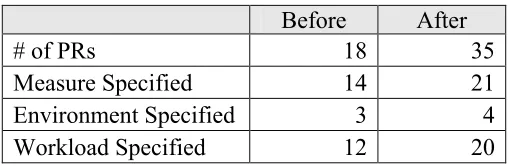
This product has been used in the field for more than five years. PRIFF was applied on the version released in late 2005. This release supports more managed computers and monitoring agents than the previous release. Because this organization recognized the special nature of PRs, these requirements are specified in a separate document and reviewed by designated performance engineers before approval. This practice enabled the performance engineering team to focus their efforts. Eighteen performance-related requirements were specified for the 2005 release. The development team did not provide any other requirements documents to the PI, such as the documents for functional requirements. The development team was made up of more than 50 full-time engineers. Additionally, a performance testing team was assigned to identify and investigate performance problems in
Portal Server
Hub (Remote)
Hub (Master)
Hub (Remote) Client
Managed Computers (with Agents)
Managed Computers (with Agents)
the software. During the 20 months of development, the number of performance engineers varied from four to eleven. The development team employed a customized Rational Unified Process [50] as the software development process.
The responsibility of the PI in this case study was to apply PRIFF and report the outcome. Besides serving the role of the PI in this case study, the dissertation author also worked as a performance engineer for the development team. The development team assigned three performance engineers to assist the PI to understand the case study materials, including the field failure reports and the PRs document.
As shown in Section 3.4, a wide array of techniques is available to validate PRs whenever a new PR element is introduced. In this case study, the PI applied an informal approach when validating PREM-0 and PREM-1 requirements, primarily with discussions with the performance engineers and the manager of the performance testing team. PREM-2 requirements were validated by the PI with the help from the performance engineers, using queueing network models.
4.4. Results and Discussion
The PI had a 30-minute meeting with the three performance engineers assigned to assist him each week during the case study. The purpose of the meeting was for the performance engineers to review the tasks performed by the PI and answer the questions raised by the PI. For the preparation for applying PRIFF, the PI spent approximately five days understanding the functionalities of the software system and PRs, 15 days reading the field failure reports and identifying performance-related field failure reports, and two days building the traceability between performance field failure reports and PRs. Throughput the preparation, the performance engineers and the PI had five weekly meetings. After the preparation, the actual application of PRIFF took the PI three days, including two day on writing down the results in a document. Therefore, the preparation process consumed approximately 180 person-hours, and the application, 24 person-hours.
4.4.1. Impact of missing or unspecific requirements
After selecting the field failures for requirements improvement in Step 1 of the improvement procedure, the PI identified the field failures caused by missing or unspecific requirements. Of the 17 field failures that are related to performance, two had been already identified by the performance testing team before the software was shipped. The requirements were specific enough for the testers to determine that the failures would eventually occur, but the development team decided to defer the fix in that release. Therefore, these two field failures were not used in PRIFF.