ISSN(Online): 2319-8753 ISSN (Print) : 2347-6710
I
nternational
J
ournal of
I
nnovative
R
esearch in
S
cience,
E
ngineering and
T
echnology
(An ISO 3297: 2007 Certified Organization)
Vol. 5, Issue 6, June 2016
Secure Data Management Using Access
Control Policies in Clouds
Nag Vaishnavi.P1, Uma.V2
M.E.Final year, Department of CSE, Sri Venkateshwara College of Engineering and Technology, Tirupachur,
Tiruvallur, India1
Associate Professor, Department of CSE, Sri Venkateshwara College of Engineering and Technology, Tirupachur,
Tiruvallur, India2
ABSTRACT: Cloud storage is an application of clouds that liberates organizations from establishing in house data storage systems. However, cloud storage gives rise to security concerns. In case of group shared data, the data face both cloud specific and conventional insider threats. Secure data sharing among a group that counters insider threats of legitimate yet malicious users is an important research issue. In this paper, we propose the Secure Data Sharing in Clouds (SeDaSC) methodology that provides: 1) data confidentiality and integrity; 2) access control; 3) data sharing (forwarding) without using compute intensive reencryption; 4) insider threat security; and 5) forward and backward ac-cess control. The SeDaSC methodology encrypts a file with a single encryption key. Two different key shares for each of the users are generated, with the user only getting one share. The possession of a single share of a key allows the SeDaSC methodology to counter the insider threats. The other key share is stored by a trusted third party, which is called the cryptographic server. The SeDaSC methodology is applicable to conventional and mobile cloud com-puting environments.
KEYWORDS: Access control, cloud computing, high-level, verification.
I. INTRODUCTION
Cloud computing is rapidly emerging due to the provi-sioning of elastic, flexible, and on-demand storage and computing services for customers [1]. Organizations with a low budget can now utilize high computing and storage services without heavily investing in infrastructure and maintenance [2], [3]. However, the loss of control over data and computation raises many security concerns for organizations, thwarting the wide adaptability of the public cloud. The loss of control over data and the storage platform also motivates cloud customers to maintain the access control over data (individual data and the data shared among a group of users through the public cloud) [4]. Moreover, the privacy and confidentiality of the data is also recommended to be cared for by the customers [5].
The confidentiality management by a customer ensures that the cloud does not learn any information about the customer data. Cryptography is used as a typical tool to provide confidentiality and privacy services to the data [5]. The data are usually encrypted before storing to the
ISSN(Online): 2319-8753 ISSN (Print) : 2347-6710
I
nternational
J
ournal of
I
nnovative
R
esearch in
S
cience,
E
ngineering and
T
echnology
(An ISO 3297: 2007 Certified Organization)
Vol. 5, Issue 6, June 2016
The existing, departing, and newly joining group members can prove to be an insider threat violating data confidentiality and privacy [7]. Insider threats can prove to be more devastating due to the fact that they are generally launched by trusted entities. Due to the fact that people trust insider entities, the research community focuses more on outsider attackers. Nevertheless, multiple security issues can arise due to different users in a group. We discuss some of the issues in the following discussion.
A single key shared between all group members will result in the access of past data to a newly joining member. The aforesaid situation violates the confidentiality and the principle of least privilege [8]. Likewise, a departing member can access future communication. Therefore, in group-shared data, the inside members might generate the issue of backward access control (a new user accessing past data) and forward access control (a departing user accessing future data) [8]. The simple solution of rekeying (generating a new key, decrypting all the data, and reencrypting with the new key) does not prove to be scalable for frequent changes in the group membership [7].
A separate key for every user is a cumbersome solution. The data must be separately encrypted for every user in such a scenario. The changes in the data require the decryption of all of the copies of the users and encryption again with the modified contents [7].
The existing and legitimate group members might show illegitimate behavior to manipulate the data [3]. The presence of the entire symmetric key with a user allows a malicious user to turn into an insider threat [3]. The data can be decrypted, modified, and reencrypted by a malicious insider within a group. Consequently, a legitimate user in the group may access certain unauthorized files within the group [9]. On the other hand, it is necessary for a user to possess a key to conduct various operations on the data. The possession of the key also implicitly proves the legitimacy of a user to operate on the data [9]. Nevertheless, simultaneously dealing with both the issues related to the key is an important issue that needs to be addressed effectively.
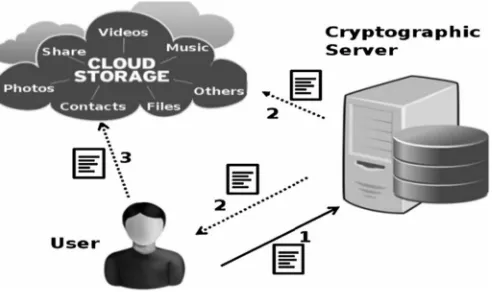
In this paper, we propose a methodology named Secure Data Sharing in Clouds (SeDaSC) that deals with the aforementioned security requirements of shared group data within the cloud. The SeDaSC methodology works with three entities as follows: 1) users; 2) a cryptographic server (CS); and 3) the cloud. The data owner submits the data, the list of the users, and the parameters required for generating an access control list (ACL) to the CS. The CS is a trusted third party and is responsible for key management, encryption, decryption, and access control.
The CS generates the symmetric key and encrypts the data with the generated key. Subsequently, for each user in the group, the CS divides the key into two parts such that a single part alone cannot regenerate the key. Successively, the original key is deleted through secure overwriting [10]. One part of the key is transmitted to the corresponding user in the group, whereas the other part is maintained by the CS within the ACL related to the data file.
The ACL is generated through the parameter submitted by the data owner. The encrypted data are subsequently uploaded to the cloud for storage on behalf of the user. The user who wishes to access the data sends a download request to the CS. The CS, after authenticating the requesting user, receives the portion of the key from the user and sub-sequently downloads the data file from the cloud. The key is regenerated by operating on the user portion of the key, and the corresponding CS maintained portion for that particular user. The data are decrypted and sent back to the user. For a newly joining member, the two portions of the key are generated, and the user is added to the ACL. For a departing member, the record is deleted from the ACL. The departing member cannot decrypt the data on its own as he/she only possesses a portion of the key. Similarly, no frequent decryption and reencryption are needed in case of changes in the group membership. More-over, SeDaSC can be used with the mobile cloud computing paradigm in addition to conventional cloud computing due to the fact that compute-intensive operations are performed by the CS.
The working of the SeDaSC methodology is shown in Fig. 1, and the details are provided in Section III. Our major contributions, as reported in this paper, are as follows. The proposed methodology ensures the confidentiality of the data on the cloud by using symmetric encryption.
• The secure data sharing over the cloud among the group of users is ensured without the elliptic curve or bilinear Diffie– Hellman problem (BDH) cryptographic reencryption.
• The possession of a portion of the key secures the data against malicious insiders within the group.
• The proposed SeDaSC methodology secures the data against issues of forward and backward access control that
ISSN(Online): 2319-8753 ISSN (Print) : 2347-6710
I
nternational
J
ournal of
I
nnovative
R
esearch in
S
cience,
E
ngineering and
T
echnology
(An ISO 3297: 2007 Certified Organization)
Vol. 5, Issue 6, June 2016
Fig. 1. Basic idea for the SeDaSC methodology.
II. RELATED WORK
Xu et al. [9] proposed a certificateless proxy reencryption (CL-PRE) scheme for securely sharing the data within a group in the public cloud. In the CL-PRE scheme, the data owner encrypts the data with the symmetric key. Subsequently, the symmetric key is encrypted with the public key of the data owner. Both the encrypted data and the key are uploaded to the cloud. The encrypted key is reencrypted by the cloud (that acts as a proxy reencryption agent) that becomes decryptable by the user’s private key. The public–private keys generated in the proposed scheme are not based on the certificates. The user’s identity is used to generate the public–private key pair. The proxy reencryption is based on bilinear pairing and the BDH that makes the CL-PRE scheme computationally intensive.The computational cost of the bilinear pairing is high as compared with the standard operations in finite fields.
To reduce the computational overhead of bilinear pairing, Seo et al. [11] introduced a mediated certificateless
encryption approach for data sharing in the public cloud that avoids bi-linear pairing. In the proposed scheme, the cloud generates the public–private key pairs for all of the users and transmits the public keys to all of the participating users. Partial decryption is performed at the cloud. Due to the fact that key management and partial decryption are handled by the cloud, user revocation is easier to handle. However, the proposed scheme treats the public cloud both as a trusted and untrusted entity at the same time. From a security perspective, it is not recommended to shift the key generation process to the shared multitenant public cloud environment. Moreover, the decryption is performed twice in the system that reduces the advantage of not pairing to some extent.
Khan et al. [7] also utilized the El-Gamal cryptosystem and bilinear pairing for the sharing of sensitive information in the cloud. Moreover, the proposed scheme in [7] utilized the concept of incremental cryptography that divides the data into blocks and incrementally encrypts the blocks. The proposed scheme uses a trusted third party as a proxy that performs the compute-intensive operations of key generation, reencryption, and managing access to the data. However, the computational complexities of bilinear pairing still exist in the system.
Chen and Tzeng [8] proposed a methodology based on the shared key derivation method for securing data sharing among a group. The methodology uses a binary tree for the computation of keys. However, the computational cost of the proposed scheme is high as the rekeying mechanism is heavily employed in the proposed scheme. Moreover, the scheme is not tailored for public cloud systems because certain operations require cen-tralized mediations. A similar Rivest–Shamir–Adleman (RSA)-based approach was also proposed in [12]. However, the scheme was vulnerable against collusion attacks.
ISSN(Online): 2319-8753 ISSN (Print) : 2347-6710
I
nternational
J
ournal of
I
nnovative
R
esearch in
S
cience,
E
ngineering and
T
echnology
(An ISO 3297: 2007 Certified Organization)
Vol. 5, Issue 6, June 2016
III. SeDaSC
In this section, we present the design of our proposed methodology SeDaSC that secures the sharing and forwarding of data among a group without involving reencryption in the cloud environment.
A. Entities
The SeDaSC methodology has the following entities. Cloud: The cloud provides storage services to the user. The
data on the cloud need to be secured against privacy breaches. The confidentiality of the data is ensured by storing encrypted data over the cloud. The cloud in the SeDaSC methodology only involves basic cloud operations of file upload and down-load. Therefore, no changes at the protocol or implementation level on the cloud are required.
CS: The CS is a trusted party and is responsible for securityoperations, such as key management, encryption, decryption, the management of the ACL for providing confidentiality, and se-cure data forwarding among the group. The users of SeDaSC are required to be registered with the CS to obtain the security ser-vices. The CS is assumed to be a secure entity in the proposed methodology. The CS can be maintained by an organization or can be owned by a third-party provider. However, the CS main-tained by an organization will generate more trust in the system.
Users: The users are the clients of the storage cloud. For each data file, one user will be the owner of the file, whereas the others in the group will be the data consumers. The owner
of the file decides the access rights of the other group members. The access rights are granted and revoked based on the decision of the owner. The access rights are managed by the CS in the form of an ACL file. A separate ACL is maintained for each of the data files.
B. Cryptographic Keys
The SeDaSC methodology maintains a single cryptographic key for each of the data files. However, after encryption/ decryption, the whole key is not stored and possessed by any of the involved parties. The key is partitioned into two constituent parts and are possessed by different entities. The following are the keys that are used within SeDaSC.
Symmetric Key K: K is a random secret generated by the CS for each of the data files. The length of K in SeDaSC is 256 bits, as is recommended by most of the standards regarding key length for symmetric key algorithms (SKAs).
However, the length of the key can be altered according to the requirements of the underlying SKA. K is obtained in a
two-step process. In the first step, a random number R of length 256 bits is generated such that R = {0, 1}256. In the
next step, R is passed through a hash function that could be any hash function with a 256-bit output. In our case, we
ISSN(Online): 2319-8753 ISSN (Print) : 2347-6710
I
nternational
J
ournal of
I
nnovative
R
esearch in
S
cience,
E
ngineering and
T
echnology
(An ISO 3297: 2007 Certified Organization)
Vol. 5, Issue 6, June 2016
number R. The output of the hash function is termed as K and is used in symmetric key en-cryption [e.g., the Advanced
Encryption Standard (AES)] for securing the data.
CS Key Share Ki: For each of the users in the group, the CS generates Ki, such that Ki = {0, 1}256. Ki serves as the CS
portion of the key and is used to compute K whenever an encryption/decryption request is received by the CS.
Moreover, it is ensured by comparison that the distinct Ki is generated for every file user. Kiserves as the user portion
of the key and is used tocompute K when needed
User Key Share Ki: Ki is computed for each of the users in the group as follows:
K= K
⊕K . (1)
i i
IV. DISCUSSION ON SeDaSC
The SeDaSC methodology is proposed to provide the follow-ing services to the outsourced data:
• confidentiality;
• secure data sharing among the group;
• secure data from unauthorized access of valid insiders within the group; and
• forward and backward access control to counter insiders and departing group users.
The following discussion briefly describes how the afore-mentioned services are achieved.
We do not consider the cloud to be a secure and trustful entity in the context of SeDaSC. Multitenancy, virtualization, and a shared pool of resources may pose many forms of insider and other threats to the data. Moreover, the cloud may also retain copies of the file even after it is requested for deletion.
In the case of SeDaSC, the file is encrypted with K. K is generated at the CS and is deleted right after utilization. The CS or the user cannot reconstruct K alone. For confidentiality, the data cannot be leaked unless the attacker gains access to K.
K in its entirety is not stored anywhere, and neither does it travel on the communication channel. Therefore, the access
to
K is a difficult task. Although an attacker gets hold of the user share, i.e., Ki, he/she will have to guess the other share correctly. The guess or random generation is to be made from a
total of 2256− 1 possible shares. The probability of generating the correct share is (1/(2256 − 1)) = 8.636 × 10−78,
which is negligible. Moreover, if the insider within the cloud gets access to the file, the absence of K will be a barrier to
subvert the confidentiality of the data.
For secure data sharing, SeDaSC does not utilize the concept of reencryption with multiple keys. The encryption is done with a single symmetric key. However, the authorized users are granted access on the basis of possession of the key share and the typical authentication and authorization phenomenon. The ACL lists the authorized users with their credentials and corresponding CS key shares. After authentication, the user share of the key is used, along with the CS
share, to generate K. As the user share is only possessed by a valid user, only a valid user can lead to successful
ISSN(Online): 2319-8753 ISSN (Print) : 2347-6710
I
nternational
J
ournal of
I
nnovative
R
esearch in
S
cience,
E
ngineering and
T
echnology
(An ISO 3297: 2007 Certified Organization)
Vol. 5, Issue 6, June 2016
The division and dispersal of the key also helps counter the insider malicious users within the group. The ACL is separately maintained for each group file. Therefore, a valid group user cannot access the group file that is not shared with him/her. An attempt to access an unauthorized file is also blocked by the fact that the user will not have the key share for that file. Moreover, the ACL of the unauthorized file will not contain any record for the malicious user. Furthermore, the absence of the entire key with the user and the ACL collectively ensures the forward and backward access control for the data. Most of the data forwarding schemes are dependent on the El-Gamal cryptosystem and bilinear pairing [7]. The aforesaid schemes require the reencryption of the data each time the access to the data is requested by any user other than the owner. The El-Gamal cryptosystem is computationally inten-sive. Moreover, reencryption at each access adds to the over-head. The SeDaSC methodology utilizes symmetric encryption, and the access to multiple users is achieved through key man-agement, as explained in the preceding section. Therefore, the overhead of the SeDaSC methodology is fairly less as compared with the traditional El-Gamal-based reencryption systems.
VII. CONCLUSION
We proposed the SeDaSC methodology, which is a cloud storage security scheme for group data. The proposed method-ology provides data confidentiality, secure data sharing with-out reencryption, access control for malicious insiders, and forward and backward access control. Moreover, the SeDaSC This methodology provides assured deletion by deleting the param-eters required to decrypt a file. The encryption and decryption functionalities are performed at the CS that is a trusted third party in the SeDaSC methodology. The proposed methodology can be also employed to mobile cloud computing due to the fact that compute-intensive tasks are performed at the CS. The working of SeDaSC was formally analyzed using HLPNs, the SMT-Lib, and a Z3 solver. The performance of the SeDaSC methodology was evaluated based on the time consumption during the key generation, file upload, and file download oper-ations. The results revealed that the SeDaSC methodology can be practically used in the cloud for secure data sharing among the group In the future, the proposed methodology can be extended by limiting the trust level in the CS. This will further enhance the system to cope with insider threats. Moreover, the response of the methodology with varying key sizes can be evaluated.
REFERENCES
[1] A. Abbas and S. U. Khan, “A review on the State-of-the-art privacy pre-serving approaches in e-health clouds,” IEEE J. Biomed. Health Informat., vol. 18, no. 1, pp. 1431–1441, Jul. 2014.
[2] K. Alhamazani et al., “An overview of the commercial cloud monitoring tools: Research dimensions, design issues, state-of-the-art,”
Computing, DOI: 10.1007/s00607-014-0398-5, 2014, to be published.
[3] A. N. Khan, M. L. M. Kiah, S. U. Khan, and S. A. Madani, “Towards secure mobile cloud computing: A survey,” Future Gen. Comput. Syst., vol. 29, no. 5, pp. 1278–1299, Jul. 2013.
[4] L. Wei, H. Zhu, Z. Cao, Y. Chen, and A. V. Vasilakos, “Security and pri-vacy for storage and computation in cloud computing,” Inf. Sci., vol. 258, pp. 371–386, Feb. 2014.
[5] Cloud security Alliance, “Security guidelines for critical areas of focus in cloud computing v3.0,” 2011.
[6] D. Chen et al., “Fast and scalable multi-way analysis of massive neural data,” IEEE Trans. Comput., DOI: 10.1109/TC.2013.2295806, 2014, to be published.
[7] A. N. Khan, M. M. Kiah, S. A. Madani, M. Ali, and S. Shamshir-band, “Incremental proxy re-encryption scheme for mobile cloud computing environment,” J. Supercomput., vol. 68, no. 2, pp. 624–651, May 2014.
[8] Y. Chen and W. Tzeng, “Efficient and provably-secure group key man-agement scheme using key derivation,” in Proc. IEEE 11th Int. Conf. TrustCom, 2012, pp. 295–302.
[9] L. Xu, X. Wu, and X. Zhang, “CL-PRE: A certificateless proxy re-encryption scheme for secure data sharing with public cloud,” in Proc.7th ACM Symp. Inf. , Comput. Commun. Security, 2012, pp. 87–88.
[10] P. Gutmann, “Secure deletion of data from magnetic and solid-state memory,” in Proc. 6th USENIX Security Symp. Focusing Appl. Cryptog-raphy, 1996, p. 8.
[11] S. Seo, M. Nabeel, X. Ding, and E. Bertino, “An Efficient Certificate-less Encryption for Secure Data Sharing in Public Clouds,” IEEE Trans. Knowl. Data Eng., vol. 26, no. 9, pp. 2107–2119, Sep. 2013.
[12] Y. Chen, J. D. Tygar, and W. Tzeng, “Secure group key management using uni-directional proxy re-encryption schemes,” in Proc. IEEE INFOCOM, 1952–1960.
[13] T. Murata, “Petri Nets: Properties, analysis and applications,” Proc. IEEE, vol. 77, no. 4, pp. 541–580, Apr. 1989.
[14] L. Moura and N. Bjrner, “Satisfiability modulo theories: An appetizer,” in Proc. Formal Methods, Found. Appl., vol. 5902, Lecture Notes in Computer Science, 2009, pp. 23–36.