Secure Data Group Sharing with Attribute and Time based
encrypted data access over cloud
Ms. B.N.V.D.Bhavani
1,
Dr. A. Veerabhadra Rao
2#1Student, Department Of Computer Science Engineering,Jogaiah Institute of
Technology and Sciene College of Engineering, Kalagampudi, Near Palakol, West
Godavari District, Andhra Pradesh – 534268 .
#2HOD, Department Of Computer Science Engineering,Jogaiah Institute of
Technology and Sciene College of Engineering, Kalagampudi, Near Palakol, West
Godavari District, Andhra Pradesh – 534268 Email:- [email protected]
Abstract_ Cloud computing has gotten progressively prevalent among clients and
organizations around the globe. Albeit cryptographic systems can give information
assurance to clients out in the open cloud, a few issues additionally stay tricky, for
example, secure information bunch scattering and fine-grained get to control of
time-delicate information. In this paper, we propose a character based information bunch
sharing and spread plan in broad daylight cloud, in which information proprietor
could communicate encoded information to a gathering of beneficiaries one after
another by indicating these collectors' personalities in an advantageous and secure
manner. So as to accomplish secure and adaptable information bunch dispersal, we
embrace quality based and coordinated discharge contingent intermediary
re-encryption to ensure that lone information disseminators whose properties fulfill the
entrance arrangement of scrambled information can spread it to different gatherings
after the discharging time by assigning a encryption key to cloud server. The
re-encryption conditions are related with qualities and discharging time, which enables
information proprietor to implement fine-grained and planned discharge get to
authority over scattered ciphertexts.
Index Terms—Attribute-based encryption, conditional proxy re-encryption,
timed-release encryption, cloudcomputing
1.INTRODUCTION
Cloud computing is regarded as such a computing paradigm in which
The cloud computing benefits individual users and enterprises with convenient
access, increased operational eciencies and rich storage resources by combining a set
of existing and new techniques from research areas such as service-oriented
architectures and virtualization. Although the great benefits brought by cloud
computing are exciting for users, security problems may somehow impede its quick
development .Currently, more and more users would outsource their data to cloud
service provider (CSP) for sharing. However, the CSP which deprives data owners
direct control over their data is assumed to be honest-but- curious, that may prompt
security concerns. These security matters existing in public cloud motivate the
requirement to appropriately keep data confidential. Several schemes exploiting
cryptographic mechanisms to settle the security problems have been proposed. In
order to guarantee secure data group sharing, identity-based broadcast encryption
(IBBE) scheme [11] is employed in public cloud. The data owners could broadcast
their encrypted data to a group of receivers at one time and the public key of the user
can be regarded as email, unique id and user- name Hence, by using an identity, data
owner can share data with other group users in a convenient and secure manner.
Attribute- based encryption (ABE) is one of new cryptographic mechanisms used in
cloud to reach flexible and fine-grained secure data group sharing. Especially, cipher
text-policy ABE (CP-ABE) allows data owners to encrypt data with an access policy
such that only users whose attributes satisfy the access policy can decrypt the data
[12]. Time-sensitive data such as a business plan and a tender, is a special data in
cloud which requires time-based exposing [2] It means that data owner may want
different users to disseminate data after different time. For instance, data owner may
share sensitive business plan with directors, and he hopes these directors only can
disseminate business plan to managers at an early time and then to other employees
at last.
2.LITERATURE SURVEY
1.TAFC: Time and Attribute Factors Combined Access Control for Time-Sensitive
Data in Public Cloud
Description : By integrating TRE and CP-ABE in public cloud storage, an
effcient scheme to realize secure negrained access control for time-sensitive data. In
their relevant access privilege releasing time points. Besides realizing the function, it
is proved that the negligible burden is upon owners, users and the trusted CA. It is
presented how to design access structure for any potential timed release access policy,
especially embedding multiple releasing time points for different intended users.
Timed-Release Encryption (TRE) becomes a promising primitive, in which, a trusted
time agent, instead of data owners, uniformly executes the timedrelease function.
2. RAAC: Robust and Auditable Access Control With Multiple Attribute Authorities
for Public Cloud Storage
Description : To address the single-point performance bottleneck of key
distribution existed in the existing schemes, here propose a robust and efficient
heterogeneous framework with single CA (Central Authority) and multiple AAs
(Attribute Authorities) for public cloud storage. The heavy load of user legitimacy
verification is shared by multiple AAs, each of which man- ages the universal
attribute set and is able to independently complete the user legitimacy verification,
while CA is only responsible for computational tasks. This is the first work that
proposes the heterogeneous access control framework to address the low efficiency
and single-point performance bottleneck for cloud storage. It is reconstructed the
CP-ABE scheme to fit our proposed framework and propose a robust and high- efficient
access control scheme, meanwhile the scheme still preserves the fine granularity,
flexibility and security features of CP-ABE.
3.EXISTING SYSTEM
There have been numerous works on secure data group sharing and dissemination
in public cloud based on various cryptographic primitives [14], such as PRE
[15,16,17], broadcast encryption [18,19] and ABE [20,21]. Ulybyshev et al. [22]
designed a solution that ensures privacy preserving data sharing based on the
role-based access control and cryptographic capabilities of client’s browser. Popa et al.
[23] proposed CryptDB based on order preserving encryption and homomorphic
encryption to guarantee data confidentiality of database in public cloud.
Zhou et al. [24] proposed a secure data group sharing scheme based on IBBE
the same time. In order to achieve data collaboration and dissemination, this
scheme adopted the PRE technique to allow an authorized proxy to convert an
IBBE cipher text into an identity-based encryption (IBE) cipher text. Hence, the
intended receiver can decrypt the IBE cipher text. However, this PRE scheme only
allows the re-encryption procedure to be executed in an all-or-nothing manner,
which means the proxy can either re-encrypt all the initial cipher texts or none of
them. The CPRE scheme could allow users to generate a re-encryption key
associated with a condition and only the encrypted data meeting the condition can
be re-encrypted [25,26].
4.PROPOSED WORK
The essential objective of our plan is to accomplish fine-grained and
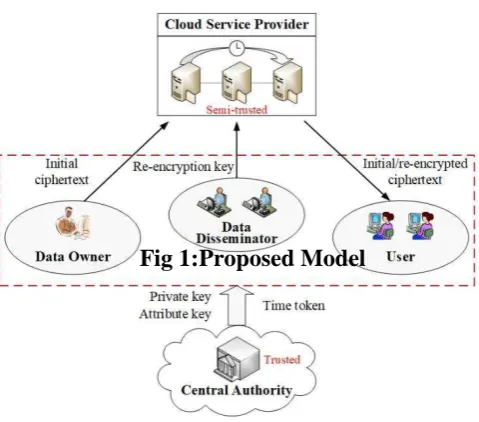
coordinated discharge information bunch dispersal. Fig. 1 shows the framework
model of our plan, which comprises of the accompanying framework elements.
The focal power (CA) is a completely confided in au-thority running on
confided in cloud stage with adaptability and versatility that oversees and dis-tributes
open/mystery enters in the framework, including creates framework parameters to
instate sys-tem and produces private keys and quality keys with clients' character and
characteristics. Likewise, it goes about as a confided in time specialist to distribute
time token at each pre-characterized time.
The CSP is a semi-confided in substance that has rich stockpiling limit and
calculation influence to master vide information sharing administrations in broad
daylight cloud. It is accountable for controlling the gets to from outside us-ers to the
put away information and giving compare ing administrations. At the point when it
gets the solicitation of information encryption, it is answerable for creating a
re-scrambled ciphertext with re-encryption key from information disseminator.
Consequently, CSP stores initial ciphertexts, yet in addition re-scrambled ciphertexts.
The information proprietor wishes to redistribute the information into cloud
for comfort of gathering sharing and dissemination. The information proprietor is
accountable for encrypting information for a lot of collectors. On the off chance that
the information proprietor has the prerequisite to confine his information to be
proprietor can characterize at-tribute-based and planned discharge get to approach,
and uphold it all alone information by scrambling the information under the
arrangement before re-appropriating it.
Fig 1:Proposed Model
The data disseminator is the person who wishes to share data owner’s data with
other people (e.g. his friends, family members, colleagues). For security and access
control considerations, data dissemina-tor must be one of intended receivers defined
by the data owner, who could decrypt the initial ci-phertexts. The data disseminator
can generate re-encryption keys, and then send data re-encryption requests with these
keys to the CSP to disseminate data owner’s data to others. Only the attributes of data
disseminator satisfy access policy and the pdetermined time arrives, data
re-encryption request can be successfully executed by CSP. The user is the ciphertexts
receiver who can access the outsourced data. The user is able to decrypt the initial and
re-encrypted ciphertexts if he is the in-tended receiver defined by the data owners or
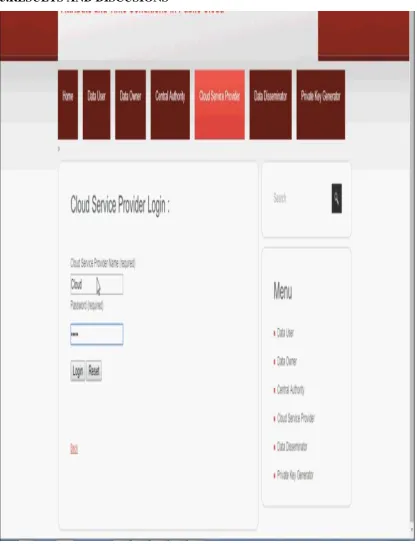
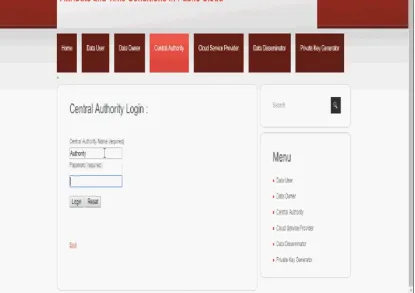
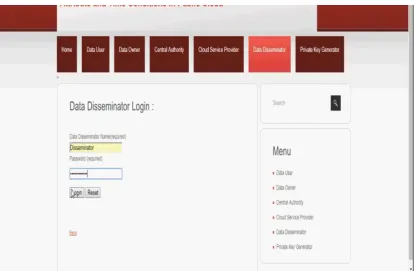
5.RESULTS AND DISCUSIONS
Fig 3: view all files
Fig 4: data disseminator page
6.CONCLUSION
In this paper, propose a secure information bunch sharing and scattering plan
out in the open cloud dependent on at-tribute-based and planned discharge restrictive
personality based communicate PRE. Our plan enables clients to impart information
to a gathering of beneficiaries by utilizing character, for example, email and username
at once, which would ensure information sharing security and accommodation out in
the open cloud. In addition, with the use of fine-grained and planned discharge CPRE,
our plan enables information proprietors to custom access arrangements and time
trapdoors in the ciphertext which could restrain the dispersal conditions while
re-appropriating their information. The CSP will re-encode the figure message
effectively just when the qualities of information disseminator related with the
re-encryption key fulfill get to strategy in the underlying ciphertext and the time
trapdoors in the underlying figure content are uncovered. We lead our tests with
matching based cryptography library. The hypothetical analaysis and trial results have
REFERENCES
[1] K. Ren, C. Wang, and Q. Wang, ―Security Challenges for the Public Cloud,‖
IEEE Internet Computing, vol. 16, no. 1, pp. 69-73, 2012.
[2] C. Delerablée, ―Identity-based Broadcast Encryption with Constant Size
Ciphertexts and Private Keys,‖ Proc. the 13th International Confer- ence on the
Theory and Application of Cryptology and Information Security (ASIACRYPT 2007),
pp. 200-215, 2007.
[3] F. Beato, S. Meul, and B. Preneel, ―Practical Identity-based Private Sharing for
Online Social Networks,‖ Computer Communications, vol. 73, pp. 243-250, 2016. [4] J. Bethencourt, A. Sahai, and B. Waters, ―Ciphertext-policy Attribute- based Encryption,‖ Proc. the 28th IEEE Symposium on Security and Pri- vacy (S&P 2007),
pp. 321-334, 2007.
[5] Z. Wan, J. Liu, and R. Deng, ―HASBE: A Hierarchical Attribute-based Solution
for Flexible and Scalable Access Control in Cloud Compu- ting,‖ IEEE Transactions
on Information Forensics and Security, vol. 7, no. 2, pp. 743-754, 2012.
[6] H. Hu, G. Ahn, and J. Jorgensen, ―Multiparty Access Control for Online Social Networks: Model and Mechanisms,‖ IEEE Transactions on Knowledge and Data
Engineering, vol. 25, no. 7, pp. 1614-1627, 2013.
[7] M. Blaze, G. Bleumer, and M. Strauss, ―Divertible Protocols and Atomic Proxy Cryptography,‖ Proc. Advances in Cryptology- EUROCRYPT 1998 (EUROCRYPT
'98), pp.127-144, 1998.
[8] D. Tran, H. Nguyen, W. Zha, and W. Ng, ―Towards Security in Shar- ing Data
on Cloud-based Social Networks,‖ Proc. the 8th International Conference on
Information, Communications and Signal Processing (ICICS2011), pp. 1-5, 2011.
[9] J. Weng, R. Deng, X. Ding, C. Chu, and J. Lai, ―Conditional Proxy Re-
Encryption Secure Against Chosen-ciphertext Attack,‖ Proc. the 4th International
Symposium on ACM Symposium on Information, Computer and Communications
Security (CCS 2009), pp. 322-332, 2009.
[10] P. Xu, T. Jiao, Q. Wu, W. Wang, and H. Jin, ―Conditional Identity- based
Broadcast Proxy Re-encryption and its Application to Cloud Email,‖ IEEE
Author’s Profile
Ms. B.N.V.D.Bhavani, B.Tech in computer science and engineering
from SWARNANDHRA ENGINEERING COLLEGE, affiliated to
JNTU, Kakinada in 2016 , pursuing M.Tech in Computer science and
engineering from JOGAIAH INSTITUTE OF TECHNOLOGY
AND SCIENCE COLLEGE OF ENGINEERING affiliated to the
JNTU, Kakinada in 2017-19
Dr. A. Veerabhadra Rao M.Tech., (Ph.D.,),
Head of Department,Computer Science Engineering Department
Jogaiah Institute of Technology and Sciene College of
Engineering, Kalagampudi, Near Palakol, West Godavari District,