Automated Irrigation System using
ZigBee - GSM
Shikha1,Vibha2
P.G. Student, Department of Computer Science IGDTUW, Kashmere gate,Delhi,India 1
Assistant Professor,Department of Computer Science IGDTUW, Kashmere gate,Delhi, India 2
ABSTRACT: In recent years, Distributed Wireless sensor technology becomes very popular and extensively used in the scientific world. The WSN helps in the advancement of the current developing and rapidly changing technology. Power management, cost-saving and labour-saving is always a major issue in the research field of wireless sensor networks. This paper gives a review of some existing or proposed systems based on the different technologies and also focuses on generic automated irrigation system based on WSN with GSM-ZigBee for remote monitoring and controlling devices. The objective is to make use of wireless sensor network and communication technology such as ZigBee and GSM in industrial field to make low-cost automated irrigation system to monitor the condition of the soil and to lower the energy consumption. The system helps the farmer to monitor and control the parameters of the soil such as air temperature, humidity, soil moisture. At any abnormal condition, the farmer is informed and will be able to take actions remotely by using GSM. Due to its lower energy consumption and low cost, the system has the potential to be useful in semiarid or arid areas.
KEYWORDS: WSN, GSM, ZigBee
I. INTRODUCTION
Irrigation is the application of water to the land or soil. It is an essential in all agriculture cropping systems. Agriculture requires usage of plenty of water. There is abundant of water on our planet. However, about or less than 1 % of the water is available for human use and approx. 70% is used for irrigation. Therefore, it becomes important to minimize the water waste. There are many irrigation systems are available, but most of them requires a lot of power that makes difficult for the farmers to gain information regarding soil or weather conditions. As a result, farmers suffer a lot. To overcome this issue, wireless sensor network and ZigBee technology is used.
A WSN is a distributed network of tiny, lightweight wireless nodes that are implemented with sensors which provide real-time monitoring and controlling solutions. Sensor nodes are the basic part of the wireless sensor network. A typical node of wireless sensor network consists of a transceiver, sensors, memory and power source and it has the ability to sense, process the sensed data and communicate with each other. Therefore, the sensor node plays an important role in agriculture. It is a reliable, high performance and cost effective solution through which many parameters can be controlled such as temperature, humidity, soil moisture and much more.
ZigBee is IEEE 802.15.4 standard technology, used for short range WSN with small, low-power digital radios. It was selected for battery operated sensor network because it is simpler, less expensive, low power consumption and greater useful range as compared to other wireless networks (WPANs) such as Bluetooth or Wi-Fi. ZigBee devices can transmit the data over long distance through mesh networking where intermediate devices are used to reach more distant ones. The ZigBee communication protocol is basically useful for low data rate applications such as control and monitoring systems that require long battery life, short range and secure networking.
Features:
Low battery consumption. The ZigBee devices can operate for months or even years without battery replacement.
Low cost.
Supports up to 65,535 nodes connected in a network.
More reliable as Channel access using Carrier Sense Multiple Access with Collision Avoidance (CSMA - CA). A ZigBee end device can be in sleep mode and still keep its association with its network.
II. LITERATURE SURVEY
WSNs have been widely used in many irrigation systems to obtain accurate results. Each application has its own characteristics and objectives. [15] Proposed an economical and generic automatic irrigation control system using GSM and Bluetooth. This paper gives a detailed survey of various remote monitoring and control systems based on different technologies. In the proposed system, both GSM and Bluetooth modules are interfaced with the 8-bit microcontroller. GSM is used for remote monitoring and controlling the devices via messages and Bluetooth was also used for the same purpose but within a range of few meters which eliminates the cost of network usage to a great extent. If the moisture or temperature exceeds the predefined threshold values then the system informs the user via SMS from the GSM Module to the user's smartphone and actions will be taken by the user accordingly. But this system was not efficient for strong real-time monitoring.
[2] Proposed, the ARM control based Drip irrigation system for sensing various parameters of the soil. The proposed system utilizes micro sensors for N, P, K measurement, temperature, humidity, soil moisture, soil PH for the agriculture environment and interfaced with ARM LPC2148 Microcontroller. The content measurement of N, P, K elements helps to decide fertilizers requirement and also useful to manage the content of these elements in chemical mixing during the formation of fertilizers. This system uses a wired communication network to control the valves of the drip irrigation system.
[5] Proposed, an automatic irrigation system using ZigBee and WSN to make effective utilization of water resources for agriculture. It consists of distributed wireless sensor system consisting soil moisture and temperature sensors fixed near roots of the plants and all the components are powered by a solar panel for charging the battery so that need not to worry about the battery replacement every time. All the data received from the wireless sensor unit is identified, recorded, analysed and the information is transferred to the web server via GPRS Module. The farmer can set crop types such as Wheat, Bajra, Rice, and Jowar in the master node. Moisture, temperature and humidity value required for a particular crop are set in the microcontroller as a threshold value. The actual values are compared with the threshold values. If the actual value crosses the threshold values then corresponding pump, buzzer, fan is switched on. In future mobile can be used to receive messages directly instead of PC.
Gutierrez, Jessica, et al.
[1] proposed an automated irrigation system using GPRS Module for the effective utilization of water in agriculture. It consists of distributed wireless sensor unit with soil moisture and temperature sensors deployed in plant root zones. The data from the wireless sensor unit is transferred to the main controller where the data is identified, recorded and analysed. This main controller permits the automated activation of irrigation when the threshold value of soil moisture and temperature are reached. The communication between the sensor node and the main controller is via ZigBee protocol under the IEEE 802.15.14WPAN.The receiver unit also has a duplex communication link based on a cellular-Internet interface, using general packet radio service (GPRS) protocol, which is a packet-oriented mobile data service used in 2G and 3G cellular global system for mobile communications (GSM)[1]. The data is allowed to transfer to the web server in real time through the internet, where the soil moisture and temperature levels are graphically displayed and stored in a database server.predefined web page using router connected to Wi-Fi wireless network. The monitored data displays the status directly to the webpage.
A. Limitations of the Existing System
All the proposed systems have used the star topology. This topology consists of a central node to which all other nodes are connected. But if the central node fails then the entire system is affected.
PC incurs additional cost, although one can monitor and control devices remotely from any part of the world provided internet access is available.
Normally farms are very far from the house so the farmers have to travel to the farm for irrigating the crops which cause inconvenience, takes time and requires fuel consumption. There should be a way through which user can perform various actions remotely.
Security is always a major concern in everywhere. In dry or hot season, the outsider can use the water tank to irrigate their own crops.
Low-cost product with more features always a requirement.
If the farmer is out of his farm then in any emergency he should be notified automatically.
As the farmers does not know the technical details of the device. Data is displayed in terms of values which are difficult for the farmers to understand.
III. AUTOMATED IRRIGATION SYSTEM
The objective is to make use of wireless sensor network and communication technologies like ZigBee, GSM in industrial field to design a remote control and monitoring system for farmers that would graphically represent the soil condition of the crop distantly using ZigBee. At any abnormal condition, an alarm is raised and an alert message is sent to the user via GSM so that user can remotely perform an action by sending a message.
A. System Architecture
Fig 1 shows, the designed system with two nodes i.e. Sensor node and Coordinator node, linked by radio
transceivers that allow the transfer of sensor data using ZigBee technology. The coordinator node receives, analyse and store the data to the database.
Figure 1: Architecture of Automated Irrigation System
1)
Sensor Node:
A node is comprised of RF transceiver, Sensors, a microcontroller and Power sources. The numberof WSUs can be deployed in the field to configure a distributed sensor network. Each unit is cable to route the sensor data with some delay of seconds to the Coordinator node via ZigBee. The sensor unit supports sleep mode to decrease power consumption by transmitting data at one-minute interval.
to Digital converter(ADC), PWM and different serial interface such as UART, SPI, I2C, CAN, USB. The AVR is preferred because it is easy to program in embedded C and inexpensive with low power consumption.
The system utilizes different sensors to control and monitor the various parameters of the soil such as Soil temperature sensor, Humidity sensor, soil moisture sensor. Fire sensor is used for fire detection. Grove soil moisture sensor, DHT11 humidity sensor and Fire sensor is used. Measuring soil moisture is important to get the information regarding the exact quantity of the water needed to irrigate the crops. Humidity sensor gives two parameters; humidity and air temperature. The sensor has a crucial role in plants growth; low temperature causes a decrease in the absorption and movement of water in the plants and low humidity causes fast transpiration. Fast transpiration means the plants using lots of water (nutrients).
2)
Coordinator Node:
The soil moisture, humidity and temperature data from the WSU are transferred to the Wireless information unit via ZigBee receiver. The PC with GSM and ZigBee is used as a Coordinator node to identify and analyze the data. Farmers can easily visualize the condition of the soil through graph. The collected data is updated to the MySQL database by which one can easily check the previous day’s data and make an appropriate decision for the crops. The user is allowed to set the threshold value for the particular crop. If the running value crosses the threshold value then a warning message is sent to the user mobile device via GSM. In case of fire, an alert message is displayed on the screen as well as send to the user’s mobile. The user can also perform an action through an on/off message.IV. WORKING
The designed system consists of three nodes, Node 1 and Node 2 called as sensing node and node 3 is a Coordinator node. Coordinator node plays an important role in the automated irrigation system. Node1 and Node 2 perform the same operation as it senses the information by using sensors and this sensing information is transferred to the ADC. The ADC is inbuilt in AVR microcontroller where ADC converts the Analog data to digital data and transfer to the UART for serial communication. The ZigBee communication protocol is used for a wireless transmission of data. ZigBee transmits the data of Node1 and Node2 to the Coordinator node where ZigBee receiver connected to PC receives and display the data graphically on the screen. For any particular crop, the threshold value can be set by the user and compare the threshold value with the actual value. If the threshold value exceeds the actual value then automatically alarm is raised and message is sent via GSM on the registered number. In case of fire, an alert message is sent to the user mobile. LED is used in place of pump so that a message can be sent by the user to on/off LEDs.
Figure 3 Interfacing Diagram:DHT11 is interfaced with atmega32 via PINC0, VCC and Ground. Grove soil moisture sensor interfaced via PIN A1. Zigbee is connected to Port D.
V. EXPERIMENTAL RESULTS
These are the following results after receiving the data from different nodes:
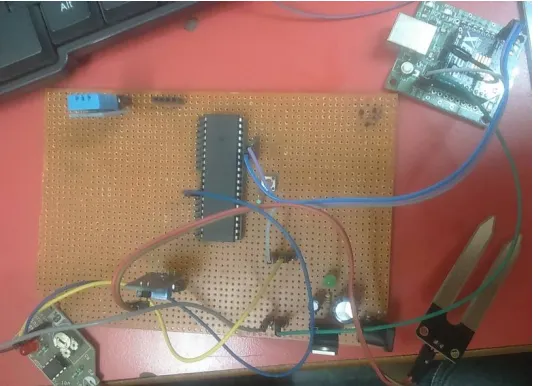
Sensor node read the data from different sensors and transmitted the serial data to the coordinator node via ZigBee. The ZigBee works as a transmitter whereas at the coordinator node ZigBee works as a receiver. Figure 4 shows, Atmega32 Microcontroller are interfaced with DHT11, Soil Moisture sensor and Fire Sensor. Microcontroller read the data and transfers to the main controller via ZigBee Transceiver.
Figure 4: DHT11, Fire Sensor, Grove soil moisture sensor and ZigBee interfaced with Atmega 32
(a)
(b)
Figure 5: (a) Humidity, Temperature and Soil Moisture represent graphically (b) Warning message displayed on the screen ‘Temperature is High”.
The database using MySQL open source software created. In Database, the values of the sensor are stored with date and time. Figure 6 Shows, Table of Humidity, Temperature and soil moisture real time data with date and time.
Figure 6: MySQL Database to store sensor value with date and time.
VI. CONCLUSION
In this paper, detailed study and literature survey of various automated irrigation system have been presented. We have successfully designed a remote control and monitoring system for farmers that will graphically represent the soil condition of the crop distantly using ZigBeeThe designed system is Power-efficient, cost-effective and user-friendly that is efficient enough to monitor the crop condition and remotely control the peripherals of the irrigation system which will make the job of the farmers easier.This system is scalable, as it allows any number of devices to be added with no major changes in its core architecture. Currently, the soil humidity, soil moisture sensor and fire sensor has been successfully interfaced with Atmega32. Wireless transmission between sensor and coordinator node is done through ZigBee. GSM is used as a remote controller to perform action remotely if the user is out of range. In future, the following points will be covered.
At least the network of three or four nodes will be created using mesh networking.
More sensors will be interfaced such as pressure sensor to know weather conditions, Soil temperature sensor and PH sensor to make the system much more efficient.
The software will be developed on the server where a user can view the sensor data and schedule the irrigation schemes remotely.
Security is always a major concern. Encryption of data will be done if needed.
Providing the data in more precise and accurate way as industrial application require 99% accuracy for its system deployment in the practical field.
REFERENCES
[1] Gutierrez, Jessica, et al. "Automated irrigation system using a wireless sensor network and GPRS module." Instrumentation and Measurement, IEEE Transactions on 63.1 (2014): 166-176.
[2] Galande, Mr SG, G. H. Agrawal, and Mr NB Waditke. "The ARM Control Based Drip Irrigation System." International Journal of Emerging Trends in Science and Technology 2.05 (2015).
[3] Tarange, Pandurang H., Rajan G. Mevekari, and Prashant A. Shinde. "Web based automatic irrigation system using wireless sensor network and embedded Linux board." Circuit, Power and Computing Technologies (ICCPCT), 2015 International Conference on.IEEE, 2015.
[4] Patel, Nirmit, and Nilseh Desai. "Wi-Fi Module and Wireless Sensor Network Based Automated Irrigation System." SYSTEM 2.4 (2015). [5] Chikankar, Pravina B., Deepak Mehetre, and Soumitra Das. "An automatic irrigation system using ZigBee in wireless sensor network."Pervasive Computing (ICPC), 2015 International Conference on. IEEE, 2015.
[6] Kim, Yunseop, Robert G. Evans, and William M. Iversen. "Remote sensing and control of an irrigation system using a distributed wireless sensor network."Instrumentation and Measurement, IEEE Transactions on 57.7 (2008): 1379-1387.
[7] Akshay, C., et al. "Wireless sensing and control for precision Green house management." Sensing Technology (ICST), 2012 Sixth International Conference on.IEEE, 2012.
[8] Awati, J. S., and V. S. Patil. "Automatic Irrigation Control by using wireless sensor networks." Journal of Exclusive Management Science 1.6 (2012): 1-7.
[9] Thilagavathi, G. "Online farming based on embedded systems and wireless sensor networks." Computation of Power, Energy, Information and Communication (ICCPEIC), 2013 International Conference on.IEEE, 2013.
[10] Rani, M. Usha, and S. Kamalesh. "Web based service to monitor automatic irrigation system for the agriculture field using sensors." Advances in Electrical Engineering (ICAEE), 2014 International Conference on.IEEE, 2014.
[11] Yu, Xiaoqing, Wengting Han, and Zenglin Zhang. "Remote Monitoring System for Intelligent Irrigation in Hybrid Wireless Sensor networks." International Journal of Control and Automation 8.3 (2015): 185-196.
[12] Anisi, Mohammad Hossein, Gaddafi Abdul-Salaam, and Abdul Hanan Abdullah. "A survey of wireless sensor network approaches and their energy consumption for monitoring farm fields in precision agriculture." Precision Agriculture 16.2 (2015): 216-238. 27
[13] Khriji, Sabrine, et al. "Precision irrigation based on wireless sensor network."Science, Measurement & Technology, IET8.3 (2014): 98-106. [14] Balbudhe, K. S., et al. "Cloud Based Cultivation Management System." (2015).
[15] Purnima, S. R. N., and PhD Reddy. "Design of remote monitoring and control system with automatic irrigation system using GSM-Bluetooth."International Journal of Computer Applications (0975–888) Volume (2012).
[16] Awati, J. S., and V. S. Patil. "Automatic Irrigation Control by using wireless sensor networks." Journal of Exclusive Management Science 1.6 (2012): 1-7.
[17] Dhiman, MsHina, and Mrs SA Shirsat. "Throughput Enhancement of ZigBee and WLAN under the Influence of Bluetooth."Coexistence 4.6 (2015).