DOI: 10.15680/IJIRSET.2014.0312073
Design Modification and Analysis for an
Attachment Bracket of Fuselage Floor Beam
Rahul Sharma
1,Garima Garg
2B.Tech, Department of Mechanical Engineering, Chandigarh Group of College, Gharuan, Mohali, Punjab, India1 B.Tech, Department of Aeronautical Engineering, Gurukul Vidyapeeth Institute of Engineering and Technology, Patiala,
Punjab, India 2
ABSTRACT:The Floor beam of an aircraft is attached to the two brackets as shown in the fig.1. The Floor beam has an I Cross Section. The total load transferred by the floor beam to a single bracket is calculated to be 180 kg. The scope of the work is that the current configuration needs to be redesigned as per the strength point of view. The main emphasis should be on the manufacturability, cost reduction and weight reduction. Validate the optimum design selected by conventional Hand Calculation.
KEYWORDS: Al 7075-T6, Attachment, Bracket, Design, FEA,Fuselage,Modification, NASTRAN, PATRAN. I. INTRODUCTION
To begin with fuselage, it is a main structure of any aircraft. It is a tunnel type structure closed from both ends and provides space for passengers, cargo, control unit, accessories and other equipment. In some aircrafts it also provides housing space to power plant. Fuselage is the combination of lots of structural members. Basically two types of fuselage are very famous on the basis of structural members. First one is truss type which is a rigid frame combination of beams, struts and other bars. Second one is monocoque type which consists formers, frame assemblies, bulkheads, stringers, skin and longerons. Thus, both have a common structural member which is very predominant for the fuselage known as floor beam. Floor beam is a structural member which is used as floor space to passengers, cargo, control unit, accessories and other equipment. The floor beam fixes with fuselage skin with the help of attachment bracket. Here the floor beam has chosen of I section and connection provided to fuselage with attachment bracket and other methods of joining. In this paper design modification of attachment bracket has done for 180 kg of load only as conceptual design for the improvement of strength, manufacturability, cost reduction and weight reduction.
II. MATERIALS&METHODS Non- Design Space and FEA of Bracket
Changing of materials is not allowed.
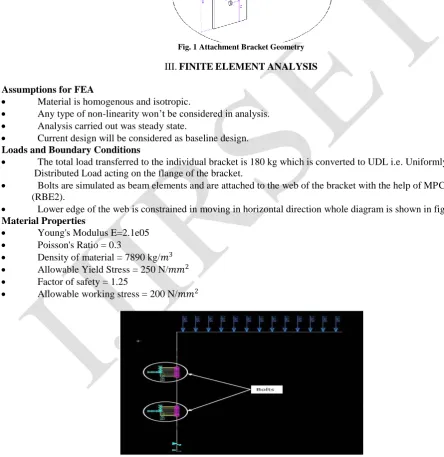
Basic Geometry of Flange attached to the floor beam not to be modified shown in fig.1
In order to make sure that the design carried out is safe, it is necessary to carry out the FE analysis and compare the stresses arrived from FE analysis with the stresses arrived in the designed calculations. The main scope of this FE analysis was to carry out strength analysis of bracket with available commercial FE analysis tool (NASTRAN & PATRAN), compare the predicted maximum stresses under the given loading conditions against the material allowable stress values. The main tasks in the FE analysis includes:
Generate Finite element model by selecting compatible element type in PATRAN. Apply material properties to the different components in the bracket.
Define the required connections appropriately, especially the interface between the adjacent components. Apply of boundary conditions based on the working principal and condition in PATRAN.
Study animations and verify behavior of the assembly under the given loads and boundary conditions in PATRAN.
Carry out the necessary mesh adequacy checks to ensure that FE meshes are dense enough to capture stress & deflection values accurately.
Fig. 1 Attachment Bracket Geometry
III.FINITEELEMENTANALYSIS Assumptions for FEA
Material is homogenous and isotropic.
Any type of non-linearity won’t be considered in analysis. Analysis carried out was steady state.
Current design will be considered as baseline design.
Loads and Boundary Conditions
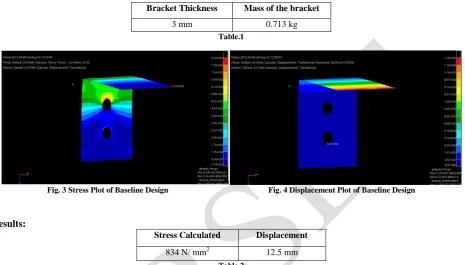
The total load transferred to the individual bracket is 180 kg which is converted to UDL i.e. Uniformly Distributed Load acting on the flange of the bracket.
Bolts are simulated as beam elements and are attached to the web of the bracket with the help of MPC (RBE2).
Lower edge of the web is constrained in moving in horizontal direction whole diagram is shown in fig.2.
Material Properties
Young's Modulus E=2.1e05 Poisson's Ratio = 0.3
Density of material = 7890 kg/𝑚3
Allowable Yield Stress = 250 N/𝑚𝑚2
Factor of safety = 1.25
DOI: 10.15680/IJIRSET.2014.0312073
FE Analysis of Baseline Design
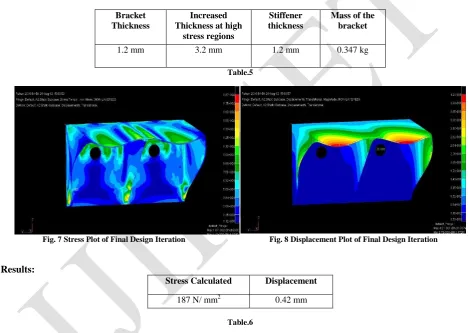
The FEM analysis of the baseline bracket model was done using PATRAN and NASTRAN. The stress plot and displacement plots are as follows:-
Bracket Thickness Mass of the bracket
3 mm 0.713 kg
Table.1
Fig. 3 Stress Plot of Baseline Design Fig. 4 Displacement Plot of Baseline Design
Results:
Stress Calculated Displacement
834 N/ mm2 12.5 mm
Table.2
Remarks: The Stress so produced was high in value so, design modification is recommended. Studying the stress tensor plot we can conclude that the second hole is not effective in sharing the load. So, a change in position and orientation of hole is done.
Initial Design Iteration
Changing the hole orientation from vertical to horizontal.
Bracket Thickness Mass of the bracket
3 mm 0.713 kg
Table.3
Results:
Stress Calculated Displacement
723 N/ mm2 15.1mm Table.4
Remarks: The Stress so produced was greater than the required value i.e. 200 N/ mm2 so, design modification is recommended.
Final Design Iteration
Machined bracket with horizontal holes 24 mm from top with a central stiffener and two side by side stiffener and length of web reduced to half and thickness increased locally at higher stress regions.
Bracket Thickness
Increased Thickness at high
stress regions
Stiffener thickness
Mass of the bracket
1.2 mm 3.2 mm 1.2 mm 0.347 kg
Table.5
Fig. 7 Stress Plot of Final Design Iteration Fig. 8 Displacement Plot of Final Design Iteration
Results:
Stress Calculated Displacement
187 N/ mm2 0.42 mm
Table.6
Remarks:The Stress so produced was below the required limit i.e. 200 N/ mm2 and the mass of the bracket is also less as compared to the rest of the cases. In this case there will be an additional cost of machining hence the above case can’t be considered as the best optimum design solution.
IV.DESIGNCALCULATIONS
The optimum design identified as per strength, weight and cost point of view is “Design Iteration 18- Bracket with Horizontal Holes 24 mm from top with a Central Stiffener and two side by side Stiffeners”. The design calculations carried out for the stated optimum design to validate the FE analysis results are as follows:-
DOI: 10.15680/IJIRSET.2014.0312073
Design Iteration 18- Bracket with 3 stiffeners having uniform thickness of 1.2 mm: Input:
Thickness, t = 1.2 mm
Shorter edge length, b = 60 mm Longer edge, a = 100 mm Pressure, p = 0.0735 N/𝑚𝑚2
Fig.9
Allowable ultimate tensile stress, σ;
𝜎 = 200 𝑁/𝑚𝑚2
𝑎
𝑏= 1.677 From graph,
𝛽1 = 0.9 𝛽2 = 0.54 𝑘1 = 0.72 𝑘2 = 0.95 Max.Bending stress at x=0 and y=0
𝑓 = −𝛽1. 𝑝. 𝑏2 𝑡2
𝑓 = 16.375 𝑁/𝑚𝑚2
Shear force at x=0 and y=0, V
𝑉 = 𝑘1. 𝑝. 𝑏 𝑉 = 3.175 𝑁/𝑚𝑚 Bending stress at free edges 𝑥 = 0 and 𝑦 = 𝑏, 𝑓1
𝑓1 = −𝛽2 𝑝. 𝑏2 𝑡2
𝑓1 = −99.225 𝑁/𝑚𝑚2
Bending stress at free edges 𝑥 = 𝑎/2 and 𝑦 = 𝑏, 𝑓2
𝑓2 = −𝛽1 𝑝. 𝑏2 𝑡2
𝑓2 = −165.375 𝑁/𝑚𝑚2
Max. Shear force at free edges, 𝑥 =𝑎
2𝑎𝑛𝑑 𝑦 = 𝑏, 𝑣1
𝑣1 = 𝑘2. 𝑝. 𝑏2
𝑣1 = 251.37𝑁 Max. Shear stress at free edges, 𝑥 =𝑎
2𝑎𝑛𝑑 𝑦 = 𝑏, 𝜁:
𝑏1 = 60 𝑚𝑚 𝑑1 = 0.6𝑚𝑚 𝐴𝑟𝑒𝑎 = 𝑏1. 𝑑1 𝐴𝑟𝑒𝑎 = 36 𝑚𝑚2
𝑦 = 0.3 𝑚𝑚 𝐼𝑛𝑒𝑟𝑡𝑖𝑎, 𝐼 = 𝑏 ∗ 𝑑3/12
𝐼 = 𝑏1 ∗ 𝑑13 /12
𝐼 = 1.08𝑚𝑚4
𝜁𝑚𝑎𝑥 = (𝑣1. 𝐴𝑟𝑒𝑎. 𝑦)/I.b1
Von mises stress,
𝜎𝑣𝑚𝑠 = [ 𝑓2 + 3. (𝜁𝑚𝑎𝑥2)]
𝜎𝑣𝑚𝑠 = 180.595𝑁/𝑚𝑚2
Margin of Safety, M.O.S
𝑀. 𝑂. 𝑆 = 𝜎 𝜎𝑣𝑚𝑠 − 1 𝑀. 𝑂. 𝑆 = 0.107
Remarks: The predicted stresses from the FE analysis are matching with the stresses obtained from hand calculation. Hence, this validates the FE analysis results.
Fig.10 Coefficients for Rectangular Plate with Uniform Load
V. CONCLUSION
DOI: 10.15680/IJIRSET.2014.0312073
Design Iteration Bracket Thickness (mm)
Stiffener Thickness
(mm) Stress(N/mm
2
) Weight(kg)
Vertical Holes 3 - 834 0.713
Horizontal holes
75mm offset from base 3 - 723 0.713
Horizontal holes
90mm offset from base 3 - 701 0.713
Horizontal holes
24mm offset from top 3 - 739 0.713
No stiffener 5 - 247 1.198
No stiffener 7 - 122 1.691
Two side by side
stiffeners 3 3 101 1.104
Two side by side
stiffeners 2 2 228 0.726
Two side by side
stiffeners 3 2 123 0.95
Two side by side
stiffeners 2.3 2.3 173 0.839
Central Stiffener 3 3 117 0.891
Central Stiffener 3 2 127 0.832
Central Stiffener 2.3 2.3 197 0.681
Three stiffeners 3 3 49 1.282
Three stiffeners 2.3 2.3 77.6 0.975
Three stiffeners 2 2 104 0.845
Machined Bracket Variable Variable 187 0.347
Three stiffeners(Hole
position 24mm) 1.2 1.2 179 0.493
Table.7
VI.RECOMMENDATION
The following are the recommendations in the redesigning of Floor beam attachment bracket: Using different material for the bracket can be studied in future.
A total redesign of the floor beam-bracket attachment can be studied and implemented in future.
REFERENCES
Books:
[1] MIchael Chun-Yun Niu, Airframe_Stuctural_Design, Final_Issue_01, Publisher, Technical Book Company, 1988 [2] Practical Stress Analysis for Design Engineers, Jean-Claude Flabel, Lake City Publishing Company, 1997. [3] Roark’s formulas for stress and strain.
[4] Strength of Materials by Timoshenko.
[5] Peterson's Stress Concentration Factors (2nd Edition).Mechanical engineering design – Joseph E. Shigley.
Manuals: