ISSN(Online): 2319-8753 ISSN (Print): 2347-6710
I
nternational
J
ournal of
I
nnovative
R
esearch in
S
cience,
E
ngineering and
T
echnology
(A High Impact Factor & UGC Approved Journal) Website: www.ijirset.com
Vol. 6, Issue 9, September 2017
An Improvement over Fuzzy c-Means: A
Prototype based approach
K. Mrudula1, E. Keshava Reddy 2
Research Scholar, Department of Mathematics, Jawaharlal Nehru Technological University Anantapur,
Ananthapuramu, A.P. India1
Professor, Department of Mathematics, Jawaharlal Nehru Technological University Anantapur, Ananthapuramu,
A.P. India2
ABSTRACT: Fuzzy c-Means clustering method is a leading data clustering algorithm. It is an iterative approach, where in, each pattern is assigned to its nearest cluster centre with a membership value in each cluster. It requires to compute
nct
number of distance computations, wheren
is the size of the dataset,c
is the number of clusters andt
is the number of iterations. However, for large value ofn
, it may be very difficult to implement. The aim of this paper is to reduce the number of distance computations by selecting few prototypes (representative patterns), says
, fromn
and use these prototypes in the iterative process instead of the whole data. Hence the number of distance computations becomes
sct
wheres
n
. The novelty of this approach is that each prototype is fuzzy i.e., each prototype is considered as fuzzy representative pattern of some group of patterns in the given data. Experimentally it is proved that the proposed method take less number of distance computations with a negligible reduction in clustering accuracy.KEYWORDS:Data clustering, Fuzzy c-Means, prototypes.
I. INTRODUCTION
Fuzzy clustering is an active area of research with highly advanced applications including Image Processing, Document clustering, information retrieval systems, artificial intelligence and robotics etc. [7, 12]. Since the introduction of fuzzy sets by Zadeh, the fuzzy computing techniques have been highly effective with rich mathematical foundation [12]. The fuzzy clustering techniques such as Fuzzy c-Means (FCM) have been extensively studied and used in various scientific applications. Fuzzy c-Means (FCM) has been considered as an extension of the hard c-means clustering method and it is proved that FCM can achieve improved clustering accuracy than conventional c-means in case of non-isotropic clusters check the proof [9]. Unlike the hard clustering methods, in fuzzy clustering, each pat- tern can belong to multiple clusters with a degree of membership (belongingness) in each cluster. It is an iterative method, where in each iteration; it updates the membership value of every pattern in each individual cluster and recomputes the cluster centre. The time complexity of FCM is
(n
)
, wheren
is the number of patterns in the given data. However, for large value ofn
, it may be very difficult to implement. Further, it requiresnct
number of distance computations in the entire iterative process,c
is the number of clusters andt
is the number of iterations.The aim of this paper is to reduce the number of distance computations by selecting few prototypes (representative patterns), say
s
, fromn
and use these prototypes in the iterative process instead of the whole data. Thereby, the number of distance computations becomessct
wheres
n
. The novelty of the proposed approach is that each prototype is fuzzy i.e., each prototype is considered as fuzzy representative pattern of some group of patterns in the
ISSN(Online): 2319-8753 ISSN (Print): 2347-6710
I
nternational
J
ournal of
I
nnovative
R
esearch in
S
cience,
E
ngineering and
T
echnology
(A High Impact Factor & UGC Approved Journal) Website: www.ijirset.com
Vol. 6, Issue 9, September 2017
The remaining paper is organized as follows. Section II explains the related work to improve FCM algorithm in detail. Section III introduces the proposed Prototype based FCM (PFCM). Experimental results are presented in Section IV and the conclusions are provided in Section V.
II. RELATEDWORK
This section outlines the Fuzzy c-Means (FCM) clustering algorithm for the sake of completeness and then presents some recent attempts presented in the literature to reduce the running time of FCM.
The objective of FCM algorithm is to partition n data items (patterns) into
c
distinct clusters. It was initially proposed by Dunn and then extended by Bezdek [7, 13]. The iterative process starts by selectingc
patterns as initial cluster centers and assigns each pattern to different clusters with a designated membership in each cluster such that the sum of all memberships of each pattern in various clusters should be equal to one. The membership value of a pattern depends on its nearestness to the particular cluster centre in each cluster.Let D
p1,p2,p3,...,pn
be a dataset and V
v1,v2,v3,...,vc
be the set of initial cluster centres. The FCM clusteringalgorithm determines a partition of
D
by minimizing the objective functionJ
which is defined as follows:2
1 1
j i n
i c
j m
ij
p
v
J
where m is the fuzziness index,
m
1
,
and
ij represents the membership of ith pattern to jth cluster centre. After each iteration, the membership and cluster centres are updated as follows:
ck
m dik
d ij
ij
1
) 1 ( 2
1
where
1
i
c
and1
j
n
;
1 1
n
j m ij n
j j m ij
i
x
v
where
1
i
c
It has been studied that FCM often struck at local optimum. The global minimum value of
J
depends on the selection of initial cluster centres [2]. Further, it requiresnct
number of distance computations in the entire iterative process wheret
is the number of iterations.Some improvements have been proposed in order to reduce the time complexity of hard c-means clustering method viz., reduce the number of distance computations in each iteration keeping the important points in the buffer (primary memory) while discarding unimportant points [3], reduce the number of scans over the data i.e., single pass k-means [8], bootstrap averaging [5], etc. More recently some prototype based approaches become popular, which produce quality clustering results similar to the conventional hard c-means method with a greater reduction in running time [10]. Some remarkable improvements over FCM for large datasets were proposed in [7, 13, 14, 15], which have motivated the present work.
ISSN(Online): 2319-8753 ISSN (Print): 2347-6710
I
nternational
J
ournal of
I
nnovative
R
esearch in
S
cience,
E
ngineering and
T
echnology
(A High Impact Factor & UGC Approved Journal) Website: www.ijirset.com
Vol. 6, Issue 9, September 2017
whole data. To the best of our knowledge, the idea of finding fuzzy prototypes is not well explored in the literature. The proposed prototype based FCM (PFCM) is presented in the following section.
III.PROPOSED PROTOTYPE BASED FUZZY C-MEANS (PFCM)
The proposed prototype based Fuzzy c-Means (PCFM) runs in two phases. In the initial phase, it determines a set of fuzzy prototypes from
n
patterns in a single scan over the given data [11]. Each prototype, denoted byl
jis the representative of a set of patterns which are at a distance less than
. It is to be noticed that, each patternp
kmay belong to one or more prototypesl
j. The membership ofp
k inl
j is denoted by
ljpkand it is computed using theformula.
s i m k i k j p l p l d p l d k j 1 1 2 , , 1 where
m
is the fuzziness index.The sum of memberships of each pattern in various prototypes is equal to 1 i.e.,
1
1
s j p lj k
. Here the number ofprototypes, say
s
, depends on the value of
. Larger the value of
; lesser the number of prototypes and vice versa. The algorithm to find the fuzzy prototypes in presented in Algorithm 1. Let the set of prototypes after the first phase beL
l
1,l
2,l
3,...,
l
s
. During the first phase, the following matrixM
S which is of sizen
s
, is computed and stored in the primary memory.s n p l p l p l p l p l p l p l p l p l S n s n n s s
M
.
.
.
.
.
.
.
.
.
.
.
.
.
.
.
.
.
.
.
.
.
2 1 2 2 2 2 1 1 1 2 1 1In the matrix
M
Sthe sum of elements in each row is equal to 1.In the second phase, we run the FCM algorithm by selecting c initial cluster centers randomly from
D
. Here, in placeof the entire dataset
D
, the set of prototypesL
are used in the iterative process. Note thatL
D
. Each prototypej
l
may belong to one or more clustersC
ks. The membership ofl
jinC
kis denoted by
Cklj and it is computed using the formula
ISSN(Online): 2319-8753 ISSN (Print): 2347-6710
I
nternational
J
ournal of
I
nnovative
R
esearch in
S
cience,
E
ngineering and
T
echnology
(A High Impact Factor & UGC Approved Journal) Website: www.ijirset.com
Vol. 6, Issue 9, September 2017
The sum of memberships of each prototype in various clusters is equal to 1. i.e.,
1
1
c j l Cji
. During the second phase, thefollowing matrix
M
D of sizes
c
can be computed.c s l C l C l C l C l C l C l C l C l C D s c s s c c
M
.
.
.
.
.
.
.
.
.
.
.
.
.
.
.
.
.
.
.
.
.
2 1 2 2 2 2 1 1 1 2 1 1In the matrix
M
D, the sum of elements in each row is equal to 1. In each iteration of PFCM, the approximate fuzzy membership of each patternp
iin the clusterC
kcan be computed using the following formula:2
* j i kj i k l C p l p C
Where
l
jis the prototype, in which the membership ofp
iis maximum among all prototypes. It can be easily verified that the value of *i kp
C
is very close to the exact fuzzy membershipi kp C
.
c j m i j i k p C p C d p C d i k 1 1 2 , , 1 For large datasets, where n is very large, computing the approximate *
i kp
C
takes less computations compare toi kp
C
in each iteration of FCM. Hence, the proposed prototype based FCM (PFCM) converges more quickly than the conventional FCM. Interestingly, using this PFCM, it is possible to achieve the clustering quality which is very close to that obtained using the conventional FCM. The small reduction in the clustering quality is accepted for large data applications as long as there is great reduction in running time.IV.EXPERIMENTALSTUDY
This section presents a detailed experimental study on some benchmark datasets collected from UCI Machine Learning Repository [1]. The details of the datasets are given in Table 1. Experiments are conducted on a machine with corei3 processor and 8GB RAM. To run FCM algorithm, the initial centers are selected randomly from the dataset as per the number of clusters c
specified for each dataset.
Dataset Number of Patterns (n)
Number of dimensions (d)
Number of Clusters (c)
Iris 150 3 4
Pendigits 10992 16 10
OCR 10003 192 10
LIR 20000 16 26
Shuttle 58000 9 7
ISSN(Online): 2319-8753 ISSN (Print): 2347-6710
I
nternational
J
ournal of
I
nnovative
R
esearch in
S
cience,
E
ngineering and
T
echnology
(A High Impact Factor & UGC Approved Journal) Website: www.ijirset.com
Vol. 6, Issue 9, September 2017
To run the proposed prototype based FCM, the value of the
on every dataset is fixed as the average distance in 5% of randomly selected patterns from the data. The fuzziness index m is also fixed that m=2. The clustering quality is assessed using Rand-Index [4]. The Clustering Accuracy (CA) of FCM and PFCM are compared in Fig1. From Fig 1, it can be observed that PCFM has very less reduction in the CA is 5% (on average), when compared to conventional FCM, on the selected benchmark datasets as shown in Table 1.Fig.1. Comparing Clustering Accuracy (CA)
Algorithm 1: Generating Fuzzy Prototypes
(
D
,
)
---
L
;for each
p
i
D
doFind a
l
j
L
such thatl
j
p
i
if there is no such
l
j or whenL
then
p
iL
L
;end if end for
for each
p
i
D
doCompute the membership of
p
i in each leaderl
jusing the following formula
s
k k i
i j p
l
m i
j
p l d
p l d
1
) 1 ( 2
, , 1
end for
Output:
ISSN(Online): 2319-8753 ISSN (Print): 2347-6710
I
nternational
J
ournal of
I
nnovative
R
esearch in
S
cience,
E
ngineering and
T
echnology
(A High Impact Factor & UGC Approved Journal) Website: www.ijirset.com
Vol. 6, Issue 9, September 2017
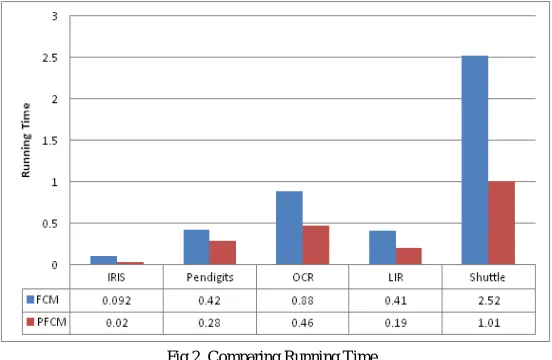
Fig 2 shows that PFCM takes very less time when compared to Conventional FCM. From Fig 2, it is observed that there is 78.26% reduction in running time on Iris data. On pendigits the reduction in running time is 33.33. Similarly we can observe that 47.72%, 53.65% and 59.92% reduction in running time over OCR, LIR and Shuttle datasets respectively.
Fig.2. Comparing Running Time
From the experimental study, it is proved that the proposed prototype based FCM result a great reduction in running time while there is small deviation in the clustering quality.
V. CONCLUSIONS
This paper presented a new prototype based Fuzzy c-Means (FCM) clustering method. The objective of this prototype based approach is to reduce the running time of FCM so that it can be used in case of very large datasets. The key idea is to identify some prototypes from the entire dataset and run FCM over these prototypes. Experimentally it is proved that the proposed method reduces the running time of FCM with a little compromise in the clustering accuracy.
REFERENCES
[1] Arthur Asuncion and David Newman. Uci machine learning repository, 2007
[2] James C Bezdek, Robert Ehrlich, and William Full. Fcm: The fuzzy c-means clustering algorithm. Computers & Geosciences, 10(2-3):191– 203, 1984.
[3] P. S. Bradley, U. Fayyad, and C. Raina. Scaling clustering algorithms to large databases. In Proceedings of Fourth International Conference on Knowledge Discovery and Data Mining, pages 9–15, AAAI Press, 1998.
[4] Roelof K Brouwer. Extending the rand, adjusted rand and jaccard indices to fuzzy partitions. Journal of Intelligent Information Systems, 32(3):213–235, 2009.
[5] Ian Davidson and Ashwin Satyanarayana. Speeding up k-means clustering by bootstrap averaging. In IEEE data mining workshop on clustering large data sets, 2003.
[6] Gan, Guojun, Qiujun Lan, and C. Ma. "Scalable clustering by truncated fuzzy c-means." Big Data and Information Analytics (2016).
[7] Timothy C Havens, James C Bezdek, Christopher Leckie, Lawrence O Hall, and Marimuthu Palaniswami. Fuzzy c-means algorithms for very large data. IEEE Transactions on Fuzzy Systems, 20(6):1130–1146, 2012.
[8] Jain, Anil K. "Data clustering: 50 years beyond K-means." Pattern recognition letters 31.8 (2010): 651-666.
[9] Nikhil R Pal, Kuhu Pal, James M Keller, and James C Bezdek. A possibilistic fuzzy c-means clustering algorithm. IEEE Transactions on fuzzy systems, 13(4):517–530, 2005.
[10] T. Hitendra Sarma and P. Viswanath. Speeding-up the k-means clustering method: A prototype based approach. In Proc. 3rd Int. Conf. on Pattern Recognition and Machine Intelligence(PReMI)LNCS 5909, page 5661, Berlin Heidelberg, 2009. Springer-Verlag.
ISSN(Online): 2319-8753 ISSN (Print): 2347-6710
I
nternational
J
ournal of
I
nnovative
R
esearch in
S
cience,
E
ngineering and
T
echnology
(A High Impact Factor & UGC Approved Journal) Website: www.ijirset.com
Vol. 6, Issue 9, September 2017
[12] Sabu Sebastian and Ramakrishnan,T. V.(2011) Multi-fuzzy sets: an extension of fuzzy sets, Fuzzy Inf.Eng. 1, 35-43.
[13] Mei, Jian-Ping, et al. "Large scale document categorization with fuzzy clustering." IEEE Transactions on Fuzzy Systems (2016).
[14] Himmelspach, Ludmila, and Stefan Conrad. "A Possibilistic Multivariate Fuzzy c-Means Clustering Algorithm." International Conference on Scalable Uncertainty Management. Springer International Publishing, 2016.