
QCD with jets and heavy flavour in pp and PbPb collisions in
ATLAS
RobertKeyes1,on behalf of the ATLAS collaboration 1McGill University
Abstract.ATLAS has studied different aspects of QCD in pp and PbPb collisions. A summary of interesting recent results at centre-of-mass energies of 7 TeV, 8 TeV and 13 TeV (pp), and 2.76 TeV (PbPb) per nucleon pair is presented. Using pp collisions, measurements of Z, W, photon, quarkonia and open charm production differential cross sections in a variety of variables are presented. Jet and heavy flavour muon measurements in PbPb collisions, aimed to test the properties of the Quark Gluon Plasma, with the view of better understanding of jet quenching, are also presented.
1 Introduction
The Large Hadron Collider (LHC) is the energy frontier of high energy particle physics, providing the highest energy and highest luminosity environment for proton-proton (pp) and heavy ion (HI) colli-sions to date. ATLAS is a multipurpose particle detector with a broad physics program that makes use of precision tracking, calorimetry and muon detectors [1]. Signals arising from collisions of coloured constituents of the matter are dominated by Quantum Chromodynamic (QCD) processes. Measur-ing broad aspects of QCD production provides constraints on QCD theoretical predictions as well as requisites for the empirical description of the proton and its constituents. Finally, having an accu-rate description of the QCD background of non-QCD measurements, such as Higgs measurements or searches beyond the Standard Model, is critical to their success.
2 Standard Model Boson measurements
2.1 Inclusive W and Z production at 13 TeV
W and Z boson production cross sections are measured at 13 TeV, providing an important benchmark of QCD and electroweak processes that are sensitive to the choice of PDF [2]. The measurements con-sider leptonic decays in the electron and muon channels: single-lepton with missing transverse energy for W boson candidate events and dilepton that fall within the Z mass window for Z boson candidate events. The primary backgrounds for the W boson measurements are multijets, which are estimated using a data driven approach. The primary backgrounds for the Z boson measurements are diboson signatures (WW), Z to di-tau and top quark decays, all of which are derived from simulations. The
measurements display a good agreement with predictions from NNLO QCD and NLO+EW correc-tions. The electron and muon channels measured separately in each case are found to be consistent. Figure 1 (left), displaying the ratio of predicted to measured cross sections shows tension between different PDFs. In Figure 1 (right), the W+ toW−cross section ratio enhances this tension due to cancellations of correlated measurement uncertainties.
Figure 1.Comparison of the measured and predicted W and Z cross sections (left) and theW+/W−ratio of the measured cross-section (right) using various PDF descriptions [2].
2.2 Inclusive ZpT at 8 TeV
The measurement of the inclusive Z boson pT spectrum at 8 TeV provides a comprehensive test of
QCD predictions spanning the non-perturbative regime at lowpT to the perturbative regime at high
pT[3]. W and Z bosons constitute a significant background in many analyses and previous simulations
of these backgrounds have required data-driven corrections [4, 5]. The measurement is conducted by selecting dilepton final states, a clean signature that benefits from a precisepTdetermination and low
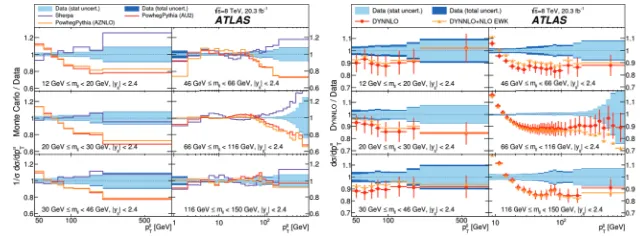
background. Measurements were compared to the predictions from Pythiaand Sherpa, as shown in Figure 2 (left), both displaying a poor agreement in the highpT tail. Comparisons to a higher order
pQCD computation DYNNLO yielded a better description of the shape but with a constant offset, as seen in Figure 2 (right).
2.3 Inclusive photonET at 8 TeV
Prompt photons originating from hard scattering are a clean probe of the parton level dynamics and of the gluon PDF. Arising predominantly through Compton process likeqg →qγscattering, prompt photon signatures are targeted experimentally by requiring that the photon is isolated, i.e. well sepa-rated from other calorimetric signatures. Events simulated using Pythiaand CTEQ6L1 PDF are used to correct for detector effects and signal leakage in order to extract the central value of the measure-ments [6]. A significant improvement in experimental uncertainties, compared to previous results, is obtained thanks to improved photon calibrations [7]. The result is compared to theory predictions at NLO from JetPhox using various PDF sets, and at NLO+NNNLL (which is comparable to NNLO) from PeTeR, as seen in Figure 3. Comparisons yield a good shape agreement and a better normal-ization with PeTeR. This measurement provides an important constraint on the global fit of the gluon PDF.
Figure 3.The measured photonETdifferential cross section compared to JetPhox and PeTeR [6].
3 Heavy flavour production measurements
3.1 J/ψandψ(2S)at 7 and 8 TeV
Figure 4. The proper time distribution (left) and comparisons of the measuredψ(2S) (middle) andJ/ψ(right) cross section ratios to NRQCD and FONLL predictions [8].
3.2 Prompt and non-promptJ/ψat 13 TeV
During the long shut down between Run 1 and Run 2 ATLAS installed additional layers of silicon pixel tracking by virtue of shrinking the beam pipe. This new "Inner B Layer" (IBL) provides en-hanced vertexing and heavy flavour tagging capabilities in anticipation of more challenging pile-up conditions for Run 2. The ratio of prompt to non-promptJ/ψproduction was measured at 13 TeV using a small preliminary dataset [9] and found to be consistent with the Run 1 results in all pseudo-rapidity regions, providing a promising first look of ATLAS heavy flavour performance in Run 2.
3.3 Open charm production at 7 TeV
D mesons arising in the fragmentation of c and b quarks provide a test of pQCD heavy flavour pro-duction, of heavy flavour content of the proton, and serve as an important constraint for heavy flavour backgrounds for Higgs measurements. At LHC the charm cross section is large cross and a clean signatures is provided by the precise tracking and vertexing capability of ATLAS [10]. Comparing the results to various predictions, we see that they typically underestimate the data, with FONLL and POWHEG showing the best shape agreement, as shown in Figure 5. The total measured cross section is consistent with those reported by ALICE [11]. The strangeness suppression factor and the charged non-strange vector D-meson fraction are consistent with previous results from ALICE [12].
4 Heavy ion measurements
Figure 5.Reconstructed mass peak for theD∗±meson (left) and the differential cross section inpT for theD±
meson (right) [10].
head-on the collision, the more interacting nucleons there are, and in turn, the more outgoing particles and energy deposited [13].
4.1 DijetpTcorrelations in PbPb at 2.76 TeV
Dijets provide a convenient probe of the QGP since in pp collisions they are typically well balanced. The dijet asymmetry,xJ= p
2
T
p1
T
, was measured to quantify the effect of jet quenching as a function of jet pTand centrality [14]. ThexJdistribution was found to strongly deviate from the nominal distribution
observed in pp collisions with decreasing jetpTand decreasing collision centrality, as shown in Figure
6 (left). The lowpTand high centrality region show the strongest asymmetry with a peak atxJ=0.5.
4.2 Internal jet structure in PbPb at 2.76 TeV
The internal structure of jets in PbPb collisions is measured to provide constraints on jet quenching models and in-medium modifications for parton shower models [15]. Charged particles withpTdown
to 1 GeV falling inside a jet are measured, correcting for tracking inefficiencies. The resulting jet fragmentation functions are reported as a function of longitudinal and transverse charged particle pT,
with respect to the jet axis, in different regions of centrality, jetηand jet pT. In comparison to pp
collision measurements, as shown in Figure 6 (right), an enhancement is observed at low and high charged particle pT and a suppression in the 4 < pT <25 GeV range. The enhancement at high
pT diminishes with increasing jet pT and with increasing jetη, and, as would be expected, all the
effects diminish with decreasing centrality.
4.3 Heavy flavour muons in PbPb
Heavy flavour signals are produced perturbatively in the hard scatter (as their masses are much greater than the temperature of the medium) and subsequently interact with the medium [16]. Heavy flavour muons are identified using an energy loss variable that takes the difference between thepT measured
by the inner detector and by the muon system. The yields show a centrality dependent suppression that is slightly more significant than that measured by the inclusive jet HI result [17]. Following its creation the QGP expands and cools. By measuring the distribution of the heavy flavour muons in azimuthal angleφ, the azimuthal anisotropy, relevant to elliptical flow, is extracted by fitting a 2nd
order Fourier coefficient, v2. v2 is measured to be up to 8% at low pT and the overall variation is
Figure 6. Comparison of the measured dijet asymmetry xJ= p 2
T
p1
T in PbPb to pp (left) [14], and the ratio of the jet fragmentation functions measured in PbPb to pp (right) [15], in different centrality regions. Statistical uncertainties are displayed using error bars while systematic uncertainties use shaded boxes.
5 Conclusions
The ATLAS experiment has a comprehensive program of QCD studies in the contexts of Standard Model, Heavy Flavour and HI. These results emphasise that ATLAS is performing well, providing new and extended measurements, which are cross checks with previous results. Simulations have also progressed considerably but improvements are still needed, motivating these and future studies.
References
[1] ATLAS Collaboration, JINST3, S08003 (2008). [2] ATLAS Collaboration, Phys. Lett. B759, 601 (2016). [3] ATLAS Collaboration, Eur. Phys. J. C76, 291 (2016). [4] ATLAS Collaboration, J. High Energy Phys.1, 69 (2015).
[5] ATLAS Collaboration, ATLAS-CONF-2014-038, https://cds.cern.ch/record/1735215 (2014). [6] ATLAS Collaboration, J. High Energy Phys.8, 5 (2016).
[7] ATLAS Collaboration, Phys. Rev. D89, (2014). [8] ATLAS Collaboration, Eur. Phys. J. C76, 283 (2016).
[9] ATLAS Collaboration, ATLAS-CONF-2015-030, https://cds.cern.ch/record/2037967 (2015). [10] ATLAS Collaboration, Nucl. Phys. B907, 717 (2016).
[11] ALICE Collaboration, J. High Energy Phys.7, 191 (2012). [12] ALICE Collaboration, J. Phys. Lett. B718, 279 (2012). [13] ATLAS Collaboration, Phys. Rev. Lett.105, 252303 (2010).
[14] ATLAS Collaboration, ATLAS-CONF-2015-052, https://cds.cern.ch/record/2055673 (2015). [15] ATLAS Collaboration, ATLAS-CONF-2015-055, https://cds.cern.ch/record/2055676 (2015). [16] ATLAS Collaboration, ATLAS-CONF-2015-053, https://cds.cern.ch/record/2055674 (2015). [17] ATLAS Collaboration, Phys. Rev. Lett.114, (2015).
![Figure 3. The measured photon ET differential cross section compared to JetPhox and PeTeR [6].](https://thumb-us.123doks.com/thumbv2/123dok_us/8152653.1359651/3.482.126.353.252.368/figure-measured-photon-dierential-section-compared-jetphox-peter.webp)
![Figure 4. The proper time distribution (left) and comparisons of the measured ψ(2S ) (middle) and J/ψ (right)cross section ratios to NRQCD and FONLL predictions [8].](https://thumb-us.123doks.com/thumbv2/123dok_us/8152653.1359651/4.482.51.430.79.247/figure-distribution-comparisons-measured-section-ratios-fonll-predictions.webp)
![Figure 5. Reconstructed mass peak for the D∗± meson (left) and the differential cross section in pT for the D±meson (right) [10].](https://thumb-us.123doks.com/thumbv2/123dok_us/8152653.1359651/5.482.105.380.80.175/figure-reconstructed-meson-dierential-cross-section-meson-right.webp)
![Figure 6.Comparison of the measured dijet asymmetryxJ =p2TpT1 in PbPb to pp (left) [14], and the ratioof the jet fragmentation functions measured in PbPb to pp (right) [15], in different centrality regions](https://thumb-us.123doks.com/thumbv2/123dok_us/8152653.1359651/6.482.71.424.80.265/comparison-measured-asymmetryxj-fragmentation-functions-measured-dierent-centrality.webp)
