Srikant Pimple*, Pravin Maurya, Krupal Salunke, Ruby Singh, Dr. Mukund Gurjar, Mahesh Shah
Research and Development, Emcure Pharmaceuticals Limited, Pune, Maharashtra, India.
*Corresponding author’s E-mail:[email protected]
Accepted on: 10-11-2014; Finalized on: 31-12-2014. ABSTRACT
Dexketoprofen Trometamol is an active enantiomer of racemic Ketoprofen categorized as non-steroidal anti-inflammatory drugs (NSAIDs). It is used in the symptomatic treatment of acute pain of moderate to severe intensity, when oral administration is not appropriate such as post-operative, renal colic and low back pain. The present study was undertaken with an intention to develop a stable and effective parenteral formulation containing Dexketoprofen Trometamol in a hydro alcoholic medium. Compatibility study was performed to evaluate the physical and chemical stability of Dexketoprofen Trometamol Injection and all data indicates that the drug product was physically compatible and chemically stable. Formulation of Dexketoprofen Trometamol injection was developed in line with the reference drug product. Aseptic filling was preferred for sterilization due to increase of R-isomer in presence of heat. Thermal cycling and Photostability Study were also performed to study the stability at adverse conditions and indicates that drug product is stable. Admixture compatibility study of drug product was performed with Normal Saline (0.9% Sodium Chloride Injection USP), Glucose (5% Dextrose Injection USP) and Ringer lactate solution (Lactate Ringer Solution USP). Results of admixture study indicate that the drug product is compatible with all above diluents. Accelerated stability study was performed at different time intervals and justified by relevant stability results. Bacterial endotoxin, Sterility test and Bioburden test were also performed and results were found satisfactory.
Keywords: Dexketoprofen Trometamol, Compatibility Study, Photostability Study, Thermal Cycling, Admixture Study, Stability Study.
INTRODUCTION
ain is a common surgery-related reason for unexpected hospital admissions. Inadequate pain control can result not only into harmful physiological consequences like nausea, vomiting, increased rate of venous thromboembolism, and delayed wound healing, but also psychological ill-effects like anxiety, anger, depression, and reduced patient satisfaction1.
Nonsteroidal anti-inflammatory drugs (NSAIDs) and opioids are considered effective analgesics for
postoperative pain control2. NSAIDs alone provide
adequate pain relief after minor surgery and have been shown to reduce opioid requirement following major surgeries3.
Parenteral formulation are widely used especially when an immediate physiologic response is needed, in emergency conditions and administering those drugs that are destroyed in gastrointestinal tract. These are the drug delivery system of choice for non-co-operative nauseous and unconscious patients4. Injections include a wide variety of therapeutic agents, e.g., for the treatment of cancer, infections, cardiovascular diseases, arthritis, inflammatory diseases, diabetes, hormonal deficiencies and many other disease states including life threatening emergency conditions5.
Dexketoprofen Trometamol is a newly developed NSAID
belonging to the aryl-propionic acid group6.
Dexketoprofen is the dextrorotatory enantiomer of
Ketoprofen. Racemic Ketoprofen is used as an anti-inflammatory agent and is one of the most potent in vitro inhibitors of prostaglandin synthesis. The effect is due to the (S)(+)-enantiomer (Dexketoprofen), while the (R)(-)-enantiomer is devoid of such activity. The racemic Ketoprofen exhibits little stereo selectivity in its pharmacokinetics7-9.
The main objective of the present study was to formulate a stable parenteral formulation of Dexketoprofen Trometamol. Compatibility study and accelerated stability study was performed to check the physical and chemical stability of the drug product.
MATERIALS AND METHODS
Materials
Dexketoprofen Trometamol was procured from Emcure Pharmaceuticals Ltd. Ethanol (96 per cent) was received from M/s Commercial Alcohols, Sodium Chloride and Sodium Hydroxide was received from Merck. The USP Type I amber glass vials and rubber stopper were obtained from Schott and Stelmi.
Method
Hot water for Injection was stored in a sterilized S.S. 316L jacketed manufacturing tank equipped with stirrer. Cooling of water for Injection was done up to 20 °C to 25 °C by circulating chilled water through jacket of the manufacturing tank. Dexketoprofen Trometamol, Sodium chloride, Ethanol, and Sodium hydroxide were dissolved in water for Injection in the tank under stirring. Volume
Formulation Development and Compatibility Study of Dexketoprofen Injection
Used in the Management of Post-Operative Pain
P
was adjusted with water for Injection, and bulk solution was blanketed with nitrogen gas. pH of bulk solution (at 25 °C) was recorded.
Preformation Study
As a part of pre-formulation studies, following compatibility and stability studies were performed
Metal (SS316L) compatibility study
Platinum cured silicone tubing compatibility study
Filter compatibility study
Stopper compatibility
Freeze thaw study
Photostability study
Admixture Studies
Filter validation study
Table 1: Manufacturing Formula and Manufacturing steps
Sr. No. Ingredients Qty/ mL
1 Dexketoprofen 25.00 mg 2 Sodium Chloride 4.00 mg 3 Ethanol (96 per cent) 100.00 mg 4 Sodium Hydroxide q.s. to adjust pH 5 Water for Injection q.s. to 1 mL
Manufacturing steps
Material/Equipment used Manufacturing steps
Preparation of
bulk solution SS316L vessel
Filtration 0.45 µm membrane PVDF filters and 0.22 µm membrane PVDF filter
Filling 2 mL Amber glass vials Stoppering and
Sealing 13 mm rubber stopper & 13 mm aluminium seal
Table 2: Metal (SS316L) Compatibility Data at Room Temperature (~20-25°C)
Test Specification Initial 24 hrs 48 hrs 72 hrs Description Clear, Colorless solution Complies Complies Complies Complies
pH Between 6.5 and 8.5 7.2 7.3 7.3 7.3
Assay (by HPLC)
Not less than 95.0% and not more than 105.0% of labelled amount of
Dexketoprofen (C16H14O3)
100.7% 103.6 % 103.3 % 104.6 %
Related Substances (by HPLC)
a) Related Compound A NMT 0.2 % ND ND ND ND
b) Any other individual
impurity NMT 0.1 % 0.01 % 0.01 % 0.01 % 0.01% c) Total impurities NMT 0.6 % 0.02 % 0.02 % 0.03 % 0.03 %
R-isomer content by HPLC NMT 0.5 % 0.15 % 0.16 % 0.16 % 0.16 % *ND: Not Detected
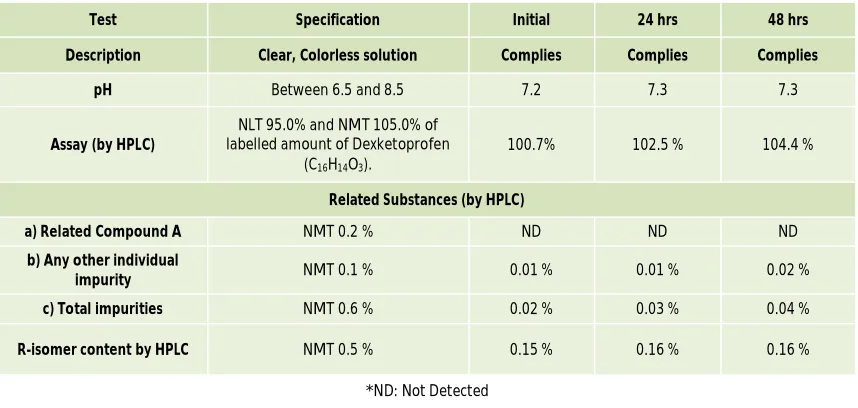
Table 3: Platinum Cured Silicone Tube Compatibility Data at Room Temperature (~20-25°C)
Test Specification Initial 24 hrs 48 hrs Description Clear, Colorless solution Complies Complies Complies
pH Between 6.5 and 8.5 7.2 7.3 7.3
Assay (by HPLC)
NLT 95.0% and NMT 105.0% of labelled amount of Dexketoprofen
(C16H14O3).
100.7% 102.5 % 104.4 %
Related Substances (by HPLC)
a) Related Compound A NMT 0.2 % ND ND ND
b) Any other individual
impurity NMT 0.1 % 0.01 % 0.01 % 0.02 %
c) Total impurities NMT 0.6 % 0.02 % 0.03 % 0.04 %
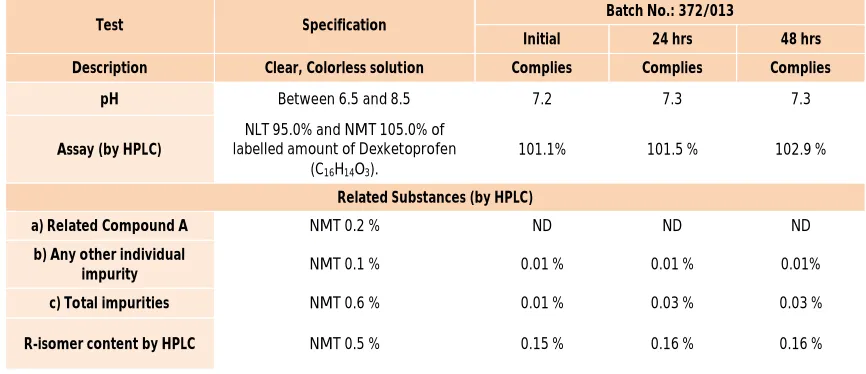
Table 4: PVDF Membrane Filters Compatibility Data at Room Temperature (~20-25°C)
Test Specification Batch No.: 372/013
Initial 24 hrs 48 hrs Description Clear, Colorless solution Complies Complies Complies
pH Between 6.5 and 8.5 7.2 7.3 7.3
Assay (by HPLC)
NLT 95.0% and NMT 105.0% of labelled amount of Dexketoprofen
(C16H14O3).
101.1% 101.5 % 102.9 %
Related Substances (by HPLC)
a) Related Compound A NMT 0.2 % ND ND ND
b) Any other individual
impurity NMT 0.1 % 0.01 % 0.01 % 0.01%
c) Total impurities NMT 0.6 % 0.01 % 0.03 % 0.03 %
R-isomer content by HPLC NMT 0.5 % 0.15 % 0.16 % 0.16 % *ND: Not Detected
Metal (SS316L) Compatibility Study with Unfiltered Bulk Solution
SS 316L vessel is used as storage tank for prepared solution and as such must not interact with the drug product. The effect of SS 316L vessel on formulation was tested. About 60 mL of the unfiltered bulk solution was stored into SS 316L vessel and was kept at room temperature for 72 hrs. Samples were periodically collected from the container at 24, 48 & 72 hours and given for analysis of the bulk solution for Description, pH, RS (Related Substances) & assay. The analytical results are given in the Table 2.
Platinum Cured Silicone Tube Compatibility Study with Unfiltered Bulk Solution
In pharmaceutical manufacturing, silicone tubing is used in transfer of solution and as such must not interact with the drug product. About 40 mL of the unfiltered bulk solution was stored into glass container. Clean dried and autoclaved Platinum cured silicone tubing of approximate 10 cm length was immersed into the glass container and kept at room temperature for 48 hrs. Samples were periodically collected from the container at 24 & 48 hours and given for analysis of the bulk solution for description, pH, RS & assay. The analytical results are given in the Table 3.
PVDF Membrane Filters Compatibility Study with Unfiltered Bulk Solution
The compatibility study of filter is the most important test for sterility of any Injectable formulation. About 40 mL of the unfiltered bulk solution was stored into glass container. Clean and dried 0.45µm and 0.22µm PVDF membrane filter was immersed into the glass container and the container was kept at room temperature for 48 hrs. Samples were periodically collected from the container at 24 & 48 hours and given for analysis of the bulk solution for description, pH, RS & assay. The analytical results are given in the Table 4.
Compatibility of Dexketoprofen Injection with Rubber Stopper
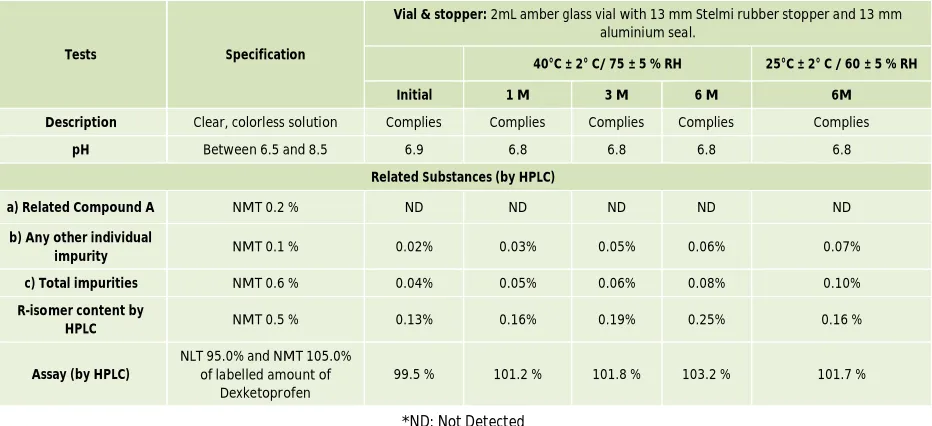
The container-closure system is an essential part of the final presentation of a pharmaceutical product. It defines the closure, protection, and functionality of a container while it ensures the safety and quality of the drug product over the product shelf life. To establish the compatibility of Dexketoprofen Injection with rubber stopper, prepared bulk solution of Dexketoprofen Injection was filtered through 0.45 micron and 0.22 micron PVDF membrane filters. Filtered solution was filled in 2 mL USP Type -I amber glass vials, stoppered and sealed with rubber stoppers and aluminum seal. Sealed vials were subjected at different Stability conditions. The analytical results of stopper compatibility study are given in the Table 5.
Thermal Cycling (Freeze Thaw & Cool Thaw Cycle) Study
The Freeze thaw & Cool thaw cycle study ensures that the product attributes at the extreme conditions of temperature are not altered. This study was designed to simulate the conditions that the product may experience during shipping.
Following procedure was followed for Freeze Thaw & Cool Thaw Cycle
Cool Thaw Cycle Study
Cycle-I
Charge the samples in upright orientation in the refrigerator maintained at temperature between 2 °C to 8 °C for 2 days. On 3rd day remove all vials from the refrigerator. Place the above samples in the 40 ± 2 °C / 75 ± 5 % RH chamber for 2 days.
Cycle-II
Place them in the 40 ± 2 °C / 75 ± 5 % RH chamber for 2 days.
Cycle-III
On 9th day remove all the vials from the 40 ± 2 °C / 75 ± 5 % RH stability chamber. Store them in refrigerator maintained at temperature between 2 °C to 8 °C for 2 days. On 11th day remove all vials from the refrigerator. Place them in the 40 ± 2 °C / 75 ± 5 % RH chamber for 2 days.
Upon completion of Cycle-III, remove all samples from the 40 ± 2 °C / 75 ± 5 % RH chamber.
Cool Thaw Cycle Study (Study-I)
Thermal Cycle (Freeze Thaw & Cool Thaw Cycle) Study
Cycle-I
Charge the samples in upright orientation in the freezer maintained at temperature between -10 °C to -20 °C for 2 days. On 3rd day remove all vials from the freezer. Place the above samples in the 40 ± 2 °C / 75 ± 5 % RH chamber for 2 days.
Cycle-II
On 5th day remove all the vials from the 40 ± 2 °C / 75 ± 5 % RH stability chamber. Store them in freezer maintained at temperature between -10 °C to -20 °C for 2 days. On 7th day remove all vials from the freezer. Place them in the 40 ± 2 °C / 75 ± 5 % RH chamber for 2 days.
Cycle-III
On 9th day remove all the vials from the 40 ± 2 °C / 75 ± 5 % RH stability chamber. Store them in freezer maintained at temperature between -10 °C to -20 °C for 2 days. On 11th day remove all vials from the freezer. Place them in the 40 ± 2 °C / 75 ± 5 % RH chamber for 2 days. Upon completion of Cycle-III, remove all samples from the 40 ± 2 °C / 75 ± 5 % RH chamber.
Thermal Cycle (Freeze Thaw & Cool Thaw Cycle) Study (Study-II)
The analytical results are given in the Table 6.
Photostability Study
The study was carried out in Photostability chamber with samples as follows
Test Sample
Product filled in amber glass vials
Control Sample
Product filled in amber glass vials wrapped by aluminium foil.
Carton Pack
Product filled in amber glass vials and packed in a carton.
The vials were exposed to light for an overall illumination of not less than 1.2 million lux hours and an integrated near ultraviolet energy of not less than 200 watt hours/square meter. The analytical results of various tests performed in the Photostability studies are presented in the Table 7.
Filter validation study
Bubble Point Test
A bubble point test is a test designed to determine the pressure at which a continuous stream of bubbles is initially seen downstream of a wetted filter under gas pressure. The point at which the first stream of bubbles emerges is the largest pore. Therefore, the bubble point value can be used to obtain a relative measure of the size of the single largest pore in a filter element. The purpose of this study was to determine the minimum product bubble point value for the sterilizing grade hydrophilic durapore membrane wetted with Dexketoprofen Injection. The bubble point of the filter was detected at 34.4 psi at 19-25 °C and the limit of the filter was 50 psi.
Extractable Test
The primary function of filter devices is to remove unwanted contaminants from pharmaceutical products. Unwanted contaminants could include environmental debris, insoluble materials, microorganisms, etc. Depending on the nature and level of contaminants in the pharmaceutical products as well as the characteristics of the product itself, a particular filter type is selected. During the filtration process the pharmaceutical product could potentially extract materials from the filter device. Extractables from filter devices have been extensively studied and such studies are part of filter device validation.
Bacterial Retention Study
Bacterial retention study was performed to check the sterility and integrity of filter.
Performance of sterilizing grade filter has been demonstrated to be acceptable as the membrane retained the B. diminuta challenge concentration equal to or greater than 1*107 cfu per cm2 of effective filtration area.
So it was concluded that the challenge test was passed.
Bacterial Endotoxin Test
Bacterial Endotoxin test is performed to detect the pyrogens present in the Dexketoprofen Trometamol Injection, using Gel clot technique given in the Ph. Eur.
The limit of bacterial endotoxin in finished product is not more than 2.33 IU/mg of Dexketoprofen.
Sterility Test
Sterility test is performed for determination of aerobic and anaerobic bacteria, yeast and mould present in the Dexketoprofen Trometamol Injection, and the sterility test complies with the method given in the Ph. Eur.
There is no evidence of microbial growth found in the test; the product examined complies with the test for sterility.
Bioburden
Bioburden test is performed to determine the number of viable microorganism present in the bulk solution of Dexketoprofen Trometamol Injection, prior to filling.
The tested Bioburden limit for bulk solution of Dexketoprofen Trometamol Injection is NMT 10 cfu/100mL.
Admixture Studies
Admixture Studies of drug product with following diluents have been performed as suggested in PIL of reference product.
1. Normal Saline (0.9% Sodium Chloride Injection USP),
2. Glucose (5% Dextrose Injection USP) and
3. Ringer lactate solution (Lactate Ringer Injection USP)
From the Admixture Study data, it was concluded that Dexketoprofen Trometamol Injection 50 mg/2mL is compatible at room temperature (at 25 °C) and at 2 to 8 °C up to 24 hours when admixed with Normal Saline (0.9 % Sodium Chloride Injection USP), Glucose (5 % Dextrose Injection USP) and Ringer lactate solution (Lactate Ringer Injection USP).
RESULTS AND DISCUSSION
NSAIDs have been shown to provide effective postoperative analgesia in orthopaedic surgery. In the present study formulation of stable parenteral
preparation Dexketoprofen Trometamol Injection was done (Table 1).
The main objective of the present study was to evaluate the physical and chemical stability of Dexketoprofen Trometamol Injection.
Compatibility study of Dexketoprofen Trometamol Injection with platinum cured silicon tubes, metal (SS316 L), PVDF membrane filters and stoppers were performed.
Compatibility study results indicate that there was no significant degradation in Dexketoprofen Trometamol Injection in contact with platinum cured silicon tubes, metal (SS316 L), and PVDF membrane filters at room temperature (~20 - 25 °C) over a period of 24 hours and 48 hours respectively (Table 2, 3 and 4).
Rubber stopper compatibility study was also performed and analytical results were found well within the specified limits (Table 5).
Thermal cycling and photo stability study was also performed on the drug product. Results obtained from Freeze thaw and Cool thaw studies indicate that the product was thermo stable and it can withstand thermal excursions in the range of -10 °C to 40 °C ± 2 °C / 75 ± 5 % RH (Table 6).
In Photostability study no significant degradation was observed on Dexketoprofen Trometamol injection vials upon exposure to light, hence the product was photo stable (Table 7).
In addition to compatibility study Admixture study was performed with Normal Saline (0.9 % Sodium Chloride Injection USP), Glucose (5% Dextrose Injection USP) and Ringer lactate solution (Lactated Ringer’s Solution USP) at room temperature (at 25 °C) and at 2 to 8 °C up to 24 hours and it was observed that Dexketoprofen Trometamol Injection 50 mg/2mL was compatible with the above injections.
Formulation was developed according to the reference drug product and excipients used were similar as listed in PIL of reference product.
Sterilized microbial retentive filters used for filtration and filling of vials as terminal sterilization cannot be done due to increase of R-isomer in presence of heat.
Vials of Dexketoprofen Trometamol injection were kept at accelerated (40 °C ± 2° C / 75 ± 5 % RH), intermediate (30 °C ± 2°C / 65 ± 5 % RH) & long term (25 °C ± 2 °C / 60 ± 5 % RH) condition for 1, 2, and 3 months for stability study.
Table 5: Analytical Results of Stopper Compatibility Study
Tests Specification
Vial & stopper: 2mL amber glass vial with 13 mm Stelmi rubber stopper and 13 mm
aluminium seal.
40°C ± 2° C/ 75 ± 5 % RH 25°C ± 2° C / 60 ± 5 % RH
Initial 1 M 3 M 6 M 6M
Description Clear, colorless solution Complies Complies Complies Complies Complies
pH Between 6.5 and 8.5 6.9 6.8 6.8 6.8 6.8
Related Substances (by HPLC)
a) Related Compound A NMT 0.2 % ND ND ND ND ND
b) Any other individual
impurity NMT 0.1 % 0.02% 0.03% 0.05% 0.06% 0.07% c) Total impurities NMT 0.6 % 0.04% 0.05% 0.06% 0.08% 0.10%
R-isomer content by
HPLC NMT 0.5 % 0.13% 0.16% 0.19% 0.25% 0.16 % Assay (by HPLC)
NLT 95.0% and NMT 105.0% of labelled amount of
Dexketoprofen
99.5 % 101.2 % 101.8 % 103.2 % 101.7 % *ND: Not Detected
Table 6: Analytical Results of Freeze Thaw & Cool Thaw Cycle Study
Test Specification Thermal cycling Results
Initial Study I Study II Description Clear, colorless solution Complies Complies Complies
pH Between 6.5 and 8.5 7.5 7.4 7.4
Assay (by HPLC)
Not less than 95.0% and not more than 105.0% of labelled amount of
Dexketoprofen (C16H14O3).
100.5% 99.9% 99.0%
Related Substances (by HPLC)
a) Related Compound A NMT 0.2 % ND ND ND
b) Any other individual
impurity NMT 0.1 % ND 0.03% 0.03%
c) Total impurities NMT 0.6 % 0.00% 0.03% 0.03%
R-isomer content by HPLC NMT 0.5 % 0.11% 0.12% 0.12% *ND: Not Detected
Table 7: Analytical Results of Photo Stability Study
Test Specification
Photostability study Initial Test sample Dark Control
sample
Carton Control Sample Description Clear, colorless solution Complies Complies Complies Complies
pH Between 6.5 and 8.5 7.5 7.4 7.4 7.4
Assay (by HPLC)
Not less than 95.0% and not more than 105.0% of labelled amount of
Dexketoprofen (C16H14O3)
100.5% 100.0% 99.9% 99.7%
Related Substances (by HPLC)
a) Related Compound A NMT 0.2 % ND ND ND ND
b) Any other individual
impurity NMT 0.1 % ND 0.03% 0.02% 0.03%
c) Total impurities NMT 0.6 % 0.00% 0.03% 0.02% 0.03%
R-isomer content by
CONCLUSION
On the basis of present research work it can be concluded that parenteral formulation containing Dexketoprofen Trometamol was found compatible with all the contact materials used during formulation and was stable.
Admixtures of Dexketoprofen Injection with Normal Saline, Glucose and Ringer lactate solution were physically compatible and chemically stable.
Accelerated stability studies at different conditions were performed and results were found well within limits. So it can be concluded that a robust, reproducible, and stable formulation of Dexketoprofen Trometamol Injection was developed.
REFERENCES
1. P. T. Jamdade, A. Porwal, J. V. Shinde, S. S. Erram, V. V. Kamat, P. S. Karmarkar, K. Bhagtani, S. Dhorepatil, R. Irpatgire, H. Bhagat, S. S. Kolte, and P. A. Shirure, Efficacy and Tolerability of Intramuscular Dexketoprofen in Postoperative Pain Management following Hernia Repair Surgery, Anesthesiology Research and Practice, Volume 2011, Article ID 579038, 2011, 4 pages.
2. M. A. E. Ramsay, “Acute postoperative pain management,” BUMC Proceedings, 13, 2000, 244–247.
3. D. F. Murphy, “NSAIDs and postoperative pain,” British Medical Journal, 306(6891), 1993, 1493–1494.
4. Avis KE, Herbert A. Lieberman and Lachman, Pharmaceutical Dosage form: Parenteral Medication. 2nd Ed. New York, Marcel Dekker Inc; 2004, 17-18.
5. Y. S. Nagaraja, T. S. Nagaraja, D. R. Bharathi and T. O. Manjunatha, Formulation and evaluation of Ofloxacin aqueous injection, International Journal of Pharmacy & Life Sciences, 3(10), 2012, 2015-2020.
6. M. H. Hanna, K. M. Elliott, M. E. Stuart-Taylor, D. R. Roberts, D. Buggy & G. J. Arthurs, Comparative study of analgesic efficacy and morphine-sparing effect of intramuscular Dexketoprofen trometamol with Ketoprofen or placebo after major orthopedic surgery, Blackwell Science Ltd Br J Clin Pharmacol, 55, 2003, 126–133. 7. Wangding Lu, Huafei Luo, Zhuangzhi Zhu, Yubo Wu, Jing
Luo, and Hao Wang, Preparation and the Biopharmaceutical Evaluation for the Metered Dose Transdermal Spray of Dexketoprofen, Journal of Drug Delivery, Article ID 697434, 2014, 2014, 12 pages.
8. R Andrew Moore and Jodie Barden, Systematic review of Dexketoprofen in acute and chronic pain, BMC Clinical Pharmacology, 2008, 8-11.
9. Joy Philip, Chirally Pure Non-Steroidal Anti-Inflammatory Drugs, 17: 7, Medicine Update, 20, 2010, 837-840.