325 | P a g e
A COMPARATIVE STUDY OF CONVENTIONAL
DATA MINING ALGORITHMS AGAINST
MAP-REDUCE ALGORITHM
Bhawna
1,Dr. Gagandeep Jagdev
2 1Research Scholar, M.Tech. (CE), Yadavindra College of Engineering, Talwandi Sabo (PB).
2
Faculty, Dept. of Comp. Science, Punjabi University Guru Kashi College, Damdama Sahib (PB).
ABSTRACT
Data Mining has always remained a prominent aspect of filtering small or huge databases. It is actually data
which has gone through many changes in terms of volume, variety and veracity. The past three years have
witnessed enormous growth in the size of data. The major sources responsible for thisare social networking,
RFID, sensors generated data, banking transactions, hospitals, educational institutes, major organizations in
retail sector, stock market and many more. Gone are the days when data was used to be measured in kilobytes,
megabytes, gigabytes, terabytes or petabytes. Today new units have evolved for measuring data – exabytes,
zettabytes, yottabytes. The traditional data mining algorithms were capable of handling limited data. But data
which grows beyond limit is something more demanding and is referred as Big Data. The popular technique,
originally proposed by google, capable of handling Big Data is Map-Reduce. This research paper is primarily
concerned with studying different conventional data mining algorithms and comparing Apriori Algorithm with
Map-Reduce algorithm. The paper also focuses on elaborating Big Data and its characteristics.
Index Terms – Apriori algorithm, Big Data,Data mining, Map-Reduce algorithm.
I. INTRODUCTION
Data mining is all about processing data and identifying patterns in the information to reach to any specific
decision. The principles of data mining have become more predominant with the advent of Big Data. It is not
possible to obtain relatively simple and easy statistics out of Big Data using conventional data mining
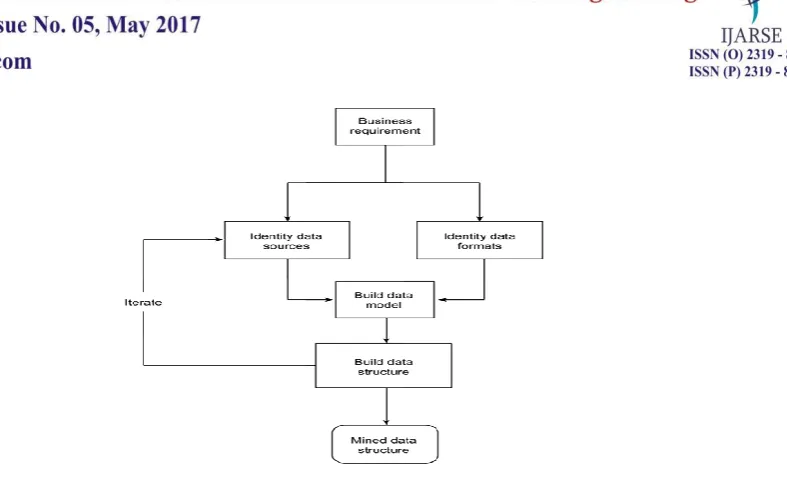
techniques.The process of data analysis, discovery, and model-building is often iterative. One must also
comprehend how to relate, map, associate, and cluster it with other data to produce fruitful result. The flowchart
326 | P a g e Fig. 1 Figure illustrates flowchart depicting the Data Mining process
Different techniques involved in data mining process are mentioned as under.
Association - Association is the most popular among available data mining techniques. Based on relationship
between items in the same transaction, a unique pattern. Association technique is frequently used in retail
sector to identify what customers frequently purchase together.
Classification - Classification is based on machine learning. Classification classifies each item in a set of data
into one of the predefined set of groups. It makes use of mathematical techniques like neural networks,
statistics, decision trees and linear programming.
Clustering - Clustering is a data mining technique that makes a meaningful or useful cluster of objects which
have similar characteristics using the automatic technique. The clustering technique defines the classes and
puts objects in each class, while in the classification techniques, objects are assigned into predefined classes.
To make the concept clearer, we can take book management in the library as an example. In a library, there is
a wide range of books on various topics available. The challenge is how to keep those books in a way that
readers can take several books on a particular topic without hassle. By using the clustering technique, we can
keep books that have some kinds of similarities in one cluster or one shelf and label it with a meaningful
name. If readers want to grab books in that topic, they would only have to go to that shelf instead of looking
for the entire library.
Prediction - The prediction, as its name implied, is one of a data mining techniques that discovers the
relationship between independent variables and relationship between dependent and independent
variables. For instance, the prediction analysis technique can be used in the sale to predict profit for the future if we consider the sale is an independent variable, profit could be a dependent variable. Then based on the
historical sale and profit data, we can draw a fitted regression curve that is used for profit prediction.
Sequential Patterns - Sequential patterns analysis is one of data mining technique that seeks to discover or
327 | P a g e historical transaction data, businesses can identify a set of items that customers buy together different times in
a year. Then businesses can use this information to recommend customers buy it with better deals based on
their purchasing frequency in the past.
Decision trees - The A decision tree is one of the most common used data mining techniques because its
model is easy to understand for users. In decision tree technique, the root of the decision tree is a simple
question or condition that has multiple answers. Each answer then leads to a set of questions or conditions that
help us determine the data so that we can make the final decision based on it.
II. DIFFERENT ALGORITHMS CONCERNED WITH DATA MINING
Conventional Data Mining Algorithm
Some of the popular conventional algorithms involved in data mining process are mentioned as under.
C4.5 k-means
Support vector machines Apriori
A. C4.5 - C4.5 constructs a classifier in the form of a decision tree. In order to do this, C4.5 is given a set of
data representing things that are already classified. A classifier is a tool in data mining that takes a bunch of
data representing things we want to classify and attempts to predict which class the new data belongs to.
Arguably, the best-selling point of decision trees is their ease of interpretation and explanation. They are also
quite fast, quite popular and the output is human readable.
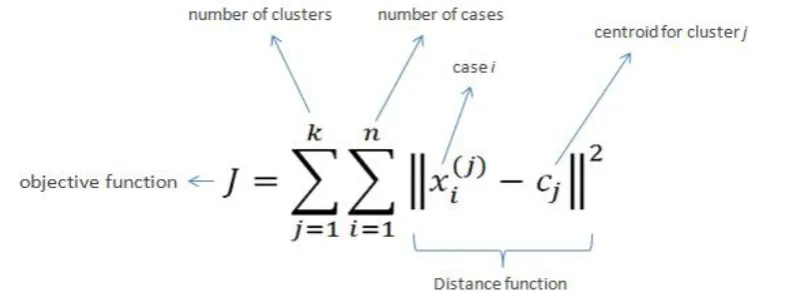
B. k-means - k-means creates k groups from a set of objects so that the members of a group are more similar
(Fig. 2). It’s a popular cluster analysis technique for exploring a dataset. Cluster analysis is a family of
algorithms designed to form groups such that the group members are more similar versus non-group
members. Clusters and groups are synonymous in the world of cluster analysis.
328 | P a g e Algorithm for k-means
1.Clusters the data into k groups where k is predefined. 2.Select k points at random as cluster centers.
3.Assign objects to their closest cluster center according to the Euclidean distance function. 4.Calculate the centroid or mean of all objects in each cluster.
5.Repeat steps 2, 3 and 4 until the same points are assigned to each cluster in consecutive rounds.
C. Support Vector Machine (SVM) - Support vector machine (SVM) learns a hyperplane to classify data
into 2 classes. At a high-level, SVM performs a similar task like C4.5 except SVM doesn’t use decision
trees at all. A hyperplane is a function like the equation for a line, y = mx + b. In fact, for a simple
classification task with just 2 features, the hyperplane can be a line.SVM can perform a trick to project your
data into higher dimensions. Once projected into higher dimension, SVM figures out the best hyperplane
which separates your data into the 2 classes. For example - Consider a bunch of red and blue balls on a
table. If the balls aren’t too mixed together, you could take a stick and without moving the balls, separate
them with the stick.When a new ball is added on the table, by knowing which side of the stick the ball is on,
you can predict its color. The balls represent data points, and the red and blue color represent 2 classes. The
stick represents the simplest hyperplane which is a line.
D. K - Nearest Neighbor (kNN) - KNN can be used for both classification and regression predictive
problems. However, it is more widely used in classification problems in the industry. Consider the example
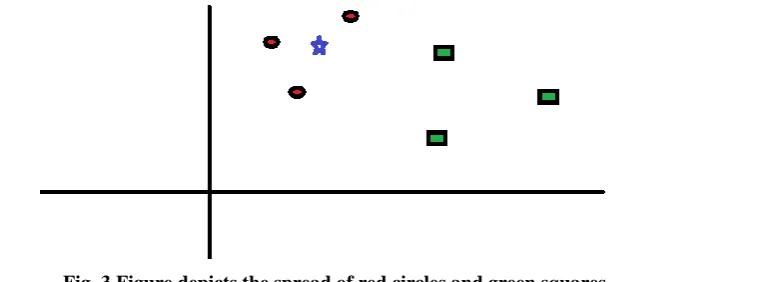
mentioned as under to place KNN in the scale. Fig. 3 shows the spread of red circles (RC) and green
squares (GS):
Fig. 3 Figure depicts the spread of red circles and green squares
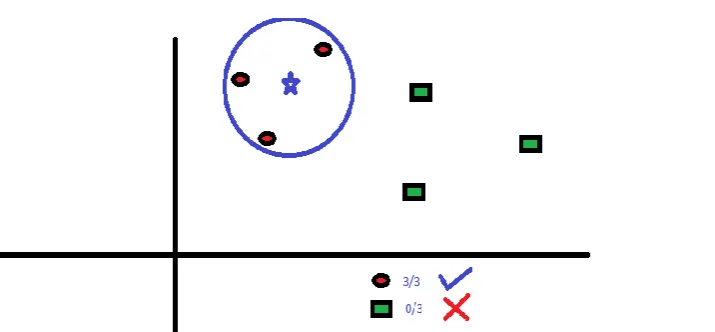
We intend to find out the class of the blue star (BS). BS can either be RC or GS and nothing else. The “K” is KNN algorithm is the nearest neighbors we wish to take vote from. Let’s say K = 3. Hence, we will now
make a circle with BS as center just as big as to enclose only three data points on the plane. Refer to Fig. 4
329 | P a g e Fig. 4 Figure depicts three similar data points enclosed on the plane.
The three closest points to BS is all RC. Hence, with good confidence level we can say that the BS should
belong to the class RC. Here, the choice became very obvious as all three votes from the closest neighbor went
to RC. The choice of the parameter K is very crucial in this algorithm. Next, we will understand what are the
factors to be considered to conclude the best K.
E. Apriori Algorithm - It is a classic algorithm used in data mining for learning association rules. It is nowhere
as complex as it sounds, on the contrary it is very simple. Apriori [2] is an algorithm for frequent item set
mining and association rule learning over transactional databases. It proceeds by identifying the frequent
individual items in the database and extending them to larger and larger item sets as long as those item sets
appear sufficiently often in the database. The frequent item sets determined by Apriori can be used to determine
association rules which highlight general trends in the database.Apriori uses a "bottom up" approach, where
frequent subsets are extended one item at a time and groups of candidates are tested against the data. The
algorithm terminates when no further successful extensions are found.
Recently, researchers are applying the association rules to a wide variety of application domains such as
Relational Databases, Data Warehouses, Transactional Databases, and Advanced Database Systems like
Object-Relational, Spatial and Temporal, Time-Series, Multimedia, Text, Heterogeneous, Legacy, Distributed, and web
data [1]. Since data generated day by day activities, the volume of data is increasing dramatically. Massive
amount of data is available in the data warehouses. Therefore, mining association rules helps in many business
decision making processes. Some examples are cross-marketing, Basket data analysis and promotion assortment
etc. In the area of association rules mining, a lot of studies have been done [1, 2].
The problem of discovering association rules is decomposed into two stages:
Discovering all frequent patterns represented by large item sets in the database, and generating the association
rules from those frequent item sets.
The second sub problem is a straightforward problem, and can be managed in polynomial time. On the other
330 | P a g e The Apriori is the first efficient algorithm for solving the association rule mining, and many of the forthcoming
algorithms are based on this algorithm. Confidence denotes the strength of implication and support indicates the
frequencies of the occurring patterns in the rule. It is often desirable to pay attention to only that rule which may
have reasonably large support. Such rules with high confidence and strong support are referred to as strong
rules. The prime objective of mining association rules is to discover strong association rules in large databases.
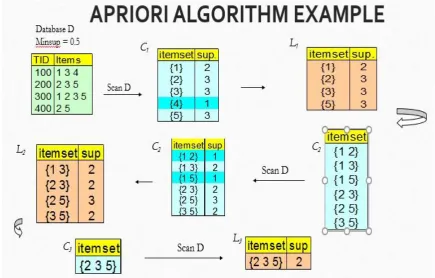
Fig. 5 illustrates an example for understanding the working of Apriori algorithm. The four item sets under study
are {1 3 4}, {2 3 5}, {1 2 3 5}, {2 5}. The golden rule set for example is to only consider the items having 2 or
more than 2 occurrences. The highlighted rows in tables indicates the items to be rejected.
Fig. 5 Figure depicting an example of working of Apriori algorithm
III. MAP-REDUCE ALGORITHM FOR BIG DATA
Hadoop is one such java framework which is capable of handling large data sets in a distributed computing
environment. Apache Software Foundation [8, 9] is the authority sponsoring Hadoop. Applications run on
systems constructed of thousands of nodes involved in processing thousands of Terabytes of data. Because of
distributed nature, Hadoop facilitates very fast data transfer and system continues to operate even if any node
failure occurs. This notion minimizes the risk of devastating system failure even when multiple nodes become
non-operational. The creator of this technology was Google. It was developed by them during their early days to
331 | P a g e meaningful results to the users. Hadoop finds its application in several sectors which comprises of retail, sports,
medical science, business, education and of course now in elections.
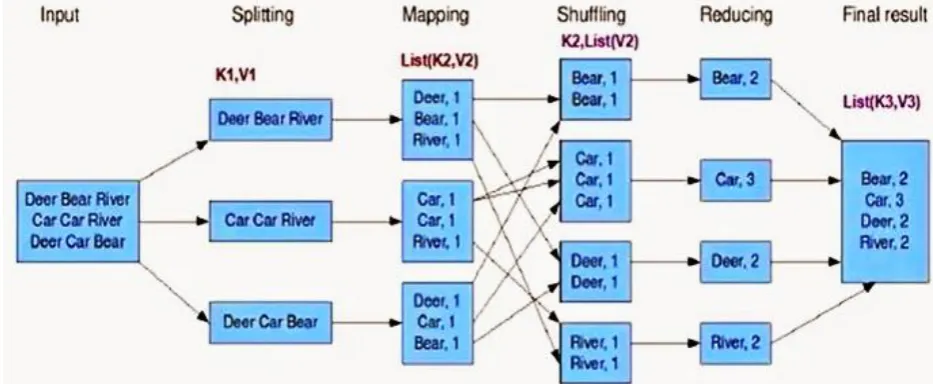
Map-Reduce algorithm [10, 11] works behind Hadoop and can be written in any language [5, 12]. Fig. 6
depicts the working of Map-Reduce technology.
Fig. 6 Flowchart showing working of Map-Reduce technology
The input file comprises of three statements, each having three words in it. Firstly, the input is distributed in
three different <key, value> pairs. Thereafter mapping is conducted in which the number of occurrences of each
word is written against it. During shuffling, pairs having similar keys are gathered. Then in reduction, the
values of similar keys are summed up and placed against the key. Finally, all obtained <key, value> pairs are
accumulated [13].
Algorithm for Map-Reduce
The incoming data can be alienated into n number of modules which depends upon the amount of input data
and processing power of the individual unit.
All these fragmented modules are then passed over to mapper function where these modules undergo
simultaneous parallel processing.
Thereafter, shuffling is conducted in order to gather similar looking patterns.
Finally, reducer function is called which is responsible for getting the ultimate output in a reduced form. Moreover, this technique is scalable and depending upon increase in the data to be processed, the processing
units can be further extended.
IV. MAP-REDUCE VS. APRIORI ALGORITHM
The research work is based on mining a huge database constructed and to use best available platform or
332 | P a g e Apriori algorithm [3, 4, 6, 7] is regarded as the best whenever there’s a need to perform mapping or mining
database in combinations. So, the target is to compare Apriori algorithm with the Map-Reduce algorithm related
to Hadoop platform. For this, a small excel file is taken as input comprising of few numbers. The snapshot of the
input file is shown in Fig. 7.
Fig. 7 Input data file
A source code is constructed in C++ for implementing working of Apriori algorithm and the above-mentioned
data in Fig. 6 is given as input.
On executing the source code of Apriori algorithm, the following output was obtained.
1 2 3 3
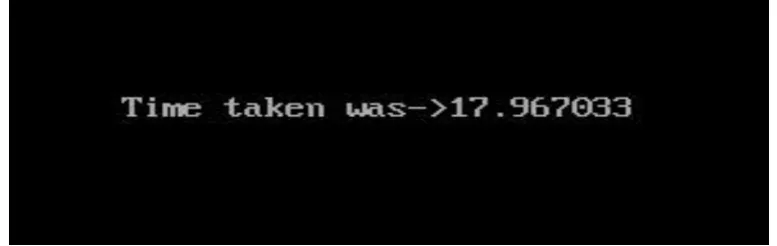
The result shows that 1, 2 and 3 appears 3 times together in the input file and it took 17.967033 seconds. The
snapshots shown in Fig. 8 shows time consumed as the output obtained on implementing Apriori algorithm.
Fig. 8 Output obtained after executing Apriori algorithm source code
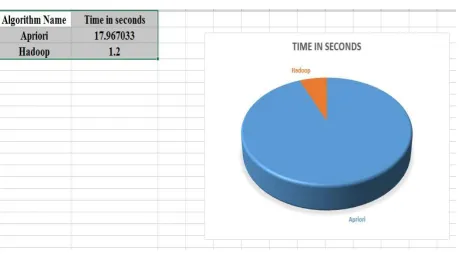
When the same input was given to Hadoop Framework, the result was obtained in only 1.2 Seconds. The
333 | P a g e Fig. 9 Comparison of Apriori and Map-Reduce algorithm in terms of time in seconds.
This result shows that Map-Reduce algorithm is much speedier and efficient in mining as compared to Apriori
algorithm.
V. CONCLUSION AND FUTURE SCOPE
Most of the researchers have considered association rule mining problems as single objective problem and
validated on static database but it is a multi-objective problem because it uses measures like support count,
comprehensibility and interestingness for mining the strong association rule. Since the database is being updated
periodically due to daily business requirement. Incremental mining deals with generating association rules from
updated database.Most of the existing algorithms for incremental mining rescan the entire database again. Cost
ofscanning large database is high. The association rules generated on static database are not meaningful,
effective and not appropriate for making business strategies and decisions. Hence,it requires to devise a new and
efficient algorithm for incremental mining without rescanning of database. Therefore, there is a need to shift the
paradigm form single objective to multi-objective association rule mining and also requires consideration of
incremental data. Data mining is a new and significant area of research, and soft computing tools itself are
extremely appropriate to solve the problems. Soft computing characteristics include high robustness, parallel
processing, self-organizing adaptive, high degree of fault tolerance distributed storage etc. are much suitable for
data mining applications. It also obtains a greater attention in Artificial Neural Networks, whichoffer qualitative
334 | P a g e REFERENCES
[1] Hemant Kumar Soni et al., “ASSOCIATION RULE MINING: A DATA PROFILING AND
PROSPECTIVE APPROACH”, International Conference on Futuristic Trends in Engineering, Science,
Humanities, and Technology (FTESHT-16) ISBN: 978-93-85225-55-0, January 23-24, 2016, Gwalior.
[2] Gianni D'Angelo, Salvatore Rampone et al., “Developing a Trust Model for Pervasive Computing Based on
Apriori Association Rules Learning and Bayesian Classification”.
[3] JayshreeJha and LeenaRagha, “Educational Data Mining using Improved Apriori Algorithm”, International
Journal of Information and Computation Technology. ISSN 0974-2239 Volume 3, Number 5 (2013), pp.
411-418.
[4] Jiao Yabing, “Research of an Improved Apriori Algorithm in Data Mining Association Rules”,
International Journal of Computer and Communication Engineering, Vol. 2, No. 1, January 2013.
[5] Sheila A. Abaya, “Association Rule Mining based on Apriori Algorithm in Minimizing Candidate
Generation”, International Journal of Scientific & Engineering Research Volume 3, Issue 7, July-2012 1
ISSN 2229-5518.
[6] Shweta et al., “Mining Efficient Association Rules Through Apriori Algorithm Using Attributes and
Comparative Analysis of Various Association Rule Algorithms”, IJARCSSE, Volume 3, Issue 6, June 2013
ISSN: 2277 128X.
[7] Dean, Jeffery, and Ghemawat Sanjay. 2004. “MapReduce: Simplified Data Processing on Large Clusters.”
Google.
[8] Dr. Gagandeep Jagdev et. al., “Comparing Conventional Data Mining Algorithms with Hadoop based
Map-Reduce Algorithm considering elections perspective”, in International Journal of Innovative Research in Science and Engineering (IJIRSE), ISSN: 2454-9665 (O), ISSN: 2455-0663(P), Volume – 3, Issue – 3,
March 2017.
[9] Gagandeep Jagdev et. al., “Association of Big Data with Map-Reduce Technology Augments for Economic
Growth in Retail”, in International Journal of Engineering Technology Science and Research (IJETSR),
ISSN: 2394 - 3386, Volume 4, Issue 2, February 2017.
[10]Dr. Gagandeep Jagdev et. al. “Implementation of Big Data concerned with Elections using Map-Reduce as
novel mining algorithm” has been accepted for publication at International Conference ICCCN-2017 at
NITTTR, Chandigarh on 23rd-24th March 2017.
[11]Dr. Gagandeep Jagdev et. al., “Boosting Revenue growth in retail sector via mining Big Data to utmost
potential”, at 24th International Conference on Finite or Infinite Dimensional Complex Analysis and
Applications (24-ICFIDCAA-2016) held at Anand International College of Engineering, Jaipur, Rajasthan
sponsored by IEEE, SIAM, ISAAC, INSERB from 22nd -26th August, 2016.
[12]Dr. Gagandeep Jagdev et. al., “Implementation of Map-Reduce Algorithm for Mining Big Data concerned
with Indian Election Scenario”, at 24th International Conference on Finite or Infinite Dimensional Complex
Analysis and Applications (24-ICFIDCAA-2016) held at Anand International College of Engineering,
335 | P a g e [13]Dr. Gagandeep Jagdev et. al., “Analyzing and Mining Big Data In Health Care Sector For Healthy Human
Survival Via Competent Technologies”, at 1st International Conference on Technology Management held at
National Institute of Management, Hamirpur on July 14-15, 2016.
ABOUT THE AUTHOR
Dr. Gagandeep Jagdev is working in the capacity of faculty member in Dept. of Computer Science, Punjabi
University Campus, Damdama Sahib (PB). His total teaching experience is above 10 years and has above 105
international and national publications in reputed journals and conferences to his credit. He is also a member of
editorial board and advisory board of several reputed international peer reviewed journals and Technical
Committee Member of many reputed universities. His areas of interest are Big Data, Data Mining, RFID,