4825
THE INTELLIGENT USER INTERFACE SYSTEM BASED ON
3D DIGITAL ACTOR AND UTILIZATION
1EELJIN CHAE, 2JUNHO LEE, 3JUWON HWANG, 4HONGSIK PAK
1.3.4Professor, Dongseo University, Busan, South Korea
2CEO. David line Inc., Irvine, USA.
E-mail: 1[email protected], 2[email protected], 3[email protected], 4[email protected]
ABSTRACT
In the era of Industry 4.0, when we observe the UI, which is a characteristic of digital media with openness and interaction, we find that concepts and functions improve with each new media appearance. The research process and methods for improving these user interfaces can enable user-centered interactions between users and digital devices based on 3D Digital Actor. We need to expand our concepts and methods to create people or virtual people who have existed in the past and present in 3D Digital Actor and use them as User Interface. Currently, the level of applications developed by filmmakers and computer engineers in the audio-visual industry has become so high that it is difficult to distinguish actual human performance from digital human acting. In a system where 3D Digital Actor acts as an operating system or application, it will recognize the form, action, and expression between 3D Digital Actor and actively interact with the user. This paper presents the development of 3D Digital Actor authoring tool in conjunction with game engines is to expand 3D Digital Actor based intelligent user-customized interface.
Keywords: 3D Digital Actor, Intelligent User Interface, Industry 4.0, Sound cognition Interface, User Feeling.
1. INTRODUCTION
As consequence of the digital revolution, internet digitalizes individuals, relationships and social life and has become widely used in both public and private areas with the combination of mobile technologies. Online social media networks with all the contents, the phenomenon of present time plays an important role in cultural diversity. This could be interpreted that media and advanced devices will tear down the boundary in digital space and influence user’s sensation, reception, acceptance, and interaction. [1,2] Although the fourth industrial revolution is just around the corner, we are hesitant to decide what type of content to fill and appreciate that new media platform. In other words, there is a need for new and diverse forms of consumption that are suitable for an era when technologies such as big data, IoT, and Artificial Intelligence are burrowing into everyday life. It is the fact that most leading companies find a different point of view of each company's products only in the diversity of content. However, the user is considering whether he or she can conveniently select and appreciate various contents, such as traveling, dancing, MOOC, accounting, and cooking, beyond simple content consumption - music, movies, dramas, games, e-books, and audio books. ICT-based
competitive organizations must offer new interaction methods that go beyond this stage. That is, as analogs that have existed in human life are converted to digital, they must be intelligent, and they must implement an interfacing method when multi-faceted information interacts with other objects. When these efforts come to fruition, they will lead the way in the era of the Fourth Industrial Revolution.
4826 changes in the production cost structure. 21st century’s digital technology is developing to aim cognitive interaction with a human. Digital devices such as desktops, notebooks, smartphones, smart pads, and HMD (Head Mounted Display) provide various experiences and services that transcend physical boundaries of time and space to users through interaction. [3]
Traditional media interaction displays limited one-dimensional expression with the linear concept during input and output process. Latest digital devices’ interaction input process and the role is expanding from physical touch to audio input. But there are frequent input and output errors during expansion and development process. It’s necessary to expand the concept and method in media interaction process if you could recall how media expands and interacts with human’s senses. This disquisition proposes how to utilize 3D Digital Actor into the user interface; thus, the user and digital media will interact smoothly through a digital device. Interface refers to an object’s boundary line and a medium that enables communication and access on that boundary. The term interface is a compound with ‘inter’ (mutual) and ‘face’ (surface, exterior) and it means between two systems or objects, at point of contact on boundary or faced part in between. It also refers an input/output device that works as a means for interaction between human and digital media and what is expressed on that device.
2. RELATED RESEARCH
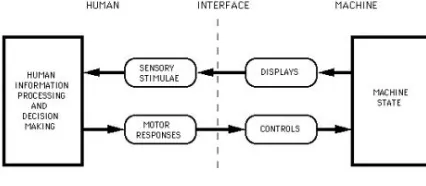
[image:2.612.92.305.587.680.2]When a human decides and enters commands to a machine, the machine outputs that with sensory information. As shown in Figure 1, it is the domain of interface that lies between human’s input and machine’s output. [4] The 3D Digital Actor (DA) is defined in this thesis have been the concept and function of interacting with active by transcending the passive level of a virtual
Figure 1: Diagram of Human-Machine-Interface
(McKenzie, I.S., 1995)
man, a virtual character, and a digital character, which functions as a technology applied simply by visualizing human-like features. Therefore, the prior study of digital actors has completed a combination of digital character representation technology for muscle, hair, facial, motion capture, clothes animation and the real-life image-based rendering technology that was accurately synthesized and composed of the modeling object with the camera correction technology, it was confirmed that the character was completed with natural movements without any heterogeneity. Afterward, the UI, which is comprised of intuitive technologies that freely show users the location, function and the information they want describes the concepts and examples of interaction with digital media devices connected with ICT technologies.
There is a huge amount of technology improving the performance of character animation among research fields; an image-based technique that replaces the animation that samples the movements of characters in each camera direction with images instead of articulation [5].
The development of complex technologies that intuitively implement digital actors has continued over the past decades. The level-of-detail (LoD), which is a method of reducing polygons on a mesh, is one of the most fundamental techniques in real-time rendering. In this paper, we propose a novel level-of-detail technique applied to the virtual character’s motion (Motion LoD). [6] <TOY STORY>, <MATRIX>, <AVATAR>, <AVENGERS>, <TINTIN>, the fact that these films played by these realistic characters have been shown because of the continuous improvement in the level of R&D production tools and IT infrastructure.
4827 Early interaction in digital contents environment concept was the user’s command and the digital system’s reactions being repeated. However, the developed user interface, based on research about how media technology is a concrete expression of the human mind and the technology itself is the core text of semantic analysis, has a possibility of developing with user interface concept with media itself. Digital device and human coexist and interact in a reproduce virtual space beyond physical boundaries of time and space. [2, 3]
QWERTY keyboard and stylus pen performed as interfaces during early digital device development, current interface method that has been an issue is the multi-touch and machine learning-based speech recognition. The multi-touch interface conduct most of the input using fingers, but the user must use their eyes and hand at the same time and the user must need a touch screen. To complement multi-touch interface’s flaws, artificial intelligent based speech recognition interface that’s been on the rise shortens menu’s depth steps and continuously holds standby. But due to the imperfection of audio recognition, it’s expected that it will need more time and cost to improve interaction. [10-13]
From humanoid robot and human’s interaction research, there was a result that humanoids will have more learning effect if the human supervises the interaction. [14, 15] This means that the interaction between the human and digital media needs a user-centered intelligent interface. Information is often represented in text form and classified into multiple categories. In the information space spanned by the categories, upon receiving a document, automatic text filtering and text classification are essential. One of the popular ways to achieve the task is to delegate a classifier to each category. Therefore, the function of information delivery and feedback should be considered when designing the user interface. And it could be seen that it needs to be built for convenience, functionality, and concentration to interact with the user smoothly. This paper discusses the concept of configuring an already deployed contactless interface and how DA can be used to enhance user experience and develop and apply interactive designs in an IT technology environment that it is feasible to implement it.
3. SYSTEM IMPLEMENTATION
This disquisition researches about how to utilize 3D digital actor to the user interface. Implementation and application of 3D digital
interface are based on precedent research (H. S. Pak, E. J. Chae, H. J. Jeon and J. H. Ko, 2017)’s proposal [16]. Particularly, the purpose of the 3D DA is to be used as a user interface for digital devices such as computers/ laptops/ smart pads/ HMD. This 3D DA could be created by character pools of virtual characters, currently existed people, and all characters reproduced through cultural content such as myth/ religion/ literature/ movie/ animation/ game. As a result, a variety of virtual characters can be used in real life, when using digital devices, we can get more excited and increased immersive experience. 3D DA is implemented as an intelligent interactive UI that expresses response actions or response messages by reacting real-time to the user's voice/ motion/ expression, providing a three-dimensional and dynamic UI. Users can create customized 3D DAs with a variety of characteristics based on age, personality, nationality, race, and emotion depending on their preferences. The 3D DA UI effectively accommodates the needs of different users and individual needs. As a result, interactions between users and 3D DA can be realistically implemented. Besides, 3D DA actively performs certain actions in response to the characteristics of the content displayed on digital devices in real-time, allowing 3D DA to act as an operating system or application and perform various functions of digital devices in a human-to-human way processing.
3D digital actor, which is used as an intelligent interaction user interface, selects past, current, or future figure and generate and utilize form information, pattern images, and action videos. 3D digital actor based intelligent interaction user interface can reinforce the interaction between the user and 3D digital actor.
3.1 System block
4828 and voice pattern, tailored to specific information of 3D digital actor.
[image:4.612.90.300.138.333.2]
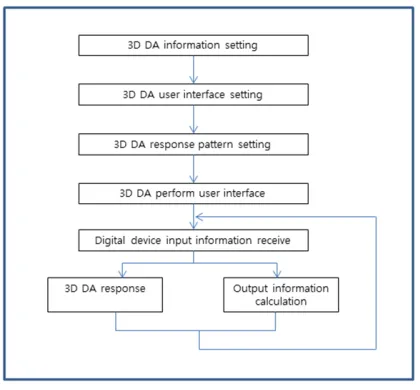
Figure 2: System block diagram
On Fig. 2, It describes the concept of this system’s block diagram. Setting stages of 3D digital actor information represent setting CG digital information of selected 3D digital actor, action, language, and reaction information to a digital device. In a stage of setting 3D digital actor to a user interface, it includes expressing default information message to 3D digital actor’s voice and displaying texts and other graphics through display channel. Default information action is set up to use motion expression of 3D digital actor. In the subsequent 3D digital actor response pattern setting stage, signal information, which is input to a digital device, outputs as customized information action and voice pattern, tailored to specific information of 3D digital actor.
When a 3D digital actor performs as a user interface, it outputs input information received through a digital device, including displaying through an output device and react function using the sound system. Active motion pattern of 3D digital actor sets question message and motion per contents’ attributes, and question message and motion each users’ attributes, including contents operating motion each users’ attributes. A 3D digital actor can also respond to relevant digital device’s attribute. Thus, in a stage of output information of 3D digital actor get calculated, the user and 3D digital actor can interact based on set information in the reaction pattern stage. User can also conduct however the user wants to set based on
result value from the display through an output device. Various functions of the digital device can process as human interactions through interaction between the user and 3D digital actor, by setting questions regarding operation system and operating applications installed in the digital device or system managing task related questions.
3.2 Configuration of intelligent UI utilizing 3D
DA
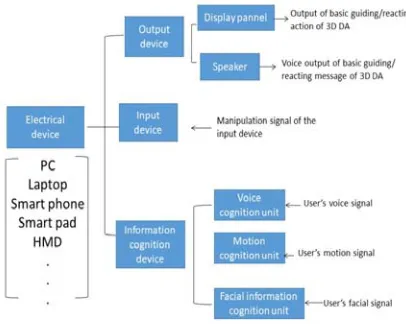
4829 system itself can perform diverse functions for the operation of the digital device by directly facing the user via 3D DA. In the phase of reacting pattern setting of 3D DA, the input value can be manipulation signal from input devices, voice signal from the user’s voice, an activation signal from the user’s action and a facial signal from the user’s facial changes. The manipulation signals from input devices make the reaction message and action which are coherent to the machine language or natural language-related to the given signal be set and performed by 3D DA. For example, in the case of the voice signal from the user, the reaction message and action that is coherent to the text, vocal loudness or tone that the given voice signal is expressing is set. In the case of action signal and facial signal, the reaction message, and action is coherent to the motion size/pace, and message, change of the face, the changing rate of the face that given facial expression is delivering each.
[image:5.612.314.517.331.495.2]
Figure 3: Configuration of intelligent UI utilizing 3D DA
The phase ‘UI operation of 3D DA’ let 3D DA be displayed on the output device when the user is using digital devices and performs as a basic guidance action. A language expression delivers the basic guidance message to the user. Moreover, 3D DA functions as UI through printing basic guidance message or reaction message out via sound.
Reception of input information from an electric device is the phrase that receives input information. Input information includes manipulation signal from input devices, voice signal from the user’s voice, action signal from the user’s action and a facial signal from the user’s facial changes. To receive the signal, information cognition device can be installed in the digital device. The information
cognition device includes voice cognition unit, motion cognition unit, and facial information cognition unit.
In the phrase of the reaction of 3D DA, the reactive information which is coherent to the input information is printed out from the information set in the phase of reacting pattern setting of 3D DA. Then the reactive message and action are printed out through the output device of the digital device according to the previously printed out 3D DA reactive information. As a result, the requirement and offer of informational input/output between the user and 3D DA are proceeded with mutual communication between them being performed at the same time.
The phrase ‘output of information’ is the phrase where output information which is replying to input information is being created by the digital device and printed out.
Figure4: the process of information recognition
4830
4. SETTING UP DIGITAL ACTOR
Most of box office hit contents have in common that their production companies have efficiently made use of the advanced in-house toolkits based on CG, which are developed by the production companies themselves. Having the successful toolkits for automating and supporting the powerful new functionality causes the companies to hold unrivaled technological prowess in the industry and guarantees a continuous research and development investment environment in the line of business. The successful in-house toolkits eventually lead the companies to retain the stable production pipelines which can originate the big hits in the days to come.
4.1 Workflow for 3D DA
The 3D DA proposed by this disquisition is one of remarkable CG toolkits. We suggest the industry–university collaboration to create and develop the successful 3D DA toolkits. We need to set up the goals of each process for developing the key productivity toolkits and divide up the work in association with the industrial parts.
This Figure 5(at the end of this paper) is our development system for different stages to make the 3D DA toolkits. The detailed processes in each stage are represented in there. We also suggest utilizing the game engine which executes the core functionality of the game in our development system. The game engine provides an easily approachable software-development environment to construct 3D graphics, animation, scene graph, sound, scripting, networking, memory management, and artificial intelligence. We make the best use of the game engine to materialize the 3D DA in our disquisition. Each of the steps is designed according to its importance for developing the 3D DA and includes the module design, modeling, texturing, and animation workflow.
In the first stage, we need to build up the structure for acquiring the technology issue through our industry-university collaboration, and disseminate the issue that we acquire from our collaboration to the public through articles and textbooks, as well as create an environment for expanding R&D technology capabilities. We get to understand our game engine utilization and can collect feedback on the efficient functionality demanded to develop our 3D DA toolkits. The 3D character modeling is to be developed to replace each part of 3D characters. We can change not only the heads of the characters but also any parts of the body with any counterparts
of all the characters we have created or already got. We can make our own 3D characters or buy the already existing characters as well.
The next stages will go on from 2 to 6 according to the progress of the tasks. Each stage has four important tasks; satisfying the requirement of 3D DA development capabilities, making the solution for engine utilization, developing network solution, and satisfying the competence for programming. The detailed goals and plans are represented in the stages from 2 to 6 of Figure 5. These four tasks are not carried out in consecutive order but are performed and developed simultaneously in all these stages. We establish an agreement on creating our characters to replace the parts of one character with other parts of another character freely. This agreement defines the property and quality of our characters to create. And we design a network solution which can aid us in gathering and sorting the 3D CG data. The UI routine is an important work in these stages as well. We use the 3D DA as an UI in our project. The toolkits we want to develop help the 3D DA to be our UI. So, we can call them the 3D DA UI toolkits. The crucial part of our toolkits is to set the routine for manipulating our UI. If we configure the UI routine properly, we can control the characters we have procured and cultivated rightly.
4831 modeling. If we do not have the rules of making 3D polygon modeling, it is a real difficult job to combine the regions of the body with the other regions of.
After dividing up the parts for each body regions and creating each polygon of that regions, we need a solution to map one region on parts of the body, or a part of the body on another part of the body. The solution helps us to transform every polygon modeling we have created easy to combine with one another.
We need to build a database system to collect, sort, and manage every 3D polygons we have covered under the polygons creating regulations. We call this database system for polygons Assets DB. It can help us maximize the contents production efficiencies. The Assets DB is operating on the network, so we can use it without time and distance barriers. We should set up the network for the Assets DB throughout the stages 2 to 6 as well.
The Assets DB embraces the module of every polygon created under the regulations for 3D polygon and the animation retargeting parameters. With using our Assets DB, we can transfer the animation from one character to another and alter the retargeting parameters easily. For the animation parameters, we need the modules which contain the motion capture for generating animation resources, and the joint set-up task for modifying key animation resources and linking the resources with each other. The animation module must follow the regulations of the game engine animation schema in which the motion responses and patterns are regulated and yield the outcomes of animation under that regulations. If we follow the regulations to create the animation outcomes, we can easily access and use the functionality of the game engine to do the animation tasks.
4.2 Technical Development
We present the concepts of UI design development and the range of our technical development here. The UI we illustrated in this disquisition executes the combination tasks. We can choose the polygon modeling and the animation data from our Asset DB network, and combine with each other, which is the role of the UI. So, we need to add the user interface on the game engine to do this combination work.
The UI design includes the modeling & texture map publishing, and the animation data retargeting. The modeling & texturing map publishing has several tasks as follows: the human head modeling, the human head texture map, the human body
[image:7.612.313.520.236.445.2]modeling, and the human body texture map. We can change the head part of the character we want to produce as well as the hair part of the head. The color of the hair and the skin is also changed easily in our UI. This color change work is performed in the diffuse map mode. We divide the body into the upper body and the lower body and create each part separately. Table 1 is an example to divide the parts of the body. We illustrate 8 parts of body modeling in Table 1, but we can divide more separate parts and add the part numbers, such as Part 1-2, 2-4, etc.
Table 1: 3D Character basic body modeling
Body parts mapping Add
Upper body
Part 1-1 Head
Skin color,
Skin tone, transfor mations
tatto o
Body type, musc le mass, cloth s, and acces sory
Part 2-1 Face
Part 3-1 Torso
Part 4-1 Below
Elbow
Part 5-1 Below
Wrist
Lower body
Part 6-1 Pelvis
Part 7-1 Below
Thigh
Part 8-1 Below
Ankle
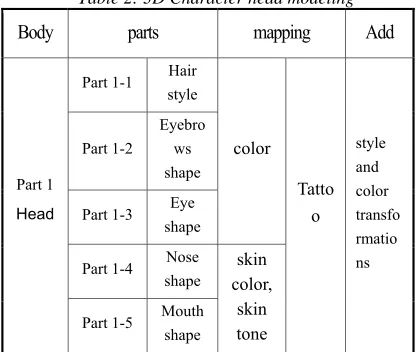
[image:7.612.312.520.531.707.2]Table 2 is an instance of more specific divided parts. There are 6 specific parts of the head there. We can easily alter the 6 parts of the body to other parts of. All of 3D polygon mesh structures should be standardized for the alteration.
Table 2: 3D Character head modeling
Body parts mapping Add
Part 1 Head
Part 1-1 Hair
style
color
Tatto o
style and color transfo rmatio ns Part 1-2
Eyebro ws shape
Part 1-3 Eye
shape
Part 1-4 Nose
shape
skin color,
skin tone
Part 1-5 Mouth
4832
Part 1-6 Ears
shape
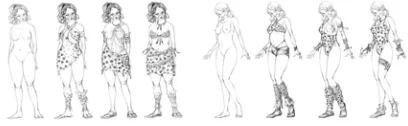
[image:8.612.98.302.345.408.2]We map the texture on the parts of the body. We can supply several body types, muscle mass, clothes, accessories, styles, tone, and color to our Asset DB. The Users can change any parts of modeling to the ones they want and add tattoos or anything we have provided with. Figure 6 is one of the examples of changing clothes. The uses can change the character’s clothes to another the Asset DB has provided with. The color of any parts can also be modified with the human body texture map UI which we have furnished with. All of outcomes we have produced in the above tasks are transferred to the Asset DB through the network and are well under control. The end users can easily create various styles of characters through our UI.
Figure 6: Changing clothes through UI
[image:8.612.314.521.551.710.2]The animation data retargeting is specified under the animation schema through our UI. The UI can retarget the animation parameters variously. So, we can easily move the head up and down, or back and forth through the UI. We need to make some facial expressions in the head parts as well. The Facial expressions can illustrate all sorts of human shared emotions and lip-sync mouth shapes. We use the blend shape technique in rigging to show the facial expressions. Figure 7 is an example of the blend shape of rigging.
Figure 7: Blend shape emotion expressions
In the animation data retargeting, we need to search the basic movements of human, for example: standing, sitting, etc., and inspect the sequence of walking, running, and jumping and the sequence of
walking, jumping, and running. We also prepare the continuous moves of the upper body and the low body, and make some combination moves, for example, the combination with several upper body moves of swimming and one lower body move of, and the several movements of sitting in the movie set with smoking, sitting, reading, chatting, etc.
The technical development process we discuss here is summarized more specifically in Table 3 which corresponds to the middle part of Figure 5 because those tasks are very crucial to the 3D DA whole development. We set the specific goals of each task and the detailed instructions to propose the tasks more explicitly in Table 3. As we mentioned in 4.1, the tasks of all phases are performed simultaneously. The number of Table 1 is not for working order. As shown in Table 1, we need industry feedback on our detailed plan for technical development. After getting feedback, we revise our detailed plan and share the new plan to execute with members. We need to make sure whether the arrangement of modeling guidelines is efficient or not. If it is not efficient, it needs to be reformed to improve efficiencies. The arrangement of modeling guidelines and regulations need to be verified by the industry. If there are problems, we need to fix them. We need to do the same things to other tasks.
We need an algorithm to connect our 3D polygon and animation solutions with the game engine. The data from the solution should support the 3D authoring tools, such as Maya, 3Ds Max, and be compatible with those tools. The Asset DB in the network can guarantee the perfect comparability with 3D authoring tools. And we continue to find out the user convenience UI, and seamless network service between the body parts exchanging tools and Asset DB.
Table 3: Specific technical development
N
o. Goals of the Research Details
1
-Detailed plan of full process & Industry Feedback - Whole detailed planning of implementation of development
ꞏExecution on production pipeline of character animation
ꞏ Rewriting of detailed action plans required for the research execution
2
- Basic modeling of 3D character’s body and establishment of modeling structure capable of body part
[image:8.612.89.299.577.643.2]4833 exchange of anatomical body structure,
clothes, etc.
3
- Structuring of character body polygon mash classification
-Structuring of character face basic modeling/deformation of expression
ꞏ Arrangement of guidelines about mash structure of detailed grafting part by part ꞏ Arrangement of the modeling guidelines after establishing the modeling structure required for anatomical facial structure / its deformation
4
- Structuring of character facial polygon mash classification
- Planning of viewable UI /design development
ꞏ Arrangement of mash structure guidelines on grafting part for the Fine details of facial expression deformation
ꞏ Detailed UI system planning and graphic design development.
5
- Development of a viewable part-exchange routine
- Added 3D character body part modeling by type
ꞏ Development of algorithm about game engine and solution connected part exchange
ꞏ Working on body parts modeling by type added to Asset DB
6
-Development of Universalization Module for Animation
- Added 3D character’s facial modeling by type
ꞏ Guaranteed data compatibility with 3D authoring tool (Maya, 3ds Max) for animation production
ꞏWorking on facial parts modeling by type added to Asset DB
7
- Modeling DB Structuring and Network Configuration
- Development of body part exchanging tool and DB network
interworking
ꞏ Synchronizing the task of Modeling Data Structure with Asset DB Structure compatible on 3D authoring tool (Maya, 3ds Max)
ꞏInterworking between the tool and Asset DB used in the network
8 -Optimization and
Stabilization of the body
ꞏAdded task of user convenience features and
part exchanging Tool seamless network between body part exchanging tool and asset DB
4.3. Expected Effect and Commercialization Method
We discuss the expected effect of our 3D DA development project and how to commercialize here. The concept of ‘Industry 4.0’ was quickly taken seriously by all countries and industries in the world. Through our development work represented in this disquisition, we can efficiently manage the data which are collected from the 3D characters body, clothes, accessories, and tattoos, etc. All the data will be processed in the Assets DB, anytime and anywhere in the era of Industry 4.0. Each part of 3D modeling can easily become the last products just with combinations of each other’s parts. All processes are developed by the modules, such as 3D polygons module, animation module. So, we can constantly update the modules easily to improve the quality of our outcomes and distribute our improved products. If we add new parts of characters or new characters in our Asset DB, the newly added materials are shared in real-time with our users. The end users can change any parts of 3D DA with the newly added ones immediately. The Asset DB can be extended to the 3D library.
When creating 3D characters contents, the users can apply our viewable UI to alter the parts of 3D DA to another easily and quickly. The artists can stably manage their 3D assets and strengthen their competitiveness to leverage their high quality and creative outcomes with the 3D DA UI. Their products will be improved to international level with the simple production process. Most production companies have problems with simple repetitive work and unsystematic manufacturing process. The UI through the Assets DB can solve the companies’ chronic problems. The production companies can save time and money by using our UI. The company can spend time and money more efficiently to ameliorate their products. Therefore, our manufacturing competitiveness and the quality of the outcomes will be improved.
4834 more 3D data, and we can use more materials. The resources we have used are becoming more refined and more acceptable in the various markets. We can make a profit in history, culture, social sectors, as well as in the 3D industry. We can also enter the growing VR market to use our 3D DA as source data.
5. CONCLUSIONS
As the basis of commercialization of high-performance 5G ICT technologies and artificial intelligence are added to cloud services, the size of big data processing by the public is rapidly increasing.While conventional computer operating systems and applications were common, user interfaces that were implemented with text information or static CG image information, the advent of platforms that could interact with a high body like HMD has led to the need for corresponding immersion and interactive user interface development.
The previous research of the digital actor focused on the division of the pipeline such as the technology for muscle, hair, facial, motion capture, clothes, rendering, and camera correction to create a character. It’s the technology for creating a character from the beginning. However, this research focused on the creation of new characters from the pre-existing assets we’ve already secured. In this paper, we’ve described the process and method of implementing an intelligent user interface based on 3D digital actor. Digital device and human’s interaction in media’s development process is changing with a higher level of interaction for accurate input and output. This requires 3D DA to act as a UI and interact with users by their device and content characteristics. Particularly, UI implementations that interact with digital devices and users in interactive formats can enable 3D DA to act as a type of operating system or application, creating a user-centered environment that is more than traditional UI implementations. Through this implemented system research, it could induce the interest and increase immersion as the user’s various virtual characters from a digital device is being used. This also corresponds with recent content where characterizing individuation. In this paper, 3D digital elements that are implemented with realism that cannot be distinguished from real people by interface operation program modules are located within 3D virtual space on various electronic device screens such as computers, smartphones, and HMDs. This means that 3D digital virtual space is a
new type of 3D digital interface operating system that automatically recognizes current user behavior or current facial expressions and actively performs user interface functions beyond providing simple information.
Using the game engine to make high-quality cinematics is not a new area in the CG industry anymore. The industry has already gathered much knowledge and skills for using the game engine. This research proposes to use the game engine to create a new character for the cinematics from our secured assets. It is a whole new venture in the industry, which enables the common people who do not even have specific skills for modeling to create a new character easily and quickly. The great merit of our 3D DA system saves time and money in the industry. The more we accumulate the assets database, the more elaborate outcomes we make.
We’ve seen the possibility of using the algorithm and functions of the game engine to make our 3D DA system for creating a new character. Our 3D DA system can be called a new game to create a character for cinematics or games. We play our 3D DA (game) and make a new character.
The game engine has enough functions to make our 3D DA system. If we gather enough assets database and put the data into our 3D DA system, we make a new character more creatively and quickly. The assets from previous works are reusable endlessly, so we need fewer modelers. We can be freed from tedious and repetitive modeling tasks thanks to the 3D DA system, which makes a more efficient pipeline.
In an age of transmedia that transcends the boundaries of digital space and character by media, the public needs an intuitive user-friendly environment.This research is especially significant because it implemented a dynamic and solid user interface via an intelligent user interface and expanded activities of a 3D digital actor.
ACKNOWLEDGEMENTS:
4835
Figure 6. Development workflow for 3D DA REFRENCES:
[1] Güzel, Ebru, “DIGITAL CULTURE AND THE ACTOR OF COMPETITION IN ONLINE SOCIAL NETWORKS” DIGITAL HABITUS, Gümüshane Üniversitesi Iletisim
Fakültesi Elektronik Dergisi, Vol. 4, Issue 1, Mar 2016. pp.82-103.
[2] Jeong-tak Kim, “Overcoming Lasswell and McLuhan-From EffectꞏMedia Paradigm to Symbolic Exchange Paradigm,” Korean Society for Journalism and Communication Studies, Korean Journal of Journalism & Communication Studies, vol. 43, no.5, 1999,
pp.113-154.
[3] Joo-hee Um, Jeong-kee Park, “A Study on the Interaction Paradigm Shift in Environment of Internet of Things -Focusing on Smart Devices-,” Korea Science & Art Forum, Journal of Korea Science & Art Forum, vol.19,
2015, pp.471-487.
[4] Dongwoo Lee, Hyungjin Jeon, Hongsik Pak, “Utilization of 3D Digital Actors as Digital Interface”, Proceedings of ICCT 2018,
Nov.2018, pp.143-146.
[5] A. Aubel, R. Boulic and D. Thalmann, "Real-time display of virtual humans: Level of details and impostors," IEEE Transactions on Circuits and Systems for Video Technology,
Special Issue on 3D Video Technology, Vol.10, No.2, 2000, 207-217.
[6] Junghyun Ahn, Seungwoo Oh, Kwangyun Wohn. "Motion Simplification of Virtual Character." Journal of KISS, Computer
Systems and Theory, Vol.33, No.10, Oct. 2006, pp.759-767.
[7] Joo-hee Um, “A Study on the interaction types of interactive advertising based on the digital sinage,” Korea Science & Art Forum, Journal of Korea Science & Art Forum, vol.14,
2013, pp.271-284.
[8] Yu-ri Ahn, Don-ryun Chang and Jai-beom Kim, “A Study on Flexible Identity from Interactive Perspectives,” Korea Society of Basic Design & Art, Journal of Basic Design & Art, vol.12, no.5, 2011, pp. 265-279.
[9] Yun-ho Cho, “A Study on the On-line Game Characters as an Interactive Channel,”
Council for Advanced media & Moving pictures, The Korean Journal of Art and Media, vol.5, no.1, 2006, pp192-223.
Developing modules for replacing parts of 3D DA in the game engine and for applying animation type
ꞏDeveloping the high polygon character modeling and texturing toolkits, and improving the Asset DB and the production environment
ꞏFostering the realistic and effective R&D infrastructure through convergence of the game engine and the graphic solution
Satisfying the requirement
of 3D DA developmen t capabilities
-ꞏ Developing the module for utilizing the resource. -Establishin g the agreement on developing, modeling, mapping and texturing. Making the solution for engine utilization -ꞏDeveloping the module for establishing the agreement on 3D character creation and utilizing the resource Developi ng network solution -ꞏDeveloping the network solution for constructing the Asset data base of 3D CG resource Satisfying the competenc e for program ming -ꞏDeveloping the algorithm for toolkits and putting to practical use them ꞏDeveloping the UI routine for manipulating tool
Build up the structure for improvement based on
R&D
-ꞏStructure for acquiring technology issue through industry-university collaboration, and for disseminating the issue through articles and textbooks ꞏStructure for gathering feedback on the data architecture of soon-to developed toolkits, and for documenting the source code, algorithm, etc.
Promoting an environment for expanding R&D technology capabilities
-ꞏUnderstanding our game engine utilization through technology conference ꞏCollecting feedback on efficient functionality required to develop toolkits
4836 [10]KAKAO, “KAKAO AI REPORT,” vol.17,
2017.
[11]Seung-taek Park, In-jae Sung, Sang-won Seo, Ji-soo Hwang, Ji-sung Noh and Dae-won Kim, “News recommendation service using machine learning -focusing on Kakao’s Rubics-,”
Journal of Cyber communication Academic Society, Cyber communication Academic
Society, vol.34, no.1, 2017, pp.5-48.
[12]Bo-ah Choi, Jong-wan Jung, “Analysis on e-Learning Contents UI Layout and Research on Effective UI Layout of a screen Demanded by Learner”, Journal of Digital Design, Korea
Digital Design Council, vol.9, no.2, 2009, pp.359-368.
[13]Jerome R. Bellagrada, “Spoken Language Understanding for Natural Interaction: The siri experience,” Natural Interaction with Robots, Knowbots and smartphones. Springer New
York, 2014, pp.3-14.
[14]Kwang-guk Kim, Peter Mundy, “Joint attention, social-cognition, and recognition memory in adults,” Frontiers in human neuroscience, vol.6, 2012.
[15]Myeong-gul Jung, Min-gyu Kim and Kwang-guk Kim, “Research on interaction methods and types for human-robot interaction,” In Proceeding of The HCI Korea 2017,
pp.603-606.
[16]Hong-sik Pak, Eel-jin Chae, Hyung-jin Jeon and Jae-hyuk Ko, “Figuration of Digital Actor and Its Application to Digital Contents,”
Journal of Theoretical and Applied Information Technology, Asian Research