Western University Western University
Scholarship@Western
Scholarship@Western
Electronic Thesis and Dissertation Repository
3-18-2015 12:00 AM
Trust based Privacy Policy Enforcement in Cloud Computing
Trust based Privacy Policy Enforcement in Cloud Computing
Karthick Ramachandran
The University of Western Ontario
Supervisor
Dr. Hanan Lutfiyya
The University of Western Ontario Joint Supervisor Mark Perry
The University of Western Ontario Graduate Program in Computer Science
A thesis submitted in partial fulfillment of the requirements for the degree in Doctor of Philosophy
© Karthick Ramachandran 2015
Follow this and additional works at: https://ir.lib.uwo.ca/etd
Part of the Information Security Commons, OS and Networks Commons, and the Systems Architecture Commons
Recommended Citation Recommended Citation
Ramachandran, Karthick, "Trust based Privacy Policy Enforcement in Cloud Computing" (2015). Electronic Thesis and Dissertation Repository. 2728.
https://ir.lib.uwo.ca/etd/2728
This Dissertation/Thesis is brought to you for free and open access by Scholarship@Western. It has been accepted for inclusion in Electronic Thesis and Dissertation Repository by an authorized administrator of
(Thesis format: Monograph)
by
Karthick Ramachandran
Graduate Program in Department of Computer Science
A thesis submitted in partial fulfillment
of the requirements for the degree of
Doctor of Philosophy
The School of Graduate and Postdoctoral Studies
The University of Western Ontario
London, Ontario, Canada
c
Abstract
Cloud computing offers opportunities for organizations to reduce IT costs by using the
com-putation and storage of a remote provider. Despite the benefits offered by cloud computing
paradigm, organizations are still wary of delegating their computation and storage to a cloud
service provider due to trust concerns. The trust issues with the cloud can be addressed by a
combination of regulatory frameworks and supporting technologies. Privacy Enhancing
Tech-nologies (PET) and remote attestation provide the techTech-nologies for addressing the trust
con-cerns. PET provides proactive measures through cryptography and selective dissemination of
data to the client. Remote attestation mechanisms provides reactive measures by enabling the
client to remotely verify if a provider is compromised. The contributions of this work are
three fold. This thesis explores the PET landscape by studying in detail the implications of
us-ing PET in cloud architectures. The practicality of remote attestation in Software as a Service
(SaaS) and Infrastructure as a Service (IaaS) scenarios is also analyzed and improvements have
been proposed to the state of the art. This thesis also propose a fresh look at trust relationships
in cloud computing, where a single provider changes its configuration for each client based on
the subjective and dynamic trust assessments of clients. We conclude by proposing a plan for
expanding on the completed work.
Keywords:Trust, Privacy, Security, Cloud Computing, Subjective and Dynamic Trust, Remote
Attestation, Privacy Enhancing Technologies
Acknowledgments
I am deeply indebted to my supervisors Dr. Hanan Lutfiyya and Prof. Mark Perry for giving me
an opportunity to work on this field. Dr. Lutfiyya is one of the most patient and humble people I
have ever met. This thesis would not have been possible without her continued support, patient
guidance and encouragement. Prof. Perry was always a Skype call away for any discussion.
His support is deeply appreciated.
I would like to thank my colleagues at DiGS (Distributed and Grid Systems) research group for
fruitful discussions and their help and support for the past 5 years. Thanks to Sharmila Mohan
for collaborating with me in a project for trusted healthcare database.
Special thanks to the Computer Science Department and its amazing staff: Janice, Cheryl,
Dianne and Angie.
To University of Western Ontario for providing such a beautiful and healthy environment to
perform research.
I would also like to acknowledge the Ontario Government for granting scholarship that
sup-ported the final two years.
Ph.D is a long and sometimes a very lonely journey. I would not have made it, if it is not for
my near and dear.
To my friends here in Canada and around the world (in alphabetical order): Achuthan, Aditi,
Anu, Deepak, Dinagar, Gaston, Hareesh, Harpreet, Jananee, Lankesh, Manasi, Mike,
Niru-pama, Prakruti, Rachita, Roopa, Sharmila, Shivangi, Siva, Siya, Sneha, Sriram, Viji, Vijay and
the countless others. Thank you so much for making my travel adventurous.
To my roommates Amit, Esperanza and Javier for accommodating me under the same roof and
being the family in Canada.
To my sister’s folks for their constant motivation and strength.
Finally this thesis is for my parents and my sister Ramya: for always placing my happiness
before yours.
Abstract . . . ii
Acknowledgments . . . iv
Table of Contents . . . v
List of Figures . . . xi
List of Tables . . . xiii
List of Acronyms . . . xiv
1 Introduction 1 1.1 Privacy Enhancing Technologies . . . 2
1.2 Need for trust: Remote Attestation . . . 3
1.3 Trust Relationships . . . 5
1.3.1 The Plumber Problem . . . 5
1.3.2 Trust Relationships in Cloud . . . 8
1.4 Contributions of Thesis . . . 10
1.5 Scope . . . 12
1.6 Thesis Organization . . . 12
2 Background 15 2.1 Cloud Computing . . . 15
2.1.1 Service Models . . . 16
2.1.2 Deployment models . . . 17
2.1.3 Characteristics . . . 17
2.2 Privacy, Security and Trust . . . 18
2.2.1 Privacy . . . 18
2.2.2 Security . . . 21
vi CONTENTS
2.2.3 Trust . . . 22
2.2.4 Risk Vs Trust . . . 24
2.3 Threat Model . . . 25
2.4 Privacy Enhancing Technologies (PET) . . . 26
2.5 Remote Attestation . . . 28
2.5.1 Trusted Computing . . . 28
2.5.2 Trusted Boot . . . 29
2.5.3 Trusted Platform Module (TPM) . . . 30
2.5.4 Realtime Measurements . . . 33
2.5.5 Dynamic Root of Trust for Measurement . . . 34
3 Chaavi: Webmail with Searchable Encryption 36 3.1 Motivating Example: Webmail Services . . . 37
3.2 Background . . . 38
3.2.1 Mail Architecture . . . 38
Components . . . 38
Privacy Threats . . . 39
3.2.2 Pretty Good Privacy . . . 40
3.2.3 Searchable Encrypted Data . . . 41
3.3 Architecture . . . 42
3.3.1 Browser . . . 43
3.3.2 Browser Extension . . . 43
3.3.3 Web Application . . . 44
3.3.4 Database . . . 44
3.3.5 Mail Server . . . 44
3.4 Implementation . . . 45
3.4.1 Browser Extension . . . 46
3.4.2 Web Application: . . . 47
3.5 Experiments . . . 48
Key Generation . . . 48
Encryption and Decryption . . . 49
Keyword Encryption . . . 50
3.5.2 Space Complexity . . . 51
Impact of increase in size on the keyword index . . . 51
Impact of increase on Final Message size . . . 52
3.6 Limitations of our implementation . . . 52
3.7 Conclusion . . . 53
4 A notification based remote attestation framework for IaaS 54 4.1 Related Work - Remote Attestation Infrastructure . . . 55
4.1.1 Integrity Measurement Architecture (IMA) . . . 55
4.1.2 Privacy Certificate Authority (CA) . . . 58
4.2 Virtual Machines based Architectures . . . 60
4.2.1 Terra . . . 61
4.2.2 HIMA . . . 62
4.2.3 In VM measurement . . . 64
4.2.4 Certicloud . . . 65
4.2.5 vTPM . . . 67
myTrustedCloud . . . 69
Implementation of Trusted IaaS using vTPM and Trusted Third Party (TTP) . . . 70
4.3 Our Work . . . 71
4.4 Architecture . . . 72
4.4.1 IaaS Cloud . . . 74
IaaS Trust Component . . . 75
4.4.2 Trusted Third Party . . . 76
Trust Verifier . . . 77
RIMM Datastore . . . 78
viii CONTENTS
4.4.4 Client . . . 80
4.4.5 VM Policy . . . 81
Formalisms . . . 81
4.5 Scenarios . . . 83
4.5.1 Registration . . . 83
4.5.2 Verification . . . 85
4.5.3 RIMM policy update . . . 86
4.6 Establishing a minimal trusted computing base . . . 88
TCB using Debian Package Management (dpkg) . . . 89
4.7 Implementation . . . 90
4.8 Experiments . . . 90
4.8.1 Heartbleed Detection . . . 90
4.8.2 Overhead . . . 91
Booting . . . 92
Computations . . . 93
4.9 Limitations . . . 93
4.10 Conclusion . . . 94
5 Subjective and Dynamic Trust in SaaS 95 5.1 Configurable Elements . . . 96
5.1.1 Storage Engine . . . 96
5.1.2 Policy Engine . . . 97
5.1.3 Monitoring Engine . . . 98
5.2 Configurations . . . 99
5.3 Architecture . . . 100
5.3.1 Application Server . . . 100
put (data, policy, config info) . . . 101
get (data id) . . . 101
get tpm quote () . . . 101
delete(data id, is shred) . . . 102
5.3.2 Crypto Server . . . 102
crypt init key (enc type, operation, key, data id) . . . 102
crypt (data) . . . 103
get tpm quote () . . . 103
5.3.3 Storage Server . . . 103
put(data, data id) . . . 103
get(data id) . . . 103
delete(data id, is shred) . . . 103
5.3.4 Monitoring Server . . . 104
5.3.5 Configuration of Servers . . . 104
5.4 Scenarios . . . 105
5.4.1 get tpm quote . . . 105
5.4.2 put . . . 106
5.4.3 get . . . 107
5.4.4 migrate . . . 108
Migration to trust level - 0 . . . 108
Migration to trust level - 0.5 . . . 108
Migration to trust level - 1 . . . 109
5.5 Implementation . . . 110
5.6 Experiments . . . 110
5.6.1 Performance of Put and Get . . . 110
5.6.2 Scalability Experiments . . . 111
5.6.3 Performance of Migrate . . . 113
5.7 Related Work . . . 114
5.7.1 Trust Model . . . 114
5.7.2 Policy Enforcement Mechanisms in Trusted and Untrusted Clouds . . . 116
5.8 Conclusion . . . 117
x CONTENTS
6.1 Supporting trust relationships in IaaS . . . 118
6.1.1 Scenario 1: U ser1moves from trusting the provider to distrusting . . . 119
6.1.2 Scenario 2: U ser2starts to trust the provider . . . 120
6.1.3 Requirements . . . 121
6.2 Architecture . . . 121
6.2.1 Infrastructure Controller . . . 122
6.2.2 Trusted Pools . . . 123
6.2.3 Untrusted Pools . . . 123
6.2.4 Unallocated Servers . . . 123
6.2.5 Resource Middleware . . . 124
6.2.6 Modifications to Trusted Third Party (TTP) . . . 124
6.3 Algorithms . . . 125
6.3.1 Migration Algorithms in Resource Middleware . . . 125
6.3.2 Resource allocation algorithms in Controller . . . 126
Migration of VMs . . . 127
Defragmentation Algorithm . . . 129
6.4 Implementation Details . . . 130
6.5 Experiments . . . 131
6.6 Related Work . . . 131
6.7 Conclusion . . . 132
7 Conclusion 133 7.1 Contributions . . . 133
7.2 Application Scenarios . . . 135
7.3 Future Work . . . 136
Bibliography 139
1.1 The Plumber Problem . . . 6
1.2 Alice and Pixelcloud . . . 9
1.3 Contribution . . . 14
2.1 Core P-RBAC . . . 20
2.2 Trusted Boot . . . 29
2.3 TPM Architecture . . . 31
3.1 Email Architecture . . . 38
3.2 Chaavi - Architecture . . . 42
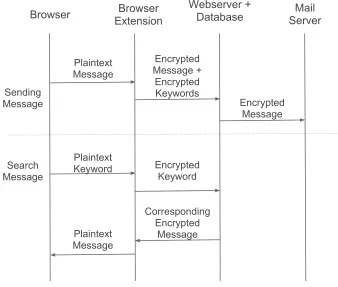
3.3 Sending and Searching for a Message . . . 45
3.4 Key Management . . . 47
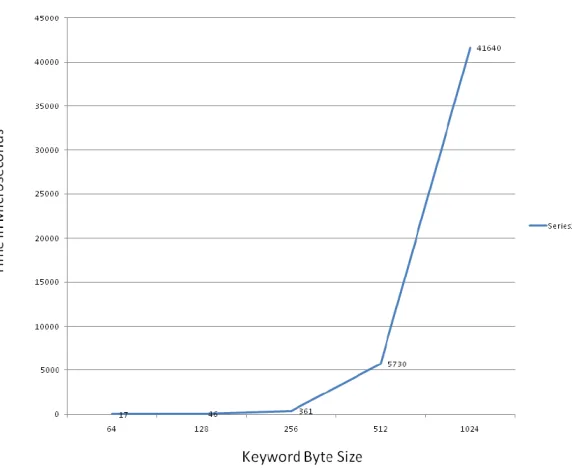
3.5 Key Generation . . . 49
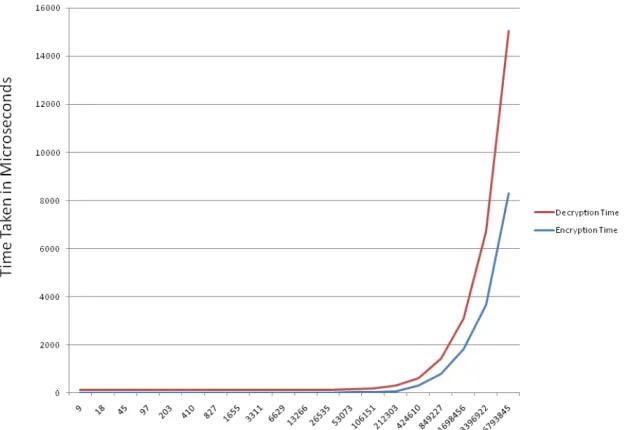
3.6 Encryption and Decryption . . . 50
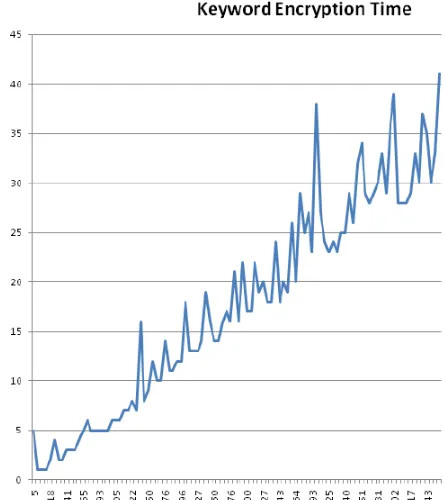
3.7 Keyword Encryption Time . . . 51
4.1 Integrity Measurement Architecture . . . 56
4.2 ASCII Runtime Measurements . . . 57
4.3 Privacy CA . . . 58
4.4 Privacy CA: Trusted Computing Base . . . 60
4.5 Terra Architecture [49] . . . 61
4.6 HIMA Architecture [26] . . . 63
4.7 In VM measuring framework . . . 64
4.8 Certicloud Architecture Architecture [34] . . . 66
4.9 vTPM Architecture [18] . . . 68
xii LIST OF FIGURES
4.10 myTrustedCloud Architecture . . . 69
4.11 Trusted Cloud with TTP . . . 71
4.12 Architecture . . . 74
4.13 IaaS Server Components . . . 75
4.14 Trusted Third Party . . . 77
4.15 Registration Scenario . . . 84
4.16 Verification Scenario . . . 86
4.17 RIMM Update Scenario . . . 88
4.18 Heartbleed Detection Workflow . . . 92
5.1 System Architecture . . . 100
5.2 Configuration of the servers . . . 104
5.3 PUT . . . 106
5.4 GET . . . 107
5.5 Put, Get Performance . . . 111
5.6 Plain Text with concurrent connections . . . 112
5.7 AES Encryption/Decrpytion with concurrent connections . . . 113
5.8 TPM with concurrent connections . . . 114
5.9 Response time for trust transition . . . 115
6.1 IaaS and Trust Relationship: Initial State . . . 119
6.2 IaaS and Trust Relationship: Steps . . . 120
4.1 Iterations per second for Setup A and Setup B . . . 93
5.1 Configuration Parameters . . . 99
List of Acronyms
List of Acronyms
AES Advanced Encryption Standard
AIK Attestation Identification Key
CA Certification Authority
CSC Cloud Service Client
CSP Cloud Service Provider
DRTM Dynamic Root of Trust for Measurement
IaaS Infrastructure as a Service
IMA Integrity Management Architecture
MTA Mail Transfer Agent
MUA Mail User Agent
PaaS Platform as a Service
PCR Platform Control Register
PET Privacy Enhancing Technology
PII Personally Identifiable Information
P-RBAC Privacy aware Role Based Access Control
PEKS Public-key Encryption with Keyword Search
RAD Rapid Application Development
RIMM Resource Integrity Measurement Manifest
RSC RIMM SaaS Cloud
SaaS Software as a Service
SMTP Simple Mail Transfer Protocol
TCB Trusted Computing Base
TCG Trusted Computing Group
TPM Trusted Platform Module
TTP Trusted Third Party
TVMM Trusted Virtual Machine Monitor
VM Virtual Machine
Chapter 1
Introduction
Cloud computing represents a model of computing, where consumers can rent a pool of
config-urable resources such as networks, servers, storage and services, from a Cloud Service Provider
(CSP) [25]. There are three main types of cloud offerings: Infrastructure as a Service (IaaS),
Platform as a Service (PaaS) and Software as a Service (SaaS). IaaS offers virtualized instances
of bare machines leaving the installation and customization of softwares including the
Operat-ing System to the cloud computOperat-ing clients. In PaaS, an application framework is provided to
the clients for developers to develop their software with. A SaaS provider offers a particular
application as a web service, which customers can customize to their needs.
Cloud Service Clients (CSC) can dynamically provision the resources as per the client’s
requirements, using a pay-per-resources business model. Cloud computing enables elasticity
(grow or shrink as per the client’s requirements) of resources, multi-tenancy, maximal resource
utilization and the utility model (pay per use). These new features empower the provider to
leverage large infrastructures through virtualization of resources and optimum job and resource
management.
From the client’s perspective, there are not only cost savings due to the economies of scale
on the service provider side, but also the amount of investment on the client is decreased for
buying the infrastructure upfront. Due to these benefits, users and enterprises are looking to
delegate the storage of data and service execution on resources owned by a cloud providers.
Forrestor (the independent market research firm) estimates that the cloud computing global
market will increase from $40.7 billion USD in 2010 to $241 billion in 2020 [4].
Despite the benefits offered by the cloud computing paradigm, organizations are still wary
of delegating their computation and storage to a cloud service provider. According to a survey
conducted by IDC (a market research firm), the CIOs (Chief Information Officers) of
enter-prises identifysecurity concerns as the top reason for them to not aggressively adopting the cloud [9]. A Fujitsu Research Institute study on potential cloud customers [21] found that 88%
of potential cloud consumers are worried about who has access to their data, and demanded
more awareness of what goes on in the physical cloud server.
Many clients, such as health-care companies, financial companies and government
orga-nizations require strictprivacyandsecurityrequirements. Apolicyis a specification of these requirements. An example of a specification language that can be used to specify privacy
poli-cies is P-RBAC [86]. To enforce the security and privacy policy, clients need totrustthat the remote cloud provider is not malicious and the provider will comply with the security
require-ments. There is a perceived lack of trust in cloud services, which is hindering some companies
from completely embracing cloud computing.
These privacy, security and trust concerns of the cloud can be addressed by a combination of
regulatory frameworks and supporting technologies [88]. The regulatory frameworks provides
the clients with legal protection against any adversary provider and the supporting technologies
aids the the clients to identify breaches and take any proactive and reactive measures against
possible breach of the clients data.
The chapter starts with a discussion on the supporting technology, Privacy Enhancing
Tech-nologies (PET) with its limitations are presented in Section 1.1. This is followed by a
moti-vation for the need of trust in cloud computing and the introduction of Remote Attestation
in Section 1.2. Section 1.3 describes complex trust relationships by illustrating a real world
example. The contributions of the thesis are enumerated in 1.4 and the scope of the thesis is
discussed in 1.5. The chapter ends with thesis organization in Section 1.6.
1.1
Privacy Enhancing Technologies
Privacy Enhancing Technologies (PET) enable clients to transact with providers securely even
1.2. Need for trust: RemoteAttestation 3
allow users to protect their privacy online against adversaries. Blarkom et al. [108] defines
PET asa system of information and communication technology measures protecting informa-tional privacy by eliminating or minimizing personal data thereby preventing unnecessary or unwanted processing of personal data, without the loss of the functionality of the information system. Privacy preserving protocols [47], a class of PET, enable users to perform computation over cryptographically protected data. Homomorphic encryption and searchable encryption schemes are notable privacy preserving protocols.
Homomorphic encryption is an asymmetric encryption technique, where algebraic opera-tions are performed directly on the cipher text which represents the encryption of plain text.
This was first introduced by Goldwasser et al. [53], where the authors performed modular
addition of two bits using multiplication of ciphertexts. Craig Gentry [51] designed an
homo-morphic encryption scheme that allows both addition and multiplication on plain text through
their cipher texts.
Searchable encryption allows users to search for particular keywords on encrypted data. Public Key Encryption with Keyword Search (PEKS) [71] is one of the seminal works in
the area of making encrypted data searchable. The authors of PEKS propose to encrypt the
message using the Public-Private key infrastructure. Along with this cipher text a Public-Key
Encryption with Keyword Search (PEKS) of each keyword (the words that make up the
mes-sage) is appended to the final message. The PEKS of the keyword is used as the keyword index
for searching in the server without revealing the exact plain text keyword (more in Chapter 3).
Although homomorphic encryption and searchable encryption are viable proven ways of
preserving privacy of data in the cloud without compromising on the functionality,
cryptogra-phy increases the computational and storage overhead on the server [94]. Computation over
encrypted data even though theoretically possible is not yet practically feasible [83].
1.2
Need for trust: Remote Attestation
As the solutions proposed by PET are mostly in the theoretical realm, clients are forced totrust the cloud provider with the data and hope that the provider will not breach that trust. Trust
will exhibit characteristics consistent with the role of the trustee” [120]. The client establishes
trust on emotional and cognitive (evidence based) grounds. To enforce the strict security
re-quirements on the server, the trust relationship between the client and server should be formed
more based on cognitive, evidence based grounds. The evidence should be unforgeable and
should assure that the server will not act against the client’s interest.
Remote attestation provides such evidence by allowing clients to accurately verify if the remote server’s state is compromised. A server can be trusted if the client can accurately
verify all the software binaries that the server has executed [50]. The veracity of a software is established through its identity, which is expressed by means of the hash1 of the software
binary. For verification of the server’s state, the measured hash of all the software binaries
(measurement list) is sent to the client. The client performs the comparison against known
software hash values, whose security has been verified. This will enable clients to verify that
the server is free of malware or any unauthorized software.
Remote attestation [50] refers to theprocess of authenticating and verifying the state of the remote platform and its operating system outside of the platform. The remote platform can either be hosted on a physical server or a Virtual Machine (VM) in the physical server or both.
In the context of cloud computing, remote attestation of the cloud server is performed either
by cloud clients or a trusted third party on behalf of the cloud clients.
Based on remote attestation, trusted computingtechnology was developed by the Trusted Computing Group (TCG). It provides specifications for securely reporting and verifying a
re-mote platform (i.e. server hardware and software).
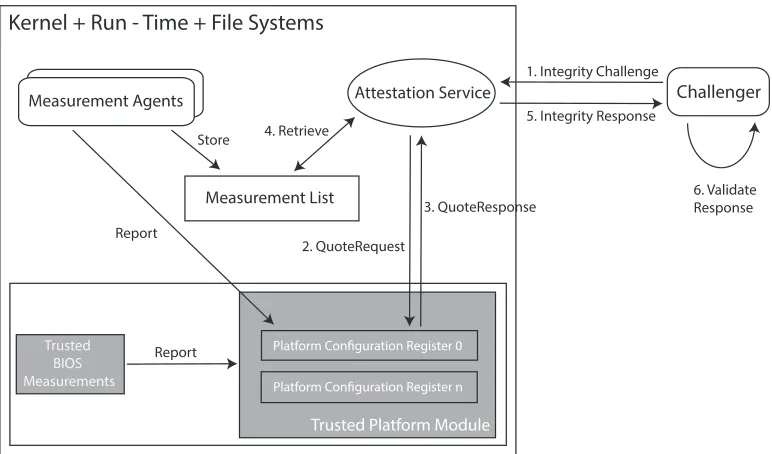
Existing work in remote attestation of the server includes: securely collecting and storing
information about the software state (hash values) of the server [50], methods for using the
information on the state locally in the server [17, 30], for conveying the state information to an
external client for remote attestation [106, 98, 34] and for managing the list of software that is
allowed to be executed in the server [60].
In theory, it should be possible to test whether the hardware and the software hosted in
the server are secure and remotely attest if a server is hosting the tested hardware and
soft-ware components. However, remote attestation has several practical limitations. Establishing a
1.3. TrustRelationships 5
trusted computing base (TCB), the software and hardware stack that is audited and well tested
for the security of a particular application is challenging. With the advent of technologies such
as Rapid Application Development (RAD), maintaining the latest secure software updates on
remote server is non-trivial. Moreover, economically, a remote attestation infrastructure can be
expensive to the client.
The challenges and costs imposed by PET and remote attestation make them an undesirable
option for clients that trust the provider already without the attestation provisions. This trust
may arise from several subjective factors such as proven history of provider’s strong SLA compliance with the client. In some context when the client is dealing with insensitive data,
the clients need not completely trust the provider for operations on the data. For example,
clients absolutely need to trust the banking provider for the everyday banking needs, however
they do not really need to trust the social media platform to share their messages with their
friends or followers.
1.3
Trust Relationships
Trust relationships are complex. Trust is subjective. Different clients may perceive the same provider differently. For example, a forgiving client may be willing to accept more failures
from the provider while a less forgiving may not. Trust is also dynamic. A client’s trust perception of a server may change over time based on the performance of server. To illustrate
this relationship a societal (real world) scenario is presented through the plumber problem.
1.3.1
The Plumber Problem
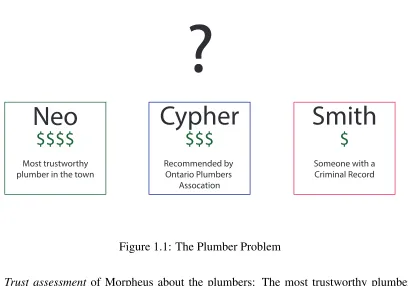
The plumber problem is illustrated in Figure 1.1. Morpheus wakes up one day to find a broken
pipe in his house. He needs to call a plumber to fix it. He has the following options: Neo, the
most trusted plumber and the busiest in the town; Cypher, recommended by the government
and Smith, a plumber with a criminal record. Neo chargers more for his services followed by
Cypher and then Smith. Who should Morpheus choose for fixing the pipe?
There is no single right answer to this question. The safest plumber here, Neo, may not be
Most trustworthy plumber in the town
Recommended by Ontario Plumbers
Assocation
Someone with a Criminal Record
??
Neo
Cypher
Smith
$$$$
$$$
$
Figure 1.1: The Plumber Problem
• Trust assessment of Morpheus about the plumbers: The most trustworthy plumber in the town may not be the most trusted plumber by Morpheus. Morpheus may personally
know and trust Cypher and Smith even though Neo is trusted by the entire town.
• Mechanisms that Morpheus can deploy to work with an untrusted plumber: Morpheus may have the ability to inspect the working of the plumber directly or remotely inspect
through a camera. This may give him an option to work with an untrusted plumber safely.
• Location of pipe: Morpheus may choose an untrusted plumber to fix the pipe even
with-out the mechanisms in place, if the pipe is located in a distant garage and the plumber
cannot do any damage to the property of Morpheus.
• Economical constraints of Morpheus.
If Smith is someone Morpheus knows in person compared to Neo and Cypher, Morpheus
may choose Smith as the plumber. Morpheus may also choose Smith if he can inspect Smith
when he is plumbing. If Morpheus does not want to take a risk with Smith, he may choose Neo,
paying Neo extra money. Morpheus may choose Cypher if he finds Cypher the right value for
1.3. TrustRelationships 7
Morpheus’s trust assessment of each plumber can be completely different from his friend
Trinity’s, making it a subjective assessment. This is because Trinity may be friends with
Cypher where as Morpheus may be friends with Smith. Moreover, Morpheus may trust a
plumber today and decide not to trust him tomorrow based on the plumber’s performance.
We observe that for a simple question on choosing a plumber there are various subjective and
dynamic parameters that affect making a decision. Despite all this, the process of calling a plumber and fixing the pipe, in general seem to work.
There are two kinds of trust that influence the decision of Morpheus: personaland imper-sonal trust[101]. A personal trust requires intimate knowledge of the plumber by Morpheus. If the plumber is Morpheus’ friend, the trust Morpheus has on the friend is not tied to the
plumber’s actions in the past. It’s a reliance that, the plumber has good intention with respect
to Morpheus and will not act against Morpheus’ interests.
Shapiro et al. [102] studied Impersonal trustelaborately and explored how societies con-trol trust relationships between entities that are not not influenced by personal relations. Our
society has formed several systems that enable the process of working with entities (in this case
plumbers) of different trust. These systems are referred by Shapiro et al. [102] as guardians of impersonal trust. There are legal systems in place to punish the criminal conduct of any entity, and there are recommendation systems (through word of mouth, sites such as yelp.com,
plumbers association of canada) that make people aware of competent and incompetent
enti-ties.
The process of calling a plumber works because we tend to trust these systems more than
people. These systems have become the backbone of our society. One may not trust the
plumber, but may trust the systems that produced the plumber. There are laws that govern the
system that keep the delinquent plumbers in check. There are mechanisms (such as
monitor-ing the plumber while workmonitor-ing) in place, that give users like Morpheus and Trinity enough
1.3.2
Trust Relationships in Cloud
In a cloud computing context, the systems that govern computing and the mechanisms that
protect the users are currently evolving. Therefore trust in cloud computing is considered as
largely unidimensional without the subjective and dynamic properties.
To illustrate a cloud computing system with a multidimensional trust, let us consider an
example of a photographer Alice. Alice is a photographer who wants to store her photograph
collection with a provider called Pixelcloud. She has the following privacy requirement:
Pic-tures should only be visible to her and her friends that have permission to view the photographs.
This can be formalized using a P-RBAC [86] like policy specification language as follows:
(FR, ((RD, Catalog), Viewing, OC=Yes, Notify(ByEmail)))
The notation FR is used to denote the role: friends of Alice. The notation (RD,
Catalog) denotes that the users in FR can only execute a read only operation, denoted by
RD, on the photgraph collection, which is denoted byCatalog. The notationViewing
spec-ifies the policy purpose. The condition, denoted by the notation OC=YES, represents that the
owner needs to give consent before a read operation on the catalog can be carried out. The
obligation’s action is denoted by the notation Notify(ByEmail), which states that Alice is
notified by email for each read access of the catalog.
When the data storage is outsourced to Pixelcloud, Alice may or may not trust Pixelcloud
to enforce the policy. If Alice trusts Pixelcloud, then she can depend on Pixelcloud to enforce
the policy as per the specification. However, if Alice does not trust the Pixecloud, she will take
the sole responsibility for enforcing the policy.
When Alice is uncertain if she can trust Pixelcloud or not, she will have to continuously
monitor to make the Pixelcloud accountable when there is a policy violation. We present these
three scenarios below (Figure 1.2).
The first scenario to be considered is thatAlice distrusts PixelCloud. A possible approach to enforcing the privacy policy is to have Alice encrypt her photograph collection before sending
it to PixelCloud. PixelCloud is not able to read Alice’s photograph collection since the data
is encrypted and PixelCloud is unaware of the keys for decryption. Alice privately shares the
1.3. TrustRelationships 9
Alice
Distrusted Untrusted Trusted
Encryption Plaintext
Attestation
Pixelcloud
Figure 1.2: Alice and Pixelcloud
photograph collection in response to a request for the data from PixelCloud. Any unauthorized
access of the encrypted files in Pixelcloud will be futile without having access to keys. Alice’s
friend uses the client software provided by Pixelcloud to stop the friend from using the data
for any other purpose than for what it is intended by not allowing the data to be transmitted or
stored.
When the data is encrypted and keys are with the owner, the data is secure and no policy
violations by the provider can occur. Therefore, an argument could be made that a CSP should
always be considered to be untrusted. However, the performance overhead introduced by such
policy enforcement mechanisms may be prohibitively high [52, 99, 92].
If Alice trusts PixelCloud, she may provide her data unencrypted to PixelCloud and del-egate the responsibility for policy enforcement to PixelCloud. The performance overhead is
reduced since encryption and decryption operations are not used.
The responsibility of policy enforcement is shared between Alice and PixelCloud when
Alice is not sure if she can trust PixelCloud. Alice requests that PixelCloud encrypts her catalog. PixelCloud’s records transactions involving Alice’s catalog. The logs with transaction
When a friend of Alice, Bob, accesses the catalog, PixelCloud decrypts the catalog and presents
it to Bob through client software provided by PixelCloud to Bob. The client software executing
in Bob’s computer will ensure that the picture shared with Bob is used only for the purpose it
is shared. In this scenario of uncertain trust, If PixelCloud is an adversary or has a malicious
insider, then the logging can be circumvented. This is addressed using a Trusted Platform
Module (TPM) with a check of integrity values of the software that is executed in the server.
The performance assuming uncertain trust, is higher than if PixelCloud is trusted but not as
high, if PixelCloud is distrusted.
We observe that Pixelcloud has three different “views” (trusted, distrust and uncertain trust)
and Alice can choose a view based on her trust perception of Pixelcloud.
In industry, unlike the example of Pixelcloud, we do not notice a single provider behaving in
a trusted mode to a client and an distrusted mode to someone else. Google, Facebook, Dropbox
are used even when users do not have complete trust on them. Users who highly suspect these
providers switch to secure (sometimes limiting) alternatives such as Duckduckgo, Diaspora,
Wuala etc.
We propose that there is a need for services to support the subjective and dynamic nature
of trust in general. When trust assessment is performed based on subjective factors, the final
configuration requirements (remote attestation or no attestation) of the provider can vary from
client to client. Therefore the provider needs to let clients choose the final configuration based
on the client’s subjective trust assessment. The clients should be able to accommodate the
dynamic nature of trust: when the trust on the cloud provider changes over time, the clients
should be able to change their configuration.
Current work in the state of the art does not study these trust relationships and the
corre-sponding policy enforcement mechanisms.
1.4
Contributions of Thesis
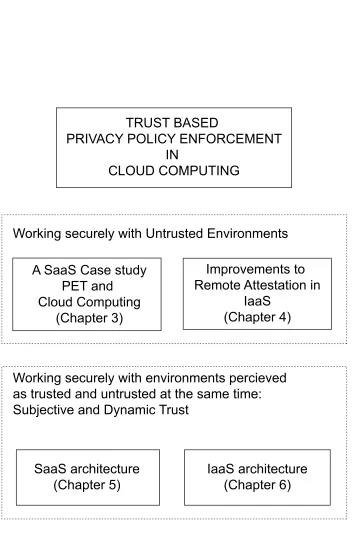
The contributions of this thesis are illustrated in Figure 1.3. Listed below are the contribution
1.4. Contributions ofThesis 11
• PET in cloud architectures:This thesis explores the state of the art in PET and proposes
a privacy preserving architecture for a webmail SaaS system without compromising on
the functionality. The prototype is benchmarked and based on the results show the
fea-sibility to architect a privacy preserving solution for webmail systems in a real working
environment. The thesis also discusses the limitations of PET and future work for PET
in cloud architectures extensively.
• Practicality of remote attestation in SaaS and IaaS: A notification based remote
at-testation infrastructure is proposed that supports verification of servers and virtual
ma-chines using a TTP (trusted third party) and RIMM (Resource Integrity Measurement
Manifest). The RIMM maintains a list of known secure software integrity values. The
remote attestation of the server and VM is delegated to a TTP. The software state of the
server and the VM is verified continuously by the TTP in predefined intervals through
polling. The proposed remote attestation infrastructure is studied in a web application
scenario. A known minimal trusted computing base (TCB) is established and its security
implications and overhead of attestation are studied in detail.
• Subjective and dynamic nature of trust for a cloud: The dynamic and the subjective
nature of trust is introduced and its implications to cloud computing is studied in detail
in both the SaaS and IaaS cloud.
For the SaaS cloud, a policy based approach to the implementation of subjective and
dy-namic trust so as to enable privacy policy enforcement in a SaaS cloud is proposed. An
abstract model containing computational, storage and monitoring unit with configurable
elements is introduced and algorithms that reflect how a change of trust influences the
configuration of these elements are described.
In the IaaS context, the server pool is divided into virtual trusted and untrusted pools. The
trusted pools supports the notification based remote attestation infrastructure whereas
the untrusted pool do not have the overhead of the remote attestation infrastructure. We
describe algorithms for the migration of VMs between the pools based on the trust
1.5
Scope
The NIST definition of cloud computing [80] enumerates the following essential characteristics
of cloud computing:
1. On demand self-serviceA consumer can dynamically provision services and resources, as needed without any human intervention.
2. Broad network accessThe resources can be accessed through standard mechanisms that enables use of heterogeneous clients such as mobile phones or browsers.
3. Resource Pooling The provider serves clients using multi-tenant model to optimize re-source usage at the provider’s end.
4. Rapid elasticityThe consumers can scale-up or scale-down the resource usage automat-ically.
5. Measured ServiceThe provider serves resources and services through a pay-per-use busi-ness model, where computing is treated as utility such as electricity and water.
The proposed architectures in this thesis addresses on demand self service, broad network
access and resource pooling. The architectures do not directly focus on rapid elasticity and
measured service. However, the architectures can be expanded to support rapid elasticity and
measured service in future work.
1.6
Thesis Organization
Chapter 1 presents the introduction for the the rest of the dissertation.
Chapter 2 presents background on Privacy Enhancing Technologies (PET) and Trusted
Computing with focus on remote attestation.
Chapter 3 explores the practicality of PET by presenting a prototype of a web mail system
using searchable encryption. The prototype is benchmarked and its feasibility in a real world
scenario is discussed in detail. This chapter concludes with PET’s disadvantages and the need
1.6. ThesisOrganization 13
In Chapter 4, a notification based remote attestation infrastructure for a Infrastructure as a
Service (IaaS) cloud is discussed to address the limitations presented in Chapter 3. The chapter
describes the components of the infrastructure along with the protocols and algorithms. A
trusted computing base for hosting a web application in a virtual machine is established and
the system is benchmarked to study its overhead.
Chapter 5 studies the subjective and dynamic nature of trust in detail. It presents a SaaS
cloud, supporting dynamic configuration (using PET and remote attestation) of its services
based on the trust assessment of the client. We describe an architecture and algorithms for
policy mapping that considers viability of trust and present a cloud storage framework that
enforces privacy policy according to the varying trust levels of the CSP. An abstract model
containing computational, storage and monitoring unit with configurable elements is presented.
Algorithms that reflects how a change of trust influences the configuration of elements are
described.
Chapter 6 studies subjective and dynamic trust in the context of an IaaS. Trusted and
non-trusted pools are established and the migration of VMs based on the trust assessment is
pre-sented in detail.
TRUST BASED
PRIVACY POLICY ENFORCEMENT
IN
CLOUD COMPUTING
Working securely with Untrusted Environments
A SaaS Case study
PET and
Cloud Computing
(Chapter 3)
Improvements to
Remote Attestation in
IaaS
(Chapter 4)
Working securely with environments percieved
as trusted and untrusted at the same time:
Subjective and Dynamic Trust
SaaS architecture
(Chapter 5)
IaaS architecture
(Chapter 6)
Chapter 2
Background
In this chapter we present the background required for the rest of the thesis. We present the
definition of Cloud Computing and its service models and deployment models in Section 2.1. In
Section 2.2 we discuss privacy, security and trust implications of cloud computing. In Section
2.4, we introduce PET and present searchable encryption in detail. Section 2.5 presents a
primer on remote attestation.
2.1
Cloud Computing
The idea of cloud computing was first proposed in 1963 by J.C.R. Licklider in “Intergalactic
Computer Network” [69]. Licklider envisioned that everyone on the globe to be interconnected
and accessing programs and data from any site, from anywhere. John McCarthy suggested
that the time sharing technology of 1960s might lead to a future where computing power and
applications could be sold as a public utility [87]. Over the years, the cloud computing idea
evolved considerably under the several terms such as grid computing, utility computing and
Service Oriented Architectures (SOA).
The word “cloud” was first used in the above context by Google ex-CEO Eric Schmidt
to describe the business model of services across Internet. Amazon in 2006 launched Elastic
Compute Cloud (EC2) as a commercial web service that allows small companies and
individ-uals to rent virtual machines on which to run the company’s own computer applications. Since
then there have been several definitions for cloud computing [109]. We adopt the definition of
cloud computing by NIST [79] as it covers all the key concepts of cloud computing. The NIST
definition of cloud computing states,
Cloud computing is a model for enabling ubiquitous, convenient, on-demand network ac-cess to a shared pool of configurable computing resources (e.g., networks, servers, storage, applications, and services) that can be rapidly provisioned and released with minimal man-agement effort or service provider interaction.
The service models, deployment models and characteristics of the cloud computing are
presented in this section.
2.1.1
Service Models
The configurable computing resources, denoted in NIST definition, are provisioned to cloud
customers in several layers, referred to asservice models, each offering discrete capabilities. The service models provided by cloud computing are the following:
• Infrastructure as a service (IaaS): IaaS refers to the service model where resources
such as the physical/virtual machines from the Cloud Service Provider (CSP) are rented
to the Cloud Service Clients (CSC). The CSP may also enable resource management
capabilities through a public Application Programming Interface (API), which can be
utilized by the CSC for dynamic provisioning. Examples of IaaS include Amazon and
Rackspace.
• Platform as a Service (PaaS):In PaaS, the CSP allows the CSC to develop new
applica-tions using the software stack and runtime environment (platform) provided by the CSP.
Examples of PaaS include Google App Engine and Microsoft Azure.
• Software as a Service (SaaS):The SaaS refers to the delivery model where the provider
implements the application (software) for the client and hosts the client data in a separate
client specific virtual container. In SaaS, the client delegates the application development
and the technical expertise to the host or scales the developed application to the provider.
The CSP uses its infrastructure to provide the services to the client. Examples of SaaS
2.1. CloudComputing 17
These service models of cloud computing can be deployed in several ways in the cloud
server.
2.1.2
Deployment models
The cloud computing model offers flexibility in its deployment, depending on the security
requirements of the organization, organizational structure and the location of the infrastructure.
The following are the four common deployment models [80]:
• Private Cloud:The cloud infrastructure is owned and managed within a private network
by an organization. The infrastructure is not shared with any other organization.
• Public Cloud: The cloud infrastructure is owned by the cloud provider and the
organiza-tions (CSC) rent the required resources from the provider. The infrastructure is typically
shared between different clients through virtualization of resources.
• Community Cloud:The cloud infrastructure is shared between organizations with shared
interests. It may be owned and managed by one or more organizations in the community.
• Hybrid Cloud: Hybrid clouds are the combination of two or more different cloud
de-ployment models (private, public or community) that are connected together by well
defined secure protocols.
2.1.3
Characteristics
Along with the flexibility of service and deployment models, cloud computing offers the
fol-lowing key functionalities [79]:
• On-demand self service: The client can automatically provision resources from the
server based on its demand without any human intervention.
• Resource pooling: The provider’s computing resources are pooled to serve multiple
clients using a multi-tenant model with different physical and virtual resources
• Elasticity:Capabilities provided to the client can scale and shrink as per the demand.
• Measured service: Cloud systems automatically control and optimize resource use as
per the requirements of the client. The clients can be charged based on their usage of the
resources (Utility model).
These functionalities and the cost benefits offered by cloud computing due to economies of
scale make cloud computing extremely attractive for businesses and governments.
In terms of security, Small and Medium-sized Enterprises (SMEs) may gain from switching
to a cloud computing provider as the cloud provider may have better security infrastructure and
expertise to maintain them. Moreover, a privacy breach or security incident with respect to a
SME may not be as damaging compared to the benefits offered to the clients by the provider as
the functionality.
However, clients with mission critical applications, such as banking, healthcare and
financ-ing industries, may have stricter privacy and security requirements. Adoptfinanc-ing cloud computfinanc-ing
is risky for these enterprises, as they lose control over the data stored in a cloud computing
provider’s infrastructure. Loss of privacy can prove catastrophic for these clients.
To effectively work with the provider, the clients with mission critical applications need to
make these assumptions: The cloud provider has the necessary infrastructure and expertise to
secure the client’s data from privacy breach and the cloud provider will not act against provider
voluntarily or involuntarily against the client’s interests. These assumptions make it necessary
for the clients to trust the cloud provider.
2.2
Privacy, Security and Trust
Privacy, Security and Trust are complex concepts with many definitions. In this section we
present the privacy, security and trust implications in cloud computing.
2.2.1
Privacy
In 1890, Warren et al. [114] defined privacy as the “right to be let alone” with the focus on
2.2. Privacy, Security andTrust 19
Rights and Fundamental Freedoms. Section 8 of the Canadian Charter of Rights and Freedoms
and Section 4 of the Bill of Rights in the USA provides constitutionally enforced privacy rights
for Canadians and US citizens respectively. In democratic societies, the right to privacy is a
fundamental right [74].
In information theory, data privacy is described as the right of the user to know where the
owner’s personal data is transferred to and what it is used for. It is considered as “the
inde-feasible right of an individual to control the ways in which personal information is obtained,
processed, distributed, shared, and used by any other entity” [20].
In today’s technological world, there are several services that aim to enhance people’s lives
by using the personal data of individuals as the main resource. For example, a service can
better target a particular user demographic, by knowing the users’ date of birth and address.
However, these benefits bring alongside new risks such as identity theft, surveillance, fraud,
e-mail spams etc. The client’s data that uniquely identifies the client, referred to as Personally
Identifiable Information (PII), should not be be used for any purpose by the provider that the
client has not authorized for. PII should be strictly bound by the privacy requirements of the
client. Aprivacy policyis the specification of the privacy requirements. An example language for specifying privacy policies is P-RBAC [86] which has an XML representation.
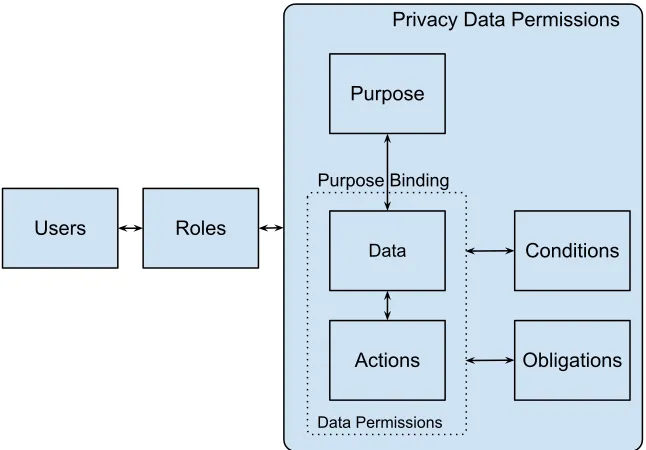
P-RBAC has sets of entities: users, roles, data, actions, purposes, obligations and conditions
(Figure 2.1). In P-RBAC, permissions are assigned to roles and users obtain permissions by
being assigned to roles. Data is related to a user and action is the activity that can be performed
on the data. The data is usually bound to a purpose (e.g., data collected for one purpose should
not be used for other purposes without user consent). Obligations refer to actions that need to
be performed after a particular action is executed on the data. Conditions are the pre-requisites
that must be satisfied before performing an action.
Example Privacy Policy: A data owner has the following requirement: The user type
re-searchers, can only read the zipcode field from the data for the purpose of Research, provided
the data owner has given consent for that particular researcher. For every read by a researcher
the owner is notified by their official email. This policy is expressed in P-RBAC as the
Purpose
Conditions
Obligations
Data
Actions
Data Permissions Purpose Binding
Privacy Data Permissions
Roles Users
Figure 2.1: Core P-RBAC
(RS, ((RD, ZCode), Research, OC=Yes, Notify(ByOfficialEmail)))
There are two types of users: Researchers (RS) and Customers. We assume that there
are also two roles which have the same names. The notation(RD, ZCode)denotes the data
(ZCode for zip code) and action (RD for read only). The notation Research specifies the
purpose. The notationOC=Yesdenotes the condition OwnerConsent (the owner needs to give
consent for revealing this data).
The notationNotify(ByOfficialEmail)is the obligation which states that the the
cus-tomer is notified by email for each read access of the zipcode. The policy specification is
independent of any configuration of services needed to support it.
Cloud computing and Privacy: Cloud computing is based on the concept of outsourcing
storage and computing of data (sometimes sensitive data) to a third party. With the increased
market appeal of cloud computing, there is growing concern over issues of data privacy within
the cloud based architectures. In the cloud computing context, the privacy policy is created by
the consumer of the cloud services, client and it is enforced by the server. Pearson et al. [88]
2.2. Privacy, Security andTrust 21
• Lack of user control of disclosed data with a cloud provider.
• Lack of training and expertise of the provider in handling PII.
• Unauthorized secondary usage of the data shared with the provider.
• Complexity of regulatory compliance in a dynamic cloud infrastructure, where data is
hosted simultaneously in multiple countries with different regulations.
• Addressing transborder data flow restrictions where certain types of data (such as health
information in USA) are not allowed to be transferred to a data center outside of the
country.
• Legal issues such as litigations a CSP may face to handover the data to a third party or
government.
The cloud faces the same privacy issues as other service delivery models, but it magnifies
existing issues due to the innate nature of delegation in cloud. The privacy issues in cloud are
deeply connected to data security.
2.2.2
Security
Security is one of the planet’s oldest activities [101]. It is hardwired into our ancestors for
survival against perceived threats from nature. Over the course of our evolution, security has
taken different forms: Physical security, national security, financial security, home security,
food security, school security, information security are few of them.
Security in information theory [88] is the preservation ofconfidentiality, integrity and avail-abilityof information. Confidentialityis the assurance that only the intended and authorized entities have access to the information.Integrityguarantees that the data is not modified in stor-age or transmission except by authorized entities. Availabilityensures information is available to authorized entities.
Security is a necessary, but not a sufficient condition for privacy [88]. Privacy specifications
allow clients to specify access and usage restrictions on the data, whereas security focuses on
Cloud computing and Security: As stated in Chapter 1, a survey conducted by IDC (a
market research firm) found that the Chief Information Officers of enterprises identify security
concerns as the top reason for them to not aggressively adopt cloud technologies [9]. Cloud
Security Alliance (CSA) [59] enumerates the following threats to the data in a cloud computing
environment.
• Sharing of data with an unauthorized party: The cloud provider could compromise
the confidentiality of the client’s data by sharing the data with unauthorized parties. This
can go against the Service Level Agreement (SLA) between the client and provider. The
client may never be aware of such a breach.
• Corruption of data stored: As the cloud provider has root access to physical machines,
the access allows the provider to modify/delete client’s data. The provider could tamper
with the data making the data non-usable or modify the data in a way that the system
can-not detect the modification. This poses a serious threat to the integrity of the application
data.
• Malicious internal users:The employee of a CSP who has root access to these physical
machines, could access the data and use it for their own advantage.
• Data loss or leakage: When a virtual machine is used in an infrastructure, it poses a
variety of security issues [48] which could compromise the data security. Moreover,
when the facility that hosts the user’s data is subjected to a natural calamity, it could risk
the loss of the user’s data.
These security issues need not hinder the clients from adopting cloud computing. Clients
can either deploy mechanisms such as Privacy Enhancing Technologies (PET) to protect their
PII ortrustthe provider is competent and will not act against the client’s interests.
2.2.3
Trust
The concept of trust spans across several domains. Sociologist Piotr Sztompka stated that “trust
is a bet about future contingent action of others” [105]. In psychology, trust “is believing that
2.2. Privacy, Security andTrust 23
Computational trust in cloud systems is defined by Yew et al. [120] as “a particular level
of subjective assessment of whether a trustee (cloud provider) will exhibit characteristics
con-sistent with the role of the trustee”. A model that aids in the calculation and analysis of
com-putational trust, is referred to as a trust model. Sabater et al. [97] classified these models as
conceptual models, information sources, direct experiences, witness information, sociological
information and prejudice. Trust is not unidimensional. It has the following properties [120]:
• Quantifiable and Comparable: A trust assessment of a trustor about a trustee can be
converted to a single scalar value which can be compared with the trustor’s assessment
of another trustee.
• Subjective: A trustor’s assessment of the trustee can be completely different to some
other trustor’s trust assessment.
• Dynamic:A trustor’s trust on a trustee can evolve/devolve with time.
• Multidimensional: A trustor may trust a trustee for a specific purpose but for not any
other purpose.
• Reflexive, Non-symmetrical and Non-Transitive.
Trust is essential for every society to work. Bruce Schneier in Liars and Outliers [101]
proposed when there is a lack of trust or dilemma on the part of the trustor several societal pressures can be introduced to induce trust (cooperation). These social pressures can be
cate-gorized as follows:
• Moral pressure: Pressure arising from an entity’s1 convictions on what is right and
wrong.
• Reputational pressure: Pressure that forces entities to follow group norms so that they
do not get bad reputation.
• Institutional pressure: Rules and laws of a state, ensureinstitutional pressure. They induce entities to conform to the rules by imposing penalties and sanctions on defaulters.
• Pressure introduced through Security systems: Security mechanisms induce
cooper-ation, prevent defection and compel compliance. They include proactive and preventive
systems such as door locks, alarms, tall fences and reactive systems such as forensic and
audit systems.
In this work we study in detail about inducing trust in the cloud service provider through
security systems. We focus on proactive preventive systems such as Privacy Enhancing
Tech-nologies (PET) and reactive systems such as remote attestation that apply social pressures on
the cloud service provider to conform to the accepted SLA. We do not study the calculation
of trust through a trust model. Trust models for clouds not only use performance related
at-tributes (downtime, responsiveness of services) to assess the trustworthiness of a cloud but
also, attributes that represent privacy compliance. We assume that there is a trust model that
will provide the client with trust values.
2.2.4
Risk Vs Trust
A concept that is closely related to trust is risk. Risk is the statistical expected value of an
unwanted event that may or may not occur [55]. Both trust and risk are essential tools used for
making decisions in an uncertain environment [63]. In the context of cloud computing risks
can arise from the following inherent issues in cloud computing [25]:
1. Business Continuity and Service Availability
2. Data Lock-in
3. Performance unpredictability
4. Data confidentiality and other security issues
Each of these inherent issues pose a potential risk to a cloud computing consumer. The
2.3. ThreatModel 25
2.3
Threat Model
Threat models in a cloud computing infrastructure are discussed in the literature by McCune
et al. [77], Bertholon et al. [34] and Bleikerts et al. [35]. Bertholon et al. [34] does not
elaborate on the threats in cloud server and remote adversary. Bleikerts et al. [35] discusses
threats arising from the cloud clients and the end users of the client’s services. We presented
the security threats to data stored in cloud computing by CSA in Section 2.2.2. To concretize
the threat model for the rest of the thesis, we introuduce a model that is very similar to the one
discussed in Mccune et al. [77] in a remote attestation context. The threats from the client and
the end users of client’s services are grouped under remote adversary. Threats for the client in
a cloud computing architecture can arise from the following entities: cloud server or a remote
adversary.
• Cloud server: A cloud server administrator has not only complete access to all the
in-formation stored in a cloud server but also has physical access to the server’s hardware.
They can execute and modify any binary in the server and have the ability to inject
ma-licious code in an executing binary by modifying the memory. In the extreme case a
malicious administrator has the ability to replace the bios, bootloader and the
operat-ing system with malwares. Physical attacks against the CPU, Trusted Platform Module
(TPM) or the system busses are not considered as part of this threat model.
• Remote adversary: A remote adversary can either attack the cloud server or try to
compromise the communication channel between the server and the client. The remote
adversary has access to the IP address of the cloud server and can deploy state of the art
attacks against the server.
As in any standard secure communication in the Internet, the Dolev-Yao intruder model
[42] is considered for network communication. A network adversary has the ability to analyze,
interject or modify network traffic between cloud server and the client. However, the adversary
cannot break cryptographic primitives.
In a cloud computing infrastructure the focus is largely on the cloud server adversary.
in-stalling firewalls and Intrusion Detection Softwares (IDS) [96]. It is also common among the
system administrators to follow some of the best practices in industry to secure against remote
attacks. The communication channels are protected using an encrypted SSL based pipeline
[41] for transmitting data in the network.
2.4
Privacy Enhancing Technologies (PET)
Privacy Enhancing Technologies (PET) induces trust on the cloud service provider by
pro-viding with a set of tools and mechanisms that cryptographically protect the clients privacy
online against the cloud service providers. PET is defined by Blarkom et al. [108] as “a system of information and communication technology measures protecting informational pri-vacy by eliminating or minimizing personal data thereby preventing unnecessary or unwanted processing of personal data, without the loss of the functionality of the information system.”. Privacy preserving protocols [47], a class of PET, enable users to perform computation over
cryptographically protected data.
PET technologies include:
1. Privacy management tools that enable inspection of server-side policies that specify the
permissible accesses to data.
2. Secure online access mechanisms to enable individuals to check and update the accuracy
of their personal data.
3. Anonymizer tools, which will help users from revealing their true identity by not
reveal-ing the PII (Privately Identifiable Information) to the cloud service provider.
Privacy Enhancing Technologies (PET) can be used by the developers of the application to
enhance the individual’s privacy in an application development environment. In this section,
we survey state of the art in PET.
Homomorphic Functions: Homomorphic encryption schemes refer to asymmetric
encryp-tion techniques, where algebraic operaencryp-tions on plain text can be performed directly on a
2.4. PrivacyEnhancingTechnologies(PET) 27
performed modular addition of two bits using multiplication of ciphertexts. The two kinds of
homomorphic functions are the following:
1. Partially homomorphic functions and
2. Fully homomorphic functions
Partial homomorphic functions enable either addition or multiplication on plaintexts, but
not both. However, in a fully homomorphic scheme, both operations are supported. Fully
homomorphic functions, allows executions of programs in an untrusted party without revealing
the input to the party. The untrusted party can been seen as a cloud provider.
Craig Gentry [51] described the first fully homomorphic encryption scheme based on
lattice-based cryptography. However performing Google search on encrypted keywords using
homo-morphic encryption based on Gentry’s scheme will increase the computing time by trillion
cycles.
Homomorphic encryption remains in the theoretical realm as more advanced abstractions
need to be created for using homomorphic functions in practical applications.
Privacy By Secure Computation: The objective of secure computation is to evaluate a
func-tion f that takes inputs from two parties A and B without revealing the exact inputs to each other. Yao’s protocol [119] provides some of the basic techniques to perform a computation in a
secure way without revealing the inputs. Yao’s protocol forces the expression of a computation
problem in terms of logical circuit using gates. The input of each gate is randomly encrypted
and then the final resulting output is decrypted to get the exact answer of the computation. The
encryption and the decryption is done at the client’s end. The expression of a simple problem
using Yao’s protocol is found to be non-trivial. Applications that typically reside in the cloud
(e.g., mail) are too complex to be converted into Yao’s circuits.
Privacy By Encryption: Privacy can be enforced by encrypting all the data that is stored in
the cloud. The main issue is that the cloud can be only used for storage of the data. As the
data will be unrecognizable to the cloud service provider, it will not be possible for the cloud
encryption uses an algorithm, which allows users to encrypt the data and then provides the
server with trapdoor information [36], so that the server can search for a given string through
the searchable encryption algorithm. This part is discussed in detail in Section 3.2.3 of Chapter
3.
Privacy-Preserving Multi-keyword Ranked Search over Encrypted Cloud Data [38]
pro-poses a new encryption scheme for keyword search over encrypted data in cloud computing
environment with privacy and performance requirements.
Although searchable encryption is a proven way of preserving privacy of data in the cloud
without compromising on the functionality of searching, cryptography increases the
compu-tational overhead on the server [94]. Moreover, the use case in which searchable encrpytion
is applicable to is ad-hoc (in this case for searching keywords) and may not be applicable to
complex application scenarios.
2.5
Remote Attestation
Remote attestation is a reactive security system that provides mechanisms for a client to verify
and attest a remote platform. This section presents the necessary background on remote
attesta-tion. The basic concepts of trusted computing and trusted boot is presented in Section 2.5.1 and
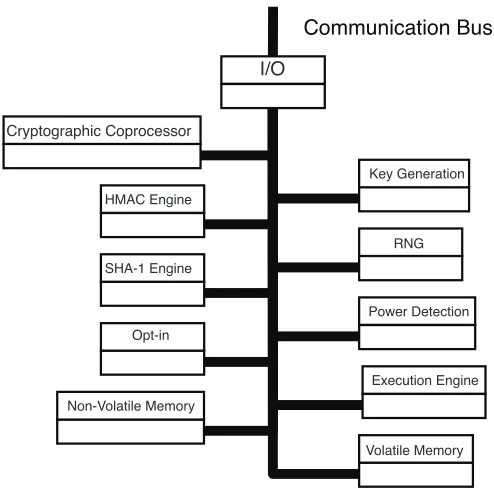
Section 2.5.2, respectively. The cryptographic coprocessor, Trusted Platform Module (TPM),
is discussed in detail in Section 2.5.3. This section concludes by presenting several methods of
remote attestation such as realtime measurements and dynamic measurements in Section 2.5.4
and Section 2.5.5.
2.5.1
Trusted Computing
To address the cloud server threat model described in Section 2.3, trusted computing was
intro-duced by Trusted Computing Group (TCG) [106]. Trusted Computing refers to the
infrastruc-ture that behaves consistently based on the expected behavior of the user. The behaviors are
enforced by computer hardware and software through remote attestation. The Trusted
Comput-ing Group is a consortium founded by AMD, CISCO, IBM, HP, Microsoft and Wave Systems