1999;54;413-419
Thorax
Anna Hansell, Jen Hollowell, Tom Nichols, Rosie McNiece and David Strachan
(MSGP4)
with the 4th Morbidity Survey in General Practice
(GPRD) for respiratory epidemiology: a comparison
Use of the General Practice Research Database
http://thorax.bmj.com/cgi/content/full/54/5/413
Updated information and services can be found at:
These include:
References
http://thorax.bmj.com/cgi/content/full/54/5/413#otherarticles
28 online articles that cite this article can be accessed at:
http://thorax.bmj.com/cgi/content/full/54/5/413#BIBL
This article cites 9 articles, 5 of which can be accessed free at:
service
Email alerting
top right corner of the article
Receive free email alerts when new articles cite this article - sign up in the box at the
Topic collections
(1862 articles)
Other Pediatrics
(1227 articles)
Asthma
(1074 articles)
Other respiratory medicine
Articles on similar topics can be found in the following collections
Notes
http://journals.bmj.com/cgi/reprintform
To order reprints of this article go to:
http://journals.bmj.com/subscriptions/
go to:
Thorax
Use of the General Practice Research Database
(GPRD) for respiratory epidemiology: a
comparison with the 4th Morbidity Survey in
General Practice (MSGP4)
Anna Hansell, Jen Hollowell, Tom Nichols, Rosie McNiece, David Strachan
Abstract
Background—The General Practice Re-search Database (GPRD) covers over 6% of the population of England and Wales and holds data on diagnoses and prescrib-ing from 1987 onwards. Most previous studies using the GPRD have concen-trated on drug use and safety. A study was undertaken to assess the validity of using the GPRD for epidemiological research into respiratory diseases.
Methods—Age-specific and sex-specific rates derived from the GPRD for 11 respi-ratory conditions were compared with patient consultation rates from the 4th Morbidity Survey in General Practice (MSGP4). Within the GPRD comparisons were made between patient diagnosis rates, patient prescription rates, and pa-tient “prescription plus relevant diagno-sis” rates for selected treatments.
Results—There was good agreement be-tween consultation rates in the MSGP4 and diagnosis or “prescription plus diag-nosis” from the GPRD in terms of pattern and magnitude, except for “acute bron-chitis or bronchiolitis” where the best comparison was the combination category of “chest infection” and/or “acute bron-chitis or bronchiolitis”. Within the GPRD, patient prescription rates for inhalers, tuberculosis or hayfever therapy showed little similarity with diagnosis only rates but a similarity was seen with the combi-nation of “prescription plus diagnosis” which may be a better reflection of morbidity than diagnosis alone.
Conclusions—The GPRD appears to be valid for primary care epidemiological studies by comparison with MSGP4 and oVers advantages in terms of large size, a longer time period covered, and ability to link prescriptions with diagnoses. How-ever, careful interpretation is needed because not all consultations are recorded and the coding system used contains terms which do not directly map to ICD codes.
(Thorax1999;54:413–419)
Keywords: computerised medical records; General Practice Research Database (GPRD); Morbidity Survey in General Practice (MSGP4); general practice; epide-miology; respiratory diseases
Increasing numbers of general practices are using computers to store patient details for various administrative functions1
which could potentially be used to investigate patterns of morbidity and repeat prescribing for assess-ment of local needs.2 3
One problem is ensuring the quality of the data, which is usually assessed by looking at completeness of recording and the accuracy of diagnoses compared with a “gold standard”.2
However, interpretation of computerised databases also requires an under-standing of the often complex ways in which data are recorded and of the limitations of observational data.4
In recent years the largest nationally recog-nised sources of information about consulta-tions in primary care in England and Wales have been the Morbidity Surveys in General Practice (MSGP).5
The first three surveys were in 1955/6, 1971/2 and 1981/2. The fourth Morbidity Survey in General Practice (MSGP4)6
was designed to record data on all consultations during the period 1 September 1991 to 31 August 1992 from 60 practices covering 1% of the population of England and Wales. Diagnoses were coded using Read codes and these were mapped to ICD9 codes in pub-lished results. Socioeconomic data were col-lected for 83% of patients and this showed that the population covered was broadly representa-tive of the general population, but under-representative of ethnic minorities and those living alone. Evaluation suggested that 96% of consultations in the surgery and 95% of home visits were recorded and that there was correct reporting in 93% of consultations.
There are several sources of computerised routine information on general practice mor-bidity and prescribing in England, but the larg-est is the General Practice Research Database (GPRD, formerly the VAMP database). This contains data from 1987 up to the present and in 1994 covered 5.6% of the population of England and Wales.7
The GPRD was designed to record all prescriptions issued, the indication for all new prescriptions, and all “significant” events such as consultations resulting in a referral and “events which the partner will require to be reminded of at a later date”8
—for example, diagnoses such as cystic fibrosis and tuberculosis and information from hospital let-ters and coroners’ reports. There is no require-ment to enter diagnoses for minor consulta-tions or to record follow up consultaconsulta-tions for chronic conditions unless the consultation leads to new treatment or to a referral. The Department of Public
Health Sciences, St George’s Hospital Medical School, Cranmer Terrace, London SW17 0RE, UK
A Hansell T Nichols D Strachan
General Practice Research Database, OYce for National Statistics, Room B6/04, 1 Drummond Gate, London SW1V 2QQ, UK
J Hollowell R McNiece
Correspondence to: Dr A Hansell.
diagnostic coding system used is OXMIS which can be cross-referenced to Read codes. None of the GPs supplying data to the GPRD took part in the MSGP4.
Not all practices using the VAMP medical practice software are included on the database (for inclusion practices must satisfy standard validation checks to ensure good capture of data).9
Recording of consultations resulting in a prescription is good: a study looking at first time use of non-steroidal anti-inflammatory drugs suggested that the indication for first time prescribing was recorded in 96% of cases.9 The extent to which consultations not resulting in a prescription are recorded is less certain. A study in 1990 of psychoses in 11 practices using VAMP found that 95% of prescriptions, but only 73% of consultations, in the written notes were entered on the computer.10
The GPRD has potential advantages over the MSGPs in that a larger proportion of the population is covered, data are available year on year, and information on both consulting and prescribing is collected; this may be particularly valuable for assessing the primary care burden of illnesses such as wheezing illness in childhood which is not always labelled as asthma.
While the MSGP4 is a widely used source of epidemiological information, the use of the GPRD to date has mainly been for studies of drug use and drug safety.7
Few studies have commented on its validity. One of these11
used the GPRD to estimate the incidence of anorexia nervosa and bulimia nervosa detected by GPs and found on record review that the clinical diagnosis of GPs matched DSM-IV criteria for 60% of anorexia and 52% of bulimia nervosa cases. Another commented that the rates of congenital malformations recorded were similar to national statistics and a special study.12
Only one paper has so far investigated the interpretation of GPRD data by a comparison with MSGP4.13
Good
agree-ment with MSGP4 was reported for consulta-tions for chickenpox and allergic rhinitis but GPRD rates for asthma and diabetes showed consultation rates “10–20% lower, depending on age”. The present study investigates the consistency of the GPRD with MSGP4 in more detail by comparisons of rates for 11 res-piratory diseases including asthma and also makes within database comparisons of pre-scribing and diagnostic information for four respiratory conditions.
Methods
Age-specific and sex-specific patient consulta-tion rates (measures of period prevalence) from the MSGP4 were compared with period preva-lence rates for England derived from the GPRD for 11 respiratory diagnoses: asthma; hayfever or allergic rhinitis (referred to as “hayfever”); chronic bronchitis, emphysema, or obstructive airways disease excluding asthma (“COPD”); tuberculosis; pneumonia; acute bronchitis or bronchiolitis; chest infec-tion or bronchitis not otherwise specified (“chest infection”); cystic fibrosis; sarcoidosis; fibrosing alveolitis; and pneumothorax.
MSGP4 patient consultation rates came from published data6
supplemented by special analyses to separate pneumonia from influenza and to combine codes relating to COPD. GPRD period prevalence rates were defined as a retrospective assessment of the numbers of subjects (recurrent and incident cases) with a specific diagnosis recorded within the calendar year in question divided by the person years at risk during that period. A weighted average of rates for 1991 and 1992 was calculated by add-ing one third of the GPRD consultadd-ing rate for 1991 and two thirds of the GPRD consulting rate for 1992 to approximate most closely the time period covered by MSGP4. A weighted number of patients was calculated in the same way. Weighted averages were used for all diag-noses except hayfever where 1992 data were
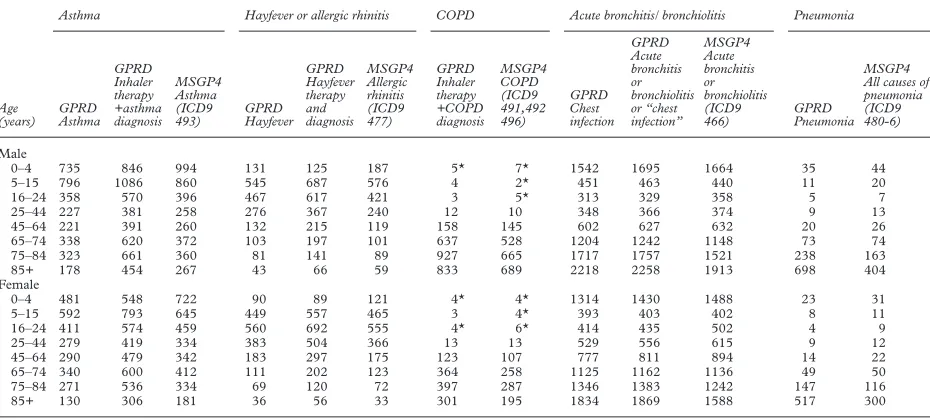
Table 1 Comparisons of age and sex-specific rates (expressed as numbers of patients per 10 000 patient years at risk) from the GPRD and MSGP4 for asthma; hayfever or allergic rhinitis; COPD excluding asthma; acute bronchitis or bronchiolitis and “chest infection”; and pneumonia. All GPRD rates are a weighted average of 1991 and 1992 figures except hayfever which relates to 1992 only
Age (years)
Asthma Hayfever or allergic rhinitis COPD Acute bronchitis/ bronchiolitis Pneumonia
GPRD Asthma GPRD Inhaler therapy +asthma diagnosis MSGP4 Asthma (ICD9 493) GPRD Hayfever GPRD Hayfever therapy and diagnosis MSGP4 Allergic rhinitis (ICD9 477) GPRD Inhaler therapy +COPD diagnosis MSGP4 COPD (ICD9 491,492 496) GPRD Chest infection GPRD Acute bronchitis or bronchiolitis or “chest infection” MSGP4 Acute bronchitis or bronchiolitis (ICD9 466) GPRD Pneumonia MSGP4 All causes of pneumonia (ICD9 480-6)
Male
0–4 735 846 994 131 125 187 5* 7* 1542 1695 1664 35 44
5–15 796 1086 860 545 687 576 4 2* 451 463 440 11 20
16–24 358 570 396 467 617 421 3 5* 313 329 358 5 7
25–44 227 381 258 276 367 240 12 10 348 366 374 9 13
45–64 221 391 260 132 215 119 158 145 602 627 632 20 26
65–74 338 620 372 103 197 101 637 528 1204 1242 1148 73 74 75–84 323 661 360 81 141 89 927 665 1717 1757 1521 238 163
85+ 178 454 267 43 66 59 833 689 2218 2258 1913 698 404
Female
0–4 481 548 722 90 89 121 4* 4* 1314 1430 1488 23 31
5–15 592 793 645 449 557 465 3 4* 393 403 402 8 11
16–24 411 574 459 560 692 555 4* 6* 414 435 502 4 9
25–44 279 419 334 383 504 366 13 13 529 556 615 9 12
45–64 290 479 342 183 297 175 123 107 777 811 894 14 22
65–74 340 600 412 111 202 123 364 258 1125 1162 1136 49 50 75–84 271 536 334 69 120 72 397 287 1346 1383 1242 147 116
85+ 130 306 181 36 56 33 301 195 1834 1869 1588 517 300
*Small numbers (<30 patients) within age/sex category.
used (1992 was a year with an exceptionally high number of consultations for hayfever14 and, as most cases of hayfever occur in summer, this seemed the more appropriate).
For diagnoses of asthma, COPD, hayfever and tuberculosis, additional prescribing data for relevant treatments was obtained from the GPRD. Treatment for asthma and COPD was defined as any prescription from the British National Formulary (BNF) sections 3.1 to 3.3 inclusive (referred to as “inhalers”), treatment for hayfever as prescriptions from BNF chap-ters 3.4.1 plus 12.2 (“hayfever therapy”), and treatment for tuberculosis prescriptions from section 5.1.9 (“tuberculosis therapy”). Patient prescription rates, defined as the number of patients with any relevant prescription during the calendar year divided by the person years at risk during that period, were calculated for inhalers, hayfever therapy, and tuberculosis therapy. Rates for the combinations of “rel-evant therapy plus diagnosis” were also calcu-lated for four categories: inhaler plus diagnosis of asthma but excluding patients who also had a diagnosis of COPD; inhaler plus diagnosis of COPD; hayfever therapy plus diagnosis of hay-fever; tuberculosis therapy plus tuberculosis diagnosis. The “combination” rates were
de-fined as the numbers of patients with both a relevant prescription within the calendar year in question and an associated diagnosis (re-corded at any time before the prescription including previous years, or at the same time as the prescription, or at some time after the pre-scription up to the end of the calendar year) divided by the total patient years at risk for the period.
Our presentation focuses on the similarity or diVerences between the patterns of prevalence
by age and sex as derived from the two data sources. Confidence intervals for rates were not calculated because the data sources referred to diVerent populations and data were collected
in diVerent ways.
Results
Comparisons within the GPRD and between the GPRD and MSGP4 are discussed by disease category. Comparisons are presented by sex and age bands for more frequently occurring conditions (table 1) while total and sex-specific rates are presented for rarer condi-tions (table 2).
Table 2 Comparison of total and sex-specific rates (expressed as numbers of patients per 10 000 patient years at risk) from the GPRD and MSGP4 for tuberculosis (TB), cystic fibrosis, sarcoidosis, fibrosing aleveolitis and pneumothorax. All GPRD rates are a weighted average of 1991 and 1992 figures
Tuberculosis Cystic fibrosis Sarcoidosis Fibrosing alveolitis Pneumothorax
GPRD TB diagnosis (all sites)
MSGP4 TB (ICD9 010-018) (all sites)
GPRD Cystic fibrosis
MSGP4 Cystic fibrosis (ICD9 277.0)
GPRD Sarcoidosis
MSGP4 Sarcoidosis (ICD9 135)
GPRD Fibrosing alveolitis
MSGP4 Fibrosing alveolitis (ICD9 516.3)
GPRD Pneumothorax
MSGP4 Pneumothorax (ICD9 512)
Rates
Total 1.4 3 0.7 0.8 1.1 1 1.5 1.8 1.7 2
Males 1.6 4 0.8 0.6 1.2 1 1.8 2.3 2.6 2
Females 1.3 2 0.7 0.7 1.1 1 1.2 1.3 1.0 1
Numbers
Total 200 78 103 34 159 129 211 83 242 79
Males 108 46 56 15 76 68 124 52 174 54
Females 92 32 47 19 83 61 87 31 68 25
Figure 1 Asthma in GPRD and MSGP4.
2500
2000
1000 1500
500
0
Age in years Men
No. of patients per 10 000 person years at risk
0–4 5–15
16–24 25–44 45–64 65–74 75–84
85+
GPRD inhaler prescription
GPRD asthma diagnosis
GPRD inhaler prescription plus asthma diagnosis
MSGP4 consultation for asthma
2500
2000
1000 1500
500
0
Age in years Women
0–4 5–15
16–24 25–44 45–64 65–74 75–84
ASTHMA AND COPD
Within GPRD comparisons showed a striking diVerence in the patient inhaler prescription
rates compared with diagnosis rates for asthma (fig 1) and for COPD (fig 2), which suggests that inhaler prescription was not a reasonable proxy for consultations for COPD and could only be used as a proxy for asthma in patients aged 16–44 years. Further analysis showed that COPD was the indication for inhalers in less than 2.5% of patients under 45 years, rising to 46% in those aged 75–84 years. Excluding patients with a diagnosis of COPD, 57% of the remaining patients prescribed an inhaler had received a diagnosis of asthma but this varied widely by age, rising from 39% of 0–4 year olds
to 80% of 15–24 year olds then declining with age to 19% of those aged 85–99 years.
In general, GPRD diagnosis rates for COPD and asthma were similar to consultation rates seen in the MSGP4, while GPRD rates for inhaler plus diagnosis (of COPD or asthma excluding COPD) were slightly higher.
HAYFEVER
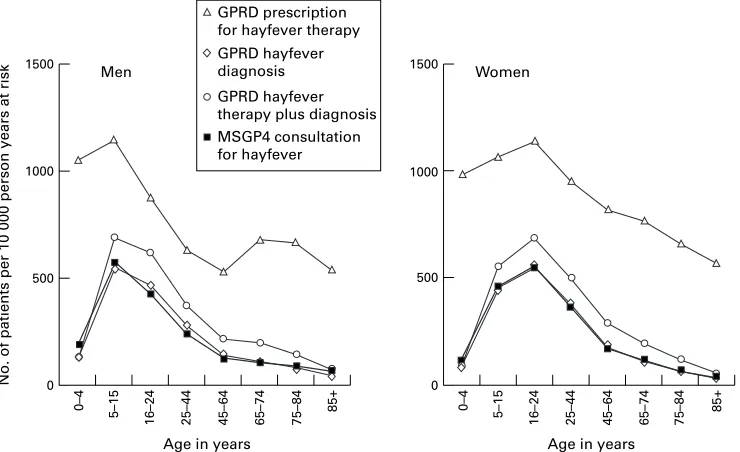
Again, a striking diVerence was seen between
GPRD hayfever therapy rates and hayfever diagnosis rates with the greatest diVerences
seen at the extremes of age (fig 3). Hayfever therapy as defined could therefore not be used as a proxy for hayfever prevalence. GPRD rates for “hayfever therapy plus diagnosis” were
Figure 2 COPD in MSGP4 and GPRD.
2500
2000
1000 1500
500
0
Age in years Men
No. of patients per 10 000 person years at risk
0–4 5–15
16–24 25–44 45–64 65–74 75–84
85+
GPRD inhaler prescription
GPRD COPD diagnosis
GPRD inhaler prescription plus COPD diagnosis
MSGP4 consultation for chronic bronchitis, emphysema or COAD
2500
2000
1000 1500
500
0
Age in years Women
0–4 5–15
16–24 25–44 45–64 65–74 75–84
85+
Figure 3 Hayfever in MSGP4 and GPRD.
1500
1000
500
0
Age in years Men
No. of patients per 10 000 person years at risk
0–4 5–15
16–24 25–44 45–64 65–74 75–84
85+
GPRD prescription for hayfever therapy
GPRD hayfever diagnosis
GPRD hayfever therapy plus diagnosis
MSGP4 consultation for hayfever
1500
1000
500
0
Age in years Women
0–4 5–15
16–24 25–44 45–64 65–74 75–84
85+
slightly higher than for diagnosis alone, and both categories were similar to MSGP4 consultation rates for allergic rhinitis.
PNEUMONIA
GPRD diagnosis rates for pneumonia were similar to MSGP4 consultation rates except in the elderly (85+) where GPRD rates were higher.
ACUTE BRONCHITIS OR BRONCHIOLITIS OR CHEST INFECTION
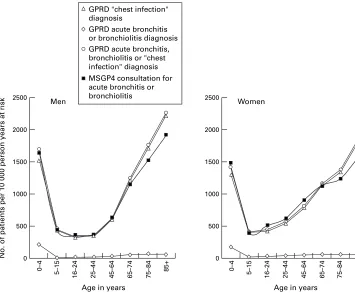
GPRD diagnosis rates for “acute bronchitis or bronchiolitis” were an order of magnitude lower and a diVerent pattern from MSGP4
consultation rates for “acute bronchitis or bronchiolitis” (fig 4) and a diVerent pattern
from “bronchitis not otherwise specified” (ICD9 code 490)6
(not shown). GPRD diagnosis rates for “chest infection” were an order of magnitude higher than MSGP4 con-sultation rates for “bronchitis” or “pneumonia and influenza” (ICD9 codes 480–7),6
but there were some similarities with MSGP4 consultation rates for the common cold (ICD9 code 460) in children aged 0–15 years6
(not shown). However, GPRD diagnosis rates for both “chest infection” and the combination category of “acute bronchitis or bronchiolitis” or “chest infection or bronchitis not otherwise specified” in GPRD showed a similar pattern and order of magnitude to MSGP4 consulta-tion rates for “acute bronchitis or bronchioli-tis”, particularly in those under 65 years of age (fig 4). In those aged over 65 years the GPRD rates were slightly higher than the MSGP4 rates; some of the discrepancy may be accounted for by the increased rates of
diagnoses of “bronchitis not otherwise speci-fied” (ICD9 490) in MSGP4 in these age groups.6
It is possible that the diagnosis “chest infec-tion” as used in the GPRD could be more pre-cisely coded as a number of other conditions, but the comparisons made suggest that most of these would have been coded as “acute bronchitis or bronchiolitis” in MSGP4.
TUBERCULOSIS(ALL SITES)
GPRD patient prescription rates for tuberculo-sis treatment were much higher than diagnotuberculo-sis rates, particularly in children aged 0–4 years, which suggests that prescription rates could not be used as a proxy for prevalence rates. In general, GPRD data showed slightly higher rates for diagnosis alone than for tuberculosis therapy plus diagnosis. There were close similarities between the rates for a diagnosis of tuberculosis in GPRD and in MSGP4 but small numbers were involved—in the GPRD the maximum number of patients in any age/sex group was 32.
CYSTIC FIBROSIS
On first analysis the GPRD recorded 23 women, but no men, aged 45–64 years with cystic fibrosis, which was inconsistent with the known epidemiology of the disease. Further manual review of records showed that a total of 57 women (of all ages) with fibrocystic disease of the breast had been miscoded as having cystic fibrosis. Using corrected figures, rates in both GPRD and MSGP4 were similar, based on small numbers of patients.
Figure 4 Acute bronchitis or bronchiolitis in MSGP4 and GPRD.
2500
2000
1000 1500
500
0
Age in years Men
No. of patients per 10 000 person years at risk
0–4 5–15
16–24 25–44 45–64 65–74 75–84
85+
GPRD acute bronchitis or bronchiolitis diagnosis GPRD "chest infection" diagnosis
GPRD acute bronchitis, bronchiolitis or "chest infection" diagnosis
MSGP4 consultation for acute bronchitis or
bronchiolitis 2500
2000
1000 1500
500
0
Age in years Women
0–4 5–15
16–24 25–44 45–64 65–74 75–84
SARCOIDOSIS,FIBROSING ALVEOLITIS AND PNEUMOTHORAX
For all three conditions, consultation and diag-nosis rates were similar in both the MSGP4 and GPRD, based on small numbers of patients.
Discussion
Despite diVerent recording and coding
re-quirements, GPRD rates of subjects with a diagnosis or prescription plus diagnosis closely approximated rates of subjects consulting for that illness in the MSGP4 for most respiratory diseases. For acute bronchitis or bronchiolitis the most appropriate comparison appeared to be between the combination category “acute bronchitis or bronchiolitis” or “chest infection” from the GPRD and the MSGP4 category “acute bronchitis or bronchiolitis”.
MISCLASSIFICATION
The misclassification identified in cystic fibro-sis was probably related to the OXMIS coding scheme structure as both “cystic fibrosis” and “fibrosis cystic” are grouped together under a single code.
The diagnosis category “chest infection” in the GPRD presented a problem of interpret-ation as it was non-specific and involved a large number of patients. Misclassification of other diagnoses as “chest infection” could potentially have caused large biases in those conditions aVecting smaller numbers of patients. Some
overlap was identified: 49% of those with a diagnosis of chronic bronchitis, emphysema or obstructive airways disease (excluding asthma) also had a diagnosis of chest infection within the same year. Part of this may reflect the natu-ral history of the diseases with a number of chest infections occurring prior to diagnosis, but this overlap group represented only 4.5% of patients with a diagnosis of chest infection. A large degree of misclassification is unlikely since GPRD rates seen for “chest infection” closely resembled the MSGP4 rates for consul-tations for “acute bronchitis or bronchiolitis”, while GPRD rates for other conditions closely approximated the MSGP4 rates.
RECORDING AND CODING DIFFERENCES
There are a number of reasons why the rates in the GPRD and MSGP4 might not be exactly the same—for example, recording require-ments diVer. MSGP4 data relate to all GP
consultations while GPRD data relate to “significant” consultations and events and pre-scriptions issued. Paperless GPRD practices are likely to record more consultations than those who enter paper records into the database.
Another possibility for discrepancies between the rates is that the MSGP4 requires that defini-tive diagnoses should be recorded where possi-ble. The GPRD does not have this requirement, so diagnoses recorded may reflect clinical practice more closely than MSGP4. For exam-ple, higher consultation rates for asthma in chil-dren aged 0–4 years in the MSGP4 than in the GPRD (fig 1) may reflect a greater readiness to label wheezing illness as asthma.
It is also possible that the prescription given will influence the diagnosis recorded in the GPRD—for example, if a patient with COPD consults with a chest infection and requires antibiotics they may be recorded as “chest infection”, but if a prescription for an inhaler is also required the most appropriate indication would be “chronic bronchitis”.
USE OF PRESCRIBING DATA
For asthma, COPD and hayfever, GPRD rates for therapy plus diagnosis were higher than diagnosis rates from both the MSGP4 and the GPRD and may better reflect the disease bur-den in primary care than diagnosis rates—for example, detecting patients with an exacerba-tion of COPD or asthma which is classified as “chest infection” and including repeat mainte-nance prescribing. In contrast, the rates for tuberculosis therapy plus diagnosis were lower than those with diagnosis alone. Explanations for this include the miscoding of BCG vaccina-tions, recording of information from death cer-tificates, and patients whose tuberculosis treat-ment was not recorded in the GPRD because they were treated wholly as outpatients.
Patient prescription rates alone could not be used as a proxy for disease prevalence rates. Inhaler prescriptions alone were not a good proxy for either asthma or COPD, particularly at the extremes of age. The discrepancy between inhaler prescriptions and asthma diagnosis suggests that inhalers cannot be con-sidered solely as asthma drugs and is consistent with other criticisms of the use of the overall steroid:bronchodilator ratio as a proxy for quality prescribing for asthma.15
In children it is possible that some of the diVerence between
prescriptions and diagnoses represents wheez-ing due to lower respiratory tract infection such as bronchiolitis, and some relates to a reluc-tance to diagnose asthma until a clinical pattern is established.
The a priori definition of hayfever therapy was not a good measure of hayfever prevalence, probably because the category used was too broad, including nose drops which are pre-scribed for other reasons than hayfever. Tuber-culosis therapy was not a good measure of the prevalence of tuberculosis, probably because of the use of rifampicin for meningitis prophylaxis and as a general antibiotic.
GENERALISABILITY
In 1991/2 the GPRD covered approximately 2.9% of the population of England while the MSGP4 covered 1% of the population of Eng-land and Wales. This study found that the GPRD rates were generally similar to those seen in the MSGP4. However, GPs in both the MSGP4 and GPRD volunteered to take part. Those who participated in the MSGP4 have been described as “diVerent from the average
of all practices in England and Wales”7 —for example, there are fewer single handed GPs and principal doctors in these practices are younger than the average—and this may limit the generalisability of the rates. GPs involved in the GPRD are more representative than MSGP practices in terms of geographical
spread and 17% of practices are single handed compared with 12% in the MSGP4 and 31% nationally (unpublished data).
Use of both the GPRD and MSGP4 for epi-demiological analysis is likely to increase as CD-ROMs containing selected tables and/or datasets of anonymised patient records from both the MSGP416
and from the GPRD17 have recently become available. This comparative analysis required access to the full datasets, which is not available at the time of writing but release of a CD-ROM for the full MSGP4 dataset is forthcoming.
We conclude that the GPRD appears to be a valid source of epidemiological information on respiratory diseases. It has the potential to extend the analysis of primary care data offered by the MSGP4, due to its larger size, longer time period covered, wide geographical rep-resentation, and the ability to link prescriptions with diagnoses. However, careful interpretation of the data is necessary to make allowance for the way in which the information has been col-lected and coded.
The authors acknowledge Professor Ross Anderson (Depart-ment of Public Health Sciences, St George’s Hospital Medical School) for comments on an earlier draft of this paper. The views expressed in this paper are those of the authors and not necessarily those of the Department of Health.
Funding: Department of Health.
1 Purves IN. The paperless general practice. BMJ
1996;312:1112–3.
2 Whitelaw FG, Taylor RJ, Nevin SL,et al. Completeness and accuracy of morbidity and repeat prescribing records held on general practice computers in Scotland.Br J Gen Pract
1996;46:181–6.
3 Tyrer F, Hambleton I, Lawrenson R,et al. Building a research database from computerised general practice record.J Informatics Primary Care1996;September:8–13. 4 Jick H. A database worth saving.Lancet1997;350:1045. 5 McCormick A, Charlton J, Fleming D. Assessing health
needs in primary care. Morbidity study from general prac-tice provides another source of information.BMJ1995; 310:1534.
6 McCormick A, Fleming D, Charlton J.Morbidity statistics from general practice. Fourth national study 1991–1992. London: HMSO, 1995.
7Key health statistics in general practice.London: The Station-ery OYce, 1996.
8 Mann RD, Hall G, Chukwujindu J. Research implication of computerised primary care. Post-Marketing Surveillance
1992;5:259–68.
9 Jick H, Jick SS, Derby LE. Validation of information recorded on general practitioner based computerised data resource in the United Kingdom.BMJ1991;302:766–8. 10 Nazareth I, King M, Haines A,et al. Accuracy of diagnosis
of psychosis on general practice computer system.BMJ
1993;307:32–4.
11 Turnbull S, Ward A, Treasure J,et al. The demand for eat-ing disorder care. An epidemiological study useat-ing the Gen-eral Practice Research Database.Br J Psychiatry1996;169: 705–12.
12 Lis Y, Mann RD. The VAMP research multi-purpose data-base in the UK.J Clin Epidemiol1995;48:431–43. 13 Hollowell J. The General Practice Research Database:
qual-ity of morbidqual-ity data.Population Trends1997;87:36–40. 14 Ross AM, Fleming DM. Incidence of allergic rhinitis in
general practice, 1981–92.BMJ1994;308:897–900. 15 Shelley M, Croft P, Chapman S,et al. Is the ratio of inhaled
corticosteroid to bronchodilator a good indicator of the quality of asthma prescribing? Cross-sectional study linking prescribing data to data on admissions.BMJ1996; 313:1124–6.
16 OYce for National Statistics (ONS).Morbidity statistics from general practice 1991–2.CD-ROM. London: ONS, 1998. 17The EPIC encyclopaedia of clinical practice. London: GP