912 | P a g e
LOCATION BASED E-BLOOD BANKING SYSTEM
FOR EMERGENCY SITUATIONS
Mr. S. Venkatasubramanian, N.Ramya, P. Nivetha, P. Nivetha,
J.Vijayalakshmi
Associate Professor, Saranathan College of Engineering (India)
Computer Science and Engineering, Saranathan College of Engineering
ABSTRACT
Every day, a large number of people need blood to undergo various medical procedures. It is very difficult to
find people who are willing to provide blood and are available within close proximity. In order to help people
who are in need of blood, the E Blood Banking System can be used effectively for getting the details of blood
donors having the same blood group and are nearby, so that blood can be obtained when needed urgently. This
is an online system, where anyone who wishes to donate blood can get themselves registered by creating an
account by providing a username and password. Upon registration, they will have an option to submit their
contact details, blood group, their availability to donate blood and the location details. Anyone, who is in need
of blood can visit the site and search for donors by supplying the required blood group or location where the
blood is needed. Instantly, the system will show the contact details of the available donors nearby. This will
greatly enhance the possibility of finding an available donor quickly there by help save precious lives.
Keywords: Blood Donor, Haversineformula, Googlemaps, Key
I. INTRODUCTION
Blood is a precious thing in life and is in great demand due to various life threatening situations. In most of the
cases, blood will be needed very urgently. Due to various stocking policy of hospitals, patients will be asked to
arrange for blood even if blood of matching group is available in the hospital. In situation like this, it is very
difficult for the people to arrange sufficient quantity of blood in short period of time.
So, if there is a system that can help people find willing donors in nearby location quickly, it will be of immense
help. Keeping this in mind, eBlood Banking System has been developed. eBlood Banking System is an online
system, developed using Python keeping scalability and availability of the system in mind.
Every willing donor has to register with the system and provide various personal details that are required to
identify their blood group, their contact details to contact them in emergency situations, their location details in
google map. Once, the system has all the above details, it’s very easy for a person in need of the blood to search
and contact the donors.
When someone is in need of blood, all they have to do is, open the application, feed the blood group needed and
913 | P a g e
and identify suitable donors based on their blood group, availability, suitability and proximity. This way, systemwill avoid wastage of time and will provide the contact details of the donors instantly for the needy to get in
touch with the donor and get help.
II E-BLOOD BANKING SYSTEM
2.1Approach
This project is aimed at providing a reliable and faster way to identify potential blood donors who can be
approached to donate blood in quick time. Just by providing the required blood group and selecting the location
where the blood is required, user will be able to get a list of potential donors contact details. They can then use
the details to contact the donors and have them donate blood.
There are three stages in the system
1. Donor Registration
2. Donor Profile Management
3. Donor Search
2.2 Donor Registration
Every donor has to register with the system. To register, the donor has to provide a username and password.
User name can be of any length greater than zero and should be less than 25 characters. Password can be also of
any length greater than zero and should be less than 25 characters. Password will be encrypted using werkzeug
micro framework for flask and python. To access the system, the donor has to sign in using a valid credential
that was used during the registration process.
Fig1.Sign Up
2.3Donor Profile Management
Once, a donor is registered with the system, he/she has to update the profile. In profile module, details such as
914 | P a g e
fields that must be supplied to save the profile. They are Name, Mobile Number and Blood Group. If these,three data are not supplied, the system will not allow the data to be saved.
It is very important to have a proper location of the donor as the entire system relies on this accuracy. To help
the donor to specify their location accurately, google maps has been integrated with this module. User can click,
Open Map button to open google map in a dialog window. They can find their location on the map and click it to
get the corresponding latitude and longitude. They will get automatically populated to the fields on the profile
window.
When a logged in user visits this module, it will show their details. If any change is required, they can change it
here and save it again.
Fig 2. Profile Update
2.4 Donor Search
Both registered user and un-registered user can use this module. User has to provide the blood group required
and the location it is required. Similar to Donor Profile Update Module, here also the system is integrated with
google maps. User can use the map to specify the location where the blood is required. Upon clicking search,
915 | P a g e
details if any potential donor is found.Fig3. Donor Search
III. ALGORITHM
EBBS uses Haversine formula to calculate the radius within which the donors have to be searched. It’s a simple
and efficient algorithm to filter out the donors who can be contacted easily.
EBBS analyses the suitability of the blood group, proximity and availability of the donor, donor’s previous
donation history to identify the potential donors.
Presuming a spherical Earth with radius R (see below), and that the locations of the two points in spherical
coordinates (longitude and latitude) are lon1,lat1 and lon2,lat2, then the Haversine Formula (from R. W. Sinnott,
"Virtues of the Haversine," Sky and Telescope, vol. 68, no. 2, 1984, p. 159):
dlon = lon2 - lon1
dlat = lat2 - lat1
a = (sin(dlat/2))^2 + cos(lat1) * cos(lat2) * (sin(dlon/2))^2
c = 2 * atan2(sqrt(a), sqrt(1-a))
916 | P a g e
will give mathematically and computationally exact results. The intermediate result c is the great circle distancein radians. The great circle distance d will be in the same units as R.
IV. SYSTEM ARCHITECTURE
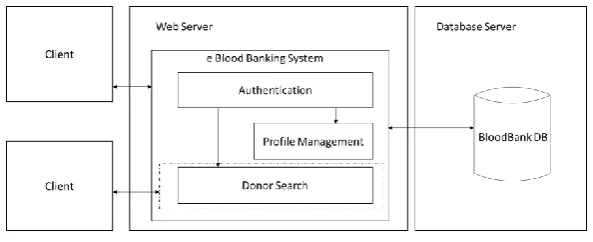
The below diagram depicts a high level architecture of eBlood Banking system.
Fig 4. system architecture
V. DATA ACCURACY
5.1Google Maps
In system, the more accurate the data, the more accurate the result will be. To enhance the accuracy of the data entered
into the system, eBBS uses google map while creating the profile of the donor. Donor can use google maps to search for
their location and select it to feed the address as well as the geo location. This greatly avoids mistakes and enhances the
accuracy of the data. Also, it provides an easy way for the donor to fill the data.
VI CONCLUSION
EBlood Banking System helps to locate potential donors in a very short time. It can be used by anyone having a
browser enabled device and an internet connection to search for a donor and contact him/her. With the location
tracking feature enabledthe donor can be easily found and contacted. A mobile version of the application will be
of great help.
REFERENCES
[1] http: //python.org/
[2] http://flask.pocoo.org/
[3] VikasKulshreshtha, Dr. SharadMaheshwari, “Blood Bank Management Information System in India”,
GovernmentEngineering College Jhalawar,International Journal of Engineering, Research and
Applications, Volume 1 , pp.260-263
[4] P. Priya1, V. Saranya2, S. Shabana3, Kavitha Subramani4, “The Optimization of Blood Donor
Information and Management System by Technopedia”. Department of Computer Science and
917 | P a g e
[5] TusharPandit, SatishNiloor and A.S. Shinde, “A Survey Paper on -Blood Bank and an Idea to use onSmartphone”. Dept. of I.T Sinhgad Academy of Engineering, Pune, India.Year 2015.
[6] Narendra Gupta1, Ramakant Gawande2 and Nikhil Thengadi3, “MBB: A Life Saving Application”. Final
Year, CSE Dept., JDIET, Yavatmal, India.VOLUME-2, SPECIAL ISSUE-1, MARCH-2015.