578 | P a g e
COMPARATIVE ANALYSIS OF FLEXURAL STRENGTH BY
USE OF BRICK DUST AND FLY ASH AS A REPLACEMENT OF
FINE AGGREGATE IN SELF COMPACTING CONCRETE
Sameer Malhotra
1and JavaidIqbal
21
Assistant Professor, Department of Civil Engineering,
Gurukul Vidyapeeth Institute of Engineering & Technology, Banur
2
Research Scholar, Department of Civil Engineering,
Gurukul Vidyapeeth Institute of Engineering & Technology, Banur
ABSTRACT
Sustainable resource management and development have been at the forefront of important issue concerning the
construction industry for the past several years. Specifically, the use of sustainable building material and reuse
waste materials in gaining importance and becoming common place in many areas. As one of the most commonly
used construction material in the world, concrete composed of natural aggregate, natural sand, cement and water,
out of these common materials for concrete, cement can be manufactured in industries but natural aggregates are
non-renewable resources and depleting at an alarming rate, resulting in scarcity of good quality natural occurring
aggregates (coarse and finer). In addition, India is the second largest producer of clay fired bricks, accounting to
more than 10 percent of the global production. India is estimated to have more than 100,000 brick kilns,
manufacturing about 150 – 200 billion bricks annually. Due to the manufacturing defects in shape of bricks, the
brick specimen is discarded and considered as a waste also the broken pieces of brick bats during handling and
transportation are of no use in construction work and considered as waste material and are dumped as waste,
causing land scarcity and environmental pollution. Using these types of waste material for concrete is a bigger step
towards sustainable infrastructure development.
Similarly, thermal power station using pulverized coal or lignite as fuel generate large quantities of ash as a
by-product. There are about 82 power plants in India, which form the major source of fly ash in the country. With the
commissioning of super thermal power plants and with the increasing use of low grade coal of high ash content, the
current production of ash is about 85 million tonnes per year. The figure is likely to go upto 100 million tonnes per
579 | P a g e
1.0.
INTRODUCTION
Compared to normally vibrated concrete (NVC), self-compacting concrete (SCC) possesses enhanced qualities and
improves productivity and working conditions due to the elimination of compaction. SCC generally has higher
powder content than NVC and thus it is necessary to replace some of the cement by additions to achieve an
economical and durable concrete. Japan has used self-compacting concrete (SCC) in bridge, building and tunnel
construction since the early1990„s. In the last five years, a number of SCC bridges have been constructed in Europe.
In the United States, the application of SCC in highway bridge construction is very limited at this time. However,
the U.S. precast concrete industry is beginning to apply the technology to architectural concrete. SCC has high
potential for wider structural applications in highway bridge construction. The application of concrete without
vibration in highway bridge construction is not new. For examples, placement of concrete underwater has been
placed without vibration, and shaft concrete can be successfully placed without vibration. These seal, mass and shaft
concretes are generally of lower strength, less than 34.5 MPa and difficult to attain consistent quality. Modern
application of self-compacting concrete (SCC) is focused on high performance. Better and more reliable quality,
dense and uniform surface texture, improved durability, high strength, and faster construction. Recognizing the lack
of uniformity and complete compaction of concrete by vibration, researchers at the University of Tokyo, Japan,
started out in late 1980„s to develop SCC. By the early 1990„s Japan has developed and used SCC that does not
require vibration to achieve full compaction. More and more applications of SCC in construction have been reported
in Japan. As of the year 2000, the amount of SCC used for prefabricated products (precast members) and
ready-mixed concrete (cast-in-place) in Japan was about 400,000 m3. Several European countries were interested in
exploring the significance and potentials of SCC developed in Japan. These European countries formed a large
consortium in 1996 to embark on a project aimed at developing SCC for practical applications in Europe. The title
of the project is Rational Production and Improved Working Environment through using Self- Compacting
Concrete. In the last six years, a number of SCC bridges, walls and tunnel linings have been constructed in Europe.
In the INDIA, SCC is beginning to gain interest, especially by the precast concrete industry and admixture
manufacturers. The precast concrete industry is beginning to apply the technology to commercial projects when
specifications permit. The applications range from architectural concrete to complex private bridges.
2.0.
NEED FOR THIS RESEARCH
Awareness of SCC has spread across the world, prompted by concerns with poor consolidation and durability in
case of conventionally vibrated normal concrete. However, the awareness in the India regarding SCC is somewhat
muted and this explains the lack of any commercial use of SCC in the India thus far. The reluctance in utilizing the
advantages of SCC, if any, in India, stems from two contributing factors:
580 | P a g e
The potential problems for the production of SCC, if any, with local marginal aggregates and the harshenvironmental conditions prevailing in the region.
There is a need to conduct studies on SCC using local aggregates. Self-compacting concrete (SCC) is a sensitive
mix, strongly dependent on the composition and the characteristics of its constituents. It has to possess the
incompatible properties of high flowability together with high segregation resistance, a balance made possible by the
dispersing effect of water reducing admixture combined with cohesiveness produced by a high concentration of fine
particles. The motive for development of self-compacting concrete was the social problem on durability of concrete
structures that arose around 1983 in Japan. Due to a gradual reduction in the number of skilled workers in Japan's
construction industry, a similar reduction in the quality of construction work took place. As a result of this fact, one
solution for the achievement of durable concrete structures independent of the quality of construction work was the
employment of self-compacting concrete, which could be compacted into every corner of a formwork, purely by
means of its own weight
3.0.
RESEARCH OBJECTIVES
The main objectives set for this research were to compare the mechanical properties of self-compacting and normal
concrete specimens and. The criteria used were based on 7days, 28-day and 56 days compressive, splitting tensile
and flexure strength and of conventional and self-compacting concrete for five Fly ash & Brick dust ratios as a
replacement to fine aggregate.
3.1.
RESEARCH SCOPE
The scope of this research included an examination of:
o The effect of brick dust on SCC
o The effect of brick dust and fly ash on replacement of fine aggregate on flexure strength properties of
self-compacting concrete.
4.0.
EXPERIMENTAL SUITE
Table 1.1:Mix Proportions of SCC
Mix design
Normal mix
Mix 1
Mix 2
Mix 3
Mix 4
Cement (Kg/m
3)
440
440
440
440
440
Fly ash
00
440
440
440
440
581 | P a g e
Coarse Aggregate
720
53
85
107
128
Fine Aggregate
1067
720
720
720
720
Super Plasticizer
1.25%
1.25% 1.25% 1.25% 1.25%
Water/Cement
0.40
0.40
0.40
0.40
0.40
4.1.FRESH CONCRETE PROPERTIES
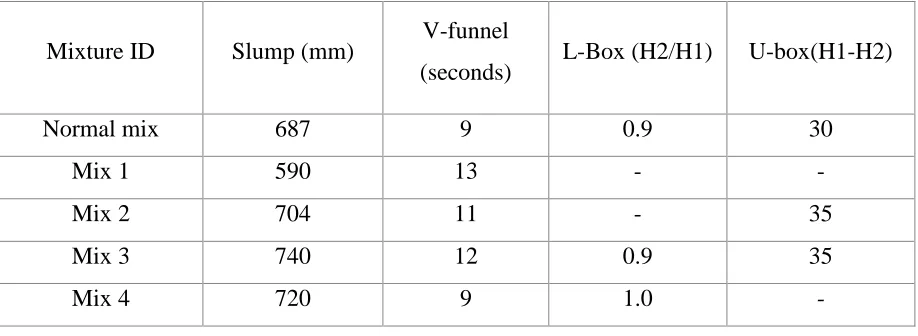
As per research, time ranging from 6 to 12 seconds is considered adequate for a SCC. The V-funnel flow times
were in the range of 9-13 seconds. Test results of this investigation indicated that all SCC mixes meet the
requirements of allowable flow time. Maximum size of coarse aggregate was kept as 16 mm in order to avoid
blocking effect in the L-box. The gap between re-bars in L-box test was 35 mm. The L-box ratio H2/H1 for the
mixes was above 0.8 which is as per EFNARC standards. U-box difference in height of concrete in two
compartments was in the range of 5–40 mm. All the Fresh properties of concrete values were in good agreement
to that of the values given by European guidelines. After 24 hours of casting, the specimens were removed from
the moulds and immediately dipped in clean fresh water. The specimens were cured for 7 days, 28 days and 56
days respectively depending on the requirement of age of curing. The freshwater tanks used for the curing of the
specimens were emptied and cleaned once in every fifteen days and were filled once again. All the specimens
under immersion were always kept well under water and it was seen that at least about 15 cm of water was
above the top of the specimens.
Table 1.2:Fresh Concrete Properties
Mixture ID
Slump (mm)
V-funnel
(seconds)
L-Box (H2/H1)
U-box(H1-H2)
Normal mix
687
9
0.9
30
Mix 1
590
13
-
-
Mix 2
704
11
-
35
Mix 3
740
12
0.9
35
582 | P a g e
4.2 FLEXURE STRENGTH
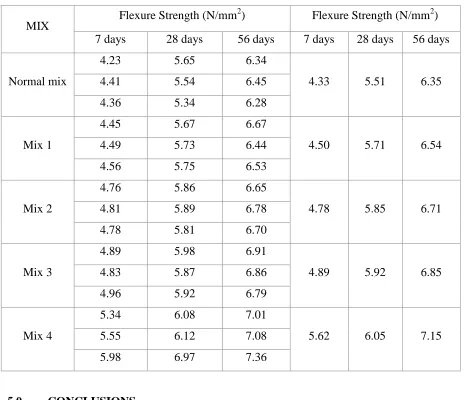
The flexural strength of the concrete mix was measured at 7 days 28 days &56 days by using universal testing
machine on standard beams of size 100mmx100mmx500mm). The flexural strength was found to increase for all
mixes at all days in comparison to control mix.
Table 1.3: Flexure Strength
MIX
Flexure Strength (N/mm
2
)
Flexure Strength (N/mm
2)
7 days
28 days
56 days
7 days
28 days
56 days
Normal mix
4.23
5.65
6.34
4.33
5.51
6.35
4.41
5.54
6.45
4.36
5.34
6.28
Mix 1
4.45
5.67
6.67
4.50
5.71
6.54
4.49
5.73
6.44
4.56
5.75
6.53
Mix 2
4.76
5.86
6.65
4.78
5.85
6.71
4.81
5.89
6.78
4.78
5.81
6.70
Mix 3
4.89
5.98
6.91
4.89
5.92
6.85
4.83
5.87
6.86
4.96
5.92
6.79
Mix 4
5.34
6.08
7.01
5.62
6.05
7.15
5.55
6.12
7.08
5.98
6.97
7.36
5.0
CONCLUSIONS
Taking into account the findings from this study, previously presented, the following conclusions can be drawn:
It has been verified, by using the slump flow and U-tube tests, that self-compacting concrete (SCC) achieved
583 | P a g e
because of the special admixtures used, SCC has achieved a density between 2400 and 2500 kg/m3, which wasgreater than that of normal concrete, 2370-2321 kg/m3. Self-compacting concrete can be obtained in such a way, by
adding chemical and mineral admixtures, so that it‟s flexural strength is higher than those of normal vibrated
concrete.
The flexural strength was found to increase for all mixes at all days in comparison to control mix.
REFERENCES
[1.] Khaloo, A. R., Houseinian, M. R. (1999). Evaluation of properties of silica fume for use in concrete,
International Conference on Concretes, Dundee, Scotland.
[2.] Khatib, J.M. (2008). Performance of self-compacting concrete containing fly ash, Construction and
Building Materials vol: 22, pp. 1963–1971.
[3.] Khayat, K.H., Aitcin, P.C. (1987). Silica Fume a unique Supplementary Cementitious Material, Mineral
Admixture in Cement and Concrete, Vol.4, by Dr. N.S Ghosh (Ed.)
[4.] Khayat, K.H., Vachon, M., Lanctot, M.C. (1997). Use of Blended Silica Fume Cement in Commercial
Concrete Mixtures, ACI Materials Journal, pp.183-192
[5.] Kosmatka, S.H., Kerkhoff, B., Panarese, W.C. (2002). Design and Control of Concrete Mixtures, 14th
Edition, Portland Cement Association.
[6.] Kraus, R.N., Naik, T.R., Ramme, B.W., Kumar Rakesh. (2009). Use of foundry silica- dust in
manufacturing economical self-compacting concrete. Construction and Building Materials vol: 23, pp.
3439-3442.
[7.] Krieg, W. (2003). Self-Compacting Concrete: Definition, Development, and Applications, A Technical
Paper Presented in the Meeting of the ACI, Saudi Arabia Chapter, Eastern Province, October.
[8.] Kuroiwa, S., “High Performance Concrete in Severe Environments”, ACI SP-140, pp.147-161 (1993).
[9.] Liu, M. (2010). Self-compacting concrete with different levels of pulverized fuel ash, Construction and
Building Materials vol: 24, pp.1245–1252
[10.]Lothia, R.P., Joshi, R.C. (1996). Mineral Amixture – concrete Admixture handbook by V S
ramachandran (Ed.)
[11.]Mata, L.A., (2004). Implementation of Self-Consolidating Concrete (SCC) for Prestressed Concrete
Girders, MS Thesis, North Carolina State University, November.
[12.]Mindess, S., Young, J. F., Darwin, D. (2003). Concrete, Second Edition, Prentice Hall.
[13.]N. Bouzoubaa and M. Lachemi, “Self-compacting concrete incorporating high volumes of class F fly ash
584 | P a g e
[14.]Nagataki, S., Fujiwara, H. (1995), Self-compacting property of highly-flowable concrete, V.M.Malhotra, Editor, American Concrete Institute SP 154, pp 301–314.
[15.]Naik, T.R., Singh S. (1997). Influence of fly ash on setting and hardening characteristics of concrete
systems, Materials Journal, Vol.94, Issue 5, pp.355-360.
[16.]Najimi, M., Sobhani, J., Pourkhorshidi, A.R. (2011). Durability of copper slag contained exposed to