
Prediction of surface tension of binary mixtures with the parachor method
Tom´aˇs Nˇemec1,a
Institute of Thermomechanics ASCR, v.v.i., Dolejˇskova 5, 18200 Praha 8, Czech Republic
Abstract. The parachor method for the estimation of the surface tension of binary mixtures is modified by considering temperature-dependent values of the parachor parameters. The temperature dependence is calcu-lated by a least-squares fit of pure-solvent surface tension data to the binary parachor equation utilizing the Peng-Robinson equation of state for the calculation of equilibrium densities. A very good agreement between experimental binary surface tension data and the predictions of the modified parachor method are found for the case of the mixtures of carbon dioxide and butane, benzene, and cyclohexane, respectively. The surface tension is also predicted for three refrigerant mixtures, i.e. propane, isobutane, and chlorodifluoromethane, with carbon dioxide.
1 Introduction
The parachor method [1] relates the surface tension of liq-uids to the densities of the liquid and the vapor phase. In the simplest case of a pure substance, the surface tension
σ[N/m] is evaluated asσ1/4 = P(
l−v) [2, 3], wherel
[mol/m3] is the density of the liquid phase andv[mol/m3] is the density of the vapor phase. The relation involves a substance-specific constantPcalled the parachor. Its value was estimated for a wide range of substances from exper-imental surface tension data [4, 5]. Also, a correlation be-tween the parachor and the critical volume was identified [6].
More advanced methods of the surface tension predic-tion are based on the gradient theory coupled with various equations of state, e.g. the Peng-Robinson EOS [7], PC-SAFT EOS [8], or PCP-PC-SAFT EOS [9]. However, the para-chor method presents a simple alternative, with a straight-forward implementation and a sufficient precision for en-gineering applications.
In the case of multicomponent mixtures ofN compo-nents the parachor relation takes the form
σ=
⎛ ⎜⎜⎜⎜⎜ ⎝
N
i=1
Pi(lxi−vyi)
⎞ ⎟⎟⎟⎟⎟ ⎠
n
, (1)
wherexiis the mole fraction of the liquid componenti, and
yiis the mole fraction of the vapor componenti. Several
bi-nary systems were already investigated with the parachor method [10, 11], and a good agreement with available ex-perimental surface tension data [12, 13] was observed.
The exponentnin Eq. (1) was often discussed in the literature, and, instead of the original value of 4, values of 3.57, 3.66, or 3.88 were found more appropriate in some cases. Higher exponents seem more suitable for higher den-sities (intermediate temperatures), while lower exponents
a e-mail:[email protected]
work better for lower densities (close to the critical point); see [5, 14] for a more detailed discussion.
Also, the constant nature of the parachor was put to question. Zhelezny et al.[6] investigated the temperature dependence of the parachor, and they found a considerable increase, by tens of percent, in the parachor value in the limit of the critical point.
In this work, the parachor method will be applied to the prediction of the surface tension of binary mixtures of carbon dioxide. The goal is to investigate the possible temperature-dependence of the parachor parameters, i.e. the parachorsPiand the exponentnin Eq. (1), or, in other
words, to assess the improvement in predictive capability of the parachor method by allowing the parachor param-eters to vary with temperature. In section 2, an overview of the method is given. In section 3.1, the surface ten-sion predicted with constant parachor parameters is com-pared to the available experimental data for the binary mix-tures of carbon dioxide and n-butane, benzene, and cyclo-hexane, respectively. In section 3.2, the derivation of the temperature-dependent parachor parameters is given, and the predictions of the parachor method with temperature-dependent parameters are presented. In section 3.3, the sur-face tension of the refrigerant mixtures of carbon dioxide and propane, isobutane, and chlorodifluoromethane (R22), respectively, is predicted. The surface tension of these re-frigerant mixtures is valuable for nucleation studies [15], since no experimental data are available so far. Finally, in section 3.4, the scaling behavior of the temperature-dependent parachor is studied, focusing on the correlation between the parachor and the critical volume of a given substance [6].
2 Parachor method
In order to estimate the surface tension of a binary mixture according to Eq. (1), the densities of the vapor phasevand
C
Owned by the authors, published by EDP Sciences, 2015
of the liquid phaselare required at the vapor-liquid
equi-librium (VLE). For the binary mixtures considered in this work, except R22, the available experimental VLE data from the literature are accurately represented by the pre-dictive Peng-Robinson equation of state (PPR78 EOS) of Vituet al.[16]. PPR78 features a temperature-dependent interaction parameterki j. In order to evaluate the PPR78
equation, the values ofki j given in Vitu’s work were
fit-ted to a polynomial function of temperature. For the case of R22, the original Peng-Robinson EOS was used with the interaction parameterki j=0.009, as predicted by Vrabecet
al.[17].
The calculation of the surface tension with the parachor method proceeds as follows. The surface tension is being evaluated as a function of the temperatureT [K] and the composition of the liquid phase, given by the carbon diox-ide mole fractionx2. The respective EOS is used to
eval-uate the corresponding equilibrium composition of the va-por phase,y2, and the vapor pressurep[Pa], by means of a
bubble-point calculation (see e.g. Smith and Van Ness [18], p. 490). Having the equilibrium compositionsx2, y2at hand,
the equilibrium vapor and liquid densitiesvandlare
ob-tained by solving the cubic EOS at p,T, and x2, or y2,
respectively. This procedure results in the evaluation ofyi,
v, andlfor use in Eq. (1) at a givenT, andx2.
Now, to evaluate Eq. (1), the parachor parametersP1, P2,nremain to be specified. Either the value reported in
the literature can be used, or the parameters can be fitted to available experimental data with Eq. (1). Both approaches will be discussed further, focusing of the possibility of the temperature dependence of the parachor parameters.
3 Results and discussion
Two different cases will be discussed in order to study the possibility of a temperature dependence of the parachor pa-rameters.
First, constant values ofP1,P2, andnwill be assumed.
This is a standard approach, applied for example by Gasem et al.[10], who fitted the three parameters to experimental VLE data (i.e. surface tension, liquid and vapor densities) of binary mixtures. The estimated surface tension based on the parachors of Gasemet al.is discussed in section 3.1.
Second, temperature-dependent values ofP1andnwill
be considered. The parachor of carbon dioxide is taken constantP2=79.2 [10] in this case, because all the
mix-tures investigated in this work are studied above the critical point of the pure carbon dioxide, and therefore the depen-dence on its reduced temperature is irrelevant. The predic-tions of the surface tension by the parachor method in case the model parametersP1 andn are allowed to vary with
temperature are discussed in section 3.2.
3.1 Constant parachors
In the work of Gasemet al.[10] the parachors of several substances were calculated from the experimental data for the VLE densities and the surface tension of binary mix-tures. A least-squares optimizing procedure was applied to
Table 1.Parachors by Gasem et al.[10] corresponding to the exponentn=3.57 of Eq. (1).
Compound Parachor
carbon dioxide 79.2 n-butane 199.7 benzene 200.4 cyclohexane 234.9
fit the parameters P1, P2, and n to the available
experi-mental data for mixtures of carbon dioxide and n-butane, benzene, cyclohexane. The value of the exponent fitted by Gasem et al. isn = 3.57, and their parachor values are given in table 1.
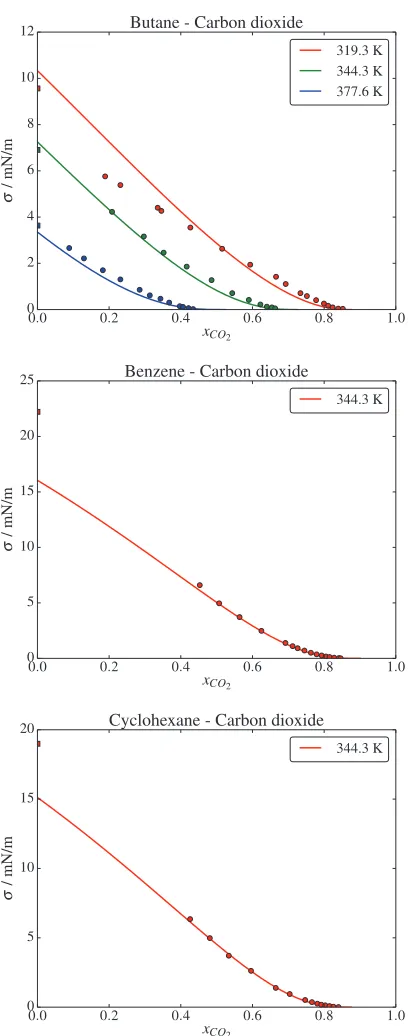
The surface tension of the three above mentioned bi-nary mixtures calculated according to Eq. (1) with the para-chor parameters from table 1 are shown in figure 1. In all three cases the experimental binary surface tension data (circles) are reproduced satisfactorily. However, large dis-crepancies can be observed in the surface tensions of pure solvents (squares), especially in the cases of benzene and cyclohexane. Moreover, no definite rule can be spotted in the nature of this discrepancy; the surface tension is both overestimated (butane at low temperatures), but also under-estimated (other cases). For benzene, the measured surface tension is 35% higher than the surface tension predicted by the parachor method. This presents a strong argument for parachors and/or exponent being dependent on the ther-modynamic state of the system rather than being universal constants.
3.2 Temperature dependent parachor and exponent
The possibility of the temperature dependence of the para-chor parameters will be investigated in the following two cases:
case 1 The value ofP1 is allowed to vary with
tempera-ture, while the exponent is assumed constant,n=4. case 2 Both parametersP1andnare considered
temperature-dependent.
As already noted, the parachor of the carbon dioxide is taken constant, P2 = 79.2. Actually, the precise value of P2 does not have a significant influence on the results.
Only in case a considerably different value ofP2would be
used, e.g. multiplied by a factor of 2, the convexity of the resulting functional dependence σ(x2) would be slightly
changed.
In both the above specified cases, the parachor parame-ters are calculated from the available experimental surface tension data of the pure solvents only. No binary experi-mental surface tension data are involved in the calculation. The two parametersP1 andnof Eq. (1) are fitted to the
surface tension data with a least-squares optimization pro-cedure implemented in Python1.
Figure 2 shows the results of the optimization proce-dure for the case 1. The parachors of the solvents are fitted
0.0 0.2 0.4 0.6 0.8 1.0
xCO2
0 2 4 6 8 10 12
σ
/m
N
/m
Butane - Carbon dioxide
319.3 K 344.3 K 377.6 K
0.0 0.2 0.4 0.6 0.8 1.0
xCO2
0 5 10 15 20 25
σ
/m
N
/m
Benzene - Carbon dioxide
344.3 K
0.0 0.2 0.4 0.6 0.8 1.0
xCO2
0 5 10 15 20
σ
/m
N
/m
Cyclohexane - Carbon dioxide
344.3 K
Fig. 1.Surface tension of binary mixtures predicted with the para-chor parameters by Gasemet al.[10]. The experimental surface tension data [12, 13] are plotted as circles, and the pure solvent surface tension [19] is plotted with squares.
assuming a constant exponentn=4, and plotted as a func-tion of the reduced temperatureTr=T/Tc, whereTcis the
critical temperature of the pure solvent. A common feature of all the parachors is that they are almost constant up to a reduced temperature of roughly 0.8. Above this value, the parachors increase steeply, by more than 30 % when approaching the critical point.
0.5 0.6 0.7 0.8 0.9
Tr
100 150 200 250 300 350
P
Parachor
Propane Butane Isobutane R22 Cyclohexane Benzene
Fig. 2.Solvent parachors fitted with a constant exponentn=4 (case 1).
Figure 3 shows the fitted solvent parachors and the cor-responding exponentn for the case 2. The parachors fea-ture a common functional dependence onTr, similarly to
the case 1. However, the parachor is almost a linearly in-creasing function of the reduced temperature. The expo-nentnis a linearly decreasing function of temperature;n being around 4.5 at Tr = 0.5, and around 2.5 when
ap-proaching the critical temperature of the solvent. Interest-ingly,nis almost identical for all the binary mixtures con-sidered in this analysis.
The predictions of the parachor method comparing the two scenarios of parachor parameters estimation, case 1 and case 2, are shown in figure 4. The predictions of case 1 are plotted as dashed lines, and the predictions of case 2 are drawn as full lines. For all the three mixtures, the predic-tions of case 2 show a better agreement with the binary ex-perimental surface tension data, although for benzene and cyclohexane the improvement is almost negligible.
3.3 Parachor method predictions for refrigerant mixtures
The binary mixtures of a refrigerant and carbon dioxide were investigated extensively in bubble nucleation studies [15]. There is a wide range of experimental bubble nucle-ation data available in the literature [20]. However, the the-oretical explanation of the measured nucleation rates was not given with sufficient precision yet. One of the reasons for the failure of the theoretical predictions of bubble nu-cleation rate in the binary case is the lack of knowledge of the surface tension of these mixtures. So far, the theoretical predictions utilized the pure-solvent surface tension [15], which is considerably higher than the surface tension of the mixture at higher concentrations of carbon dioxide. As the nucleating mixtures are typically rich in carbon diox-ide, the approximation of the binary surface tension with the pure-solvent surface tension is rather crude.
0.5 0.6 0.7 0.8 0.9
Tr
100 150 200 250 300
P
Parachor
Propane Butane Isobutane R22 Cyclohexane Benzene
0.5 0.6 0.7 0.8 0.9
Tr
2.0 2.5 3.0 3.5 4.0 4.5 5.0
n
Exponent
Propane Butane Isobutane R22 Cyclohexane Benzene
Fig. 3.Solvent parachors and exponent fitted with Eq. (1) to the surface tension data of pure solvents (case 2).
method. The case 2 version of parachor parameters fitting was used; the parachor parameters used in calculating the surface tension in figure 5 are those from figure 3.
3.4 Parachor scaling
Zheleznyet al.[6] found a correlation between the critical parachorPcand the molecular volumevc[cm3/mol]. Their
critical parachor is defined asPc = Mσβ/μ0 /0, where M
is the molecular weight,σ0and0are the constants of the
critical scaling of the surface tensionσ=σ0(1−Tr)μand
of the VLE density differencel−g = 0(1−Tr)β,
re-spectively, andβ = 1.260 andμ = 0.325 are the critical exponents.
The relation, Pc = 0.75vc, between the critical
para-chor and the critical volume was confirmed for a set of 26 substances (refrigerants, alkanes, atmospheric gases) by Zheleznyet al. To investigate the scaling behavior of the temperature-dependent parachors calculated in this work, the parachors from the case 2 (figure 3) are plotted in fig-ure 6 and are scaled by the critical volume of the respective substance. The factor 0.75 found in the work of Zhelezny et al. was omitted in this scaling, because it is related to their specific choice of the critical parachorPc, which uses
0.0 0.2 0.4 0.6 0.8 1.0
xCO2
0 2 4 6 8 10
σ
/m
N
/m
Butane - Carbon dioxide
319.3 K 344.3 K 377.6 K
0.0 0.2 0.4 0.6 0.8 1.0
xCO2
0 5 10 15 20 25
σ
/m
N
/m
Benzene - Carbon dioxide
344.3 K
0.0 0.2 0.4 0.6 0.8 1.0
xCO2
0 5 10 15 20
σ
/m
N
/m
Cyclohexane - Carbon dioxide
344.3 K
0.0 0.2 0.4 0.6 0.8 1.0
xCO2
0 1 2 3 4 5 6
σ
/m
N
/m
Propane - Carbon dioxide
313.15 K 323.15 K 333.15 K 343.15 K 353.15 K
0.0 0.2 0.4 0.6 0.8 1.0
xCO2
0 1 2 3 4 5 6 7
σ
/m
N
/m
Isobutane - Carbon dioxide
333.15 K 343.15 K 353.15 K 363.15 K 373.15 K 383.15 K
0.0 0.2 0.4 0.6 0.8 1.0
xCO2
0 1 2 3 4 5 6 7
σ
/m
N
/m
R22 - Carbon dioxide
313.15 K 323.15 K 333.15 K 343.15 K 353.15 K
Fig. 5.Surface tension of refrigerant mixtures with carbon diox-ide relevant to bubble nucleation studies [15] predicted by the parachor method with temperature-dependent parachor P1 and exponentn(case 2).
the exponentn = β/μ = 3.87. Since, in this analysis, the exponentnis resulting from the fitting procedure, and its value reaches 2.5 close to the critical point, the factor 0.75 has no relevance here.
No definite statement, however, can be made about the scaled parachors in figure 6. The dependence of the scaled parachor on the reduced temperature is almost identical for the 4 out of 6 substances, i.e. propane, butane,
cyclohex-0.5 0.6 0.7 0.8 0.9
Tr
0.60 0.65 0.70 0.75 0.80 0.85 0.90 0.95 1.00
P
/
vc
Scaled Parachor
Propane Butane Isobutane R22 Cyclohexane Benzene
Fig. 6.Parachor values from case 2 scaled by the critical volume
vc[cm3/mol].
ane, and R22. But the remaining two substances, i.e. ben-zene and isobutane, show a 10 % deviation from the behav-ior of the other substances. Moreover, the scaled parachor of isobutane is lower, and the scaled parachor of benzene is higher than the scaled parachors of the other substances. The scaled parachors roughly coincide at low reduced tem-peratures only, e.g. atTr =0.5 the scaled parachors P/vc
equal 0.66±0.02.
4 Conclusion
A modification of the parachor method for the prediction of the surface tension of binary mixtures of carbon diox-ide was studied in this work by consdiox-idering the possibility of temperature-dependent parameters of the parachor rela-tion. For the case of binary mixtures of carbon dioxide, a procedure for the calculation of the temperature-dependent parachor parameters from the experimental pure-solvent surface tension data was presented, and a considerable im-provement of the predictive capability of the parachor me-thod was observed. Although the parachor parameters were fitted to the experimental surface tension of pure solvents only, the binary surface tension data from independent lit-erature sources are estimated very accurately. The absence of the need for a binary mixing rule, or a binary interac-tion parameter, to accurately estimate the binary surface tension data makes this method quite robust.
A quite simple temperature dependence of the parachor parameters resulted from this analysis. The individual sol-vent parachors increase almost linearly with the reduced temperature. The exponent of the parachor equation de-creases with the reduced temperature uniformly for all the binary mixtures investigated in this work.
Acknowledgement
by the Technology Agency of the Czech Republic (project TA03030978).
References
1. S.N. Balasubrahmanyam, Curr. Sci. India 94, 1650 (2008)
2. D. Macleod, Trans. Faraday Soc.19, 0038 (1923) 3. S. Sugden, J. Chem. Soc.125, 1177 (1924)
4. V.P. Zhelezny, E.G. Bysko, Int. J. Thermophys. 20, 1699 (1999)
5. D. Broseta, Y. Mele´an, C. Miqueu, Fluid Phase Equi-lib.233, 86 (2005)
6. V.P. Zhelezny, Y.V. Semenyuk, S.N. Ancherbak, N.V. Emel’yanenko, Russ. J. Phys. Ch.83, 182 (2009) 7. H. Lin, Y.Y. Duan, Q. Min, Fluid Phase Equilib.254,
75 (2007)
8. D. Fu, Y. Wei, Ind. Eng. Chem. Res.47, 4490 (2008) 9. V. Vins, B. Plankova, J. Hruby, Int. J. Thermophys.34,
792 (2013)
10. K. Gasem, P. Dulcamara, K. Dickson, R. Robinson, Fluid Phase Equilib.53, 39 (1989), 5th International Conf On Fluid Properties And Phase Equilibria For Chemical Process Design, Banff Ctr, Banff, Canada, Apr 30 - May 05, 1989
11. Y.X. Zuo, E.H. Stenby, Can. J. Chem. Eng.75, 1130 (1997)
12. J. Hsu, N. Nagarajan, R. Robinson, J. Chem. Eng. Data30, 485 (1985)
13. N. Nagarajan, R. Robinson, J. Chem. Eng. Data32, 369 (1987)
14. F.J. Blas, F.J. Martinez-Ruiz, A.I. Moreno-Ventas Bravo, L.G. MacDowell, J. Chem. Phys. 137(2012)
15. Y. Mori, K. Hijikata, T. Nagatani, Int. J. Heat Mass Transfer19, 1153 (1976)
16. S. Vitu, R. Privat, J.N. Jaubert, F. Mutelet, J. Supercrit. Fluid.45, 1 (2008)
17. J. Vrabec, Y. Huang, H. Hasse, Fluid Phase Equilib. 279, 120 (2009)
18. J.M. Smith, H.C. Van Ness, Introduction to Chemi-cal Engineering Thermodynamics, 4th edn. (McGraw-Hill Book Company, 1987)
19. A. Mulero, I. Cachadi˜na, M.I. Parra, J. Phys. Chem. Ref. Data41, 043105 (2012)
![Table 1. Parachors by Gasemexponent et al. [10] corresponding to the n = 3.57 of Eq. (1).](https://thumb-us.123doks.com/thumbv2/123dok_us/8179535.1366083/2.595.309.419.93.159/table-parachors-gasemexponent-et-al-corresponding-n-eq.webp)

![Fig. 5. Surface tension of refrigerant mixtures with carbon diox-ide relevant to bubble nucleation studies [15] predicted by theparachor method with temperature-dependent parachor P1 andexponent n (case 2).](https://thumb-us.123doks.com/thumbv2/123dok_us/8179535.1366083/5.595.69.267.69.586/surface-refrigerant-nucleation-predicted-theparachor-temperature-dependent-andexponent.webp)
