Study of Soil Structure Interaction of R.C.Frame
Structure Supported on Different Types of Foundation
Sameer P. Chambulwar
1, Sudhir L. Bhilare
21
P.G. Student,
2Assistant Professor
Department of Civil Engineering, J.S.P.M’s R.S.C.O.E, Tathawade, Pune, Maharashtra,(India)
ABSTRACT
In the analysis of R.C. frame structure, the base is considered to be fixed neglecting the effect of soil
and foundation flexibility. Flexibility of the soil causes the decrease in stiffness resulting increase in
the natural period of the structure. Such as increase in the natural periods, changes the seismic
response of structure, it may be an important issue for design considerations. The present study
provides systematic guidelines for determining the natural periods of frame buildings due to the effect
of soil-flexibility and identification of spring stiffness for different regular and irregular story
buildings and various influential parameters have identified and the effect of the same on change in
natural periods has to be studied. The study has carried out for building with isolated and pile
foundations for different soil conditions like soft, medium, and a comparison between the regular and
irregular buildings and natures of change in the natural periods has to be present.
Keywords— Soil Structure Interaction, Spring Stiffness, Soil Flexibility, Base Shear,
Displacement, Period
.
I.
INTRODUCTION
The rapid development of urban populations and the pressure which are developing on limited space significantly some influence the residential development of city. The price of land is high to avoid the uneven and uncontrolled developing of urban area. The local topographical restrictions in the urban area only possible solutions for construction of multi-storey buildings to full fill the residential needs. The multi-storey buildings all initially a reaction to the demand by activity of business close to each other and in city centre, the less availability of land in the area. The multi-storey buildings are frequently developed in the centre of the city is prestige symbols for commercial organizations.
The structure with irregularity is to be design at most care by understanding detrimental effects of irregularities to fulfill the requirements. In this work to finding plan irregularities because of its mass distribution, non-uniform stiffness, strength in horizontal direction, even through structure are of same region, same configuration and same earthquake magnitude but damage will happens during the earthquake are not same pattern. This means that the some factors that affects damage patterns like earthquake characteristic, structural system of plan, mass, stiffness and vertical irregularities.
II.
ISOLATED
FOOTING
It is type of shallow foundation which are transferring the building loads in to the soil and also it is circular, square or rectangular slab of uniform thickness. Sometimes, it is stepped to spread the load over a larger area, when footing is provided to support an individual column; it is called “Isolated footing”.
Figure 1: Flexible and Rigid Spread Footing
The isolated footings essentially consist of bottom slab. This bottom slab can either flat, stepped or sloping in nature. The bottom of the slab is reinforced with steel mesh to resist the two internal forces namely bending moment and shear force. And in this work we going to used Fixed and flexible supports for determining the Base shear, time period, displacement, moments etc of regular and irregular building.
III. PILE FOUNDATION
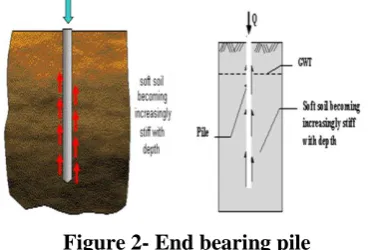
A pile is basically a long cylinder of a strong material such as concrete that is pushed into the ground to act as a steady support for structures built on top of it. When there is a layer of weak soil at the surface. This layer cannot support the weight of the building, so the loads of the building have to bypass this layer and be transferred to the layer of stronger soil or rock that is below the weak layer and when a building has very heavy, concentrated loads, such as in a high rise structure, bridge, or water tank. and pile foundation are capable to talking higher loads than spread footing.
IV. END BEARING PILE
Figure 2- End bearing pile
As pile foundations carry a lot of load, they must be designed very carefully. A good engineer will study the soil the piles are placed in to ensure that the soil is not overloaded beyond its bearing capacity. Every pile has a zone of influence on the soil around it. Care must be taken to space the piles far enough apart so that loads are distributed evenly over the entire bulb of soil that carries them, and not concentrated into a few areas.
V. MODELLING AND ANALYSIS
A) Details of Soil Parameters considered
The soil-flexibility effects on frame building resting on different types of soils, viz, medium, soft is also trying to be studied in the present work.
The value of the spring‟s stiffness of the varieties of soil, the shear modulus (G) is estimated to use the following expression.
G = (1)
The shear wave velocity is estimated to use the following expression.
(2)
where,
Vs = Shear wave velocity, in m/sec. ρ = Mass density of soil in kN/m3 (ν) = Poisson ratio
Table 1- Details of Soil parameters Considered
Where N = Applied for Number of in Standard penetration test (SPT) on the soil.
Table 2- N and Φ value are used to get SBC and the size of footing
Type of
Soil
N value
considered
Mass density of soil
(ρ) kN/m
3Shear
wave
velocity (m/sec)
Poisso
n ratio
Medium
soil
20
17
63.04
0.48
Type of Soil
N value
Angle of internal friction
Allowable SBC of
soil(KN/m
2)Size of footing (m)
Medium Soil
20
33
200
2.1x2.1
Soft Soil (Pile
Foundation)
9
29
120
0.6
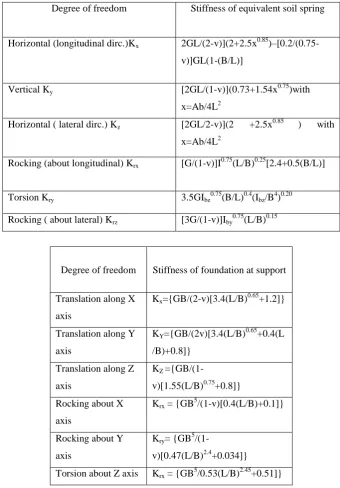
Table 3- Expressions for Static stiffness of equivalent soil springs along various degrees of freedom
Degree of freedom Stiffness of equivalent soil spring
Horizontal (longitudinal dirc.)Kx 2GL/(2-v)](2+2.5x0.85
)–[0.2/(0.75-v)]GL(1-(B/L)]
Vertical Ky [2GL/(1-v)](0.73+1.54x0.75)with
x=Ab/4L2
Horizontal ( lateral dirc.) Kz [2GL/2-v)](2 +2.5x0.85 ) with
x=Ab/4L2
Rocking (about longitudinal) Krx [G/(1-v)]I 0.75
(L/B)0.25[2.4+0.5(B/L)]
Torsion Kry 3.5GIbz0.75(B/L)0.4(Ibz/B4)0.20
Rocking ( about lateral) Krz [3G/(1-v)]Iby0.75(L/B)0.15
Degree of freedom Stiffness of foundation at support
Translation along X axis
Kx={GB/(2-v)[3.4(L/B)0.65+1.2]}
Translation along Y axis
KY={GB/(2v)[3.4(L/B)0.65+0.4(L
/B)+0.8]} Translation along Z
axis
KZ
={GB/(1-v)[1.55(L/B)0.75+0.8]} Rocking about X
axis
Krx = {GB5/(1-v)[0.4(L/B)+0.1]}
Rocking about Y axis
Kry= {GB5
/(1-v)[0.47(L/B)2.4+0.034]}
B) Description of Analytical Model
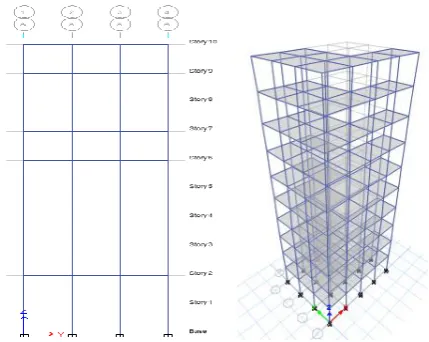
Different building models are analyzed in ETABS. The properties of the building configurations are
considered in the present work are summarized below.
Degree of freedom Spring stiffness of pile foundation Translation along X
axis
Kx=((8Gr/2-v) x (1+(2d/3r))
Translation along
Y axis
K
Y=K
xTranslation along
Z axis
K
Z=((4Gr/1-v) x (1+0.4(d/r)))
Rocking about X
axis
K
rx= K
z∑
i-1 npd
2yiRocking about Y
axis
K
ry= K
z∑
i-1 npd
2xiTorsion about Z
axis
K
rx= K
x∑
i-1 np(d
2xi+d
2yi
)
Size of columns
0.25m x 0.45m
0.25m x
0.45m
Moderate seismic
zone
IV
IV
Grade of steel (
F
y)
500 N/mm
2500 N/mm
2Grade of concrete
(F
ck)
30 N/mm
230 N/mm
2Density of
concrete(ρ)
25 kN/m
325 kN/m
3Dead load
5 kN/m
25 kN/m
2Live load
4 kN/m
24 kN/m
2Floor finish load
1.5 kN/m
21.5 kN/m
2Load on wall
11.73 kN/m
11.73 kN/m
Parapet wall load
5.75 kN/m
5.75 kN/m
Poisson ratio
0.15
0.15
damping
0.05
0.05
Table 4- Details Specification of Frame Structure
Specifications of
structure
Regular frame
structure
Irregular
frame
structure
Plan size
12m x 9m
12m x 9m
Height of each floor
3m
3m
No. of storey‟s
5, 10, 15
5,10,15
Size of beams
0.25m x 0.45m
0.25m x0.45
VII. REGULAR AND IRREGULAR R.C. FRAME
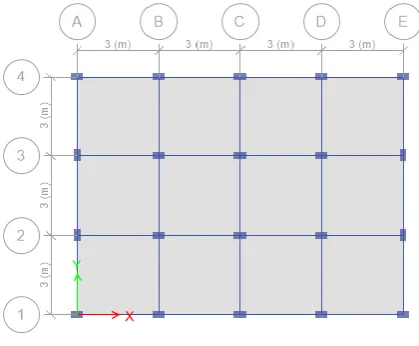
When the mass and stiffness are constant of the structure then is called as Regular RC frame and also it just a box shape like rectangular and square shape and there has no re-entrant corners and setback.
Figure 3: Plan of Regular Frame
When the mass and stiffness of structure is not constant means vary then the building called as
Irregular building. for irregular building will used Re-entrant corner method will be used.
Re-entrant Corners – Plan configuration of structure and its lateral force resisting system contain
re-entrant corners, where the both projections of structure beyond the re-re-entrant corner are greater than
the 15 percent of its plan dimensions in the given direction.
Foundation
Size of Footing
Isolated Footing
2.1m x 2.1m
Pile Foundation
(Diameter of Pile )
Figure 4: Plan of Irregular Frame
„
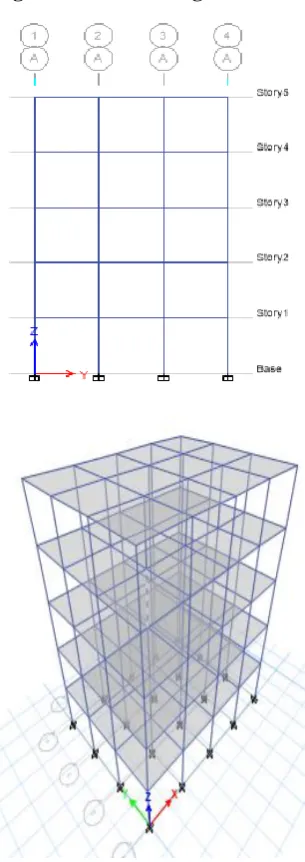
FIGURE 5-3D MODEL OF 10STOREY REGULAR FRAME STRUCTURE
FIGURE 7-3D MODEL OF 5STOREY IRREGULAR FRAME STRUCTURE
Figure 8- 3d Model of 10 Storey Irregular Frame Structure
FIGURE 8- 3D MODEL OF 15STOREY REGULAR FRAME STRUCTURE
building for soft soil
Table 6- Stiffness of foundation at surface
Table 6- Spring Stiffness of pile foundation
VII.
RESULT
AND
DISCUSSION
The present work attempts to study the behaviour of framed structures with rigid and flexible foundation. Framed structure having same height with regular and irregular plans have been considered with fixed and flexible foundation resting on three different types of soil and different types of foundation, a framed structure of rectangular plan with 5, 10 and 15 storey is analysed for earthquake load consider in zone-IV, importance
Type of soil
Medium soil
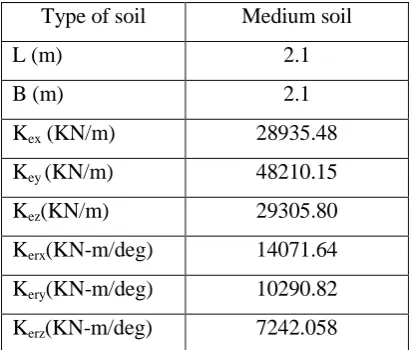
L (m)
2.1
B (m)
2.1
K
ex(KN/m)
28935.48
K
ey(KN/m)
48210.15
K
ez(KN/m)
29305.80
K
erx(KN-m/deg)
14071.64
K
ery(KN-m/deg)
10290.82
K
erz(KN-m/deg)
7242.058
Type of soil
Medium soil
L (m)
2.1
B (m)
2.1
K
ex(KN/m)
37283.96
K
ey(KN/m)
72554.21
K
ez(KN/m)
38273.61
K
erx(KN-m/deg)
30180.71
K
ery(KN-m/deg)
21523.90
K
erz(KN-m/deg)
17508.68
Type of soil
Medium soil
D (m)
0.6
d (m)
10
K
ex(KN/m)
175810.60
K
ey(KN/m)
175810.60
K
ez(KN/m)
157619.80
K
erx(KN-m/deg)
8444734.10
K
ery(KN-m/deg)
2819816.20
factor of 1.5, with the different soil type like medium and soft soil with fixed and flexible base condition. Response spectrum analysis is done and the parameters like time period, base shear, bending moment in column and top storey displacement are measured and are present below.
For 5, 10, 15 storeys framed structure the foundations are designed as isolated footing for medium soil. and also for 5,10,15 storey framed structure the foundation for soft soil is pile foundation. 5, 10 and 15 storey frame is considered and is analyzed for dead load, live load, and earthquake load with base as fixed and flexible, the response of the structure is measured with the different soil type. in the flexible base condition the soil and foundation is modeled as spring element. The stiffness of spring is calculated based on soil properties.
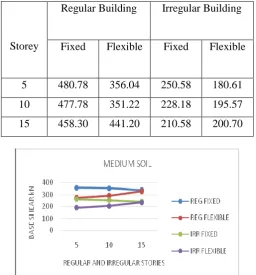
Base Shear:
Storey
Regular Building
Irregular Building
Fixed
Flexible
Fixed
Flexible
5
480.78
356.04
250.58
180.61
10
477.78
351.22
228.18
195.57
15
458.30
441.20
210.58
200.70
Figure 10: Base shear of regular and irregular building for Medium soil
Storey
Regular Building
Irregular Building
Fixed
Flexible
Fixed
Flexible
5
592.30
403.47
431.27 283.70
10
585.44
464.46
422.48
320.61
Figure 11: Base shear of regular and irregular
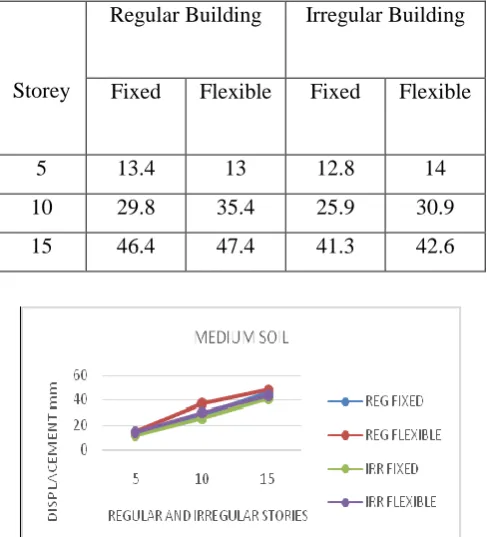
Displacement:
Storey
Regular Building
Irregular Building
Fixed
Flexible
Fixed
Flexible
5
13.4
13
12.8
14
10
29.8
35.4
25.9
30.9
15
46.4
47.4
41.3
42.6
Figure 12: Displacement of regular and irregular frame for medium soil
Storey
Regular Building
Irregular Building
Fixed
Flexible
Fixed
Flexible
5
18.9
17.9
12.5
18.8
10
33.2
43.1
30.7
41.5
Figure 13: Displacement of regular and irregular frame for soft soil
Time Period :
Storey
Regular Building
Irregular Building
Fixed
Flexible
Fixed
Flexible
5
0.8606
1.087
0.8817
1.1397
10
1.7335
2.5068
1.7599
2.2959
15
2.8061
3.0104
2.3948
3.2314
Figure 13: Time period of regular and irregular frame for medium soil
Storey
Regular Building
Irregular Building
Fixed
Flexible
Fixed
Flexible
5
0.8706
1.2758
0.8817
1.2508
10
1.7335
2.3765
1.9599
2.3315
Figure14- Time period of regular and irregular frame for soft soil
Moments :
Storey
Regular
Building
Irregular
Building
Fixed
Flexible Fixed Flexible
5 17.95 28.92 21.03 32.64 10 30.17 45.06 33.69 39.6 15 41.59 44.45 43.31 34.27
Figure 15 - Moments of regular and irregular frame for medium soil
Storey
Regular Building
Irregular Building
Fixed
Flexible
Fixed
Flexible
5
17.95
28.92
21.03
32.64
10
30.17
45.06
33.69
39.6
Figure 16- Moments of regular and irregular frame for
soft soil
VIII.
CONCLUSION
1. Base shear has reduced for flexible foundation in comparison with fixed base analysis since the
natural period increases for flexible base condition.
2. There is no much variation in time period for frame model with pile foundation of flexible base in
comparison with the fixed base model.
3. Framed structure with pile foundation modelled as flexible base shows no difference in Base shear
value in comparison with fixed base analysis.
4. Response of the structure increases with change in soil type from medium and soft irrespective of
height of structure and type of foundation.
5. Framed structure with pile foundation resting on soft soil and medium soil can be treated as fixed
since no much variation in the response of the structure.
6. Bending moment and displacement increases from fixed base analysis to flexible base analysis.
7. Framed structure with Irregular and regular plan did nost differ much in its response since the percentage of irregularity is less.
IX. ACKNOWLEDGMENT
The authors of this paper acknowledge the research contributions of all the citations under reference and the support by faculty members of JSPM, RSCOE, Tathawade.
REFERENCES
[1] Koushik Bhattacharya et.al, “The effect of soil structure interaction of low rise building on Shallow foundation” November 2006, volume 3, pp 341-348.
[2] Dutta S.C. et.al, “Study of Soil Structure Interaction of pile structure system for investigating the seismic response” July 2010, volume 51, pp 1661-1673.
[4] Ravikumar C M et.al, “Soil Structure Interaction of Irregular Building on Shallow Foundation” August 2012, volume 2, pp 418-427.
[5] G Kraus & D. Dzakic, “Soil Structure Interaction Effects on Seismic Behaviour of Reinforced Concrete Frames” April 2013, volume 4, pp 973-982.
[6] Amar R. Chougule and S. S. Dyavanal, “Seismic Soil Structure Interaction of Buildings with Rigid and Flexible Foundation” June 2015, volume 4, pp 513-517.
[7] Dr. S. K. Halkude, M. G. Kalyanshetti, S. H. Kalyani, “Soil structure interaction effect on seismic response of R.C. frames with isolated footing” January 2014, volume 3, pp 2767- 2775.
[8] Vinayak Garag and Mrs. S Karuna, “Effect of Soil-Structure Interaction on Regular and Irregular, Medium RC Framed Structure” May 2016, pp 1643-1648