684 | P a g e
CLOUD COMPUTING IN NIGERIAN UNIVERSITY
LIBRARY SYSTEM: AN OVERVIEW
Suleiman Hussaini
1, Dr Rajeev Vashistha
2Ali Garba
3, Hassana Jimah
41
Research Scholar, Department of Library and Information Science,
Nims University, Jaipur (India)
2
Associate Professor, Department of Library and Information Science,
Nims University Jaipur, (India)
3
Kashim Ibrahim Library, Ahmadu Bello University, Zaria Nigeria.
4
Department of Library and Information Science,
Ahmadu Bello University, Zaria Nigeria.
ABSTRACT
The world of Information is progressively transforming libraries in Nigeria due to the paradigm shift of
computing in the advancement of Information Communication Technology and its management. This technology
has brought changes to various fields of endeavor and the library is as well not exempted. The paper examines
cloud computing services in Nigerian academic setting with emphasis to libraries and the rationale behind
adoption of cloud computing in the libraries of these strategic institutions in Nigeria. The paper would help
University libraries in Nigeria to discover the challenges faced by libraries in the implementation of cloud
based services and how best to create cloud computing services for libraries.
Keywords: Cloud Computing, Digital library, Nigerian University Library, Paradigm Shift,
Technology.
I.INTRODUCTION
The global information revolution of the 20th century made manual systems of delivering information services in the libraries especially academic and research libraries mundane, clumsy and inefficient, though the era of total electronic or paperless libraries is yet a mirage. Aguolu & Aguolu 2002 cited in [1]. Information Communication Technology has brought change to many activities of our present day libraries from digital contents providers and hardcopies [2].
685 | P a g e
communication technology on content delivery, communication and collaboration by adopting cloud computing currently often been used by libraries in Nigeria. In the library, cloud computing is used to put together a digital library and to computerize housekeeping operations using third party services, software and hardware[6]. It has the capability to change the way information systems are built and services delivered by giving ample opportunities to libraries to extend its impact to its users at anywhere and time. Thus, any library user who connect to the internet is using some type of cloud computing services for example Gmail, Yahoo mail and searching the web with bling[7].
Cloud Computing is seen as a technology that uses the internet and central server to maintain data, software and applications[8]. [9] posit that, cloud computing enables task distribution in large number by collecting large amount of information stored in personal computer and other tools by integrating and putting them on public cloud for serving users. Cloud computing can also be seen as service model for computing resources that can be accessed in a flexible, elastic, on demand way with low management effort[10]. It helps to integrate large quantity of information resources stored in Personal Computers, mobile phones and other equipments by putting them on the public cloud for serving users[11].
University Libraries are established to support the teaching, learning, research and community service of their parent institutions by acquiring, processing, storing, preserving and making information available to users[12]. According to [13], Digital Library is a managed collection of information, with associated services, where the information is stored in digital formats and accessible over a network. The client do not need to border about the amount of space of information resource in cloud computing.
II. TYPES OF CLOUD COMPUTING SERVICES
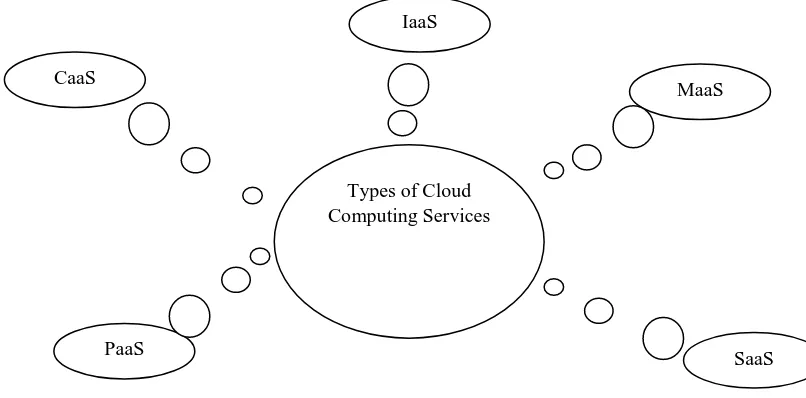
Libraries in Nigeria have been considering services over the cloud to save and cut costs of consumptions, without any form of compensation in using recent technologies[14]. The cloud computing services are usually based on subscription services as shown below;
1. Software as a Service (SaaS) 2. Infrastructure as a Service (IaaS) 3. Communication as a Service (CaaS) 4. Platform as a Service (PaaS) 5. Monitoring as Service (MaaS)
1. Software as a Service (SaaS): This type of service is usually controlled and managed by cloud service provider who supplies software over the network with the user having no control over the infrastructure. For example IBM, Microsoft, Oracles and sales force.com. Application deliver as a service on the internet like facebook, youtube e.t.c
2. Infrastructure as a Service (IaaS): This type of service allows customer to transfer information from one machine to another or over the internet allowing customer to maintain ownership of their application while offloading infrastructure management to Iaas provider.
686 | P a g e
4. Platform as a Service (PaaS): This type of service is usually used for web-based development infrastructure.
5. Monitoring as a Service (MaaS): This service is used for outsourcing of securities service 10 to a third party security team.
Figure 1, Types of Cloud Computing Service
III.CLOUD COMPUTING MODELS
There are basically four cloud computing models as listed below; Private Cloud
Public Cloud Community Cloud Hybrid Cloud
Private Cloud:This cloud computing models is usually implemented for organizations or group of organizations and it is broadly used by their employees. Also known as internal cloud or on premises cloud.
Public Cloud: Is usually distributed to the public users. It is managed by government or organizations or combination of both.
Community Cloud: This is usually enforced by many corporate firms with common concerns of security requirements, mission and action consideration. One or more organization can manage this cloud and also can be managed by third party.
Hybrid Cloud: This deals with the combination of two or more clouds. It provides assistance to multiple deployment models[15].
CaaS
PaaS
IaaS
MaaS
Types of Cloud Computing Services
687 | P a g e
IV.CLOUD COMPUTING VENDORS (COMPANIES) PROVIDING LIBRARY SERVICES
Ex Libris: This Company provides services to all type of libraries and also serve as a consortia. It is built on different standard and involves a number of features such as movement of data, customization, flexibility, compatibility with Unicode font[16].
Dura Cloud: Is established to provide solutions to digital library services. Dura cloud is an associate of Dspace digital library software and fedora commons. It offers standard hardware and software solutions. Dura Space also provide open source code and codes which needs to be installed in the machine by subscribing to cloud services with an insignificant cost[17].
Polaris Library System: This is a cloud based service system available in the market usually used for a cloud based library automation systems. They are involved in processing and acquisition system. With this, the library can incorporate numerous personal computers and print management systems at no cost. It uses well known standard like the Z39.50 for information retrieved, XML, MARC 21 for bibliography data and Unicode[18].
Others are;
Online Computer Library Centre (OCLC)
Sirsi
Dynix
However, libraries in Nigerian Universities need to critically examine the benefits, challenges of these third party cloud vendors to know the type of cloud based services that can be applied going to the fact that most libraries have started migrating to using cloud based services as a way of storing their resources.
V. NEED FOR IMPLEMENTATION OF CLOUD COMPUTING IN NIGERIAN
UNIVERSITY LIBRARIES
The rationale for adopting cloud computing in Nigerian University library includes;
i. Changing need of technological advancement: Cloud computing would help libraries to meet the information needs of numerous numbers of users spread across the world or country at the same time.
ii. Remote local storage, maintenance and backup is removed since third party are there to take over these services, it ensures large capacity of storage information. With cloud computing, libraries can be rest assured of a strong back up of their information resources in case of server crash and other unforeseen events. iii. It saves the time of the users: It enhances speedy retrieval of information. Once you are connected to
internet, within a twinkle of an eye, you can have access to numerous number of information resources at your disposal, thereby saving the time of the user.
iv. It saves cost in terms of budgetary aspects towards implementation: One third party cloud computing vendor can manage the services of a library together with other satellite libraries thereby saving cost.
688 | P a g e
VI. Tools Used for Implementing Cloud Computing in Universities Libraries.
The equipments/devices used for implementing cloud computing are;
Desktop Computers
Personal Computer
Scanners
Mobile and Smartphone
Cameras
Internet network
Paperless documents e.t.c
VII. PLACES WHERE CLOUD COMPUTING CAN BE APPLIED IN THE LIBRARY
The following are areas where cloud computing can be applied in the library;
Digital Library
Online Public Access Catalogue
Acquisition etc
VIII. BENEFITS OF CLOUD COMPUTING TO UNIVERSITY LIBRARIES
1. Centralization of resources and disk spaces: Since the resources are stored in the cloud by the third party, it helps to concentrate and position the resources from different sections in the library and disk space.
2. Data Management: Enables data to be shared across multiple resources by ensuring reliability of data needs is maintained over a wide distribution of replicated data sources.
3. Uninterrupted Service to its stake holders: Once a user is connected to internet, he will be able to access or retrieve ample amount of resources continuously.
4. Convenience: Cloud computing: It is suitable, simple to integrate, flexible and innovative.
5. Research in the university libraries would be enhanced by faster, efficient and reliable service. This would lead to improve productivity, effectiveness and decision making[19].
6. Saves Time: It helps to save the time of the users and service providers.
7. Cost effective: It reduces hardware and maintenance cost by simplifying cost and consumption model. 8. Security in terms of data loss, leakage and system crash is guaranteed, since the account, service is always
689 | P a g e
IX. CHALLENGES OF CLOUD COMPUTING TO UNIVERSITY LIBRARIES IN NIGERIA
Budget Constraint: Cost implication is a major challenge to libraries who are not financially buoyant to subscribe to cloud computing services. It involves infrastructural setup and implementation and procurement of standard equipments.
Conversion of Printed Copies to Electronic: The time it usually takes to convert these resources particularly when it is handled by unqualified personnel is a major problem in our universities.
Internet Connectivity: Constant connection is required for smooth running of cloud computing in the library with high internet bandwidth. Libraries without internet connections cannot implement cloud computing because it work along with internet connection.
Epileptic Power Supply: Cloud computing requires constant power supply to be able to function and sustained. Library should device other power backup’s storage to help supplement power in case of power failure.
Privacy
Security
X. CONCLUSION
It is important to note that, universities libraries in Nigeria have all it takes to establish cloud computing services in their various libraries. However, some of these libraries have moved a step further over the last 5 years with the process of taking up a digital technology (Cloud Computing) to help store their information resources in the cloud. But one very great challenge faced by these libraries towards the establishment of cloud computing are finances, inadequate information resources within the library and the complications involved. Thus, for the success of cloud computing in Universities libraries, effective and efficient internet resources needs to be provided to help enhance easy access to information resources from the cloud.
REFERENCES
[1] V.C. Anunobi, O.N. Paul, and M.C. Oga, The Adoption of ICT for library and information services: The case of the library federal university of technology Owerri, Journal of Nigerian library Association, 44(1), 2013, 89-104
[2] S Dhanavandan, M. Tamiz hchelvan, Role of information technology in academic libraries: Personal computer to cloud computing, International Journal of Advances, Library & Information Science, 2(1),
2014, 62-71.
[3] Allan, Vineeth, and Jayan, Automated vehicle information system using cloud computing, Proc. of ICICCT Conf. on Information Communication and Computing Technology, Jagan Institute of Management Studies, 3 Institutional Area, Sector 5 Rohini, Delhi. 2016, 45-53.
[4] S. Chandrakanta, K.N Pradip, Cloud computing in digital library (NewDelhi, SK Book Agency, 2013) [5] U. Ossai, B. Ngozi, and S.A. Ogunrombi SA, Library autmation: Experiences of nigerian universities,
690 | P a g e
[6] M. Padya, Cloud computing for libraries: ASWOT Analysis, 8th Convention PLANNER-2012 IFLIBNET Centre Sikkim Ahmedabab University, Gangok, 2012, 387-394
[7] M.E. Okwoli, Adoption of cloud computing technology for library services in national open university of nigerian library, Maters Thesis, Department of Library and Information, Nigeria, Ahmadu Bello University Zaria MSc, 2015
[8] M. Padya, Cloud computing for libraries: ASWOT Analysis, 8th Convention PLANNER-2012 IFLIBNET Centre Sikkim Ahmedabab University, Gangok, 2012, 387-394
[9] S Rupesh, K. Gaura, Cloud Computing in Digital and University Libraries, Global Journal of Computer Science and Technology, 11(12), 2011, 36-42.
[10] Organization for Economic Cooperative and Development, OECD, Cloud computing: The concept, impacts and the role of government policy, 2014, 1-34. Paper No. 240.
[11] S Rupesh, K. Gaura, Cloud Computing in Digital and University Libraries, Global Journal of Computer Science and Technology, 11(12), 2011, 36-42.
[12] E. R. Oluwole, A. Abiola, Preservation Management in University Libraries in Southern Nigeria. Samaru Journal of information, 15(1&2), 2015, 53-65
[13] S. Chandrakanta, K.N Pradip, Cloud computing in digital library (NewDelhi, SK Book Agency, 2013) [14] G. Avni, S. Priyanka, Identifying data security issues in cloud computing, Proc. of ICICCT on Information
Communication and Computing Technology, Jagan Institute of Management Studies, 3 institutional area, sector-5 Rohini, Delhi. 2016, 30-307.
[15] G. Avni, S. Priyanka, Identifying data security issues in cloud computing, Proc. of ICICCT on Information Communication and Computing Technology, Jagan Institute of Management Studies, 3 institutional area, sector-5 Rohini, Delhi. 2016, 30-307.
[16] ExLibris, The bridge to knowledge, Available at www.exlibrisgroup.com Retrieved 02/08/2017 [17] Dura cloud, Retrieved at http://duracloud.org Retrieved on 02/08/2017
[18] Polaris library systems, Retrieved http://www.iii.com/products/polariss-i-ils Retrieved 02/08/2017